Real time Study of a System with
n
Non-Identical Elements by Increasable Failure Rates
M. Sharifi, A. N. Masouleh, P. Shafie
Abstract- Reliability models based on Markov chain (Except in queuing systems) have extensive applications in electrical and electronically devices. In this paper we consider a system with n parallel and not necessarily identical elements with increasable failure rates (Failure rates are wiebull distributed) and the elements are non repairable. The system works until all elements fail. The system of equations are established and the exact equations are sought for the parameters like MTTF and the probability that system working at the time
t
. A numerical example has been solved to demonstrate the procedure which clarifies the theoretical development. It seems that the model can tackle more realistic situations.Index Terms- Reliability, Markov chain, Parallel systems,
Wiebull distribution.
1. Nomenclature
The notations used in this paper are as follows:
n
: Number of elements,i
λ
: Failure rate of thei
st element,( )
t
P
i : Probability that the system is in statei
at the timet
,( )
t
R
P : Probability that system works at timet
,MTTF
: Mean time to failure of the system,j
X
: Interval between(
j
−
1
)
st andj
st failure.2. Introduction
n
of
out
k
−
−
−
Models, are one of the most useful models to calculate the reliability of electrical and electronically devices and systems. Lots of studies have been done so far in this area. We try to categoricallyMani. Sharifi is with the Industrial Engineering Department, Islamic Azad University– Qazvin Branch ([email protected])
Arash .Nazer .Masouleh is with Computer Engineering Department, Islamic Azad University– Qazvin Branch ([email protected])
Parham. Shafie is the student of Industrial Engineering, Islamic Azad
classify them. At the first glance, they may be classifying in to two namely steady state and real time distinct classes. The element in both classes may be repairable or non repairable. The failure rates of the elements can be considered constant, increasing or decreasing whereas the repair rate is constant. Most of studies in this field are in steady state and a few studies are in real time conditions. Gera [1] use a matrix formulation and solution for these systems, Lam, Keong and Tony [2] use a general model for consecutive k-out-of-n: F repairable system with exponential distribution and (k-1) - step Markov dependence, Sarhan, Abouammoh [3] work on nonrepairable system with no independent components subject to common shocks, Arumozhi [4] calculate the Exact equation and an algorithm for reliability evaluation of k-out-of-n systems, Koucky [5] calculate Exact reliability formula and bounds for general systems, Flynn and Chung [6] use a heuristic algorithm for determining replacement policies in consecutive k-out-of-n systems, Guan and Wu [7] work on Repairable consecutive system with fuzzy states, Li, Zho and Yam [8] works on a system with some components being suspended when the system is down, Sharifi and Moosakhani [9] works on a system with two element with constant and increasable fuzzy failure rates in real time situations.
In this paper we work on a system with
n
parallel and not necessarily identical element with increasable failure rates for real time conditions. The system works until more than all elements failed. The paper is divided into five parts. First part is nomenclature and second part is introduction. The third part explores the models. Numerical examples are presented in the fourth part and the final section deals with the conclusion.3. Modeling
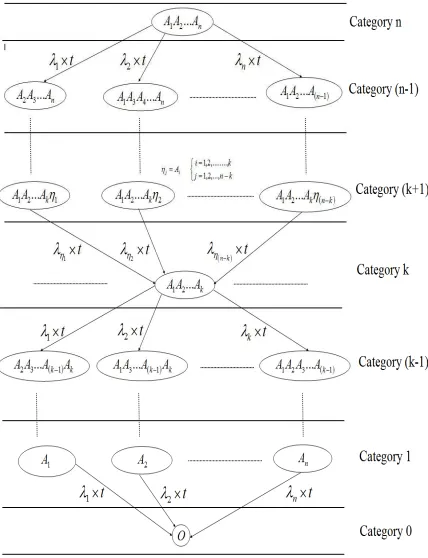
the system will have
2
n states. LetA
1A
2...
A
kbe the state where the elementsA
1,A
2,…andA
k are working and other(
n
−
k
)
elements are failed. Alsoj k
A
A
A
1 2...
η
is the state that the elementη
jworks in addition to otherk
elements. The stateO
indicates that all the elements are failed. The state structure of the system is shown in figure 1.In this figure, the category
i
,i
=
1
,
2
,...,
n
, indicates that the states in this category are withi
elements working and(
n
−
i
)
elements failed. Each state is closely related to the states in the antecedent and precedent categories. I.e., if an element failed in any state, then the state is transferred to the next category. In other words, if the system is in any state in categoryk
, with the failure of one element, the state will be in category(
k
−
1
)
. The system works if at leastk
elements work. Therefore we have:The system failed in state
O
and now we have:( )
∑
( )
≤ < < < ≤ ==
n n A A A k A A A P k kt
P
t
R
... 1 1 ... 2 1 21
( )
01
And we know that:
( )
( )
1
... 1 1 ... 2 1 2
1
+
=
∑
≤ < < < ≤ =t
P
t
P
O n n A A A k A A A kk
( )
02
In this system, the purpose is to find
P
i( )
t
for all states. From stateA
1A
2...
A
nthroughO
in figure 1 we have:(
)
( )
( )
( )
∑
∑
= ≠ = = × Δ × × + × Δ × × − = Δ + n k i A j A A A A A A k i A A A A A A A i j j k j k i k k t P t t t P t t t P t t P ,..., 2 , 1 1 ... ... 1 ... ... 2 1 2 1 2 1 2 1 η η η λ λ( )
03
( )
t Pk
A A
A1 2... is the probability that the system be in the
k i i 1 2 1
∑
=state to states of category
(
k
−
1
)
at timeΔ
t
. By solving equation( )
03
we can calculate the values ofP
i( )
t
as follows:( )
(
)
( )
( )( )
( )∑
∑
∑
∑
= × − − = ≤ < < < ≤ × − − = ≤ < ≤ × + − × −−
+
+
∑
−
+
+
−
=
= n i t n n k n i i i t k n i n i i t t P i k k j j i i i ie
e
e
e
t
R
1 2 1 1 ,..., 2 , 1 ... 1 2 1 1 1 1 2 1 2 1 2 2 1 2 1 2 1 2 2 1 21
...
1
...
λ λ λ λ λ( )
05
And the system
MTTF
is also calculated as followed:( )
( )
(
)
( )
(
)
∑
∑
∑
∑
∫
= − = ≤ < < < ≤ = − ≤ < ≤ = +∞ − + + ∑ − + + + − = = n i i n n k n i i i k j i k n ii i i
n i i P k j i dt t R MTTF 1 1 ,..., 2 , 1 ... 1 1 1 1 1 0 2 1 ... 2 1 ... 2 2 2 1
2 1 2
λ
π
λ
π
λ
λ
π
λ
π
( )
06
4. Numeric Samples
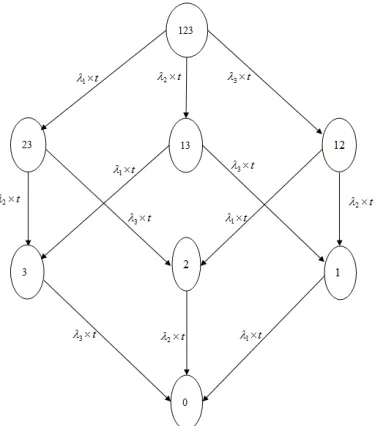
Figure 2: The states of example 1
By the equation
( )
03
we can calculate the Pi( )
t as follow:(
)
( )
(
)
t
t
P
( )
t
t
P
t
t
P
123 3 2 1 123 123×
Δ
×
×
+
+
−
=
Δ
+
λ
λ
λ
( )
07
(
)
( )
(
)
( )
( )
t
P
t
t
t
P
t
t
t
P
t
t
P
123 3 12 2 1 12 12×
Δ
×
×
+
×
Δ
×
×
+
−
=
Δ
+
λ
λ
λ
( )
08
(
)
( )
(
)
( )
( )
t
P
t
t
t
P
t
t
t
P
t
t
P
123 2 13 3 1 13 13×
Δ
×
×
+
×
Δ
×
×
+
−
=
Δ
+
λ
λ
λ
( )
09
(
)
( )
(
)
( )
( )
t
P
t
t
t
P
t
t
t
P
t
t
P
123 1 23 3 2 23 23×
Δ
×
×
+
×
Δ
×
×
+
−
=
Δ
+
λ
λ
λ
( )
10
(
)
( )
( )
( )
t
t
t
P
( )
t
P
t
t
t
P
t
t
t
P
t
t
P
1 1 12 2 13 3 1 1×
Δ
×
×
−
×
Δ
×
×
+
×
Δ
×
×
+
=
Δ
+
λ
λ
λ
( )
11
(
)
( )
( )
( )
t
t
t
P
( )
t
P
t
t
t
P
t
t
t
P
t
t
P
2 2 12 1 23 3 2 2×
Δ
×
×
−
×
Δ
×
×
+
×
Δ
×
×
+
=
Δ
+
λ
λ
λ
( )
12
(
t
t
)
P
( )
t
t
t
P
( )
t
P
+
Δ
=
+
λ
×
×
Δ
×
+
( )
( )
( ) ( )
( )
( )2
3 2 1 2 3 2 2 3 1 2 2 1 2 3 2 1 2 1 2 1 2 1 2 1 2 1 2 2 t t t t t P
e
e
e
e
e
e
e
t
R
λ λ λ λ λ λ λ λ λ λ + + − + − + − + − −+
⎥
⎥
⎥
⎦
⎤
⎢
⎢
⎢
⎣
⎡
+
+
−
⎟
⎟
⎟
⎠
⎞
⎜
⎜
⎜
⎝
⎛
+
+
=
( )
14
And at last the
MTTF
is:( )
⎟
⎟
⎠
⎞
⎜
⎜
⎝
⎛
+
+
+
⎟
⎟
⎟
⎟
⎟
⎠
⎞
⎜
⎜
⎜
⎜
⎜
⎝
⎛
+
+
+
+
+
−
⎟
⎟
⎠
⎞
⎜
⎜
⎝
⎛
+
+
=
=
+∞∫
3 2 1 3 2 3 1 2 1 3 2 1 02
2
2
2
2
2
2
λ
λ
λ
π
λ
λ
π
λ
λ
π
λ
λ
π
λ
π
λ
π
λ
π
dt
t
R
MTTF
P( )
15
Assume with a independent sample with size
n
, the parameters of failure rates areλ
1=
0
.
01
,λ
2=
0
.
02
and03
.
0
3
=
λ
, now theMTTF
is:h
MTTF
28
.
29
52
.
16
03
.
0
02
.
0
01
.
0
2
03
.
0
02
.
0
2
03
.
0
01
.
0
2
02
.
0
01
.
0
2
03
.
0
2
02
.
0
2
01
.
0
2
=
×
=
⎟⎟
⎠
⎞
⎜⎜
⎝
⎛
+
+
+
⎟⎟
⎟
⎟
⎟
⎠
⎞
⎜⎜
⎜
⎜
⎜
⎝
⎛
+
+
+
+
+
−
⎟⎟
⎠
⎞
⎜⎜
⎝
⎛
+
+
=
π
π
π
π
π
π
π
π
( )
( ) ( )
( )
( )
0
150
2 2
2 2
2
2 2
150 03 . 0 02 . 0 01 . 0 2 1
150 03 . 0 02 . 0 2 1
150 03 . 0 01 . 0 2 1 150 02 . 0 01 . 0 2 1
150 03 . 0 2 1
150 02 . 0 2 1 150 01 . 0 2 1
≈
+
⎟
⎟
⎟
⎠
⎞
⎜
⎜
⎜
⎝
⎛
+
+
−
⎟
⎟
⎟
⎠
⎞
⎜
⎜
⎜
⎝
⎛
+
+
=
× + + × −
× + × −
× + × − ×
+ × −
× × −
× × − ×
× −
e
e
e
e
e
e
e
R
P( )
16
5. Conclusion
In this paper, we present a real time model to calculate the reliability of systems. This model can be expanded and a
n
of
out
k
−
−
−
system withn
identical and increasable failure rates can be considered. In this system, we must determine a policy to decide when the whole system fails.
REEFERNCE
[1] A. E. Gera, A Consecutive k-out-of-n system with dependent elements – A matrix formulation and solution, Reliability Engineering and System safety, 68 (2000) 61-67.
[2] Yeh. Lam, Hon. Keong, Tony. Ng, A general model for consecutive k-out-of-n: F repairable system with exponential distribution and (k-1) - step Markov dependence, European Journal of Operation Research, 129 (2001) 663-682.
[3] A. M. Sarhan, A.M. Abouammoh, Reliability of k-out-of-n nonrepairable system with no independent components subject to common shocks, Microelectronic Reliability, 41 (2001) 617-621.
[4] G. Arumozhi, Exact equation and an algorithm for reliability evaluation of k-out-of-n: G system, Reliability Engineering and System safety, 78 (2002) 87-91.
[5] M. Koucky, Exact reliability formula and bounds for general k-out-of-n systems, Reliability Ek-out-of-ngik-out-of-neerik-out-of-ng ak-out-of-nd System safety, 82 (2003) 229-231.
[6] J. Flynn, C.S. Chung, A heuristic algorithm for determining replacement policies in consecutive k-out-of-n systems, Computer & Operations Research, 31 (20040 1335-1348.
[7] J. Guan, Y. Wu, Repairable consecutive k-out-of-n: F system with fuzzy states, Fuzzy Sets and Systems, 157 (2006) 121-142.
[8] X. Li, M. J. Zho, R.C.M. Yam, Reliability analysis of a repairable k-out-of-n system with some components being suspended when the system is down,, Reliability Engineering and System safety, 91 (2006) 305-310.