Journal of Education in Black Sea Region Vol. 1, Issue 2, 2016
56 | P a g e
Reconceptualization of the Concept of Quality in Education: An Exploratory Study
M. Murat ERGUVAN*
Abstract
The definition of quality is vague, let alone the educational quality. There are so many different perceptions around that we find it quite difficult to produce a single definition of quality. This study attempts to analyze the quality definitions offered by the quality experts of the last century, as well as modern researchers coming from different scientific areas, and find out a way to summarize the definitions. The study also includes the issue of educational quality (with specific reference to Georgian higher education setting) and tries to find a definition of quality in higher education through the stakeholders’ eyes. Having examined various views on the definition of quality put forward by researchers, the study identifies 9 properties of quality under the headings of: Method, Attribute, Scope, Process, Party, Aspect, Perception, Concept, and Influence. A Wordle diagram provides a visual idea about the main terms used to define quality in literature, and a table in the appendix sums up the definitions under 9 property headings together in more detail. This study is part of the author’s unpublished doctoral dissertation about total quality management principles in higher education.
Keywords: quality, definition of quality, perception of quality, dimensions of quality, educational quality
1. Introduction
Quality is an abstract term. We find it difficult to express what exactly we mean when we talk about quality. We believe we know it, feel it, and that maybe why we find it unnecessary to explain it when everyone knows it. We all have innate understandings for quality, but when it comes to defining it, we usually provide a framework for quality rather than a direct definition of it, because there is quite a large number of definitions or perceptions of quality that our own definition can only be the result of our own experiences. Attempting to define quality is, therefore, a challenging task.
* MA, International Black Sea University, Tbilisi, Georgia.
57 | P a g e
2. Research Questions
This study emerged from the curiosity about what quality means. The research questions were:
1. How is the concept of quality defined in literature? How can we summarize the definitions in a more understandable framework?
2. What are the factors that influence quality in higher education?
3. Literature Review
The Merriam-Webster Online Dictionary (2014) defines quality as:
“how good or bad something is;
a characteristic or feature that someone or something has;
something that can be noticed as a part of a person or thing;
a high level of value or excellence”.
Shewhart (1931), defined quality as the ‘goodness of the product’, which may be perceived as a very broad one. His definition applies to both services and products. Education can also be considered under this definition because when we talk about the quality of education, we tend to refer to the visible outcomes, such as assessment, number of graduates, or the people involved, for instance, students, staff members, or the facilities as well as the customer - seller relationship to a certain extent.
Tuchman (1980:38) provides more detail by coming up with two definitions of quality:
referring to the intrinsic aspect of quality as “the nature or essential characteristic of something”.
referring to “condition of excellence”.
Journal of Education in Black Sea Region Vol. 1, Issue 2, 2016
58 | P a g e asks all the stakeholders of the object under discussion to get together for the sake of reaching an agreement about what they would like to achieve, and what the ‘right things’ are to achieve it.
Juran (1951), one of the recognized quality experts, sees quality as ‘fitness for use’. Feigenbaum, another quality expert, looks at the same idea of use in Juran’s definition from the customer’s view and concludes that quality is “the total composite product and service characteristics of marketing, engineering, manufacture, and maintenance through which the product and service in use will meet the expectations of the customer” (Feigenbaum, 1991: 7). Shewhart, in this sense, seems to have a big impact on their ideas of quality.
In the same fashion, Townsend and Gebhart (1986) speak of ‘quality in fact’ and ‘quality in perception’” (as cited in Edvardsson, 1998, p. 144). Quality, in fact, hints that the product meets planned characteristics. Quality in perception, however, is the positive match in the buyer’s mind.
Shewfelt (1999: 197) also advocates these ideas and argues that “Quality can be viewed as an absence of defects or a degree of excellence” in his article about food quality, making a similar distinction between product and consumer oriented quality understandings.
When it comes to quality of life, it totally becomes a subjective concept: the gap between the person’s experiences and his / her expectations defines the quality (Calman, 1984). We cannot talk about a seller nor a customer: only the individual with his / her own perception of quality, and the analysis of customer satisfaction is totally subject to the person him/herself.
Following the internal-external quality differentiation, Taguchi (1986) emphasizes the external aspect of quality as a new dimension to the product quality, believing that quality is the gap between the time of a product is shipped till it reaches the buyers. The customer would then decide if the product in his/her hand is of ‘quality’, or not.
3.1.Quality Movement
Given that the quality movement started with a view to correcting manufacturing errors last century, it is understandable why the quality definitions started to revolve mainly around production and then ‘service’ only after the manufacturing capacity reached a certain level. People began to question the quality of products when they started to have more choices for the same product range. Crosby (1979), therefore, offered his definition of quality as conformance to requirements when he produced his ‘zero defects’ concept. Crosby preferred to define quality as existent or non-existent. His definition was criticized for not being suitable for geographical distribution of the customers, quality perceptions of people, educational concepts, and background and economic power of the customers.
59 | P a g e hard for raising the quality in the American industry that was greatly challenged by the Japanese products at the time.
3.2.Grönroos’s Contribution
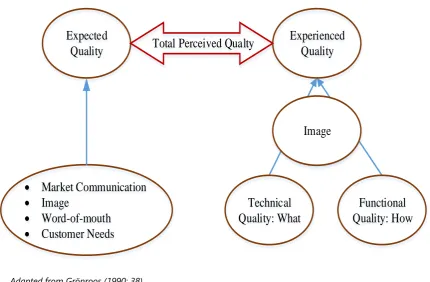
Contributing to the significance of expected and perceived quality by the consumers (or the customers), Grönroos (1990) established a link (Figure 1) between expected and perceived quality in his quality model. The model explains the perception of quality in fine detail, but fails to offer insight for the service quality. Grönroos modified his quality perception model later on, and stated that the service quality cannot be approached the same way as product quality is looked at. He believed that a service is a process which produces an output, and this output is a product of two processes happening at the same time: production and consumption (ibid: 150). Therefore, he contended that service industries should look into “perceived service features”, but not “perceived service quality”. Service quality dimensions were analyzed by Kang and James (cited in Gi‐Du & Jeffrey, 2004) and consequently blended with the process approach as suggested by Grönroos earlier (Chen, Chen, & Chen, 2012).
Figure 1. Grönroos's Total Perceived Quality Model
Experienced
Quality
Technical
Quality: What
Functional
Quality: How
Expected
Quality
Market Communication
Image
Word-of-mouth
Customer Needs
Total Perceived Qualty
Image
Adapted from Grönroos (1990: 38)
3.3.Attempting to Categorize Quality Definitions
Journal of Education in Black Sea Region Vol. 1, Issue 2, 2016
60 | P a g e circumstances, influencing factors around, and a thorough understanding of the possible outcomes of the corresponding processes in which all the involved people / stakeholders are interested.
Up to this point, we have mentioned various aspects of quality: exception, “perfection or consistency, fitness for purpose, value for money and transformative” (Dahlgaard, Khanji, & Kristensen, 2008; Harvey & Green, 1993). Harvey & Green also maintain that these aspects represent the transformative notion of quality (1993).
Because of the challenging task of producing a classification of quality definitions, it was not until 1983 that some tangible work was done. It was Garvin (1983, 1987) who offered a classification of quality definitions and quality dimensions to which most of the literature points (Flynn, Schroeder, & Sakakibara, 1994; Forker, Vickery, & Droge, 1996; Harvey & Green, 1993; Parasuraman, Zeithaml, & Berry, 1985; Reeves & Bednar, 1994; Seawright & Young, 1996; Sebastianelli & Tamimi, 2002; Van Kemenade, Pupius, & Hardjono, 2008).
Garvin (1988) summarizes the definitions of quality in five categories:
1. Transcendental view of quality, where people ‘sense’ it but somehow fail to exactly utter what they mean by it, as we have mentioned previously.
2. Product-based, where quality is measured by certain characteristics and objective methods. 3. User-based, where what matters is totally individual taste and satisfaction.
4. Manufacturing-based, where audit, conformity to regulations, and aligning with standards are more important.
5. Value-based, where the ‘price’ is the focal point in the eyes of the buyer.
Another review of a quality framework will be Garvin’s (1987) 8 dimensions of product quality he proposed in an article published in Harvard Business Review. He argued that they can also be utilized for service quality. Parasuraman and his colleagues (1985), on the other hand, had already developed a more detailed conceptual model for service quality that they called SERVQUAL (Service Quality), which has been a very popular tool ever since.
The dimensions (Table 1) that Garvin offered, though, allow us to start attempting to divide the quality into manageable ‘chunks’.
Table 1. Garvin's (1987) Eight Dimensions of Product Quality
Dimension Description
Performance A product’s primary characteristics
61 | P a g e Reliability Probability of a product malfunctioning within a specific time period
Conformance The degree to which the design features meet the recognized standards Durability Predicted product life
Serviceability Speed, courtesy, competence, and ease of repair Aesthetics How the good looks, feels, sounds, tastes, or smells Perceived Quality Reputation and other indirect measures of quality Adapted from (Sower, 2010, p. 7)
3.4.Quality in Higher Education
Quality demand in higher education is not new, and ‘is not free’ (Harvey, 1997) whereas in the field of manufacturing, some people may think that ‘quality is free’ (Crosby, 1979) (emphasis is ours). Crosby’s zero cost concept seeks a certain amount of compensation between eliminating waste and its possible effects at the end of the production line, something which may not apply to education. Quality has a certain cost in the field of education, but the society benefits from well-equipped graduates and research output.
We can assume that the demand for quality was already there when the first school was ever set up, but it officially came to the agenda only 3 decades ago. In Britain, a set of academic standards were introduced in the 1980s (Green, 1994). At this point, it is necessary to identify from where the demand comes.
Thus, the definition of quality differs from one stakeholder to another through the literature review. The stakeholders of higher education are identified to be students, job providers, educational personnel, official units and offices, and people who work in the accreditation process (Wittek & Kvernbekk, 2011) obviously along with parents, legal guardians, and/or sponsors of students. Considering the quality perceptions of the stakeholders in higher education, we can assume that the more the higher education institutions (HEIs) address various aspects of quality dimensions, the more they will be successful in their operations.
Sallis (1990) and Hurley (1992) identify a set of elements that reinforced the importance of quality in education: changing conditions, increasing demand, scarcity of resources, accreditation and authorization (as cited in: Harvey & Green, 1993: 9). Since the 1990s, the need for quality has been increased with the emergence (or expansion) of e-learning, internet technologies, and the introduction of the Bologna Process.
Journal of Education in Black Sea Region Vol. 1, Issue 2, 2016
62 | P a g e Owlia and Aspinwall (1996), in one of the earliest studies on quality in higher education (HE), argue that a set of quality characteristics must be found to measure and improve quality in higher education. In support of the same idea, Van Nederpelt (2009) came up with a more detailed proposal with his theory of object-oriented quality. He implies that the higher education institutions should identify the influencing factors of education, and understand how they should improve their management systems.
3.5.Main Influential Factors
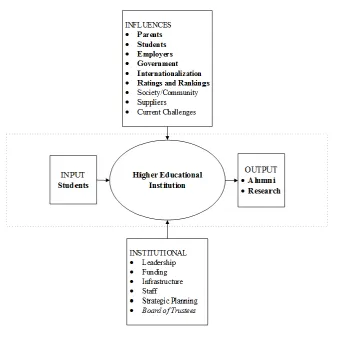
Figure 2 displays the main influential factors on quality of the higher education. If a higher education institution is to be considered as a system, the input is mainly the students, and the output is both graduates (alumni) and research, which is a very broad interpretation of the whole HE system. The input in reality is surely not only the degree seeking students, nor the output is only the graduates with degrees, but the student-education-graduate line in the figure forms a model to discuss the main processes that take place within a HEI. After the stakeholders, the main processes and the accompanying factors to be measured are identified, we may start identifying and improving the sub-processes.
Figure 2. Influencing Factors on Quality
63 | P a g e
3.5.1. Students and Parents
The quality perceptions of the student candidates and their parents play a significant role in their preference of a particular HEI. Because, students are internal stakeholders whereas parents are external (Cortese, 2003).
Students and their parents can find it very difficult to move away from the influence coming from their immediate family members, family traditions, friends and peers in order to reach an educated decision for which HEI to go. Their preconceptions they have are based on their experiences, idols, media, and the target culture they probably envisage to live in one day, all have a decisive role in determining the ‘quality’ of certain HEIs in their minds. Unless the students check with the teaching body (teaching staff background, experience, research output, etc.), campus facilities, the suitability of the learning environment of an HEI, and possibly pay a visit to the institution, the preconceptions for quality will probably remain to be the main driving force for their HEI preference. The management, therefore, has to study the quality perceptions of their prospective and current students, and receive feedback from their alumni in order to align their strategies and run a successful PR process at first.
3.6.Employers
Employers, as one of the stakeholders (Conway, Mackay, & Yorke, 1994) who would favor the definition of quality to be made as added value (McClain, 1986), should be able to have a direct influence on the quality of a HEI because they are directly exposed to the output, i.e. the graduates.
Employer feedback in curriculum and capacity building as well as improvement of employability skills of the students is of crucial importance. King (2007: 26) mentions the need for a system through which the accumulated expertise on stakeholder relations and essential educational skills could be shared. It is an issue of which we may utterly believe in the importance, but usually fail to take the right measures to realize it due to the possible lack of a sound curriculum building policy, non-existence of or poor accreditation criteria that question the employability status of the graduates, and a management review system that helps continuous improvement.
3.7.Government
Governmental influence is very important because the main educational policies are drawn up by the Ministry of Education and Science (in the case of Georgia). Cox, Imrie, & Miller (2014) believe that governments are external stakeholders of HE. In the Georgian situation, though independent but funded by the government, the governmental bodies are the national accrediting organs in the country, therefore the official policies play the dominant role in shaping the overall HEI setting.
3.8.Internationalization
Journal of Education in Black Sea Region Vol. 1, Issue 2, 2016
64 | P a g e European, and enjoy large numbers of student and staff exchanges and transfers, as well as setting up joint / double / dual degree programs which helped increase the quality of the educational programs. The EU also provided significant funding for capacity building and research, and all the ministries have a due interest in the quality of higher education thanks to the multidimensionality of the European agenda.
More than two decades ago, Scott (1994) pointed out to various aspects of internationalization including what Qiang (2003: 251) briefly puts forward as funding challenges, interaction with other institutions, demographic changes, global companies, changes in how business is done throughout the world (giant companies against smaller ones), racial differences in the teaching body, and security concerns in international relations.
Since then, many things have surely changed in the world where the physical borders and boundaries have been vanishing. Emphasis on lifelong learning, availability of e-learning programs and distance course certifications are now gaining speed; recognition of credits has been generally facilitated world-wide, so there are many international students at HEIs, be them either degree-seeking students or just course takers. Massification and diversity are other critical issues for HEIs (Altbach, Reisberg, & Rumbley, 2009). The tendency is towards earning Master’s or even Ph.D. degrees to secure their places in the fierce competition of finding jobs. Ministries of Education have developed international strategies for the HEIs in their countries to attract international students and academic staff to study and work at their institutions (Byun & Kim, 2011; EUA, 2013; Palmer & Cho, 2012; Ryan, 2011; Yonezawa, 2011).
3.9.Ratings and Rankings
65 | P a g e
3.10. Quality Dimensions in Higher Education
Change efforts call for strategic planning, which in fact demands a quality management system in order to analyze the quality areas to plan, measure, and correct. Strategic plans will surely differ from institution to institution, and year by year, and will cover areas such as funding, PR, teaching and learning, research, capacity building, student and staff support services, career development, etc. If measurement is the key for successful management, and university is to improve the quality of a higher educational system, see what it planned and could realize in the past, what it is doing now, and what it will do in the future, it needs to have a set of certain criteria in hands.
Quality in higher education used to be excellence in the past. However, similar to Juran’s definition of quality as fitness for use (Juran, 2003: 26), it has rather become fitness for purpose now (Lomas, 2004: 158) with the introduction of quality assurance systems that examine performance and learning outcomes.
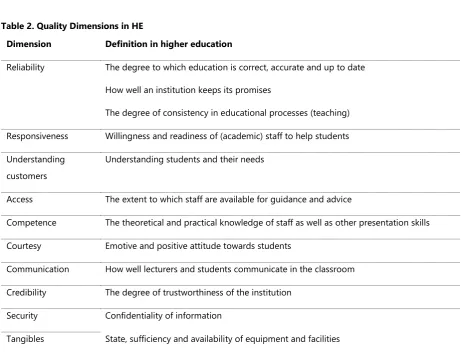
Owlia and Aspinwall (1996) did a thorough analysis of quality factors in higher education set forth by major studies by mainly making use of Garvin’s quality definitions and dimensions, and factors offered by Parasuraman (1985: 47) for SERVQUAL as well as Watts (1987) for software quality, who suggested a framework of quality dimensions as well.
Table 2. Quality Dimensions in HE
Dimension Definition in higher education
Reliability The degree to which education is correct, accurate and up to date How well an institution keeps its promises
The degree of consistency in educational processes (teaching) Responsiveness Willingness and readiness of (academic) staff to help students Understanding
customers
Understanding students and their needs
Access The extent to which staff are available for guidance and advice
Competence The theoretical and practical knowledge of staff as well as other presentation skills Courtesy Emotive and positive attitude towards students
Communication How well lecturers and students communicate in the classroom Credibility The degree of trustworthiness of the institution
Security Confidentiality of information
Journal of Education in Black Sea Region Vol. 1, Issue 2, 2016
66 | P a g e Performance Primary knowledge/skills required for students
Completeness Supplementary knowledge and skills, use of computer
Flexibility The degree to which knowledge/skills learned are applicable to other fields Redress How well an institution handles customers’ complaints and solves problems
(Owlia & Aspinwall, 1996: 18)
4. Findings
In order to answer the research questions, fifty nine articles and books were analyzed for literature review. Since the definitions were numerous, we tried to summarize them under certain categories. Figure 3 depicts the frequency of words used in these studies. The more a word is utilized in the text, the bigger they look. A maximum of 150 words have been displayed in the figure with the help of Wordle platform. The figure instantly provides an idea about the main terms used (as well as researchers) to define the ‘quality’ in literature.
Figure 3. Frequency of Terms in Literature
67 | P a g e
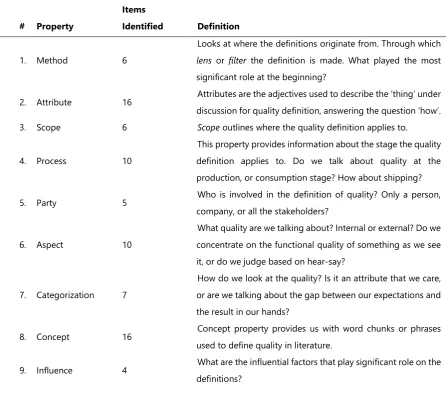
Table 3. Quality Properties
# Property
Items
Identified Definition
1. Method 6
Looks at where the definitions originate from. Through which lens or filter the definition is made. What played the most significant role at the beginning?
2. Attribute 16 Attributes are the adjectives used to describe the ‘thing’ under discussion for quality definition, answering the question ‘how’. 3. Scope 6 Scope outlines where the quality definition applies to.
4. Process 10
This property provides information about the stage the quality definition applies to. Do we talk about quality at the production, or consumption stage? How about shipping? 5. Party 5 Who is involved in the definition of quality? Only a person,
company, or all the stakeholders?
6. Aspect 10
What quality are we talking about? Internal or external? Do we concentrate on the functional quality of something as we see it, or do we judge based on hear-say?
7. Categorization 7
How do we look at the quality? Is it an attribute that we care, or are we talking about the gap between our expectations and the result in our hands?
8. Concept 16 Concept property provides us with word chunks or phrases used to define quality in literature.
9. Influence 4 What are the influential factors that play significant role on the definitions?
5. Limitations
Since there was no attempt made so far to categorize the definitions of quality by a similar approach, the researcher had to rely on his personal analysis of the literature available for himself at the time of his study with a view to understand into how many properties of quality the definitions could be grouped, and what the literature says about HE quality.
The study obviously lacks concrete examples of real-life experiences in the application of the quality definitions in higher education; therefore, there is a need for another study that would look into a set of case studies.
6. Conclusion
Journal of Education in Black Sea Region Vol. 1, Issue 2, 2016
68 | P a g e The study attempted to scratch the surface of the strenuous task of defining the term of ‘quality’ by categorizing the major definitions offered so far. A categorization has been offered in the appendix covering the properties of method, attribute, scope, process, party, aspect, perception, concept, and influence. The items found under the properties have been placed into a table in order to alleviate future attempts to produce a broader definition of quality with the help of an extensive literature review.
References
Altbach, P. G., Reisberg, L., & Rumbley, L. E. (2009). Trends in Global Higher Education: Tracking an Academic Revolution. Chestnut Hill, MA:.Boston College Center for International Higher Education
Byun, K. & Kim, M. (2011). Shifting patterns of the government’s policies for the internationalization of Korean higher education. Journal of Studies in International Education, 15(5), 467-486.
Calman, K. (1984). Quality of life in cancer patients - a hypothesis. Journal of Medical Ethics, 10(3), 124-127. Chen, C.-Y., Chen, P.-C., & Chen, P.-Y. (2012). Teaching quality in higher education: An introductory review on a
process-oriented teaching-quality model. Total Quality Management & Business Excellence, 25(1-2), 36-56. Conway, T., Mackay, S., & Yorke, D. (1994). Strategic planning in higher education: Who are the customers.
International Journal of Educational Management, 8(6), 29-36.
Cortese, A. D. (2003). The critical role of higher education in creating a sustainable future. Planning for higher education, 31(3), 15-22.
Cox, K., Imrie, B. W., & Miller, A. (2014). Student Assessment in Higher Education: A Handbook for Assessing Performance. Abingdon: Routledge.
Crosby, P. B. (1979). Quality is free: The art of making quality certain (Vol. 94). New York: McGraw-Hill.
Dahlgaard, J. J., Khanji, G. K., & Kristensen, K. (2008). Fundamentals of Total Quality Management. London & New York: Taylor & Francis.
Deming, W. E. (1982). Quality, Productivity, and Competitive Position. Cambridge, MA: MIT, Center for Advanced Engineering Study.
Edvardsson, B. (1998). Service quality improvement. Managing Service Quality: An International Journal, 8(2), 142-149.
EUA. (2013). Internationalisation in European Higher Education: European Policies, Institutional Strategies and EUA Support. Brussels: European University Association.
69 | P a g e Flynn, B. B., Schroeder, R. G., & Sakakibara, S. (1994). A framework for quality management research and an
associated measurement instrument. Journal of Operations Management, 11(4), 339-366.
Forker, L. B., Vickery, S. K., & Droge, C. L. (1996). The contribution of quality to business performance. International Journal of Operations & Production Management, 16(8), 44-62.
Garvin, D. A. (1983). Quality on the line. Harvard Business Review, 61(5), 65-75.
Garvin, D. A. (1987). Competing on the 8 dimensions of quality. Harvard Business Review, 65(6), 101-109. Garvin, D. A. (1988). Managing Quality: The Strategic and Competitive Edge. London:Simon and Schuster.
Gi‐Du, K. & Jeffrey, J. (2004). Service quality dimensions: an examination of Grönroos’s service quality model. Managing Service Quality: An International Journal, 14(4), 266-277.
Green, D. M. (1994). What is Quality in Higher Education? Concepts, Policy and Practice. In D. Green (Ed.), What Is Quality in Higher Education? (p. 13-30). London: Society for Research into Higher Education, Ltd.
Grönroos, C. (1990). Service Management and Marketing: Managing the Moments of Truth in Service Competition. Lexington, MA. Lexington Books.
Grönroos, C. (2001). The perceived service quality concept – a mistake? Managing Service Quality: An International Journal, 11(3), 150-152.
Harvey, L. (1997). Quality is not free! Quality monitoring alone will not improve quality. Tertiary Education and Management, 3(2), 133-143.
Harvey, L. & Green, D. M. (1993). Defining quality. Assessment and Evaluation in Higher Education, 18 (1), 9. Hurley, B. (1992). TQ implementation: Cultural issues and training. AETT Conference on Quality Education. University
of York. Retrieved March 10, 2016 from researchrepository.napier.ac.uk/4279/1/Telford.pdf Juran, J. M. (1951). Quality-control handbook: New York: McGraw-Hill.
Juran, J. M. (2003). Juran on Leadership For Quality. New York: Free Press. Kennedy, B. (2014). Finding Harmony. ASQ Quality Progress, 47(11), 5.
Khoon, K. A., Shukor, R. A., Hassan, O., Saleh, M. Z., Hamzah, A., & Ismail, A. R. H. (2005). Hallmark of a world-class university. College Student Journal, 39(4), 765.
King, M. (2007). Workforce development: how much engagement do employers have with higher education? a review of the evidence on employer demand. Retrieved March 10, 2016 from http://hdl.voced.edu.au/10707/86361 Lomas, L. (2004). Embedding quality: the challenges for higher education. Quality Assurance in Education, 12(4),
Journal of Education in Black Sea Region Vol. 1, Issue 2, 2016
70 | P a g e McClain, C. J. (1986). Northeast Missouri State University's value-added assessment program: A model for
educational accountability. International Journal of Institutional Management in Higher Education, 10(3), 252-261.
Merriam-Webster Online Dictionary. (2014). Quality. Retrieved March 10, 2016 from http://www.merriam-webster.com/dictionary/quality
Owlia, M. S. & Aspinwall, E. M. (1996). A framework for the dimensions of quality in higher education. Quality Assurance in Education, 4(2), 12-20.
Palmer, J. D. & Cho, Y. H. (2012). South Korean higher education internationalization policies: perceptions and experiences. Asia Pacific Education Review, 13(3), 387-401.
Parasuraman, A., Zeithaml, V. A., & Berry, L. L. (1985). A conceptual model of service quality and its implications for future research. The Journal of Marketing, 49, 4, 41-50.
Qiang, Z. (2003). Internationalization of higher education: Towards a conceptual framework. Policy Futures in Education, 1(2), 248-270.
Reeves, C. A. & Bednar, D. A. (1994). Defining quality: alternatives and implications. Academy of Management Review, 19 (3), 419-445.
Ryan, J. (2011). China's Higher Education Reform and Internationalisation. Abingdon: Taylor & Francis. Sallis, E. (1990). The National Quality Survey. Blagdon, Bristol: Staff College.
Scott, R. A. (1994). Campus Developments in Response to the Challenges of Internationalization: The Case of Ramapo College of New Jersey (USA). Springfield: CBIS Federal.
Seawright, K. W. & Young, S. T. (1996). A quality definition continuum. Interfaces, 26(3), 107-113.
Sebastianelli, R., & Tamimi, N. (2002). How product quality dimensions relate to defining quality. International Journal of Quality & Reliability Management, 19(4), 442-453.
Shewfelt, R. L. (1999). What is quality? Postharvest Biology and Technology, 15(3), 197-200. Shewhart, W. A. (1931). Economic control of quality of manufactured product. NY: D. Van Nostrand.
Shin, J. C. & Toutkoushian, R. K. (2011). The past, present, and future of university rankings (p. 1-18). In J. C. Shin, R. K. Toutkoushian, & U. Teichler (Eds.), University Rankings: Theoretical Basis, Methodology and Impacts on Global Higher Education. Dordrecht: Springer.
Sower, V. E. (2010). Essentials of Quality with Cases and Experiential Exercises. Denvers, MA: John Wiley & Sons. Taguchi, G. (1986). Introduction to quality engineering: designing quality into products and processes. Quality and
71 | P a g e Tuchman, B. W. (1980). The decline of quality. New York Times Magazine, 2, 38-41.
Van Kemenade, E., Pupius, M., & Hardjono, T. W. (2008). More value to defining quality. Quality in Higher Education, 14(2), 175-185.
Van Nederpelt, P. W. (2009). The creation and application of a new quality management model. Statistika, 5, 385-395.
Watts, R. A. (1987). Measuring Software Quality. Hertfordshire: National Computer Center Publications.
Wittek, L., & Kvernbekk, T. (2011). On the problems of asking for a definition of quality in education. Scandinavian Journal of Educational Research, 55(6), 671-684.
Journal of Education in Black Sea Region Vol. 1, Issue 2, 2016
72 | P a g e
Appendix 1 Quality Properties
Method Attribute Scope Process Party Aspect Categorizat
ion
Concept Influence
Definitions Good Product / Object Manufacturing /
Production
Customer Intrinsic Characteri
stic
Zero Defects Geographical Distribution
of
Perceptions Bad Service Marketing Seller External Feature Absence of Defects Educational Concepts
Experiences Excellent Area Engineering Society Subjective Part Amount of Losses Background
Expectations and needs
Right Purpose Support / Maintenance Stakeholders Individual Aspect Suited to Market Economic Power
Agreements Fit Performance Service Provision User Perceived Gap Fitness For Purpose
Complaints Existent Product Submission Reality (in Fact) Nature Conformance to
Requirements
Non-Existent Consumption Technical Essence Predictable Degree of
Uniformity
Dependable Shipping Functional High Level of Value
Uniform Word-of-Mouth High Level of Excellence
Perfect Image Degree of Excellence
Consistent Condition of Excellence
Aesthetic Goodness of The Product
Serviceable The Nature of Something
Durable Essential Characteristic of
Something
Reliable Doing The Right Things
Right
Exceptional Low Cost
Safe Willing to understand