Overcoming the Lack of Parallel Data in Sentence Compression
Katja Filippova and Yasemin Altun Google
Brandschenkestr. 110 Z¨urich, 8004 Switzerland
katjaf|[email protected]
Abstract
A major challenge in supervised sentence compression is making use of rich feature rep-resentations because of very scarce parallel data. We address this problem and present a method to automatically build a compres-sion corpus with hundreds of thousands of instances on which deletion-based algorithms can be trained. In our corpus, the syntactic trees of the compressions are subtrees of their uncompressed counterparts, and hence super-vised systems which require a structural align-ment between the input and output can be suc-cessfully trained. We also extend an exist-ing unsupervised compression method with a learning module. The new system uses struc-tured prediction to learn from lexical, syntac-tic and other features. An evaluation with hu-man raters shows that the presented data har-vesting method indeed produces a parallel cor-pus of high quality. Also, the supervised sys-tem trained on this corpus gets high scores both from human raters and in an automatic evaluation setting, significantly outperforming a strong baseline.
1 Introduction and related work
Sentence compression is a paraphrasing task where the goal is to generate sentences shorter than given while preserving the essential content. A robust compression system would be useful for mobile de-vices as well as a module in an extractive sum-marization system (Mani, 2001). Although a com-pression may differ lexically and structurally from the source sentence, to date most systems are ex-tractive and proceed by deleting words from the
input (Knight & Marcu, 2000; Dorr et al., 2003; Turner & Charniak, 2005; Clarke & Lapata, 2008; Berg-Kirkpatrick et al., 2011, inter alia). To de-cide which words, dependencies or phrases can be dropped, (i) rule-based approaches (Grefenstette, 1998; Jing & McKeown, 2000; Dorr et al., 2003; Zajic et al., 2007), (ii) supervised models trained on parallel data (Knight & Marcu, 2000; Turner & Charniak, 2005; McDonald, 2006; Gillick & Favre, 2009; Galanis & Androutsopoulos, 2010, inter alia) and (iii) unsupervised methods which make use of statistics collected from non-parallel data (Hori & Furui, 2004; Zajic et al., 2007; Clarke & Lapata, 2008; Filippova & Strube, 2008) have been investi-gated. Since it is infeasible to manually devise a set of accurate deletion rules with high coverage, recent research has been devoted to developing statistical methods and possibly augmenting them with a few linguistic rules to improve output readability (Clarke & Lapata, 2008; Nomoto, 2009).
Supervised models. A major problem for super-vised deletion-based systems is very limited amount of parallel data. Many approaches make use of a small portion of the Ziff-Davis corpus which has about 1K sentence-compression pairs1. Other main sources of training data are the two manually crafted compression corpora from the University of Edin-burgh (“written” and “spoken”, each approx. 1.4K pairs). Galanis & Androutsopoulos (2011) attempt at getting more parallel data by applying a deletion-based compressor together with an automatic
para-1The method of Galley & McKeown (2007) could benefit
from a larger number of sentences.
phraser and generating multiple alternative com-pressions. To our knowledge, this extended data set has not yet been used for successful training of com-pression systems.
Scarce parallel data makes it hard to go beyond a small set of features and explore lexicalization. For example, Knight & Marcu (2000) only induce non-lexicalized CFG rules, many of which occurred only once in the training data. The features of McDon-ald (2006) are formulated exclusively in terms of syntactic categories. Berg-Kirkpatrick et al. (2011) have as few as 13 features to decide whether a con-stituent can be dropped. Galanis & Androutsopou-los (2010) use many features when deciding which branches of the input dependency tree can be pruned but require a reranker to select most fluent com-pressions from a pool of candidates generated in the pruning phase, many of which are ungrammatical.
Even further data limitations exist for the algo-rithms which operate on syntactic trees and refor-mulate the compression task as a tree pruning one (Nomoto, 2008; Filippova & Strube, 2008; Cohn & Lapata, 2009; Galanis & Androutsopoulos, 2010, in-ter alia). These methods are sensitive to alignment errors, their performance degrades if the syntactic structure of the compression is very different from that of the input. For example, see Nomoto’s 2009 analysis of the poor performance of the T3 system of Cohn & Lapata (2009) when retrained on a corpus of loosely similar RSS feeds and news.
Unsupervised models. Few approaches require no training data at all. The model of Hori & Fu-rui (2004) combines scores estimated from mono-lingual corpora to generate compressions of tran-scribed speech. Adopting an integer linear program-ming (ILP) framework, Clarke & Lapata (2008) use hand-crafted syntactic constraints and an ngram lan-guage model, trained on uncompressed sentences, to find best compressions. The model of Filippova & Strube (2008) also uses ILP but the problem is for-mulated over dependencies and not ngrams. Condi-tional probabilities and word counts collected from a large treebank are combined in an ad hoc man-ner to assess grammatical importance and informa-tiveness of dependencies. Similarly, Woodsend & Lapata (2010) formulate an ILP problem to gener-ate news story highlights using precomputed scores.
Again, an ad hoc combination of the scores learned independently of the task is used in the objective function.
Contributions of this paper. Our work is moti-vated by the obvious need for a large parallel corpus of sentences and compressions on which extractive systems can be trained. Furthermore, we want the compressions in the corpus to be structurally very close to the input. Ideally, in every pair, the com-pression should correspond to a subtree of the input. To this end, our contributions are three-fold:
• We describe an automatic procedure of con-structing a parallel corpus of 250,000 sentence-compression pairs such that the dependency tree of the compression is a subtree of the source tree. An evaluation with human raters demonstrates high quality of the parallel data in terms of readability and informativeness.
• We successfully apply the acquired data to train a novel supervised compression system which produces readable and informative compres-sions without employing a separate reranker. In particular, we start with the unsupervised method of Filippova & Strube (2008) and re-place the ad hoc edge weighting with a lin-ear function over a rich feature representation. The parameter vector is learned from our cor-pus specifically for the compression task us-ing structured prediction (Collins, 2002). The new system significantly outperforms the base-line and hence provides further evidence for the utility of the parallel data.
• We demonstrate that sparse lexical features are very useful for sentence compression, and that a large parallel corpus is a requirement for ap-plying them successfully.
2 Framework and baseline
We adopt the unsupervised compression framework of Filippova & Strube (2008) as our baseline and ex-tend it to a supervised structured prediction problem. In the experiments reported by Filippova & Strube (2008), the system was evaluated on the Edinburgh corpora. It achieved an F-score (Riezler et al., 2003) higher than reported by other systems on the same data under an aggressive compression rate and thus presents a competitive baseline.
Tree pruning as optimization. In this framework, compressions are obtained by deleting edges of the source dependency structure so that (1) the retained edges form a valid syntactic tree, and (2) their to-tal edge weight is maximized. The objective func-tion is defined over set X = {xe, e ∈ E} of
bi-nary variables, corresponding to the set E of the source edges, subject to the structural and length constraints,
f(X) =X
e∈E
xe×w(e) (1)
Here,w(e)denotes the weight of edgee. This con-strained optimization problem is solved under the tree structure and length constraints using ILP. Ifxe
is resolved to1, the respective edge is retained, oth-erwise it is deleted. The tree structure constraints en-force at most one parent for every node and structure connectivity (i.e., no disconnected subtrees). Given thatlength(node(e))denotes the length of the node to which edgeepoints andαis the maximum per-mitted length for the compression, the length con-straint is simply
X
e∈E
xe×length(node(e))≤α (2)
Word limit is used in the original paper, whereas we use character length which is more appropriate for system comparisons (Napoles et al., 2011). If uni-form weights are used in Eq. (1), the optimal so-lution would correspond to a subtree covering as many edges as possible while keeping the compres-sion length under given limit.
The solution to the surface realization problem (Belz et al., 2011) is standard: the words in the com-pression subtree are put in the same order they are found in the source.
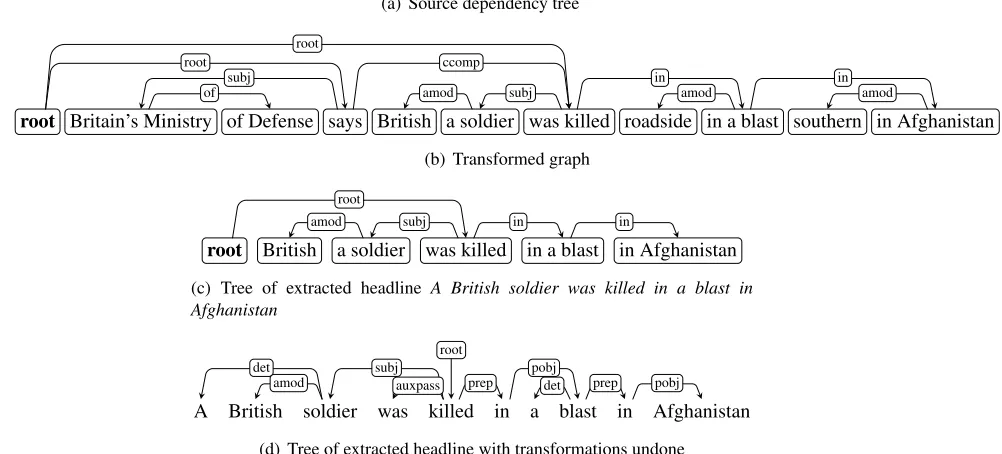
Due to space limitations, we refer the reader to (Filippova & Strube, 2008) for a detailed descrip-tion on the method. Essential for the present discus-sion is that source dependency trees are transformed to dependency graphs in that (1) auxiliary, deter-miner, preposition, negation and possessive nodes are collapsed with their heads; (2) prepositions re-place labels on the edges to their arguments; (3) the dummy root node is connected with every inflected verb. Figures 1(a)-1(b) illustrate most of the trans-formations. The transformations are deterministic and reversible, they can be implemented in a single top-down tree traversal2.
The set E of edges in Eq. (1) is thus the set of edges of thetransformed dependency graph, like in Fig. 1(b). A benefit of the transformations is that function words and negation appear in the compres-sion if and only if their head words are present. Hence no separate constraints are required to en-sure that negation or a determiner is preserved. The dummy root node makes constraint formulation eas-ier and also allows for the generation of compres-sions from any finite clause of the source.
The described pruning optimization framework is used both for the unsupervised baseline and for our supervised system. The difference between the baseline and our system is in how edge weights,
w(e)’s in Eq. (1), are instantiated.
Baseline edge weights. The precomputed edge weights reflect syntactic importance as well as infor-mativeness of the nodes they point to. Given edge
efrom head node h to node n, the edge weight is the product of the syntactic and the informativeness weights,
w(e) =wsynt(e)×winfo(e) (3)
The syntactic weight is defined as
wsynt(e) =P(label(e)|lemma(h)) (4)
For example, verb kill may have multiple argu-ments realized with dependency labelssubj,dobj,in, etc. However, these argument labels are not equally likely, e.g.,P(subj|kill) > P(in|kill). When forced to prune an edge, the system would prefer to keep
2Some of the transformations are comparable to what is
Britain ’s Ministry of Defense says a British soldier was killed in a roadside blast in southern Afghanistan ps
poss
prep pobj nsubj
amod det
auxpass nsubj ccomp
prep
pobj
amod det
prep
pobj
amod root
(a) Source dependency tree
root Britain’s Ministry of Defense says British a soldier was killed roadside in a blast southern in Afghanistan of
subj root
root
ccomp
subj amod
in amod
in amod
(b) Transformed graph
root British a soldier was killed in a blast in Afghanistan subj
root
amod in in
(c) Tree of extracted headline A British soldier was killed in a blast in Afghanistan
A British soldier was killed in a blast in Afghanistan
det amod
subj
auxpass prep pobj
det prep pobj root
[image:4.612.70.571.121.348.2](d) Tree of extracted headline with transformations undone
Figure 1: Source, transformed and extracted trees given headlineBritish soldier killed in Afghanistan
the subject edge over the preposition-in edge since it contributes more weight to the objective function.
The informativeness score is inspired by Wood-send & Lapata (2012) and is defined as
winfo(e) =
Pheadline(lemma(n))
Particle(lemma(n))
(5)
This weight tells us how likely it is that a word from an article appears in the headline. For exam-ple, given two edges one of which points to verbsay and another one to verbkill, the latter would be pre-ferred over the former becausekill is more “head-liny” thansay. When collecting counts for the syn-tactic and informativeness scores, we used 9M news articles crawled from the Internet, much more than Filippova & Strube (2008). As a result our estimates are probably more accurate than theirs.
Although both wsynt and winfo have a meaning-ful interpretation, there is no guarantee that product is the best way to combine the two when assign-ing edge weights. Also, it is unclear how to inte-grate other signals, such as distance to the root, node length or information about the siblings, which
pre-sumably all play a role in determining the overall edge importance.
3 Learning edge weights
Our supervised system differs from the unsupervised baseline in that instead of relying on precomputed scores, we define edge weightw(e)in Eq. (1) with a linear function over a feature representation,
w(e) =w·f(e) (6)
Heref(e) is a vector of binary variables for every feature from the set of all possible but very infre-quent features in the training set.f(e)has1for every feature extracted for edgeeand zero otherwise.
syntactic label(e); fore*toh,label(e*);pos(h);pos(n)
structural depth(n);#children(n);#children(h);char length(n);#words in(n) semantic NE tag(h);NE tag(n);is negated(n)
lexical lemma(n);lemma(h)-label(e); fore*ton’s siblings,lemma(h)-label(e*)
Table 1: Types of features extracted for edgeefromhton
the head and the target nodes, and the siblings as well as the children of the latter. The negation fea-ture is only applicable to verb nodes which contain a negative particle, like not, after the tree transfor-mations. Lexical features which combine lemmas and syntactic labels are inspired by the unsupervised baseline and are very sparse.
In what follows, our assumption is that we have a compression corpus at our disposal where for every input sentence there is a correct “oracle” compres-sion such that its transformed parse tree matches a subtree of the transformed input graph. Given such a corpus, we can apply structured prediction meth-ods to learn the parameter vector w. In our study we employ an averaged variant of online structured perceptron (Collins, 2002). In the context of sen-tence fusion, a similar dependency structure prun-ing framework and a similar learnprun-ing approach was adopted by Elsner & Santhanam (2011).
At every iteration, for every input graph, we find the optimal solution with ILP under the current pa-rameter vector w. The maximum permitted com-pression length is set to be the same as the length of the oracle compression. Since the oracle com-pression is a subtree of the input graph, it represents a feasible solution for ILP. The parameter vector is updated if there is a mismatch between the predicted and the oracle sets of edges for all the features with a non-zero net count. More formally, given an input graph with the set of edges E, oracle compression
C ⊂E and compressionCt⊆Epredicted at
itera-tiont, the parameter update vector att+ 1is given by
wt+1 =wt+
X
e∈C\Ct
f(e)− X
e∈Ct\C
f(e) (7)
w is averaged over all the wt’s so that features
whose weight fluctuated a lot during training are pe-nalized (Freund & Shapire, 1999).
Of course, training a model with a large number of features, such as a lexicalized model, is only pos-sible if there is a large compression corpus where the dependency tree of the compression is a subtree of the source sentence. In the next section we in-troduce our method of getting a sufficient amount of such data.
4 Acquiring parallel data automatically
In this section we explain how we obtained a parallel corpus of sentences and compressions. The underly-ing idea is to harvest news articles from the Internet where the headline appears to be similar to the first sentence and use it to find an extractive compression of the sentence.
Collecting headline-sentence pairs. Using a news crawler, we collected a corpus of news arti-cles in English from the Internet. Similarly to previ-ous work (Dolan et al., 2004; Wubben et al., 2009; Bejan & Harabagiu, 2010, inter alia), the Google News service3was used to identify news. From ev-ery article, the headline and the first sentence, which are known to be semantically similar (Dorr et al., 2003), were extracted. Predictably, very few head-lines are extractive compressions of the first sen-tence, therefore simply looking for pairs where the headline is a subsequence of the words from the first sentence would not solve the problem of getting a large amount of parallel data. Importantly, headlines are syntactically quite different from “normal” sen-tences. For example, they may have no main verb, omit determiners and appear incomplete, making it hard for a supervised deletion-based system to learn useful rules. Moreover, we observed poor parsing accuracy for headlines which would make syntactic annotations for headlines hardly useful.
Thus, instead of taking the headline as it is, we use it to find a proper extractive compression of the
sen-3http://news.google.com
tence by matching lemmas of content words (nouns, verbs, adjectives, adverbs) and coreference IDs of entities from the headline with those of the sentence. The exact procedure is as follows (H,SandTstand forheadline,sentenceandtransformed graphof the sentence):
PREPROCESSING HandSare preprocessed in a
standard way: tokenized, lemmatized, PoS and NE tagged. Additionally,Sis parsed with a dependency parser (Nivre, 2006) and transformed as described in Section 2 to obtainT. Finally, pronominal anaphora is resolved inS. Recall that Sis the first sentence, so the antecedent must be located in a preceding, higher-level clause.
FILTERING To restrict the corpus to grammatical and informative headlines, we implemented a cas-cade of filters. Pair (H,S) is discarded if any of the questions in Table 2 is answered positively.
IsHa question?
IsHorStoo short? (less than four word tokens) IsHabout as long asS? (min ratio: 1.5)
DoesHlack a verb? DoesHbegin with a verb?
Is there anoun, verb, adj, advlemma fromH
not found inS?
Are thenoun, verb, adj, advlemmas fromH
found inSin a different order?
Table 2: Filters applied to candidate pair (H, S)
MATCHING Given the content words ofH, a sub-set of nodes in T is selected based on lemma or coreference identity of the main (head) word in the nodes. For example, the main word of a collapsed node in T, which covers two words was killed, is killed;wasis its child attached with labelauxin the untransformed parse tree. This node is marked ifH
contains wordkilledorkillingbecause of the lemma identity. In some cases there are multiple possible matches. For example, givenSBarack Obama said he will attend G20andHmentioningObama, both Barack Obamaandhenodes are marked inT. Once all the nodes in T which match content words and entities from H are identified, a minimum subtree covering these nodes is found such that every word or entity from H occurs as many times in T as in
H. So ifH mentionsObama only once, then either Barack Obamaorhemust be covered by the subtree but not both. This minimum subtree corresponds to an extractive headline, H*, which we generate by ordering the surface forms of all the words in the subtree nodes by their offsets inS. Finally, the char-acter length of H*is compared with the length of
H. IfH*is much longer thanH, the pair (H, S) is discarded (max ratio 1.5).
As an illustration to the procedure, consider the example from Figure 1 with the extracted headline and its tree presented in Figure 1(c). Given the headline British soldier killed in Afghanistan, the extracted headline would be A British soldier was killed in a blast in Afghanistan. The lemmasbritish, soldier, kill, afghanistanfrom the headline match the nodesBritish, a soldier, was killed, in Afghanistan in the transformed graph. The node in a blast is added because it is on the path fromwas killedtoin Afghanistan. Of course, it is possible to determinis-tically undo the transformations in order to obtain a standard dependency tree. In this case the extracted headline would still correspond to a subtree of the input (compare Fig. 1(d) with Fig. 1(a)). Also note that a similar procedure can be implemented for con-stituency parses.
The resulting corpus consists of 250K tuples (S,
T, H, H*), Appendix provides more examples of
source sentences, original headlines and extracted headlines. We did not attempt to tune the values for minimum/maximum length and ratio – lower thresh-olds may have produced comparable results.
Evaluating data quality. The described proce-dure produces a comparatively large compression corpus but how good are automatically constructed compressions? To answer this question, we ran-domly selected 50 tuples from the corpus and set up an experiment with human raters to validate and as-sess data quality in terms ofreadability4and infor-mativeness5 which are standard measures of com-pression quality (Clarke & Lapata, 2006). Raters were asked to read a sentence and a compression (original Hor extractedH*headline) and then rate the compression on two five-point scales. Three rat-ings were collected for every item. Table 3 gives
4
Also calledgrammaticalityandfluency.
5
average ratings with standard deviation.
AVG read AVG info ORIG. HEADLINE 4.36 (0.75) 3.86 (0.79)
[image:7.612.329.528.57.112.2]EXTR. HEADLINE 4.26 (1.01) 3.70 (1.04)
Table 3: Results for two kinds of headlines
In terms of readability and informativeness the extracted headlines are comparable with human-written ones: at 95% confidence there is no statis-tically significant difference between the two.
Encouraged by the results of the validation exper-iment we proceeded to our next question: Can a su-pervised compression system be successfully trained on this corpus?
5 System evaluation and discussion
From the corpus of 250K tuples we used 100K to get pairs of extracted headlines and sentences for training (on the development set we did not observe much improvement from using more training data), 250 for development and the rest for testing. We ran the learning algorithm for 20 iterations, checking the performance on the development set. Features which applied to less than 20 edges were pruned, the size of the feature set is about 28K.
5.1 Evaluation with humans
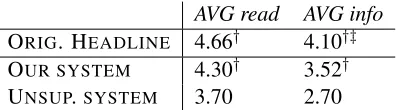
50 pairs oforiginalheadlines and sentences (differ-ent from the data validation set in Sec. 4) were ran-domly selected for an evaluation with humans from the test data. As in the data quality validation ex-periment, we asked raters to assess the readability and informativeness of proposed compressions for the unsupervised system, our system and human-written headlines. The latter provide us with upper bounds on the evaluation criteria. Three ratings per item per parameter were collected. To get compara-ble results, the unsupervised and our systems used the same compression rate: for both, the requested maximum length was set to the length of the head-line. Table 4 summarizes the results.
The results indicate that the trained model signifi-cantly outperforms the unsupervised system, getting particularly good marks for readability. The differ-ence in readability between our system andoriginal headlines is not statistically significant. Note that
AVG read AVG info ORIG. HEADLINE 4.66† 4.10†‡
OUR SYSTEM 4.30† 3.52†
UNSUP.SYSTEM 3.70 2.70
Table 4: Results for the systems and original headline:† and‡stand forsignificantly better than Unsupervisedand Our system at 95% confidence, respectively
the unsupervised baseline is also capable of generat-ing readable compressions but does a much poorer job in selecting most important information. Our trained model successfully learned to optimize both scores. We refer the reader to Appendix for input and compression examples. Note that the ratings for the human-written headlines in this experiment are slightly different from the ratings in the data valida-tion experiment because a different data sample was used.
5.2 Automatic evaluation
Our automatic evaluation had the goal of explic-itly addressing two relevant questions related to our claims about (1) the benefits of having a large paral-lel corpus and (2) employing a supervised approach with a rich feature representation.
1. Our primary motivation for collecting parallel data has been that having access to sparse lex-ical features, which considerably increase the feature space, would benefit compression sys-tems. But is it really the case for sentence com-pression? Can a comparable performance be achieved with a closed, moderately sized set of dense, non-lexical features? If yes, then a large compression corpus is probably not needed. Furthermore, to demonstrate that a large corpus is not only sufficient but also necessary to learn weights for thousands of features, we need to compare the performance of the system when trained on the full data set and a small portion of it.
their feature counterparts? Recall that one of our feature types in Table 1 is the concate-nation of lemma(h) (parent lemma) and la-bel(e) which relies on the same information aswsynt = P(label(e)|lemma(h)). The fea-ture counterpart of winfo defined in Eq. (5) is lemma(n)–the lemma of the node to which edge points. How would the supervised system per-form against the unsupervised one, if it only ex-tracted features of these two types?
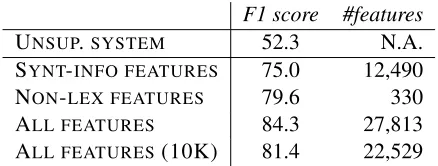
To answer these questions, we sampled 1,000 tu-ples from the unused test data and measured F1 score (Riezler et al., 2003) by comparing the trees of the generated compression and the “correct”, ex-tracted headline. The systems we compared are the unsupervised baseline (UNSUP. SYSTEM) and the
supervised model trained on three kinds of feature sets: (1) SYNT-INFO FEATURES, corresponding to the supervised training of the unsupervised base-line model (i.e., lemma(h)-label(e) andlemma(n)); (2) NON-LEX FEATURES, corresponding to a dense, non-lexical feature representation (i.e., all the fea-ture types from Table 1 excluding the three involv-ing lemmas); (3) ALL FEATURES (same as OUR SYSTEM). Additionally, we trained the system on
10% of the data–10K as opposed to 100K tuples, ALL FEATURES (10K)–for 20 iterations ignoring features which applied to less than three edges6. As before, the same compression rate was used for all the systems. The results are summarized in Table 5.
F1 score #features
UNSUP.SYSTEM 52.3 N.A.
SYNT-INFO FEATURES 75.0 12,490
NON-LEX FEATURES 79.6 330
ALL FEATURES 84.3 27,813
[image:8.612.76.295.485.568.2]ALL FEATURES(10K) 81.4 22,529
Table 5: Results for the unsupervised baseline and the supervised system trained on three kinds of feature sets
Clearly, having more features, lexicalized and un-lexicalized, is important: there is a significant
im-6
Recall from the beginning of the section that for the full (100K) training set the threshold was set to 20 with no tuning. For the 10K training set, we tried values of two, three, five and varied the number of iterations. The result we report is the high-est we could get for 10K.
provement in going beyond the closed set of 330 non-lexical features to all, from 79.6 to 84.3 points. Moreover, successful training requires a large cor-pus since the performance of the system degrades if only 10K training instances are used. Note that this number already exceeds all the existing compression corpora taken together. Hence, sparse lexical fea-tures are useful for compression and a large paral-lel corpus is a requirement for successful supervised training.
Concerning our second question, learning feature weights from the data produces significantly better results than the hand-crafted way of making use of the same information, even if a much larger data set is used to collect statistics. We observed a dra-matic increase from 52.3 to 75.0 points. Thus, we may conclude that training with dense and sparse features directly from data definitely improves the performance of the dependency pruning system.
5.3 Discussion
It is important to note that the data we used is chal-lenging: first sentences in news articles tend to be long, in fact longer than other news sentences, which implies less reliable syntactic analysis and noisier input to the syntax-based systems. In the test set we used for the evaluation with humans, the mean sentence length is 165 characters. The average com-pression rate in characters is0.46±0.16 which is quite aggressive7. Recall that we used the very same framework for the unsupervised baseline and our system as well as the same compression rate. All the preprocessing errors affect both systems equally and the comparison of the two is fair. Predictably, wrong syntactic parses significantly increase chances of an ungrammatical compression, and parser errors seem to be a major source of readability deficiencies.
A property of the described compression frame-work is that a desired compression length is ex-pected to be provided by the user. This can be seen both as a strength and as a weakness, depending on the application. In a scenario where mobile devices with a limited screen size are used, or in a summa-rization scenario where a total summary length is provided (see the DUC/TAC guidelines8), being able
7We follow the standard terminology where smaller values
implyshortercompressions.
to specify a length is definitely an advantage. How-ever, one can also think of other applications where the user does not have a strict length constraint but wants the text to be somewhat shorter. In this case, a reranker which compares compressions generated for a range of possible lengths can be employed to find a single compression (e.g., mean edge weight in the solution or a language model-based score).
6 Conclusions
We have addressed a major problem for supervised extractive compression models – the lack of a large parallel corpus. To this end, we presented a method to automatically build such a corpus from web doc-uments available on the Internet. An evaluation with humans demonstrates that the quality of the corpus is high – the compressions are grammati-cal and informative. We also significantly improved a competitive unsupervised method achieving high readability and informativeness scores by incorpo-rating thousands of features and learning the feature weights from our corpus. This result further con-firms the practical utility of the automatically ob-tained data. We have shown that employing lexi-cal features is important for sentence compression, and that our supervised module can successfully learn their weights from the corpus. To our knowl-edge, we are the first to empirically demonstrate that sparse features are useful for compression and that a large parallel corpus is a requirement for a success-ful learning of their weights. We believe that other supervised deletion-based systems can benefit from our work.
Acknowledgements: The authors are thankful to the EMNLP reviewers for their feedback and sug-gestions.
Appendix
The appendix presents examples of source sentences (S), original headlines (H), extracted headlines (H*), unsupervised baseline (U) and our system (O) com-pressions.
References
Bejan, C. & S. Harabagiu (2010). Unsupervised event coreference resolution with rich linguistic features. InProc. of ACL-10, pp. 1412–1422.
Belz, A., M. White, D. Espinosa, E. Kow, D. Hogan & A. Stent (2011). The first surface realization shared task: Overview and evaluation results. In Proc. of ENLG-11, pp. 217–226.
Berg-Kirkpatrick, T., D. Gillick & D. Klein (2011). Jointly learning to extract and compress. InProc. of ACL-11.
Clarke, J. & M. Lapata (2006). Models for sen-tence compression: A comparison across do-mains, training requirements and evaluation mea-sures. InProc. of COLING-ACL-06, pp. 377–385.
Clarke, J. & M. Lapata (2008). Global inference for sentence compression: An integer linear pro-gramming approach. Journal of Artificial Intelli-gence Research, 31:399–429.
Cohn, T. & M. Lapata (2009). Sentence compres-sion as tree transduction. Journal of Artificial In-telligence Research, 34:637–674.
Collins, M. (2002). Discriminative training methods for Hidden Markov Models: Theory and exper-iments with perceptron algorithms. In Proc. of EMNLP-02, pp. 1–8.
de Marneffe, M.-C., B. MacCartney & C. D. Man-ning (2006). Generating typed dependency parses from phrase structure parses. InProc. of LREC-06, pp. 449–454.
Dolan, B., C. Quirk & C. Brokett (2004). Unsu-pervised construction of large paraphrase corpora: Exploiting massively parallel news sources. In Proceedings of the 20th International Conference on Computational Linguistics, Geneva, Switzer-land, 23–27 August 2004, pp. 350–356.
S Country star Sara Evans has married former University of Alabama quarterback Jay Barker. H Country star Sara Evans marries
H* Country star Sara Evans has married U Sara Evans has married Jay Barker O Sara Evans has married Jay Barker
S Intel would be building car batteries, expanding its business beyond its core strength, the company said in a statement H Intel to build car batteries
H* Intel would be building car batteries U would be building the company said O Intel would be building car batteries
S A New Orleans Saints team spokesman says tight end Jeremy Shockey was taken to a hospital but is doing fine. H Spokesman: Shockey taken to hospital, doing fine
H* spokesman says Jeremy Shockey was taken to a hospital but is doing fine U A New Orleans Saints team spokesman says Jeremy Shockey was taken O tight end Jeremy Shockey was taken to a hospital but is doing fine
S President Obama declared a major disaster exists in the State of Florida and ordered Federal aid to supplement State and local recovery efforts in the area struck by severe storms, flooding, tornadoes, and straight-line winds beginning on May 17, 2009, and continuing.
H President Obama declares major disaster exists in the State of Florida H* President Obama declared a major disaster exists in the State of Florida U President Obama declared a major disaster exists and ordered Federal aid O President Obama declared a major disaster exists in the State of Florida
S Regulators Friday shut down a small Florida bank, bringing to 119 the number of US bank failures this year amid mounting loan defaults.
H Regulators shut down small Florida bank H* Regulators shut down a small Florida bank U shut down bringing the number of failures O Regulators shut down a small Florida bank
S Three men were arrested Wednesday night and Dayton police said their arrests are in connection to a west Dayton bank robbery.
H 3 men arrested in connection with Bank robbery
H* Three men were arrested are in connection to a bank robbery U were arrested and Dayton police said their arrests are O Three men were arrested and police said their arrests are
S The government and the social partners will resume the talks on the introduction of the so-called crisis tax, which will be levied on all salaries, pensions and incomes over HRK 3,000.
H Government, social partners to resume talks on introduction of “crisis” tax.
H* The government and the social partners will resume the talks on the introduction of the crisis tax U The government will resume the talks on the introduction of the crisis tax which will be levied O The government and the social partners will resume the talks on the introduction of the crisis tax
S England star David Beckham may have the chance to return to AC Milan after the Italian club’s coach said he was open to his move on Sunday.
H Beckham has chance of returning to Milan
H* David Beckham may have the chance to return to AC Milan U David Beckham may have the chance to return said star was O David Beckham may have the chance to return to AC Milan
S Eastern Health and its insurance company have accepted liability for some patients involved in the breast cancer testing scandal, according to a statement released Friday afternoon.
H Eastern Health accepts liability for some patients H* Eastern Health have accepted liability for some patients U Health have accepted liability according to a statement O Eastern Health have accepted liability for some patients
S Frontier Communications Corp., a provider of phone, TV and Internet services, said Thursday it has started a cash tender offer to purchase up to $700 million of its notes.
H Frontier Communications starts tender offer for up to $700 million of notes
Elsner, M. & D. Santhanam (2011). Learning to fuse disparate sentences. InProceedings of the Work-shop on Monolingual Text-to-text Generation, Prt-land, OR, June 24 2011, pp. 54–63.
Filippova, K. & M. Strube (2008). Dependency tree based sentence compression. In Proc. of INLG-08, pp. 25–32.
Freund, Y. & R. E. Shapire (1999). Large margin classification using the perceptron algorithm. Ma-chine Learning, 37:277–296.
Galanis, D. & I. Androutsopoulos (2010). An ex-tractive supervised two-stage method for sentence compression. In Proc. of NAACL-HLT-10, pp. 885–893.
Galanis, D. & I. Androutsopoulos (2011). A new sentence compression dataset and its use in an ab-stractive generate-and-rank sentence compressor. InProc. of UCNLG+Eval-11, pp. 1–11.
Galley, M. & K. R. McKeown (2007). Lexicalized Markov grammars for sentence compression. In Proc. of NAACL-HLT-07, pp. 180–187.
Gillick, D. & B. Favre (2009). A scalable global model for summarization. InILP for NLP-09, pp. 10–18.
Grefenstette, G. (1998). Producing intelligent tele-graphic text reduction to provide an audio scan-ning service for the blind. In Working Notes of the Workshop on Intelligent Text Summarization, Palo Alto, Cal., 23 March 1998, pp. 111–117.
Hori, C. & S. Furui (2004). Speech summariza-tion: An approach through word extraction and a method for evaluation. IEEE Transactions on Information and Systems, E87-D(1):15–25.
Jing, H. & K. McKeown (2000). Cut and paste based text summarization. In Proc. of NAACL-00, pp. 178–185.
Knight, K. & D. Marcu (2000). Statistics-based summarization – step one: Sentence compression. InProc. of AAAI-00, pp. 703–711.
Mani, I. (2001).Automatic Summarization. Amster-dam, Philadelphia: John Benjamins.
McDonald, R. (2006). Discriminative sentence com-pression with soft syntactic evidence. InProc. of EACL-06, pp. 297–304.
Napoles, C., C. Callison-Burch, J. Ganitkevitch & B. Van Durme (2011). Paraphrastic sentence com-pression with a character-based metric: Tighten-ing without deletion. InProceedings of the Work-shop on Monolingual Text-to-text Generation, Prt-land, OR, June 24 2011, pp. 84–90.
Nivre, J. (2006). Inductive Dependency Parsing. Springer.
Nomoto, T. (2008). A generic sentence trimmer with CRFs. InProc. of ACL-HLT-08, pp. 299–307.
Nomoto, T. (2009). A comparison of model free ver-sus model intensive approaches to sentence com-pression. InProc. of EMNLP-09, pp. 391–399.
Riezler, S., T. H. King, R. Crouch & A. Zaenen (2003). Statistical sentence condensation using ambiguity packing and stochastic disambiguation methods for Lexical-Functional Grammar. In Proc. of HLT-NAACL-03, pp. 118–125.
Turner, J. & E. Charniak (2005). Supervised and unsupervised learning for sentence compression. InProc. of ACL-05, pp. 290–297.
Woodsend, K. & M. Lapata (2010). Automatic gen-eration of story highlights. In Proc. of ACL-10, pp. 565–574.
Woodsend, K. & M. Lapata (2012). Multiple as-pect summarization using Integer Linear Pro-gramming. InProc. of EMNLP-12, pp. 233–243.
Wubben, S., A. van den Bosch, E. Krahmer & E. Marsi (2009). Clustering and matching head-lines for automatic paraphrase acquisition. In Proc. of ENLG-09, pp. 122–125.