Weighted Alignment Matrices for Statistical Machine Translation
Yang Liu , Tian Xia , Xinyan Xiao and Qun Liu
Key Laboratory of Intelligent Information Processing Institute of Computing Technology
Chinese Academy of Sciences P.O. Box 2704, Beijing 100190, China
{yliu,xiatian,xiaoxinyan,liuqun}@ict.ac.cn
Abstract
Current statistical machine translation sys-tems usually extract rules from bilingual corpora annotated with 1-best alignments. They are prone to learn noisy rules due to alignment mistakes. We propose a new structure called weighted alignment matrix to encode all possible alignments for a par-allel text compactly. The key idea is to as-sign a probability to each word pair to in-dicate how well they are aligned. We de-sign new algorithms for extracting phrase pairs from weighted alignment matrices and estimating their probabilities. Our ex-periments on multiple language pairs show that using weighted matrices achieves con-sistent improvements over using n-best lists in significant less extraction time.
1 Introduction
Statistical machine translation (SMT) relies heav-ily on annotated bilingual corpora. Word align-ment, which indicates the correspondence be-tween the words in a parallel text, is one of the most important annotations in SMT. Word-aligned corpora have been found to be an excellent source for translation-related knowledge, not only for phrase-based models (Och and Ney, 2004; Koehn et al., 2003), but also for syntax-based models (e.g., (Chiang, 2007; Galley et al., 2006; Shen et al., 2008; Liu et al., 2006)). Och and Ney (2003) indicate that the quality of machine transla-tion output depends directly on the quality of ini-tial word alignment.
Modern alignment methods can be divided into two major categories: generative methods and
dis-criminative methods. Generative methods (Brown
et al., 1993; Vogel and Ney, 1996) treat word alignment as a hidden process and maximize the likelihood of bilingual training corpus using the
expectation maximization (EM) algorithm. In contrast, discriminative methods (e.g., (Moore et al., 2006; Taskar et al., 2005; Liu et al., 2005; Blunsom and Cohn, 2006)) have the freedom to define arbitrary feature functions that describe var-ious characteristics of an alignment. They usu-ally optimize feature weights on manuusu-ally-aligned data. While discriminative methods show supe-rior alignment accuracy in benchmarks, genera-tive methods are still widely used to produce word alignments for large sentence-aligned corpora.
However, neither generative nor discriminative alignment methods are reliable enough to yield high quality alignments for SMT, especially for distantly-related language pairs such as Chinese-English and Arabic-Chinese-English. The F-measures for Chinese-English and Arabic-English are usually around 80% (Liu et al., 2005) and 70% (Fraser and Marcu, 2007), respectively. As most current SMT systems only use 1-best alignments for ex-tracting rules, alignment errors might impair trans-lation quality.
Recently, several studies have shown that offer-ing more alternatives of annotations to SMT sys-tems will result in significant improvements, such as replacing 1-best trees with packed forests (Mi et al., 2008) and replacing 1-best word segmenta-tions with word lattices (Dyer et al., 2008). Sim-ilarly, Venugopal et al. (2008) use n-best align-ments instead of 1-best alignalign-ments for translation rule extraction. While they achieve significant im-provements on the IWSLT data, extracting rules fromn-best alignments might be computationally expensive.
In this paper, we propose a new structure named
weighted alignment matrix to represent the
align-ment distribution for a sentence pair compactly. In a weighted matrix, each element that corresponds to a word pair is assigned a probability to measure the confidence of aligning the two words. There-fore, a weighted matrix is capable of using a
the
development
of
China
’s
economy
zh
on
gg
uo
de
jin
gj
i
fa
zh
[image:2.595.114.248.61.214.2]an
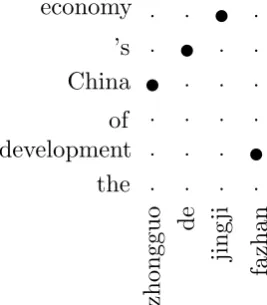
Figure 1: An example of word alignment between a pair of Chinese and English sentences.
ear space to encode the probabilities of exponen-tially many alignments. We develop a new algo-rithm for extracting phrase pairs from weighted matrices and show how to estimate their relative frequencies and lexical weights. Experimental re-sults show that using weighted matrices achieves consistent improvements in translation quality and significant reduction in extraction time over using
n-best lists.
2 Background
Figure 1 shows an example of word alignment be-tween a pair of Chinese and English sentences. The Chinese and English words are listed horizon-tally and vertically, respectively. The dark points indicate the correspondence between the words in two languages. For example, the first Chinese word “zhongguo” is aligned to the fourth English word “China”.
Formally, given a source sentence f = f1J =
f1, . . . , fj, . . . , fJ and a target sentencee=eI1 = e1, . . . , ei, . . . , eI, we define a link l = (j, i) to exist iffj and ei are translation (or part of trans-lation) of one another. Then, an alignment ais a subset of the Cartesian product of word positions:
a⊆ {(j, i) :j= 1, . . . , J;i= 1, . . . , I} (1) Usually, SMT systems only use the 1-best align-ments for extracting translation rules. For exam-ple, given a source phrase f˜and a target phrase
˜
e, the phrase pair ( ˜f,e)˜ is said to be consistent (Och and Ney, 2004) with the alignment if and only if: (1) there must be at least one word in-side one phrase aligned to a word inin-side the other
phrase and (2) no words inside one phrase can be aligned to a word outside the other phrase.
After all phrase pairs are extracted from the training corpus, their translation probabilities can be estimated as relative frequencies (Och and Ney, 2004):
φ(˜e|f˜) = Pcount( ˜f,˜e)
˜
e′count( ˜f,e˜′)
(2)
wherecount( ˜f,e)˜ indicates how often the phrase pair( ˜f,e)˜ occurs in the training corpus.
Besides relative frequencies, lexical weights (Koehn et al., 2003) are widely used to estimate how well the words in f˜translate the words in
˜
e. To do this, one needs first to estimate a lexi-cal translation probability distribution w(e|f) by relative frequency from the same word alignments in the training corpus:
w(e|f) = Pcount(f, e)
e′count(f, e′) (3) Note that a special source NULL token is added to each source sentence and aligned to each un-aligned target word.
As the alignment˜abetween a phrase pair( ˜f,e)˜ is retained during extraction, the lexical weight can be calculated as
pw(˜e|f,˜˜a) = |˜e|
Y
i=1
1
|{j|(j, i)∈a˜}|
X
w(ei|fj) (4)
If there are multiple alignmentsa˜ for a phrase pair ( ˜f,e)˜, Koehn et al. (2003) choose the one with the highest lexical weight:
pw(˜e|f˜) = max˜a
n
pw(˜e|f,˜a)˜
o
(5)
Simple and effective, relative frequencies and lexical weights have become the standard features in modern discriminative SMT systems.
3 Weighted Alignment Matrix
We believe that offering more candidate align-ments to extracting translation rules might help improve translation quality. Instead of using n -best lists (Venugopal et al., 2008), we propose a new structure called weighted alignment matrix.
the developmentof China ’s economy
zh
on
gg
uo de
jin
gj
i
fa
zh
an
the developmentof China ’s economy
zh
on
gg
uo de
jin
gj
i
fa
zh
an
the developmentof China ’s economy
zh
on
gg
uo de
jin
gj
i
fa
zh
an
1.0 0.6 0.4 0.4
1.0
1.0 0.4 0
0 0 0 0
0 0 0 0
0 0 0 0
0 0 0 0
(a) (b) (c)
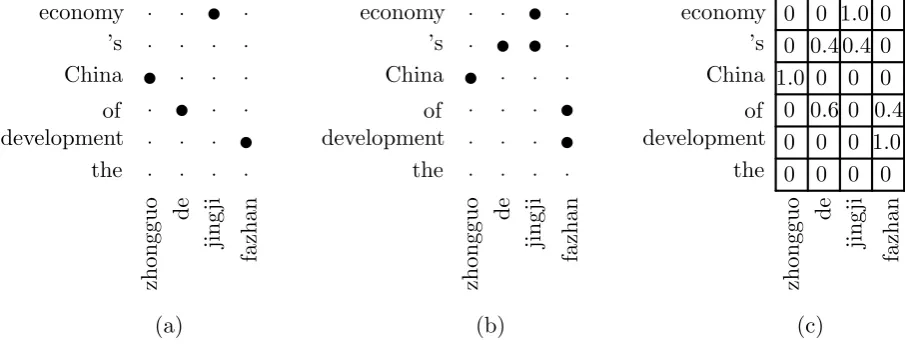
Figure 2: (a) One alignment of a sentence pair; (b) another alignment of the same sentence pair; (c) the resulting weighted alignment matrix that takes the two alignments as samples, of which the initial probabilities are 0.6 and 0.4, respectively.
pair (“zhongguo”, “China”)) occur in both align-ments, some links (e.g., (2,3) corresponding to the word pair (“de”,“of”)) occur only in one align-ment, and some links (e.g., (1,1) corresponding to the word pair (“zhongguo”, “the”)) do not oc-cur. Intuitively, we can estimate how well two words are aligned by calculating its relative fre-quency, which is the probability sum of align-ments in which the link occurs divided by the probability sum of all possible alignments. Sup-pose that the probabilities of the two alignments in Figures 2(a) and 2(b) are 0.6 and 0.4, respectively. We can estimate the relative frequencies for every word pair and obtain a weighted matrix shown in Figure 2(c). Therefore, each word pair is associ-ated with a probability to indicate how well they are aligned. For example, in Figure 2(c), we say that the word pair (“zhongguo”, “China”) is def-initely aligned, (“zhongguo”, “the”) is defdef-initely unaligned, and (“de”, “of”) has a 60% chance to get aligned.
Formally, a weighted alignment matrix m is a
J ×Imatrix, in which each element stores a link
probability pm(j, i) to indicate how well fj and
eiare aligned. Currently, we estimate link proba-bilities from ann-best list by calculating relative frequencies:
pm(j, i) =
P
a∈NPp(a)×δ(a, j, i) a∈Np(a)
(6)
= X
a∈N
p(a)×δ(a, j, i) (7)
where
δ(a, j, i) =
(
1 (j, i)∈a
0 otherwise (8)
Note thatN is ann-best list,p(a)is the probabil-ity of an alignment ain the n-best list, δ(a, j, i) indicates whether a link(j, i) occurs in the align-ment a or not. We assign 0 to any unseen alignment. As p(a) is usually normalized (i.e.,
P
a∈Np(a) ≡ 1), we remove the denominator in
Eq. (6).
Accordingly, the probability that the two words
fj andeiare not aligned is
¯
pm(j, i) = 1.0−pm(j, i) (9)
For example, as shown in Figure 2(c), the prob-ability for the two words “de” and “of” being aligned is 0.6 and the probability that they are not aligned is 0.4.
Intuitively, the probability of an alignmentais the product of link probabilities. If a link (j, i) occurs in a, we use pm(j, i); otherwise we use
¯
pm(j, i). Formally, given a weighted alignment matrix m, the probability of an alignment a can be calculated as
pm(a) = J
Y
j=1 I
Y
i=1
(pm(j, i)×δ(a, j, i) + ¯
[image:3.595.72.525.65.243.2]1: procedure PHRASEEXTRACT(f1J,eI1,m,l) 2: R ← ∅
3: forj1←1. . . Jdo
4: j2←j1
5: whilej2< J∧j2−j1< ldo
6: T← {i|∃j:j1≤j≤j2∧pm(j, i)>0} 7: il←MIN(T)
8: iu←MAX(T)
9: forn←1. . . ldo
10: fori1←il−n+ 1. . . iudo
11: i2←i1+n−1
12: R ← R ∪ {(fj2
j1, e
i2
i1)}
13: end for
14: end for
15: j2←j2+ 1
16: end while
17: end for
18: returnR
19: end procedure
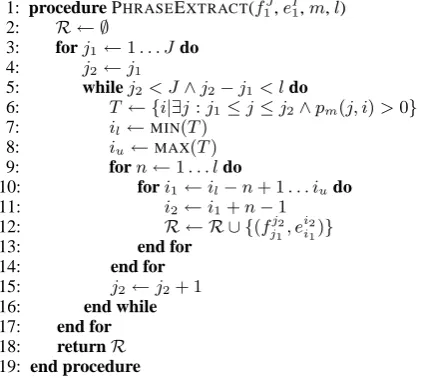
Figure 3: Algorithm for extracting phrase pairs from a sentence pair hf1J, eI1i annotated with a weighted alignment matrixm.
is the set of all possible alignments. Therefore, a weighted alignment matrix is capable of encoding the probabilities of 2J×I alignments using only a
J×Ispace.
Note thatpm(a)is not necessarily equal top(a) because the encoding of a weighted alignment ma-trix changes the alignment probability distribu-tion. For example, while the initial probability of the alignment in Figure 2(a) (i.e.,p(a)) is 0.6, the probability of the same alignment encoded in the matrix shown in Figure 2(c) (i.e.,pm(a)) becomes 0.1296 according to Eq. (10). It should be em-phasized that a weighted matrix encodes all pos-sible alignments rather than the input n-best list, although the link probabilities are estimated from then-best list.
4 Phrase Pair Extraction
In this section, we describe how to extract phrase pairs from the training corpus annotated with weighted alignment matrices (Section 4.1) and how to estimate their relative frequencies (Section 4.2) and lexical weights (Section 4.3).
4.1 Extraction Algorithm
Och and Ney (2004) describe a “phrase-extract” algorithm for extracting phrase pairs from a sen-tence pair annotated with a 1-best alignment. Given a source phrase, they first identify the target phrase that is consistent with the alignment. Then, they expand the boundaries of the target phrase if the boundary words are unaligned.
Unfortunately, this algorithm cannot be directly used to manipulate a weighted alignment matrix, which is a compact representation of all pos-sible alignments. The major difference is that the “tight” phrase that has both boundary words aligned is not necessarily the smallest candidate in a weighted matrix. For example, in Figure 2(a), the “tight” target phrase corresponding to the source phrase “zhongguo de” is “of China”. According to Och’s algorithm, the target phrase “China” breaks the alignment consistency and therefore is not valid candidate. However, this is not true for using the weighted matrix shown in Figure 2(c). The target phrase “China” is treated as a “potential” candidate 1, although it might be assigned only a small fractional count (see Table 1).
Therefore, we enumerate all potential phrase pairs and calculate their fractional counts for eliminating less promising candidates. Figure 3 shows the algorithm for extracting phrases from a weighted matrix. The input of the algorithm is a source sentence f1J, a target sentence eI1, a weighted alignment matrixm, and a phrase length limitl(line 1). After initializingRthat stores col-lected phrase pairs (line 2), we identify the cor-responding target phrases for all possible source phrases (lines 3-5). Given a source phrasefjj12, we find the lower and upper bounds of target positions (i.e., il and iu) that have positive link probabili-ties (lines 6-8). For example, the lower bound is 3 and the upper bound is 5 for the source phrase “zhongguo de” in Figure 2(c). Finally, we enu-merate all target phrases that allow for unaligned boundary words with varying phrase lengths (lines 9-14). Note that we need to ensure that1≤i1 ≤I and1 ≤i2 ≤I in lines 10-11, which are omitted for simplicity.
4.2 Calculating Relative Frequencies
To estimate the relative frequency of a phrase pair, we need to estimate how often it occurs in the training corpus. Given ann-best list, the fractional count of a phrase pair is the probability sum of the alignments with which the phrase pair is con-sistent. Obviously, it is unrealistic for a weighted alignment matrix to enumerate all possible align-ments explicitly to calculate fractional counts. In-stead, we resort to link probabilities to calculate
1By potential, we mean that the fractional count of a
[image:4.595.73.285.64.253.2]the developmentof China ’s economy
zh
on
gg
uo de
jin
gj
i
fa
zh
an
1.0 0.6 0.4 0.4
1.0
1.0 0.4
0 0 0 0 0
0 0 0 0
0 0 0 0
[image:5.595.334.500.61.147.2]0 0 0 0
Figure 4: An example of calculating fractional count. Given the phrase pair (“zhongguo de”, “of
China”), we divide the matrix into three areas:
in-side (heavy shading), outin-side (light shading), and irrelevant (no shading).
counts efficiently. Equivalent to explicit enumera-tion, we interpret the fractional count of a phrase pair as the probability that it satisfies the two align-ment consistency conditions (see Section 2).
Given a phrase pair, we divide the elements of a weighted alignment matrix into three categories: (1) inside elements that fall inside the phrase pair, (2) outside elements that fall outside the phrase pair while fall in the same row or the same col-umn, and (3) irrelevant elements that fall outside the phrase pair while fall in neither the same row nor the same column. Figure 4 shows an exam-ple. Given the phrase pair (“zhongguo de”, “of
China”), we divide the matrix into three areas:
in-side (heavy shading), outin-side (light shading), and irrelevant (no shading).
To what extent a phrase pair satisfies the align-ment consistency is measured by calculating
in-side and outin-side probabilities. Although there are
the same terms in the parsing literature, they have different meanings here. The inside probability in-dicates the chance that there is at least one word inside one phrase aligned to a word inside the other phrase. The outside probability indicates the chance that no words inside one phrase are aligned to a word outside the other phrase.
Given a phrase pair(fjj12, eii21), we denote the in-side area as in(j1, j2, i1, i2) and the outside area asout(j1, j2, i1, i2). Therefore, the inside proba-bility of a phrase pair is calculated as
α(j1, j2, i1, i2) = 1−
Y
(j,i)∈in(j1,j2,i1,i2)
¯
pm(j, i)(11)
target phrase α β count
of China 1.0 0.36 0.36
of China ’s 1.0 0.36 0.36
China ’s 1.0 0.24 0.24
China 1.0 0.24 0.24
’s economy 0.4 0 0
Table 1: Some candidate target phrases of the source phrase “zhongguo de” in Figure 4, whereα is inside probability, β is outside probability, and
countis fractional count.
For example, the inside probability for
(“zhong-guo de”, “of China”) in Figure 4 is 1.0, which
means that there always exists at least one aligned word pair inside.
Accordingly, the outside probability of a phrase pair is calculated as
β(j1, j2, i1, i2) =
Y
(j,i)∈out(j1,j2,i1,i2)
¯
pm(j, i) (12)
For example, the outside probability for (“zhongguo de”, “of China”) in Figure 4 is 0.36, which means the probability that there are no aligned word pairs outside is 0.36.
Finally, we use the product of inside and outside probabilities as the fractional count of a phrase pair:
count(fj2 j1, e
i2
i1) = α(j1, j2, i1, i2)× β(j1, j2, i1, i2) (13) Table 1 lists some candidate target phrases of the source phrase “zhongguo de” in Figure 4. We also give their inside probabilities, outside proba-bilities, and fractional counts.
After collecting the fractional counts from the training corpus, we then use Eq. (2) to calculate relative frequencies in two translation directions.
Often, our approach extracts a large amount of phrase pairs from training corpus as we soften the alignment consistency constraint. To main-tain a reasonable phrase table size, we discard any phrase pair that has a fractional count lower than a threshold t. During extraction, we first obtain a list of candidate target phrases for each source phrase, as shown in Table 1. Then, we prune the list according to the thresholdt. For example, we only retain the top two candidates in Table 1 if
[image:5.595.115.248.61.214.2]training corpus, such global pruning strategy usu-ally leads to very large disk and memory require-ments.
4.3 Calculating Lexical Weights
Recall that we need to obtain two translation prob-ability tables w(e|f) and w(f|e) before calculat-ing lexical weights (see Section 2). Following Koehn et al. (2003), we estimate the two distribu-tions by relative frequencies from the training cor-pus annotated with weighted alignment matrices. In other words, we still use Eq. (3) but the way of calculating fractional counts is different now.
Given a source wordfj, a target word ei, and a weighted alignment matrix, the fractional count
count(fj, ei) is pm(j, i). For NULL words, the fractional counts can be calculated as
count(fj, e0) = I
Y
i=1 ¯
pm(j, i) (14)
count(f0, ei) = J
Y
j=1 ¯
pm(j, i) (15)
For example, in Figure 4,count(de, of) is 0.6,
count(de,NULL) is 0.24, and count(NULL,of) is 0.24.
Then, we adapt Eq. (4) to calculate lexical weight:
pw(˜e|f, m) =˜ |˜e|
Y
i=1
1
{j|pm(j, i)>0} ×
X
∀j:pm(j,i)>0
p(ei|fj)×pm(j, i)
+
p(ei|f0)× |f˜|
Y
j=1 ¯ pm(j, i)
!
(16)
For example, for the target word “of” in Figure 4, the sum of aligned and unaligned probabilities is
1
2 ×(p(of|de)×0.6 +p(of|fazhan)×0.4) + p(of|NULL)×0.24
Note that we take link probabilities into account and calculate the probability that a target word translates a source NULL token explicitly.
5 Experiments
5.1 Data Preparation
We evaluated our approach on Chinese-to-English translation. We used the FBIS corpus (6.9M
+ 8.9M words) as the training data. For lan-guage model, we used the SRI Lanlan-guage Mod-eling Toolkit (Stolcke, 2002) to train a 4-gram model on the Xinhua portion of GIGAWORD cor-pus. We used the NIST 2002 MT evaluation test set as our development set, and used the NIST 2005 test set as our test set. We evaluated the trans-lation quality using case-insensitive BLEU metric (Papineni et al., 2002).
To obtain weighted alignment matrices, we fol-lowed Venugopal et al. (2008) to produce n -best lists via GIZA++. We first ran GIZA++ to produce 50-best lists in two translation direc-tions. Then, we used the refinement technique “grow-diag-final-and” (Koehn et al., 2003) to all
50 ×50 bidirectional alignment pairs. Suppose thatps2tandpt2sare the probabilities of an align-ment pair assigned by GIZA++, respectively. We used ps2t×pt2s as the probability of the result-ing symmetric alignment. As different alignment pairs might produce the same symmetric align-ments, we followed Venugopal et al. (2008) to remove duplicate alignments and retain only the alignment with the highest probability. Therefore, there were 550 candidate alignments on average for each sentence pair in the training data. We obtainedn-best lists by selecting the top n align-ments from the 550-best lists. The probability of each alignment in then-best list was re-estimated by re-normalization (Venugopal et al., 2008). Fi-nally, these n-best alignments served as samples for constructing weighted alignment matrices.
After extracting phrase pairs from n-best lists and weighted alignment matrices, we ran Moses (Koehn et al., 2007) to translate the development and test sets. We used the simple distance-based reordering model to remove the dependency of lexicalization on word alignments for Moses.
5.2 Effect of Pruning Threshold
0.195 0.196 0.197 0.198 0.199 0.200 0.201 0.202 0.203 0.204 0.205 0.206 0.207 0.208
150 200 250 300 350 400 450 500
BLEU score
phrase table size (103)
t=10-4
[image:7.595.80.291.70.216.2]t=10-3 t=10-2 t=0.9...0.1
Figure 5: Effect of pruning threshold on transla-tion quality and phrase table size.
and the BLEU score was 20.55. Generally, both the number of phrase pairs and the BLEU score went down with the increase of t. However, this trend did not hold within the range [0.1, 0.9]. To achieve a good tradeoff between translation qual-ity and phrase table size, we sett = 0.01 for the following experiments.
5.3 N-best lists Vs. Weighted Matrices
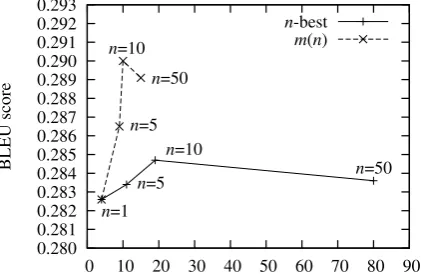
Figure 6 shows the BLEU scores and aver-age extraction time using n-best alignments and weighted matrices, respectively. We used the en-tire training data for phrase extraction. When us-ing 1-best alignments, Moses achieved a BLEU score of 0.2826 and the average extraction time was 4.19 milliseconds per sentence pair (see point
n = 1). The BLEU scores rose with the in-crease of n for using n-best alignments. How-ever, the score went down slightly when n= 50. This suggests that including more noisy align-ments might be harmful. These improvements over 1-best alignments are not statistically signif-icant. This finding failed to echo the promising results reported by Venogopal et al. (2008). We think that there are two possible reasons. First, they evaluated their approach on the IWSLT data while we used the NIST data. It might be easier to obtain significant improvements on the IWSLT data in which the sentences are shorter. Sec-ond, they used the hierarchical phrase-based sys-tem while we used the phrase-based syssys-tem, which might be less sensitive to word alignments because the alignments inside the phrase pairs hardly have an effect.
When using weighted alignment matrices, we
0.280 0.281 0.282 0.283 0.284 0.285 0.286 0.287 0.288 0.289 0.290 0.291 0.292 0.293
0 10 20 30 40 50 60 70 80 90
BLEU score
average extracting time (milliseconds/sentence pair)
n=1 n=5
n=10
n=50 n=5
n=10
n=50
n-best m(n)
Figure 6: Comparison of n-best alignments and weighted alignment matrices. We usem(n)to de-note the matrices that taken-best lists as samples.
obtained higher BLEU scores than using n-best lists with much less extraction time. We achieved a BLEU score of 0.2901 when using the weighted matrices estimated from 10-best lists. The abso-lute improvement of 0.75 over using 1-best align-ments (from 0.2826 to 0.2901) is statistically sig-nificant at p < 0.05 by using sign-test (Collins et al., 2005). Although the improvements overn -best lists are not always statistically significant, weighted alignment matrices maintain consistent superiority in both translation quality and extrac-tion speed.
5.4 Comparison of Parameter Estimation
In theory, the set of phrase pairs extracted fromn -best alignments is the subset of the set extracted from the corresponding weighted matrices. In practice, however, this is not true because we use the pruning threshold t to maintain a reasonable table size. Even so, the phrase tables produced by
n-best lists and weighted matrices still share many phrase pairs.
[image:7.595.314.525.72.209.2]shared non-shared all method
phrases BLEU phrases BLEU phrases BLEU
10-best 4.58M 28.35 1.55M 12.32 6.13M 28.47
[image:8.595.151.452.63.119.2]m(10) 4.58M 28.90 1.76M 13.21 6.34M 29.01
Table 2: Comparison of phrase tables learned fromn-best lists and weighted matrices. We usem(10) to represent the weighted matrices estimated from 10-best lists. “all” denotes the full phrase table, “shared” denotes the intersection of two tables, and “non-shared” denotes the complement. Note that the probabilities of “shared” phrase pairs are different for the two approaches.
0.200 0.210 0.220 0.230 0.240 0.250 0.260 0.270 0.280 0.290
0 50 100 150 200 250
BLEU score
training corpus size (103) 1-best 10-best
m(10)
Figure 7: Comparison of n-best alignments and weighted alignment matrices with varying training corpus sizes.
pairs might be different in two tables. We found that using matrices outperformed usingn-best lists even with the same phrase pairs. This suggests that our methods for parameter estimation make better use of noisy data. Another interesting finding was that using the shared phrase pairs achieved almost the same results with using full phrase tables.
5.5 Effect of Training Corpus Size
To investigate the effect of training corpus size on our approach, we extracted phrase pairs from n -best lists and weighted matrices trained on five training corpora with varying sizes: 10K, 50K, 100K, 150K, and 239K sentence pairs. As shown in Figure 7, our approach outperformed both 1-best and n-best lists consistently. More impor-tantly, the gains seem increase when more training data are used.
5.6 Results on Other Language Pairs
To further examine the efficacy of the proposed ap-proach, we scaled our experiments to large data with multiple language pairs. We used the Eu-roparl training corpus from the WMT07 shared
S↔E F↔E G↔E
Sentences 1.26M 1.29M 1.26M
Foreign words 33.16M 33.18M 29.58M
[image:8.595.78.290.208.351.2]English words 31.81M 32.62M 31.93M
Table 3: Statistics of the Europarl training data. “S” denotes Spanish, “E” denotes English, “F” de-notes French, “G” dede-notes German.
1-best 10-best m(10)
S→E 30.90 30.97 31.03
E→S 31.16 31.25 31.34
F→E 30.69 30.76 30.82
E→F 26.42 26.65 26.54
G→E 24.46 24.58 24.66
E→G 18.03 18.30 18.20
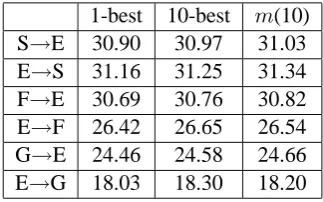
Table 4: BLEU scores (case-insensitive) on the Europarl data. “S” denotes Spanish, “E” denotes English, “F” denotes French, “G” denotes Ger-man.
task. 2 Table 3 shows the statistics of the train-ing data. There are four languages (Spanish, French, German, and English) and six transla-tion directransla-tions (Foreign-to-English and English-to-Foreign). We used the “dev2006” data in the “dev” directory as the development set and the “test2006” data in the “devtest” directory as the test set. Both the development and test sets contain 2,000 sentences with single reference translations. We tokenized and lowercased all the training, development, and test data. We trained a 4-gram language model using SRI Language Modeling Toolkit on the target side of the training corpus for each task. We ran GIZA++ on the entire train-ing data to obtainn-best alignments and weighted matrices. To save time, we just used the first 100K sentences of each aligned training corpus to ex-tract phrase pairs.
2
[image:8.595.335.497.316.417.2]Table 4 lists the case-insensitive BLEU scores of 1-best, 10-best, and m(10) on the Europarl data. Using weighted packed matrices continued to show advantage over using 1-best alignments on multiple language pairs. However, these improve-ments were very small and not significant. We at-tribute this to the fact that GIZA++ usually pro-duces high quality 1-best alignments for closely-related European language pairs, especially when trained on millions of sentences.
6 Related Work
Recent studies has shown that SMT systems can benefit from making the annotation pipeline wider: using packed forests instead of 1-best trees (Mi et al., 2008), word lattices instead of 1-best segmentations (Dyer et al., 2008), and n-best alignments instead of 1-best alignments (Venu-gopal et al., 2008). We propose a compact repre-sentation of multiple word alignments that enables SMT systems to make a better use of noisy align-ments.
Matusov et al. (2004) propose “cost matrices” for producing symmetric alignments. Kumar et al. (2007) describe how to use “posterior probabil-ity matrices” to improve alignment accuracy via a bridge language. Although not using the term ”weighted matrices” directly, they both assign a probability to each word pair.
We follow Och and Ney (2004) to develop a new phrase extraction algorithm for weighted alignment matrices. The methods for calculating relative frequencies (Och and Ney, 2004) and lex-ical weights (Koehn et al., 2003) are also adapted for the weighted matrix case.
Many researchers (e.g., (Venugopal et al., 2003; Deng et al., 2008)) observe that softening the alignment consistency constraint help improve translation quality. For example, Deng et al. (2008) define a feature named “within phrase pair consistency ratio” to measure the degree of consis-tency. As each link is associated with a probability in a weighted matrix, we use these probabilities to evaluate the validity of a phrase pair.
We estimate the link probabilities by calculating relative frequencies overn-best lists. Niehues and Vogel (2008) propose a discriminative approach to modeling the alignment matrix directly. The dif-ference is that they assign a boolean value instead of a probability to each word pair.
7 Conclusion and Future Work
We have presented a new structure called weighted alignment matrix that encodes the alignment dis-tribution for a sentence pair. Accordingly, we de-velop new methods for extracting phrase pairs and estimating their probabilities. Our experiments show that the proposed approach achieves better translation quality over using n-best lists in less extraction time. An interesting finding is that our approach performs better than the baseline even they use the same phrase pairs.
Although our approach consistently outper-forms using 1-best alignments for varying lan-guage pairs, the improvements are comparatively small. One possible reason is that taking n-best lists as samples sometimes might change align-ment probability distributions inappropriately. A more principled solution is to directly model the weighted alignment matrices, either in a genera-tive or a discriminagenera-tive way. We believe that better estimation of alignment distributions will result in more significant improvements.
Another interesting direction is applying our ap-proach to extracting translation rules with hierar-chical structures such as hierarhierar-chical phrases (Chi-ang, 2007) and tree-to-string rules (Galley et al., 2006; Liu et al., 2006). We expect that these syntax-based systems could benefit more from our approach.
Acknowledgement
The authors were supported by Microsoft Re-search Asia Natural Language Processing Theme Program grant (2009-2010), High-Technology R&D Program (863) Project No. 2006AA010108, and National Natural Science Foundation of China Contract 60736014. Part of this work was done while Yang Liu was visiting the SMT group led by Stephan Vogel at CMU. We thank the anonymous reviewers for their insightful comments. We are also grateful to Stephan Vogel, Alon Lavie, Fran-cisco Guzman, Nguyen Bach, Andreas Zollmann, Vamshi Ambati, and Kevin Gimpel for their help-ful feedback.
References
Peter F. Brown, Stephen A. Della Pietra, Vincent J.
Della Pietra, and Robert L. Mercer. 1993. The
mathematics of statistical machine translation:
Pa-rameter estimation. Computational Linguistics,
19(2):263–311.
David Chiang. 2007. Hierarchical phrase-based trans-lation. Computational Linguistics, 33(2):201–228.
Michael Collins, Philipp Koehn, and Ivona Ku˘cerov´a. 2005. Clause restructuring for statistical machine
translation. In Proceedings of ACL 2005, pages
531–540, Ann Arbor, USA, June.
Yonggang Deng, Jia Xu, and Yuqing Gao. 2008.
Phrase table training for precision and recall: What makes a good phrase and a good phrase pair? In Proceedings of ACL/HLT 2008, pages 81–88, Columbus, Ohio, USA, June.
Christopher Dyer, Smaranda Muresan, and Philip
Resnik. 2008. Generalizing word lattice
trans-lation. In Proceedings of ACL/HLT 2008, pages
1012–1020, Columbus, Ohio, June.
Alexander Fraser and Daniel Marcu. 2007. Measur-ing word alignment quality for statistical machine translation. Computational Linguistics, Squibs and Discussions, 33(3):293–303.
Michel Galley, Jonathan Graehl, Kevin Knight, Daniel Marcu, Steve DeNeefe, Wei Wang, and Ignacio Thayer. 2006. Scalable inference and training of context-rich syntactic translation models. In Pro-ceedings of COLING/ACL 2006, pages 961–968, Sydney, Australia, July.
Philipp Koehn, Franz J. Och, and Daniel Marcu. 2003. Statistical phrase-based translation. In Proceedings of HLT/NAACL 2003, pages 127–133, Edmonton, Canada, May.
Philipp Koehn, Hieu Hoang, Alexandra Birch, Chris Callison-Burch, Marcello Federico, Nicola Bertoldi, Brooke Cowan, Wade Shen, Christine Moran, Richard Zens, Chris Dyer, Ondrej Bojar, Alexan-dra Constantin, and Evan Herbst. 2007. Moses: Open source toolkit for statistical machine transla-tion. In Proceedings of ACL 2007 (poster), pages 77–80, Prague, Czech Republic, June.
Shankar Kumar, Franz J. Och, and Wolfgang
Macherey. 2007. Improving word alignment with bridge languages. In Proceedings of EMNLP 2007, pages 42–50, Prague, Czech Republic, June.
Yang Liu, Qun Liu, and Shouxun Lin. 2005. Log-linear models for word alignment. In Proceedings of ACL 2005, pages 459–466, Ann Arbor, Michigan, June.
Yang Liu, Qun Liu, and Shouxun Lin. 2006. Tree-to-string alignment template for statistical machine translation. In Proceedings of COLING/ACL 2006, pages 609–616, Sydney, Australia, July.
Evgeny Matusov, Richard Zens, and Hermann Ney.
2004. Symmetric word alignments for statistical
machine translation. In Proceedings of COLING
2004, pages 219–225, Geneva, Switzerland, August.
Haitao Mi, Liang Huang, and Qun Liu. 2008. Forest-based translation. In Proceedings of ACL/HLT 2008, pages 192–199, Columbus, Ohio, June.
Robert C. Moore, Wen-tau Yih, and Andreas Bode.
2006. Improved discriminative bilingual word
alignment. In Proceedings of COLING/ACL 2006, pages 513–520, Sydney, Australia, July.
Jan Niehues and Stephan Vogel. 2008. Discrimina-tive word alignment via alignment matrix modeling. In Proceedings of WMT-3, pages 18–25, Columbus, Ohio, USA, June.
Franz J. Och and Hermann Ney. 2003. A systematic comparison of various statistical alignment models. Computational Linguistics, 29(1):19–51.
Franz J. Och and Hermann Ney. 2004. The alignment template approach to statistical machine translation. Computational Linguistics, 30(4):417–449.
Kishore Papineni, Salim Roukos, Todd Ward, and
Wei-Jing Zhu. 2002. Bleu: a method for automatic
evaluation of machine translation. In Proceedings of ACL 2002, pages 311–318, Philadelphia, Penn-sylvania, USA, July.
Libin Shen, Jinxi Xu, and Ralph Weischedel. 2008. A new string-to-dependency machine translation al-gorithm with a target dependency language model. In Proceedings of ACL/HLT 2008, pages 577–585, Columbus, Ohio, June.
Andreas Stolcke. 2002. Srilm - an extension language model modeling toolkit. In Proceedings of ICSLP 2002, pages 901–904, Denver, Colorado, Septem-ber.
Ben Taskar, Simon Lacoste-Julien, and Dan Klein. 2005. A discriminative matching approach to word alignment. In Proceedings of HLT/EMNLP 2005, pages 73–80, Vancouver, British Columbia, Canada, October.
Ashish Venugopal, Stephan Vogel, and Alex Waibel. 2003. Effective phrase translation extraction from
alignment models. In Proceedings of ACL 2003,
pages 319–326, Sapporo, Japan, July.
Ashish Venugopal, Andreas Zollmann, Noah A. Smith,
and Stephan Vogel. 2008. Wider pipelines:
n-best alignments and parses in mt training. In Pro-ceedings of AMTA 2008, pages 192–201, Waikiki, Hawaii, October.
Stephan Vogel and Hermann Ney. 1996. Hmm-based
word alignment in statistical translation. In