HMM Word and Phrase Alignment for Statistical Machine Translation
Yonggang Deng1 , William Byrne1,2
Center for Language and Speech Processing, Johns Hopkins University Baltimore, MD 21210, USA1
Machine Intelligence Lab, Cambridge University Engineering Department Trumpington Street, Cambridge CB2 1PZ, UK2
[email protected] , [email protected]
Abstract
HMM-based models are developed for the alignment of words and phrases in bitext. The models are formulated so that align-ment and parameter estimation can be per-formed efficiently. We find that Chinese-English word alignment performance is comparable to that of IBM Model-4 even over large training bitexts. Phrase pairs extracted from word alignments generated under the model can also be used for phrase-based translation, and in Chinese to English and Arabic to English transla-tion, performance is comparable to sys-tems based on Model-4 alignments. Di-rect phrase pair induction under the model is described and shown to improve trans-lation performance.
1 Introduction
Describing word alignment is one of the fundamen-tal goals of Statistical Machine Translation (SMT). Alignment specifies how word order changes when a sentence is translated into another language, and given a sentence and its translation, alignment spec-ifies translation at the word level. It is straightfor-ward to extend word alignment to phrase alignment: two phrases align if their words align.
Deriving phrase pairs from word alignments is now widely used in phrase-based SMT. Parameters of a statistical word alignment model are estimated from bitext, and the model is used to generate word alignments over the same bitext. Phrase pairs are ex-tracted from the aligned bitext and used in the SMT system. With this approach the quality of the under-lying word alignments can have a strong influence
on phrase-based SMT system performance. The common practice therefore is to extract phrase pairs from the best attainable word alignments. Currently, Model-4 alignments (Brown and others, 1993) as produced by GIZA++ (Och and Ney, 2000) are often the best that can be obtained, especially with large bitexts.
Despite its modeling power and widespread use, Model-4 has shortcomings. Its formulation is such that maximum likelihood parameter estimation and bitext alignment are implemented by approximate, hill-climbing, methods. Consequently parameter es-timation can be slow, memory intensive, and diffi-cult to parallelize. It is also diffidiffi-cult to compute statistics under Model-4. This limits its usefulness for modeling tasks other than the generation of word alignments.
We describe an HMM alignment model devel-oped as an alternative to Model-4. In the word align-ment and phrase-based translation experialign-ments to be presented, its performance is comparable or im-proved relative to Model-4. Practically, we can train the model by the Forward-Backward algorithm, and by parallelizing estimation, we can control memory usage, reduce the time needed for training, and in-crease the bitext used for training. We can also com-pute statistics under the model in ways not practical with Model-4, and we show the value of this in the extraction of phrase pairs from bitext.
2 HMM Word and Phrase Alignment Our goal is to develop a generative probabilistic model of Word-to-Phrase (WtoP) alignment. We start with anl-word source sentencee=el
1, and an
m-word target sentence f = fm
1 , which is realized
as a sequence ofKphrases: f =vK
1 .
Each phrase is generated as a translation of one source word, which is determined by the alignment sequenceaK
1 :eak →vk. The length of each phrase
is specified by the processφK1 , which is constrained so thatPK
k=1φk=m.
We also allow target phrases to be inserted, i.e. to be generated by a NULL source word. For this, we define a binary hallucination sequencehK
1 : ifhk=
0, then NULL→vk; ifhk= 1theneak →vk.
With all these quantities gathered into an align-menta= (φK
1 , aK1 , hK1 , K), the modeling objective
is to realize the conditional distribution P(f,a|e).
With the assumption thatP(f,a|e) = 0iff 6=vK
1 ,
we writeP(f,a|e) =P(vK
1 , K, aK1 , hK1 , φK1 |e)and
P(vK1 , K, aK1 , hK1 , φK1 |e) =ǫ(m|l)×P(K|m,e)
×P(aK1 , φK1 , hK1 |K, m,e)
×P(v1K|a1K, hK1 , φK1 , K, m,e)
We now describe the component distributions.
Sentence Length ǫ(m|l) determines the target sentence length. It is not needed during alignment, where sentence lengths are known, and is ignored.
Phrase Count P(K|m,e)specifies the number of
target phrases. We use a simple, single parameter distribution, withη = 8.0throughout
P(K|m,e) =P(K|m, l)∝ηK
Word-to-Phrase Alignment Alignment is a Markov process that specifies the lengths of phrases and their alignment with source words
P(aK1 , hK1 , φK1 |K, m,e)
=
K
Y
k=1
P(ak, hk, φk|ak−1, φk−1,e)
=
K
Y
k=1
p(ak|ak−1, hk;l)d(hk)n(φk;eak)
The actual word-to-phrase alignment (ak) is a first-order Markov process, as in HMM-based word-to-word alignment (Vogel et al., 1996). It necessarily
depends on the hallucination variable
p(aj|aj−1, hj;l)
=
1 aj =aj−1, hj = 0
0 aj 6=aj−1, hj = 0
a(aj|aj−1;l) hj = 1
This formulation allows target phrases to be in-serted without disrupting the Markov dependencies of phrases aligned to actual source words.
The phrase length modeln(φ;e)gives the proba-bility that a wordeproduces a phrase withφwords in the target language; n(φ;e) is defined for φ = 1,· · · , N. The hallucination process is a simple i.i.d. process, whered(0) =p0, andd(1) = 1−p0.
Word-to-Phrase Translation The translation of words to phrases is given as
P(vK1 |aK1 , hK1 , φK1 , K, m,e) =
K
Y
k=1
p(vk|eak, hk, φk)
We introduce the notation vk = vk[1], . . . , vk[φk] and a dummy variablexk(for phrase insertion) :
xk=
eak hk= 1
NULL hk= 0
We define two models of word-to-phrase translation. This simplest is based on context-independent word-to-word translation
p(vk|eak, hk, φk) =
φk
Y
j=1
t(vk[j]|xk)
We also define a model that captures foreign word context with bigram translation probabilities
p(vk|eak, hk, φk)
=t(vk[1]|xk) φk
Y
j=2
t2(vk[j]|vk[j−1], xk)
Here,t(f|e)is the usual context independent word-to-word translation probability. The bigram trans-lation probabilityt2(f|f′, e)specifies the likelihood
2.1 Properties of the Model and Prior Work
The formulation of the WtoP alignment model was motivated by both the HMM word alignment model (Vogel et al., 1996) and IBM Model-4 with the goal of building on the strengths of each.
The relationship with the word-to-word HMM alignment model is straightforward. For example, constraining the phrase length component n(φ;e)
to permit only phrases of one word would give a word-to-word HMM alignment model. The exten-sions introduced are the phrase count, and the phrase length models, and the bigram translation distribu-tion. The hallucination process is motivated by the use of NULL alignments into Markov alignment models as done by (Och and Ney, 2003).
The phrase length model is motivated by Toutanova et al. (2002) who introduced ‘stay’ prob-abilities in HMM alignment as an alternative to word fertility. By comparison, Word-to-Phrase HMM alignment models contain detailed models of state occupancy, motivated by the IBM fertility model, which are more powerful than a single staying pa-rameter. In fact, the WtoP model is a segmental Hidden Markov Model (Ostendorf et al., 1996), in which states emit observation sequences.
Comparison with Model-4 is less straightforward. The main features of Model-4 are NULL source words, source word fertility, and the distortion model. The WtoP alignment model includes the first two of these. However distortion, which al-lows hypothesized words to be distributed through-out the target sentence, is difficult to incorporate into a model that supports efficient DP-based search. We preserve efficiency in the WtoP model by insisting that target words form connected phrases; this is not as general as Model-4 distortion. This weakness is somewhat offset by a more powerful (Markov) alignment process as well as by the phrase count distribution. Despite these differences, the WtoP alignment model and Model-4 allow similar align-ments. For example, in Fig. 1, Model-4 would allow
f
e
f
e
f f
1 2 1 2
1 2 3 4
Figure 1: Word-to-Word and Word-to-Phrase Links
f1,f3, andf4 to be generated bye1 with a fertility
of 3. Under the WtoP model,e1 could generatef1
andf3f4 with phrase lengths 1 and 2, respectively:
source words can generate more than one phrase. This alignment could also be generated via four single word foreign phrases. The balance between word-to-word and word-to-phrase alignments is set by the phrase count distribution parameter η. As
η increases, alignments with shorter phrases are favored, and for very large η the model allows only word-to-word alignments (see Fig. 2). Al-though the WtoP alignment model is more com-plex than the word-to-word HMM alignment model, the Baum-Welch and Viterbi algorithms can still be used. Word-to-word alignments are generated by the Viterbi algorithm: aˆ = argmax
aP(f,a|e); if
eak →vk,eak is linked to all the words invk.
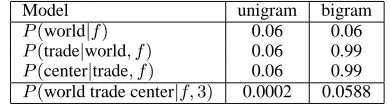
The bigram translation probability relies on word context, known to be helpful in translation (Berger et al., 1996), to improve the identification of tar-get phrases. As an example,f is the Chinese word for “world trade center”. Table 1 shows how the likelihood of the correct English phrase is improved with bigram translation probabilities; this example is from the C→E, N=4 system of Table 2.
Model unigram bigram
P(world|f) 0.06 0.06
P(trade|world, f) 0.06 0.99
P(center|trade, f) 0.06 0.99
[image:3.612.328.523.406.458.2]P(world trade center|f,3) 0.0002 0.0588
Table 1: Context in Bigram Phrase Translation.
There are of course much prior work in translation that incorporates phrases. Sumita et al. (2004) de-velop a model of phrase-to-phrase alignment, which while based on HMM alignment process, appears to be deficient. Marcu and Wong (2002) propose a model to learn lexical correspondences at the phrase level. To our knowledge, ours is the first non-syntactic model of bitext alignment (as opposed to translation) that links words and phrases.
Baum-Welch parameter estimation. We show the forward recursion as an example.
Given a sentence pair(el
1, f1m), the forward
prob-ability αj(i, φ)is defined as the probability of gen-erating the first j target words with the added con-dition that the target words fj−φj +1 form a phrase aligned to source wordei. It can be calculated recur-sively (omitting the hallucination process, for sim-plicity) as
αj(i, φ) =
n X
i′,φ′
αj−φ(i′, φ′)a(i|i′, l)
o
·η
·n(φ;ei)·t(fj−φ+1|ei) · j
Y
j′=j−φ+2
t2(fj′|ei)
This recursion is over a trellis ofl(N+ 1)mnodes. Models are trained from a flat-start. We begin with 10 iterations of EM to train Model-1, followed by 5 EM iterations to train Model-2 (Brown and oth-ers, 1993). We initialize the parameters of the word-to-word HMM alignment model by collecting word alignment counts from the Model-2 Viterbi align-ments, and refine the word-to-word HMM alignment model by 5 iterations of the Baum-Welch algorithm. We increase the order of the WtoP model (N) from 2 to the final value in increments of 1, by perform-ing 5 Baum Welch iterations at each step. At the fi-nal value ofN, we introduce the bigram translation probability; we use Witten-Bell smoothing (1991) as a backoff strategy fort2, and other strategies are
possible.
4 Bitext Word Alignment
We now investigate bitext word alignment perfor-mance. We start with the FBIS Chinese/English parallel corpus which consists of approx. 10M En-glish/7.5M Chinese words. The Chinese side of the corpus is segmented into words by the LDC seg-menter1. The alignment test set consists of 124 sen-tences from the NIST 2001 dry-run MT-eval2set that are manually word aligned.
We first analyze the distribution of word links within these manual alignments. Of the Chinese words which are aligned to more than one English words, 82% of these words align with consecutive
1
http://www.ldc.upenn.edu/Projects/Chinese 2http://www.nist.gov/speech/tests/mt
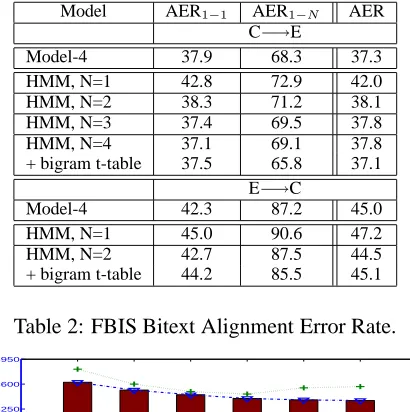
Model AER1−1 AER1−N AER
C−→E
Model-4 37.9 68.3 37.3
HMM, N=1 42.8 72.9 42.0
HMM, N=2 38.3 71.2 38.1
HMM, N=3 37.4 69.5 37.8
HMM, N=4 37.1 69.1 37.8
+ bigram t-table 37.5 65.8 37.1
E−→C
Model-4 42.3 87.2 45.0
HMM, N=1 45.0 90.6 47.2
HMM, N=2 42.7 87.5 44.5
[image:4.612.324.529.54.260.2]+ bigram t-table 44.2 85.5 45.1
Table 2: FBIS Bitext Alignment Error Rate.
2 4 6 8 10 12
1500 1850 2200 2550 2900 3250 3600 3950
η
# of hypothesized links
0 2 4 6 8 10 12 1426
28 30 32 34 36 38 40
Overall AER
η
1−1 Links 1−N Links Total Links Overall AER
Figure 2: Balancing Word and Phrase Alignments
English words (phrases). In the other direction, among all English words which are aligned to mul-tiple Chinese words, 88% of these align to Chinese phrases. In this collection, at least, word-to-phrase alignments are plentiful.
Alignment performance is measured by the Alignment Error Rate (AER) (Och and Ney, 2003)
AER(B;B′) = 1−2× |B∩B′|/(|B′|+|B|)
whereBis a set reference word links, andB′are the word links generated automatically.
AER gives a general measure of word alignment quality. We are also interested in how the model performs over the word-to-word and word-to-phrase alignments it supports. We split the reference align-ments into two subsets: B1−1 contains
word-to-word reference links (e.g. 1→1 in Fig 1); and
B1−N contains word-to-phrase reference links (e.g. 1→3, 1→4 in Fig 1); The automatic alignment B′ is partitioned similarly. We define additional AERs:
AER1−1 = AER(B1−1, B1′−1), and AER1−N =
AER(B1−N, B1′−N), which measure word-to-word and word-to-phrase alignment, separately.
the WtoP alignment models trained as described in Section 3. GIZA++ Model 4 alignment performance is also presented for comparison. We note first that the word-to-word HMM (N=1) alignment model is worse than Model 4, as expected. For the WtoP models in the C→E direction, we see reduced AER for phrases lengths up to 4, although in the E→C di-rection, AER is reduced only for phrases of length 2; performance forN >2is not reported.
In introducing the bigram phrase translation (the bigram t-table), there is a tradeoff between word-to-word and word-to-phrase alignment quality. As mentioned, the bigram t-table increases the likeli-hood of word-to-phrase alignments. In both transla-tion directransla-tions, this reduces the AER1−N. However, it also causes increases in AER1−1, primarily due to
a drop in recall: fewer word-to-word alignments are produced. For C→E, this is not severe enough to cause an overall AER increase; however, in E→C, AER does increase.
Fig. 2 (C→E, N=4) shows how the 1 and 1-N alignment behavior is balanced by the phrase count parameter. As η increases, the model favors alignments with more word-to-word links and fewer word-to-phrase links; the overall Alignment Error Rate (AER) suggests a good balance atη= 8.0.
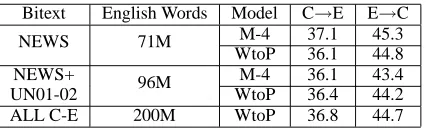
After observing that the WtoP model performs as well as Model-4 over the FBIS C-E bitext, we inves-tigated performance over these large bitexts : - “NEWS” containing non-UN parallel Chi-nese/English corpora from LDC (mainly FBIS, Xin-hua, Hong Kong, Sinorama, and Chinese Treebank). - “NEWS+UN01-02” also including UN parallel corpora from the years 2001 and 2002.
- “ALL C-E” refers to all the C-E bitext available from LDC as of his submission; this consists of the NEWS corpora with the UN bitext from all years.
Over all these collections, WtoP alignment per-formance (Table 3) is comparable to that of Model-4. We do note a small degradation in the E→C WtoP alignments. It is quite possible that this one-to-many model suffers slightly with English as the source and Chinese as the target, since English sentences tend to be longer. Notably, simply increasing the amount of bitext used in training need not improve AER. How-ever, larger aligned bitexts can give improved phrase pair coverage of the test set.
One of the desirable features of HMMs is that the
Bitext English Words Model C→E E→C
M-4 37.1 45.3
NEWS 71M
WtoP 36.1 44.8
NEWS+ M-4 36.1 43.4
UN01-02 96M WtoP 36.4 44.2
[image:5.612.322.535.53.117.2]ALL C-E 200M WtoP 36.8 44.7
Table 3: AER Over Large C-E Bitexts.
Forward-Backward steps can be run in parallel: bi-text is partitioned; the Forward-Backward algorithm is run over the subsets on different CPUs; statistics are merged to reestimate model parameters. Parti-tioning the bitext also reduces the memory usage, since different cooccurrence tables can be kept for each partition. With the “ALL C-E” bitext collec-tion, a single set of WtoP models (C→E, N=4, bi-gram t-table) can be trained over 200M words of Chinese-English bitext by splitting training over 40 CPUs; each Forward-Backward process takes less than 2GB of memory and the training run finishes in five days. By contrast, the 96M English word NEWS+UN01-02 is about the largest C-E bitext over which we can train Model-4 with our GIZA++ configuration and computing infrastructure.
Based on these and other experiments, in this pa-per we set a maximum value ofN = 4for F→E; in E→F, we set N=2 and omit the bigram phrase trans-lation probability; η is set to 8.0. We do not claim that this is optimal, however.
5 Phrase Pair Induction
A common approach to phrase-based translation is to extract an inventory of phrase pairs (PPI) from bi-text (Koehn et al., 2003), For example, in the phrase-extract algorithm (Och, 2002), a word alignment
ˆ am
1 is generated over the bitext, and all word
sub-sequencesei2
i1 andf
j2
j1 are found that satisfy :
ˆ
am1 : ˆaj ∈[i1, i2]iffj∈[j1, j2]. (1)
The PPI comprises all such phrase pairs(ei2
i1, f
j2
j1).
The process can be stated slightly differently. First, we define a set of alignments :
A(i1, i2;j1, j2) ={am1 :aj ∈[i1, i2]iffj∈[j1, j2]}.
If aˆm
1 ∈ A(i1, i2;j1, j2) then (eii21, f
j2
j1) form a
phrase pair.
the selection of phrase pairs need not be based on a single alignment. Rather than simply accepting a phrase pair(ei2
i1, f
j2
j1)if the unique MAP alignment
satisfies Equation 1, we can assign a probability to phrases occurring as translation pairs :
P(f, A(i1, i2;j1, j2)|e) = X
a:am
1 ∈A(i1,i2;j1,j2) P(f,a|e)
For a fixed set of indices i1, i2, j1, j2, the
quan-tityP(f, A(i1, i2;j1, j2)|e)can be computed
effi-ciently using a modified Forward algorithm. Since
P(f|e) can also be computed by the Forward
al-gorithm, the phrase-to-phrase posterior distribution
P(A(i1, i2;j1, j2)|f,e)is easily found.
PPI Induction Strategies In the phrase-extract algorithm (Och, 2002), the alignment ˆa is gener-ated as follows: Model-4 is trained in both directions (e.g. F→E and E→F); two sets of word alignments are generated by the Viterbi algorithm for each set of models; and the two alignments are merged. This forms a static aligned bitext. Next, all foreign word sequences up to a given length (here, 5 words) are extracted from the test set. For each of these, a phrase pair is added to the PPI if the foreign phrase can be found aligned to an English phrase under Eq 1. We refer to the result as the Model-4 Viterbi Phrase-Extract PPI.
Constructed in this way, the PPI is limited to phrase pairs which can be found in the Viterbi align-ments. Some foreign phrases which do appear in the training bitext will not be included in the PPI because suitable English phrases cannot be found. To add these to the PPI we can use the phrase-to-phrase posterior distribution to find English phrase-to-phrases as candidate translations. This adds phrases to the Viterbi Phrase-Extract PPI and increase the test set coverage. A somewhat ad hoc PPI Augmentation algorithm is given to the right.
Condition (A) extracts phrase pairs based on the geometric mean of the E→F and F→E posteriors (Tg = 0.01 throughout). The threshold Tp selects additional phrase pairs under a more forgiving crite-rion: asTp decreases, more phrase pairs are added and PPI coverage increases. Note that this algorithm is constructed specifically to improve a Viterbi PPI; it is certainly not the only way to extract phrase pairs under the phrase-to-phrase posterior distribution.
Once the PPI phrase pairs are set, the phrase trans-lation probabilities are set based on the number of times each phrase pair is extracted from a sentence pair, i.e. from relative frequencies.
For each foreign phrasevnot in the Viterbi PPI : For all pairs(f1m, el1)andj1, j2 s.t.fjj12 =v:
For1≤i1≤i2 ≤l, find
f(i1, i2) =PF→E(A(i1, i2;j1, j2)|el1, f1m)
b(i1, i2) =PE→F(A(i1, i2;j1, j2)|el1, f1m)
g(i1, i2) =
p
f(11, i2)b(i1, i2)
(ˆi1,ˆi2) = argmax 1≤i1,i2≤l
g(i1, i2), and setu=eˆˆii2 1
Add(u, v)to the PPI if any of A, B, or C hold :
b(ˆi1,ˆi2)≥Tgandf(ˆi1,ˆi2)≥Tg (A)
b(ˆi1,ˆi2)< Tgandf(ˆi1,ˆi2)> Tp (B)
f(ˆi1,ˆi2)< Tgandb(ˆi1,ˆi2)> Tp (C)
PPI Augmentation via Phrase-Posterior Induction
HMM-based models are often used if posterior distributions are needed. Model-1 can also be used in this way (Venugopal et al., 2003), although it is a relatively weak alignment model. By comparison, finding posterior distributions under Model-4 is dif-ficult. The Word-to-Phrase alignment model appears not to suffer this tradeoff: it is a good model of word alignment under which statistics such as the phrase-to-phrase posterior can be calculated.
6 Translation Experiments
We evaluate the quality of phrase pairs extracted from the bitext through the translation performance of the Translation Template Model (TTM) (Kumar et al., 2005), which is a phrase-based translation sys-tem implemented using weighted finite state trans-ducers. Performance is measured by BLEU (Pap-ineni and others, 2001).
Chinese→English Translation We report
perfor-mance on the NIST Chinese/English 2002, 2003 and 2004 (News only) MT evaluation sets. These consist of 878, 919, and 901 sentences, respectively. Each Chinese sentence has 4 reference translations.
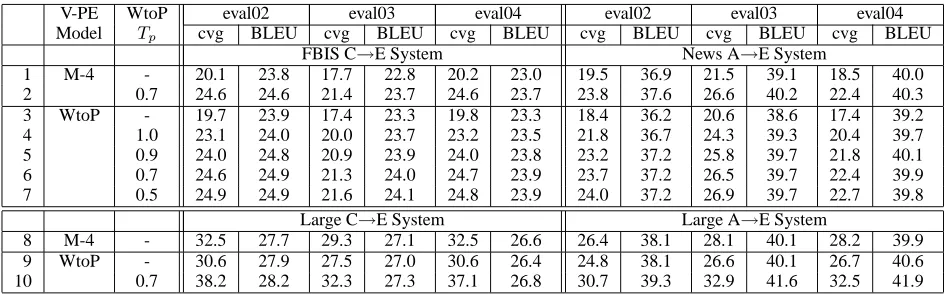
V-PE WtoP eval02 eval03 eval04 eval02 eval03 eval04
Model Tp cvg BLEU cvg BLEU cvg BLEU cvg BLEU cvg BLEU cvg BLEU
FBIS C→E System News A→E System
1 M-4 - 20.1 23.8 17.7 22.8 20.2 23.0 19.5 36.9 21.5 39.1 18.5 40.0
2 0.7 24.6 24.6 21.4 23.7 24.6 23.7 23.8 37.6 26.6 40.2 22.4 40.3
3 WtoP - 19.7 23.9 17.4 23.3 19.8 23.3 18.4 36.2 20.6 38.6 17.4 39.2
4 1.0 23.1 24.0 20.0 23.7 23.2 23.5 21.8 36.7 24.3 39.3 20.4 39.7
5 0.9 24.0 24.8 20.9 23.9 24.0 23.8 23.2 37.2 25.8 39.7 21.8 40.1
6 0.7 24.6 24.9 21.3 24.0 24.7 23.9 23.7 37.2 26.5 39.7 22.4 39.9
7 0.5 24.9 24.9 21.6 24.1 24.8 23.9 24.0 37.2 26.9 39.7 22.7 39.8
Large C→E System Large A→E System
8 M-4 - 32.5 27.7 29.3 27.1 32.5 26.6 26.4 38.1 28.1 40.1 28.2 39.9
9 WtoP - 30.6 27.9 27.5 27.0 30.6 26.4 24.8 38.1 26.6 40.1 26.7 40.6
[image:7.612.71.543.54.201.2]10 0.7 38.2 28.2 32.3 27.3 37.1 26.8 30.7 39.3 32.9 41.6 32.5 41.9
Table 4: Translation Analysis and Performance of PPI Extraction Procedures
words taken from the English side of the bitext; all language models are built with the SRILM toolkit using Kneser-Ney smoothing (Stolcke, 2002).
The larger system is based on alignments gener-ated over all available C-E bitext (the “ALL C-E” collection of Section 4). The language model is an equal-weight interpolated trigram model trained over 373M English words taken from the English side of the bitext and the LDC Gigaword corpus.
Arabic→English Translation We also evaluate our
WtoP alignment models in Arabic-English transla-tion. We report results on a small and a large system. In each, Arabic text is tokenized by the Buckwalter analyzer provided by LDC. We test our models on NIST Arabic/English 2002, 2003 and 2004 (News only) MT evaluation sets that consists of 1043, 663 and 707 Arabic sentences, respectively. Each Arabic sentence has 4 reference translations.
In the small system, the training bitext is from A-E News parallel text, with∼3.5M words on the English side. We follow the same training proce-dure and configurations as in Chinese/English sys-tem in both translation directions. The language model is an equal-weight interpolated trigram built over∼400M words from the English side of the bi-text, including UN bi-text, and the LDC English Gi-gaword collection. The large Arabic/English system employs the same language model. Alignments are generated over all A-E bitext available from LDC as of this submission; this consists of approx. 130M words on the English side.
WtoP Model and Model-4 Comparison We first
look at translation performance of the small A→E
and C→E systems, where alignment models are trained over the smaller bitext collections. The base-line systems (Table 4, base-line 1) are based on Model-4 Viterbi Phrase-Extract PPIs.
We compare WtoP alignments directly to Model-4 alignments by extracting PPIs from the WtoP alignments using the Viterbi Phrase-Extract proce-dure (Table 4, line 3). In C→E translation, perfor-mance is comparable to that of Model-4; in A→E translation, performance lags slightly. As we add phrase pairs to the WtoP Viterbi Phrase-Extract PPI via the Phrase-Posterior Augmentation procedure (Table 4, lines 4-7), we obtain a∼1% improvement in BLEU; the value ofTp = 0.7gives improvements across all sets. In C→E translation, this yields good gains relative to Model-4, while in A→E we match or improve the Model-4 performance.
The performance gains through PPI augmentation are consistent with increased PPI coverage of the test set. We tabulate the percentage of test set phrases that appear in each of the PPIs (the ‘cvg’ values in Table 4). The augmentation scheme is designed specifically to increase coverage, and we find that BLEU score improvements track the phrase cover-age of the test set. This is further confirmed by the experiment of Table 4, line 2 in which we take the PPI extracted from Model-4 Viterbi alignments, and add phrase pairs to it using the Phrase-Posterior aug-mentation scheme withTp = 0.7. We find that the augmentation scheme under the WtoP models can be used to improve the Model-4 PPI itself.
Performance of systems based on Model-4 Viterbi Phrase-Extract PPIs is shown in Table 4, line 8. To train Model-4 using GIZA++, we split the bi-texts into two (A-E) or three (C-E) partitions, and train models for each division separately; we find that memory usage is otherwise too great. These serve as a single set of alignments for the bitext, as if they had been generated under a single align-ment model. When we translate with Viterbi Phrase-Extract PPIs taken from WtoP alignments created over all available bitext, we find comparable perfor-mance to the Model-4 baseline (Table 4, line 9). Us-ing the Phrase-Posterior augmentation scheme with
Tp = 0.7yields further improvement (Table 4, line 10). Pooling the sets to form two large C→E and A→E test sets, the A→E system improvements are significant at a 95% level (Och, 2003); the C→E sys-tems are only equivalent.
7 Conclusion
We have described word-to-phrase alignment mod-els capable of good quality bitext word alignment. In Arabic-English and Chinese-English translation and alignment they compare well to Model-4, even with large bitexts. The model architecture was in-spired by features of Model-4, such as fertility and distortion, but care was taken to ensure that dy-namic programming procedures, such as EM and Viterbi alignment, could still be performed. There is practical value in this: training and alignment are easily parallelized. Working with HMMs also makes it straightforward to explore new modeling approaches. We show an augmentation scheme that adds to phrases extracted from Viterbi alignments; this improves translation with both the WtoP and the Model-4 phrase pairs, even though it would be infea-sible to implement the scheme under Model-4 itself. We note that these models are still relatively simple, and we anticipate further alignment and translation improvement as the models are refined.
Acknowledgments The TTM translation system was provided by Shankar Kumar. This work was funded by ONR MURI Grant N00014-01-1-0685.
References
A. L. Berger, S. Della Pietra, and V. J. Della Pietra. 1996. A maximum entropy approach to natural language pro-cessing. Computational Linguistics, 22(1):39–71.
P. F. Brown et al. 1993. The mathematics of machine translation: Parameter estimation. Computational
Lin-guistics, 19:263–312.
P. Koehn, F. Och, and D. Marcu. 2003. Statistical phrase-based translation. In Proc. of HLT-NAACL.
S. Kumar, Y. Deng, and W. Byrne. 2005. A weighted fi-nite state transducer translation template model for sta-tistical machine translation. Journal of Natural
Lan-guage Engineering, 11(3).
D. Marcu and W. Wong. 2002. A phrase-based, joint probability model for statistical machine translation. In Proc. of EMNLP.
F. Och and H. Ney. 2000. Improved statistical alignment models. In Proc. of ACL, Hong Kong, China.
F. J. Och and H. Ney. 2003. A systematic comparison of various statistical alignment models. Computational
Linguistics, 29(1):19–51.
F. Och. 2002. Statistical Machine Translation: From
Single Word Models to Alignment Templates. Ph.D.
thesis, RWTH Aachen, Germany.
F. Och. 2003. Minimum error rate training in statistical machine translation. In Proc. of ACL.
M. Ostendorf, V. Digalakis, and O. Kimball. 1996. From HMMs to segment models: a unified view of stochas-tic modeling for speech recognition. IEEE Trans. Acoustics, Speech and Signal Processing, 4:360–378.
K. Papineni et al. 2001. BLEU: a method for automatic evaluation of machine translation. Technical Report RC22176 (W0109-022), IBM Research Division.
A. Stolcke. 2002. SRILM – an extensible language mod-eling toolkit. In Proc. ICSLP.
E. Sumita et al. 2004. EBMT, SMT, Hybrid and More: ATR spoken language translation system. In Proc.
of the International Workshop on Spoken Language Translation, Kyoto, Japan.
K. Toutanova, H. T. Ilhan, and C. Manning. 2002. Exten-tions to HMM-based statistical word alignment mod-els. In Proc. of EMNLP.
A. Venugopal, S. Vogel, and A. Waibel. 2003. Effective phrase translation extraction from alignment models. In Proc. of ACL.
S. Vogel, H. Ney, and C. Tillmann. 1996. HMM based word alignment in statistical translation. In Proc. of
the COLING.
I. H. Witten and T. C. Bell. 1991. The zero-frequency problem: Estimating the probabilities of novel events in adaptive text compression. In IEEE Trans. Inform