Improved Alignment Models for Statistical Machine Translation
F r a n z J o s e f O c h , C h r i s t o p h T i l l m a n n , a n d H e r m a n n N e y L e h r s t u h l fiir I n f o r m a t i k VI
R W T H A a c h e n - University of T e c h n o l o g y Ahornstrafie 55; 52056 Aachen; GERMANY
{och,
t illmann, ney}@inf ormat ik. rwth-aachen, deA b s t r a c t
In this paper, we describe improved alignment models for statistical machine translation. The statistical translation approach uses two types of information: a translation model and a lan- guage model. The language model used is a bigram or general m-gram model. The transla- tion model is decomposed into a lexical and an alignment model. We describe two different ap- proaches for statistical translation and present experimental results. The first approach is based on dependencies between single words, the second approach explicitly takes shallow phrase structures into account, using two differ- ent alignment levels: a phrase level alignment between phrases and a word level alignment between single words. We present results us- ing the Verbmobil task (German-English, 6000- word vocabulary) which is a limited-domain spoken-language task. The experimental tests were performed on both the text transcription and the speech recognizer output.
1 S t a t i s t i c a l M a c h i n e T r a n s l a t i o n
The goal of machine translation is the transla- tion of a text given in some source language into a target language. We are given a source string
f / = fl...fj...fJ,
which is to be translated into a target string e{ = el...ei...ex. Among all possi- ble target strings, we will choose the string with the highest probability:= a r g m a x
{Pr(ezIlflJ)}
e 1= a r g m a x
{Pr(e[). Pr(f/le~) }
• (1)The argmax operation denotes the search prob- lem, i.e. the generation of the o u t p u t sentence in the target language.
Pr(e{)
is thelanguage
model
of the target language, whereasPr (ff~lel I)
is the
translation model.
Many statistical translation models (Vogel et al., 1996; Tillmann et al., 1997; Niessen et al., 1998; Brown et al., 1993) try to model word-to- word correspondences between source and tar- get words. The model is often further restricted that each source word is assigned
exactly one
target word. These alignment models are sire- ilar to the concept of Hidden Markov models (HMM) in speech recognition. The alignment mapping is j ~ i =aj
from source position j to target position i =aj.
The use of this align- ment model raises major problems as it fails to capture dependencies between groups of words. As experiments have shown it is difficult to han- dle different word order and the translation of c o m p o u n d nouns•2 S i n g l e - W o r d B a s e d A p p r o a c h 2.1 B a s i c A p p r o a c h
In this section, we shortly review a translation approach based on the so-called
monotonicity
requirement (Tillmann et al., 1997). Our aim is to provide a basis for comparing the two differ- ent translation approaches presented.
In Eq. (1),
Pr(e~)
is the language model, which is a trigram language model in this case. For the translation modelPr(flJ[e{)
we make the assumption t h a t each source word is aligned to exactly one target word (a relaxation of this assumption is described in section 2.2). For our model, the probability of alignmentaj
for position j depends on the previous alignment position a j - 1 (Vogel et al., 1996). Using this assumption, there are two types of probabil- ities: the alignment probabilities denoted byp(aj
[aj-1) and the lexicon probabilities denoted byp(fj[ea~).
T h e string translation probability can be re-written:Pr(flJ[elI) = E H [p(ajlaj_l)'p(fj[ea~)]
a~
For the training of the above model parame- ters, we use the m a x i m u m likelihood criterion in the so-called m a x i m u m approximation. W h e n aligning the words in parallel texts (for Indo- E u r o p e a n lar~guage pairs like Spanish-English, French-English, Italian-German,...), we typi- cally observe a strong localization effect. In many cases, although not always, there is an even stronger restriction: over large portions of the source string, the alignment is mono- tone. In this approach, we first assume that the alignments satisfy the
monotonicity
require- ment. Within the translation search, we will in- troduce suitably restricted permutations of the source string, to satisfy this requirement. For the alignment model, the monotonicity property allows only transitions from a j - 1to
a j with a j u m p width5:5 _-- a s
-- a j - 1 C{0,
1, 2}. Theses j u m p s correspond to the following three cases(5 = 0, 1,2):
• 5 ---- 0 (horizontal transition = alignment
repetition): This case corresponds to a tar- get word with two or more aligned source words.
• 5 = 1 (forward transition = regular align- ment): This case is the regular one: a single
new target word is generated.
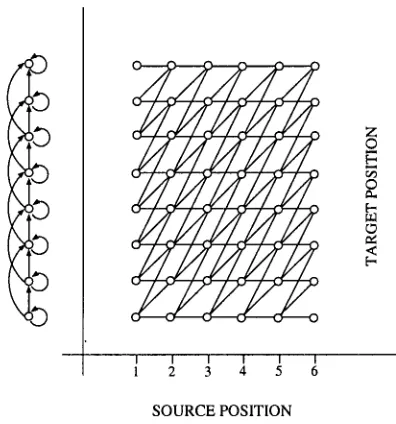
• 5 = 2 (skip transition = non-Migned word): This case corresponds to skipping a word, i.e. there is a word in the target string with no aligned word in the source string. The possible alignments using the monotonic- ity assumption are illustrated in Fig. 1. Mono- tone alignments are paths t h r o u g h this uni- form trellis structure. Using the concept of
I I I I I I
1 2 3 4 5 6
SOURCE POSITION
Figure 1: Illustration of alignments for the monotone HMM.
monotone alignments a search procedure can be formulated which is equivalent to finding the best p a t h t h r o u g h a translation lattice, where the following auxiliary quantity is evaluated us- ing d y n a m i c programming: Here, e and e' are
Qe,(j, e)
probability of the best partial hypothesis (e~,a~) with ei = e, ei-1 = e ~ andaj = i.
[image:2.612.330.528.198.410.2]Q~,(j, e) = p ( f j ] e ) . max{
p ( O ) . Q e ' ( J - 1, e),
p(1) . n ~ a x { p ( e l e ' , e") . Q~,,(j - 1, e')} p(2). ~ {p(e[e', e"). p(e'[e", e'")
• Qe,,, (J - 1, e")}}
p ( 5 ) is the alignment probability for the three cases above, p(.[., .) denoting the trigram lan- guage model, e , e ~ , e " , e m are the four final words which are considered in the dynamic pro- gramming taking into account the monotonicity restriction and a trigram language model. The DP equation is evaluated recursively to find the best partial path to each grid point (j, e ~, e). No explicit length model for the length of the gen- erated target string el / given the source string fl J is used during the generation process. The length model is implicitly given by the align- ment probabilities. The optimal translation is obtained by carrying out the following optimiza-
tion:
max{Qe, ( J, e) . p($1e, e')},
el le
where J is the length of the input sentence and $ is a symbol denoting the sentence end. The complexity of the algorithm for full search is J - E 4, where E is the size of the target language vocabulary. However, this is drastically reduced by beam-search.
2.2 O n e - t o - m a n y a l i g n m e n t m o d e l The baseline alignment model does not per- mit that a source word is aligned with two or more target words. Therefore, lexical corre- spondences like ' Z a h n a r z t t e r m i n ' for d e n t i s t ' s
a p p o i n t m e n t cause problems because a single source word must be mapped on two or more target words. To solve this problem for the alignment in training, we first reverse the trans- lation direction, i. e. English is now the source language, and German is the target language. For this reversed translation direction, we per- form the usual training and then check the alignment paths obtained in the maximum ap- proximation. Whenever a German word is aligned with a sequence of the adjacent English words, this sequence is added to the English vo- cabulary as an additional entry. As a result, we have an extended English vocabulary. Using this new vocabulary, we then perform the stan-
dard training for the original translation direc- tion.
2.3 E x t e n s i o n to H a n d l e N o n - M o n o t o n i c i t y
Our approach assumes that the alignment is monotone with respect to the word order for the lion's share of all word alignments. For the translation direction German-English the monotonicity constraint is violated mainly with respect to the verb group. In German, the verb group usually consists of a left and a right ver- bal brace, whereas in English the words of the verb group usually form a sequence of consec- utive words. For our DP search, we use a left- to-right beam-search concept having been intro- duced in speech recognition, where we rely on beam-search as an efficient pruning technique in order to handle potentially huge search spaces. Our ultimate goal is speech translation aim- ing at a tight integration of speech recognition and translation (Ney, 1999). The results pre- sented were obtained by using a quasi-monotone search procedure, which proceeds from left to right along the position of the source sentence but allows for a small number of source posi- tions that are not processed monotonically. The word re-orderings of the source sentence posi-
tions were restricted to the words of the Ger-
man verb group. Details of this approach will be presented elsewhere.
3 A l i g n m e n t T e m p l a t e A p p r o a c h A general deficiency of the baseline alignment models is that they are only able to model corre- spondences between single words. A first coun- termeasure was the refined alignment model de- scribed in section 2.2. A more systematic ap- proach is to consider whole phrases rather than single words as the basis for the alignment mod- els. In other words, a whole group of adjacent words in the source sentence may be aligned with a whole group of adjacent words in the tar- get language. As a result the context of words has a greater influence and the changes in word order from source to target language can be learned explicitly.
3.1 T h e w o r d level a l i g n m e n t : a l i g n m e n t t e m p l a t e s
• 3 . • m m m
• • m • • •
T 1 m . . . .
Ti: zwei, drei, vier, ffinf, ...
T2: Uhr
T3: vormittags, nachmittags, abends,
$1: two, three, four, five . . . .
$2: o'clock
$3: in
S4: the
S5: morning, evening, afternoon, ...
Figure 2: Example of an alignment template and bilingual word classes.
The key element of our translation model are the
alignment tempJa(es.
An alignment tem- plate z is a triple (F, E, A) which describes the alignment A between a source class sequence and a target class sequence E.The alignment A is represented as a matrix with binary values. A matrix element" with value 1 means that the words at the correspond- ing positions are aligned and the value 0 means that the words are not aligned. If a source word is not aligned to a target word then it is aligned to the e m p t y word e0 which shall be at the imag- inary position i = 0. This alignment represen- tation is a generalization of the baseline align- ments described in (Brown et al., 1993) and al- lows for m a n y - t o - m a n y alignments.
The classes used in F and E are automati- cally trained bilingual classes using the m e t h o d described in (Och, 1999) and constitute a parti- tion of the vocabulary of source and target lan- guage. T h e class functions .T and E map words to their classes. The use of classes instead of words themselves has the advantage of a better generalization. If there exist classes in source and target language which contain all towns it is possible that an alignment template learned using a special town can be generalized to all towns. In Fig. 2 an example of an alignment template is shown.
An alignment template z = (F, E, A) is ap-
plicable to a sequence of source words ] if the alignment t e m p l a t e classes and the classes of the source words are equal: .T(]) = F. The appli- cation of the alignment template z constrains the target words ~ to coffrespond to the target class sequence: E(~) = E.
The application of an alignment template does not determine the target words, but only constrains them. For the selection of words from classes we use a statistical model for
p(SIz,/)
based on the lexicon probabilities of a statistical lexicon
p(f[e).
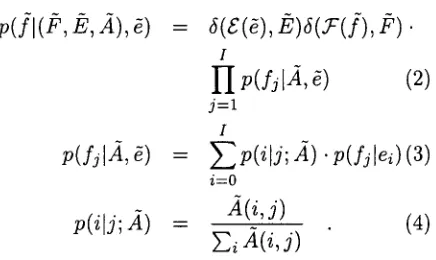
We assume a mixture alignment between the source and target language words constrained by the alignment matrix A:p ( ] I ( F , E , A ) , ~ ) = ~ ( E ( ~ ) , k ) 5 ( 7 ( / ) , F ) .
I
I I P(fjiA,~)
(2)j = l
I
p(fjlA, 8) = E p ( i [ j ; A ) . p ( f j [ e i ) ( 3 )
i=O
A ( i , j )
=
E i A ( i , j )
(4) 3.2p(ilj; A)
The phrase level alignment
In order to describe the phrase level alignment in a formal way, we first decompose both the source sentence f l J and the target sentence el / into a sequence of phrases (k = 1 , . . . , K):
fx g = /1 ~ ,
fk = fjk-x+l,'",fjk
e f ---- e l K , e k ---- e i k _ l + l , . . . , e i k
In order to simplify the notation and the pre- sentation, we ignore the fact that there can be a large n u m b e r of possible segmentations and as- sume t h a t there is only one segmentation. In the previous section, we have described the align- ment
within
the phrases. For the alignment 5~"• between
the source phrases ~1K and the target p h r a s e s / ~ , we obtain the following equation:Pr(f~g[e{)
=Pr(/~l~)
aft
= X:Pr(afl )-
K
=
I I p(akla -z, K) p(Ll .k)
[image:4.612.319.537.242.372.2]For the phrase level alignment we use a first-order alignment model p(Sklgl k-~,K) = p(SklSk_l, K) which is in addition constrained to be a permutation of the K phrases.
For the translation of one phrase, we intro- duce the alignment template as an unknown variable:
P(]I~) = Z P(zle)"P(Ylz,
e)
(5)
Z
The probability
p(zl~ )
to apply an alignment template gets estimated by relative frequencies (see next section). The probabilityp(flz, ~)
is decomposed by Eq. (2).3.3 Training
In this section we show how we obtain the pa- rameters of our translation model by using a parallel training corpus:
1. We train two HMM alignment models (Vo- gel et al., 1996) for the two translation di- rections f ~ e and e ~ f by applying the EM-algorithm. However we do not ap- ply m a x i m u m approximation in training, thereby obtaining slightly improved align- ments.
2. For each translation direction we calcu- late the Viterbi-alignment of the transla- tion models determined in the previous step. Thus we get two alignment vectors al J and bl / for each sentence.
We increase the quality of the alignments by combining the two alignment vectors into one alignment matrix using the fol- lowing method.
A1 = {(aj,j)[j = 1... J}
and A2 = {(i,
bi)li
= 1 . . . I} denote the set of links in the two Viterbi-alignments. In a first step the intersection A = A1 n A2 is determined. The elements within A are justified by b o t h Viterbi-alignments and are therefore very reliable. We now ex- tend the alignment A iteratively by adding links (i, j) occurring only in A1 or in A2 if they have a neighbouring link already in A or if neither the wordfj
nor the wordei
are aligned in A. The alignment (i, j) has the neighbouring links (i - 1,j),
(i,j -
1), (i + 1, j), and (i, j + 1). In the Verbmobil task (Table 1) the precision of the baseline Viterbi alignments is 83.3 percent with En- glish as source language and 81.8 percentwith German as source language. Using this heuristic we get an alignment matrix with a precision of 88.4 percent without loss in recall.
3. We estimate a bilingual word lexicon
p(fle)
by the relative frequencies of the alignment determined in the previous step:
p(fle)
_ h A ( f , e)(6)
n(e)
Here
nA(f,e)
is the frequency that the word f is aligned to e andn(e)
is the fre- quency of e in the training corpus.4. We determine word classes for source and target language. A naive approach for do- ing this would be the use of monolingually optimized word classes in source and tar- get language. Unfortunately we can not ex- pect that there is a direct correspondence between independently optimized classes. Therefore monolingually optimized word classes do not seem to be useful for ma- chine translation.
We determine correlated bilingual classes by using the m e t h o d described in (Och, 1999). The basic idea of this m e t h o d is to apply a maximum-likelihood approach to the joint probability of the parallel training corpus. T h e resulting optimization crite- rion for the bilingual word classes is similar to the one used in monolingual maximum- likelihood word clustering.
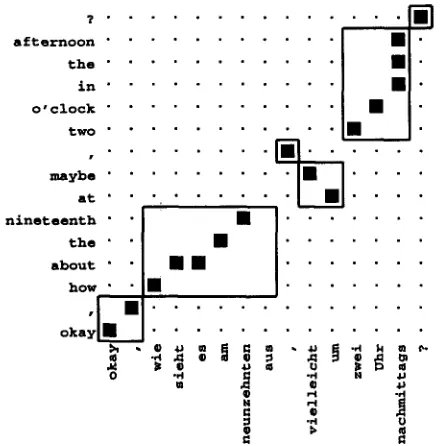
5. We count all phrase-pairs of the training corpus which are consistent with the align- ment matrix determined in step 2. A phrase-pair is consistent with the align- ment if the words within the source phrase are only aligned to words within the tar- get phrase. Thus we obtain a count
n(z)
of how often an alignment template oc- curred in the aligned training corpus. The probability of using an alignment template needed by Eq. (5) is estimated by relative frequency:
p(z = (F,E,.a)I~)
= n(z)" ~(k,E(~)) n(E(~))n i n e t e e n t h "
t h e '
a b o u t °
h o w "
O
======================
t h . . . . I " 1 " in . . . I " 1 " o.oloo . . . l " I "
two . . . 1 • l "
m a y b e . . . . • o o . . . . . .
a t ,~
• • . . .
• • . . 0 . . . . . ~ ~ | ~ ~ "Y~ ~'~ ~ g'-
O
• a l
Figure 3: Example of a word alignment and some learned alignment templates.
does not perform a selection of good or bad alignment templates - it simply extracts all possible alignment templates.
3.4 S e a r c h
For decoding we use the following search crite- rion:
arg max {p(e~).p(e~lf~)) (8)
4
This decision rule is an approximation to Eq. (1) which would use the translation probability
p(flJle{).
Using the simplification it is easy to integrate translation and language model in the search process as both models predict target words. As experiments have shown this simpli- fication does not affect the quality of translation results.To allow the influence of long contexts we use a class-based five-gram language model with backing-off.
The search space denoted by Eq. (8) is very large. Therefore we apply two preprocessing steps before the translation of a sentence:
1. We determine the set of all source phrases in f for which an applicable alignment tem- plate exists. Every possible application of an alignment template to a sub-sequence of the source sentence is called
alignment
template instantiation.
2. We now perform a segmentation of the in- put sentence. We search for a sequence of phrases f l o . . . o / k = fl J with:
K
arg max I I maxz
p(zlfk )
(9)]lO...oh=:: k=l
This is done efficiently by dynamic pro- gramming. Because of the simplified de- cision rule (Eq. (8)) it is used in Eq. (9)
p(z]fk)
instead of p(z]~k).Afterwards the actual translation process be- gins. It has a search organization along the po- sitions of the target language string. In search we produce partial hypotheses, each of which contains the following information:
1. the last target word produced,
2. the state of the language model (the classes of the last four target words),
3. a bit-vector representing the already cov- ered positions of the source sentence, 4. a reference to the alignment template in-
stantiation which produced the last target word,
5. the position of the last target word in the alignment template instantiation,
6. the accumulated costs (the negative loga- rithm of the probabilities) of all previous decisions,
7. a reference to the previous partial hypoth- esis.
A partial hypothesis is extended by append- ing one target word. The set of all partial hy- potheses can be structured as a graph with a source node representing the sentence start, leaf nodes representing full translations and inter- mediate nodes representing partial hypotheses. We recombine partial hypotheses which cannot be distinguished by neither language model nor translation model. When the elements 1 - 5 of two partial hypotheses do not allow to distin- guish between two hypotheses it is possible to drop the hypothesis with higher costs for the subsequent search process.
[image:6.612.65.286.67.290.2]the input sentence. This makes the compari- son of the costs somewhat problematic. There- fore we integrate an (optimistic) estimation of the remaining costs to arrive at a full trans- lation. This can be done efficiently by deter- mining in advance for each word in the source language sentence a lower bound for the costs of the translation of this word. Together with the bit-vector stored in a partial hypothesis it is possible to achieve an efficient estimation of the remaining costs.
4 T r a n s l a t i o n r e s u l t s
The "Verbmobil Task" (Wahlster, 1993) is a speech translation task in the domain of ap- pointment scheduling, travel planning, and ho- tel reservation. The task is difficult because it consists of spontaneous speech and the syntac- tic structures of the sentences are less restricted and highly variable.
The translation direction is from German to English which poses special problems due to the big difference in the word order of the two lan- guages. We present results on both the text transcription and the speech recognizer output using the alignment template approach and the single-word based approach.
The text input was obtained by manu- ally transcribing the spontaneously spoken sen- tences. There was no constraint on the length of the sentences, and some of the sentences in the test corpus contain more than 50 words. There- fore, for text input, each sentence is split into shorter units using the punctuation marks. The segments thus obtained were translated sepa- rately, and the final translation was obtained by concatenation.
In the case of speech input, the speech recog- nizer along with a prosodic module produced so-called prosodic markers which are equivalent to punctuation marks in written language. The experiments for speech input were performed on the single-best sentence of the recognizer. The recognizer had a word error rate of 31.0%. Con- sidering only the real words without the punc- tuation marks, the word error rate was smaller, namely 20.3%.
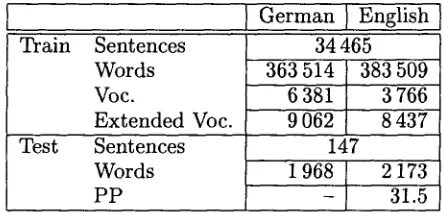
A summary of the corpus used in the experi- ments is given in Table 1. Here the term word refers to full-form word as there is no morpho- logical processing involved. In some of our ex-
periments we use a domain-specific preprocess- ing which consists of a list of 803 (for German) and 458 (for English) word-joinings and word- splittings for word compounds, numbers, dates and proper names. To improve the lexicon prob- abilities and to account for unseen words we added a manually created German-English dic- tionary with 13 388 entries. The classes used were constrained so that all proper names were included in a single class. Apart from this, the classes were automatically trained using the de- scribed bilingual clustering method. For each of the two languages 400 classes were used.
For the single-word based approach, we used the manual dictionary as well as the preprocess- ing steps described above. Neither the transla- tion model nor the language model used classes in this case. In principal, when re-ordering words of the source string, words of the German verb group could be moved over punctuation marks, although it was penalized by a constant cost.
Table 1: Training and test conditions for the Verbmobil task. The extended vocabulary in- cludes the words of the manual dictionary. The trigram perplexity (PP) is given.
Train
Test
Sentences Words Voc.
Extended Voc. Sentences Words P P
German I English 34465 363 514 383 509
6 381 3 766 9 062 8 437
147
1 968 2 173
- 3 1 . 5
In all experiments, we use the following three error criteria:
• W E R (word error rate):
The W E R is computed as the minimum number of substitution, insertion and dele- tion operations that have to be performed to convert the generated string into the tar- get string. This performance criterion is widely used in speech recognition.
• P E R (position-independent word error rate):
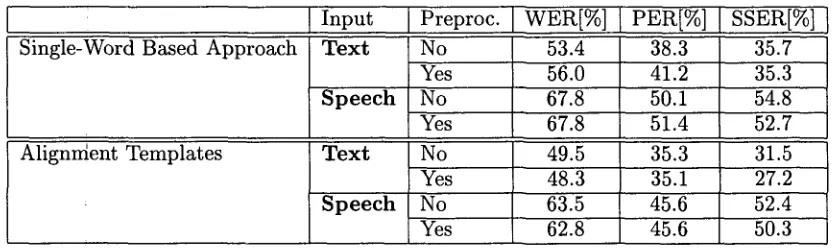
[image:7.612.316.538.405.511.2]Table 2: E x p e r i m e n t s for T e x t a n d S p e e c h I n p u t : Word error rate (WER), position- independent word error rate (PER) and subjective sentence error rate (SSER) with/without pre- processing (147 sentences = 1 968 words of the Verbmobil task).
Single-Word Based Approach
Alignrtlent Templates
T e x t No 53.4 38.3 35.7
Yes 56.0 41.2 35.3
S p e e c h No 67.8 50.1 54.8
Yes 67.8 51.4 52.7
T e x t
S p e e c h
No 49.5 35.3 31.5
Yes 48.3 35.1 27.2
No 63.5 45.6 52.4
Yes 62.8 45.6 50.3
particularly a problem for the Verbmobil task, where the word order of the German- English sentence pair can be quite different. As a result, the word order of the automat- ically generated target sentence can be dif- ferent from that of the target sentence, but nevertheless acceptable so that the WER measure alone could be misleading. In or- der to overcome this problem, we intro- duce as additional measure the position- independent word error rate (PER). This measure compares the words in the two sen- tences without taking the word order into account. Words that have no matching counterparts are counted as substitution errors. Depending on whether the trans- lated sentence is longer or shorter than the target translation, the remaining words re- sult in either insertion or deletion errors in addition to substitution errors. The P E R is guaranteed to be less than or equal to the WER.
SSER (subjective sentence error rate): For a more detailed analysis, subjective judgments by test persons are necessary. Each translated sentence was judged by a human examiner according to an error scale from 0.0 to 1.0. A score of 0.0 means that the translation is semantically and syntac- tically correct, a score of 0.5 means that a sentence is semantically correct but syntac- tically wrong and a score of 1.0 means that the sent6nce is semantically wrong. The human examiner was offered the translated sentences of the two approaches at the same time. As a result we expect a better possi-
bility of reproduction.
The results of the translation experiments using the single-word based approach and the alignment template approach on text input and on speech input are summarized in Table 2. The results are shown with and without the use of domain-specific preprocessing. The alignment template approach produces better translation results than the single-word based approach. From this we draw the conclusion that it is im- portant to model word groups in source and tar- get language. Considering the recognition word error rate of 31% the degradation of about 20% by speech input can be expected. The average translation time on an Alpha workstation for a single sentence is about one second for the align- ment template apprbach and 30 seconds for the single-word based search procedure.
Within the Verbmobil project other trans- lation modules based on rule-based, example- based and dialogue-act-based translation are used. We are not able to present results with these methods using our test corpus. But in the current Verbmobil prototype the prelimi- nary evaluations show that the statistical meth- ods produce comparable or better results than the other systems. An advantage of the sys- tem is that it is robust and always produces a translation result even if the input of the speech recognizer is quite incorrect.
5 S u m m a r y
[image:8.612.102.521.120.244.2]based approach allows for the the possibility of one-to-many alignments. The alignment tem- plate approach uses two different alignment lev- els: a phrase level alignment between phrases and a word level alignment between single words. As a result the context of words has a greater influence and the changes in word order from source to target language can be learned explicitly. An advantage of both meth- ods is that they learn fully automatically by us- ing a bilingual training corpus and are capa- ble of achieving better translation results on a limited-domain task than other example-based or rule-based translation systems.
A c k n o w l e d g m e n t
This work has been partially supported as part of the Verbmobil project (contract number 01 IV 701 T4) by the German Federal Ministry of Education, Science, Research and Technol- ogy and as part of the EuTrans project by the by the European Community (ESPRIT project number 30268).
R e f e r e n c e s
Hiyan Alshawi, Srinivas Bangalore, and Shona Douglas. 1998. Automatic acquisition of hi- erarchical transduction models for machine
translation. In COLING-ACL '98: Annual
Conf. of the Association for Computational Linguistics and 17th Int. Conf. on Compu- tational Linguistics, volume 1, pages 41-47, Montreal, Quebec, Canada, August.
Peter F. Brown, Stephen A. Della Pietra, Vin- cent J. Della Pietra, and Robert L. Mercer. 1993. The mathematics of statistical machine
translation: Parameter estimation. Compu-
tational Linguistics, 19(2):263-311.
Hermann Ney. 1999. Speech translation: Cou- pling of recognition and translation. In Proc. Int. Conf. on Acoustics, Speech, and Sig- nal Processing, pages 517-520, Phoenix, AR, March.
Sonja Niessen, Stephan Vogel, Hermann Ney, and Christoph Tillmann. 1998. A DP-based search algorithm for statistical machine trans-
lation. In COLING-ACL '98: Annual Conf.
of the Association for Computational Lin- guistics and 17th Int. Conf. on Computa- tional Linguistics, pages 960-967, Montreal, Canada, August.
Franz Josef Och and Hans Weber. 1998. Im- proving statistical natural language transla- tion with categories and rules. In Proc. of the 35th Annual Conf. of the Association for Computational Linguistics and the 17th Int. Conf. on Computational Linguistics, pages 985-989, Montreal, Canada, August.
Franz Josef Och. 1999. An efficient method to determine bilingual word classes. In EACL '99: Ninth Conf. of the Europ. Chapter of the Association for Computational Linguis- tics, Bergen, Norway, June.
Christoph Tillmann, Stephan Vogel, Hermann Ney, and Alex Zubiaga. 1997. A DP-based search using monotone alignments in statisti- cal translation. In Proc. 35th Annual Conf. of the Association for Computational Linguis- tics, pages 289-296, Madrid, Spain, July. Stephan Vogel, Hermann Ney, and Christoph
Tillmann. 1996. HMM-based word align- ment in statistical translation. In COLING '96: The 16th Int. Conf. on Computational Linguistics, pages 836-841, Copenhagen, Au- gust.
Wolfgang Wahlster. 1993. Verbmobih Transla- tion of face-to-face dialogs. In Proc of the M T Summit IV, pages 127-135, Kobe, Japan. Ye-Yi Wang and Alex Waibel. 1998. Modeling