Convolution Kernels on Constituent, Dependency and Sequential
Structures for Relation Extraction
Truc-Vien T. Nguyen and Alessandro Moschitti and Giuseppe Riccardi nguyenthi,moschitti,[email protected]
Department of Information Engineering and Computer Science University of Trento
38050 Povo (TN), Italy
Abstract
This paper explores the use of innovative kernels based on syntactic and semantic structures for a target relation extraction task. Syntax is derived from constituent and dependency parse trees whereas se-mantics concerns to entity types and lex-ical sequences. We investigate the effec-tiveness of such representations in the au-tomated relation extraction from texts. We process the above data by means of Sup-port Vector Machines along with the syn-tactic tree, the partial tree and the word sequence kernels. Our study on the ACE 2004 corpus illustrates that the combina-tion of the above kernels achieves high ef-fectiveness and significantly improves the current state-of-the-art.
1 Introduction
Relation Extraction (RE) is defined in ACE as the task of finding relevant semantic relations between pairs of entities in texts. Figure 1 shows part of a document from ACE 2004 corpus, a collec-tion of news articles. In the text, the relacollec-tion be-tweenpresidentandNBC’s entertainment division describes the relationship between the first entity (person) and the second (organization) where the person holds a managerial position.
Several approaches have been proposed for au-tomatically learning semantic relations from texts. Among others, there has been increased interest in the application of kernel methods (Zelenko et al., 2002; Culotta and Sorensen, 2004; Bunescu and Mooney, 2005a; Bunescu and Mooney, 2005b; Zhang et al., 2005; Wang, 2008). Their main prop-erty is the ability of exploiting a huge amount of
This work has been partially funded by the LiveMemo-ries project (http://www.livememoLiveMemo-ries.org/) and Expert Sys-tem (http://www.expertsysSys-tem.net/) research grant.
Jeff Zucker, the longtime executive producer of NBC’s ”Today” program, will be named Friday as the newpresidentofNBC’s entertainment division, replacing Garth Ancier, NBC execu-tives said.
Figure 1: A document from ACE 2004 with all entity mentions in bold.
features without an explicit feature representation. This can be done by computing a kernel function between a pair of linguistic objects, where such function is a kind of similarity measure satisfy-ing certain properties. An example is the sequence kernel (Lodhi et al., 2002), where the objects are strings of characters and the kernel function com-putes the number of common subsequences of characters in the two strings. Such substrings are then weighted according to a decaying factor pe-nalizing longer ones. In the same line, Tree Ker-nels count the number ofsubtreeshared by two in-put trees. An example is that of syntactic (or sub-set) tree kernel (SST) (Collins and Duffy, 2001), where trees encode grammatical derivations.
Previous work on the use of kernels for RE has exploited some similarity measures over di-verse features (Zelenko et al., 2002; Culotta and Sorensen, 2004; Zhang et al., 2005) or subse-quence kernels over dependency graphs (Bunescu and Mooney, 2005a; Wang, 2008). More specif-ically, (Bunescu and Mooney, 2005a; Culotta and Sorensen, 2004) use kernels over depen-dency trees, which showed much lower accuracy than feature-based methods (Zhao and Grishman, 2005). One problem of the dependency kernels above is that they do not exploit the overall struc-tural aspects of dependency trees. A more effec-tive solution is the application of convolution ker-nels to constituent parse trees (Zhang et al., 2006) but this is not satisfactory from a general
spective since dependency structures offer some unique advantages, which should be exploited by an appropriate kernel.
Therefore, studying convolution tree kernels for dependency trees is worthwhile also considering that, to the best of our knowledge, these models have not been previously used for relation extrac-tion1 task. Additionally, sequence kernels should be included in such global study since some of their forms have not been applied to RE.
In this paper, we study and evaluate diverse con-volution and sequence kernels for the RE problem by providing several kernel combinations on con-stituent and dependency trees and sequential struc-tures. To fully exploit the potential of dependency trees, in addition to the SST kernel, we applied the partial tree (PT) kernel proposed in (Moschitti, 2006), which is a general convolution tree kernel adaptable for dependency structures. We also in-vestigate various sequence kernels (e.g. the word sequence kernel (WSK) (Cancedda et al., 2003)) by incorporating dependency structures into word sequences. These are also enriched by including information from constituent parse trees.
We conduct experiments on the standard ACE 2004 newswire and broadcast news domain. The results show that although some kernels are less effective than others, they exhibit properties that are complementary to each other. In particu-lar, we found that relation extraction can benefit from increasing the feature space by combining kernels (with a simple summation) exploiting the two different parsing paradigms. Our experiments on RE show that the current composite kernel, which is constituent-based is more effective than those based on dependency trees and individual sequence kernel but at the same time their com-binations, i.e. dependency plus constituent trees, improve the state-of-the-art in RE. More interest-ingly, also the combinations of various sequence kernels gain significant better performance than the current state-of-the-art (Zhang et al., 2005).
Overall, these results are interesting for the computational linguistics research since they show that the above two parsing paradigms provide dif-ferent and important information for a semantic task such as RE. Regarding sequence-based ker-nels, the WSK gains better performance than pre-vious sequence and dependency models for RE.
1The function defined on (Culotta and Sorensen, 2004),
although on dependency trees, is not a convolution tree ker-nel.
A review of previous work on RE is described in Section 2. Section 3 introduces support vec-tor machines and kernel methods whereas our spe-cific kernels for RE are described is Section 4. The experiments and conclusions are presented in sec-tions 5 and 6, respectively.
2 Related Work
To identify semantic relations using machine learning, three learning settings have mainly been applied, namely supervised methods (Miller et al., 2000; Zelenko et al., 2002; Culotta and Sorensen, 2004; Kambhatla, 2004; Zhou et al., 2005), semi supervised methods (Brin, 1998; Agichtein and Gravano, 2000), and unsupervised method (Hasegawa et al., 2004). In a supervised learning setting, representative related work can be classified into generative models (Miller et al., 2000), feature-based (Roth and tau Yih, 2002; Kambhatla, 2004; Zhao and Grishman, 2005; Zhou et al., 2005) or kernel-based methods (Ze-lenko et al., 2002; Culotta and Sorensen, 2004; Bunescu and Mooney, 2005a; Zhang et al., 2005; Wang, 2008; Zhang et al., 2006).
The learning model employed in (Miller et al., 2000) used statistical parsing techniques to learn syntactic parse trees. It demonstrated that a lexi-calized, probabilistic context-free parser with head rules can be used effectively for information ex-traction. Meanwhile, feature-based approaches often employ various kinds of linguistic, syntac-tic or contextual information and integrate into the feature space. (Roth and tau Yih, 2002) ap-plied a probabilistic approach to solve the prob-lems of named entity and relation extraction with the incorporation of various features such as word, part-of-speech, and semantic information from WordNet. (Kambhatla, 2004) employed maximum entropy models with diverse features including words, entity and mention types and the number of words (if any) separating the two entities.
relations by computing kernel functions between parse trees. (Bunescu and Mooney, 2005a) pro-posed a shortest path dependency kernel by stipu-lating that the information to model a relationship between two entities can be captured by the short-est path between them in the dependency graph.
Although approaches in RE have been domi-nated by kernel-based methods, until now, most of research in this line has used the kernel as some similarity measures over diverse features (Zelenko et al., 2002; Culotta and Sorensen, 2004; Bunescu and Mooney, 2005a; Zhang et al., 2005; Wang, 2008). These are not convolution kernels and pro-duce a much lower number of substructures than the PT kernel. A recent approach successfully em-ploys a convolution tree kernel (of type SST) over constituent syntactic parse tree (Zhang et al., 2006; Zhou et al., 2007), but it does not capture gram-matical relations in dependency structure. We be-lieve that an efficient and appropriate kernel can be used to solve the RE problem, exploiting the advantages of dependency structures, convolution tree kernels and sequence kernels.
3 Support Vector Machines and Kernel Methods
In this section we give a brief introduction to sup-port vector machines, kernel methods, diverse tree and sequence kernel spaces, which can be applied to the RE task.
3.1 Support Vector Machines (SVMs)
Support Vector Machines refer to a supervised ma-chine learning technique based on the latest results of the statistical learning theory (Vapnik, 1998). Given a vector space and a set of training points, i.e. positive and negative examples, SVMs find a separating hyperplane H(~x) = ~ω×~x+b = 0
whereω ∈Rnandb∈Rare learned by applying the Structural Risk Minimization principle (Vap-nik, 1995). SVMs is a binary classifier, but it can be easily extended to multi-class classifier, e.g. by means of theone-vs-allmethod (Rifkin and Pog-gio, 2002).
One strong point of SVMs is the possibility to apply kernel methods (robert Mller et al., 2001) to implicitly map data in a new space where the examples are more easily separable as described in the next section.
3.2 Kernel Methods
Kernel methods (Schlkopf and Smola, 2001) are an attractive alternative to feature-based methods since the applied learning algorithm only needs to compute a product between a pair of objects (by means of kernel functions), avoiding the ex-plicit feature representation. A kernel function is a scalar product in a possibly unknown feature space. More precisely, The objectois mapped in
~xwith a feature functionφ:O → <n, whereOis the set of the objects.
The kernel trick allows us to rewrite the deci-sion hyperplane as:
H(~x) = X
i=1..l
yiαi~xi
·~x+b=
X
i=1..l
yiαi~xi·~x+b= X
i=1..l
yiαiφ(oi)·φ(o) +b,
whereyiis equal to 1 for positive and -1 for neg-ative examples, αi ∈ < with αi ≥ 0, oi ∀i ∈ {1, .., l}are the training instances and the product
K(oi, o) = hφ(oi)·φ(o)i is the kernel function associated with the mappingφ.
Kernel engineering can be carried out by com-bining basic kernels with additive or multiplica-tive operators or by designing specific data objects (vectors, sequences and tree structures) for the tar-get tasks.
Regarding NLP applications, kernel methods have attracted much interest due to their ability of implicitly exploring huge amounts of structural features automatically extracted from the origi-nal object representation. The kernels for struc-tured natural language data, such as parse tree kernel (Collins and Duffy, 2001) and string ker-nel (Lodhi et al., 2002) are examples of the well-known convolution kernels used in many NLP ap-plications.
2001) and (Moschitti, 2006), respectively. In con-trast, we report some descriptions in terms of fea-ture space that may be useful to understand the new engineered kernels.
In principle, a SubTree (ST) is defined by tak-ing any node along with its descendants. A Sub-Set Tree (SST) is a more general structure which does not necessarily include all the descendants. It must be generated by applying the same grammat-ical rule set, which generated the original tree. A Partial Tree (PT) is a more general form of sub-structures obtained by relaxing constraints over the SST.
4 Kernels for Relation Extraction
In this section we describe the previous kernels based on constituent trees as well as new kernels based on diverse types of trees and sequences for relation extraction. As mentioned in the previ-ous section, we can engineer kernels by combin-ing tree and sequence kernels. Thus we focus on the problem to define structure embedding the de-sired syntactic relational information between two named entities (NEs).
4.1 Constituent and Dependency Structures
Syntactic parsing (or syntactic analysis) aims at identifying grammatical structures in a text. A parser thus captures the hidden hierarchy of the input text and processes it into a form suitable for further processing. There are two main paradigms for representing syntactic information: constituent and dependency parsing, which produces two dif-ferent tree structures.
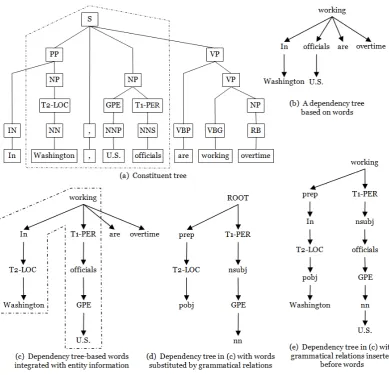
Constituent tree encodes structural properties of a sentence. The parse tree contains constituents, such as noun phrases (NP) and verb phrases (VP), as well as terminals/part-of-speech tags, such as determiners (DT) or nouns (NN). Figure 2.a shows the constituent tree of the sentence: In Washing-ton, U.S. officials are working overtime.
Dependency tree encodes grammatical rela-tions between words in a sentence with the words as nodes and dependency types as edges. An edge from a word to another represents a grammatical relation between these two. Every word in a de-pendency tree has exactly one parent except the root. Figure 2.b shows and example of the depen-dency tree of the previous sentence.
Given two NEs, such as Washington and offi-cials, both the above trees can encode the syntactic
dependencies between them. However, since each parse tree corresponds to a sentence, there may be more than two NEs and many relations expressed in a sentence. Thus, the use of the entire parse tree of the whole sentence holds two major draw-backs: first, it may be too computationally expen-sive for kernel calculation since the size of a com-plete parse tree may be very large (up to 300 nodes in the Penn Treebank (Marcus et al., 1993)); sec-ond, there is ambiguity on the target pairs of NEs, i.e. different NEs associated with different rela-tions are described by the same parse tree. There-fore, it is necessary to identify the portion of the parse tree that best represent the useful syntactic information.
Lete1ande2be two entity mentions in the same
sentence such that they are in a relationship R. For the constituent parse tree, we used the path-enclosed tree (PET), which was firstly proposed in (Moschitti, 2004) for Semantic Role Labeling and then adapted by (Zhang et al., 2005) for re-lation extraction. It is the smallest common sub-tree including the two entities of a relation. The dashed frame in Figure 2.a surrounds PET associ-ated with the two mentions,officialsand Washing-ton. Moreover, to improve the representation, two extra nodes T1-PER, denoting the type PERSON, and T2-LOC, denoting the type LOCATION, are added to the parse tree, above the two target NEs, respectively. In this example, the above PET is de-signed to capture the relationLocated-inbetween the entities ”officials” and ”Washington” from the ACE corpus. Note that, a third NE,U.S., is char-acterized by the node GPE (GeoPolitical Entity), where the absence of the prefix T1 or T2 before the NE type (i.e. GPE), denotes that the NE does not take part in the target relation.
In previous work, some dependency trees have been used (Bunescu and Mooney, 2005a; Wang, 2008) but the employed kernel just exploited the syntactic information concentrated in the path be-tweene1ande2. In contrast, we defined and
stud-ied three different dependency structures whose potential can be fully exploited by our convolution partial tree kernel:
- Dependency Words (DW) tree is similar to PET adapted for dependency tree constituted by simple words. We select the minimal sub-tree which includese1 ande2, and we insert
Figure 2: The constituent and dependency parse trees integrated with entity information
the tree in Figure 2.b, we design the tree in Figure 2.c surrounded by the dashed frames, where T1-PER, T2-LOC and GPE are the ex-tra nodes inserted as fathers of Washington, soldierandU.S..
- Grammatical Relation (GR) tree, i.e. the DW tree in which words are replaced by their grammatical functions, e.g. prep, pobj and nsubj. For example, Figure 2.d, shows the GR tree for the previous relation: In is re-placed byprep,U.S.bynsubjand so on.
- Grammatical Relation and Words (GRW) tree, words and grammatical functions are both used in the tree, where the latter are in-serted as a father node of the former. For example, Figure 2.e, shows such tree for the previous relation.
4.2 Sequential Structures
Some sequence kernels have been used on depen-dency structures (Bunescu and Mooney, 2005b; Wang, 2008). These kernels just used lexical words with some syntactic information. To fully exploit syntactic and semantic information, we de-fined and studied six different sequences (in a style similar to what proposed in (Moschitti, 2008)), which include features from constituent and de-pendency parse trees and NEs:
1. Sequence of terminals (lexical words) in the PET (SK1), e.g.:
T2-LOC Washington , U.S. T1-PER officials. 2. Sequence of part-of-speech (POS) tags in the
PET (SK2), i.e. theSK1in which words are
replaced by their POS tags, e.g.: T2-LOC NN , NNP T1-PER NNS.
PET (SK3), i.e. theSK1in which words are
replaced by their grammatical functions, e.g.: T2-LOC pobj , nn T1-PER nsubj.
4. Sequence of words in the DW (SK4), e.g.:
Washington T2-LOC In working T1-PER of-ficials GPE U.S..
5. Sequence of grammatical relations in the GR (SK5), i.e. the SK4 in which words are
re-placed by their grammatical functions, e.g.: pobj T2-LOC prep ROOT T1-PER nsubj GPE nn.
6. Sequence of POS tags in the DW (SK6), i.e. theSK4in which words are replaced by their
POS tags, e.g.:
NN T2-LOC IN VBP T1-PER NNS GPE NNP.
It is worth noting that the potential information contained in such sequences can be fully exploited by the word sequence kernel.
4.3 Combining Kernels
Given that syntactic information from different parse trees may have different impact on relation extraction (RE), the viable approach to study the role of dependency and constituent parsing is to experiment with different syntactic models and measuring the impact in terms of RE accuracy. For this purpose we compared the composite ker-nel described in (Zhang et al., 2006) with the par-tial tree kernels applied toDW, GR, andGRW
and sequence kernels based on six sequences de-scribed above. The composite kernels include polynomial kernel applied to entity-related feature vector. The word sequence kernel (WSK) is al-ways applied to sequential structures. The used kernels are described in more detail below.
4.3.1 Polynomial Kernel
The basic kernel between two named entities of the ACE documents is defined as:
KP(R1, R2) =
X
i=1,2
KE(R1.Ei, R2.Ei),
whereR1andR2 are two relation instances,Eiis theith entity of a relation instance. KE(·,·) is a kernel over entity features, i.e.:
KE(E1, E2) = (1 +~x1·~x2)2,
where~x1and~x2 are two feature vectors extracted
from the two NEs.
For the ACE 2004, the features used include: entity headword, entity type, entity subtype, men-tion type, and LDC2 mention type. The last four attributes are taken from the ACE corpus 2004. In ACE, each mention has a head annotation and an extent annotation.
4.3.2 Kernel Combinations
1. Polynomial kernel plus a tree kernel:
CK1=α·KP + (1−α)·Kx, whereα is a coefficient to give more impact toKP and Kx is either the partial tree ker-nel applied to one the possible dependency structures, DW, GR or GRW or the SST ker-nel applied to PET, described in the previous section.
2. Polynomial kernel plus constituent plus de-pendency tree kernels:
CK2 =α·KP + (1−α)·(KSST +KP T) whereKSST is the SST kernel andKP T is the partial tree kernel (applied to the related structures as in point 1).
3. Constituent tree plus square of polynomial kernel and dependency tree kernel:
CK3 =α·KSST+ (1−α)·(KP+KP T)2
4. Dependency word tree plus grammatical re-lation tree kernels:
CK4 =KP T−DW +KP T−GR whereKP T−DW andKP T−GR are the par-tial tree kernels applied to dependency struc-tures DW and GR.
5. Polynomial kernel plus dependency word plus grammatical relation tree kernels:
CK5 =α·KP+(1−α)·(KP T−DW+KP T−GR)
Some preliminary experiments on a validation set showed that the second, the fourth and the fifth combinations yield the best performance withα= 0.4while the first and the third combinations yield the best performance withα= 0.23.
Regarding WSK, the following combinations are applied:
2Linguistic Data Consortium (LDC):
1. SK3+SK4
2. SK3+SK6
3. SSK=Pi=1,..,6SKi
4. KSST +SSK
5. CSK=α·KP + (1−α)·(KSST+SSK)
Preliminary experiments showed that the last com-bination yields the best performance with α = 0.23.
We used a polynomial expansion to explore the bi-gram features of i) the first and the second en-tity participating in the relation, ii) grammatical relations which replace words in the dependency tree. Since the kernel function set is closed un-der normalization, polynomial expansion and lin-ear combination (Schlkopf and Smola, 2001), all the illustrated composite kernels are also proper kernels.
5 Experiments
Our experiments aim at investigating the effec-tiveness of convolution kernels adapted to syntac-tic parse trees and various sequence kernels for the RE task. For this purpose, we use the sub-set and partial tree kernel over different kinds of trees, namely constituent and dependency syntac-tic parse trees. Diverse sequences are applied indi-vidually and in combination together. We consider our task of relation extraction as a classification problem where categories are relation types. All pairs of entity mentions in the same sentence are taken to generate potential relations, which will be processed as positive and negative examples.
5.1 Experimental setup
We use the newswire and broadcast news domain in the English portion of the ACE 2004 corpus provided by LDC. This data portion includes 348 documents and 4400 relation instances. It defines seven entity types and seven relation types. Every relation is assigned one of the seven types: Phys-ical, Person/Social, Employment/Membership/-Subsidiary, Agent-Artifact, PER/ORG Affiliation, GPE Affiliation, and Discourse. For sake of space, we do not explain these relationships here, never-theless, they are explicitly described in the ACE document guidelines. There are 4400 positive and 38,696 negative examples when generating pairs of entity mentions as potential relations.
Documents are parsed using Stanford Parser (Klein and Manning, 2003) to pro-duce parse trees. Potential relations are generated by iterating all pairs of entity mentions in the same sentence. Entity information, namely entity type, is integrated into parse trees. To train and test our binary relation classifier, we used SVMs. Here, relation detection is formulated as a multiclass classification problem. Theone vs. rest strategy is employed by selecting the instance with largest margin as the final answer. For experimentation, we use 5-fold cross-validation with the Tree Kernel Tools (Moschitti, 2004) (available at http://disi.unitn.it/˜moschitt/Tree-Kernel.htm).
5.2 Results
In this section, we report the results of different kernels setup over constituent (CT) and depen-dency (DP) parse trees and sequences taken from these parse trees. The tree kernel (TK), compos-ite kernel (CK1, CK2, CK3, CK4, and CK5
corresponding to five combination types in Sec-tion 4.3.2) were employed over these two syntactic trees. For the tree kernel, we apply the SST kernel for the path-enclosed tree (PET) of the constituent tree and the PT kernel for three kinds of depen-dency tree DW, GR, and GRW, described in the previous section. The two composite kernelsCK2
and CK3 are applied over both two parse trees. The word sequence kernels are applied over six sequencesSK1, SK2, SK3, SK4, SK5, andSK6
(described in Section 4.3).
The results are shown in Table 1 and Table 2. In the first table, the first column indicates the structure used in the combination shown in the second column, e.g. PET associated with CK1
means that the SST kernel is applied on PET (a portion of the constituent tree) and combined with theCK1schema whereas PET and GR associated
with CK5 means that SST kernel is applied to PET and PT kernel is applied to GR inCK5. The
remaining three columns report Precision, Recall and F1 measure. The interpretation of the second table is more immediate since the only tree ker-nel involved is the SST kerker-nel applied to PET and combined by means ofCK1.
We note that: first, the dependency kernels, i.e. the results on the rows from 3 to 6 are be-low the composite kernel CK1, i.e. 68.9. This
Parse Tree Kernel P R F
PET CK1 69.5 68.3 68.9
DW CK1 53.2 59.7 56.3
GR CK1 58.8 61.7 60.2
GRW CK1 56.1 61.2 58.5
[image:8.595.78.288.63.183.2]DW and GR CK5 59.7 64.1 61.8 PET and GR CKCK2 70.7 69.0 69.8 3 70.8 70.2 70.5
Table 1: Results on the ACE 2004 evaluation test set. Six structures were experimented over the
constituent and dependency trees.
Kernel P R F
CK1 69.5 68.3 68.9
SK1 72.0 52.8 61.0 SK2 61.7 60.0 60.8 SK3 62.6 60.7 61.6 SK4 73.1 50.3 59.7 SK5 59.0 60.7 59.8
SK6 57.7 61.8 59.7
SK3+SK4 75.0 63.4 68.8 SK3+SK6 66.8 65.1 65.9
SSK=PiSKi 73.8 66.2 69.8
CSK 75.6 66.6 70.8
CK1+SSK 76.6 67.0 71.5
(Zhou et al., 2007) 82.2 70.2 75.8
CK1with Heuristics
Table 2: Performance comparison on the ACE 2004 data with different kernel setups.
a slightly smaller result than the original version (i.e. an F1 of about 72 using a different syntactic parser).
Second, CK1 improves to 70.5, when the con-tribution of PT kernel applied to GR (dependency tree built using grammatical relations) is added. This suggests that dependency structures are effec-tively exploited by PT kernel and that such infor-mation is somewhat complementary to constituent trees.
Third, in the second table, the model CK1 + SSK, which adds toCK1 the contribution of di-verse sequence kernels, outperforms the state-of-the-art by 2.6%. This suggests that the sequential information encoded by several sequence kernels can better represents the dependency information. Finally, we also report in the last row (in italic) the superior RE result by (Zhou et al., 2007). However, to achieve this outcome the authors used
the composite kernelCK1with several heuristics
to define an effective portion of constituent trees. Such heuristics expand the tree and remove unnec-essary information allowing a higher improvement on RE. They are tuned on the target RE task so al-though the result is impressive, we cannot use it to compare with pure automatic learning approaches, such us our models.
6 Conclusion and Future Work
In this paper, we study the use of several types of syntactic information: constituent and depen-dency syntactic parse trees. A relation is repre-sented by taking the path-enclosed tree (PET) of the constituent tree or of the path linking two enti-ties of the dependency tree. For the design of auto-matic relation classifiers, we have investigated the impact of dependency structures to the RE task. Our novel composite kernels, which account for the two syntactic structures, are experimented with the appropriate convolution kernels and show sig-nificant improvement with respect to the state-of-the-art in RE.
Regarding future work, there are many research line that may be followed:
i) Capturing more features by employing ex-ternal knowledge such as ontological, lexical re-source or WordNet-based features (Basili et al., 2005a; Basili et al., 2005b; Bloehdorn et al., 2006; Bloehdorn and Moschitti, 2007) or shallow se-mantic trees, (Giuglea and Moschitti, 2004; Giu-glea and Moschitti, 2006; Moschitti and Bejan, 2004; Moschitti et al., 2007; Moschitti, 2008; Moschitti et al., 2008).
ii) Design a new tree-based structures, which combines the information of both constituent and dependency parses. From dependency trees we can extract more precise but also more sparse relationships (which may cause overfit). From constituent trees, we can extract subtrees consti-tuted by non-terminal symbols (grammar sym-bols), which provide a better generalization (with a risk of underfitting).
iii) Design a new kernel which can integrate the advantages of the constituent and dependency tree. The new tree kernel should inherit the benefits of the three available tree kernels: ST, SST or PT.
References
[image:8.595.82.283.237.450.2]col-lections. In Proceedings of the 5th ACM Interna-tional Conference on Digital Libraries.
Roberto Basili, Marco Cammisa, and Alessandro Mos-chitti. 2005a. Effective use of WordNet semantics via kernel-based learning. In Proceedings of the Ninth Conference on Computational Natural Lan-guage Learning (CoNLL-2005), pages 1–8, Ann Ar-bor, Michigan, June. Association for Computational Linguistics.
Roberto Basili, Marco Cammisa, and Alessandro Mos-chitti. 2005b. A semantic kernel to classify texts with very few training examples. InIn Proceedings of the Workshop on Learning in Web Search, at the. Stephan Bloehdorn and Alessandro Moschitti. 2007.
Structure and semantics for expressive text ker-nels. In CIKM ’07: Proceedings of the sixteenth ACM conference on Conference on information and knowledge management, pages 861–864, New York, NY, USA. ACM.
Stephan Bloehdorn, Roberto Basili, Marco Cammisa, and Alessandro Moschitti. 2006. Semantic kernels for text classification based on topological measures of feature similarity. InProceedings of the 6th IEEE International Conference on Data Mining (ICDM 06), Hong Kong, 18-22 December 2006, DEC. Sergey Brin. 1998. Extracting patterns and relations
from world wide web. In Proceeding of WebDB Workshop at 6th International Conference on Ex-tending Database Technology, pages 172–183. Razvan C. Bunescu and Raymond J. Mooney. 2005a.
A shortest path dependency kernel for relation ex-traction. InProceedings of EMNLP, pages 724–731. Razvan C. Bunescu and Raymond J. Mooney. 2005b. Subsequence kernels for relation extraction. In Pro-ceedings of EMNLP.
Nicola Cancedda, Eric Gaussier, Cyril Goutte, and Jean Michel Renders. 2003. Word sequence ker-nels. Journal of Machine Learning Research, pages 1059–1082.
Michael Collins and Nigel Duffy. 2001. Convolution kernels for natural language. InProceedings of Neu-ral Information Processing Systems (NIPS’2001). Aron Culotta and Jeffrey Sorensen. 2004. Dependency
tree kernels for relation extraction. InProceedings of the 42nd Annual Meeting on ACL, Barcelona, Spain.
Ana-Maria Giuglea and Alessandro Moschitti. 2004. Knowledge discovery using framenet, verbnet and propbank. In A. Meyers, editor, Workshop on On-tology and Knowledge Discovering at ECML 2004, Pisa, Italy.
Ana-Maria Giuglea and Alessandro Moschitti. 2006. Semantic Role Labeling via Framenet, Verbnet and Propbank. In Proceedings of ACL 2006, Sydney, Australia.
Takaaki Hasegawa, Satoshi Sekine, and Ralph Grish-man. 2004. Discovering relations among named en-tities from large corpora. InProceedings of the 42nd Annual Meeting on ACL, Barcelona, Spain.
Nanda Kambhatla. 2004. Combining lexical, syntactic and semantic features with maximum entropy mod-els for extracting relations. In Proceedings of the ACL 2004 on Interactive poster and demonstration sessions, Barcelona, Spain.
Dan Klein and Christopher D. Manning. 2003. Ac-curate unlexicalized parsing. InProceedings of the 41st Meeting of the ACL, pages 423–430.
Huma Lodhi, Craig Saunders, John Shawe-Taylor, Nello Cristianini, , and Chris Watkins. 2002. Text classification using string kernels. Journal of Ma-chine Learning Research, pages 419–444.
Mitchell P. Marcus, Beatrice Santorini, , and Mary Ann Marcinkiewicz. 1993. Building a large annotated corpus of english: the penn treebank. Computa-tional Linguistics, 19(2):313–330.
Scott Miller, Heidi Fox, Lance Ramshaw, , and Ralph Weischedel. 2000. A novel use of statistical parsing to extract information from text. InProceedings of the 1st conference on North American chapter of the ACL, pages 226–233, Seattle, USA.
Alessandro Moschitti and Cosmin Bejan. 2004. A se-mantic kernel for predicate argument classification. InCoNLL-2004, Boston, MA, USA.
Alessandro Moschitti, Silvia Quarteroni, Roberto Basili, and Suresh Manandhar. 2007. Exploit-ing syntactic and shallow semantic kernels for question/answer classification. In Proceedings of ACL’07, Prague, Czech Republic.
Alessandro Moschitti, Daniele Pighin, and Roberto Basili. 2008. Tree kernels for semantic role label-ing.Computational Linguistics, 34(2):193–224. Alessandro Moschitti. 2004. A study on convolution
kernels for shallow semantic parsing. In Proceed-ings of the 42nd Meeting of the ACL, Barcelona, Spain.
Alessandro Moschitti. 2006. Efficient convolution ker-nels for dependency and constituent syntactic trees. InProceedings of the 17th European Conference on Machine Learning, Berlin, Germany.
Alessandro Moschitti. 2008. Kernel methods, syntax and semantics for relational text categorization. In
CIKM ’08: Proceeding of the 17th ACM conference on Information and knowledge management, pages 253–262, New York, NY, USA. ACM.
Klaus robert Mller, Sebastian Mika, Gunnar Rtsch, Koji Tsuda, , and Bernhard Schlkopf. 2001. An introduction to kernel-based learning algorithms.
IEEE Transactions on Neural Networks, 12(2):181– 201.
Dan Roth and Wen tau Yih. 2002. Probabilistic rea-soning for entity and relation recognition. In Pro-ceedings of the COLING-2002, Taipei, Taiwan. Bernhard Schlkopf and Alexander J. Smola. 2001.
Learning with Kernels: Support Vector Machines, Regularization, Optimization, and Beyond. MIT Press, Cambridge, MA, USA.
Vladimir N. Vapnik. 1995. The Nature of Statistical Learning Theory. Springer–Verlag, New York. Vladimir N. Vapnik. 1998. Statistical Learning
The-ory. John Wiley and Sons, New York.
S.V.N. Vishwanathan and Alexander J. Smola. 2002. Fast kernels on strings and trees. InProceedings of Neural Information Processing Systems.
Mengqiu Wang. 2008. A re-examination of depen-dency path kernels for relation extraction. In Pro-ceedings of the 3rd International Joint Conference on Natural Language Processing-IJCNLP.
Dmitry Zelenko, Chinatsu Aone, and Anthony Richardella. 2002. Kernel methods for relation extraction. InProceedings of EMNLP-ACL, pages 181–201.
Min Zhang, Jian Su, Danmei Wang, Guodong Zhou, and Chew Lim Tan. 2005. Discovering relations be-tween named entities from a large raw corpus using tree similarity-based clustering. InProceedings of IJCNLP’2005, Lecture Notes in Computer Science (LNCS 3651), pages 378–389, Jeju Island, South Korea.
Min Zhang, Jie Zhang, Jian Su, , and Guodong Zhou. 2006. A composite kernel to extract relations be-tween entities with both flat and structured features. In Proceedings of COLING-ACL 2006, pages 825– 832.
Shubin Zhao and Ralph Grishman. 2005. Extracting relations with integrated information using kernel methods. InProceedings of the 43rd Meeting of the ACL, pages 419–426, Ann Arbor, Michigan, USA. GuoDong Zhou, Jian Su, Jie Zhang, , and Min Zhang.
2005. Exploring various knowledge in relation ex-traction. InProceedings of the 43rd Meeting of the ACL, pages 427–434, Ann Arbor, USA, June. GuoDong Zhou, Min Zhang, DongHong Ji, and