Klara Volckaert,1,∗ Habib Rostami,2,∗ Deepnarayan Biswas,3Igor Markovi´c,3, 4 Federico Andreatta,1 Charlotte E. Sanders,5 Paulina Majchrzak,5 Cephise Cacho,5 Richard T. Chapman,5 Adam Wyatt,5 Emma Springate,5
Daniel Lizzit,6 Luca Bignardi,6,† Silvano Lizzit,6 Sanjoy K. Mahatha,1 Marco Bianchi,1 Nicola Lanata,1 Phil D. C. King,3 Jill A. Miwa,1 Alexander V. Balatsky,2 Philip Hofmann,1 and Søren Ulstrup1,‡
1
Department of Physics and Astronomy, Interdisciplinary Nanoscience Center, Aarhus University, 8000 Aarhus C, Denmark 2Nordita, Center for Quantum Materials, KTH Royal Institute of Technology and Stockholm University,
Roslagstullsbacken 23, SE-106 91 Stockholm, Sweden 3
SUPA, School of Physics and Astronomy, University of St Andrews, St Andrews KY16 9SS, United Kingdom 4Max Planck Institute for Chemical Physics of Solids, N¨othnitzer Str. 40, 01187 Dresden, Germany 5
Central Laser Facility, STFC Rutherford Appleton Laboratory, Harwell 0X11 0QX, United Kingdom 6
Elettra-Sincrotrone Trieste, S.S. 14 Km 163.5, Trieste 34149, Italy
In solid state photoemission experiments it is possible to extract information about the symmetry and orbital character of the electronic wave functions via the photoemission selection rules that shape the measured intensity. This approach can be expanded in a pump-probe experiment where the intensity contains additional information about interband excitations induced by an ultrafast laser pulse with tunable polarization. Here, we find an unexpected strong linear dichroism effect (up to 42.4%) in the conduction band of bilayer MoS2, when measuring energy- and momentum-resolved snapshots of excited electrons by time- and angle-resolved photoemission spectroscopy. We model the polarization-dependent photoemission intensity in the transiently-populated conduction band using the semiconductor Bloch equations. Our theoretical analysis reveals a strongly anisotropic momentum-dependence of the optical excitations due to intralayer single-particle hopping, which explains the observed linear dichroism.
Optical selection rules in absorption experiments are powerful tools that can be used to determine the sym-metry of electronic states in solids [1]. Given the simi-larity of the processes underlying optical absorption and photoemission, selection rules have also been exploited in angle-resolved photoemission spectroscopy (ARPES) for decades [2]. More recently, optical dichroism has been used in ARPES to study orbital degrees of freedom [3– 5], as well as the Berry curvature of the initial Bloch states [6, 7]. A particularly interesting opportunity for polarization-dependent excitations arises in single-layer (SL) transition metal dichalcogenides (TMDCs) such as MoS2, where the helicity of circularly polarized light strongly couples to the valley and spin degrees of free-dom [8, 9], permitting the generation of a finite valley polarization [10, 11].
Adding time-resolution (TR) to ARPES in a pump-probe experiment leads to a process involving two op-tical excitations. This opens the possibility of exploit-ing not only the selection rules governexploit-ing the photoe-mission process, but also those giving rise to the initial optical excitation into a transiently populated conduc-tion band (CB) state [12–18]. Indeed, the creaconduc-tion of a finite valley-polarization in SL WS2 has recently been followed in momentum space by TR-ARPES using cir-cularly polarized pump pulses [19, 20]. Here, we extend such an experiment to the case of bilayer (BL) MoS2 in the 2H structure, which is inversion-symmetric due to the relative orientation of the two layers. Surprisingly, we observe a substantial pump-induced linear dichroism effect for photoemission from the excited states near the
conduction band minimum (CBM). Our results can be explained in terms of the momentum-dependent excited state population determined by solving the semiconduc-tor Bloch equations within the framework of a low energy k·pmodel that accounts for intra- and interlayer inter-actions between thedorbitals forming the valence band maximum (VBM) and CBM around ¯K ( ¯K0). These find-ings underline the necessity of accounting for selection rules governing the optical excitation in addition to the photoemission matrix elements when interpreting the in-tensity in dichroic TR-ARPES. They also open the possi-bility to exploit a combination of selection rules to obtain new information about the wave functions involved in the processes.
2 1 0 -1
1.3 0.0
k (Å-1) Γ
kf ˆz
(a) (c)
(d) (e) (f) (g)
ˆy ˆx
ˆep ˆes
ˆx ˆy
K' K
Mo S
Scattering plane Brillouin zone
L 2 B MoS Lattice
(b)
Ebin
(eV)
Γ K'
1.3 0.0
k (Å-1) Γ
CBM K CBM
probe
pump
1.0
0.5
0.0
-1.0 -0.5 0.0
Ebin (eV)
-1.0 0.0
2.0 1.5 1.0
Ebin (eV) 1.0
0.0
-1.0 -0.5 0.0
Ebin (eV)
0.2
0.1
0.0
200 0
-200
Δt (fs)
τ = 45 fs τ = 40 fs τ = 52 fs τ = 38 fs
s
σl
p
σr
W
(arb. u.)
s
σl
p
σr
s
σl
p
σr
s
σl
p
σr
VBM
K' CBM
s
σl
p
σr
Int. Diff. (10
6 counts)
max
min
K'
K' K'
pos
neg
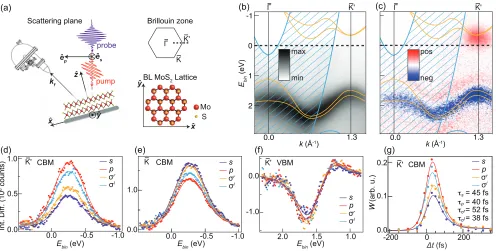
FIG. 1. (a) TR-ARPES setup: Geometry of the scattering plane with definitions of coordinate system{xˆ,yˆ,zˆ}, photoelectron wavevectorkf and polarization vectors{eˆp,eˆs}of the light pulses. The orientations of the BL MoS2 lattice and the Brillouin zone (BZ) are shown for the measurement geometry. The dashed line on the BZ marks the measurement direction. (b) ARPES intensity along the ¯Γ- ¯K0 high symmetry direction before arrival of the pump pulse (∆t <0). (c) Intensity difference between the spectrum in (b) and one obtained at the peak of the optical excitation at∆t= 40 fs with as-polarized pump pulse. The dispersion of BL MoS2has been overlaid (orange curves) together with the bulk continuum of Ag(111) [21] (blue hatched area) in (b)-(c). (d)-(f) EDCs of the intensity difference for different pump polarizations, fitted with Gaussian peaks for the CBM at (d) ¯K0and (e) ¯K, respectively, as well as (f) for the VBM at ¯K0. (g) Time dependence of the estimated spectral weightW from (d) fitted with a function composed of an exponential rise and a single exponential decay with the given time constantsτi.
The photoemission intensity at a time delay,∆t, before excitation (∆t <0) is shown in Fig. 1(b). The spectrum mainly resembles the bare dispersion of BL MoS2 (or-ange curves) [31] while the intensity from the Ag(111) bulk states (expected in the blue hatched area) is very faint. The intensity of the global VBM of BL MoS2 (up-per band at ¯Γ) is strongly suppressed at the energy of the probe pulse, but it is clearly visible at higher pho-ton energies when measured with static ARPES [23, 32]. Figure 1(c) displays the intensity difference between the equilibrium spectrum in panel (b) and an excited state spectrum collected at the peak of optical excitation at ∆t = 40 fs with a s-polarized pump pulse. The domi-nant features are a strong excitation of electrons around the local CBM at ¯K0 (positive intensity difference) and an excitation of holes that peaks at the local VBM at
¯
K0 (negative intensity difference). The red/blue inten-sity difference associated with the rest of the valence band (VB) is mainly caused by a linewidth broadening of the entire band, which is induced by the pump pulse as observed in TR-ARPES measurements of other mate-rials [33]. From these data we extract an indirect gap of (1.49±0.06) eV from ¯Γ to ¯K0 and a direct gap at ¯K0 of
(1.90±0.04) eV, which is close to resonant with our 2 eV optical excitation.
Energy distribution curves (EDCs) of the intensity dif-ference in the CBM averaged over a momentum range from -0.2 to 0.2 ˚A−1 around ¯K0 are shown with Gaus-sian fits fors- andp-polarized pump pulses in Fig. 1(d). EDCs are also shown for polarizations generated by ro-tations of the half-waveplate midway betweens- and p -polarizations, which we assume to be circular and there-fore label σl and σr [23]. A strong change is
visi-ble between the intensity difference spectra of s- and p-polarized pulses, while a smaller change is seen be-tweenσl- andσr-polarizations. We quantify dichroism as ρij = (W(i)−W(j))/(W(i) +W(j)), wherei6=j labels
s- andp- orσl- andσr-polarization andW represents the corresponding spectral weight, determined as the area of the EDC fits. At ¯K0 we then obtainρps = 42.4 % and
ρσlσr = 19.7 %. A similar EDC analysis for the CBM at
¯
K is presented in Fig. 1(e) and exhibits a reversal and re-duction of the linear dichroism effect withρps=−15.2 %
and likewiseρσlσr =−4.7 %. EDCs of the VBM at ¯K0 in
[image:2.612.59.555.53.304.2]0.3 0.2 0.1 0.0 fc
80 60 40 20 0 1
0 -1 Eq
(eV)
-0.4 0.0 0.4
(a) (b)
(e)
(d) (f)
1.0
0.5
0.0
Intensity (arb. u.)
-90 -45 0 45
SL BL
θ (degree) (c)
v1 c2
c1
v2 Eg
qx (Å-1)
qx (Å-1)
qx (Å-1) qy
(Å
-1)
s σl p σr
p-pol
s-pol
σ-pol
qx (Å-1)
1.2 0.8 0.4 0.0
p-pol
-0.2 0.0 0.2
-0.2
0.0
0.2
s-pol
-0.2 0.0 0.2
0.5 0.0 -0.5
difference -0.2 0.0 0.2
exc
Δt (fs)
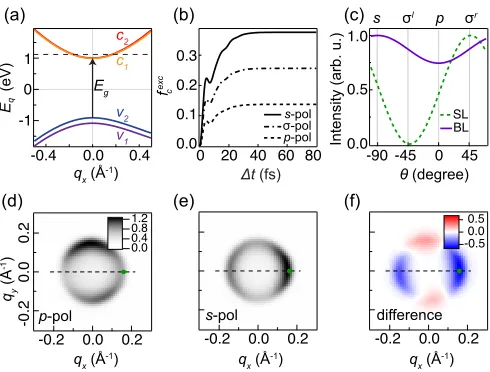
FIG. 2. (a) BL MoS2 dispersion around ¯K determined within ak·pmodel. The energy split VB states are labeledv1andv2 and the CB states are labeledc1andc2. The direct band gap ofEg= 1.9 eV is marked by an arrow. (b) Optically induced population in the CB states obtained at q = (0.16,0) ˚A−1 (indicated by the green dot in (d)-(f)) by solving the semicon-ductor Bloch equations forp-, σ- ands-polarized light. (c) Photoemission intensity calculated atqy= 0 andqx-averaged from -0.22 to 0.22 ˚A−1, as shown by the dashed black line in (d)-(f), as a function of pump pulse polarizationθ for SL MoS2 (dashed green) and BL MoS2 (solid purple). (d)-(e) Momentum-dependent photoemission intensity calculated for (d)p- and (e)s-polarized pump pulses. The color scale in (d) also applies to (e). (f) Intensity difference obtained by sub-tracting the data in (e) from that in (d). The constant energy cuts in (d)-(f) were obtained atEq= 1.15 eV as shown via a dashed horizontal line in (a).
We speculate that ultrafast momentum relaxation of the holes involving the remaining VB states leads to a loss of polarization information of the holes on a faster timescale than we can resolve with our experimental setup.
The time- and polarization-dependence of the spectral weight W at ¯K0 is shown in Fig. 1(g). In all cases we find that the decay part is well described by single ex-ponentials with the time constantsτi given in Fig. 1(g).
The values ofτiare similar for all cases and indicate that
the carriers are rapidly scattered into the metal substrate [16, 33]. The excitation signal is detectable up to 300 fs while the dichroic signal exceeds the noise level for only 85 fs.
We seek an explanation of the measured dichroism by calculating the polarization-dependent photoemission in-tensity from the transiently populated CB around ¯K. A full account of the theory is given in Ref. 34. As a sim-plified expression we use
In(E,q, θ)∝ |Mn(q)|2An(E,q)fnexc(q, θ), (1)
where An is the photohole spectral function and fnexc is
the excited state population in the CBs, which we treat as
two-fold degenerate and label with the indexn∈ {c1, c2} wherec1 and c2 are the two states. The wave vector is measured from ¯K and expressed as q = (qx, qy) in units
of√3/awherea = 3.16 ˚A is the MoS2 lattice constant. The one-electron dipole matrix element (Mn)
describ-ing photoemission from the CB near ¯K is determined by the simple assumption that the initial Bloch state (ψn) is
matched to a single free-electron final state in the photoe-mission process. This assumption leads to the expression Mn(q)∝eˆp·kfhkf|ψn(q)i, where ˆepis the polarization
unit vector of the probe pulse (see Fig. 1(a)) and kf
is the wavevector of the free electron [34, 35]. The wave functions and dispersion are determined by diagonalizing ak·pHamiltonian given by
ˆ
HBL(q, τz, sz) =
ñˆ
HSL(−q,−τz, sz) Hˆ⊥(q, τz)
ˆ
H⊥†(q, τz) HSLˆ (q, τz, sz)
ô ,
(2) where ˆHSL is the Hamiltonian for SL MoS2 including trigonal warping effects [36–38], and ˆH⊥accounts for the weak interlayer interaction in BL MoS2[23, 39, 40]. Fur-thermore, τz = ±1 andsz = ±1 denote the valley and
spin indices, respectively. The corresponding dispersion relation is presented in Fig. 2(a).
To simulate the transient CB population generated by the pump pulse we model the electric field as an ultra-short pulse given by E(∆t) = ˆ(θ)E0cos(ω0∆t)e
−(∆t τ0)
2
, where ˆ(θ) = ˆepcosθ+ i ˆessinθis the polarization of the
pump pulse with unit vectors ˆep and ˆes defined
accord-ing to the scatteraccord-ing geometry in Fig. 1(a). Experimen-tal values are used as input for the electric field strength E0= 0.87 V/nm (determined by the measured pump spot size and fluence), the pulse energy~ω0= 2.0 eV and the pulse duration τ0 = 30 fs. We then solve the semicon-ductor Bloch equations [41] as described in detail in Ref. 34, and obtain the excited CB population shown in Fig. 2(b). There is no decrease of the excited state population in time as we have neglected any relaxation processes. As we shall see below, the dichroism in the excited state vanishes exactly at ¯K. The plot has therefore been made at the pointq = (0.16,0) ˚A−1, which clearly reveals a strong polarization-dependence of the population at fi-nite q. The noticeable cusps in the early stages of the excitation are strongly dependent on the model param-eters and are not considered in further detail here since they can not be resolved in our experiment. For the res-onance condition|~ω0−Eg| ~/τ0around ¯K (i.e. small
q), we can write the population as [34]
fnexc(q, θ)≈
Å√πτ
0eE0 4Eg
ã2
X
m
|Mnm(q, θ)|2, (3)
where Eg = 1.9 eV is the measured direct band gap,
the sum is over the two valence bands, m ∈ {v1, v2}, and Mnm is the velocity matrix element describing
[image:3.612.55.300.52.238.2]hψn(q)|(ˆθ)·∇qHBL|ˆ ψm(q)i. Note that, since we only
consider the fully excited state and neglect relaxation in the model, we drop the dependence on ∆t. After sum-ming over the possible transitions from the VB to the two-fold degenerate CB, we can formally write the ex-cited state population as [34]
fexc(q, θ)∝1 +flin(q) cos(2θ) +fcirc(q) sin(2θ), (4)
where flin and fcirc are spin-, valley- and momentum-dependent pre-factors that determine the weight be-tween the linear (cos(2θ)) and circular (sin(2θ)) dichro-ism terms.
We calculate the intensity using Eq. (1) based on the assumption that the photoemitted electrons from the CB at q stem exclusively from pumping into this state and not from the decay of higher lying states. In our case, this is a justified assumption because of the resonant pumping condition. Moreover, we neglect many-body interactions and therefore disregard any recombination effects. Since our TR-ARPES spectra were collected along the ¯Γ- ¯K di-rection and the dichroism was extracted for a k-range covering the CBM, we calculate the intensity resulting from the resonant excitation to the CB at qy = 0 and
sum overqxfrom -0.22 to 0.22 ˚A−1for all possible pump
pulse polarization angles, as shown for both SL and BL MoS2 in Fig. 2(c). Our model recovers strong circular dichroism in SL MoS2 (valley-polarization), but with a slightly asymmetric polarization-dependence due to a fi-nite contribution from the linear dichroism term in Eq. (4) at finiteq. In BL MoS2the circular dichroism term is absent, due to inversion symmetry, and we only observe the cos(2θ) dependence.
The complete (qx, qy)-dependent photoemission
inten-sity in the CB of BL MoS2is shown forp- ands-polarized excitations in Figs. 2(d)-(e), respectively. The intensity difference between these cuts is shown in Fig. 2(f), where the blue (red) color signifies a negative (positive) sign corresponding to a momentum-dependent linear dichro-ism effect. Neglecting spin-orbit coupling and trigo-nal warping, the leading intralayer contribution to this momentum-resolved linear dichroism is
flin(q)≈2
t2
1−2E0Eg
E2
g
q2cos(2φ), (5)
where t1 is the intralayer effective hopping parameter which we set equal to 2.0 eV, φ = arctan(qy/qx) is the
azimuthal angle of vectorq andE0= 3~2/4µa2with the
reduced mass of electron-hole pairs given asµ ∼ 0.15m0. The interlayer coupling term ( ˆH⊥) in Eq. (2) cancels af-ter summing over the optical transitions to the two-fold degenerate CB. Furthermore, Eq. (5) shows that linear dichroism only appears at finite momentum (q), that it cancels when azimuthally averaging over momentum and that the modulation depends on the intralayer interac-tion strengtht1. Finally, circular dichroism is absent in a
W
(arb. u.)
θ (degree)
-90 -45 0 45
p
s σl σr
K'
0.32
0.24
0.16
0.08
0.00
K = -0.10 = 0.08 Amp. = 0.29ƒcirc
ƒlin
= 0.46 = -0.17 Amp. = 0.13ƒcirc
[image:4.612.320.561.53.249.2]ƒlin
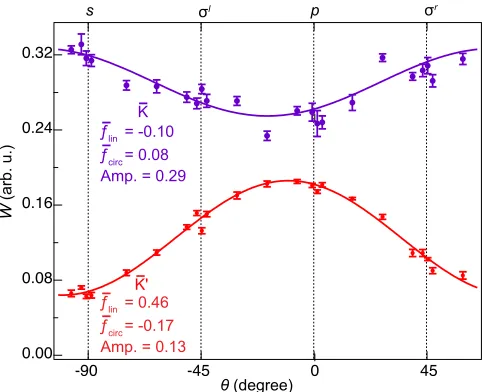
FIG. 3. Spectral weightW (markers) in the CB as a function of polarization angleθmeasured at ¯K0(red) and ¯K (purple). Curves represent fits of the energy- and k-integrated pho-toemission intensity incorporating our model for the excited-state population in Eq. (4) with the given pre-factors and amplitude (Amp.).
perfectly inversion-symmetric BL when neglecting exter-nal influences, becausefcirc(q)≈τz(−τz) for the bottom
(top) layer, and thusτz+ (−τz) = 0 when summing over
layers.
The general form of the occupation function writ-ten in Eq. (4) shows that the inwrit-tensity in polarization-dependent TR-ARPES spectra can be decomposed into linear and circular dichroism contributions. We explore this idea further by fitting the measured θ-dependent spectral weight (W) at the peak of the optical excitation to an energy- and k-integrated form of the intensity in Eq. (1) with the expression in Eq. (4) implemented. The spectral weight and the results of the fitting are presented at ¯K0 and ¯K in Fig. 3. The fits provide the amplitudes
¯
flinand ¯fcirc, which represent an average over thek-range used to determineW. The values are stated in Fig. 3 and reveal that both the cos(2θ)- and sin(2θ)-terms are significant in our sample. The cos(2θ)-dependence is in agreement with the model around ¯K for BL MoS2. The sign-change between ¯K0and ¯K of the cos(2θ)-terms is not explained by our simple model and may arise due to a strong anisotropy of the photoemission matrix element (Mn) as described in Ref. 34. Many-body interactions
dichroism. Indeed, if the ARPES signal was completely dominated by the first layer, one would expect similar results for a single layer [19, 20], bilayer and bulk [17]. This is clearly not the case. Substrate-induced symmetry breaking, on the other hand, is expected to be rather mi-nor because the substrate is known to have only a small effect on the electronic structure and spin texture of SL TMDCs on noble metal surfaces, since the region around
¯
K falls into a projected band gap of the substrate [43, 44]. Finally, deviations from the ideal case could here also be caused by a minor presence of single-domain SL MoS2 areas on the sample.
In summary, we observe momentum-resolved linear dichroism associated with optically excited electrons in the CB of BL MoS2. Using a model to account for the polarization in both steps of our photoemission pump-probe experiment, we show that this can be linked to the intralayer single-electron hopping in the system. Exploiting the polarization of both pulses governing the optical excitation and subsequent photoemission in TR-ARPES offers an intriguing possibility to extract information about the electronic wave functions involved in the processes. The utility of this approach extends beyond valley dependent selection rules to studies of complex topological properties of unoccupied states such as the Berry curvature.
We thank Phil Rice and Alistair Cox for technical support during the Artemis beamtime. We gratefully acknowledge funding from VILLUM FONDEN through the Young Investigator Program (Grant. No. 15375) and the Centre of Excellence for Dirac Materials (Grant. No. 11744), the Danish Council for Independent Re-search, Natural Sciences under the Sapere Aude program (Grant No. DFF-4002-00029 and DFF-6108-00409) and the Aarhus University Research Foundation. Access to the Artemis Facility was funded by STFC. H.R. acknowl-edges the support from the Swedish Research Council (VR 2018-04252). I.M. acknowledges financial support by the International Max Planck Research School for Chemistry and Physics of Quantum Materials (IMPRS-CPQM).
∗
These authors contributed equally to the work.
†
current address: Department of Physics, University of Trieste, Via Valerio 2,Trieste 34127, Italy
‡
Electronic address: [email protected]
[1] B. Henderson and G. F. Imbusch, Optical Spectroscopy of Inorganic Solids (Oxford University Press, 2006). [2] W. Eberhardt and E. W. Plummer, Physical Review B
21, 3245 (1980).
[3] I. Gierz, M. Lindroos, H. H¨ochst, C. R. Ast, and K. Kern, Nano Letters12, 3900 (2012).
[4] Z.-H. Zhu, C. N. Veenstra, G. Levy, A. Ubaldini, P. Syers,
N. P. Butch, J. Paglione, M. W. Haverkort, I. S. Elfimov, and A. Damascelli, Phys. Rev. Lett.110, 216401 (2013). [5] Y. Cao, J. A. Waugh, X.-W. Zhang, J.-W. Luo, Q. Wang, T. J. Reber, S. K. Mo, Z. Xu, A. Yang, J. Schneeloch, G. D. Gu, M. Brahlek, N. Bansal, S. Oh, A. Zunger, and D. S. Dessau, Nature Physics9, 499 EP (2013). [6] M. Sch¨uler, U. D. Giovannini, H. H¨ubener, A. Rubio,
M. A. Sentef, and P. Werner, “Local berry curvature signatures in dichroic angle-resolved photoelectron spec-troscopy,” (2019), arXiv:1905.09404.
[7] S. Cho, J.-H. Park, J. Hong, J. Jung, B. S. Kim, G. Han, W. Kyung, Y. Kim, S.-K. Mo, J. D. Denlinger, J. H. Shim, J. H. Han, C. Kim, and S. R. Park, Phys. Rev. Lett.121, 186401 (2018).
[8] D. Xiao, G.-B. Liu, W. Feng, X. Xu, and W. Yao, Phys. Rev. Lett.108, 196802 (2012).
[9] K. F. Mak, K. L. McGill, J. Park, and P. L. McEuen, Science344, 1489 (2014).
[10] K. Mak, K. He, J. Shan, and T. Heinz, Nature Nan-otechnology7, 494 (2012).
[11] H. Zeng, J. Dai, W. Yao, D. Xiao, and X. Cui, Nature Nanotech.7, 490 (2012).
[12] L. Perfetti, P. A. Loukakos, M. Lisowski, U. Bovensiepen, H. Eisaki, and M. Wolf, Physical Review Letters 99, 197001 (2007).
[13] E. Malic, T. Winzer, E. Bobkin, and A. Knorr, Phys. Rev. B84, 205406 (2011).
[14] T. Rohwer, S. Hellmann, M. Wiesenmayer, C. Sohrt, A. Stange, B. Slomski, A. Carr, Y. Liu, L. M. Avila, M. Kallane, S. Mathias, L. Kipp, K. Rossnagel, and M. Bauer, Nature471, 490 (2011).
[15] J. C. Johannsen, S. Ulstrup, F. Cilento, A. Crepaldi, M. Zacchigna, C. Cacho, I. C. E. Turcu, E. Springate, F. Fromm, C. Raidel, T. Seyller, F. Parmigiani, M. Gri-oni, and P. Hofmann, Physical Review Letters 111, 027403 (2013).
[16] A. Grubiˇsi´c ˇCabo, J. A. Miwa, S. S. Grønborg, J. M. Riley, J. C. Johannsen, C. Cacho, O. Alexander, R. T. Chapman, E. Springate, M. Grioni, J. V. Lauritsen, P. D. C. King, P. Hofmann, and S. Ulstrup, Nano Lett.
15, 5883 (2015).
[17] R. Bertoni, C. W. Nicholson, L. Waldecker, H. H¨ubener, C. Monney, U. D. Giovannini, M. Puppin, M. Hoesch, E. Springate, R. T. Chapman, C. Cacho, M. Wolf, A. Ru-bio, and R. Ernstorfer, Phys. Rev. Lett. 117, 277201 (2016).
[18] S. Aeschlimann, R. Krause, M. Ch´avez-Cervantes, H. Bromberger, R. Jago, E. Mali´c, A. Al-Temimy, C. Co-letti, A. Cavalleri, and I. Gierz, Phys. Rev. B96, 020301 (2017).
[19] S. Ulstrup, A. Grubiˇsi´c ˇCabo, D. Biswas, J. M. Ri-ley, M. Dendzik, C. E. Sanders, M. Bianchi, C. Cacho, D. Matselyukh, R. T. Chapman, E. Springate, P. D. C. King, J. A. Miwa, and P. Hofmann, Phys. Rev. B95, 041405 (2017).
[20] H. Beyer, G. Rohde, A. Grubiˇsi´c ˇCabo, A. Stange, T. Ja-cobsen, L. Bignardi, D. Lizzit, P. Lacovig, C. E. Sanders, S. Lizzit, K. Rossnagel, P. Hofmann, and M. Bauer, in press, Phys. Rev. Lett. (2019), 1907.10553.
[21] M. Dendzik, A. Bruix, M. Michiardi, A. S. Ngankeu, M. Bianchi, J. A. Miwa, B. Hammer, P. Hofmann, and C. E. Sanders, Phys. Rev. B96, 235440 (2017).
[23] “See Supplemental Material for details of sample growth and X-ray photoelectron diffraction data on the distribu-tion of BL MoS2domain orientations, for high resolution ARPES measurements, for TR-ARPES experimental de-tails and for full dede-tails on the Hamiltonian and tight binding parameters applied in the model.”.
[24] M. Baker, R. Gilmore, C. Lenardi, and W. Gissler, Ap-plied Surface Science150, 255 (1999).
[25] F. J. Garc´ıa de Abajo, M. A. Van Hove, and C. S. Fadley, Phys. Rev. B63, 075404 (2001).
[26] S. S. Grønborg, S. Ulstrup, M. Bianchi, M. Dendzik, C. E. Sanders, J. V. Lauritsen, P. Hofmann, and J. A. Miwa, Langmuir31, 9700 (2015).
[27] M. Dendzik, M. Michiardi, C. Sanders, M. Bianchi, J. A. Miwa, S. S. Grønborg, J. V. Lauritsen, A. Bruix, B. Ham-mer, and P. Hofmann, Phys. Rev. B92, 245442 (2015). [28] H. Bana, E. Travaglia, L. Bignardi, P. Lacovig, C. E. Sanders, M. Dendzik, M. Michiardi, M. Bianchi, D. Lizzit, F. Presel, D. D. Angelis, N. Apostol, P. K. Das, J. Fujii, I. Vobornik, R. Larciprete, A. Baraldi, P. Hof-mann, and S. Lizzit, 2D Materials5, 035012 (2018). [29] D. Woodruff, Surf. Sci. Rep.62, 1 (2007).
[30] J. B. Pendry, Journal of Physics C: Solid State Physics
13, 937 (1980).
[31] J. He, K. Hummer, and C. Franchini, Phys. Rev. B89, 075409 (2014).
[32] S. V. Hoffmann, C. Søndergaard, C. Schultz, Z. Li, and P. Hofmann, Nucl. Instr. and Meth. Phys. Res. A 523, 441 (2004).
[33] S. Ulstrup, J. C. Johannsen, A. Crepaldi, F. Cilento, M. Zacchigna, C. Cacho, R. T. Chapman, E. Springate, F. Fromm, C. Raidel, T. Seyller, F. Parmigiani, M. Gri-oni, and P. Hofmann, Journal of Physics: Condensed Matter27, 164206 (2015).
[34] H. Rostami, K. Volckaert, N. Lanata, S. K. Mahatha, C. E. Sanders, M. Bianchi, D. Lizzit, L. Bignardi, S. Lizzit, J. A. Miwa, A. V. Balatsky, P. Hofmann, and S. Ulstrup, “Layer and orbital interference effects in photoemission from transition metal dichalcogenides,” (2019), arXiv:1910.01882 [cond-mat.mtrl-sci].
[35] S. Moser, Journal of Electron Spectroscopy and Related Phenomena214, 29 (2017).
[36] A. Korm´anyos, V. Z´olyomi, N. D. Drummond, P. Rakyta, G. Burkard, and V. I. Fal’ko, Phys. Rev. B88, 045416 (2013).
[37] H. Rostami, A. G. Moghaddam, and R. Asgari, Phys. Rev. B88, 085440 (2013).
[38] H. Rostami, R. Asgari, and F. Guinea, Journal of Physics: Condensed Matter28, 495001 (2016).
[39] Z. Gong, G.-B. Liu, H. Yu, D. Xiao, X. Cui, X. Xu, and W. Yao, Nature Communications4, 2053 (2013). [40] A. Korm´anyos, V. Z´olyomi, V. I. Fal’ko, and G. Burkard,
Phys. Rev. B98, 035408 (2018).
[41] H. Haug and S. Koch, Quantum Theory of the Opti-cal and Electronic Properties of Semiconductors: Fourth Edition (World Scientific Publishing Company, 2004). [42] J. M. Riley, F. Mazzola, M. Dendzik, M. Michiardi,
T. Takayama, L. Bawden, C. Granerod, M. Leandersson, T. Balasubramanian, M. Hoesch, T. K. Kim, H. Takagi, W. Meevasana, P. Hofmann, M. S. Bahramy, J. W. Wells, and P. D. C. King, Nature Physics10, 835 (2014). [43] J. A. Miwa, S. Ulstrup, S. G. Sørensen, M. Dendzik, A. G.
ˇ
Cabo, M. Bianchi, J. V. Lauritsen, and P. Hofmann, Phys. Rev. Lett.114, 046802 (2015).