SOFTWARE ENGINEERING
Ilia Lvov
A Thesis Submitted for the Degree of PhD
at the
University of St Andrews
2019
Full metadata for this item is available in
St Andrews Research Repository
at:
http://research-repository.st-andrews.ac.uk/
Please use this identifier to cite or link to this item:
http://hdl.handle.net/10023/18936
Project Management in Social Data Science:
integrating lessons from research practice and software
engineering
Ilia Lvov
This thesis is submitted in partial fulfilment for the degree of
Doctor of Philosophy (PhD)
at the University of St Andrews
Candidate's declaration
I, Ilia Lvov, do hereby certify that this thesis, submitted for the degree of PhD, which is approximately 80,000 words in length, has been written by me, and that it is the record of work carried out by me, or principally by myself in collaboration with others as
acknowledged, and that it has not been submitted in any previous application for any degree.
I was admitted as a research student at the University of St Andrews in August 2014.
I received funding from an organisation or institution and have acknowledged the funder(s) in the full text of my thesis.
Date: 12.06.2019 Signature of candidate
Supervisor's declaration
I hereby certify that the candidate has fulfilled the conditions of the Resolution and
Regulations appropriate for the degree of PhD in the University of St Andrews and that the candidate is qualified to submit this thesis in application for that degree.
Date: 12.06.2019 Signature of supervisor
permission for it to be made available for use in accordance with the regulations of the University Library for the time being in force, subject to any copyright vested in the work not being affected thereby. We also understand, unless exempt by an award of an embargo as requested below, that the title and the abstract will be published, and that a copy of the work may be made and supplied to any bona fide library or research worker, that this thesis will be electronically accessible for personal or research use and that the library has the right to migrate this thesis into new electronic forms as required to ensure continued access to the thesis.
I, Ilia Lvov, confirm that my thesis does not contain any third-party material that requires copyright clearance.
The following is an agreed request by candidate and supervisor regarding the publication of this thesis:
Printed copy
No embargo on print copy.
Electronic copy
No embargo on electronic copy.
Date: 12.06.2019 Signature of candidate
Date: 12.06.2019 Signature of supervisor
Underpinning Research Data or Digital Outputs
Candidate's declaration
I, Ilia Lvov, understand that by declaring that I have original research data or digital outputs, I should make every effort in meeting the University's and research funders' requirements on the deposit and sharing of research data or research digital outputs.
Date: 12.06.2019 Signature of candidate
Permission for publication of underpinning research data or digital outputs
We understand that for any original research data or digital outputs which are deposited, we are giving permission for them to be made available for use in accordance with the
requirements of the University and research funders, for the time being in force.
We also understand that the title and the description will be published, and that the underpinning research data or digital outputs will be electronically accessible for use in accordance with the license specified at the point of deposit, unless exempt by award of an embargo as requested below.
The following is an agreed request by candidate and supervisor regarding the publication of underpinning research data or digital outputs:
No embargo on underpinning research data or digital outputs.
Date: 12.06.2019 Signature of candidate
Abstract
Online platforms, transaction processing systems, mobile sensors and other novel sources of data have shaped many areas of social research. The emerging discipline of social data science is subject to questions of epistemology, politics, ethics and responsibility, while the practice of doing social data science raises significant project management issues that include logistics, team communication, software system integration and stakeholder engagement. Keeping track of such a multitude of individual concerns while maintaining an overview of a social data science project as a whole is not trivial. This calls for provision of appropriate guidance for holistic project management.
The project management issues in social data science are strikingly similar to those arising in software engineering. In this thesis, I adapt a particular software engineering project management tool – the SEMAT Essence model (Jacobson et al., 2013) – to the needs of social data science. This model offers a holistic management approach by addressing key project aspects, including the often overlooked yet crucially important ones such as maintaining stakeholder engagement and establishing the ways of working. The SEMAT Essence is a progress tracking model and does not assume any specific work process, which is valuable given the great diversity of social data science projects.
Acknowledgements
This work was supported by the University of St Andrews (the 7th Century Scholarship).
I would like to thank the organisations that allowed me take part in their projects and use them as case studies: The Open University, The University of Edinburgh and The Wire Free Production company. A special thanks goes to the British Council for reviewing and approving the Shakespeare Lives evaluation case study. I would like to personally thank Dr Angus Bancroft for agreeing to test-drive the Social Data Science Scorecard Deck. Finally, I would like to express my gratitude to all the interview participants.
The digital outputs underpinning this thesis (the Social Data Science Scorecard Deck) can be accessed at:
C
ONTENTS
Contents i
List of Figures iv
List of Tables v
1 Introduction 1
1.1 Social Data Science Definition . . . 3
1.2 Research Design and Thesis Structure . . . 4
2 Key Challenges in Social Data Science: Literature Review 7 2.1 Social Data Science and Society . . . 7
2.1.1 Social Shaping of Supporting Technologies . . . 8
2.1.2 Politics of Social Data Science . . . 9
2.1.3 Accountability and Responsibility in Social Data Science . . . 11
2.2 Social Data Science and Epistemology . . . 14
2.2.1 Tension between Research Questions and Methods . . . 15
2.2.2 Data Sources and Naturally Occurring Data . . . 20
2.3 Ethics in Social Data Science . . . 21
2.4 Research Guidance and Project Management . . . 23
2.4.1 Relevance of Software Engineering Project Management Guidance to Social Data Science . . . 24
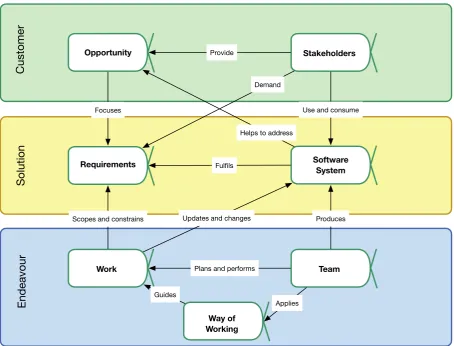
2.4.2 The SEMAT Essence . . . 26
2.5 Chapter Summary . . . 28
3 Informing the Project Management Tool: Case Studies 31 3.1 Methodology . . . 31
3.1.1 The Role of Prior Experience in Social Data Science . . . 32
3.1.2 Ethnography for Design: Justification . . . 33
3.2 Evaluation of the Shakespeare Lives Cultural Programme . . . 37
3.2.1 Case Overview: the Evaluation Project . . . 38
3.2.2 Fieldwork Methods . . . 41
3.2.3 Findings 1. Research Goals and Stakeholder . . . 44
3.2.4 Findings 2. Research Questions and Data Selection . . . 48
3.2.5 Findings 3. Research Methods and Data Analysis . . . 54
3.2.6 Findings 4. Research Infrastructure . . . 61
3.2.7 Findings 5. Project Team and Collaboration . . . 67
3.2.8 Summary: Key Lessons . . . 72
3.3 Production of Hit List Show for BBC Radio 5 live . . . 75
3.3.1 Case Overview: BBC Radio 5 live Hit List Show . . . 75
3.3.2 Fieldwork Methods . . . 78
3.3.3 Findings 1. Data Acquisition and Pre-processing: Linking Large Datasets 80 3.3.4 Findings 2. Data Analysis: Identifying Hit List Chart Entries . . . 87
3.3.5 Findings 3. Producers and Data: Establishing Trust . . . 93
3.3.6 Findings 4. Production Treatment: Turning Data into Radio . . . 97
3.3.7 Summary: Key Lessons . . . 99
3.4 Additional Fieldwork Evidence . . . 103
3.4.1 Evaluation of InfoMigrants Initiative . . . 103
3.4.2 Study of the Criminal Marketplaces on Dark Net . . . 108
3.5 Chapter Postface . . . 115
4 Social Data Science Scorecard Deck: the Project Management Tool 117 4.1 Essence of Social Data Science . . . 118
4.1.1 Demand Area of Concern . . . 118
4.1.2 Response Area of Concern . . . 121
4.1.3 Analytics Area of Concern . . . 122
4.1.4 Resources Area of Concern . . . 124
4.1.5 Endeavour Area of Concern . . . 126
4.2 Using the Scorecard Deck . . . 126
4.2.1 Process and Context of Use . . . 127
4.2.2 Spreadsheet Interface . . . 128
4.3 Content of the Scorecards . . . 131
4.3.1 Data . . . 131
4.3.2 Data Sources . . . 137
4.3.3 Research Questions . . . 144
4.3.4 Analysis Methods . . . 149
4.3.5 Artefacts . . . 156
4.3.6 Compliance . . . 160
5 Evaluation of Social Data Science Scorecard Deck 169 5.1 Methodology . . . 170
5.2 In-depth Evaluation: Applying the Deck in a Social Data Science Project . . . . 173
5.2.1 Shaping the Research Goals . . . 174
5.2.2 Assessing Project State . . . 180
5.2.3 Identifying Issues for Revision . . . 182
5.2.4 Case Conclusions . . . 185
5.3 Broad Evaluation: Expert Interviews . . . 187
5.3.1 Relevance of the Scorecards . . . 188
5.3.2 Clarity of the Scorecards . . . 193
5.3.3 Comprehensiveness of the Scorecards . . . 197
CONTENTS III
6 Conclusions 203
6.1 Limitations and Future Work . . . 205
Appendix A Scorecards Adapted from the SEMAT Kernel Model 207 A.1 Research Goals . . . 208
A.2 Stakeholders . . . 212
A.3 Infrastructure . . . 215
A.4 Team . . . 221
A.5 Work . . . 224
A.6 Ways Of Working . . . 228
Appendix B Ethical Approval Letter 235 B.1 Letters of Permission . . . 237
2.1 SEMAT Essence of Software Engineering diagram . . . 27
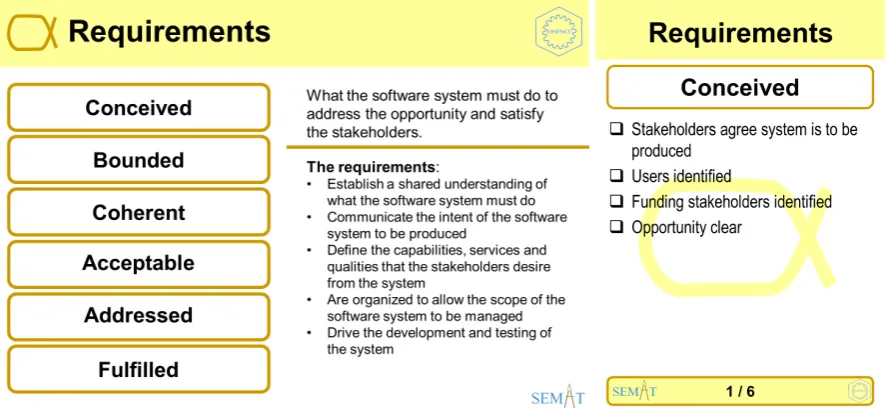
2.2 Example SEMAT alpha- and state cards . . . 28
4.1 Essence of Social Data Science diagram . . . 119
4.2 Spreadsheet representation of the Social Data Science Scorecard Deck . . . 130
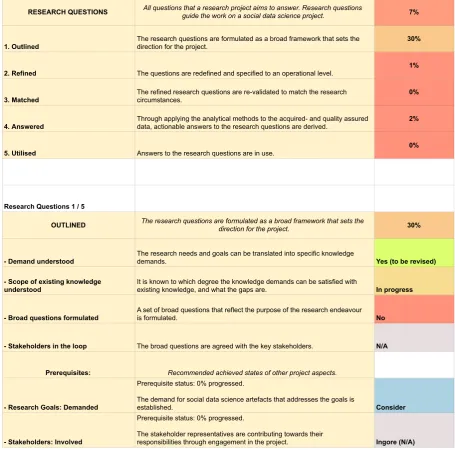
5.1 Example scorecards from the evaluation case study: Research Methods . . . 181
L
IST OF
T
ABLES
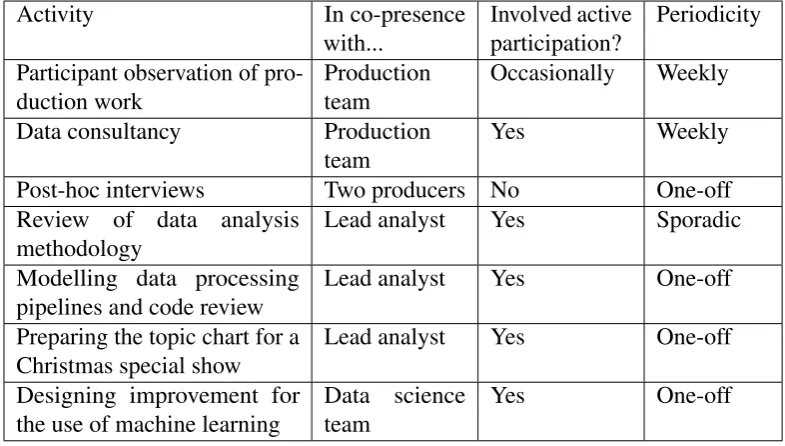
3.1 Fieldwork activities undertaken to study the Shakespeare Lives evaluation project. . 42
3.2 Fieldwork activities undertaken to study the production of the Hit List show. . . 78
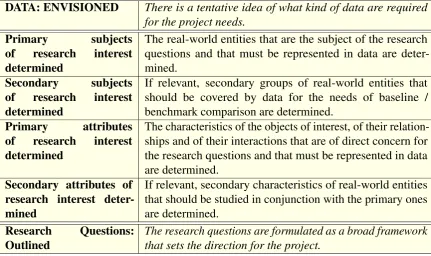
4.1 Data: Envisioned. Conditions and prerequisites. . . 132
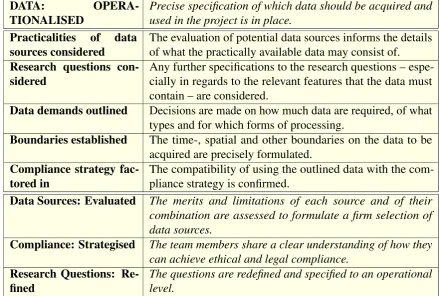
4.2 Data: Operationalised. Conditions and prerequisites. . . 133
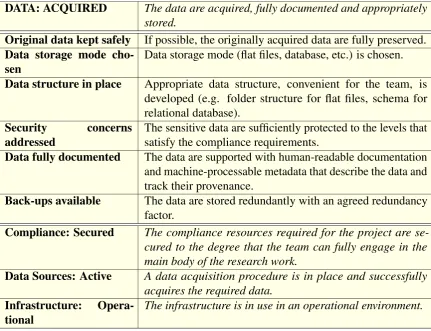
4.3 Data: Acquired. Conditions and prerequisites. . . 135
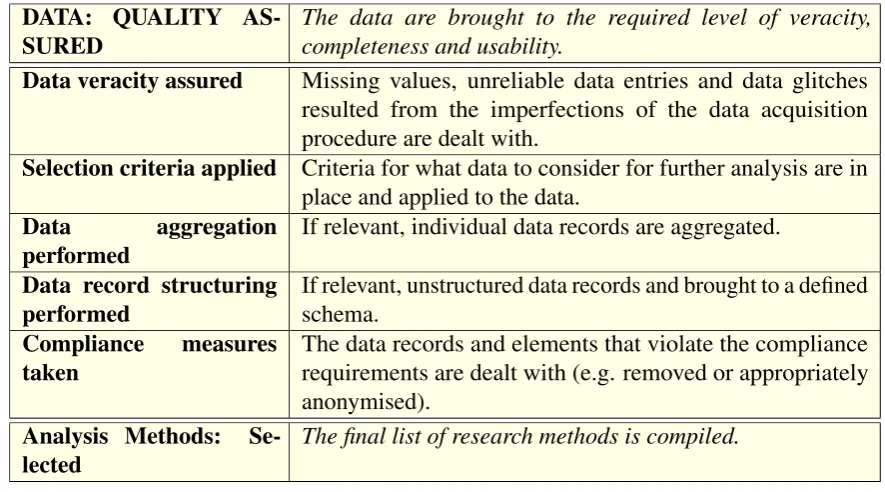
4.4 Data: Quality Assured. Conditions and prerequisites. . . 136
4.5 Data: Utilised. Conditions and prerequisites. . . 136
4.6 Data Sources: Identified. Conditions and prerequisites. . . 138
4.7 Data Sources: Evaluated. Conditions and prerequisites. . . 140
4.8 Data Sources: Selected. Conditions and prerequisites. . . 141
4.9 Data Sources: Supported. Conditions and prerequisites. . . 143
4.10 Data Sources: Active. Conditions and prerequisites. . . 143
4.11 Data Sources: Utilised. Conditions. No prerequisites specified. . . 144
4.12 Research Questions: Outlined. Conditions and prerequisites. . . 145
4.13 Research Questions: Refined. Conditions and prerequisites. . . 147
4.14 Research Questions: Matched. Conditions and prerequisites. . . 148
4.15 Research Questions: Answered. Conditions and prerequisites. . . 148
4.16 Research Questions: Utilised. Conditions and prerequisites. . . 149
4.17 Analysis Methods: Selected. Conditions and prerequisites. . . 152
4.18 Analysis Methods: Piloted. Condition. No prerequisites specified. . . 153
4.19 Analysis Methods: Executed. Conditions and prerequisites. . . 155
4.20 Analysis Methods: Extended. Condition. No prerequisites specified. . . 156
4.21 Artefacts: Outlined. Conditions and prerequisites. . . 157
4.22 Artefacts: Envisioned. Conditions and prerequisites. . . 157
4.23 Artefacts: Supported. Conditions and prerequisites. . . 158
4.24 Artefacts: Iterated. Conditions and prerequisites. . . 159
4.25 Artefacts: Released. Conditions and prerequisites. . . 160
4.26 Compliance: Considered. Conditions and prerequisites. . . 162
4.27 Compliance: Guided. Conditions and prerequisites. . . 163
4.28 Compliance: Strategised. Condition. No prerequisites specified. . . 164
4.29 Compliance: Progressed. Conditions and prerequisites. . . 165
4.30 Compliance: Secured. Condition. No prerequisites specified. . . 166
4.31 Compliance: Maintained. Condition. No prerequisites specified. . . 167
A.1 Research Goals: Problem Identified. Condition. No prerequisites specified. . . 208
A.2 Research Goals: Formulated. Conditions and prerequisites. . . 209
A.3 Research Goals: Demanded. Condition. No prerequisites specified. . . 209
A.4 Research Goals: Evaluated. Conditions and prerequisites. . . 209
A.5 Research Goals: Viable. Conditions and prerequisites. . . 210
A.6 Research Goals: Addressed. Conditions and prerequisites. . . 211
A.7 Research Goals: Fulfilled. Conditions and prerequisites. . . 211
A.8 Stakeholders: Recognised. Conditions and prerequisites. . . 213
A.9 Stakeholders: Represented. Condition. No prerequisites specified. . . 214
A.10 Stakeholders: Involved. Condition. No prerequisites specified. . . 214
A.11 Stakeholders: In Agreement. Conditions and prerequisites. . . 215
A.12 Stakeholders: Satisfied with Progress. Conditions and prerequisites. . . 216
A.13 Stakeholders: Satisfied with Artefacts. Conditions and prerequisites. . . 216
A.14 Infrastructure: Architecture Selected. Conditions and prerequisites. . . 218
A.15 Infrastructure: Demonstrable. Condition. No prerequisites specified. . . 219
A.16 Infrastructure: Usable. Condition. No prerequisites specified. . . 219
A.17 Infrastructure: Ready. Condition. No prerequisites specified. . . 220
A.18 Infrastructure: Operational. Condition. No prerequisites specified. . . 220
A.19 Infrastructure: Retired. Conditions and prerequisites. . . 220
A.20 Team: Seeded. Conditions and prerequisites. . . 222
A.21 Team: Formed. Conditions and prerequisites. . . 223
A.22 Team: Collaborating. Conditions and prerequisites. . . 224
A.23 Team: Performing. Conditions and prerequisites. . . 224
A.24 Team: Adjourned. Conditions and prerequisites. . . 225
A.25 Work: Initiated. Conditions and prerequisites. . . 225
A.26 Work: Piloted. Conditions and prerequisites. . . 227
A.27 Work: Prepared. Conditions and prerequisites. . . 228
A.28 Work: Started. Conditions and prerequisites. . . 229
A.29 Work: Under Control. Conditions and prerequisites. . . 230
A.30 Work: Concluded. Conditions and prerequisites. . . 231
A.31 Ways of Working: Informed. Conditions and prerequisites. . . 232
A.32 Ways of Working: Employed. Conditions and prerequisites. . . 233
A.33 Ways of Working: Adapted. Condition. No prerequisites specified. . . 233
A.34 Ways of Working: Optimised. Condition. No prerequisites specified. . . 234
1
C
HAPTER
O
NE
I
NTRODUCTION
The world of data is going through fundamental changes that concern the sorts of data that are acquired, the methods and technologies that are applied to them and even the subject of knowledge that results from these processes (boyd and Crawford, 2012). This can be colourfully illustrated by the appearance of a range of new terms. Just a few examples are “big data” (Jagadish et al., 2014), “open data” (Janssen et al., 2012) and “data science/scientist” (Davenport and Patil, 2012; Dhar, 2013) that captures a notion that data become a subject of expertise on their own. As Tauberer (2014) argues, while one may try to dismiss those terms as mere buzzwords, they aid in navigation through the emerging trends in the world of data and indicate changes in our perception of data, growing interest in them and rising expectations of them.
The changes in the world of data have a potential to provide new insights into the life of societies and their members. In the academic environment, they allow posing and answering new questions in social science disciplines. For example, Kitchin (2013) discusses the use of new forms of data in human geography. Mao et al. (2011) and many others apply computationally intensive methods to new forms of social data to forecast changes in financial markets. Many actors outside of academia seek knowledge about people as well – businesses are looking for marketing insights (Erevelles et al., 2016), journalists produce independent investigations of societal issues with data-driven methods and seek to present their findings in forms digestible for wider audiences (Gray et al., 2012), governments employ data for the needs of national security (Kim et al., 2014), while civic movements, in turn, demand openness of data from the government (Janssen et al., 2012) and promote unconventional use of these data to improve peoples’ lives (Baraniuk, 2013). Moreover, as this thesis will later show, new forms of collaboration on the intersection of academic- and non-academic settings are also emerging.
The scope of the social issues tackled with data-driven methods also varies greatly. For example, a study by Servia-Rodríguez et al. (2017) looks into the well-being of individuals. Many studies
look at very specific social groups and populations. For example, much of recent research studies the behaviour of users of a particular social media platform, with Twitter being the most frequently studied (e.g. Zubiaga et al., 2016). That being said, some studies are in fact concerned with questions of society as a whole. For example, Burrows and Savage (2014, p. 3) report on the experience of the Great British Class Survey – a “a hybrid project, which spliced together a fairly conventional social survey (providing accounts of actions), with a high-profile web platform hosted by the BBC asking a battery of questions about respondents’ economic, social and cultural capital”.
Quite often the data employed in the new forms of social research satisfy some quantitative definition of “bigness” – for example, the traditional 3Vs of volume, variety and velocity or any of their extensions (cf. Laney, 2001; Ari et al., 2012; Marz and Warren, 2015; Kitchin, 2013) – however, this is not necessarily the case. For example, Psylla et al. (2017), in their study of gender’s impact on social interactions, construct graphs of Facebook interactions for a limited sample of students that are subsequently contextualised with other data types, including traditional survey data. The resulting data are by no means big, but the process of their construction (i.e. systematically gathering records of Facebook interactions, transforming them into a meaningful dataset and putting the data into context of data from other sources) requires actions and decisions uncommon for traditional social research.
The example above shows how the new forms of research embrace the emerging world of digital traces that allow us to navigate back and forth between detailed and aggregated descriptions of social processes (Latour, 2009; Procter et al., 2015). Some of these traces may be transformed into data akin to the naturally occurring data known to traditional social sciences – e.g., some of social media user-generated content is similar to dialogue transcripts studied by sociologists engaged in conversation analysis (Wetherell, 1998) and some transnational data is familiar to economics and management (cf. Hallowell, 1996; McInish and Wood, 1992). Other forms of digital traces (e.g. sensor data) are out of scope of traditional social sciences (a detailed taxonomy suggesting 26 types of new social data can be found in Kitchin and McArdle, 2016). The value of data resulting from different digital traces can thus be maximised by interlinking and aggregation (boyd and Crawford, 2012).
1.1. SOCIAL DATA SCIENCE DEFINITION 3
gives a new spin to key issues in epistemology (Kitchin, 2014; Burns, 2015). It may not only be difficult to judge whether the research findings are valid – it is sometimes hard to say whether the research questions have been correctly posed in the first place. This suggests that the crucial aspect of scientific ethos in data-driven research should becontinuous maintenance of critical, self-reflective stance towards own research activities, which involves keeping track of- and accounting for the decisions and operationalisations involved, understanding their limitations and assessing the validity of the process as a whole and of the derived findings. In the world of the ubiquitous epistemological crisis that goes way beyond research inquiry1, data-intensive
research, as a new paradigm of knowledge discovery (Tansley et al., 2009), simply cannot afford to ignore these issues.
1.1 Social Data Science Definition
Reflecting on the discussion of the new opportunities for studying the social, the new actors emerging in this the field and the new challenges of adhering to the scientific ethos, I would like to suggestsocial data scienceas the key term for this thesis and to provide the following definition:
Social data science (SDS) is the whole range of activities, both academic and non-academic, that seek to gain verifiable and robust actionable knowledge about societies, their groups and individual members through embracing a variety of forms and types of data and investigating them within a self-reflective research process using well-informed methods.
This term, while in use in the literature, is not the most popular one among those that aim to capture the essence of new form of social inquiry. One may quite often see it as a publication keyword (cf. Margetts, 2016; Gao et al., 2017), but there have been only few attempts to thoroughly discuss it. Therefore, I would like to motivate my choice of terminology.
First of all, the parental termdata scienceis certainly among the most popular ones. Burrows and Savage (2014) show that “data scientist” has become a more frequent search term on Google than “statistician” in 2013. At the moment of writing, the frequency of searching for “data scientist” is at a historic peak with approximately 5 times more searches per month than for “statistician”2.
1One example of this crisis is the ongoing discussion of critical thinking and media literacy, cf. boyd (2018);
Doctrow (2018).
This off-the-chart popularity has led Davenport and Patil (2012) to famously pronounce data scientist “the sexiest job of the 21st century”. Cassel et al. (2017) argue that the basics of data science should be taught to undergraduate students of all disciplines.
Second,socialdata science is not an obscure term by itself either. Arguably, it is most widely recognised within the United Kingdom. For example, multiple research initiatives unequivocally specialise in social data science. Cardiff University hosts the Social Data Science Lab3. The Alan
Turing Institute – a national cross-university research institution in data science – has a Social Data Science interest group4. One of its participating academic bodies, Oxford Internet Institute
of the University of Oxford, even offers an MSc in Social Data Science5. The international recognition of social data science as a valid term may be illustrated by the University of Copenhagen’s Centre for Social Data Science6and the Social Data Science lab in Montréal7– this is not to mention that other organisations may recognise and adopt the term without using it as part of their title.
The most important reason for choosing the term “social data science” is its ability to capture the essence of this thesis’ subject of inquiry and being a natural match for the suggested definition. A particular aspect of this definition that is worth mentioning in this regard it the use of the phrase “actionable knowledge”. Indeed, this phrase is something of a tautology: according to the widely accepted Knowledge Hierarchy model (Rowley, 2007), knowledge is by definition transferable into instructions for further actions. Yet, knowledge’s potential for action is worth re-emphasising to strengthen the notion that social data science has directimpacton human lives and society in general and thus making sure that social data science is done in accordance with good research principles and practice is ofsignificant societal importance.
1.2 Research Design and Thesis Structure
In this thesis, I argue that the complexity of doing social data science transcends the questions of methodology and raises significant project management issues that include logistics, team communication, software system integration, stakeholder engagement and ensuring compliance with ethical and regulatory frameworks. Keeping track of such a multitude of individual aspects while maintaining an overview of the project as a whole and ensuring ashared understandingof the key project’s decisions and operationalisations within the team is far from trivial. This calls
3http://socialdatalab.net/
4https://www.turing.ac.uk/research_projects/social-data-science/ 5https://www.oii.ox.ac.uk/study/msc-in-social-data-science/ 6http://sodas.ku.dk/
1.2. RESEARCH DESIGN AND THESIS STRUCTURE 5
for provision ofguidance for holistic project management of social data science projects. The project management issues in social data science are strikingly similar to those arising in software engineering. Through decades of existence, software engineering (Sommerville, 2016) has gone through a number of shifts to increasingly mature project management paradigms that have led to production of numerous pieces of increasingly robust management guidance. Given this, I propose a thesisthat there is significant value for social data science in adapting the guidance from software engineering for the needs of holistic project managementand design my research to address the correspondinggoalofimplementing a successful adaptation of such guidance.
To progress towards this goal, I set out to achieve the followingobjectives:
1. to contextualise my work in understanding of the grand challenges that social data science faces as a discipline;
2. to make an informed decision on what project management guidance from the field of software engineering can be effectively adapted to social data science;
3. to discover the particular issues that arise in the practice of doing social data science, how those issues intertwine and amplify each other and how they are dealt with by social data science project teams;
4. combining the outcomes of objectives 1-3, to implement a tool for holistic project management in social data science;
5. to use the implemented tool in the management of a social data science project;
6. to subject the tool to external validation.
The main body of the thesis is structured in accordance with these objectives. Chapter 2 addresses the objectives 1 and 2 through reviewing literatureon challenges in social data science (see Sections 2.1, 2.2 and 2.3) and on relevant project management guidance (see Section 2.4). Chapter 3 addresses objective 3 through reporting onethnographic case studiesinformed by
participant observationof social data science projects. The ethnographies produced stand as a significant contribution on their own. Chapter 4 addresses objective 4 by discussing the processes ofsystematically informing the designof a project management tool for social data science – the Social Data Science Scorecard Deck. Chapter 5 addresses objective 5 by reporting on an
2
C
HAPTER
T
WO
K
EY
C
HALLENGES IN
S
OCIAL
D
ATA
S
CIENCE
:
L
ITERATURE
R
EVIEW
The Introduction has provided the definition for social data science and suggested that it is a highly problematic field of activity. It is thus logical to proceed to a critical analysis of the major known issues in social data science and to examine how a project management tool that captures the lessons from software engineering may assist in coping with these issues. Given thesocial nature of the discipline, I choose to start with discussion of the problematic relationships between social data science and society.
2.1 Social Data Science and Society
In the following discussion of the relationship between social data science and society I will draw heavily on literature in science and technology studies (STS). Indeed, as a discipline that relies on data generated through new technologies and on methods that are implemented in new technologies, social data science goes hand in hand with technological development and innovation (Edwards et al., 2013; Halfpenny and Procter, 2015; Wright, 2014; Jagadish et al., 2014). The STS frameworks can help to assess the roles of different social groups in the development of tools and methods for social data science and to discuss the social and political implications of this division of roles.
2.1.1 Social Shaping of Supporting Technologies
As outlined above, social data science is continuously supported by technological development. These developments do not happen in vacuum – rather, technology and society continuously interact and shape each other (Williams and Edge, 1996). Therefore, social factors might influence the prioritisation with which different developments that support social data science are produced. As such, one important factor for this prioritisation is whatperceived advantagea potential technological development is expected to bring. Such advantages may, for example, be managerial (McAfee et al., 2012), political (Janssen et al., 2012) or scientific (Raghavan, 2014). MacKenzie and Wajcman (1999) point out that specifically the economic or business advantage is commonly the strongest motivation force. Moreover, the technological developments for social data science are likely to happen in the areas where growing expertise in dealing with new forms of data leads to increasing returns on adoption (cf. Arthur, 1994) of data science.
The notions above correlate with the history of innovations that support social data science. In its early days, social data science largely relied on so-called “big data” technologies that developed in- and were adopted by large hi-tech companies. For example, the famous MapReduce computational paradigm for parallel data processing was designed at Google (Dean and Ghemawat, 2008). It has subsequently received an open-source implementation in Apache Hadoop whose co-founder Doug Cutting was Yahoo’s employee at the time and led the development project in this capacity (Shvachko et al., 2010). Many of the most famous earliest methodological innovations in social data science also came from the hi-tech industry – for example, collaborative filtering algorithms for personalisation of recommendations (Linden et al., 2003; Das et al., 2007) and Google’s PageRank algorithm for ranking importance of nodes in larges-scale networks of linked texts (Page et al., 1999).
2.1. SOCIAL DATA SCIENCE AND SOCIETY 9
they are more light-weight than Hadoop, less rigid in terms of suggested data processing pipeline, provide convenient APIs for many programming languages and thus can be repurposed with more flexibility.
What is arguably even more important for wider adoption of social data science is the appearance of technologies specifically for dealing with datasets whose complexity is higher than supported by standard data analysis software such as spreadsheet software yet not high enough to require a complex multi-node hardware infrastructure. Voss et al. (2017) refer to such datasets as “small big data”. One group of such technologies facilitate parallel computations on a single multi-core machine. For example, the Streams API for parallel computing was added to Java in version 8 of the language (Urma et al., 2015). Python and R – Programming languages of ever increasing popularity in the field of data analysis (Robinson, 2017) – also start supporting parallelism through dedicated modules and packages (Raschka, 2014; Bengtsson, 2018). Utilising the computational power of a single workstation or server is relatively straightforward compared to technologies like Hadoop (and even Spark, cf. Zaharia et al., 2010) that are aimed at performing computations in connected clusters of multiple computers. While Hadoop and Spark can run on a single machine, their overheads would be disproportionately high compared to the infrastructure complexity – and starting up a cluster is often neither feasible nor required (Stucchio, 2013). Thanks to technological and methodological advancements, social data science has started to be adopted by a diverse set of social actors such as journalists (Gray et al., 2012), civic movements (Townsend, 2013), smaller businesses (Coleman et al., 2016) and authorities (Berk et al., 2016). However, this does not by itself bring true democratisation to social data science due to the inequalities in access to- and control of the new forms of social data themselves, which by themselves become a valuable resource of power. The next section will look at these issues through the prism of politics of data science.
2.1.2 Politics of Social Data Science
Data by themselves are also becoming increasingly political, as varying levels of data access and control create digital divides in the society (boyd and Crawford, 2012; Savage and Burrows, 2007) and raise questions of ownership of data, human rights, and ethics and privacy (Savage and Burrows, 2007; Ruppert, 2013). The distribution of access to new forms of social data is strongly skewed in favour of a limited number of big corporations (Törnberg and Törnberg, 2018; Department for Digital, Culture, Media and Sport, 2018a). This inequality in access to data does not only mean that other actors in social data science have a hard time competing with the big players; it also raises questions of whether the owners of large datasets are effectively capable of public surveillance (Fuchs, 2017, pp. 52-61, 183-207), or at least of knowing more than the data they own immediately suggest. Indeed, social data science methods allow to use the digital traces (Latour, 2009) that individuals routinely leave in the form of user-generated-, transaction-or senstransaction-or data to draw reliable inferences about private aspects of human life that individuals do not directly disclose (Kosinski et al., 2013) and to link disparate anonymised data records with a person’s identity (De Montjoye et al., 2015).
The example of using social data science as a means of gaining power unfairly that has arguably sparked the biggest public and journalistic outcry thus far is the one related to manipulation of voter opinions before the US Presidential Election (Rosenberg et al., 2018; Cadwalladr and Graham-Harrison, 2018) and the Brexit referendum (Cadwalladr, 2017) in 2016. The “Leave” referendum campaign and the Trump’s presidential campaign were accused of using Facebook data for micro-targeting, i.e. for selecting individual recipients of promotional messages and for tailoring the message to the exact social, economic, demographic and psychological characteristics of each recipient or of small groups (Papakyriakopoulos et al., 2018).
Micro-targeting was not by itself a new technique. It had been known in marketing for almost a decade (cf. Agan, 2007). In the context of politics, its aspects were employed in Obama’s presidential campaign in 2008 (Franz and Ridout, 2010). The ethical concerns of micro-targeting were also not new, as they started to appear almost simultaneously with the initial spread of the technique (Barbu, 2014). Korolova (2010) questioned the ethical and privacy considerations of using social media data for micro-targeting.
2.1. SOCIAL DATA SCIENCE AND SOCIETY 11
Trending” feature – a chart of the most popular news stories – did not manage to filter out unreliable news entries, or “fake news” (Thielman, 2016). While there were political fake news that supported both Trump and his opponent Clinton, the frequency of the pro-Trump fake news was much higher (Allcott and Gentzkow, 2017). Thanks to Facebook Trending, the already high reach of the those articles was further increased.
Interestingly, the topic of the 2016 US presidential elections can also show how social data science can potentially empower society. Indeed, it provides an example of social data science being used to oppose another instrument of public opinion manipulation – social media bots that spread promotional messages while pretending to be human users. Bessi and Ferrara (2016) use contemporary data analysis techniques to compare tweets by bots and genuine users who support either Trump or Clinton. The findings of this study may equip those who read political debates on Twitter with better understanding of how bots behave, so that they could spot bot tweets in the conversations. To construct samples of bot and human post, Bessi and Ferrara (ibid.) employ “BotOrNot” (Davis et al., 2016) – a bot-detection system that also employs data-driven algorithms. Similar techniques are applied by Narayanan et al. (2017) to Twitter posts around Brexit. Such studies demonstrate the potential social value of social data science. The juxtaposition of these studies with the scandals surrounding Facebook, in turn, raise the questions ofresponsibility and accountabilityin social data science.
2.1.3 Accountability and Responsibility in Social Data Science
As social data science may equally bring value to the society and, when misused, pose societal risks, it is important to consider how the notions of responsibility and accountability can be incorporated into its practice. Given the strong ties between social data science and methodological and technical innovation, a natural first step in that is examination of the responsible innovationprinciples. Responsible innovation is a relatively new and broad concept. While its precise scope is a bit ill-defined, its widely cited definition is given by von Schomberg (2011, p. 50):
“A transparent, interactive process by which societal actors and innovators become mutually responsive to each other with a view to the (ethical) acceptability, sustainability and societal desirability of the innovation process and its marketable products (in order to allow a proper embedding of scientific and technological advances in our society).”
successor of various earlier concepts, including “anticipatory governance, technology assessment, and upstream public engagement” (van Oudheusden, 2014, p. 68). The constructive technology assessment school of thought seems to be of the most direct relevance, at it argues for assessing technologies not through observing their impact, but through predicting it in advance (Schot and Rip, 1997) and can help ensure that innovations meet existing societal demands (Genus, 2006; van Merkerk and Smits, 2008). This notion is closely related to the public engagement with science movement, which also considers responsible innovation to be its successor (Stilgoe et al., 2014).
Responsible innovation poses the questions of who exactly is responsible, how they are responsible and for what (Grinbaum and Groves, 2013; Stahl et al., 2013). Because of this, the concept can be operationalised in various ways. For example, Stahl et al. (ibid.) attempt to provide a framework for responsible and ethical developments in ICT. They identify the ethical issues associated with emerging types of ICTs and suggest some specific institutional measures to address those such as provision of ethical regulation for ICTs. A more general framework for responsible innovation is suggested by Stilgoe et al. (2013). They suggest that responsible innovation should be:
• anticipative: consequences of the developments should be predicted and evaluated in advance;
• reflexive: the steps in the developments that are already performed should be subject to questioning and critique by the developers;
• inclusive: the developments should be public-oriented and open to public discussions and engagement;
• responsive: the critique should bring practical actions.
This framework focuses on the core properties of responsible innovation itself rather than some particular associated issues and measures. This makes it useful as a generic starting point for tailoring to specific disciplines. Below I attempt to do that by formulating a list ofsocial data science responsibility principles.
2.1.3.1 Social Data Science Responsibility Principles
2.1. SOCIAL DATA SCIENCE AND SOCIETY 13
Being considerate of biases coming from data, methods and researchers. Responsible data science should be aware of possible imperfections in data. This is especially relevant in the modern era of “big data’. As boyd and Crawford (2012) put it, “big” does not mean “good” if data fail to represent relevant characteristics of the studied phenomenon. Similarly, regardless of how complex and flexible the methods of data analysis are, they bring along their own assumptions and hence biases. An example of this is a study by Cannarella and Spechler (2014), who use a complex data-driven methodology to predict the changes in the number of active Facebook users. While arguably the most staggering result of their work is the prediction of Facebook’s eventual decline, this outcome, to their own admission, is a property of the underlying statistical model and not of the empirical evidence. Finally, and especially important for reasoning on socially sensitive subjects such as predictive policing (cf. Seo et al., 2018), there is a great room for a researcher to bring their own biases and assumptions into social data science.
Supporting iterative and reflexive use of analytical modes. While the importance of
iterative and reflective use of methods in data science in general – i.e. moving iteratively between evidence and theory and using results derived with one method to inform the use of another method – will be discussed in detail later (see Section 2.2.1), it is worth pointing out its specific importance for social data science from the perspective of responsibility. Iterative reasoning motivates deeper reflective interpretations of what has been discovered. As an example from my prior research work in social media analysis (Hutchings et al., 2015; Procter et al., 2015), the meaning behind the quantitative figures for the most cited users on Twitter becomes much clearer when one uses these figures to qualitatively study specific tweets by those users.
Being aware of performativity. As discussed above, research into social matters may impact the reality studied. While this is expected of normative recommendations that can be derived from such research, this may be an unexpected side effect of the positively stated findings (the ones that suggest that somethingdoeshappen – not that somethingought tohappen). MacKenzie (2008) calls the latter effect “performativity”. He discusses how the work of financial theorists influenced the market actors whose behaviour became better aligned with the positive model predictions. Conversely, sometimes a discovery of a pattern in social behaviour may destroy it. An example of that will be discussed later in this literature review in regard to Phillip’s curve (see Section 2.2.1.1). While it may be hard to anticipate in advance whether either of the possible perfomativity effects may take place, social researchers (including social data scientists) may wish to try to at least anticipate what consequences those effects might bring.
of my prior work, the results of technical data analysis can be very effectively interpreted and contextualised within the research questions if the analysis steps are discussed and reflected on by a wider team than includes non-technical specialists (cf. Hutchings et al., 2015). Moreover, providing stakeholders outside a project team with some modes of feedback and critique can also be of great aid in doing social data science responsibly. Taylor et al. (2014) show that asking the wider public about requirements for a data-driven project poses many challenges but also greatly informs the process.
Supporting accountability and transparency. The implication of the above is the importance of accountabilityin social data science, which first and foremost means that a project team can answer why certain decisions have been made and actions have been taken – and that they actually provide such answers on a systematic basis (Schedler, 1999). The question of whom a social data science team is accountable to and what for is inevitable in this context(ibid.). While the precise answer depends on a project, it is worth pointing out that project team members share both external accountability – i.e. to the stakeholders – and internal accountability – i.e. to each other (Fuhrman, 1999). This relates to the notions ofresearch transparency(Miguel et al., 2014), reproducibility(De Roure et al., 2011; Plesser, 2018; Gent, 2013) – and, most importantly for this thesis, to the importance ofshared understandingwithin the research team.
As can be seen, ensuring that a social data science project is executed responsibly and supports accountability is by itself not trivial. The following section will examine how the epistemological issues of social data science pose an additional layer of difficulty to this problematic endeavour.
2.2 Social Data Science and Epistemology
2.2. SOCIAL DATA SCIENCE AND EPISTEMOLOGY 15
2.2.1 Tension between Research Questions and Methods
As shown in the Introduction, social data science is an umbrella term for a variety of research areas. Hence, it is not entirely fair to speak about the types of questions and methods in social data science in general. Yet, it seems plausible to argue that there is a natural tendency in social data science to bring togetherquestions pertinent to a social- or human study disciplines– be that sociology, economics, psychology, HCI, marketing, etc. – and themethods of pattern recognition in high-dimensional data – whether they go by the name of data mining, machine learning, artificial intelligence and so forth. These types of questions and methods are in tension with each other. What this tension exactly is will be examined below, but first it is worth looking at what it is notto contest common misconceptions.
The tension between the questions and methods of social data science should not be cast as one between “quals” and “quants”. Quantitative methods have a long tradition of being used in social-and human studies. The field of economics went through “a phase of intense mathematization” (Debreu, 1991, p.1) early in the second half of the 20th century. The mathematisation concerned both the modes of communicating the economic theories (ibid.) and, thanks to the advances in econometrics, validation of the theories’ empirical plausibility (Eichenbaum, 1995, p. 1609). Other fields of social enquiry do not necessarily employ as much mathematical apparatus as a means for theoretical modelling; however, the use of quantitative methods in empirical work is rather routine. Data produced in experiments in psychology (and, by extension, HCI, cf. Carroll, 1997) are most often subjected to statistical analysis (Ferguson, 1971). Even in sociology, the textbooks on empirical research would often make a point on covering both quantitative and qualitative methods (Neuman, 2014).
Moreover, the tension does not lie between hypothesis-driven versus data-driven approach to knowledge discovery – or, as it is often recast, between deductive (cf. Popper, 1959) and inductive (cf. Bacon, 1620) reasoning. The existence of this tension might bepartially true for hard sciences, where deductive reasoning (effectively operationalised as first formulate a hypothesis and then test it with data, cf. Oldroyd, 1986) “appears to enjoy preferred philosophical status” (Kell and Oliver, 2004, p. 100), while the process of inductively finding knowledge through observing patterns in data is often seen as not robust. Indeed, by the laws of logic, we can assert effect (data) from cause (the process that generates those data and is captured by theory), but not vice versa (cf. problem of induction, Vickers, 2014).
First, hypotheses do not come from nowhere. While they can come from pure reasoning, e.g. by theory synthesis (Whitehead et al., 2016; Tygart, 1988), they also do come from new observations, i.e. through induction. In fact, the importance of iterative and reflective reasoning – i.e. moving between evidence and theory and using results derived with one method to inform the use of another method – is emphasised by many authors (Kell and Oliver, 2004; boyd and Crawford, 2012; Halfpenny and Procter, 2015). Second, as Gigerenzer (2004) points out in his critique of the “null ritual”1, the statistical techniques (including hypothesis testing) are all different
attempts to address – not resolve – the problem of induction, which inevitably underlines all science (p. 604). In fact, the null ritual, so popular among the purists of deductive reasoning, seeks accepting non-specific (in statistical terminology,alternative) hypotheses that are often as vague assomething is not equal to zero. Such hypotheses are not falsifiable and thus “unscientific” (Popper, 1959).
The real epistemological tension in social data science comes from the difficulty of interpreting the patterns discovered in large multidimensional datasets in terms of the underlying social phenomena – and it is those phenomena that the questions inherited from traditional social research are interested in (cf. Ritchie and Ormston, 2014). Even if it is possible in principle, in practice the models that result from data-intensive social research are steadily becoming black-boxed for all practical purposes with the growth of computational powers and the complexity of the analysis methods. This is especially true in case when the research methods involve translating the data in human-understandable form to feature sets with features of limited interpretability (e.g. in natural language processing) or when the features in data represent proxies for the underlying phenomena rather than their direct measurements (more on that in Section 2.2.2). Being fundamental to social data science, the tension between questions and methods is met by almost everyone who does it. Therefore, either consciously or unwittingly, social data scientists make attempts at resolving this tension between questions and methods. Those attempts normally go into one of the two principle directions – either through re-purposing the methods or through adjusting the questions. As reader may imagine, both options are problematic. In the following sections, I will discuss some of the more common modes of social data science that show the associated problems.
1Gigerenzer (2004) defines null ritual as “1. Set up a statistical null hypothesis of ‘no mean difference’ or ‘zero
2.2. SOCIAL DATA SCIENCE AND EPISTEMOLOGY 17
2.2.1.1 Predictive social data science
“Predictive” social data science poses questions that quite severely differ from the traditional ones. This mode is arguably the most closely associated with the notion of Big Data. It is based around a central argument that the questions of causality – and thus of theorising and explanation – are not relevant as long as correlations are examined sufficiently well for the needs of prediction (Anderson, 2008; Mayer-Schönberger and Cukier, 2013). This line of reasoning is akin the positivist outlook at research and has been historically contested in various context, especially within social studies (McIntyre and Rosenberg, 2017). The revival of this idea is arguably provoked by the dominance of data science as done by business. As businesses often use data applications for classification and prediction (Davenport et al., 2012; McAfee et al., 2012), they may feel relaxed about causality. This view is supported by Lowrie (2017), who provides the following quote from an interview with a data scientist:
“It’s an area where it’s hard to separate out whether you are doing something in the name of doing good science, or in the name of doing good business, because they come together.” (p. 6)
At least three major problems arise from this stance. Two are related to non-neutrality of social data science (see Section 2.1) and of responsibility and accountability in this field (see Section 2.1.3). First, if predictive algorithms that emerge out of doing social data science – or rather decisions based on those predictions – can profoundly affect society and its members, it may be crucial to understand the “why” behind those decisions. Otherwise, a decision-maker who uses a prediction system risks to not anticipate the systematic prediction errors until many false judgements are made (see discussions of systematic errors in the algorithms used in criminal justice systems, e.g. Kirkpatrick, 2016). Besides, it becomes harder to assign responsibility for unjust decisions for any particular actor (Inagaki and Sheridan, 2012).
from real increase in wealth. In line with Friedman’s prediction, the USA experienced a major economic crisis accompanied by simultaneous high unemployment and high inflation in 1973-75 (McNees, 1978).
The other problem with focusing social data science solely on prediction tasks is very different in nature and has to do with the role of academic research in the face of business orientation of predictive social data science. Törnberg and Törnberg (2018) argue that the researchers still “[at least should] seekexplanationandunderstanding” in contrast to corporate enterprises that “seek predictionand control” (p. 9, italics preserved). It is thus hardly surprising that in the field of predictive social data science the focus of academic activity among scholars with technical background shifts from substantive research on social phenomena to evaluation and advancement of the predictive methods themselves (Lowrie, 2017). This observation is an interesting counterpoint to earlier suggestion by Savage and Burrows (2007) that the advancements in academic sociology are more likely to be achieved through focusing on the social implications of the emerging empirical methods. While both issues of accuracy and applicability of the predictive methods and of their politics are of undoubted interest, I suggest that there is a moral argument to be made in favour of having a place in academic research for the more substantive social matters.
2.2.1.2 Exploratory social data science
In contrast to what predictive social data science seeks, “exploratory” social data science attempts to apply novel methods to traditional research questions. It tries to employ pattern-discovery methods and other methods applicable to high-dimensional datasets to study datauntil findings that can be interpreted in terms of the underlying social phenomena are derived. In that, they attempt to arrive at new knowledge basing on a minimum number of prior assumptions and expectations of what variable relationships would be discovered in the data.
2.2. SOCIAL DATA SCIENCE AND EPISTEMOLOGY 19
This abundance of choices for how to start tackling a large dataset is often compounded by a lack of prior knowledge about the subject matter. While the advantage of inductive exploration is precisely in its ability to discover aspects of phenomena that have not been thought of before, a researcher’s prior knowledge and beliefs inevitably affect what patterns they may notice in data in the first place (Silverman, 2011; Ritchie and Ormston, 2014). Unfortunately, those prior beliefs are not always sufficiently informed either because of insufficient interdisciplinarity of research teams and thus a lack of subject expertise or because the subject matters are novel by themselves. For example, Ruths and Pfeffer (2014) show why prior concepts of social relationships do not perfectly apply to user interactions on social media platforms.
As a result, while doing exploratory social data science requires considerable effort and often leads to findings that are impressive in “statistical” terms, their substantive interpretation sometimes appears to be somewhat underwhelming. For example, Stopczynski et al. (2014) provides an overview of key findings from a number of exploratory social data science projects that all relied on data collected from mobile devices belonging to large samples of a human population. For some of the cited studies, their key findings are as follows:
• People exhibit strong patterns in day-to-day mobility with a small number of frequented locations (data on 100 thousand people studied).
• Individuals tend to maintain active communication with a limited number of close social contacts (data on 20 million people studied).
• People with greater network of contacts tend to be presented with more economic opportuni-ties (data on 65 million people studied).
2.2.2 Data Sources and Naturally Occurring Data
Another set of epistemological issues result from social data science’s reliance on data that are not generated for the research purposes and within a controlled research process but occur naturally as a by-product of human activities. Such naturally occurring data raise multiple concerns as they are not tailored to a study’s research questions and are often not controlled by a researcher. Even though social sciences have a long tradition of dealing with naturally occurring data and thus have experience in handling the associated concerns (Levallois et al., 2013), the new forms of data and the related research questions often elevate the associated problems to a new level. First of all, in social data science the data often serve as a mere proxy for underlying phenomena of interest that are not observable (at least not practically). For example, when using social media data to monitor public reactions, one has to come up with operationalisations for what a reaction is and how a sentiment of that reaction should be interpreted. Lee et al. (2016) shows that, depending on psychological characteristics of an individual, pressing a “like” button on Facebook may have two distinct meanings – one is showing the appreciation of the posted content and the other is attempting to get affirmation from others. Moreover, even the forms of behaviour that do have direct analogues outside the virtual forms of interaction (such as dialogue) are also shown to be carried out differently online (Bruns and Stieglitz, 2014).
A closely related issue is that of sample self-selection: for social media, the data come only from the platform users; even for the most ubiquitous mobile devices such as smartphones, the data come only from those device users who opt into data collection. In both examples, non-participation is likely to be associated with a certain demographic profile (Ruths and Pfeffer, 2014), degree of technological savviness (Costello et al., 2016) and possibly other personal traits. Thus, any findings derived from naturally occurring data have to treated with caution when generalised outside the data-producing environment.
2.3. ETHICS IN SOCIAL DATA SCIENCE 21
shows that some hashtags can be used in multiple contexts (Procter et al., 2015). Simultaneously, González-Bailón et al. (2014) show that accidental omission of some less popular topical hashtags may significantly skew descriptive statistics of the resulting sample of tweets.
Finally, even if some naturally occurring data are justifiably operationalised to the research questions and are acquired in accordance with appropriate data selection criteria, they still may pose research problem due to their limited quality. For example, there are severe concerns about the veracity of health data collected by the Apple smartphones: their built-in pedometers, while performing quite accurately in laboratory conditions, are shown to have an error margin of more than 20% in the wild (Duncan et al., 2018). In other cases, data may be accurate but contain plenty of missing values. For example, Twitter is known for having geolocation coordinates in only 5% of the platform’s posts (Graham et al., 2014).
2.3 Ethics in Social Data Science
While explicitly mentioned only in brief, the theme of ethics in social data science has been underpinning much of the discussion above, as the notion of ethics is in general deeply intertwined with those of responsibility (cf. Keenan, 1997; Tauber, 2005; Knights and O’Leary, 2006) and politics (cf. Baron, 2001; Bellamy, 2010; Green, 2018) – not to mention the crucial role of ethics in modern research traditions. Many ethical issues in social data science have thus been already mentioned – and a more detailed review of them may be a subject of its own thesis. Yet, it is still worth to re-iterate that the public discourse around ethics in social data science and the corresponding ethical guidance and legislation are all in active development, most actively in the context of privacy. The famous suggestion by boyd and Crawford (2012) that “[j]ust because [data are] accessible does not make [them] ethical” (p. 671) immediately poses the question of whatdoesmake them so. As Voss et al. (2016) (citing Cate and Mayer-Schönberger, 2013) put it, there is a “question [of] whether or not ticking a box when signing up [...] constitutes an acceptable indication of consent” (p. 169). Even though some outline solutions – e.g. the one of social contracts (Martin, 2016) – are being provided, those are hardly definitive.
with those on academia in the face of appearing new scandals such as the recent Cambridge Analytica one (Cadwalladr, 2017). The fast pace with which the discussion – and the sheer scope of the actors involved (Crawford, 2014) – unfolds can be illustrated by the fact that even academics (such as both boyd and Crawford in their respective pieces) often prefer to weigh in on the conversation in blog posts and opinion pieces rather in peer-reviewed publications. The evolving nature of discourse on ethics in social data science has ramifications for the field well beyond moral ones – it affects the way the field is governed, for example through influencing the legislation. Arguably the biggest recent change in this regard is the General Data Protection Regulation (GDPR) that significantly increased the rights of European residents and, at least in principle, gives them control over the data organisations store on them (European Parliament, 2016). Such changes in legislation impact social data science both directly and indirectly. Directly, they may affect the logistics of handling the data collected for research. For example, GDPR forces researchers to track and rigorously record their decisions in regard to collecting, storing and archiving data (Dickson and Sigala, 2018). Indirectly, the data legislation changes cause usual external data sources to change their own data sharing policies and license agreements, which has arguably even more significant consequence for social data science than the direct legislation effect. For example, Twitter stopped returning user profile timezones via their public API in the face of GDPR (Piper, 2018).
In addition to formal legislation, there are also guidance sources that are not legally binding but may still have authority. An example of such guidance at the national level may be the Data Ethics Framework in the UK (Department for Digital, Culture, Media and Sport, 2018b). At the international level, the IEEE standard on algorithmic bias considerations (IEEE, 2017), which is currently under development, is a relevant example. Such guidance may influence the public discussion of ethics and may raise the bar of expectations towards ethics in social data science, thus driving more ethical research in both for-profit (through pressure from customers) and non-for-profit (through pressure from funders) sectors. This forms a system ofinformal institutions(Stiglitz, 2000) that govern the ethical landscape.
2.4. RESEARCH GUIDANCE AND PROJECT MANAGEMENT 23
2.4 Research Guidance and Project Management
The discussion above shows that social data science is an activity performed in a highly problematic context of political, epistemological and ethical challenges. Those challenges are amplified by the logistics of social data science – project teams have to manage IT infrastructures, stakeholders engagement and their own work. Under such circumstances, keeping track of the research process and maintaining shared understanding within a research team is non-trivial. Yet, as shown in Section 2.1.3, such shared understanding is central to success in responsible social data science. This calls for provision ofguidance for social data science teamsthat would help the teams to incorporate all the core aspects of a social data science project into their collective consideration.
Different pieces of guidance relevant to social data scientists are indeed appearing. Section 2.3 has mentioned examples in the realm of research ethics. Most of the appearing guidance focuses on methodology. For example, the book by Krishnan and Rogers (2015) guides businesses on modern types of social analytics. I have contributed to a handbook for social media research (Sloan and Quan-Haase, 2017). Finally, some limited guidance on management of social data science teams also exists. For example, Patil (2011) discusses the key competencies of social data scientists depending on their area of specialisation and suggests appropriate recruiting tactics. Being focused on specific aspects of doing social data science, the examples of guidance above can be of great value when a social data science project faces a particular issue and the team member responsible for it requires additional advice. However, they are not tailored to observing the “bigger picture” of a project. Moreover, if the goal is not only to see this bigger picture but to share its vision across the whole team, a form of guidance that would sparkcollaborative discussions(Bokhour, 2006) would be optimal. Long policy documents and books are arguably better suited for a focused read than for interactive environments such as team meetings. A form of guidance that would be more appropriate to the tasks at hand is a holistic project management tool. Such a tool should provide a common talking point that all team members can use regardless of their disciplinary background. In that, it can help social data science teams to:
• consider the potential issues as early on in the project as possible;
• keep track of the project state, of the decisions that went into it and of their provenance;
While thus far social data science lacks its own systematic project management guidance that could be turned into such a tool, there are a number of disciplines that have provided substantive contributions to knowledge in project management and thus may potentially provide a starting point. For example, project management is (perhaps unsurprisingly) often a focus of management studies (e.g. Meredith and Mantel, 2012). More discipline-specific guidance appears, for example, in the field of industrial engineering (Kerzner, 2003). Arguably more directly relevant to social data science (and data-driven research in general) is project-level guidance from the field of research data management (Ball, 2012).
Software engineering(Sommerville, 2016) is another field that has been making substantive contributions to project management over the years, with these contributions being increasingly accepted across other fields (e.g. Richards, 2007). In the next section I will show that the fields of software engineering and social data science, despite their differences in the goals and nature of work, have a very significant overlap in key concerns of both hard (technical) and soft (logistics and management) nature. This overlap is crucial for successful adaptation of holistic guidance, as such guidance is meant to tackle multiple core project aspects at once. This makes project management guidance from software engineeringuniquely positionedto be adapted to social data science. It is worth noting that this does not make project management experience of other fields irrelevant: the latter may be successfully adapted to tacklespecificissues in social data science as and when appropriate.
2.4.1 Relevance of Software Engineering Project Management Guidance
to Social Data Science
There are multiple reasons why project management guidance in software engineering tends to address concerns pertinent to social data science. To start with the obvious, doing data science in general often requires software development. Kim et al. (2016) argues that data scientist has become a legitimate role for a member of a software development team and points out that many data scientists write actual production code. However, even when software development is not required, social data science happens in the context of a project’s software- and wider IT infrastructure (see Section 2.1.1). This is similar to how software engineering mostly “involves extension of preexisting systems and integration with ‘legacy’ infrastructure” (Finkelstein and Kramer, 2000, p. 6). Furthermore, software engineers do not necessarily seek to make such extensions through building software from scratch, as an organisation’s needs may often be partially resolved through purchasing and integrating software (Daneshgar et al., 2013) and configuring the resulting system (Sommerville, 2008).
2.4. RESEARCH GUIDANCE AND PROJECT MANAGEMENT 25
since the stakeholder needs inform the software requirements (Harker et al., 1993). The problem of understanding stakeholder needs and eliciting requirements has been long acknowledged and supported with extensive discussion (cf. Jirotka and Goguen, 1994). Active involvement of project stakeholders and recognition of their contributions is known to increase the chances of a software engineering project success (McManus, 2004) and recent attempts to involve wider social groups as project stakeholders (cf. Lohmann et al., 2009) only strengthen the parallels with social data science.
Arguably the most important similarity between social data science and software engineering is the non-linear process of work and iteration. As much as research questions, design and methods are iteratively refined in the face of limitations (limited availability of data, high costs of computation) and incoming evidence (interim findings), modern agile software engineering methods support continuous refinement of system design and requirements in response to the development iterations (Vlaanderen et al., 2011; Leffingwell and Widrig, 2000, pp. 225-310). These modern methods have become prominent in the face of the limitations that older approaches including the linear waterfall software development model (Aitken and Ilango, 2013). Hence, using them as a starting point to inform project management in social data science would allow to capitalise on thematurityof software engineering as a discipline.
2.4.1.1 Limitations of Software Engineering Guidance
The discussion above justifies applicability of software engineering project management guidance – and especially of the modern tools that adhere to the agile philosophy – to social data science.
With that in mind, it is worth to discuss two characteristics common among the popular agile models that present a challenge for the process of their adaptation.
First, the models tend to suggest quite a rigidway of working. For example, the DSDM model (Stapleton, 1999) forces a defined set of roles on team members. SCRUM (Schwaber and Beedle, 2002) is more flexible and supports cross-functional development teams, however it implies a set of specific events through which the project is managed. Such strict methods may well be valuable for many social data science projects, especially the ones done in industrial environment under time pressure. More generally, however, the extreme variety of social data science projects calls for a project management tool that would be agnostic to such specificities.