Identifying Intention Posts in Discussion Forums
Zhiyuan Chen, Bing Liu
Meichun Hsu, Malu Castellanos,
Riddhiman Ghosh
Department of Computer Science HP Labs
University of Illinois at Chicago Palo Alto, CA 94304, USA
Chicago, IL 60607, USA {meichun.hsu, malu.castellanos,
riddhiman.ghosh}@hp.com [email protected],[email protected]
Abstract
This paper proposes to study the problem of identifying intention posts in online discus-sion forums. For example, in a discusdiscus-sion fo-rum, a user wrote “I plan to buy a camera,” which indicates a buying intention. This in-tention can be easily exploited by advertisers. To the best of our knowledge, there is still no reported study of this problem. Our research found that this problem is particularly suited to transfer learning because in different do-mains, people express the same intention in similar ways. We then propose a new transfer learning method which, unlike a general transfer learning algorithm, exploits several special characteristics of the problem. Exper-imental results show that the proposed meth-od outperforms several strong baselines, including supervised learning in the target domain and a recent transfer learning meth-od.
1
Introduction
Social media content is increasingly regarded as an information gold mine. Researchers have stud-ied many problems in social media, e.g., senti-ment analysis (Pang & Lee, 2008; Liu, 2010) and social network analysis (Easley & Kleinberg, 2010). In this paper, we study a novel problem which is also of great value, namely, intention
identification, which aims to identify discussion
posts expressing certain user intentions that can be exploited by businesses or other interested parties. For example, one user wrote, “I am looking for a
brand new car to replace my old Ford Focus”.
Identifying such intention automatically can help social media sites to decide what ads to display so
that the ads are more likely to be clicked.
This work focuses on identifying user posts with explicit intentions. By explicit we mean that the intention is explicitly stated in the text, no need to deduce (hidden or implicit intention). For example, in the above sentence, the author clearly expressed that he/she wanted to buy a car. On the other hand, an example of an implicit sentence is
“Anyone knows the battery life of iPhone?” The
person may or may not be thinking about buying an iPhone.
To our knowledge, there is no reported study of this problem in the context of text documents. The main related work is in Web search, where user
(or query) intent classification is a major issue
(Hu et al., 2009; Li, 2010; Li, Wang, & Acero, 2008). Its task is to determine what the user is searching for based on his/her keyword queries (2 to 3 words) and his/her click data. We will discuss this and other related work in Section 2.
We formulate the proposed problem as a two-class two-classification problem since an application may only be interested in a particular intention. We define intention posts (positive class) as the posts that explicitly express a particular intention of interest, e.g., the intention to buy a product. The other posts are non-intention posts (negative class). Note that we do not exploit intention spe-cific knowledge since our aim is to propose a ge-neric method applicable to different types of intentions.
There is an important feature about this prob-lem which makes it amenable to transfer learning so that we do not need to label data in every do-main. That is, for a particular kind of intention such as buying, the ways to express the intention in different domains are often very similar. This
fact can be exploited to build a classifier based on labeled data in some domains and apply it to a new/target domain without labeling any training data in the target domain. However, this problem also has some special difficulties that existing general transfer learning methods do not deal with. The two special difficulties of the proposed problem are as follows:
1. In an intention post, the intention is typically expressed in only one or two sentences while most sentences do not express intention, which provide very noisy data for classifiers. Fur-thermore, words/phrases used for expressing intention are quite limited compared to other types of expressions. These mean that the set of shared (or common) features in different domains is very small. Most of the existing ad-vanced transfer learning methods all try to ex-tract and exploit these shared features. The small number of such features in our task makes it hard for the existing methods to find them accurately, which in turn learn poorer classifiers.
2. As mentioned above, in different domains, the ways to express the same intention are often similar. This means that only the positive (in-tention) features are shared among different domains, while features indicating the negative class in different domains are very diverse. We then have an imbalance problem, i.e., the shared features are almost exclusively features indicating the positive class. To our knowledge, none of the existing transfer learn-ing methods deals with this imbalance problem of shared features, which also results in inaccu-rate classifiers.
We thus propose a new transfer learning (or do-main adaptation) method, called Co-Class, which, unlike a general transfer learning method, is able to deal with these difficulties in solving the prob-lem. Co-Class works as follows: we first build a classifier using the labeled data from existing domains, called the source data, and then apply the classifier to classify the target (domain) data (which is unlabeled). Based on the target data la-beled by , we perform a feature selection on the target data. The selected set of features is used to build two classifiers, one ( ) from the labeled source data and one ( ) from the target data which has been labeled by . The two classifiers ( and ) then work together to perform
classi-fication of the target data. The process then runs iteratively until the labels assigned to the target data stabilize. Note that in each iteration both classifiers are built using the same set of features selected from the target domain in order to focus on the target domain. The proposed Co-Class ex-plicitly deals with the difficulties mentioned above (see Section 3). Our experiments using four real-life data sets extracted from four forum dis-cussion sites show that Co-Class outperforms sev-eral strong baselines. What is also interesting is that it works even better than fully supervised learning in the target domain itself, i.e., using both training and test data in the target domain. It also outperforms a recent state-of-the-art transfer learning method (Tan et al., 2009), which has been successfully applied to the NLP task of sen-timent classification.
In summary, this paper makes two main contri-butions:
1. It proposes to study the novel problem of inten-tion identificainten-tion. User inteninten-tion is an im-portant type of information in social media with many applications. To our knowledge, there is still no reported study of this problem. 2. It proposes a new transfer learning method Co-Class which is able to exploit the above two key issues/characteristics of the problem in building cross-domain classifiers. Our experi-mental results demonstrate its effectiveness.
2
Related Work
Although we have not found any paper studying intention classification of social media posts, there are some related works in the domain of Web search, where user or query intent classification is a major issue (Hu et al., 2009; Li, 2010; Li et al., 2008). The task there is to classify a query submit-ted to a search engine to determine what the user is searching for. It is different from our problem because they classify based on the user-submitted keyword queries (often 2 to 3 words) together with the user’s click-through data (which repre-sent the user’s behavior). Such intents are typical-ly implicit because people usualtypical-ly do not issue a search query like “I want to buy a digital cam-era.” Instead, they may just type the keywords
“digital camera”. Our interest is to identify
2006; Hu et al., 2009), which focuses on capturing commercial intention based on a user query and web browsing history. In this sense, OCI is still a user query intent problem.
In NLP, (Kanayama & Nasukawa, 2008) stud-ied users’ needs and wants from opinions. For example, they aimed to identify the user needs from sentences such as “I’d be happy if it is
equipped with a crisp LCD.” This is clearly
dif-ferent from our explicit intention to buy or to use a product/service, e.g., “I plan to buy a new TV.”
Our proposed Co-Class technique is related to transfer learning or domain adaptation. The pro-posed method belongs to “feature representation
transfer" from source domain to target domain
(Pan & Yang, 2010). Aue & Gamon (2005) tried training on a mixture of labeled reviews from oth-er domains whoth-ere such data are available and test on the target domain. This is basically one of our baseline methods 3TR-1TE in Section 4. Their work does not do multiple iterations and does not build two separate classifiers as we do. Some re-lated methods were also proposed in (W. Dai, Xue, Yang & Yu, 2007; Tan et al., 2007; Yang, Si & Callan, 2006). More sophisticated transfer learning methods try to find common features in both the source and target domains and then try to map the differences of the two domains (Blitzer, Dredze, & Pereira, 2007; Pan, et al, 2010; Bolle-gala, Weir & Carroll, 2011; Tan et al., 2009). Some researchers also used topic modeling of both domains to transfer knowledge (Gao & Li, 2011; He, Lin & Alani, 2011). However, none of these methods deals with the two prob-lems/difficulties of our task. Co-Class tackles them explicitly and effectively (Section 4).
The proposed Co-Class method is also related to Co-Training method in (Blum & Mitchell, 1998). We will compare them in detail in Section 3.3.
3
The Proposed Technique
We now present the proposed technique. Our ob-jective is to perform classification in the target domain by utilizing labeled data from the source domains. We use the term “source domains” as we can combine labeled data from multiple source domains. The target domain has no labeled data. Only the source domain data are labeled.
To deal with the first problem in Section 1 (i.e.,
the difficulty of finding common features across different domains), Co-Class avoids it by using an EM-based method to iteratively transfer from the source domains to the target domain while ex-ploiting feature selection in the target domain to focus on important features in the target domain.
Since our ideas are developed starting from the EM (Expectation Maximization) algorithm and its shortcomings, we now introduce EM.
3.1 EM Algorithm
EM (Dempster, Laird, & Rubin, 1977) is a popu-lar class of iterative algorithms for maximum like-lihood estimation in problems with incomplete data. It is often used to address missing values in the data by computing expected values using ex-isting values. The EM algorithm consists of two steps, the Expectation step (E-step) and the Max-imization step (M-step). E-step basically fills in the missing data, and M-step re-estimates the pa-rameters. This process iterates until convergence. Since our target data have no labels, which can be treated as missing values/data, the EM algorithm naturally applies. For text classification, each iter-ation of EM (Nigam, McCallum, Thrun, & Mitch-ell, 2000) usually uses the naïve Bayes (NB) classifier. Below, we first introduce the NB classi-fier.
Given a set of training documents , each doc-ument is an ordered list of words. We use
to denote the word in the position of , where each word is from the vocabulary | | , which is the set of all words con-sidered in classification. We also have a set of classes representing positive and neg-ative classes. For classification, we compute the posterior probability | . Based on the Bayes rule and multinomial model, we have:
(1)
and with Laplacian smoothing:
(2)
where is the number of times that the word occurs in document , and ( | ) is the probability of assigning class to . Assuming that word probabilities are independent given a class, we have the NB classifier:
|V|
s | D |
i s i j i
| D |
i t i j i
j t d | c d , w N | V | d | c d , w N c | w 1 1 1 ) )Pr( ( ) )Pr( ( 1 ) Ρr( | | ) | ( r ) ( r | | 1 D d c c D
i j i
j
(3)
The EM algorithm basically builds a classifier iteratively using NB and both the labeled source data and the unlabeled target data. However, the major shortcoming is that the feature set, even with feature selection, may fit the labeled source data well but not the target data because the target data has no labels to be used in feature selection. Feature selection is shown to be very important for this application as we will see in Section 4.
3.2 FS-EM
Based on the discussion above, the key to solve the problem of EM is to find a way to reflect the features in the target domain during the iterations. We propose two alternatives, FS-EM (Feature Selection EM) and Co-Class (Co-Classification). This sub-section presents FS-EM.
EM can select features only before iterations using the labeled source data and keep using the same features in each iteration. However, these features only fit the labeled source data but not the target data. We then propose to select features during iterations, i.e., after each iteration, we re-do feature selection. For this, we use the predicted classes of the target data. In naïve Bayes, we de-fine the predicted class for document as
| (4)
The detailed algorithm for FS-EM is given in Figure 1. First, we select a feature set from the labeled source data and then build an initial NB classifier (lines 1 and 2). The feature selection is based on Information Gain, which will be intro-duced in Section 3.4. After that, we classify each document in the target data to obtain its pre-dicted class (lines 4-6). A new target data set is produced in line 7, which is with added classes (predicted in line 5). Line 8 selects a new feature set from the data (which is discussed below), from which a new classifier is built (line 9). The iteration stops when the predicted classes of do not change any more (line 10).
We now turn to the data set , which can be formed with one of the two methods:
1.
2.
The first method (called FS-EM1) merges the labeled source data and the target data (with predicted classes). However, this method does not work well because the labeled source data can dominate and the target domain fea-tures are still not well represented.
The second method ( ), denoted as FS-EM2, selects features from the target domain data only based on the predicted classes. The clas-sifiers are built in iterations (lines 3-10) using on-ly the target domain data. The weakness of this is that it completely ignores the labeled source data after initialization, but the source data does con-tain some valuable information. Our final pro-posed method Co-Class is able to solve this problem.
3.3 Co-Class
Co-Class is our final proposed algorithm. It con-siders both the source labeled data and the target data with predicted classes. It uses the idea of FS-EM, but is also inspired by Co-Training in (Blum & Mitchell, 1998). It additionally deals with the second issue identified in Section 1 (i.e., the im-balance of shared positive and negative features).
Co-Training is originally designed for semi-supervised learning to learn from a small labeled and a large unlabeled set of training examples, which assumes the set of features in the data can be partitioned into two subsets, and each subset is sufficient for building an accurate classifier. The proposed Class model is similar to Co-Training in that it also builds two classifiers. However, unlike Co-Training, Co-Class does not partition the feature space. Instead, one classifier is built based on the target data with predicted classes ( ), and the other classifier is built using only the source labeled data ( ). Both classifiers use the same features (this is an important point) that are selected from the target data only, in order to focus on the target domain. The final classification is based on both classifiers. Fur-thermore, Co-Training only uses the data from the same domain.
The detailed Co-Class algorithm is given in Figure 2. Lines 1-6 are the same as lines 1, 2 and 4-7 in FS-EM. Line 8 selects new features from . Two naïve Bayes classifiers, and , are then built using the source data and predicted target data respectively with the same set of
||
1
| |
1 , |
|
1 ,
) | ( r ) ( r
) | ( r ) ( r ) | ( r
C r
d
k d k r
r d
k d k j
j i
j i
i i
i c w c
c w c
features (lines 9-10). Lines 11-13 classify each target domain document using the two classifi-ers. ( ) is the aggregate function to combine the results of two classifiers. It is defined as:
( ) {
This aims to deal with the imbalanced feature problem. As discussed before, the expressions for stating a particular intention (e.g., buying) are very similar across domains but the non-intention expressions across domains are highly diverse, which result in strong positive features and weak negative features. We then need to restrict the positive class by requiring both classifiers to give positive predictions. If we use the method in Co-Training (multiplying the probabilities of the two NB classifiers), the classification results deterio-rate from iteration to iteration because the positive class recall gets higher and higher due to strong positive features, but the precision gets lower and lower.
Since we build and use two classifiers for the final classification, we call the method Co-Class, short for Co-Classification. Co-Class is different from EM (Nigam et al., 2000) in two main aspects. First, it integrates feature selection into the itera-tions, which has not been done before. Feature selection refines features to enhance the correla-tion between the features and classes. Second, two classifiers are built based on different domains and combined to improve the classification. Only one classifier is built in existing EM methods, which gives poorer results (Section 4).
3.4 Feature Selection
As feature selection is important for our task, we briefly introduce the Information Gain (IG) meth-od given in (Yang & Pedersen, 1997), which is a popular feature selection algorithm for text classi-fication. IG is based on entropy reflecting the pu-rity of the categories or classes by knowing the presence or absence of each feature, which is de-fined as:
f f
m i
i i
m i
i
i Pc P f Pc f P c f
c P f
IG
, 1 1
) | ( log ) | ( ) ( ) ( log ) ( )
(
Using the IG value of each feature , all fea-tures can be ranked. As in normal classification tasks, the common practice is to use a set of top ranked features for classification.
4
Evaluation
We have conducted a comprehensive set of exper-iments to compare the proposed Co-Class method with several strong baselines, including a state-of-the-art transfer learning method.
4.1 Experiment Settings
Datasets: We created 4 different domain datasets
crawled from 4 different forum discussion sites:
Cellphone: http://www.howardforums.com/forums.php Electronics: http://www.avsforum.com/avs-vb/ Camera: http://forum.digitalcamerareview.com/
Algorithm FS-EM
Input: Labeled data and unlabeled data 1 Select a feature set based on IG from ; 2 Learn an initial naïve Bayes classifier from based on (using Equations (1) and (2)); 3 repeat
4 for each document in do
5 ; // predict the class of using 6 end
7 Produce data based on predicted class of ; 8 Select a new feature set from ;
9 Learn a new classifier on based on the new feature set ; 10 until the predicted classes of stabilize 11 Return the classifier from the last iteration.
Figure 1 – The FS-EM algorithm
Algorithm Co-Class
Input: Labeled data and unlabeled data 1 Select a feature set based on IG from ;
2 Learn an initial naïve Bayes classifier from based on (using Equations (1) and (2));
3 for each document in do
4 ; // predict the class of using 5 end
6 Produce data based on the predicted class of ; 7 repeat
8 Select a new feature set from ;
9 Build a naïve Bayes classifier using and ; 10 Build a naïve Bayes classifier using and ; 11 for each document in do
12 ( ); // Aggregate function 13 end
14 Produce data based on predicted class of ; 15 until the prediction classes of stabilize
16 Return classifiers and from the last iteration.
TV: http://www.avforums.com/forums/tvs/
For our experiments, we are interested in the in-tention to buy, which is our intention or positive class. For each dataset, we manually labeled 1000 posts.
Labeling: We initially labeled about one fifth of
posts by two human annotators. We found their labels highly agreed. We then used only one anno-tator to complete the remaining labeling. The rea-son for the strong labeling agreement is that we are interested in only explicit buying intentions, which are clearly expressed in each post, e.g., “I
am in the market for a new smartphone.” There is
little ambiguity or subjectivity in labeling.
To ensure that the task is realistic, for all da-tasets we keep their original class distributions as they are extracted from their respective websites to reflect the real-life situation. The intention class is always the minority class, which makes it much harder to predict due to the imbalanced class dis-tribution. Table 1 gives the statistics of each da-taset. On average, each post contains about 7.5 sentences and 122 words. We have made the da-tasets used in this paper publically available at the websites of the first two authors.
Evaluation measures: For all experiments, we
use precision, recall and F1-score as the
evalua-tion measures. They are suitable because our ob-jective is to identify intention posts.
4.2 One Domain Learning
The objective of our work is to classify the target domain instances without labeling any target do-main data. To set the background, we first give the results of one domain learning, i.e., assuming that there is labeled training data in the target do-main (which is the traditional fully supervised learning). We want to see how the results of Co-Class compare with the fully supervised learning.
For this set of experiments, we use naïve Bayes and SVM. For naïve Bayes, we use the Lingpipe
implementation (http://alias-i.com/lingpipe/). For
SVM, we use SVMLight (Joachims, 1999) from
(http://svmlight.joachims.org/) with the linear
kernel as it has been shown by many researchers that linear kernel is sufficient for text classifica-tion (Joachims, 1998; Yang and Liu, 1999).
During labeling, we observed that the intention in an intention (positive) post is often expressed in the first few or the last few sentences. Hence, we tried to use the full post (denoted by Full), the first 5 sentences (denoted by (5, 0)), and first 5 and last 5 sentences (denoted by (5, 5)). We also experi-mented with the first 3 sentences, and first 3 and last 3 sentences but their results were poorer.
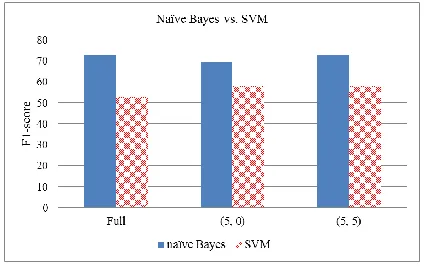
The experiments were done using 10-fold cross validation. For the number of selected features, we tried 500, 1000, 1500, 2000, 2500 and all. We also tried unigrams, bigrams, trigrams, and 4-grams. To compare naïve Bayes with SVM, we tried each combination, i.e. number of features and n-grams, and found the best model for each method. We found that naïve Bayes works best when using trigrams with 1500 selected features. Bigrams with 1000 features are the best combina-tion for SVM. Figure 3 shows the comparison of the best results (F1-scores) of naïve Bayes and SVM.
From Figure 3, we make the following observa-tions:
1. SVM does not do well for this task. We tuned the parameters of SVM, but the results were similar to the default setting, and all were worse than naïve Bayes. We believe the main reason is that the data for this application is highly noisy because apart from one or two in-tention sentences, other sentences in an inten-tion post have little difference from those in a non-intention post. SVM does not perform well with very noisy data. When there are data points far away from their own classes, SVM
Dataset No. of Intention
No. of Non-Intention
Total No. of posts
Cellphone 184 816 1000
Electronics 280 720 1000
Camera 282 718 1000
[image:6.612.319.531.561.694.2]TV 263 737 1000
[image:6.612.76.302.618.689.2]tends to be strongly affected by such points (Wu & Liu, 2007). Naïve Bayes is more robust in the presence of noise due to its probabilistic nature.
2. SVM using only the first few and/or last few sentences performs better than using full posts because full posts have more noise. However, it is still worse than naïve Bayes.
3. For naïve Bayes, using full posts and the first 5 and last 5 (5, 5) sentences give similar results, which is not surprising as (5, 5) has almost all the information needed. Without using the last 5 sentence (5, 0), the results are poorer.
We also found that without feature selection (us-ing all features), the results are markedly worse for both naïve Bayes and SVM. This is under-standable (as we discussed earlier) because most words and sentences in both intention and non-intention posts are very similar. Thus, feature se-lection is highly desirable for this application.
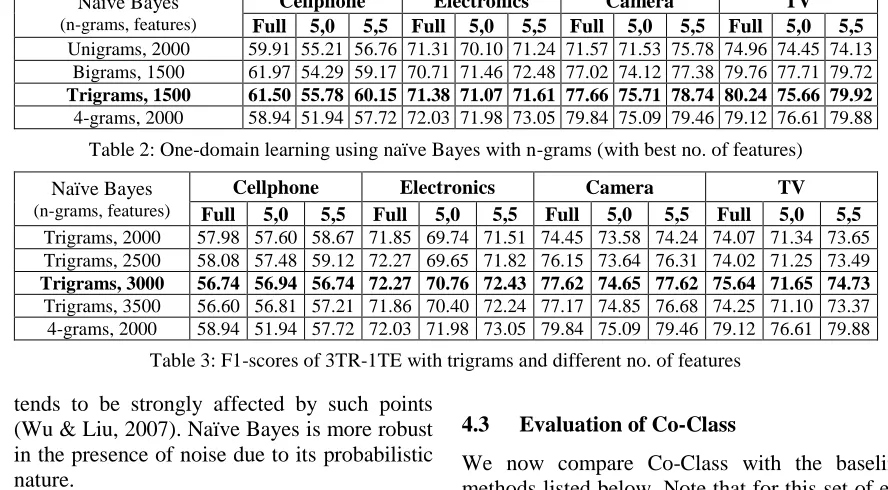
Effect of different combinations: Table 2 gives
the detailed F1-score results of naïve Bayes with best results in different n-grams (with best number of features). We can see that using trigrams pro-duces the best results on average, but bigrams and 4-grams are quite similar. It turns out that using trigrams with 1500 selected features performs the best. SVM results are not shown as they are poor-er.
In summary, we say that naïve Bayes is more suitable than SVM for our application and feature selection is crucial. In our experiments reported below, we will only use naïve Bayes with feature selection.
4.3 Evaluation of Co-Class
We now compare Co-Class with the baseline methods listed below. Note that for this set of ex-periments, the source data all contain labeled posts from three domains and the target data con-tain unlabeled posts in one domain. That is, for each target domain, we merge three other domains for training and the target domain for testing. For example, for the target of “Cellphone”, the model is built using the data from the other three do-mains (i.e., “Electronics”, “Camera” and “TV”). The results are the classification of the model on the target domain “Cellphone”. Several strong baselines are described as follows:
3TR-1TE: Use labeled data from three
do-mains to train and then classify the target (test) domain. There is no iteration. This method was used in (Aue & Gamon, 2005).
EM: This is the algorithm in Section 3.1. The combined data from three domains are used as the labeled source data. The data of the remaining one domain are used as the unlabeled target data, which is also used as the test data (since it is unla-beled).
ANB: This is a recent transfer learning method (Tan et al., 2009). ANB uses frequently
co-occurring entropy (FCE) to pick out generalizable
(or shared) features that occur frequently in both the source and target domains. Then, a weighted transfer version of naïve Bayes classifier is ap-plied. We chose this method for comparison as it is a recent method, also based on naïve Bayes, and has been applied to the NLP task of sentiment Naïve Bayes
(n-grams, features)
Cellphone Electronics Camera TV
Full 5,0 5,5 Full 5,0 5,5 Full 5,0 5,5 Full 5,0 5,5
Unigrams, 2000 59.91 55.21 56.76 71.31 70.10 71.24 71.57 71.53 75.78 74.96 74.45 74.13 Bigrams, 1500 61.97 54.29 59.17 70.71 71.46 72.48 77.02 74.12 77.38 79.76 77.71 79.72
Trigrams, 1500 61.50 55.78 60.15 71.38 71.07 71.61 77.66 75.71 78.74 80.24 75.66 79.92
4-grams, 2000 58.94 51.94 57.72 72.03 71.98 73.05 79.84 75.09 79.46 79.12 76.61 79.88
Table 2: One-domain learning using naïve Bayes with n-grams (with best no. of features)
Naïve Bayes
(n-grams, features)
Cellphone Electronics Camera TV
Full 5,0 5,5 Full 5,0 5,5 Full 5,0 5,5 Full 5,0 5,5
Trigrams, 2000 57.98 57.60 58.67 71.85 69.74 71.51 74.45 73.58 74.24 74.07 71.34 73.65 Trigrams, 2500 58.08 57.48 59.12 72.27 69.65 71.82 76.15 73.64 76.31 74.02 71.25 73.49
Trigrams, 3000 56.74 56.94 56.74 72.27 70.76 72.43 77.62 74.65 77.62 75.64 71.65 74.73
[image:7.612.82.526.68.313.2]Trigrams, 3500 56.60 56.81 57.21 71.86 70.40 72.24 77.17 74.85 76.68 74.25 71.10 73.37 4-grams, 2000 58.94 51.94 57.72 72.03 71.98 73.05 79.84 75.09 79.46 79.12 76.61 79.88
classification, which to some extend is related to the proposed task of intention classification. ANB was also shown to perform better than EM and naïve Bayes transfer learning method (Dai et al., 2007).
We look at the results of 3TR-1TE first, which are shown in Table 3. Due to space limitations, we only show the trigrams F1-scores as they perform the best on average. Table 3 gives the number of features with trigrams. We can observe that on average using 3000 features gives the best F1-score results. It has 1000 more features than one domain learning because we now combine three domains (3000 posts) for training and thus more useful features.
From Table 3, we observe that the F1-score re-sults of 3TR-1TE are worse than those of one do-main learning (Table 2), which is intuitive because no training data are used from the target domain. But the results are not dramatically worse which indicate that there are some common fea-tures in different domains, meaning people ex-pressing the same intention in similar ways.
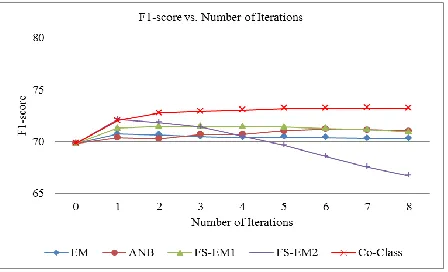
Since we found that trigrams with 3000 features perform the best on average, we run EM, FS-EM1, FS-EM2 and Co-Class based on trigrams with 3000 features. For the baseline ANB, we tuned the parameters using a development set (1/10 of the training data). We found that select-ing 2000 generalizable/shared features gives the best results (the default is 500 in (Tan et al., 2009)). We kept ANB’s other original parameter values. The F1-scores (averages over all 4 da-tasets) with the number of iterations are shown in Figure 4. Iteration 0 is the result of 3TR-1TE. From Figure 4, we can make the following obser-vations:
1. EM makes a little improvement in iteration 1. After that, the results deteriorate. The gain of iteration 1 shows that incorporating the target domain data (unlabeled) is helpful. However, the selected features from source domains can only fit the labeled source data but not the tar-get data, which was explained in Section 3.1. 2. ANB improves slightly from iteration 1 to
iter-ation 6, but the results are all worse than those of Co-Class. We checked the generaliza-ble/shared features of ANB and found that they were not suitable for our problem since they were mainly adjectives, nouns and sentiment verbs, which do not have strong correlation with intentions. This shows that it is hard to find the truly shared features indicating inten-tions. Furthermore, ANB’s results are almost the same as those of EM.
3. FS-EM2 behaves similarly to FS-EM1. After two iterations, the results start to deteriorate. Selecting features only from the target domain makes sense since it can reflect target domain data well. However, it also becomes worse with the increased number of iterations, due to strong positive features. With increased itera-tions, positive features get stronger due to the imbalanced feature problem discussed in Sec-tion 1.
4. Co-Class performs much better than all other methods. With the increased number of itera-tions, the results actually improve. Starting from iteration 7, the results stabilize. Co-Class solves the problem of strong positive features by requiring strong conditions for positive classification and focusing on features in the target domain only. Although the detailed re-sults of precision and recall are not shown, the Co-Class model actually improves the F1-score by improving both the precision and recall.
Significance of improvement: We now discuss
[image:8.612.78.302.60.196.2]the significance of improvements by comparing the results of Co-Class with other models. Table 4 summarizes the results among the models. For Co-Class, we use the converged models at itera-tion 7. We also include the One Domain learning results which are from fully supervised classifica-tion in the target domains with trigrams and 1500 features. The results of 3TR-1TE, EM, ANB, FS-EM1, and FS-EM2 are obtained based on their settings which give the best results in Figure 4. Figure 4 – Comparison EM, ANB, FS-EM1, FS-EM2,
It is clear from Table 4 that Co-Class is the best method in general. It is even better than the fully supervised One-Domain learning, although their results are not strictly comparable because One-Domain learning uses training and test data from the same domain via 10-fold cross validation, while all other methods use one domain as the test data (the labeled data are from the other three do-mains). One possible reason is that the labeled data are much bigger than those in One-Domain learning, which contain more expressions of buy-ing intention. Note that FS-EM1 and FS-EM2 work slightly better than Co-Class in domain “Camera” because it is the least noisy domain with very short posts while other domains (as source data) are quite noisy. With good quality data, FS-EM1 and FS-EM2 (also proposed in this paper) can do slightly better than Co-Class. Statis-tical paired t-test shows that Co-Class performs significantly better than baseline methods 3TR-1TE, EM, ANB and FS-EM1 at the confidence level of 95%, and better than FS-EM2 at the con-fidence level of 94%.
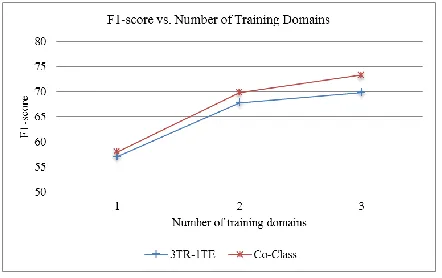
Effect of the number of training domains: In
our experiments above, we used 3 source domain data and tested on one target domain. We now show what happens if we use only one or two
source domain data and test on one target domain. We tried all possible combinations of source and target data. Figure 5 gives the average results over the four target/test domains. We can see that using more source domains is better due to more labeled data. With more domains, Co-Class also improves more over 3TR-1TE.
5
Conclusion
This paper studied the problem of identifying in-tention posts in discussion forums. The problem has not been studied in the social media context. Due to special characteristics of the problem, we found that it is particularly suited to transfer learn-ing. A new transfer learning method, called Co-Class, was proposed to solve the problem. Unlike a general transfer learning method, Co-Class can deal with two specific difficulties of the problem to produce more accurate classifiers. Our experi-mental results show that Co-Class outperforms strong baselines including classifiers trained using labeled data in the target domains and classifiers from a state-of-the-art transfer learning method.
Acknowledgments
This work was supported in part by a grant from National Science Foundation (NSF) under grant no. IIS-1111092, and a grant from HP Labs Inno-vation Research Program.
References
Aue, A., & Gamon, M. (2005). Customizing Sentiment Classifiers to New Domains: A Case Study. Pro-ceedings of Recent Advances in Natural Language Processing (RANLP).
Blitzer, J., Dredze, M., & Pereira, F. (2007). Biog-raphies, Bollywood, Boom-boxes and Blenders: Domain Adaptation for Sentiment Classification. Proceedings of Annual Meeting of the Association for Computational Linguistics (ACL).
Model Cellphone Electronics Camera TV
Full 5,0 5,5 Full 5,0 5,5 Full 5,0 5,5 Full 5,0 5,5
One-Domain 61.50 55.78 60.15 71.38 71.07 71.61 77.66 75.71 78.74 80.24 75.66 79.92 3TR-1TE 56.74 56.94 56.74 72.27 70.76 72.43 77.62 74.65 77.62 75.64 71.65 74.73 EM 60.28 59.59 60.45 70.47 69.90 71.33 79.38 77.01 80.31 74.96 70.76 74.31 ANB 62.53 59.29 62.41 66.58 68.29 68.36 78.37 77.49 78.83 78.70 75.73 78.26 FS-EM1 59.01 57.69 59.41 70.75 71.74 72.00 80.58 76.13 80.37 79.29 73.75 77.34 FS-EM2 59.54 60.09 61.33 71.19 72.09 72.07 80.14 77.93 81.09 78.90 74.21 77.53
Co-Class 62.69 61.10 62.69 73.38 73.23 73.95 79.69 74.65 78.66 81.12 76.40 81.60
[image:9.612.77.298.60.199.2]Table 4: F1-score results of One-Domain, 3TR-1TE, EM, ANB, FS-EM1, FS-EM2, and Co-Class Figure 5 – Effect of number of source domains
Blum, A., & Mitchell, T. (1998). Combining Labeled and Unlabeled Data with Co-Training. COLT: Pro-ceedings of the eleventh annual conference on Com-putational learning theory.
Bollegala, D., Weir, D. J., & Carroll, J. (2011). Using Multiple Sources to Construct a Sentiment Sensitive Thesaurus for Cross-Domain Sentiment Classifica-tion. Proceedings of Annual Meeting of the Associa-tion for ComputaAssocia-tional Linguistics (ACL).
Dai, H. K., Zhao, L., Nie, Z., Wen, J. R., Wang, L., & Li, Y. (2006). Detecting online commercial inten-tion (OCI). Proceedings of the 15th international conference on World Wide Web (WWW).
Dai, W., Xue, G., Yang, Q., & Yu, Y. (2007). Transfer-ring naive bayes classifiers for text classification. In Proceedings of the 22nd AAAI Conference on Artifi-cial Intelligence (AAAI).
Dempster, A., Laird, N., & Rubin, D. (1977). Maxi-mum likelihood from incomplete data via the EM algorithm. Journal of the Royal Statistical Society. Series B, 39(1), 1–38.
Easley, D., & Kleinberg, J. (2010). Networks, Crowds, and Markets: Reasoning About a Highly Connected World. Cambridge University Press.
Gao, S., & Li, H. (2011). A cross-domain adaptation method for sentiment classification using probabilis-tic latent analysis. Proceedings of the 20th ACM in-ternational conference on Information and knowledge management (CIKM).
He, Y., Lin, C., & Alani, H. (2011). Automatically Extracting Polarity-Bearing Topics for Cross-Domain Sentiment Classification. Proceedings of the 49th Annual Meeting of the Association for Computational Linguistics: Human Language Tech-nologies (ACL).
Hu, D. H., Shen, D., Sun, J.-T., Yang, Q., & Chen, Z. (2009). Context-Aware Online Commercial Inten-tion DetecInten-tion. Proceedings of the 1st Asian Confer-ence on Machine Learning: Advances in Machine Learning (ACML).
Hu, J., Wang, G., Lochovsky, F., tao Sun, J., & Chen, Z. (2009). Understanding user’s query intent with wikipedia. Proceedings of the 18th international conference on World wide web (WWW).
Joachims, T. (1998). Text Categorization with Support Vector Machines: Learning with Many Relevant Features. European Conference on Machine Learn-ing (ECML).
Joachims, T. (1999). Making large-Scale SVM Learn-ing Practical. Advances in Kernel Methods - Support Vector Learning. MIT Press.
Kanayama, H., & Nasukawa, T. (2008). Textual De-mand Analysis: Detection of Users’ Wants and Needs from Opinions. Proceedings of the 22nd In-ternational Conference on Computational Linguis-tics (COLING).
Li, X. (2010). Understanding the Semantic Structure of Noun Phrase Queries. Proceedings of Annual Meet-ing of the Association for Computational LMeet-inguistics (ACL).
Li, X., Wang, Y.-Y., & Acero, A. (2008). Learning query intent from regularized click graphs. Proceed-ings of the 31st annual international ACM SIGIR conference on Research and development in infor-mation retrieval (SIGIR).
Liu, B. (2010). Sentiment Analysis and Subjectivity. (N. Indurkhya & F. J. Damerau, Eds.) Handbook of Natural Language Processing, 2nd ed.
Nigam, K., McCallum, A. K., Thrun, S., & Mitchell, T. (2000). Text Classification from Labeled and Unla-beled Documents using EM. Mach. Learn., 39(2-3), 103–134.
Pan, S. J., Ni, X., Sun, J.-T., Yang, Q., & Chen, Z. (2010). Cross-domain sentiment classification via spectral feature alignment. Proceedings of the 19th international conference on World wide web (WWW).
Pan, S. J., & Yang, Q. (2010). A Survey on Transfer Learning. IEEE Trans. Knowl. Data Eng., 22(10), 1345–1359.
Pang, B., & Lee, L. (2008). Opinion mining and senti-ment analysis. Foundations and Trends in Infor-mation Retrieval, 2(1-2), 1–135.
Tan, S., Cheng, X., Wang, Y., & Xu, H. (2009). Adapt-ing Naive Bayes to Domain Adaptation for Senti-ment Analysis. Proceedings of the 31th European Conference on IR Research on Advances in Infor-mation Retrieval (ECIR).
Tan, S., Wu, G., Tang, H., & Cheng, X. (2007). A nov-el scheme for domain-transfer problem in the con-text of sentiment analysis. Proceedings of the sixteenth ACM conference on Conference on infor-mation and knowledge management (CIKM). Wu, Y., & Liu, Y. (2007). Robust truncated-hinge-loss
support vector machines. Journal of the American Statistical Association, 102(479), 974–983.
Yang, H., Si, L., & Callan, J. (2006). Knowledge Transfer and Opinion Detection in the TREC 2006 Blog Track. Proceedings of TREC.
Yang, Y., & Liu, X. (1999). A re-examination of text categorization methods. Proceedings of the 22nd annual international ACM SIGIR conference on Re-search and development in information retrieval (SIGIR).