4
Implementing UVEs
In architecture pedagogy
§ 4.1
Hypothesizing implementation of UVEs in architectural pedagogy
This chapter introduces unconventional virtual environments (UVEs) in the context of this research. The characteristics, types and parameters of UVEs are defined. Moreover, the role of experience and its efficacy on idea expansion and divergent thinking are also discussed in this Chapter.
The brain possesses existing knowledge of architectural space, styles and physical world. By exposure to UVE, previously unknown data feed can be added to this existing knowledgebase. The brain tries to digest this new feed by connecting them to the previous/existing knowledge of space. It is hypothesized that the challenge of the brain to digest new feeds, indirectly stimulate creativity. To prove this hypothesis, more research experiments were designed. These, are discussed in the following chapters. After examining the hypothesis, a possible implementation of UVEs within
architectural pedagogy is also discussed. It is also suggested to provide workshops for developing UVEs and let students navigate and interact with them during their education in order to expand their inventory of experiences. The more they can expand their experiences, the more combination of ideas is made possible, which, will indirectly influence their creativity.
Respective research findings have been published in the third journal article: “Implementing unconventional virtual environments for enhancing creativity in Architecture pedagogy”, IGI Global Publisher, Volume 3, Issue 4, 2012, pp. 41-52.
§ 4.2
Implementing unconventional virtual environments for
enhancing creativity in Architecture pedagogy
*Alireza Mahdizadeh Hakak , Nimish Biloria1, Mozhgan Raouf Rahimi2
1 Faculty of Architecture, TU Delft University, Delft, The Netherlands 2 Azad Islamic University, Parand Branch, Iran
Abstract. What is common definition amongst near 100 different definitions of creativity according to different disciplines is: Creativity is a new combination of what you have in your inventory of experiences + intuition. Now we can consider expanding the inventory of experiences, gradually helps better combination of elements inside. Surfing in a virtual environment with specific unconventional characteristics stands to be an interesting move. Detached from the real one in sense of time and matter, enables the designer to cross the borderline of reality and expand this inventory.
The authors hypothesis in cognitive point of view is extensiveness of experience gained by surfing in unconventional virtual environments can positively be related to both creative performance (enhance interactivity, lateral thinking, idea generation, etc) and creativity-supporting cognitive processes (retrieval of unconventional knowledge, recruitment of ideas from unconfined virtual environment for creative idea expansion). Authors also believe that creating a new perception of environment in the first steps of architecture pedagogy would be a broad help on expanding educator’s ideas. As a practical suggestion we suggest workshops beside the main curriculum in which designers can design, surf, play, manipulate unconventional virtual environment totally free of any constrains in an immersive, interactive virtual environments.
Keywords: Virtual Environment, Experience, Creativity and Pedagogy
* Published as: Mahdizadeh Hakak A., Biloria N, Raouf Rahimi M., (2012), “Implementing unconventional virtual environments for enhancing creativity in Architecture pedagogy”, IGI Global Publisher, Volume 3, Issue 4, 2012, pp. 41-52.
§ 4.2.1
Introduction
Many of the architects confess that, very gradually and unconsciously they stock in some conventional design approaches, because slowly confinements in construction and conventional stereotypes impose on them, dominate them and prevent them to think innovatively. Now, it is seemingly logical if you got a chance to see and explore some innovative notions in virtual environments, totally free of any limitation, causes a conceptual expansion, since irrelevant pictures are added to old design approaches. This will reverse the process and the confinements; stereotype, etc. diminish gradually; helping designers to expand their conceptual boundaries and thus eventually help them to enhance their creativity.
Creativity on the other hand is a vague term, and its definition is totally pertaining to the context of study and the discipline. As far back as 1959, Taylor surveyed about 100 definitions in his attempt to clarify the creative process (Taylor 1959). The definitions vary significantly by the content and complexity. Nevertheless, there are two commonly “universal” attributes of creativity: novelty and appropriateness. For the purpose of this paper, we will consider creativity as a cognitive process that generates new concepts, which are novel and unconventional. This study accentuates the experience. Identifying its way of operation and pointing out its existence and relevance. Experiences indirectly affect creativity. The more inventory of experiences, the more and better combination of ideas are possible.
Being in varied or diverse environments can train individuals to encode information in multiple ways, building a myriad of associations between concepts. For example, bilinguals, who have been exposed to two languages, are more creative than monolinguals (Nemeth & Kwan, 1987; Simonton, 1999). Creativity is found at relatively high rates for individuals who are first or second generation immigrants and for individuals who are ethnically diverse or ethnically marginalized (Lambert, Tucker, & d’Anglejan, 1973; Simonton, 1997, 1999). At the group level, creativity is facilitated within collaborative groups that contain diverse members (Guimera`, et al., 2005; J. M. Levine & Moreland, 2004) and in groups in which heterogeneous opinions are expressed (Nemeth & Wachtler, 1983; Simonton, 2003). Even at the societal level, creativity increases after civilizations open themselves to outside influences and when geographic areas are politically fragmented and relatively diverse (Simonton, 1997).
Considering the brief introduction on creativity and role of experience and diversity, the authors propose designers, surfing in virtual environment to
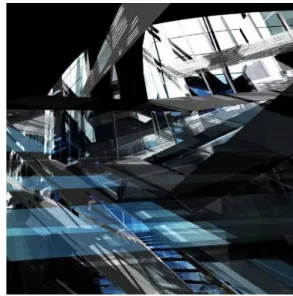
gain novel experiences, and broad their perception of environment to enhance their creativity. In this article, we define the Virtual Environment as a real-time interactive and fully immersive virtual 3d environment. In contrast to the definition of Virtual Reality which is somehow an imitation of the physical world (consider flight simulation). Also emphasizing on the unconventional virtual environments within which an emergent spatial pattern can dynamically evolve in time with respect to user interactions, a variety of spatially intriguing concepts such as: Multiple dimensions, Dematerialization, Infinite depth, Continuous change, Multiple scales etc. can be experimented with (Figure 4.1, 4.2).
FIGURE 4.1 V4D_Visio4D by Marcos Novak-Used with permission
FIGURE 4.2 V4D_Visio4D by Marcos Novak-Used with permission
Another important role of implementing virtual environment in design is trying to define a new criterion for evaluating architecture. It has been widely believed that what are now important in architecture discipline are unified concepts and objects clear function and performance. Reality, ironically, compels partiality, discontinuity of space, discontinuity of experience and conciseness. Finally, constructability, speed of procedures, etc. in designing in physical world are
evaluating parameters for architecture. Following this criterion in designing, adding to variety of constrains imposed on the architect and building close architect’s hands. Designing in virtual environments uses the same tool of expression as architecture, however it is free from the consequence of the built, technology, material etc. As such it can suggest an opposing value system: interaction, immersion, fragmentary, adventure, joy, innate stimulus, infinity, continuous change, etc. Thus virtual environment positioned in opposition to realistic architecture, as polemical, critical and experimental.
Designing in virtual environments is an ongoing practice that is built into the language of architecture. The utilitarian discipline of architecture requires a system to value them especially in a paradoxical way, negative or dichotomy to its main development course, though it can refurnish itself. Also the new evaluation criterion can be a stimulus to push designers thinks out of box. Since defining this criterion deeply related to cognitive aspects and perception of environment, it is out of scope of this paper.
The speculation on the relationship between experiencing virtual
environments and creativity is expected to answer the following questions: a. What types of virtual environments are needed for enhancing creative
performance?
b. How does surfing in virtual environment benefit creativity?
c. How does the brain perceive such immersive environments? (Does it use a reductionist point of view or is it an emergent phenomenon?)
d. In terms of topology, can this mathematical term be applicable in visual perception of environment? (Can the brain define certain characteristics of space even when the space deforms?)
As an overview of the major speculations in this paper, we are seeking to prove that:
a. Surfing/Exploring Virtual environment enhances creative performance and creativity-supporting cognitive processes (e.g., recruitment of different ideas and retrieval of unconventional knowledge);
b. The connection between experiencing virtual environments and creativity is most apparent when individuals have had the experience of deeply “immersing” themselves in virtual environment and “interacting” with the environment;
c. Adapting and opening themselves to new experiences and actively interact and compare the differences they encounter between unconventional environments and the physical world can boost the benefits of this experiencing;
d. A weaker relationship between experiencing virtual environments and creativity emerges in contexts where one confines themselves to limitations of the physical world, such as: construction limitations, material limitations etc.
§ 4.2.2
What Is Creativity?
Creativity is typically defined as the process of bringing into being something that is both novel and useful (Sawyer, 2006; Sternberg & O’Hara, 1999; see also Amabile, 1996). The creative process is often a mysterious phenomenon, with sudden insights seeming to work at an unconscious and inaccessible level (Schooler & Melcher, 1994). The magical “aha” moment of discovery, the point at which an idea leaps into consciousness, is part of what makes creativity seem sudden, without logic, and elusive (Leung, Maddux, Galinsky, Chiu, 2008).
Because of its apparent unpredictability and elusiveness, creativity may seem difficult to study scientifically and systematically. However, psychology based literature now can provide a wealth of evidence depicting the psychological factors that facilitate creativity; elements of personality, affect, cognition, and motivation can either facilitate or impair creativity (see Amabile, 1996; Csikszentmihalyi, 1996; Sawyer, 2006). For example, personality studies have demonstrated that creative people tend to be nonconforming, independent, intrinsically motivated, open to new experiences, and risk seeking (for reviews, see Simonton, 2000, 2003). Large-scale studies and meta-analyses have found that intelligence, tolerance of ambiguity, self-confidence, and cognitive flexibility also tend to be found in creative people (Feist, 1998; MacKinnon, 1978). Now, it seems logical that if we approach from the other side of the spectrum - we push designers to encounter new experiences - we can enhance their thresholds of ambiguity, self-confidence, cognitive flexibility, etc. It has been proved that a number of contextual factors related to motivation, cognition, and affect, facilitate creativity. Individuals who pursue tasks for intrinsic rather than extrinsic purposes show enhanced creativity (Amabile, 1985, 1996; Amabile, Hennessey, & Grossman, 1986; Eisenberger & Cameron, 1996; Hennessey & Amabile, 1998). Especially in
design we consider it largely intrinsic rather than extrinsic. A distant future focus, compared to a near future focus, has been shown to lead to more creative negotiation outcomes (Okhuysen, Galinsky & Uptigrove, 2003) and to enhanced creative insight (Fo¨rster, Friedman, & Liberman, 2004). Focusing on potential gains rather than losses increases the accessibility of unconventional ideas and thus enhances fluency in generating creative ideas (Friedman & Fo¨rster, 2001; Lam & Chiu, 2002). Finally, creativity seems to flourish when people are in positive or neutral affective states rather than negative affective states (Amabile, Barsade, Mueller, & Staw, 2005; Fredrickson, 2001; Fong, 2006).
§ 4.2.3
Types of creativity
There are two main types of creativity (Boden, 1990): 1) improbabilist that assumes that nothing has to be created de novo but existing elements are brought into a distinctive relation to each other by establishing new connections among them, which is the current definition of creativity in architecture, indeed this is not a defined accepted definition of creativity, however informally this is the way creative architects follow, and 2) impossibilist – a deeper type that is based on transformation of conceptual spaces. The difference between these types is determined by the mode of creative thinking. Improbabilist creativity stipulates thinking in the associative mode, adherence to rules, logic, and boundaries of the current conceptual (mental) space that is a conceptual packet or network built up for purposes of local understanding and action (Fauconnier, 1985). If we extrapolate this definition to architecture, obeying conventional rules and the role of confinements in architecture in terms of material, technology, even perception of new spaces become clear. Impossibilist creativity is subject to the bisociative mode, in which the conceptual space is transformed, yet frequently regardless of the existing rules and disciplinary boundaries (Koestler, 1967). As Boden puts it in “Creativity and unpredictability” a theory of creativity is to be a theory about the exploration, mapping, and transformation of conceptual spaces (Boden, 1995). It is presumed that a product of impossibilist creativity cannot be generated without transformation of the corresponding conceptual space. The first step here for creativity in design is enhancing the perception of space. Since we are used to the environment around us in term of scale, depth, dimension, etc., changing the characteristics of the conventional environment around us would be the right choice for transformation of the corresponding conceptual space.
§ 4.2.4
The Creative Cognition Approach
Recently, a scientific approach to studying creativity—the creative cognition approach—was proposed for understanding and specifying the cognitive processes that produce creative ideas (Amabile, 1996; Bink & Marsh, 2000; Finke, Ward, & Smith, 1992; Runco & Chand, 1995; Wan & Chiu, 2002). The central argument of this approach is that creative processes are not much different from those cognitive processes that produce our everyday mundane activities.
Every person has the potential to become creative as long as he or she effectively utilizes ordinary cognitive processes to produce extraordinary creative outcomes (Finke et al., 1992; Ward T.B., Smith, & Vaid, 1997; Weisberg, 1993). Specifically, the creative cognition approach identifies two kinds of cognitive processes implicated in creative thinking—generative processes and exploratory processes (Finke et al., 1992). First, people actively retrieve or seek out relevant information to generate candidate ideas with differing creative potential (the generative processes). Next, they survey these candidate ideas to determine which ones should receive further processing, such as modification, elaboration, and transformation (the explorative processes), (Leung, Maddux, Galinsky, Chiu, 2008). One strategy that makes effective use of generative processes is conceptual expansion, which takes place when attributes of seemingly irrelevant concepts are added to an existing concept to extend its conceptual boundary (Hampton, 1987; Wan & Chiu, 2002; Ward, T. B., Patterson, Sifonis, Dodds, & Saunders, 2002, Ward, T. B et al., 1997).
§ 4.2.5
Experiencing unconventional virtual environments and the role of creativity
As mentioned before, defining the term creativity is a hard task. Every designer has the bias that he/she is creative. Now, there is not an objective measurement or measurement tool to evaluate the creativity. On the other hand, it seems obvious that the learned routines and conventional knowledge of that discipline may limit his or her creative conceptual expansion. Prior knowledge and highly accessible exemplars are a major constraint on imagination and creative conceptual expansion (Ward, T.B., 1994). For instance, when people generate exemplars in a novel conceptual domain (e.g., animals on the planet Mars), even the most creative examples resemble highly accessible exemplars (e.g., animals on Earth with eyes and legs or
known science fiction exemplars; (see Kray, Galinsky, & Wong, 2006; Rubin & Kontis, 1983; Ward, T.B., 1994; Ward, T.B. et al., 2002). It happens exactly on design process as well. Thinking out of box would become an impossible task. To overcome the constrains, experiencing virtual environments is a solution. When individuals encounter an unconventional virtual environment, they may experience a shock, anxious feeling and disorientation in the absence of spatial perception, scale, depth, material etc, which are generally all conventional norms. People typically take these familiar things for granted can thus suddenly become lost and inaccessible when people are immersed in virtual environment.(figure 4.3, 4.4).
FIGURE 4.3 Unconventional virtual environment -©2008-Marco De Gregorio, used with permission
Although this shock has its dark side, once the initial, difficult adaptation stages have passed, it can also provide a great opportunity for acquiring new perspectives to approaching various tasks and learning new ways of thinking. Whereas old, conventional design approaches may constrain creativity, the experience of virtual environments may foster the creative expansion of ideas. Thus, we hypothesize that virtual environment experiences can contribute to creative expansion in at least four ways:
First, architects learn new ideas and concepts from surfing and designing in these environments. Through these experiences, people are also exposed to a range of behavioral and cognitive scripts for situations and problems. These new ideas, concepts, and scripts can be the inputs for the creative expansion processes because the more new ideas people have, the more likely they are to come up with novel combinations (Weisberg, 1999).
Second, although architecture pedagogy established conceptions and conventions provide the architect with structured and routine responses to the design, these cognitive structures may be destabilized as people acquire alternative conceptions through their experiences in other environment, in terms of new perception and cognition and interaction with it, particularly as people adapt their own thoughts and behaviors to the new environment. Immersing in multiple virtual environments may even lead individuals to access unconventional knowledge when back in physical world (.
FIGURE 4.5 Screenshot (authors) – new cognitive perception of virtual environments
FIGURE 4.6 Screenshot (authors) – new cognitive perception of virtual environments
Third, having acquired and successfully applied incongruent ideas from these new experiences, designers may show an increase in psychological readiness to recruit and seek out ideas from diverse sources and use them as inputs in the creative process, allowing for continued exposure to a wide range of new ideas, norms, and practices.
Forth, it is obvious that implementing formal shape, characteristics, etc. directly in physical world is not the purpose, however incongruent concepts provoke exploration into their interrelations, the process of implementing incongruent ideas may lead to greater cognitive complexity, this challenge finally help them to think out of box. Higher creativity is most likely when the two concepts involved in conceptual expansion are not normally seen as overlapping with each other seemingly non-overlapping concepts sometimes being associated with two distinct worlds (Hampton, 1987; Wan & Chiu, 2002). In short, the experience of virtual environments may foster creativity by (a) providing direct access to novel ideas and concepts in (unconventional) virtual environments, (b) creating the ability to see multiple underlying functions behind the same form, (c) destabilizing conventional knowledge structures (design approach), thereby increasing the accessibility of normally inaccessible knowledge, (d) creating a psychological readiness to recruit ideas from unfamiliar sources and places, and (e) supporting synthesis of seemingly incompatible ideas from another environment.
§ 4.2.6
Implementation in pedagogy
Design thinking harnesses tacit knowledge rather than the explicit knowledge of logically expressed thoughts. Designers operate at a level of complexity in the synthesis of constraints where it is more effective to learn by doing, allowing the subconscious mind to inform intuitions that guide actions. Perhaps the mind is like an iceberg, with just a small proportion of the overall amount protruding above the water. If we operate above the water line, we only have a small volume to use, but if we allow ourselves to use the whole submerged mass, we have a lot more to work with. If a problem has a large number of constraints, the conscious mind starts to get confused, but the subconscious mind has a much larger capacity. Designers have the ability and the training to harness the tacit knowledge of the unconscious mind, rather than being limited to working with explicit knowledge. This makes them good at synthesizing complex problems with large numbers of constraints; it also makes them bad at explaining or defining what they are doing or thinking. They
will describe process and results because they are not consciously aware of their own rationale (Designing interactions by Bill Moggridge).
In his book To Understand Is to Invent Piaget said the basic principle of active methods can be expressed as follows: “to understand is to discover, or reconstruct by rediscovery, and such conditions must be complied with if in the future individuals are to be formed who are capable of production and creativity and not simply repetition. Humans generate knowledge and meaning from an interaction between their experiences and their ideas (Jean Piaget)”. Accentuating the role experience in education, the virtual environment exploring, totally fits in educational program.
In form of some interactive workshops, which participants first build their environments with specific software like Max/Msp/Jitter/Cosm, Virtools, Blender or even by scripting, and then manipulate their environment as they follow the path of their choice. It is important to achieve the right balance between the degree of structure and flexibility that is built into the learning process. Savery (1994) contends that the more structured the learning environment, the harder it is for the learners to construct meaning based on their conceptual understandings. Instructors first introduce the basic approaches that give life and form to any unconventional designs in virtual environments, and then revisit and build upon these repeatedly. Each group examines different tasks in terms of material, depth, interactivity, etc…which is their personal subjective interpretation of the unconventional. In next step groups exchange their environments with each other and try to perceive environments of other groups. Since explaining some cognitive science seems boring, theoretical and not understandable in some cases, involving students directly is a proper idea. In this way students become active participants instead of passive sponges and the teacher takes on the role of facilitator as he/she gave them guidance in their creation. Learners should constantly be challenged with tasks that refer to skills and knowledge just beyond their current level of mastery. This captures their motivation and builds on previous successes to enhance learner confidence (Brownstein 2001). Of course proper discussion methods and exchanging ideas like Edward Harkness method would be implemented in between and students become familiar with each other approaches and senses.
§ 4.2.7
Consclusion
This paper speculations reviewed here demonstrate that virtual environment experience predicts both creative outcomes and creative processes. Virtual environment experience is positively related to conceptual boundary in design that requires insight to produce creative ideas without being confined to the widely known. It also predicts creativity supporting processes such as the tendency to access unconventional knowledge from memory and to recruit ideas from new experiences for creative idea expansion. Moreover, it is conspicuous that the relationship between virtual environment experience and creativity is stronger when people adapt and are open to these new experiences. Also authors believe that creating a new perception of environment in the first steps of architecture pedagogy would be a broad help on expanding educator’s ideas.
References
Amabile, T. M. (1985). Motivation and creativity: Effects of motivational orientation on creative writers. Journal of Personality and Social Psychology, 48, 393–399.
Amabile, T. M. (1996). Creativity in context. Boulder, CO: Westview Press. Amabile, T. M., Barsade, S. G., Mueller, J. S., & Staw, B. M. (2005).
Affect and creativity at work. Administrative Science Quarterly, 50, 367–403.
Amabile, T. M., Hennessey, B. A., & Grossman, B. S. (1986). Social influences on creativity: The effects of con-tracted-for reward. Journal of Personality and Social Psychology, 50, 14–23.
Barsalou, L. W. (1985). Ideals, central tendency, and frequency of instantiation as determinants of graded struc-ture in categories. Journal of Experimental Psychology: Learning, Memory, and Cognition, 11, 629–654. Bink, M. L., & Marsh, R. L. (2000). Cognitive regularities in creative activity. Review of General Psychology, 4, 59
78.
Boden M., The creative mind: myths and mechanism. London: Weidenfeld and Nicholson, 1990. Boden M., Creativity and unpredictibity, Stanford Humanities Rev 1995
Chen, S., & Andersen, S. M. (1999). Relationships from the past in the present: Significant-other representa-tions and transference in interpersonal life. In M. P. Zanna (Ed.), Advances in experimental social psycholo-gy (Vol. 31, pp. 123–190). San Diego, CA: Academic Press.
Chiu, C-y. (in press). Multicultural psychology. In D. Matsumoto (Ed.) Dictionary of psychology. Cambridge, England: Cambridge University Press.
Chiu, C-y., & Cheng, S. Y-y. (2007). Toward a social psychology of culture and globalization: Some social cogni-tive consequences of activating two cultures simultaneously. Social and Personality Psychology Compass, 1, 84–100.
Chiu, C-y., & Leung, A. K-y. (2007). Do multicultural experiences make people more creative? If so, how? Retrieved January 3, 2008, from http://www.in-mind.org/special-issue/do-multicultural-experiences-make-people-more-creative-if-so.html.
Chiu, C-y., Morris, M. W., Hong, Y-y., & Menon, T. (2000). Motivated cultural cognition: The impact of implicit cultural theories on dispositional attribution varies as a function of need for closure. Journal of Personality and Social Psychology, 78, 247–259.
Costa, R. T., & McCrae, R. R. (1992). Revised NEO Personality Inventory (NEO PI-R) and NEO Five-Factor Inven-tory (NEO-FFI) professional manual. Odessa, FL: Psychological Assessment Resources.
Csikszentmihalyi, M. (1996). Creativity: Flow and the psychology of discovery and invention. New York: Harper-Collins.
Earley, P. C., & Ang, S. (2003). Cultural intelligence: Individual interactions across cultures. Palo Alto, CA: Stan-ford University Press.
Earley, P. C., & Mosakowski, E. (2004, October). Cultural intelligence. Harvard Business Review, 139–146. Eisenberger, R., & Cameron, J. (1996). Detrimental effects of reward: Reality or myth? American Psychologist,
51, 1153–1166.
Fauconnier G, Mental spaces. Cambridge, MAL MIT press, 1985
Feist, G. J. (1998). A meta-analysis of the impact of personality on scientific and artistic creativity. Personality and Social Psychological Review, 2, 290–309.
Feist, G. J., & Brady, T. R. (2004). Openness to experience, non-conformity, and the preference for abstract art. Empirical Studies of the Arts, 22, 77–89.
Finke, R. A., Ward, T. B., & Smith, S. M. (1992). Creative cognition: Theory, research, and applications. Cam-bridge, MA: MIT Press.
Fong, T. T. (2006). The effects of emotional ambiguity on creativity. Academy of Management Journal, 49, 1016 1030.
Fo¨rster, J., Friedman, R. S., & Liberman, N. (2004). Temporal construal effects on abstract and concrete thinking: Consequences for insight and creative cognition. Journal of Personality and Social Psychology, 87, 177–189.
Fredrickson, B. L. (2001). The role of positive emotions in positive psychology: The broaden-and-build theory of positive emotions. American Psychologist, 56, 218–226.
Friedman, R. S., & Fo¨rster, J. (2001). The effects of promotion and prevention cues on creativity. Journal of Personality and Social Psychology, 81, 1001–1013.
Fu, H-y., Morris, M. W., Lee, S-l., Chao, M-c., Chiu, C-y., & Hong, Y-y. (2007). Epistemic motives and cultural conformity: Need for closure, culture, and context as determinants of conflict judgments. Journal of Person-ality and Social Psychology, 92, 191–207.
Galinsky, A. D., Maddux, W. W., & Ku, G. (2006). The view from the other side of the table: Getting inside your counterpart’s head can increase the value of the deal you walk away with. Here’s how to do it. Negotiation, 9, 1–5.
Glover, J. A., Ronning, R. R., & Reynolds, C. R. (Eds.). (1989). Handbook of creativity. New York: Plenum. Grant, A. M., Langer, E. J., Falk, E., & Capodilupo, C. (2004). Mindful creativity: Drawing to draw distinctions.
Journal of Creativity Research, 16, 261–265.
Guilford, J. P. (1959). Traits of creativity. In H. H. Anderson (Ed.), Creativity and its cultivation (pp. 142–161). New York: Harper.
Guimera`, R., Uzzi, B., Spiro, J., & Amaral, L. A. N. (2005). Team assembly mechanisms determine collaboration network structure and team performance. Science, 308, 697–702.
Hampton, J. A. (1987). Inheritance of attributes in natural Hennessey, B. A., & Amabile, T. M. (1998). Reality, intrinsic motivation, and creativity. American Psychologist, 53, 674–675.
Hong, Y., Wan, C., No, S., & Chiu, C-y. (2007). Multicultural identities. In S. Kitayama & D. Cohen (Eds.), Hand-book of cultural psychology (pp. 323–346). New York: Guilford Press.
Ip, G. W-m., Chen, J., & Chiu, C-y. (2006). The relationship of promotion focus, need for cognitive closure, and categorical accessibility in American and Hong Kong Chinese university students. Journal of Creative Behav-ior, 40, 201–205.
Jost, J. T., Glaser, J., Sulloway, F., & Kruglanski, A. W. (2003). Political conservatism as motivated social cogni-tion. Psychological Bulletin, 129, 339–375.
Koestler A.,The act of creation. New York: Mcmillan, 1967.
Kray, L. J., Galinsky, A. D., & Wong, E. (2006). Thinking within the box: The relational processing style elicited by counterfactual mind-sets. Journal of Personality and Social Psychology, 91, 33–48.
Ku, G., Galinsky, A. D., & Murnighan, J. K. (2006). Starting low but ending high: A reversal of the anchoring effect in auctions. Journal of Personality and Social Psychology, 90, 975–986.
Lam, T. W., & Chiu, C-y. (2002). The motivational function of regulatory focus in creativity. Journal of Creative Behavior, 36, 138–150.
Lambert, W. E., Tucker, G. R., & d’Anglejan, A. (1973). Cognitive and attitudinal consequences of bilingual schooling: The St. Lambert project through grade five. Journal of Educational Psychology, 65, 141–159. Langer, E. (2000). Mindful learning. Current Directions in Psychological Science, 9, 220–223.
Levine, J. M., & Moreland, R. L. (2004). Collaborations: The social context of theory development. Personality and Social Psychology , Review, 8, 164–172.
Leung, A.K. , Maddux, W. , Galinsky, A. , Chiu, C. (2008) . Multi cultural experience enhances creativity, American Psychologist
MacKinnon, D. (1978). In search of human effectiveness. Buffalo, NY: Bearly.
McCrae, R. R., & Costa, P. T. (1987). Validation of the five-factor model of personality across instruments and observers. Journal of Personality and Social Psychology, 52, 81–90.
Nemeth, C., & Kwan, J. (1987). Minority influence, divergent thinking and detection of correct solutions. Journal of Applied Social Psychology, 17, 788–799.
Nemeth, C., & Wachtler, J. (1983). Creative problem solving as a result of majority vs. minority influence. Euro-pean Journal of Social Psychology, 13, 45–55.
Okhuysen, G. A., Galinsky, A. D., & Uptigrove, T. A. (2003). Saving the worst for last: The effect of time horizon on the efficiency of negotiating benefits and burdens. Organizational Behavior and Human Decision Processes, 91, 269 279.
Rubin, D. C., & Kontis, T. C. (1983). A schema for common cents. Memory & Cognition, 11, 335–341. Runco, M. A., & Chand, I. (1995). Cognition and creativity. Educational Psychology Review, 7, 243–267. Sawyer, K. (2006). Explaining creativity: The science of human motivation. New York: Oxford University Press. Schooler, J., & Melcher, J. (1994). The ineffability of insight. In S. M.
Smith, T. B. Ward, & R. A. Finke (Eds.), The creative cognition approach (pp. 97–133). Cambridge, MA: MIT Press.
Simonton, D. K. (1997). Foreign influence and national achievement: The impact of open milieus on Japanese civilization. Journal of Personality and Social Psychology, 72, 86–94.
Simonton, D. K. (1999). Origins of genius: Darwinian perspectives on creativity. New York: Oxford University Press.
Simonton, D. K. (2000). Creativity: Cognitive, personal, developmental, and social aspects. American Psycholo-gist, 55, 151–158.
Simonton, D. K. (2003). Scientific creativity as constrained stochastic behavior: The integration of product, person, and process perspectives. Psychological Bulletin, 129, 475–494.
Sternberg, R. J., & O’Hara, L. A. (1999). Creativity and intelligence. In R. J. Sternberg (Ed.), Handbook of creativity (pp. 251–272). New York: Cambridge University Press.
The diversification of psychology: A multicultural revolution. American Psychologist, 54, 1061–1069. Tadmor, C. T., & Tetlock, P. E. (2006). Biculturalism: A model of the effects of second-culture exposure on
inte-grative complexity. Journal of Cross-Cultural Psychology, 37, 173–190.
Taylor AI. The nature of the creative process. In: Smith P editor. Creativity: an examination of the creative pro-cess. New York: Hastling House, 1959. P. 51-82
Torrance, E. P. (1974). Torrance Tests of Creativity Thinking. Lexington, MA: Personnel Press.
Wan, W., & Chiu, C-y. (2002). Effects of novel conceptual combination on creativity. Journal of Creative Behav-ior, 36, 227–241.
Ward, C., Bochner, S., & Furnham, A. (2001). The psychology of culture shock. London: Routledge.
Ward, T. B. (1994). Structured imagination: The role of conceptual structure in exemplar generation. Cognitive Psychology, 27, 1–40.
Weisberg, R. W. (1993). Creativity: Beyond the myth of genius. New York: W. H. Freeman.
Weisberg, R. W. (1999). Creativity and knowledge: A challenge to theories. In R. J. Sternberg (Ed.), Handbook of creativity (pp. 226–250). Cambridge, England: Cambridge University Press.