Building and using language resources and infrastructure to develop
e-learning programs for a minority language
Heli Uibo
University of Tartu
UiT The Arctic University of Norway Landstormsv¨agen 12
68534 Torsby, Sweden
Jack Rueter
University of Helsinki Keinutie 11 M 72 FIN-00940 Helsinki
Sulev Iva
University of Tartu ¨
Ulikooli 18, 50090 Tartu, Estonia V˜oro Institute
Abstract
We will demonstrate V˜oro Oahpa (http: //oahpa.no/voro), a set of language learning programs for V˜oro, a minority language in Estonia. When setting up and developing the system, we have made use of the infrastructure developed at the Saami language technology centre Giellate-kno, UiT the Arctic University of Norway and the V˜oro language resources and tools – the online electronic dictionary synaq.org that also includes pronunciations; V˜oro speech synthesis; the morphological finite state transducer that is being developed as a part of the same project and a multilin-gual word list from North Saami Oahpa. V˜oro Oahpa consists of four language learn-ing programs: Leksa – a vocabulary quiz, Numra – a program for practicing numer-als and time expressions, Morfa-S – mor-phology drill and Morfa-C – mormor-phology exercises formulated as question-answer pairs. The development is still in progress but the programs have already used within the V˜oro language course at the Univer-sity of Tartu. We discuss the issues spe-cific for V˜oro and show how combining the existing infrastructure, resources and experiences can make the development of a learning system for a language with limited resources easier and give extra values to the system.
1 Introduction
The V˜oro language is a South Estonian language with ca 70 000 speakers. (The Estonian written language is based on the dialects of Northern Esto-nia). V˜oro organisations (V˜oro Institute etc.) want
This work is licenced under a Creative Commons At-tribution 4.0 International Licence. Licence details: http: //creativecommons.org/licenses/by/4.0/
to recognise V˜oro officially as a separate language which has been discussed twice in Estonian parla-ment Riigikogu, however, without positive decision. That is why V˜oro is officially considered a dialect of Estonian even up to now. Despite of this Es-tonian government supports the maintenance and development of V˜oro by financing V˜oro Institute – a state institute dealing with V˜oro language and culture. V˜oro also has its own official ISO language code ’vro’.
The V˜oro language is taught in ca 20 kinder-gartens (in so-called language nests) and about the same number of schools in South-Eastern Estonia. Altogether 450 primary and secondary school stu-dents are learning V˜oro language and culture or participating in other classes where the language of instruction is V˜oro ( Opetajate leht, 2017). The kindergartens and schools are located in the area where children’s parents or grandparents also might speak V˜oro but it is not necessarily the case. On the other hand, thousands of V˜oro speakers or people interested in learning V˜oro language live in other parts of Estonia and V˜oro Institute has got queries about distant courses of V˜oro for adults. Since 1996 the V˜oro language as a subject can be stud-ied at the University of Tartu. The V˜oro language course is given every term and has a form of a traditional language course with auditorial lessons.
We are aware of only one other online pro-gram for V˜oro language learning that existed be-fore Oahpa – the game ”Mein Zimmer” (http:// edlv.planet.ee/meinZimmer/) that has among others been adapted to the V˜oro language. It is a nice ”find-a-key” game but it is focused on one particular topic and thus very limited.
When learning a Uralic language the most diffi-cult thing is morphology. Although there are a lot of language learning programs available, most of them deal with vocabulary learning.
the basic vocabulary for a learner and, most impor-tantly, the basic grammar. In 2013, as a part of a cooperation project between the language technol-ogy researchers at the University of Tartu and the Saami language technology centre Giellatekno at UiT the Arctic University of Norway, we started to adapt Oahpa, a set of language learning programs, initially created for North Saami and by now im-plemented for more than 20 languages, to the V˜oro language. The ICALL system Oahpa (Antonsen et al, 2009) is primarily meant as a supporting tool for learning vocabulary and grammar for adult students attending respective language courses. But as the usage statistic shows, a lot of people who do not attend any course, also use the system for learning North Saami because it is freely available on the in-ternet. During a 6 months period there were 3,676 unique visitors of North and South Saami Oahpa pages (Antonsen et al., 2013) while the number of people who were taking the respective language courses was about ten times smaller.
So, Oahpa should be a good choice for the in-tended users of our language learning programs – the participants of the V˜oro language course at University of Tartu and all other V˜oro language learners whereever in the world, with possibly no or little contact with the spoken V˜oro and no ac-cess to V˜oro language courses. When designing the content of V˜oro Oahpa we are trying to meet the needs of both user groups. Our programs can mostly be used to support the students’ individual training of vocabulary and grammar of the V˜oro language.
Other grammar learning programs we are aware of are e.g. Killerfiller (Bick, 2005) and ESPRIT (Koller, 2005). These are text-based ICALL sys-tems where sentences are extracted from a corpus. In the system VIEW (Meurers et al, 2010), any webpage that is in the right language can turned into a grammar exercise. This is a fantastic system but concerning the V˜oro language, however, the material on the web is still quite small.
2 Existing resources and infrastructure
Thanks to the cooperation project we could make use of the Giellatekno and Divvun infrastructure (Moshagen et al, 2014) – a development infras-tructure created to make it easier for people work-ing on languages with limited textual resources to build language technology applications. The general idea is that (computational) linguists
com-pose formalised grammar descriptions and lexicons, and the intrastructure makes it possible to use the lexicons and grammar as the basis for NLP tools (e.g. morphological and syntactic analyser) and end user tools such as proofing tools and electronic dictionaries. We got easily used to Giellatekno in-frastructure that has standard places for language data (word lists, source code for the morphological transducer, Oahpa source files, documentation files, etc.) and standard procedures for the production of language technology tools and end-user programs out of these. The infrastructure is well suited for morphologically rich languages.
As one of our goals was to provide pronuncia-tions for the people who live in the environment where they do not hear spoken V˜oro we decided to make use of the existing audio and text-to-speech resources.
One important V˜oro language resource is the on-line dictionaryhttp://synaq.orgthat includes 15 000 entries in the direction V˜oro-Estonian and 20 000 entries in the direction Estonian-V˜oro. The dictionary also includes high quality audio files for V˜oro words. The audio files have been produced in cooperation of the V˜oro Institute with the Cen-ter of South Estonian Language and Culture and Laboratory of Phonetics, University of Tartu.
During the development of V˜oro Oahpa a pro-totype of V˜oro speech synthesis was developed at the Institute of Estonian Language. There are two voices to choose between: a middle aged man and a 11-years-old girl. The quality of the synthesized speech is good, very close to nat-ural speech. The demo of the speech synthe-sis is available at the following URL: www.eki. ee/~indrek/voru/index.phpand the software can be downloaded from here: github.com/ ikiissel/synthts_vr.
3 Our work: V˜oro Oahpa – a set of language learning programs
We have a previous experience of setting up Oahpa for a number of languages. Although the overall procedure of setting up a new instance of Oahpa is similar, each language has some specific issues that need to be dealt with. For the V˜oro language these issues were:
• extensive spell-relax
Spell-relax means that the program accepts different variants of typing for some characters. Checking of the correct answers must not be too strict because the written language is quite new (from 1990s) and there is no consensus on how to mark e.g. glottal stop and palatalisation; some let-ters of the V˜oro alphabet are missing from the key-board layouts (there is no special V˜oro keykey-board layout yet).
The illative and inessive plural of some nouns may attest to as many as 6-9 forms, e.g. the word
pereh”family”:
pereh+N+Pl+Ill: [perrihe,perriihe,perride, perri-ide,perehtehe,perehtede]
pereh+N+Pl+Ine: [perrin,perriin,perrih,perriih,
perrihn,perriihn,perehten,perehteh,perehtehn], whereas the second person singular can attest to 3 if not 6 forms, e.g. the wordehitelem¨a”to dec-orate”ehitelem¨a+V+Act+Ind+Prt+Sg2: [ehitelit,
ehiteliq,ehitelideq,ehitellit,ehitelliq,ehitellideq] In the Oahpa exercises we need to decide which forms to accept as possible forms and which ones to display as correct answers. Whereas the parallel forms issue has to do with the morphology exer-cises Morfa-S and Morfa-C the relaxed spelling applies to all four games implemented in V˜oro Oahpa.
3.1 Multi-purpose side product
– morphological finite state transducer of V˜oro
A finite state transducer (FST) incorporates both a morphological analyser and a generator. It defines correspondences between tag strings and word forms of a language. There exists a powerful FST development environment in the Divvun ad Giel-latekno infrastructure. Using the standard file and tag names and other conventions makes it possible for a FST developer (linguist) to use the automatic build process that is taken care of by a number of filters and scripts. The compiled transducers can be used in several applications as language learning programs, online dictionaries, spelling checkers and machine translation tools. The V˜oro morphological transducer has so far been used in Oahpa and in the morphology-aware dictionary http://sonad.uit.no.
While building the morphological FST we have made use of the experience of developing morphol-ogy descriptions for other Uralic languages as the Saami languages, Erzya, Hill Mari a.o.
The problems we tackled when modeling V˜oro morphology were the following:
• Vowel harmony is not always predictable from the nominative or genitive singular forms, vari-ation between singular and plural stem har-mony, e.g. (”host”)es¨ak – es¨aku genitive singular butes¨akidegaqcomitative plural.
• Consonant gradation2– as many as 4 grades:
h¨ab¨u,h¨au,h¨ap¨uandh¨app¨u(”shame” nomina-tive, geninomina-tive, partinomina-tive, illative singular).
• Many inflection types. Even if it seems that the word belongs to the same type there might be some forms in the paradigm that are differ-ent. The classification of nouns and adjective stem types has uncovered further irregular-ities, that might be dealt with through geo-graphic/dialect classification.
• Parallel forms. For pedagogical purposes, it should be desirable that the preferred paral-lel forms are tagged differently from the non-preferred ones. Therefore, we have tagged all the non-preferred parallel forms with the tag +Use/NG. The non-preferred forms are accepted when the user enters those but not shown as correct answers.
We have applied the systematic error correction procedure of the FST:
1. All the simple words, i.e. derived and com-pound words excluded, have been generated by the FST as a large table.
2. A testing person has marked the errors in the table.
3. The errors have been corrected in the FST.
New subtypes of the inflection types for both nouns and verbs have been described in the FST as a result of this systematic work. For example, the noun types where singular nominative ends with a consonant but the stem vowel appears in genitive and other cases have been split by stem vowel to 3-4 separate types. That was implemented by introducing new continuation lexica.
Currently all the 13260 yaml tests pass, i.e. the morphological FST generates correctly all the forms that are given in the tests.
The FST has also been tested on the running text (V˜oro wikipedia and children’s book ”Suur must koer”). The current testing results are presented in the table Table 1.
Total Missing Missing %
All tokens 82 390 294 335 28%
Unique tokens 30 695 50 142 61%
Table 1: Evaluation results of the V˜oro FST.
For Oahpa the lexical coverage is good enough, as long as all the words that are in the Oahpa lex-icon are in the FST. The most important thing is, however, that all the generated forms are correct. But in the longer perspective, of course, we aim at much better lexical coverage that would facili-tate morphological analysis and spelling check of running V˜oro texts.
3.2 Online language learning tools (Oahpa games)
3.2.1 Numra – program for training
numerals and date and time expressions
Numra is probably the simplest game that a be-ginner might start with. The easiest setup of the Cardinals game presents numerals 1-10 as the sets of five and the user’s task is to guess which number corresponds to which word.
Three special finite state transducers were cre-ated to enable these exercises – a transducer of cardinal and ordinal numerals, a transducer of time expressions and a transducer of date expressions. The transducers define correspondences between numerical and textual representations of numbers, time points and dates.
3.2.2 Leksa – a vocabulary training program
Leksa is a classical vocabulary test where the user has to translate isolated words or everyday ex-pressions from V˜oro to a metalanguage or vice versa. The drop-down menus enable the selection of words by topic (semantic category, sometimes in a broader sense): human, animal, food/drink, time, body, clothes, school, nature, work/economy, etc.
There are several metalanguages – Estonian, Finnish, English, German, North Saami, Norwe-gian, Swedish. This makes it possible for people with different language backgrounds to learn V˜oro vocabulary. To make V˜oro Oahpa more accessible
we have also localised the whole user interface to Estonian, Finnish, English and V˜oro. The lexicon size of Leksa is ca 1300 words. The core of the lex-icon comes from North Saami Oahpa (therefore we also have translations to North Saami and Norwe-gian for most of the words). But we have adapted the lexicon to our needs – removed some words that belong to Saami cultural space and added lists of frequently used V˜oro words with translations to some semantic classes (alltogether ca 300 words). We have also added audio to V˜oro Leksa – a pos-sibility to listen to the pronunciations of the V˜oro words. The pronunciations have been integrated from the sound database of the V˜oro-Estonian-V˜oro electronic dictionarysynaq.org. The words have been read in by native speakers of V˜oro.
3.2.3 Morfa-S – a morphology drill program
Given the primary form (nominative singular for nouns and infinitive for verbs), the task is to build a specific inflected form. For nouns all the 14 cases in singular and plural can be practiced (except for essive that does not have separate singular/plural forms). For verbs there are exercises on indicative mood personal mode present and past tense first till third person in singular and plural, including negation forms. For adjectives we have exercises on positive and comparative grade. It is possible to practice their declination in all cases in singular and plural. Morfa-S exercises are based on isolated words.
3.2.4 Morfa-C – morphology exercises in the context
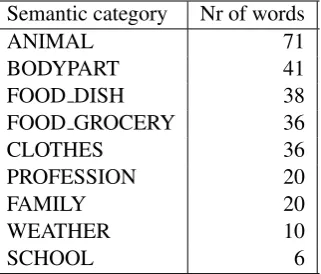
exercises and added ca 50 verbs to this list. At the moment we have 151 semantic categories defined but the number will probably increase as we add new Morfa-C question-answer templates. Some semantic categories that we are using are listed in Table 2, together with the number of words in each category.
Semantic category Nr of words
ANIMAL 71
BODYPART 41
FOOD DISH 38
FOOD GROCERY 36
CLOTHES 36
PROFESSION 20
FAMILY 20
WEATHER 10
SCHOOL 6
Table 2: Examples of semantic categories used in V˜oro Oahpa.
Another example. The question-answer pairs that are about buying and eating things require dis-tinction between the food that can be bought from the grocery shop and the food that can be eaten as a meal. Often the food and drink words belong to both categories but not always. We also needed a special category for the food words that are natu-ral to use in plunatu-ral (things that we normally eat a plenty of, not only one, e.g. peas, berries, nuts). The lists of words denoting foods and drinks have also been extended with more foods and drinks that are common in Estonia or specific to South-East Estonia.
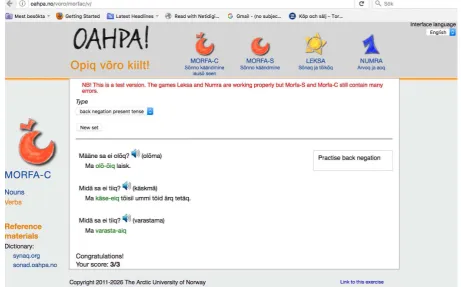
There is also a specific exercise for practicing back negation. Back negation has got a special attention because it exist neither in Estonian nor in Finnish. In Estonian, Finnish (and also in V˜oro parallel to back negation) the front negation is used where the negation word precedes the verb (e.g. ei ol˜oq= ”not is”). In back negation, the negation appears as a suffix that is added to the verb (e.g.
ol˜o-˜oiq= ”is-not”). There are more examples of back negation on Figure 1.
Morfa-C game in V˜oro Oahpa has a new feature that does not exist in any of the other implemen-tations of Oahpa. Namely, the computer will read aloud the sentences (questions) using V˜oro syn-thetic voice (of a 11-years-old girl) when the user clicks on the loudspeaker icon.
A problem we have discovered was repetition
of the identical exercises. This is partly due to the small number of words in some semantic sets but can still be avoided by improving the algorithm. There are three types of repetitions that we would like to eliminate:
1. Identical exercises within an exercise set con-sisting of three or five question-answer pairs should be prohibited.
2. It would also be good to avoid repetitions in the subsequent exercise sets. That is, if the user presses the button ”New set” then the task words she had in the previous set should not occur in the new set of exercises, or even bet-ter – the words that she answered correctly should not occur but the words where she made a mistake could be presented again. But this idea is difficult or impossible to imple-ment until we have not impleimple-mented the au-thentication of users and binding the usage data to specific users.
3. Avoid presenting the negatively loaded words (e.g. oss˜ondama”to vomit”, varastama”to steal”,pelg¨am¨a”to be frightened”,ullitama
”to act the fool”) too often. That presumes a modification of the exercise creation pro-cess: weights should be assigned to the words (low weights to the words that should appear rarely) and these weights should be taken into account in the word selection algorithm.
3.3 Discussion
The most important question is: Would V˜oro Oahpa meet the users’ needs?
We assume that most of the users are speakers of Estonian or Finnish. Therefore we need to focus on features of the V˜oro language that are different from Estonian:
• vowel harmony
• partially different case endings
Figure 1: Screenshot of the Morfa-C verb back negation exercise
• two different ways of building negation: front negation (ei ol˜oq) and back negation (ol˜o-˜oiq)
• different negation word in present vs past tense (ei ol˜oq= ”is not”,es ol˜oq= ”was not”)
• palatalisation mark in the written language
• more extensive use of diminutive
• pronouncation (especially important for the people who live outside of South-East Esto-nia)
All of the above, except for vowel harmony, also holds for Finnish speakers.
We also have to think about users with other mother tongues. Features that might be difficult for people with non-Uralic mother tongue:
• many morphological forms
• vowel harmony
• pronouncation
• usage of all the cases
All the listed topics are in fact included in Oahpa exercises in either implicit or explicit way but we
need to create more specific exercises to make the learner pay attention to the particular features of V˜oro. For example, we have specific exercises in Morfa-C for practicing back negation and using the correct negation word (eiores) but we should also create some special exercises on difficult in-flection types, vowel harmony rules and diminutive building.
V˜oro Oahpa is free to use for everybody on the URLhttp://oahpa.no/voro. The authors will be grateful for any feedback about the system.
4 Conclusion
can confirm that the infrastructure was helpful for our work. The biggest challenge is modeling the V˜oro morphology – covering all the inflection types, marking the preferred and non-preferred parallel forms and handling the different ways of spelling. Adding the audio dimension adds extra value to V˜oro Oahpa as many of the program’s prospective users are not exposed to spoken V˜oro. Reading aloud the Morfa-C questions is the feature that is totally new – it has not been implemented in any of the previous instances of Oahpa. The work on V˜oro Oahpa is continuing to enable practicing of larger vocabulary and more of the grammar.
Acknowledgments
The work has been funded by The Research Coun-cil of Norway project EMP160 ”Saami – Esto-nian language technology cooperation: similar lan-guages, same technologies”.
References
Lene Antonsen, Saara Huhmarniemi, and Trond Trosterud. 2009. Interactive pedagogical programs based on constraint grammar. Proceedings of the 17th Nordic Conference of Computational Linguis-tics. Nealt Proceedings Series 4.
Lene Antonsen, Ryan Johnson, Trond Trosterud, and Heli Uibo. 2013. Generating modular grammar ex-ercises with finite-state transducers. Proceedings of the second workshop on NLP for computer-assisted language learning at NODALIDA 2013, May 22-24, Oslo, Norway. NEALT Proceedings Series 17: 27-38.
Eckhard Bick 2005. Live use of Corpus data and Corpus annotation tools in CALL: Some new de-velopments in VISL. Nordic Language Technology,
˚
Arbog for Nordisk Sprogteknologisk Forskningspro-gram 2000-2004: 171–185 Museum Tusculanums Forlag.
Thomas Koller 2005. Development of web-based plurilingual learning software for French, Spanish and Italian. Studies in Contrastive Linguistics. Pro-ceedings of the 4th International Contrastive Lin-guistics Conference (ICLC4). University of Santi-ago de Compostela Press.
Detmar Meurers, Ramon Ziai, Luiz Amaral, Adriane Boyd, Aleksandar Dimitrov, Vanessa Metcalf, Niels Ott 2010. Enhancing authentic web pages for lan-guage learners. Proceedings of the NAACL HLT 2010 Fifth Workshop on Innovative Use of NLP for Building Educational Applications: 10–18
Sjur Moshagen, Jack Rueter, Tommi Pirinen, Trond Trosterud, and Francis M. Tyers. 2014. Open-Source Infrastructures for Collaborative Work on
Under-Resourced Languages Proceedings of CCURL (Collaboration and Computing for Under-Resourced Languages in the Linked Open Data Era) workshop 2014 organised with LREC2014: 71–77 European Language Resources Association (ELRA).