The Proceedings of the First Workshop on Human-Informed Translation and Interpreting Technology (HiT-IT), pages 21–28,
Comparing Machine Translation and Human Translation: A Case Study
Lars Ahrenberg
Department of Computer and Information Science Link¨oping University
Abstract
As machine translation technology im-proves comparisons to human perfor-mance are often made in quite general and exaggerated terms. Thus, it is impor-tant to be able to account for differences accurately. This paper reports a simple, descriptive scheme for comparing trans-lations and applies it to two transtrans-lations of a British opinion article published in March, 2017. One is a human translation (HT) into Swedish, and the other a ma-chine translation (MT). While the compar-ison is limited to one text, the results are indicative of current limitations in MT.
1 Introduction
In the CFP for this workshop it is claimed that ’Human translation and Machine Translation (MT) aim to solve the same problem’. This is doubtful as translation is not one thing but many, spanning a large space of genres, purposes, and contexts.
The aim of MT research and development is often phrased as ’overcoming language barriers’. To a large extent this aim has been achieved with many systems producing texts of gisting quality for hundreds, perhaps even thousands of language pairs, and (albeit fewer) systems that enable con-versations between speakers that do not share a common language. Human translation, however, often has a more ambitious aim, to produce texts that satisfy the linguistic norms of a target culture and are adapted to the assumed knowledge of its readers. To serve this end of the market, MT in combination with human post-editing is increas-ingly being used (O’Brien et al.,2014). The goals for MT have then also been set higher, to what is often called quality translation, and new
’in-teractive’ and/or ’adaptive’ interfaces have been proposed for post-editing (Green, 2015; Vashee, 2017). Thus, when production quality is aimed for, such as in sub-titling or publication of a news item or feature article, human involvement is still a necessity.
Some recent papers claim that MT now is al-most ’human-like’ or that it ’gets closer to that of average human translators’ (Wu et al., 2016). While such claims may be made in the excitement over substantial observed improvements in a MT experiment, they raise the question (again!) of how HT may differ from MT.
Some scholars have argued that MT will never reach the quality of a professional human trans-lator. The limitations are not just temporary, but inherent in the task. These arguments are perhaps most strongly expressed in (Melby with T. Warner, 1995). More recently, but before the breakthrough of NMT, Giammarresi and Lapalme (2016) still consider them valid. As MT can produce human-like translations in restricted domains and is creasingly being included in CAT-tools, they in-sist that MT is posing a challenge for Translation Studies.
In this paper I report a small case study, a close comparison of a human translation and a machine translation from a state-of-the-art system of the same source text. This is done with two purposes in mind. The first concerns how the differences should be described, what concepts and tools are useful to make such a comparison meaningful and enlightening. The second is to assess the differ-ences between state-of-the-art MT and HT, with the caveat, of course, that one pair of translations cannot claim to be representative of the very large translation universe.
2 MT and Translation Studies
The two fields of MT and Translation Studies (TS) have developed separately for almost as long as they have existed. In the early days of both disci-plines, some researchers attempted to account for translation in more or less formal linguistic terms, potentially forming a foundation for automatiza-tion, e.g. (Catford, 1965). The ’cultural turn’ in TS moved the field away from linguistic detail and further apart from MT. The 1990:ies saw a com-mon interest in empirical data, but while corpora, and parallel corpora in particular, were collected and studied in both fields, they were largely used for different purposes. For example, it seems that the empirical results generated by TS studies on translation universals (Baker, 1993) did not have much effect on MT.
A problem related to this challenge is that MT and TS lack common concepts and terminology. MT prefers to speak in terms of models, whereas TS is more comfortable with concepts such as function and culture. There is a mutual inter-est in translation quality assessment (TQA), how-ever, and large-scale projects on MT tend to have some participation of TS scholars. For example, one result of the German Verbmobil project is the volumeMachine Translation and Translation Theory, (Hauenschild and Heizmann, 1997) that contain several studies on human translation and how it can inform MT. It is also true of more re-cent projects such as QTLaunchPad where eval-uation of translation quality was in focus, and CASMACAT where the design of a CAT tool was informed by translation process research (Koehn et al.,2015).
Error analysis is an area of common inter-est. (O’Brian,2012) showed that error typologies and weightings were used in all eleven translation companies taking part in her study. It was also shown that some categories occurred in all or the large majority of the taxonomies. She concludes though that error analysis is insufficient and some-times rightout inappropriate. This is so because it doesn’t take a holistic view of the text and its util-ity and paying too little attention to aspects such as text type, function or user requirements. A num-ber of alternative evaluation models including us-ability evaluation, ratings of adequacy and fluency, and readability evaluation are propsed.
In the MT context the merits of error analysis is that it can tell developers where the major
prob-lems are, and users what to expect. A taxonomy which has been popular in MT is (Vilar et al., 2006). To avoid the necessity of calling in hu-man evaluators every time an error analysis is to be performed there have also been work on auto-matic error classification (Popovi´c and Burchardt, 2011). While simply counting errors seems less relevant for comparing machine translation to hu-man translation, showing what type of errors oc-cur can be useful. We must recognize then that the categories could vary with purpose.
Another line of research studies the effects of tools and processes on translations. This field is quite underresearched, though see for instance (Jim´enez-Crespo, 2009; Lapshinova-Koltunski,2013;Besacier and Schwartz,2015) for some relevant studies.
2.1 Comparing Translations
The most common standard for comparing trans-lations is probably quality, a notion that itself re-quires definition. If we follow the insights of TS, quality cannot be an absolute notion, but must be related to purpose and context. For instance, Ma-teo(2014), referring to (Nord,1997) defines it as “appropriateness of a translated text to fulfill a communicative purpose”. In the field of Trans-lation Quality Assessment (TQA) the final out-come of such a comparison will then be a judge-ment of the kind ’Very good’, ’Satisfactory’, or ’Unacceptable’ where at least some of the criteria for goodness refer to functional or pragmatic ade-quacy (Mateo et al.,2017).
In MT evaluation, which is concerned with sys-tem comparisons based on their produced trans-lations, the judgements are more often rankings: ’Better-than’ or ’Indistinguishable-from’. One fo-cus has then been on developing metrics whose ratings correlate well with human ratings or rank-ings. This line of research got a boost by Pap-ineni et al.(2002) and has since been an ongoing endeavour in the MT community, in particular in conjunction with the WMT workshops from 2006 onwards. Most measures developed within MT rely on reference translations and give a kind of measure of similarity to the references.
such as: What are the characteristics of a machine-translated text as compared to a human transla-tion? What can the human translator do that the MT system cannot (and vice versa)? What actions are needed to make it fit for a purpose?
Many works on translation, especially those that are written for presumtive translators, include a chapter on the options available to a translator, variously called strategies, methods or procedures. A translation procedure is a type of solution to a translation problem. In spite of the term, trans-lation procedures can be used descriptively, to characterize and compare translations, and even to characterize and compare translators, or trans-lation norms. This is the way they will be used here, for comparing human translation and ma-chine translation descriptively. This level of de-scription seems to me to be underused in MT, though see (Fomicheva et al.,2015) for an excep-tion.
With (Newmark,1988) we may distinguish gen-eral or global translation methods, such as seman-tic vs. communicative translation, that apply to a text as a whole (macro-level) from procedures that apply at the level of words (micro-level), such as shifts or transpositions. In this paper the focus is on the micro-level methods.
3 A Case Study 3.1 The Approach
The analysis covers intrinsic as well as extrinsic or functional properties of the translations. The intrinsic part covers basic statistical facts such as length and type-token ratios, and MT metrics. Its main focus, however, is on translation procedures or the different forms of correspondence that can be found between units. A special consideration is given to differences in word order as these can be established less subjectively than categorizations. The functional part considers purpose and context, but one translation can in principle be evaluated in relation to two or more purposes, i.e., post-editing or gisting.
Catford (1965) introduced the notion of shifts, meaning a procedure that deviates somehow from a plain or literal translation. A large catalogue of translation procedures, or methods, was pro-vided by (Vinay and Darbelnet,1958) summarized in seven major categories: borrowing, calque, lit-eral translation, transposition, modulation, equiv-alence, and adaptation. Newmark (1988)
pro-vides a larger set. The most detailed taxonomy for translation procedures is probablyvan Leuven-Zwart(1989) who establishes correspondence on a semantic basis through what she calls archi-transemes.
A problem with these taxonomies is to apply them in practice. For this reason I will only give counts for coarse top level categories and report more fine-grained procedures only in rough esti-mates. At the top level we have a binary distinc-tion between Shifts and Unshifted, or literal trans-lations. An unshifted translation is one where only procedures which are obligatory or standard for the target language have been used, and content is judged to be the same. Semantic shifts are as far as possible noted separately from structural shifts. Shifts are identified at two levels: sentences and clausal units. Relations between units are estab-lished on the basis of position and content. At the sentence level position in the linear flow of infor-mation is usually sufficient to infer a relation. At the clausal level correspondence must take syntac-tic relations into account in addition to content. As for content we require only that there is some sort of describable semantic or pragmatic relation.
3.2 The Data
The source text is an opinion article published by the Financial Times on March 17, 2017 entitled
Why I left my liberal London tribeand written by David Goodhart. It is fairly typical of a British opinion article. Paragraphs are short with only a few sentences, the length of sentences are quite varied, and long sentences tend to be built both syntactically and with insertions, appositions and parataxis. Table 1 (first column) gives an illustra-tion.
The human translation appeared in the June is-sue of the Swedish magazineAxess. It was trans-lated manually with no other computer aids than interactive dictionaries and the web for fact check-ing. No specific brief had been issued with the as-signment. The translation was published with only minor edits but under a different title.
The machine translation was produced by Google Translate in the middle of June, 2017. Ac-cording to Google’s web information, translation from English into Swedish was then using NMT1. Even a non-Swedish speaker can observe that the paragraph shown in Table 1 has the same
English source Swedish MT Swedish HT
I referred to changing my mind Jag h¨anvisade till att ¨andra mig Jag refererade till ett byte av uppfattning as though it were a rational process, som om det var en rationell process, som om det vore en rationell process,
in which one audits ones beliefs d¨ar man reviderar sin tro d¨ar man granskar sina ˚asikter every few years and decides to p˚a n˚agra ˚ar och best¨ammer sig f¨or att med n˚agra ˚ars mellanrum och beslutar sig f¨or shift ground on Israel/Palestine flytta marken mot Israel / Palestina att ¨andra st˚andpunkt ifr˚aga om Israel och
or the single market. eller den inre marknaden. palestinierna eller EU:s inre marknad But thats not how it works. Men det ¨ar inte hur det fungerar. Men det ¨ar inte s˚a det fungerar. If, like most educated people, Om du, som de mest utbildade persone- Om man, som de flesta v¨alutbildade, you place a high value on moral and rna l¨agger h¨ogt v¨arde p˚a moralisk och s¨atter stort v¨arde p˚a moralisk och
intellectual coherence, your views intellektuell sammanhang, har dina intellektuell samst¨ammighet brukar ens tend to fit together into something ˚asikter en tendens att passa in i n˚agot ˚asikter passa in i n˚agot som liknar
like an explicable worldview. som en f¨orklarlig v¨arldsutsikt. en f¨orst˚aelig v¨arlds˚ask˚adning. And that usually goes along with Och det g˚ar oftast med Och med den f¨oljer vanligtvis ett informal membership of a network informellt medlemskap i ett n¨atverk informellt medlemskap i ett n¨atverk
like-minded people. av likasinnade m¨anniskor. av likasinnade. Without having to think very hard Utan att beh¨ova t¨anka v¨aldigt sv˚art, Utan att egentligen beh¨ova fundera p˚a
you know you all broadly favour k¨anner du dig allihopa saken vet man att alla p˚a det hela and oppose the same things. och mots¨atter sig samma saker. taget ¨ar f¨or och emot samma saker.
Table 1: A source paragraph and its two translations.
ber of sentences as the source in both translations (there are 5), that the sentences correspond one-to-one and are quite similar in length. The flow of information is also very similar; shorter units than sentences such as clauses and phrases can be aligned monotonously in both translations with few exceptions.
Source MT HT
Paragraphs 30 30 30
Sentences 86 86 95
[image:4.595.108.491.60.324.2]Word tokens 2555 2415 2603 Characters 13780 13888 15248 Type-token ratio 2.84 2.56 2.58 Mean Sent.length 29.7 28.1 27.4 Avg length diff. – 2.0 3.2
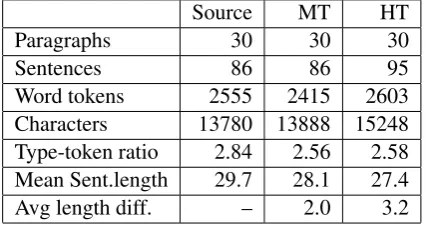
Table 2: Basic statistics for the three texts. The last line states the average absolute value of length differences at the sentence level.
4 Results
4.1 Basic Statistics
The visual impression of Table 1 indicates that the human translation is longer than the machine translation. This is confirmed when we look at the translations as wholes, the human translation is longer both in terms of number of words and num-ber of characters. In terms of characters the ratio is
1.01 for the MT and 1.11 for the HT. Yet, when the HT is shorter than the source for a given sentence, the difference can be large. The HT also has more sentences, as the human translator has decided to split eight sentences (roughly 9% of all) into two or three shorter ones. Basic statistics for all three texts are shown in Table 2.
MT metrics are especially valuable for com-parisons over time. As we only have one ma-chine translation in this study, we limit ourselves to reporting BLEU (Papineni et al., 2002) and TER (Snover et al.,2006). After tokenization and segmentation into clause units of both the MT and the HT translations, using the latter as reference we obtained the results shown in Table 32. Fol-lowing the analysis of clauses into Shifted and Un-shifted (see section 4.4) we also computed these metrics for the two types of segments separately.
Section BLEU Bleu(1) Bleu(2) TER Unshifted 42.79 69.0 48.7 0.374 Shifted 16.84 48.2 23.6 0.662
All 23.27 59.6 30.7 0.621
Table 3: BLEU and TER scores for different sec-tions of the MT, using HT as reference.
2Values were computed with the multi-bleu.perl script
[image:4.595.75.288.468.583.2]4.2 Monotonicity
By monotonicity we mean information on the or-der of content in the translation as compared to the order of corresponding content in the source text. Both translations are one-to-one as far as paragraphs are concerned. As noted, the HT is not altogether one-to-one at the sentence level, but at the level of clauses, the similarities are greater: the order is the same with the exception that the HT has added one clause.
To get a measure of monotonicity all corre-sponding word sequences s (from the source text) and t (from the translation) of the form s=a:b and t=Tr(b):Tr(a) are identified. The number of in-stances per sentence is noted as well as the number of words that are part of such a source sequence. The degree of monotonicity is expressed as a ratio between the total number of affected source words and all words in the text. The results are shown in Table 4.
Word Order MT HT
changes Sents Words Sents Words
0 36 0 15 0
1 40 125 40 197
2 9 72 22 203
3 1 10 5 52
≥4 - 0 4 110
Total 86 207 86 562
Table 4: Number of sentence segments affected by a certain number of word order changes.
A total of 61 changes of word order is observed in the MT, related to 207 words of the source text, or 1.5% of all words. Almost all of them are cor-rect, the large majority of them relates to the V2-property of Swedish main clauses. as in (1), but there are also successful changes producing cor-rect word order in subordinate clauses, as in (2), or a Swedish s-genitive from an English of-genitive as in (3). While the system thus has a high preci-sion in its word order changes, there are also cases where it misses out.
(1) Why do we1change2our minds about things?
Varf¨or f¨or¨andrar2vi1v˚art sinne om saker?
(2) and feel that for the first time in my life1I2...
och k¨anner att jag2f¨or f¨orsta g˚angen i mitt liv1...
(3) the core beliefs1of modern liberalism2
den moderna liberalismens2k¨arnf¨orest¨allningar1
The human translation displays almost twice as many word order changes, 116, and they affect
longer phrases and cover longer distances. Still 4.1% is not a very large share and confirms the im-pression that the information order in the human translation follows the source text closely. The human translator does more than fixing a correct grammar, however, and also improves the style of the text, for instance as regards the placement of insertions, as in (4), and shifts of prominence, as in (5).
(4) I have changed1my mind, more slowly2, about..
MT: Jag har f¨or¨andrat1mig, mer l˚angsamt2, om..
HT: Sj¨alv har jag, om ¨an l˚angsammare2, ¨andrat1
inst¨allning..
(5) Instead I met the intolerance1of .. for the first time2
MT: Ist¨allet m¨otte jag den intolerans av den moderna v¨anster1f¨or f¨orsta g˚angen2
HT: Ist¨allet fick jag f¨or f¨orsta g˚angen2m¨ota den
moderna v¨nsterns intolerans1
4.3 Purpose-related Analysis
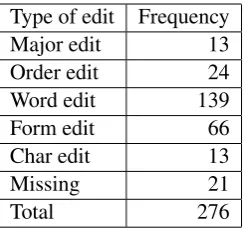
It is obvious, and unsurprising, that the MT does not achieve publication quality. To get a better idea of where the problems are, a profiling was made in terms of the number and types of edits judged to be necessary to give the translation pub-lication quality. Any such analysis is of course subjective, and it has been done by the author, so the exact numbers are not so important. However, the total number and distribution of types are in-dicative of the character of the translation. A sim-ple taxonomy was used with six types3:
• Major edit; substantial edit of garbled output requiring close reading of the source text
• Order edit; a word or phrase needs reordering • Word edit; a content word or phrase must be replaced
to achieve accuracy
• Form edit; a form word must be replaced or a content word changed morphologically
• Char edit; change, addition or deletetion of a single character incl. punctuation marks
• Missing; a source word that should have been trans-lated has not been
The distribution of necessary edits on the differ-ent types are shown in Table 4. The most frequdiffer-ent type is ’word edit’ which accounts for more than half of all edits. In this group we find words that ’merely’ affect style as well as word choices that thwarts the message substantially.
3All categories except ’Major edit’ have counterparts in
Type of edit Frequency
Major edit 13
Order edit 24
Word edit 139
Form edit 66
Char edit 13
Missing 21
[image:6.595.121.244.61.175.2]Total 276
Table 5: Frequencies of different types of required editing operations for the MT (one analyst).
A skilled post-editor could probably perform this many edits in two hours or less. However, there is no guarantee that the edits will give the translation the same quality or reading experi-ence as the human translation. Minimal edits us-ing a segment-oriented interface will probably not achieve that. The style and phrasing of the source would shine through to an extent that could offend some readers of the magazine, although most of the contents may be comprehended without prob-lems, cf. Besacier and Schwartz (2015) on literary text. However, for gisting purposes the MT would be quite adequate.
4.4 Translation Procedures: What the MT System didn’t do
While the human translator did not deviate that much in the order of content from the source text, he used a number of other procedures that seem to be beyond the reach of the MT system. Altogether we find more than 50 procedures of this kind in the HT. The most important of these are:
• Sentence splitting. There were eight such splits, including one case of splitting a source sentence into three target sentences. This procedure also comes with the insertion of new material such as a suitable adverb or restoring a subject.
• Shifts of function and/or category. These are numerous; non-finite clauses or NP:s are translated by a finite clause in Swedish, a complete clause is reduced by ellipsis, a rela-tive clause may be rendered by a conjoined clause, adjectival attributes are rendered as relative clauses, an adverb is translated by an adjective or vice versa, and so on.
• Explicitation. Names whose referents can-not be assumed to be known by the readers
are explained, e.g. ’Rusell Group universi-ties’ receives an explanation in parentheses. Also, at the grammatical level function words such as och (and), som (relative pronoun),
att(complementizer ’that’) and indefinite ar-ticles are inserted more often in the HT than in the MT.
• Modulation = change of point of view. For example, translating ’here’ and ’these islands’ in the source by ’Storbritannien’ (Great Britain).
• Paraphrasing. The semantics is not quite the same but the content is similar enough to pre-serve the message, e.g. the translation of ’move more confidently through the world’ is translated as the terser ’¨oka ens sj¨alvs¨akerhet’ (increase your confidence).
5 Conclusions and Future Work
Differences between machine translations and hu-man translations can be revealed by fairly simple statistical metrics in combination with an analy-sis based on so-called shifts or translation proce-dures. In our case, the MT is in many ways, such as length, information flow, and structure more similar to the source than the HT. More impor-tantly, it exhibits a much more restricted reper-toir of procedures, and its output is estimated to require about three edits per sentence. Thus, for publishing purposes it is unacceptable without hu-man involvement. Post-editing of the MT output could no doubt produce a readable text, but may not reach the level of a human translation. In fu-ture work I hope to be able include post-edited text in the comparison.
Another topic for future research is predicting translation procedures on a par with current shared tasks predicting post-editing effort and translation adequacy.
Acknowledgments
References
Mona Baker. 1993. Corpus linguistics and translation studies: Implications and applications. In Mona Baker, Gill Francis, and Elena Tognini-Bonelli, edi-tors, Text and Technology: In Honour of John Sin-clair, John Benjamins, Amsterdam and Philadel-phia.
Laurent Besacier and Lane Schwartz. 2015. Au-tomated translation of a literary work: A
pi-lot study. In Proceedings of the Fourth
Work-shop on Computational Linguistics for Liter-ature. Association for Computational Linguis-tics, Denver, Colorado, USA, pages 114–122.
http://www.aclweb.org/anthology/W15-0713.
John C Catford. 1965. A Linguistic Theory of Transla-tion. Oxford University Press, London, UK. Marina Fomicheva, N´uria Bel, and Iria da Cunha.
2015. Neutralizing the Effect of Translation Shifts on Automatic Machine Translation Ev aluation, Springer International Publishing, pages 596–607.
https://doi.org/10.1007/978-3-319-18111-0 45. Salvatore Giammarresi and Guy Lapalme. 2016.
Com-puter science and translation: Natural languages and machine translation. In Yves Gambier and Luc van Doorslaer, editors, Border Crossings: Translation Studies and other disciplines, John Benjamins, Am-sterdam/Philadelphia, chapter 8, pages 205–224. Spence Green. 2015. Beyond post-editing: Advances
in interactive translation environments. ATA Chron-icleWww.atanet.org/chronicle-on-line/...
Christa Hauenschild and Susanne Heizmann. 1997. Machine Translation and Translation Theory. De Gruyter.
Miguel A. Jim´enez-Crespo. 2009. Conventions in lo-calisation: a corpus study of original vs. translated web texts. JoSTrans: The Journal of Specialised Translation12:79–102.
Philipp Koehn, Vicent Alabau, Michael Carl, Fran-cisco Casacuberta, Mercedes Garc´ıa-Mart´ınez, Jes´us Gonz´alez-Rubio, Frank Keller, Daniel Ortiz-Mart´ınez, Germ´an Sanchis-Trilles, and Ulrich Germann. 2015. Casmacat, final public report.
http://www.casmacat.eu/uploads/Deliverables/final-public-report.pdf.
Ekaterina Lapshinova-Koltunski. 2013. Vartra: A comparable corpus for analysis of
transla-tion variatransla-tion. In Proceedings of the Sixth
Workshop on Building and Using Compara-ble Corpora. Association for Computational Linguistics, Sofia, Bulgaria, pages 77–86.
http://www.aclweb.org/anthology/W13-2510.
Roberto Mart´ıinez Mateo. 2014. A deeper look into metrics for translation quality assessment (TQA): A case study. Miscel´anea: A Journal of English and American Studies49:73–94.
Roberto Mart´ıinez Mateo, Silvia Montero Mart´ıinez, and Arsenio Jes´us Moya Guijarro. 2017. The modular assessment pack a new approach to trans-lation quality assessment at the directorate gen-eral for translation. Perspectives: Studies in Translation Theory and Practice 25:18–48. Doi 10.1080/0907676X.2016.1167923.
Alan Melby with T. Warner. 1995. The Possibility of Language. John Benjamins, London and New York.
https://doi.org/10.1075/btl.14.
Peter Newmark. 1988. A Textbook of Translation. Prentice Hall, London and New York.
Christiane Nord. 1997. Translation as a Purposeful Activity. St Jerome, Manchester, UK.
Sharon O’Brian. 2012. Towards a dynamic quality evaluation model for translation. The Journal of Specialized Translation17:1.
Sharon O’Brien, Laura Winther Balling, Michael Carl, Michel Simard, and Lucia Specia. 2014. Post-Editing of Machine Translation: Processes and Ap-plications. Cambridge Scholars Publishing, New-castle upon Tyne.
Kishore Papineni, Salim Roukos, Todd Ward, and Wei-Jing Zhu. 2002. Bleu: a method for automatic evaluation of machine transla-tion. In Proceedings of 40th Annual Meeting of the Association for Computational Linguis-tics. Association for Computational Linguistics, Philadelphia, Pennsylvania, USA, pages 311–318.
https://doi.org/10.3115/1073083.1073135.
Maja Popovi´c and Aljoscha Burchardt. 2011. From human to automatic error classification for machine translation output. InProceedings of the 15th Inter-national Conference of the European Association for Machine Translation. Leuven, Belgium, pages 265– 272.
Matthew Snover, Bonnie Dorr, Richard Schwartz, Lin-nea Micciulla, and John Makhoul. 2006. A study of translation edit rate with targeted human annotation. InProceedings of Association for Machine Transla-tion in the Americas.
Kitty M van Leuven-Zwart. 1989. Translation and original: Similarities and dissimilarities, 1. Target 1:2:151–181.
Kirti Vashee. 2017. A closer look at sdl’s adaptive mt technology. Http://kv- emptypages.blogspot.se/2017/01/a-closer-look-at-sdls-adaptive-mt.html.
David Vilar, Jia Xu, Luis Fernando D’Haro, and Her-mann Ney. 2006. Error analysis of machine trans-lation output. InLREC06. Genoa, Italy, pages 697– 702.