A Simple Method for Clarifying Sentences with Coordination Ambiguities
Michael White
and
Manjuan Duan
and
David L. King
Department of Linguistics
The Ohio State University
Columbus, OH 43210 USA
[email protected],
{
duan.59,king.2138
}
@osu.edu
Abstract
We present a simple, broad coverage method for clarifying the meaning of sentences with coordination ambiguities, a frequent cause of parse errors. For each of the two most likely parses involving a coordination ambigu-ity, we produce a disambiguating paraphrase that splits the sentence in two, with one con-junct appearing in each half, so that the span of each conjunct becomes clearer. In a val-idation study, we show that the method en-ables meaning judgments to be crowd-sourced with good reliability, achieving 83% accuracy at 80% coverage.
1 Introduction
In principle, intelligent systems should be capable of explaining how they have interpreted unrestricted natural language sentences. Although some early di-alogue systems such as SHRDLU (Winograd, 1973) could ask questions to clarify the meaning of certain structurally ambiguous sentences, little work has been done to date on the task of generating questions to clarify structural ambiguities in a broad coverage setting. Recently, Duan et al. (2016) have shown that generating unambiguous paraphrases from compet-ing parses of structurally ambiguous sentences can serve as a useful method for asking to clarify their intended meaning; in particular, they showed that their method enables crowd-sourced meaning judg-ments to be collected in order to improve parser ac-curacy in new domains. Duan et al.’s study cov-ered most of the major sources of common parser errors identified by Kummerfeld et al. (2012), with
the exception of ambiguities involving the correct spans of conjuncts in coordinated phrases (unless they involve modifier attachment ambiguities). Also closely related is He et al.’s (2016) work on generat-ing questions to identify semantic roles, though their work does not address coordination span ambigui-ties either.
In this paper, we present a novel method for gen-erating disambiguating paraphrases for sentences with ambiguities involving two coordinated ele-ments where the sentence is split in two, with one conjunct appearing in each half, so that the span of each conjunct becomes clearer. In a validation study, we show that the method enables meaning judg-ments to be crowd-sourced with good reliability. Following an error analysis that highlights problem-atic cases, we conclude with a discussion of ways in which the method could be improved.
2 Disambiguation Method
At a high level, our method for generating disam-biguating paraphrases for sentences with coordina-tion ambiguities is as follows:
1. Parse the sentence and determine whether the most likely parse (henceforth the ‘top’ parse) has a coordinated phrase with two con-juncts/disjuncts, recording its span in words.
2. Examine the subsequent parses in the n-best
list (in order) to determine whether the parse (henceforth the ‘next’ parse) has a coordinated phrase with a different span.
(w1 / do [mood=dcl tense=pres] :Arg0 (w0 / they)
:Arg1 (w2 / have :Arg0 w0
:Arg1 (w5 / selection [num=sg] :Det (w3 / a)
:Mod (w4 / good) :Mod (w6 / of
:Arg1 (w8 / and
:First (w7 / fabric [det=nil num=sg]) :Next (w9 / notion
[det=nil num=pl]))))))
(a) Semantic dependency graph of ‘top’ parse
(w1 / do [mood=dcl tense=pres] :Arg0 (w0 / they)
:Arg1 (w2 / have :Arg0 w0 :Arg1 (w8 / and
:First (w5 / selection [num=sg] :Det (w3 / a)
:Mod (w4 / good) :Mod (w6 / of
:Arg1 (w7 / fabric
[det=nil num=sg]))) :Next (w9 / notion [det=nil num=pl]))))
(b) Semantic dependency graph of ‘next’ parse
Figure 1: Most likely parses for (1)
(a) copying the words up to and including the first conjunct, followed by the words fol-lowing the coordinated phrase;
(b) copying any sentence-final punctuation, then starting a new sentence by copying the conjunction; and
(c) again copying the words up to the first conjunct, then copying the second con-junct, again followed by the words follow-ing the coordinated phrase.
To illustrate, consider (1) below, a sentence from the
English Web Treebank,1 a corpus which is
primar-ily out-of-domain for parsers trained on the original Penn Treebank. This sentence has a coordination
ambiguity betweena good selection of [[fabric] and
[notions]]and[[a good selection of fabric] and [no-tions]], which is not (conventionally) analyzed as a
modifier attachment ambiguity.2
(1) They do have a good selection of fabric and
notions.
a. They do have a good selection of
fab-ric. And they do have a good selection
1https://catalog.ldc.upenn.edu/ ldc2012t13
2Note that sentences with ambiguities involving
post-modifiers are dealt with symmetrically.
Figure 2: Sample survey question
of notions.
b. They do have a good selection of fabric.
And they do have notions.
The disambiguating paraphrase for the former, ‘top’ parse (correct according to the English Web Tree-bank) appears in (1-a), and the one for the latter, ‘next’ parse appears in (1-b), with underlining to highlight the differences between them.
To parse sentences, we use the Berkeley parser
(Petrov et al., 2006) trained on OpenCCG3
deriva-tions (White, 2006; White et al., 2007; Boxwell and White, 2008) extracted from the CCGbank (Hock-enmaier and Steedman, 2007). Derivations yield semantic dependency graphs represented using Hy-brid Logic Dependency Semantics; the dependency graphs for (1) appear in Figure 1 using AMR-style notation (Banarescu et al., 2013). As shown in the
figure, the :First and :Next relations can be
used to identify coordinated phrases, and word
iden-tifiers allow spans to be extracted from subtrees.4
3 Crowd-Sourcing Judgments
We used Amazon Mechanical Turk (AMT) to crowd-source meaning judgments using our method of paraphrasing coordination ambiguities. Work-ers were given no training and very simple instruc-tions, namely to select the paraphrase that is closer
3http://openccg.sourceforge.net/
4Note that the conjunct spans can be accurately obtained
Accuracy
Coverage Majority MACE
All w/ Excl. All Filtered
25% 1.00 - 1.00 1.00
35% - 0.98 0.97 1.00
50% 0.93 - 0.89 0.91
60% - 0.88 0.87 0.90
80% - - 0.83 0.84
100% 0.75 0.75 0.74
-Table 1: Coverage vs. accuracy highlights using ma-jority vote (mama-jority, strong mama-jority, near unanim-ity) and MACE with all workers; majority vote with poorly performing workers excluded; and MACE with ‘neither’ responses filtered out
in meaning to the original sentence, even it does not mean exactly the same thing, or ‘neither’ if neither sentence is closer in meaning. A screen shot show-ing a survey question appears in Figure 2.
For our validation experiment, we generated para-phrases for 172 items taken from the development section of the English Web Treebank. From these 172 items, twelve that were relatively short and clear were selected to be control items. The items were randomly distributed across eight surveys, with each survey containing 28 items, of which eight were control items, with four items per page.
We sought five workers to complete each survey. Workers were required to have a US IP address, be native speakers of English, and have achieved Mas-ters status on AMT. Workers were told that they needed to get 75% of the control items correct. For five of the eight surveys, one worker failed to achieve 75% correct on the control items, so we sought an additional worker for each of these. All workers were paid $2 per survey, including the ones who failed to reach 75% on the control items, as they did not appear to be answering randomly. Each sur-vey took 10-15 minutes to complete.
4 Results
4.1 Coverage vs. Accuracy
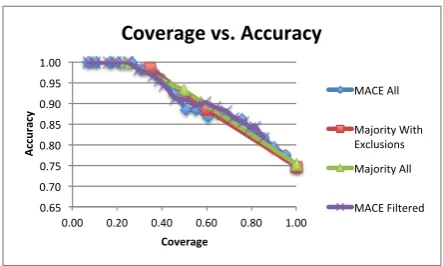
We measured the accuracy of the crowd-sourced judgments against our own expert judgments at var-ious coverage levels. The results appear in Table 1 and Figure 3. Unlike the crowd-sourced judgments,
0.65 0.70 0.75 0.80 0.85 0.90 0.95 1.00
0.00 0.20 0.40 0.60 0.80 1.00
Ac
cu
ra
cy
Coverage
Coverage vs. Accuracy
MACE All
Majority With Exclusions Majority All
MACE Filtered
Figure 3: Coverage vs. accuracy using majority vote (majority, strong majority, near unanimity) and MACE across various confidence levels
our expert judgments were based on examining the ‘top’ and ‘next’ parses to see which one (if any) was more correct, consulting the structure annotated in the English Web Treebank in cases with any doubt.
One way to aggregate crowd-sourced judgments across multiple annotators is to simply take the ma-jority judgment, breaking ties randomly. In this case, a consensus judgment is obtained for all items, so coverage is 100%. As shown in the table, accu-racy at this coverage level is 75%, much higher than the chance level of 33.3%. A trade-off between cov-erage and accuracy can also be obtained by requiring a super-majority: for a strong majority, we required at least 75% agreement, and for (near) unanimity, we required at least 90% agreement. When all annota-tors are included—even those who performed poorly on the control items—requiring a strong majority re-duces coverage to only 50%, but accuracy goes up to 93%; with the poorly performing annotators ex-cluded, there are more strong majority cases, with 60% coverage, but accuracy is relatively lower, at 88%. Requiring (near) unanimity reduces coverage further, but raises accuracy to near 100%.
As an alternative to using majority judgments,
MACE5 (Hovy et al., 2013) can be used to make
consensus predictions by weighting annotator judg-ments by their competence, where competence is estimated using expectation maximization. These consensus predictions can be assigned a confidence value according not only to agreement but also to estimated annotator competence. We ran MACE with thresholds to retain only the 5%, 10%, 15%,
[image:3.595.304.526.103.236.2] [image:3.595.77.284.104.227.2]Error type Count
preceding modifier scope ambiguity 14
following modifier scope ambiguity 4
apposition 4
miscellaneous 8
‘neither’ cases 14
[image:4.595.68.273.105.206.2]total errors 44
Table 2: Distribution of errors
. . . 100% of the items with the highest model confi-dence, as shown in the figure; with MACE, it made little difference whether poorly performing annota-tors were excluded, so we only show the results with all annotators here. The accuracy of the MACE-derived consensus judgments was no better than with the majority judgments, but MACE did make it possible to identify a sweet spot where coverage is still high at 80% while accuracy is substantially higher at 83% than in the full-coverage case. Finally, the table and figure also show the coverage and accu-racy when items where ‘neither’ was the consensus judgment are excluded, as these would be unhelpful for parser adaptation: here, a slightly higher accu-racy of 84% is attained at the 80% coverage level.
4.2 Error Analysis
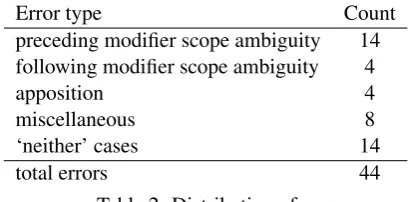
The distribution of errors using MACE at the 100% coverage level appears in Table 2. Out of 172 items, the annotator consensus differed from our judgment in 44 cases. Most of the errors were related to ei-ther modification or apposition. The miscellaneous errors were ones that only occurred once. There were also 7 items where neither parse was more cor-rect, and 7 where the annotator consensus was erro-neously ‘neither’, typically because parse errors led to hard-to-understand paraphrases.
Of the 30 remaining (non-‘neither’) errors, roughly half involved preceding modifiers with am-biguous scope. Although our paraphrasing method handles preceding modifiers within noun phrases reasonably well, adverbial scope proved more dif-ficult to disambiguate. For example, consider (2):
(2) So go and get dancing!!!!!!!!!!!!!!!!!!!!!!!!!.
a. So go![...]. And so get dancing![...].
b. So go![...]. And get dancing![...].
Although without context, it is somewhat difficult to tell whether the scope of the discourse
connec-tivesoapplies to both imperative clauses or only the
first, our crowd sourced annotators overwhelmingly preferred the paraphrase (3-b) of the ‘next’ parse, contrary to the English Web Treebank. One
possi-ble reason is that here, repeatingsoin (3-a) is quite
awkward. Additionally, although so is only in the
first sentence of paraphrase (3-b), it is easy to inter-pret it as also modifying the second clause.
Of the remaining errors, paraphrases from appos-itive constructions such as (3) stood out, as these do not have a straightforwardly distributive interpreta-tion. Likewise, there were a couple errors involving collective readings for conjoined noun phrases.
(3) Shuttle veteran and longtime NASA
execu-tive Fred Gregory is temporarily at the helm of the 18,000-person agency.
a. Shuttle veteran is temporarily at the
helm of the 18,000-person agency. And long time NASA executive Fred Gre-gory is temporarily at the helm of the 18,000-person agency.
b. Shuttle veteran is temporarily at the
helm of the 18,000-person agency. And shuttle long time NASA executive Fred Gregory is temporarily at he helm of the 18,000-person agency.
5 Discussion
Our validation study has shown that our simple, broad coverage method for clarifying the meaning of sentences with coordination ambiguities enables meaning judgments to be crowd-sourced with good reliability, far above chance and at a level that can be expected to pay off for parser domain adaptation. Since the method is so simple, it should be possible to adapt to a variety of parsing frameworks.
Acknowledgments
We thank the OSU Clippers Group and the anony-mous reviewers for helpful comments and discus-sion. This work was supported in part by NSF grant IIS-1319318.
References
Laura Banarescu, Claire Bonial, Shu Cai, Madalina Georgescu, Kira Griffitt, Ulf Hermjakob, Kevin Knight, Philipp Koehn, Martha Palmer, and Nathan Schneider. 2013. Abstract Meaning Representa-tion for Sembanking. InProceedings of the 7th Lin-guistic Annotation Workshop and Interoperability with Discourse, pages 178–186. Association for Computa-tional Linguistics.
Stephen Boxwell and Michael White. 2008. Projecting Propbank roles onto the CCGbank. InProc. LREC-08. Manjuan Duan, Ethan Hill, and Michael White. 2016. Generating disambiguating paraphrases for struc-turally ambiguous sentences. InProceedings of the 10th Linguistic Annotation Workshop held in conjunc-tion with ACL 2016 (LAW-X 2016), pages 160–170. Association for Computational Linguistics.
Luheng He, Julian Michael, Mike Lewis, and Luke Zettlemoyer. 2016. Human-in-the-loop parsing. In Proceedings of the 2016 Conference on Empiri-cal Methods in Natural Language Processing, pages 2337–2342. Association for Computational Linguis-tics.
Julia Hockenmaier and Mark Steedman. 2007. CCG-bank: A Corpus of CCG Derivations and Dependency Structures Extracted from the Penn Treebank. Com-putational Linguistics, 33(3):355–396.
Dirk Hovy, Taylor Berg-Kirkpatrick, Ashish Vaswani, and Eduard Hovy. 2013. Learning whom to trust with MACE. InProceedings of the 2013 Conference of the North American Chapter of the Association for Computational Linguistics: Human Language Tech-nologies, pages 1120–1130. Association for Compu-tational Linguistics.
Jonathan K. Kummerfeld, David Hall, James R. Curran, and Dan Klein. 2012. Parser showdown at the wall street corral: An empirical investigation of error types in parser output. In Proceedings of the 2012 Joint Conference on Empirical Methods in Natural guage Processing and Computational Natural Lan-guage Learning, pages 1048–1059, Jeju Island, South Korea, July. Association for Computational Linguis-tics.
Slav Petrov, Leon Barrett, Romain Thibaux, and Dan Klein. 2006. Learning accurate, compact, and
inter-pretable tree annotation. InProceedings of COLING-ACL.
Michael White, Rajakrishnan Rajkumar, and Scott Mar-tin. 2007. Towards broad coverage surface realiza-tion with CCG. InProc. of the Workshop on Using Corpora for NLG: Language Generation and Machine Translation (UCNLG+MT).
Michael White. 2006. Efficient Realization of Coordi-nate Structures in Combinatory Categorial Grammar. Research on Language & Computation, 4(1):39–75. Terry Winograd. 1973. A procedural model of language