Proceedings of the Joint Workshop on
Linguistic Annotation, Multiword Expressions and Constructions (LAW-MWE-CxG-2018), pages 275–282 Santa Fe, New Mexico, USA, August 25-26, 2018.
275
TRAVERSAL at PARSEME Shared Task 2018: Identification of Verbal
Multiword Expressions Using a Discriminative Tree-Structured Model
Jakub Waszczuk
Heinrich Heine University D¨usseldorf, Germany
Abstract
This paper describes a system submitted to the closed track of the PARSEME shared task (edi-tion 1.1) on automatic identifica(edi-tion of verbal multiword expressions (VMWEs). The system represents VMWE identification as a labeling task where one of two labels (MWE or not-MWE) must be predicted for each node in the dependency tree based on local context, including adja-cent nodes and their labels. The system relies on multiclass logistic regression to determine the globally optimal labeling of a tree. The system ranked1st in the general cross-lingual ranking of the closed track systems, according to both official evaluation measures: MWE-based F1and
token-based F1.
1 Introduction
In this paper we give a description of TRAVERSAL,1 a system submitted to the edition 1.1 of the PARSEME shared task on automatic identification of VMWEs (Ramisch et al., 2018). The task was multilingual (treebanks annotated with VMWEs were provided for 20 languages) and its aim was to au-tomatically identify VMWEs of several categories: light-verb constructions, idioms, inherently reflexive verbs, verb-particle constructions, multi-verb constructions, and inherently adpositional verbs.
TRAVERSAL relies on the assumption that MWEs form connected syntactic components, i.e., that lexical elements of a single MWE occurrence should be adjacent in the dependency analysis of the underlying sentence. Based on this assumption, TRAVERSAL represents the task of MWE identification as a labeling task where one of two labels (MWEornot-MWE) must be predicted for each node in the dependency tree based on local contextual information: dependency labels, word forms, lemmas, POS tags, etc., as well as theMWE/not-MWElabels assigned to adjacent nodes.
In order to capture such properties, our system encodes labelings of dependency trees as tree traversals such that each traversal corresponds to a distinct labeling of the input dependency tree. The task of MWE labeling is then reduced to finding the best traversal of the dependency tree. TRAVERSAL relies on multiclass logistic regression to discriminate between plausible and implausible traversals.
Labeling alone is not sufficient to predict MWEs since it doesn’t tell us where the individual MWE occurrences start and end, a sub-task which we refer to as MWE segmentation. TRAVERSAL relies on a rather rudimentary solution to this problem – by default, all adjacent dependency nodes marked asMWEs of the same category are assumed to form a single MWE occurrence.
This paper is structured as follows. In Sec. 2 we give information about related work. In Sec. 3 we describe our system. In Sec. 4 we describe the experiments performed to determine an optimal setup for the shared task, and in Sec. 5 we summarize the results obtained by our system with this setup. Finally, we conclude in Sec. 6 and outline the possible directions for future work.
2 Related work
A notable example of a dependency treebank in which MWEs are annotated as connected syntactic components (subtrees) is the Prague Dependency Treebank (Bejˇcek et al., 2012), in which named entities
This work is licensed under a Creative Commons Attribution 4.0 International License. License details: http:// creativecommons.org/licenses/by/4.0/
and VMWEs are both annotated on top of the tectogrammatical (deep syntactic/shallow semantic) layer. Treatment of MWEs as connected syntactic components is also adopted by Abeill´e and Schabes (1989) within the framework of tree-adjoining grammars (Joshi and Schabes, 1997). In their approach, MWEs are modeled as families of multi-anchored elementary trees.
Two broad strategies of identifying verbal MWEs can be distinguished depending on whether MWE identification takes place during (Vincze et al., 2013; Green et al., 2013; Candito and Constant, 2014; Le Roux et al., 2014; Nasr et al., 2015; Waszczuk et al., 2016; Constant and Nivre, 2016) or after (Constant et al., 2012; Nagy T. and Vincze, 2014) syntactic parsing.2 The former approach is based on the intuition that both tasks can benefit from each other and, therefore, should be performed jointly. The latter approach is simpler conceptually and can benefit from the significantly restricted solution space in comparison with the joint methods. TRAVERSAL requires that dependency trees are already constructed and, thus, adopts the latter strategy.
The method implemented in TRAVERSAL can be seen as an extension of sequential conditional ran-dom fields (CRFs) to tree structures. CRFs were applied to the task of MWE identification by Constant et al. (2012), Scholivet and Ramisch (2017), and Maldonado et al. (2017), among others. However, sequential CRFs are best applied to identification of continuous entities, while verbal MWEs are often discontinuous. The issue of discontinuity is handled in TRAVERSAL transparently since it assumes that input takes the form of a (dependency) tree and not a sequence. Otherwise, it relies on the same statistical backbone as CRFs – multiclass logistic regression (Sutton et al., 2012).
Another family of approaches related to the method used in TRAVERSAL is that of the graph-based approaches to dependency parsing (K¨ubler et al., 2009). The2-order extension of Eisner’s algorithm, for instance, adopts similar factorization as TRAVERSAL in that it captures relations between the nodes, their parents, and their siblings (McDonald and Pereira, 2006). This algorithm, however, is restricted to projective dependency trees only. Exact non-projective parsing with such a2-order model is intractable (McDonald and Satta, 2007). The method implemented in TRAVERSAL (which is already2-order) can be extended to capture higher-order relations without becoming intractable and can be used in combina-tion with non-projective trees. This is possible because TRAVERSAL labels the nodes but considers the input dependency structure as fixed.
3 System description
In this section, we describe the details of the implemented system. In Sec. 3.1, we summarize the types of features the system is able to incorporate. In Sec. 3.2, we explain how to encode the possible tree labelings as tree traversals, and we formalize the notion of traversals themselves. In Sec. 3.3, we describe the multiclass logistic regression model used to score the traversals.
3.1 Feature types
In order to discriminate the “good” from the “bad” labelings, TRAVERSAL relies on the following types of features, restricted in their scope to adjacent nodes and their labels:
• Unary features, restricted to the context of a single node
• Binary parent-child features, restricted to the context of a node and its parent
• Binary sibling features, restricted to the context of a node and its closest sibling3on the left
• Ternary features, giving access to the node, its parent, and its closest left sibling node
In our experiments we only relied on unary and binary features, assuming that ternary features might lead to overfitting. Using ternary features is nevertheless a feasible option as it does not change the computational cost of labeling in this model.
2
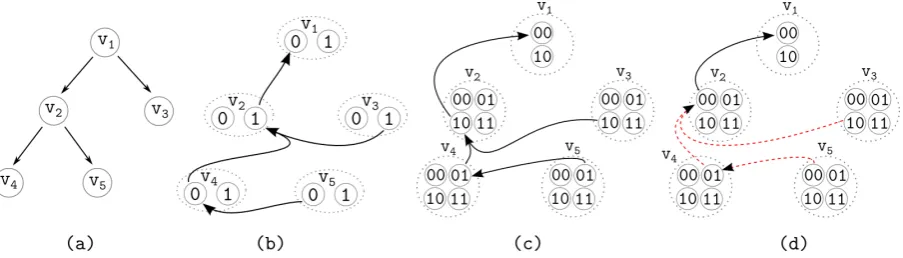
Figure 1: (a) Dependency tree with five lexical nodes. (b) A hyperpath corresponding to the labeling where onlyv2 andv3 are considered asMWEs. (c) A hyperpath with copying of parent labels,
corre-sponding the same labeling as (b). (d) An invalid hyperpath, not encoded in the hypergraph (because of the red dashed hyperarcs – for instance, the hyperarc betweenv5andv4connects two hypernodes with
different parent labels, even thoughv5andv4are siblings).
3.2 Encoding
Encoding consists in constructing a compact representation of all traversals of the given dependency tree. Formally, the resulting structure is a hypergraph (Gallo et al., 1993; Klein and Manning, 2001), and each traversal of the dependency tree is represented by a distinct hyperpath in this hypergraph.
Consider the dependency tree depicted in Fig. 1 (a). Its hypergraph encoding contains two hypernodes for each node in the dependency tree, one labeled with0(not-MWE), the other labeled with1(MWE). Furthermore, the hypergraph is populated with hyperarcs in such a way that it contains one hyperpath per each possible labeling of the nodes. For instance, the hyperpath shown in Fig. 1 (b) represents the labeling wherev2andv3are both considered asMWEs (the hyperpath traverses these nodes via hypernodes labeled
with1), while the other nodes arenot-MWEs.
Hyperacs determine the scope of the features we can define. However, certain relations we want to capture are not available in this hypergraph representation yet. For instance, there is no hyperarc between
v3andv1in Fig. 1 (b), which prevents us from using binary parent/child features. To solve this issue, we
copy the labels of parents to their children, as shown in Fig. 1 (c). Namely, each node is now represented by 4 hypernodes encoding the node’s label as well as the label of its parent: 00means that both nodes arenot-MWEs,10that the node is aMWEbut the parent is not,01that the parent is aMWEbut the node is not, and11that both areMWEs. When populating the hypergraph with hyperarcs, we make sure that only valid combinations of hypernodes are connected – invalid hyperpaths such as the one shown in Fig. 1 (d) are thus not encoded.
3.3 Model
LetH(d)be the set of hyperpaths encoded in the hypergraph for a given dependency treed. The task of labeling is reduced to the task of finding the best-score hyperpathh∈ H(d). To solve the latter problem, we rely on a multiclass logistic regression model in which each hyperpathh is reduced to a vector of featuresfhof a fixed lengthn, wherenis the number of features. More precisely, (i) each hyperarcais represented as a binary feature vectorfasuch thatfa
k = 1iff thek-th feature of the model holds within the context ofa, and (ii)fh =P
a∈hfa.
Letθbe a vector of real-valued model parameters of lengthn. The conditional probability of a partic-ular hyperpathh∈ H(d)given dependency treedis defined as:
pθ(h|d) = exp(θ·fh)/ X
h0∈H(d)exp(θ·f
h0), (1)
[image:3.595.75.527.62.191.2]efficiently using the inside-outside algorithm. For parameter learning, we rely on the maximum likeli-hood estimates (w.r.t. training dataT) with normal priors overθ. The log-likelihood takes the form:
`(θ) =X
(d,h)∈T logpθ(h|d)− Xn
k=1 θ2k
2σ2, (2)
where the regularization parameter1/2σ2determines the strength of the penalty on high parameter val-ues. The maximum likelihood estimates are then approximated using stochastic gradient descent with momentum (Qian, 1999; Ruder, 2016).
4 Experimental setup
In this section we describe how the system detailed in Sec. 3 was adapted to the shared task. In Sec. 4.1, we explain the process used to determine the set of feature templates. In Sec. 4.2 we describe the pre-processing steps used to facilitate MWE prediction for the individual languages. In Sec. 4.3 we return to the problem of MWE segmentation and outline the heuristics used to solve it. Finally, in Sec. 4.4, we give some details on how training of our system was performed.
4.1 Features templates
We used the Polish and French DEV datasets to determine a reasonable set of feature templates for our system. We started with a small set and incrementally augmented it with new templates as long as this led to better results on one or both languages. After a couple of iterations we ended up with the following set of templates, wherevis the current node,wis its sibling or parent,luis theu’s lemma,muis theu’s MWE label,pu is theu’s universal POS tag,duis the dependency label of the arc incoming tou,Sib -prefixed templates apply to sibling relations,Par-prefixed templates apply to parent-child relations, and Bin-prefixed templates apply to both types of binary relations:
• Lem:(lv, mv)
• SibMweandParMwe:(mv, mw)
• SibLemandParLem:(lv, lw, mv, mw)
• BinLem: unordered pair{(lv, mv),(lw, mw)}
• ParMweDep:(mv, mw, dv)
• SibMweDep:(mv, mw, dv, dw)
• ParLemPosDep:(lv, pw, mv, mw, dv)
• SibLemPos:(lv, pw, mv, mw)
• ParPosLemDep:(pv, lw, mv, mw, dv)
• SibPosLem:(pv, lw, mv, mw)
We used the above set of templates consistently for all languages and for all VMWE categories, except for Lithuanian – dependency trees were not available for this language. We therefore converted each sentence in theLTdataset to a pseudo-dependency tree in which (i) the first token is the root, (ii) every other token is the child of the preceding token, thus obtaining a model equivalent to a 2-order sequential CRF. We also adapted the default set of templates to Lithuanian by replacing the sibling templates with selected grandparent-related templates (possible due to the structure of pseudo-dependency trees).
4.2 Pre-processing
We applied various pre-processing procedures to 9 datasets in order to facilitate prediction of MWE labels. The pre-processing method most often applied, case lifting, consisted in reattaching case depen-dents to their grandparents so as to make MWEs of certain categories – notably, inherently adpositional verbs – connected.4 We applied it toBG,DE,EN,ES,HI,HR,PL, andSLdatasets. For Turkish, we removed tokens marked asDERIVs (with unspecified word form, and never marked as MWEs in training data) and copied word forms to lemmas where the latter were not present. In case of Slovak, we relied on language-specific POS tags rather than universal tags, since the latter were not provided, and assumed
4Consider the expression
Corpus TRAVERSAL results
#VMWE %VMWE(train+dev) MWE-based Token-based
Train Dev Test Con Conp Isop P R F1 Rank Delta P R F1 Rank Delta BG 5364 670 670 95.0 97.34 93.42 75.59 47.61 58.42 4/11 -4.1 82.36 49.79 62.06 3/11 -1.8 DE? 2820 503 500 90.76 93.17 87.69 62.93 32.73 43.06 3/11 -2.21 76.17 38.36 51.02 2/11 -0.64 EL 1404 500 501 92.86 84.66 65.7 36.33 46.79 2/11 -2.97 82.16 42.01 55.59 1/11 1.89 EN?? 331 0 501 91.84 98.19 95.17 55.5 21.16 30.64 2/10 -2.24 58.31 20.33 30.15 3/10 -4.22 ES 1739 500 500 76.55 90.13 84.59 28.84 33.4 30.95 4/11 -3.03 39.91 40.26 40.09 1/11 0.34 EU? 2823 500 500 95.28 84.38 78.28 58.4 66.9 4/10 -8.9 83.42 65.01 73.07 4/10 -3.76 FA? 2451 501 501 94.48 57.83 73.8 58.48 65.26 7/10 -12.57 90.19 65.23 75.7 6/10 -5.58 FR?? 4550 629 498 98.17 92.62 77.19 44.18 56.19 1/13 5.65 84.72 48.76 61.9 1/13 6.18 HE 1236 501 502 76.45 73.69 50.33 15.14 23.28 1/10 0.59 74.64 18.1 29.13 2/10 -0.52 HI 534 0 500 98.5 98.88 85.58 66.3 60.6 63.32 5/10 -9.66 73.15 67.12 70 4/10 -3.35 HR 1450 500 501 63.38 96.56 87.03 68.04 46.59 55.3 1/10 11.03 78.14 50.73 61.52 1/10 11.55 HU?? 6205 779 776 99.53 90.35 88.01 74.74 80.84 4/10 -9.47 89.91 79.61 84.45 4/10 -3.55 IT 3254 500 503 94.62 88.12 63.09 40.32 49.2 1/12 10.68 74.42 42.11 53.78 1/12 7.27 LT† 312 0 500 58.33 58.33 29.61 13.8 18.83 3/10 -13.34 55.56 16.92 25.94 3/10 -8.49 PL? 4122 515 515 80.87 86.09 82.42 77.02 59.22 66.96 1/11 6.42 81.85 59.03 68.59 1/11 3.67 PT? 4430 553 553 95.54 90.01 76.8 52.08 62.07 1/13 1.23 85.14 54.69 66.6 1/13 4.22 RO 4713 589 589 98.64 95.38 86.06 79.63 82.72 3/10 -2.56 88.84 82.26 85.42 2/10 -0.27 SL? 2378 500 500 71.61 88.12 86.14 79.41 54 64.29 1/10 21.95 83.61 54.54 66.01 1/10 14.04 TR 6125 510 506 55.54 98.21 91.08 81.48 26.09 39.52 5/10 -5.72 88.38 27.66 42.13 5/10 -10.89
[image:5.595.75.528.58.308.2]AVG 67.58 44.97 54 1/13 4.26 77.41 48.55 59.67 1/13 5.04
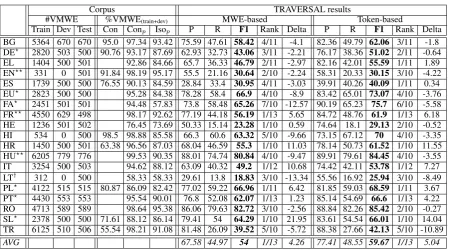
Table 1: Detailed results of TRAVERSAL for 19 languages (identified by their ISO 639-1 codes)
that tokens with an unspecified dependency head are attached to the artificial root node (with ID=0). The same pre-processing steps were applied to TRAIN, DEV, and (blind) TEST data.
4.3 Segmentation
Once the labeling of a given dependency tree is determined, we need to determine the boundaries of the detected MWEs. To this end, we considered two heuristics: (i) all adjacent nodes marked as MWEs of the same category are considered as a single MWE occurrence, and (ii) if a group of adjacent nodes is marked as MWEs but it contains two (or more) verbs, the group is divided into two (or more) distinct MWEs. We applied the first heuristic for all languages except Farsi, where the second heuristic yielded better results, notably due to a relatively high frequency of neighboring MWEs in theFAdataset.
4.4 Training
We trained the models over the combined TRAIN+DEV datasets withσ2 = 10 (see Sec. 3.3). For a given language, we trained one model per MWE category so as to handle the phenomenon of overlapping MWEs of different categories, often occurring in the provided annotated datasets.
5 Results
TRAVERSAL ranked 1st in the general ranking among the systems submitted to the closed track, ac-cording to both official evaluation measures: MWE-based F1 and token-based F1. Table 1 summarizes
the performance of our system across 19 languages of the shared task (all except Arabic). For each language, the MWE-based and token-based precision (P), recall (R), and F1(F1) scores are reported, as
well as the rank (Rank) of our system, and the difference (Delta) between the TRAVERSAL’s F1score
and the score of the other best closed-track system. The datasets with dependencies annotated manually, partially manually, or not at all, are marked with??,?, or†, respectively. For the other datasets/sentences, dependencies were obtained automatically. Conis the % of connected (via parental or sibling relation) VMWEs in the TRAIN+DEV dataset (no value =⇒ Con=Conp), andConpis the same measure after pre-processing. Finally,Isopis the % of connected and isolated (with no adjacent VMWEs of the same category) VMWEs after pre-processing, for which the baseline segmentation heuristic is sufficient.
Continuous Discont. Multi-token Single-token Seen Unseen Variant Identical F1 57.55 44.36 55.83 25.96 72.92 17.35 63.1 81.88 Delta 2.17 6.96 6.45 -6.86 0.85 -2.36 -1.92 -1.85
Table 2: Macro-average MWE-based F1-scores for different specialized phenomena
[image:6.595.95.503.62.98.2]IAV IRV LVC.cause LVC.full MVC VID VPC.full VPC.semi LS.ICV F1 44.31 68.07 23.81 46.03 17.65 34.45 34.84 42.70 30.77 Delta 8.89 8.51 -8.34 6.30 -11.39 8.01 2.07 2.2 10.77
Table 3: Macro-average MWE-based F1-scores for different MWE categories5
challenging dataset for our system, which is clearly due to the low % of isolated VMWEs in this dataset and, consequently, low effectiveness of the implemented segmentation heuristics. TRAVERSAL per-formed well on datasets with both manually annotated (FR) and automatically obtained (IT, HR,EL) dependencies, thus showing robustness w.r.t. the quality of dependency annotations.
Concerning specialized phenomena (see Table 2), TRAVERSAL performed particularly well on dis-continuous MWEs. This might be related to the view on MWEs adopted in our system, where continu-ous and discontinucontinu-ous MWEs are not really distinguished – both are “continucontinu-ous” in dependency trees. TRAVERSAL proved better in handling multi-token VMWEs than single-token (e.g. to pretty-print) VMWEs (outperformed by TRAPACC and TRAPACC S in case of the latter) and exhibited certain preference for VMWEs already seen during training (outperformed by NER-standard and GBD-NER-resplit in case of unseen VMWEs). Besides, TRAVESAL turned out less efficient in identifying identical VMWEs and variants of VMWEs seen during trainig than TRAPACC and GBD-NER-resplit, respectively, even though it outperformed the two systems for the class of seen VMWEs in general.
Category-wise (see Table 3), TRAVERSAL was quite successful in identifying inherently adpositional verbs (IAV), which suggests that the pre-processing strategy of re-attaching case markers was effective. It also performed very well for inherently reflexive verbs (IRV), verbal idioms (VID), light-verb con-structions (LVC.full), and inherently clitic verbs (LS.ICV, occurring only in the IT dataset). In case of “causative” LVCs (LVC.cause), TRAVERSAL was outperformed by varIDE, and in case of multi-verb constructions (MVC) – by TRAPACC and CRF-DepTree-categs.
6 Conclusions and future work
This paper presents a system dedicated to identification of verbal MWEs based on the explicit assumption that MWEs form connected components in dependency trees. It divides the task of MWE identification into two subsequent sub-tasks: (i) tree labeling (with two possible labels: MWE andnot-MWE), and (ii) MWE segmentation (determining the boundaries of MWEs). For the former task, it relies on the multiclass logistic regression model in order to find the globally optimal labeling for a given tree. The system ranked 1st in the closed track of the PARSEME shared task, thus showing the viability of applying CRF-like models to identification of verbal – in particular, discontinuous – MWEs.
For future work, we consider improving the MWE segmentation component of our system. In particu-lar, we would like to explore the idea of enriching labels with information about MWE boundaries so as to perform MWE segmentation jointly with MWE labeling. Another direction for future work would be to see to what extent external resources (MWE dictionaries, word embeddings) could be incorporated in our system. We could also explore usefulness of ternary features, so far ignored in our experiments. Fi-nally, we plan to perform a more fine-grained error analysis, so as to get better insight into the advantages and limitations of the implemented method.
Acknowledgements
The author thanks Behrang QasemiZadeh and the anonymous reviewers for their valuable comments.
5In Tab. 1 and Tab. 2, macro-average F
1is calculated based on macro-average precision and recall. In Tab. 3, macro-average
References
Anne Abeill´e and Yves Schabes. 1989. Parsing Idioms in Lexicalized TAGs. InProceedings of the Fourth Conference on European Chapter of the Association for Computational Linguistics, EACL ’89, pages 1–9, Stroudsburg, PA, USA. Association for Computational Linguistics.
Eduard Bejˇcek, Jarmila Panevov´a, Jan Popelka, Pavel Straˇn´ak, Magda ˇSevˇc´ıkov´a, Jan ˇStˇep´anek, and Zdenˇek ˇ
Zabokrtsk´y. 2012. Prague dependency treebank 2.5 – a revisited version of pdt 2.0. InIn Proceedings of the 24th International Conference on Computational Linguistics (Coling 2012), pages 231–246.
Marie Candito and Matthieu Constant. 2014. Strategies for Contiguous Multiword Expression Analysis and De-pendency Parsing. InProceedings of the 52nd Annual Meeting of the Association for Computational Linguistics (Volume 1: Long Papers), pages 743–753. Association for Computational Linguistics.
Matthieu Constant and Joakim Nivre. 2016. A Transition-Based System for Joint Lexical and Syntactic Analysis. InProceedings of the 54th Annual Meeting of the Association for Computational Linguistics (Volume 1: Long Papers), pages 161–171. Association for Computational Linguistics.
Matthieu Constant, Anthony Sigogne, and Patrick Watrin. 2012. Discriminative Strategies to Integrate Multiword Expression Recognition and Parsing. InProceedings of the 50th Annual Meeting of the Association for Compu-tational Linguistics (Volume 1: Long Papers), pages 204–212. Association for Computational Linguistics.
Giorgio Gallo, Giustino Longo, Stefano Pallottino, and Sang Nguyen. 1993. Directed Hypergraphs and Applica-tions. Discrete Appl. Math., 42(2-3):177–201, April.
Spence Green, Marie-Catherine de Marneffe, and Christopher D. Manning. 2013. Parsing Models for Identifying Multiword Expressions. Computational Linguistics, 39(1).
Aravind K Joshi and Yves Schabes. 1997. Tree-Adjoining Grammars. In Grzegorz Rozenberg and Arto Salomaa, editors,Handbook of Formal Languages, pages 69–123. Springer Berlin Heidelberg.
Dan Klein and Christopher D. Manning. 2001. Parsing and Hypergraphs. InSeventh International Workshop on Parsing Technologies (IWPT-2001), October.
Sandra K¨ubler, Ryan McDonald, and Joakim Nivre. 2009. Dependency parsing. Synthesis Lectures on Human Language Technologies, 1(1):1–127.
Joseph Le Roux, Antoine Rozenknop, and Matthieu Constant. 2014. Syntactic Parsing and Compound Recogni-tion via Dual DecomposiRecogni-tion: ApplicaRecogni-tion to French. InProceedings of COLING 2014, the 25th International Conference on Computational Linguistics: Technical Papers, pages 1875–1885. Dublin City University and Association for Computational Linguistics.
Alfredo Maldonado, Lifeng Han, Erwan Moreau, Ashjan Alsulaimani, Koel Dutta Chowdhury, Carl Vogel, and Qun Liu. 2017. Detection of Verbal Multi-Word Expressions via Conditional Random Fields with Syntactic Dependency Features and Semantic Re-Ranking. InProceedings of the 13th Workshop on Multiword Expres-sions (MWE 2017), pages 114–120. Association for Computational Linguistics.
Ryan McDonald and Fernando Pereira. 2006. Online learning of approximate dependency parsing algorithms. In
11th Conference of the European Chapter of the Association for Computational Linguistics.
Ryan McDonald and Giorgio Satta. 2007. On the complexity of non-projective data-driven dependency parsing. InProceedings of the Tenth International Conference on Parsing Technologies, pages 121–132. Association for Computational Linguistics.
Istv´an Nagy T. and Veronika Vincze. 2014. VPCTagger: Detecting Verb-Particle Constructions With Syntax-Based Methods. InProceedings of the 10th Workshop on Multiword Expressions (MWE), pages 17–25, Gothen-burg, Sweden, April. Association for Computational Linguistics.
Alexis Nasr, Carlos Ramisch, Jos´e Deulofeu, and Andr´e Valli. 2015. Joint Dependency Parsing and Multiword Expression Tokenization. InProceedings of the 53rd Annual Meeting of the Association for Computational Lin-guistics and the 7th International Joint Conference on Natural Language Processing (Volume 1: Long Papers), pages 1116–1126. Association for Computational Linguistics.
Carlos Ramisch, Silvio Ricardo Cordeiro, Agata Savary, Veronika Vincze, Verginica Barbu Mititelu, Archna Bhatia, Maja Buljan, Marie Candito, Polona Gantar, Voula Giouli, Tunga G¨ung¨or, Abdelati Hawwari, Uxoa I˜nurrieta, Jolanta Kovalevskait˙e, Simon Krek, Timm Lichte, Chaya Liebeskind, Johanna Monti, Carla Parra Es-cart´ın, Behrang QasemiZadeh, Renata Ramisch, Nathan Schneider, Ivelina Stoyanova, Ashwini Vaidya, and Abigail Walsh. 2018. Edition 1.1 of the PARSEME Shared Task on Automatic Identification of Verbal Multi-word Expressions. InProceedings of the Joint Workshop on Linguistic Annotation, Multiword Expressions and Constructions (LAW-MWE-CxG 2018), Santa Fe, New Mexico, USA, August. Association for Computational Linguistics.
Sebastian Ruder. 2016. An overview of gradient descent optimization algorithms.CoRR, abs/1609.04747.
Manon Scholivet and Carlos Ramisch. 2017. Identification of Ambiguous Multiword Expressions Using Sequence Models and Lexical Resources. InProceedings of the 13th Workshop on Multiword Expressions (MWE 2017), pages 167–175. Association for Computational Linguistics.
Charles Sutton, Andrew McCallum, et al. 2012. An introduction to conditional random fields. Foundations and TrendsR in Machine Learning, 4(4):267–373.
Veronika Vincze, Istv´an Nagy T., and J´anos Zsibrita. 2013. Learning to Detect English and Hungarian Light Verb Constructions. ACM Trans. Speech Lang. Process., 10(2):6:1–6:25, June.