YZU-NLP Team at SemEval-2016 Task 4: Ordinal Sentiment
Classifi-cation Using a Recurrent Convolutional Network
Yunchao He
2,3,4, Liang-Chih Yu
1,3, Chin-Sheng Yang
1,3, K. Robert Lai
2,3, Weiyi Liu
4 1Department of Information Management, Yuan Ze University, Taiwan
2
Department of Computer Science & Engineering, Yuan Ze University, Taiwan
3Innovation Center for Big Data and Digital Convergence, Yuan Ze University, Taiwan
4School of Information Science and Engineering, Yunnan University, Yunnan, P.R. China
Abstract
Sentiment analysis of tweets has attracted considerable attention recently for potential use in commercial and public sector applica-tions. Typical sentiment analysis classifies the sentiment of sentences into several discrete classes (e.g., positive and negative). The aim of Task 4 subtask C of SemEval-2016 is to classify the sentiment of tweets into an ordinal five-point scale. In this paper, we present a system that uses word embeddings and recur-rent convolutional networks to complete the competition task. The word embeddings pro-vide a continuous vector representation of words for the recurrent convolutional network to use in building sentence vectors for multi-point classification. The proposed method ranked second among eleven teams in terms of micro-averaged MAE (mean absolute error) and eighth for macro-averaged MAE.
1
Introduction
Sentiment analysis seeks to detect and analyze sen-timent within texts. Following the rapid increase of user generated content in the form of social media, sentiment analysis has attracted considerable inter-est. Typical approaches to sentiment analysis clas-sify the sentiment of a sentence into several dis-crete classes such as positive and negative polari-ties, or six basic emotions: anger, happiness, fear, sadness, disgust and surprise (Ekman, 1992). Based on this representation, various techniques have been investigated including supervised
learn-ing and lexicon-based approaches. Supervised learning approaches require training data for sen-timent classification (Go et al., 2009; Yu et al., 2009; Saif et al., 2016), while lexicon-based ap-proaches do not require training data but use a sen-timent lexicon to determine the overall sensen-timent of a sentence (Liu, 2010; Hu et al., 2013).
A five-point scale (Nakov et al., 2016) is also a popular way to evaluate sentiment. Many compa-nies, such as Amazon, Google, and Alibaba all use a multi-point scale to evaluate product or APP re-views. Unlike typical classification approaches, ordinal classification can assign different ratings (e.g., very negative,negative, neutral, positive and
very positive) according to sentiment strength (Taboada et al., 2011; Li et al., 2011; Yu et al., 2013; Wang and Ester, 2014).
Task 4 subtask C of SemEval-2016 seeks to classify the sentiment of tweets into an ordinal five-point scale. This paper presents a system that uses word embeddings (Mikolov et al., 2013) and recurrent convolutional networks to this end. The word embeddings can capture both semantic and syntactic information of words to provide a contin-uous vector representation of those words. These word vectors are then used to build sentence vec-tors through a recurrent convolutional neural net-work. For multi-point classification, we discretize the continuous sentiment intensity to a five parti-tions of equal intervals.
The proposed recurrent convolutional network consists of two parts: a convolutional neural net-work (CNN) (LeCun et al., 1990) on the bottom to reduce the dimension of a sentence matrix,
lowed by a long short-term memory (LSTM) (Hochreiter et al., 1997) layer to form the sentence representation, and a linear regression layer on the top to fit the sentiment intensity of sentences. The details of the CNN, LSTM and their combination are described in the following section.
2
Combining LSTM and CNN for
Ordi-nal Classification
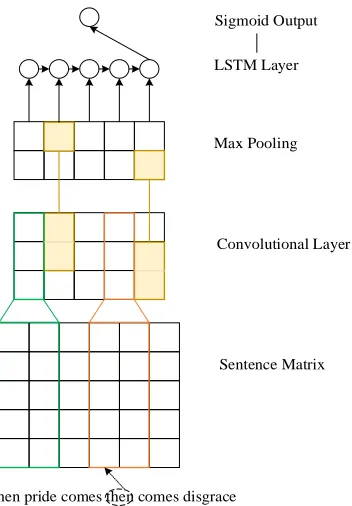
Ordinal classification of sentiment aims at classify-ing the sentence into ordinal discrete values ac-cording to their sentiment intensity. Figure 1 shows the system architecture of the proposed CNN-LSTM model for ordinal classification. In the bot-tom layer, the word vectors of vocabulary words are first trained from a large corpus using word embeddings. For each given sentence, a sentence vector is then built based on the word vectors of words in the sentences, which is further trans-formed into a matrix representation. The sentence matrix is sequentially passed through a convolu-tional layer and max pooling layer for multi-point classification. Unlike a conventional LSTM model which directly uses word embeddings as input, the proposed model takes uses outputs from a single-layer CNN with max pooling.
2.1
Convolutional Neural NetworkIn our model, the input of the LSTM layer is an output from the CNN. CNNs have achieved the state-of-the-art results in computer vision applica-tions, and also have been shown to be effective for various NLP applications (Krizhevsky et al., 2012; Kim, 2014; Ma et al., 2015). The CNN architecture used for our tasks is described as follows.
Let V denote the vocabulary of words, while d
denotes the dimensionality of word vectors, and d n
S∈R × denotes the sentence matrix built by con-catenating the word vectors occurring in the sen-tences. Suppose that the sentence T is made up of a sequence of words [d1, d2, …, dn], where n is the
length of sentence T. Then the representation of T
is given by the matrix ST∈Rd n× , where the j-th
column corresponds to the embeddings for word dj.
Note that for batch processing we the zero-pad sen-tence matrix ST so that the number of columns is a
constant (equal to the max length of sentences) for all sentences in the corpus.
We apply a narrow convolution between ST and
a filter F∈Rd w× of a width w. We then add a bias term and apply a nonlinearity function to obtain a feature map fT∈Rn w− +1 . The i-th element of T
f
is given by:
[ ] ( [:, : 1], )
T T
f i =relu <S i i+ −w F > +b (1)
where ST[:, :i i+ −w 1]is the i-to-(i+w-1)-th col-umn of ST and <A, B>=Trace(A·BT) is the Fro-benius inner product.
The feature maps are input into a max pooling layer to capture the most salient feature (i.e., the one with the highest value) for a given filter. Filter operation is useful for determining the n-grams, where the size of the n-gram corresponds to the fil-ter length.
The above description uses just one filter matrix to generate one feature. In practice, the proposed convolutional layer uses multiple filters in parallel to obtain the feature vectors.
2.2
Recurrent Neural NetworkA recurrent neural network (RNN) architecture particularly suited for modelling sequence phe-nomena (Sak et al., 2014; Zhou et al. 2015). At each time step t, the RNN takes the input vector xt when pride comes then comes disgrace
Sigmoid Output
LSTM Layer
Max Pooling
Convolutional Layer
[image:2.612.93.269.69.322.2]Sentence Matrix
and the hidden state vector ht-1 to produce the next
hidden state ht by applying the following recursive
operation:
1
( )
t t t
h = f Wx +Uh− +b (2)
Here W, U, b are the parameters of an affine transformation and f is an element-wise nonlineari-ty function. In theory, the RNN can summarize all historical information up to time t with the hidden state ht. In practice, however, a vanilla RNN has
difficulty learning long-term dependencies due to the vanishing gradient problem, as the gradient de-creases exponentially with the number of network layers and the front layer trains very slowly.
Approaches have been developed to deal with vanishing gradient problem, and certain types of RNNs (like LSTM, GRU) are specially designed to get around them. LSTM (Hochreiter et al., 1997) addresses the problem of learning long-term de-pendencies by augmenting the RNN with a gating mechanism. To illustrate this, the following formu-las show how a LSTM calculates a hidden state ht.
1
1
1
1
1
( )
( )
( )
tanh( )
tanh( )
i i i
t t t
f f f
t t t
o o o
t t t
g g g
t t t
t t t t t
t t t
i W x U h b
f W x U h b
o W x U h b
g W x U h b
c f c i g
h o c
σ σ σ
−
−
−
−
−
= + +
= + +
= + +
= + +
= +
=
(3)
Here σ( )⋅ and tanh( )⋅ are the element-wise
sig-moid and hyperbolic tangent functions, is the el-ement-wise multiplication operator, and it, ft,ot
are called the input, forget and output gates respec-tively. All the gates have the same dimension ds,
which is equal to the size of hidden state, and c0, h0
are initialized to zero vectors at t=1. ct is the
inter-nal memory of the unit, which could be regarded as
how we want to combine previous memory and the new input.
The gating mechanism allows LSTM to model long-term dependencies. By learning the
parame-ters j
W , j
U , j
b for j∈{ , , , }i f o g , the network learns how its memory cells should behave.
3
Experiments and Evaluation
Dataset. We evaluated the proposed CNN-LSTM model by submitting the results to the SemEval-2016 Task 4 subtask. The statistics of the dataset used in this competition are summarized in Table 1. As the original tweets may be removed by Twitter users themselves, we can just download a part of the data in gold training, gold development, and gold development-test dataset. The distribution of sentiment labels shown in Table 2 shows data im-balance. Most of the data were annotated in [-1, 0,
1] labels, and only a few were annotated Very
Negative (-2) or Very Positive (2).
Implementation details. As mentioned earlier, the proposed method consists of word embeddings and a recurrent convolutional network. Both parts may have their own parameters for optimization. For word embeddings, we used popular pre-trained word vectors from GloVe (Pennington et al., 2014). GloVe is an unsupervised learning algorithm for learning word representation. Training is per-formed on aggregated global word co-occurrence statistics from a large corpus, and the resulting rep-resentation showcases interesting linear substruc-tures in the word vector space. They provide pre-trained word vectors pre-trained on 840B tokens from common crawls and have a length of 300.
Although the pre-trained word embeddings can capture important semantic and syntactic
in-Name # (-2) # (-1) # (0) # (1) # (2)
Gold
Train 87 668 1654 3154 437
Gold
Dev 43 296 675 933 53
Gold
[image:3.612.73.299.69.184.2]Devtest 31 233 583 1005 148
Table 2: Distributions of sentiment ratings. # (n) denotes the number of tweets annotated with a rating of n in the range of [-2, -1, ..., 2], corresponding to Strongly Negative,
Negative, Negative or Neutral, Positive, Strongly Positive, respectively.
Name # Tweets released
# Tweets used
# Top-ics
Avg. Length Gold
Train 6,000 5,346 60 19.49
Gold
Dev 2,000 1,795 20 19.58
Gold
Devtest 2,000 1,781 20 19.69
[image:3.612.317.537.69.163.2]Test 20,632 20,632 100 19.62
formation of words, they are not sufficient to cap-ture sentiment behaviors in texts. To further im-prove word embeddings to capture sentiment in-formation, we trained our recurrent convolutional network using an additional dataset from the Vader corpus (Hutto et al., 2014). It contains 4,000 tweets pulled from Twitter’s public timeline, independent-ly annotated by 20 human raters with sentiment ratings in a range of [-4, 4]. We discretized the continuous human-assigned ratings of [-4, 4] to discrete numbers [-2, -1, …, 2] to make them com-patible with the task context.
The hyper-parameters of the network are chosen based on the performance on the development-test data. We use: rectified linear units (ReLU), filter
windows (w) of 3 with 64 feature maps, dropout
rate (p) of 0.25, pool length of 2, and mini-bath size of 16. Adagrad update rule is used to automat-ically tune the learning rate, and micro-averaged
MAE is used as the loss function. Early stop mech-anism is used to avoid overfitting. The activation function in the top layer is a sigmoid function, which scales each sentiment intensity to the range 0 to 1. These continuous intensity scores are trans-formed into a five-point scale through the cut-offs: [0, 0.2], (0.2, 0.4], (0.4, 0.6], (0.6, 0.8], (0.8, 1.0] for strongly negative, negative, negative or neutral, positive, strongly positive, respectively.
Evaluation metrics. SemEval-2016 Task 4 sub-task C published the results for all participants
us-ing both macro-averaged mean absolute error
(MAEM) and micro-averaged mean absolute error (MAEµ) (Nakov et al., 2015). The MAEM is de-fined as:
| |
1
1 1
( , ) | ( ) |
| | | | i j
C M
i i
j j X Te
MAE h Te h X y
C = Te ∈
=
∑
∑
− (4)where yi denotes the true label of Xi, h X( i) de-notes the predicted label, and Tej denotes the set of
test documents whose true class is cj. The MAE µ
is defined as:
1
( , ) | ( ) |
| |
i
i i
X Te
MAE h Te h X y
Te µ
∈
=
∑
− (5)Compared to the micro-averaged MAEµ , the
macro-averaged MAEM is more appropriate to
measure the classification robustness of systems for imbalanced data.
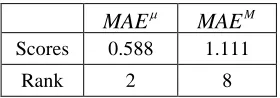
Results. A total of eleven teams participated in subtask C. Table 3 shows the results of the
pro-posed CNN-LSTM model for both MAEµ and
M
MAE . The proposed method ranked second for
MAEµ and eighth for MAEM . The results of
MAEµ and MAEM are inconsistent because we
used a standard MAE as the loss function for model training and did not consider the imbalanced sen-timent labels. Therefore, our model yielded better performance on MAEµ than on MAEM.
Table 4 shows the experimental results after the release of test set ratings. We found that the CNN-LSTM achieved better performance on the devel-opment test set than the test set. Conversely, the CNN alone yielded better performance on the test data than the development-test set.
4
Conclusions
This study presents a deep learning approach to classifying tweets into a five-point scale. The pro-posed model combines the convolutional neural networks and long short-term memory networks. To better capture the sentiment aspect of words, we further tuned our model using an additional sentiment corpus. Experimental results show that the proposed method archived good performance on the micro-averaged MAE.
Future work will focus on exploring more effec-tive features and machine learning methods to im-prove classification performance for both micro- and macro-averaged MAE.
Devtest Set Test Set
MAEµ MAEM MAEµ MAEM
CNN 0.656 0.992 0.534 0.939
[image:4.612.112.252.68.117.2]
CNN-LSTM 0.590 0.974 0.588 1.111
Table 4: Results of CNN-LSTM and CNN alone.
MAEµ MAEM
Scores 0.588 1.111
Rank 2 8
[image:4.612.319.540.69.194.2]Acknowledgments
This work was supported by the Ministry of Sci-ence and Technology, Taiwan, ROC, under Grant No. NSC102-2221-E-155-029-MY3 and MOST 104-3315-E-155-002.
References
Paul Ekman. 1992. An argument for basic emotions.
Cognition and Emotion, 6(3-4), 169-200.
Alex Go, Richa Bhayani, and Lei Huang. 2009. Twitter sentiment classification using distant supervision. In
CS224N Project Report, Stanford.
Sepp Hochreiter and Jürgen Schmidhuber. 1997. Long short-term memory. Neural computation, 9(8), 1735-1780.
Xia Hu, Jiliang Tang, Huiji Gao, and Huan Liu. 2013. Unsupervised sentiment analysis with emotional sig-nals. In Proceedings of the 22nd international
con-ference on World Wide Web, pages 607-618.
Clayton J. Hutto, and Eric Gilbert. 2014. Vader: A par-simonious rule-based model for sentiment analysis of social media text. In Proceedings of the Eighth Inter-national AAAI Conference on Weblogs and Social
Media.
Yoon Kim. 2014. Convolutional neural networks for sentence classification. In EMNLP, pages 1746–1751, Doha, Qatar.
Alex Krizhevsky, Ilya Sutskever, and Geoffrey E. Hin-ton. 2012. Imagenet classification with deep convolu-tional neural networks. In Advances in neural
infor-mation processing systems, pages 1097-1105.
B. B. LeCun, John S. Denker, D. Henderson, Richard E. Howard, W. Hubbard, and Lawrence D. Jackel. 1990. Handwritten digit recognition with a back-propagation network. In Advances in neural
infor-mation processing systems.
Fangtao Li, Nathan Liu, Hongwei Jin, Kai Zhao, Qiang Yang, and Xiaoyan Zhu. 2011. Incorporating review-er and product information for review rating predic-tion. In Proceedings of the 22nd International Joint
Conference on Artificial Intelligence (IJCAI-11),
pages 1820-1825.
Bing Liu. 2010. Sentiment Analysis and Subjectivity.
Handbook of natural language processing, 2,
627-666.
Mingbo Ma, Liang Huang, Bing Xiang, and Bowen Zhou. 2015. Dependency-based Convolutional Neu-ral Networks for Sentence Embedding. In Proceed-ings of the 53rd Annual Meeting of the Association
for Computational Linguistics (ACL-15), pages 174–
179.
Tomas Mikolov, Ilya Sutskever, Kai Chen, Greg S. Cor-rado, and Jeff Dean. 2013. Distributed
representa-tions of words and phrases and their compositionality.
In Advances in neural information processing
sys-tems, pages 3111-3119.
Preslav Nakov, Alan Ritter, Sara Rosenthal, Fabrizio Sebastiani, and Veselin Stoyanov. 2015. Evaluation Measures for the SemEval-2016 Task 4 “Sentiment Analysis in Twitter” (Draft: Version 1.1).
Preslav Nakov, Alan Ritter, Sara Rosenthal, Veselin Stoyanov, and Fabrizio Sebastiani. 2016. SemEval-2016 Task 4: Sentiment Analysis in Twitter. In Pro-ceedings of the 10th International Workshop on Se-mantic Evaluation, Association for Computational
Linguistics. San Diego, California.
Jeffrey Pennington, Richard Socher, and Christopher D. Manning. 2014. Glove: Global Vectors for Word Representation. In Proceedings of the 2014 Confer-ence on Empirical Methods on Natural Language
Processing (EMNLP-14), pages 1532-1543.
Hasim Sak, Andrew W. Senior, and Françoise Beaufays. 2014. Long short-term memory recurrent neural net-work architectures for large scale acoustic modeling.
In Proceedings ofINTERSPEECH-14, pages 338-342.
Hassan Saif, Yulan He, Miriam Fernandez, and Harith Alani. 2016. Contextual semantics for sentiment analysis of Twitter. Information Processing &
Man-agement, 52(1), 5-19.
Maite Taboada, Julian Brooke, Milan Tofiloski, Kimber-ly Voll, and Manfred Stede. 2011. Lexicon-based methods for sentiment analysis. Computational
Lin-guistics, 37(2):267-307.
Hao Wang and Martin Ester. 2014. A sentiment-aligned topic model for product aspect rating prediction. In
Proceedings of the 2014 Conference on Empirical Methods in Natural Language Processing (EMNLP-14), pages 1192-1202.
Jie Zhou and Wei Xu. 2015. End-to-end learning of se-mantic role labeling using recurrent neural networks.
In Proceedings of the 53rd Annual Meeting of the
As-sociation for Computational Linguistics (ACL-15),
pages 1127–1137.
Liang-Chih Yu, Wu, Jheng-Long Wu, Pei-Chann Chang, and Hsuan-Shou Chu. 2013. Using a contextual en-tropy model to expand emotion words and their in-tensity for the sentiment classification of stock mar-ket news. Knowledge-based Systems. 41:89-97. Liang-Chih Yu, Chung-Hsien Wu, and Fong-Lin Jang.
![Table 2: Distributions of sentiment ratings. # (Negativethe number of tweets annotated with a rating of range of [-2, -1, ..., 2], corresponding to n) denotes n in the Strongly Negative, , Negative or Neutral, Positive, Strongly Positive, respectively](https://thumb-us.123doks.com/thumbv2/123dok_us/1428078.679107/3.612.73.299.69.184/distributions-sentiment-negativethe-corresponding-negative-strongly-positive-respectively.webp)