75
Bot2Vec: Learning Representations of Chatbots
Jonathan Herzig1 Tommy Sandbank∗∗,2 Michal Shmueli-Scheuer1 David Konopnicki1 John Richards1
1IBM Research
2Similari
{hjon,shmueli,davidko}.il.ibm.com,[email protected], [email protected]
Abstract
Chatbots (i.e.,bots) are becoming widely used in multiple domains, along with supporting bot programming platforms. These platforms are equipped with novel testing tools aimed at im-proving the quality of individual chatbots. Do-ing so requires an understandDo-ing of what sort of bots are being built (captured by their under-lying conversation graphs) and how well they perform (derived through analysis of conver-sation logs). In this paper, we propose a new model, BOT2VEC, that embeds bots to a com-pact representation based on their structure and usage logs. Then, we utilize BOT2VEC
representations to improve the quality of two bot analysis tasks. Using conversation data and graphs of over than 90 bots, we show that BOT2VEC representations improve detection performance by more than16%for both tasks.
1 Introduction
As conversational systems (i.e., chatbots) become more pervasive, careful analysis of their capabil-ities becomes important. Conversational systems are being used for a variety of support, service, and sales applications that were formerly handled by human agents. Thus, organizations deploying such systems must be able to understand bots be-havior to improve their performance. In many cases, such an analysis can be viewed as a classi-fication task whose goal is to check whether a bot or a particular instance of a conversation satisfies some property (e.g., is the conversation success-ful?). Models for these downstream classification tasks should benefit from conditioning on repre-sentations that capture global bot behavior.
For a conversation itself, there exists a natural way to represent it as the concatenation of the hu-man and bot utterances. As for a bot, the question of its representation is more complicated: bots are
∗
Work was done while working at IBM.
complex objects that execute logic in order to drive conversations with users. How should they best be represented?
Many commercial companies provide bot pro-gramming platforms. These platforms provide tools and services to develop bots, monitor and improve their quality. Due to the increasing pop-ularity of bots, thousands or tens of thousands of bots could be deployed by different companies on each platform1. Although bots might have differ-ent purposes and differdiffer-ent underlying structures, the ability to understand bot behavior at a high level could inspire new tools and services bene-fitting all bots on the platform. In this work, we explore a commercial platform, and study differ-ent bot represdiffer-entations.
Inspired by the success of recently proposed learned embeddings for objects such as graphs (Narayanan et al., 2017), nodes (Grover and Leskovec, 2016), documents (Le and Mikolov,
2014) and words (Mikolov et al.,2013a), we pro-pose a new model, BOT2VEC, that learns bot embeddings, and propose both content and graph based representations. While previous graph em-bedding representations consider static local struc-tures in the graph (Narayanan et al.,2017;Grover and Leskovec,2016), our graph representation is based on dynamic conversation paths. As bots are usually represented on bot platforms as some form of directed graph, with conversations represented as traversals on the graph, this approach seems reasonable. It captures the way the bot is actually used, in addition to how it is structured.
In this paper, our goal is to consider various bot embeddings and two different but realistic classi-fication tasks, and test whether some bot represen-tations are more appropriate for these tasks. The first task, at the level of entire bots, aims to detect
1
Make_a _payment Welcome Account_ operation Payment_ time Device_ information Anything_Else Payment_ methods New_account Delete_ account Update_ account Create_user Delete_user Paypal Credit_card Paypal_error Insert_detail Headset_ problem HD_problem Battery_ problem Store_ information Technical_ problem Wired_ model Wireless_ model Goto: Echo_test jump node negative edge Charge_ headset Echo_test Location Payment_type positive edge (1) (1,1) (1,1,1) (1,1,1,1) (1,1,1,1,1)
[image:2.595.73.291.61.256.2](1,1,1,2) (4,1,1,1) (4,1,2,1) (1,1,1,1,2) (1,2) (2,1) (2,2) (2,3) (3,1) (4,1) (4,2) (4,3) (2,1,1) (2,2,1) (4,1,1) (4,1,2) (2) (3) (4) (5) (6)
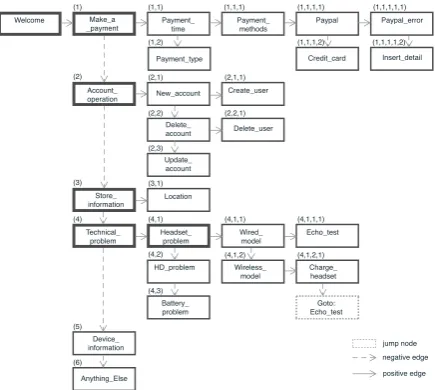
Figure 1: Example of a customer support bot graph.
whether the bot is in production (i.e., in use with real human users) or not. The second task, at the conversation level within each bot, aims to detect problematic conversations with a deployed bot in support of focusing improvement efforts.
The main contributions of this paper are three-fold: (1) this is the first research that leverages in-formation from multiple bots in order to improve bot quality, (2) this is the first research to propose an embedding approach for bots based on their structure and how this structure is exploited dur-ing conversations, and (3) we empirically evaluate these representations for two classification tasks using data from more than90conversational bots. We find that our proposed representations lead to more than 16% improvement in classification for our two tasks, with our structure-based repre-sentation performing better than our content-based representation. This suggests that the representa-tions explored in this paper are valuable across a range of possible tasks.
2 Bot Overview
Although different programming models can be used to create bots, in practice, most commercial conversational system platforms represent the con-versation control flow for bots as graphs. In this paper, we use a bot paradigm based on one of the publicly available commercial platforms, but it is quite general and can be adapted to fit to other bot programming platforms. Our example in Figure1
shows a part of a customer support bot graph, and we use it to explain how such a graph is used in
the context of a conversation.
At every step (i.e., everyturn) of a conversation with a bot, the human user expresses an utterance and the bot analyzes it, determines how to respond and updates its internal state. This determination is executed by traversing the graph, starting from a special node called the root node, and moving along the nodes of the graph according to a given set of rules as described below. Note that this de-scription aims to present and explain key abstrac-tions rather than the implementation details of an actual bot platform.
2.1 Graph Components
Every node in the graph has two internal parts: a user intent, and an optional reply of the bot. Given a user utterance, an intent classifier is used to de-termine whether the user utterance matches the in-tent associated with the node. For example, the
Technical problem node has been defined to cap-ture cases where users encounter a technical prob-lem with a product, and this is what is being ex-pressed in the utterance at hand (e.g., “I’m hav-ing some issues with my headset”). In this case, the classifier should be able to classify this utter-ance as relevant to this intent. In practice, the in-tent classifier is trained from examples of utter-ances and their corresponding intents, written by bot programmers.
Every node has two optional outgoing edges: a
positive edge and a negative edge. If a user ut-terance has been classified positively, the optional node answer is presented to the user, and the exe-cution moves to the node which is the target of the positive edge. When the execution moves along a positive edge, it is possible to obtain additional input from the user, and continue the evaluation using this input. If a user utterance has been clas-sified negatively, the execution moves to the node which is the target of the negative edge. As shown in Figure1, we represent nodes connected by neg-ative edges along the vertical axis, and nodes con-nected by positive edges along the horizontal axis. When there is no positive edge and the classi-fication is positive, the execution stops, and the system waits for the next user utterance. When there is no negative edge and the classification is negative, execution jumps back to the root node to resume evaluation from the start.
Agent:Hi, I’m Eva a virtual assistant, how may I help you?
Customer:I’m having some issues with my headset
Agent:Which model are you using?
Customer:A wireless one.
Agent:Please make sure that they are charged.
Customer: Yes they are, and they work well with other
de-vices...
Agent:Got you. In this case go and try our echo test.
Customer:Well, I’ll stop by one of your stores and see a
tech-nician.
Agent:I’m not trained on that yet, but I’m still learning. You
may want to rephrase your question and try again.
Customer:What is your closest location?
Agent:Check here to see our locations in your city.
Figure 2: Example of a possible conversation.
Anything Elsenode), which are not the source of any edges, and which typically trigger a special default message like“I’m still in a learning phase, is there anything else I can help you with?’’. As bots support only a limited set of intents, this mechanism is used to let the user know that some intent is beyond the knowledge of the bot, and to initiate a recovery process.
2.2 Graph Execution
A conversation starts by traversing the graph from the root node. The root node is special in that it does not expect a user utterance, and it only has a positive edge. Its optional response, which can be a greeting message for example, is only output once at the beginning of the conversation.
Consequently, a user utterance defines a path in the graph, and each conversation between a human and the bot can be represented as a sequence of paths in the graph. Figure2shows an example of such a conversation.
The nodes that are evaluated for the first user utterance in Figure 2 (“I’m having some issues with my headset”) are marked in bold in Figure1. Thus, the path that is created by the analysis of this utterance starts with the root node Welcome, then moves to the Make a paymentnode, check-ing whether this utterance expresses the user in-tention to make a payment. Since it is not, con-trol moves to the Account operation node, and then, in turn, to theStore informationnode, along the negative edges, until it reaches the Techni-cal problemnode. Here, the internal classifier de-termines that the utterance indeed expresses that the user encountered a technical problem. As a result, the control moves along the positive edge to theHeadset problemnode. Once the node’s re-ply is presented to the user (“Which model are you
using?”), the system then waits for the next user utterance. The next user utterance (“A wireless one.”) leads to theWireless modelnode, hence the resulting path for this utterance is a continuation of the previous path.
Note that nodes connected vertically by neg-ative edges represent alternneg-ative understand-ings of an utterance. That is, in our ex-ample, an utterance can be identified as Ac-count operation, Store information or Techni-cal problem, etc. Nodes connected by horizon-tal positive edges represent specializations of the analysis. That is, after the utterance is classified asTechnical problem, moving along the positive edge will check whether the utterance expresses a Headset problem, or (moving again vertically along negative edges) a HD problem or, alterna-tively, aBattery problem.
In addition, special jump nodes are nodes that allow the conversation to jump to a des-ignated node. In our example the node below
Charge headset, that refers to theEcho testnode, is a jump. Such jump nodes are not essential, but simplify the graph by preventing duplication of subgraphs.
2.3 Notations
We define thedepth of the bot graph as the max-imum number of nodes from left to right (ignor-ing the root node), i.e. nodes connected by pos-itive edges. The depth of a node v is defined as the number of positive edges used to traverse the graph from the root node to v. In our example from Figure 1 the depth of the graph is 5, while the depth ofHeadset problemis 2. We define the levellas the set of all the nodes whose depth isl. We define thewidthof the graph at levell as the maximum number of nodes connected by negative edges at this level. In our example, the width of level1is6, while the width of level2is3.
To further simplify notations, we consider a grid layout that defines coordinates for the nodes from left to right and from top to bottom. For example, nodeTechnical problem is mapped to (4), which means that it is the 4th node from top to bottom at level1. The nodeHeadset problemis mapped to (4,1), meaning that it is the 1st node at level
2 of the 4th node at level 1. Similarly, the node
HD problem is mapped to coordinate (4,2) and
coordinates. The maximal possible length of a co-ordinate for a node is the depth of the graph.
2.4 Bot Behavior
The graph of a bot determines its behavior, and thus, the structure of the graph captures interest-ing properties of the bot. For example, there are bots designed to handle simple Q&A conversa-tions, as opposed to bots that handle filling in the details of complex transactions. For Q&A bots, the graph is likely to be of depth 1, with many nodes at this level, representing various alternative questions and answers. For bots handling complex conversations, the graphs are likely to be deeper in order to handle more complicated cases. In gen-eral, bots handling narrow use-cases and which are very specific in their dialog capabilities, are likely to have fewer nodes and more jumps to sink nodes. Thus, in order to capture the bot behavior we should consider the different characteristics of its graph, and this is what we would like to capture in our representation.
3 Bot2Vec Framework
3.1 Representation Learning
In this work, we employ a neural network model to learn the BOT2VECrepresentation. The train-ing input to this model is either a content-based
representation or astructure-basedrepresentation of conversations between a human and a bot. Both are described in the following sections. The result of the training is a vector representation for each bot in the dataset.
To learn this BOT2VECrepresentation, a fully
connected network withN hidden layers is used. During training, the input to this network is the representation of a conversation (either content-based or structure-content-based), and the ground truth is a one-hot vector of the bot that handled this conver-sation. In other words, given a conversationc, the network predicts which bot handledc using soft-max, that is a distribution over the bots. Thus, the output layer vector of the model has the size of the number of bots in the dataset. Once the model is trained, the representation of a botbis the weights vectorVb·, whereV is the output embedding ma-trix (the weights mama-trix connecting the last hidden layer to the output layer).
The motivation for choosing this representa-tion is that the training procedure (using cross-entropy loss) should drive similar bots to
lar representations, given that they handle simi-lar conversations. In the context of learning word representations using the Word2Vec skip-gram model (Mikolov et al.,2013b), the output embed-dings were found to be of good quality (Press and Wolf, 2017). Hereafter, we denote the content-based model as BOT2VEC-C, and the
structure-based model as BOT2VEC-S.
We now describe how a conversation is rep-resented using its textual content and using its bot graph structure which is used as input for the model.
3.2 Content-based Representation
Conversations between users and bots occur in natural language, and as shown in Figure 2, are composed of user utterances and bot responses. The first step for creating our textual representa-tion of a single conversarepresenta-tion is to build a vocab-ulary, which is the union of all terms across all conversations of all the bots in the dataset. We first mask tokens that might reveal the bot’s iden-tity, such as bot names, URLs, HTML tags etc. To neglect additional bot specific words (which are probably infrequent), we take thekmost popular terms to be the vocabulary.
Now, for a given conversation, we create two vectors with term frequency (TF) entries accord-ing to the template just defined, one for the user utterances and one for the bot responses. The con-versation is then represented as their concatena-tion.
3.3 Structure-based Representation
Our goal in this representation is to characterize bot behavior by analyzing its conversations with respect to the structure of the bot graph. This learned representation should capture the charac-teristics of how bots are being utilized. We would like to capture, for example, which nodes are be-ing visited durbe-ing a conversation with a user, at which nodes the conversation turns end, etc.
Recall that each conversation can be repre-sented as a sequence of paths on the bot graph (a path for each turn). We now describe how to rep-resent a path as a vector (bin vector below), and how to aggregate paths of a single conversation.
bin 1 bin 2 bin 3 bin 1 bin 2 bin 1 section 1 section 2 section 3
[image:5.595.306.528.60.180.2](1),(1,1),(2), (2,1),(3,1), (4,1) (1,2),(2,2),(3), (4),(4,2) (1,1,1),(1,1,1,1), (2,1,1),(2,2,1), (4,1,1),(4,1,1,1), (4,1,2,1) (2,3),(4,3), (5),(6) (1,1,1,2),(4,1,2) (1,1,1,1,1), (1,1,1,1,2)
Figure 3: A mapping of a bot graph to the bin vector.
Algorithm 1Mapping a node to section and bin
nl: node depth
nw: node width
input D: graph depth
w=w1, w2, . . . , wD: graph width at each level
S: number of sections
b=b1, b2, . . . , bS: number of bins per section output ns: section index
nb: bin index
1: ns=b(nld−1)×S+ 1c
2: nb=b(nw
−1)
wl ×bns+ 1c
3: returnns,nb
We create a bin vector such that each node in the bot graph is mapped to a single bin based on its co-ordinates in the graph. Each bin vector is divided intoS sections, and each sectionsis divided into
bs bins (Figure 3). Since the idea is to represent a conversation path in a standardized and com-pact way across different bots, each level in the bot graph is mapped to a section in the bin vector, and each node in the bot graph is mapped to a bin in the appropriate section (see Algorithm 1). Sev-eral levels might be mapped to the same section, and several nodes can be mapped to the same bin (sections do not necessarily have the same number of bins). The number of sections and bins in the bin vector are set based on the depths and widths of all the bot graphs (e.g., the average depth of the graphs and the average width of each level in the graphs). For example, the bin vector in Fig-ure3 represents the mapping of all nodes for the bot graph in Figure1. This bin vector has 3 sec-tions. There are3bins in section1,2bins in sec-tion2, and1bin in section3.
Utterance modeling We now explain how each utterance is represented using the bin vector. As mentioned above, each user utterance in a conver-sation is represented by a path in the bot graph, whose nodes can be mapped to sections and bins in the bin vector. In order to capture how every utterance is being analyzed by the bot, we distin-guish between different types of nodes in the path:
1. Asuccess (s)node is the last node of the path, if it is not a sink node.
section 1 section 2 section 3
1 0 2 3
bin 1 bin 2 bin 3 bin 1 bin 2 bin 1 Turn 1: Turn 5: aggregated r u f s
0 f0 r2 u3
s
0 f0 r0u4
s
0 f0 r0 u7
s
0 f0 r0 u2
s
0 f0 r0u2
s
section 1 section 2 section 3
1 0 2 3
bin 1 bin 2 bin 3 bin 1 bin 2 bin 1
r u f s
0 f0 r1 u4
s
0 f0 r0u4
s
0 f0 r0 u7
s
0 f0 r0 u2
s
0 f0 r0u2
s
section 1 section 2 section 3
2 0 12 16
bin 1 bin 2 bin 3 bin 1 bin 2 bin 1
r u f s
0 f0 r7 18u
s
0 f1 r1 18u
s
1 f0 r2 32u
s
1 f0 r1 u8
s
0 f0 r0 10u
s
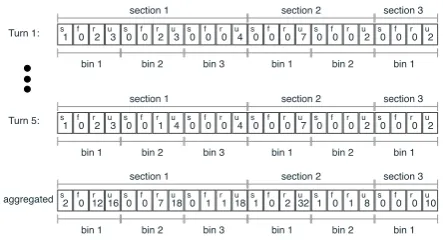
Figure 4: Bin vector representation of turns in a con-versation.
2. Afailure (f)node is the last node of the path, if it is a sink node.
3. All the other nodes that belong to the path are
regular (r)nodes.
4. Nodes that do not belong to the path are un-involved (u)nodes.
When representing a path, we consider the type of the node it is mapped to, in the corresponding bins in the bin vector: each bin maintains4 coun-ters, one counter for each type of node mentioned above (success, failure, regular anduninvolved). That is, the mapping of the first user utterance
“I’m having some issues with my headset”to the bin vector is as follows:
• The first node in the bot graph that is visited isMake a payment(1). This node is mapped to the first bin in section1of the bin vector. Thus theregular counter is set to 1 for this bin.
• The second node traversed in the bot graph is Account operation (2), which is mapped to the same first bin of section 1 of the bin vector. Hence, theregularcounter of this bin is set to2in the bin vector.
• Similarly, nodes Store information (3) and
Technical problem (4) are visited, and that sets the regular counter of bin 2 in section
1to2.
[image:5.595.71.294.62.113.2]When this path is mapped to the bin vector, we obtain the vector as shown in “Turn 1” of Figure4.
Conversation modeling As the input to the model is a conversation, we now describe how it is represented. We aggregate the bin vectors of the user utterances paths by summing each counter based on the node types (s, f, r oru) across all the bins in the matching sections. This aggrega-tion captures different patterns of the conversaaggrega-tion, such as how many times nodes which are mapped to a bin are visited, how many turns ended suc-cessfully in the mapped nodes vs. how many turns failed in these nodes, etc. Figure4depicts the de-tailed vectors for the first and the fifth customer utterance from Figure2, as well as the aggregated vector obtained for the whole conversation.
4 Classification Tasks
BOT2VECrepresentations could be used for a va-riety of bot analytics tasks. In this research, we have examined two such tasks.
Detecting production bots Several companies provide bot development platforms that are used to create and manage conversational bots. Based on analyses of the logs of one commercial platform, we have found that a large percentage of bots are not being used with real users. From the platform provider perspective, understanding bots interac-tion with actual users could inspire the develop-ment of new tools and services that could assist all of bots that use the platform. Thus, it is impor-tant to first determine which bots are used in pro-duction, rather than in debugging or testing. This is made difficult by the fact that bot testing often involves somewhat realistic simulations of conver-sations. Thus, in this binary classification task, a bot should be classified as either a production bot or not, given all of its conversations.
[image:6.595.310.493.67.180.2]Detecting egregious conversations Once in production, bot log analysis forms the basis for continuous improvement. Finding the areas most in need of improvement is complicated by the fact that bots may have thousands of conversations per day, making it hard to find conversations failing from causes such as faulty classification of user intent, bugs in dialog descriptions, and inadequate use of conversational context. Recently, a new analysis (Sandbank et al., 2018), aims at detect-ing egregious conversations, those in which the bot behaves so badly that a human agent, if available,
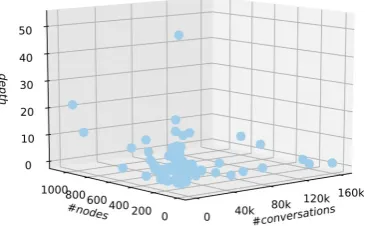
Figure 5: Bots summary: #conversations, #nodes and depth.
would be needed to salvage them. Finding these egregious conversations can help identify where improvement efforts should be focused. In this task, a conversationcshould be classified as egre-gious or not, with the BOT2VEC representation potentially improving performance.
5 Experiments
5.1 Data
We collected two months of data from92bots, in-cluding their graphs and conversations logs. The bot domains included health, finance, banking, travel, HR, IT support, and more. Figure5 sum-marizes the information about number of conver-sations, number of nodes and graph depth for the bots. In total, we collected1.3million conversa-tions, with a minimum of110conversations and a maximum of161,000conversations per bot. For 62% of the bots, the number of conversations var-ied between 1000 to 10,000. Bot graph depth ranged from2to52 levels with an average depth of7; the total number of nodes ranged from11to
1088with an average of160nodes per bot.
5.2 Experimental Setting
Common bin vector As explained, to capture comparable behavior across bots, we create one common bin vector using the average depth and average width for each level of the bots graphs. Specifically, first, based on the average depth, we define the number of sections to be7. Then we set the number of bins for each section (based on the average width per level per bot) to108,10,6,17,
8,4, and1, respectively.
Bot2Vec implementation details
Model F1-score % improvement
BOT-STAT 0.519 -BOT2VEC-C 0.545 5.0
[image:7.595.353.481.62.109.2]BOT2VEC-S 0.616 18.6
Table 1: Production bots detection - classification re-sults on the test set.
one vector representing the user utterances and the second vector representing the bot responses. The two vectors are concatenated and passed through a fully connected layer with5000units. We also calculate the squared difference of the two vectors and an element-wise multiplication of the vectors to capture the interaction between the user and the bot. The three vectors are then concatenated and passed through another two fully connected layers with1000and100units.
Structure-based:The input is a single vector with the size of 616 (the total number of bins (154) times the 4 counters per bin). This input vector is passed through two fully connected layers with
100and20units.
For both models, the last hidden layer is con-nected to the output layer (with a size equal to the total number of bots). All hidden layers consists of ReLU activation units, and are regularized using dropout rate of 0.5. The models were optimized using an Adam optimizer with a 0.001 learning rate.
5.3 Task 1 - Production Bots Detection
Ground truth To annotate bots, we randomly sampled100conversations from our dataset. The sampled conversations were tagged by two dif-ferent expert judges. Given a full conversation, each judge tagged the conversation as production or test/debugging. If more than50% of the con-versations were tagged as production, then the bot was tagged as production. In addition, if the bot was annotated as not-production, the experts had to provide a list of reasons for their choice (e.g., repeating users ids, repeating bot response, etc.). We generated true binary labels by considering a bot to be a production bot if both judges agreed. Judges had a Cohen’s Kappa coefficient of 0.95
which indicates a high level of agreement. This process generated the production bot class size of
40(44%of the92bots).
Baseline model Inspired by (McIntire et al.,
2010;Zhang et al.,2018) we implemented a base-line model denoted BOT-STAT as follows: for
Model F1-score % improvement
EGR 0.537
[image:7.595.119.246.63.100.2]-bot-STAT 0.597 11.0 BOT2VEC-C 0.617 14.8 BOT2VEC-S 0.626 16.4
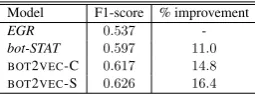
Table 2: Egregious conversations - classification results on the test set.
each bot we calculated features, such as the num-ber of unique customer sentences, numnum-ber of con-versations, number of unique agent responses, and statistical measures (mean, median, percentile) of the following metrics: number of turns of a versation, number of tokens in each turn in a con-versation, and the time of a turn in a conversation. In total we implemented17features.
In our implementation we used an SVM clas-sifier (as we only have92samples), measured the F1-score of the production bot class, and evaluated the models using10-fold cross-validation.
Results Table1depicts the classification results for the three models we explored. The BOT2VEC -S model outperformed the other models with a relative improvement of18.6%over the baseline. The performance of the BOT2VEC-C is slightly better than the baseline which indicates that the in-formation that was captured by the content of the conversations was helpful to detect the usage of the bot. The structure-based representation, how-ever, seems to capture bot variability more effec-tively, i.e. the coverage of visited nodes, different conversations patterns, etc.
5.4 Task 2 - Egregious Conversations Detection
Ground truth To collect ground truth data, we randomly sampled 12 bots (from the production bots), and for each bot100conversations were an-notated following the methodology in (Sandbank et al.,2018), namely, given the full conversation, each judge tagged whether the conversation was egregious or not. Judges had a Cohen’s Kappa co-efficient of 0.93 which indicates a high level of agreement. The size of the egregious class varied between the bots, ranging from8%to48%of the conversations. All the conversations were aggre-gated to one dataset.
Baseline model We implemented the state-of-the-art EGR model, presented in (Sandbank et al.,
its bot representation vector was concatenated to the EGR model’s original feature vector.
We measured the F1-score of the egregious class, and evaluated the models using 10-fold cross-validation.
Results Table 2 summarizes the classification results for all models. Specifically, theBOT2VEC -S outperforms all other models with a relative improvement of 16.4%. This suggests that the structure-based representation of the bot encapsu-lates information which helps the model to distin-guish between egregious and non-egregious con-versations. Moreover, although the EGR model receives the text of the conversation as input, the content-based representation of the bot also helped to improve the performance of the task.
5.5 Structure-based Analysis
In practice, bots belong to various application do-mains like banking, IT and HR. Motivated by the semantic similarities between word embed-dings (Mikolov et al.,2013b), we further analyzed the structure representation BOT2VEC-S w.r.t bots that belong to the same domain. For the set of production bots,IT,HR, and thebankingdomains were prominent with10,7, and6bots respectively, while the other bots belonged to a long tail of do-mains liketravel,medical, etc. For the prominent domains (that had more than5bots), we calculated the average cosine distance between vector repre-sentations for pairs of bots that belong to the do-main vs. pairs of bots from different dodo-mains. We find that the average distance between bots within their domain is0.614, while the distance between bots from different domains is 0.694. Thus, the representations of bots that belong to the same do-main appear to have, as one would expect, a higher level of similarity.
6 Related Work
Despite the popularity of chatbots, research on bot representations and usage analysis is still un-der explored. Works on chatbot representations are mostly concentrated on neural response gen-eration (Xu et al., 2017; Li et al., 2016; Herzig et al.,2017) and slot filling (Ma and Hovy,2016;
Kurata et al., 2016). In these works, conversa-tion history is used to generate the next bot re-sponse. Other works use conversation represen-tations for improving specific tasks useful in di-alog, like intent detection (Kato et al.,2017),
dia-log act detection (Kumar et al.,2018), and improv-ing fluency and coherency (Gangadharaiah et al.,
2018). Yuwono et al. (2018) learn the quality of chatbot responses by combining word representa-tions of human and chatbot responses using neural approaches. The main difference between these works and ours is that we analyze multiple bots within a service to generate representations use-ful to each whereas others analyze a single bot at a time. In addition, we show that our representa-tions are beneficial across different tasks. Finally, none of these works consider the structure of the bot as part of the representation.
Learning embeddings for different objects is one of the most explored tasks2. As mentioned above, graphs and nodes representations were pro-posed in (Narayanan et al., 2017; Grover and Leskovec,2016). Both works considered static lo-cal structures in graphs, whereas our graph repre-sentation is based on dynamic conversation paths. The work in (Mikolov et al., 2013b) suggested a Word2Vec skip-gram model such that a word is predicted given its context. In our work, we take a similar approach fitted to the more complex struc-ture of bots, and predict a bot id given a represen-tation of a conversation.
Recently, Guo et al. (2018); Pereira and D´ıaz
(2018) presented a chatbot usage analysis over several bots. Guo et al.(2018) compared the per-formance of various chatbots that participated in the Alexa prize challenge and implemented the same scenario. To do so, the authors used dif-ferent measures such as conversational depth and breadth, users engagement, coherency, and more.
Pereira and D´ıaz(2018) suggested a list of quality attributes, and analyzed 100 popular chatbots in Facebook Messenger. Our work focuses on learn-ing bot representations targeted towards classifica-tion tasks on the level of bots and their conversa-tions.
7 Conclusions
In this paper, we suggest two BOT2VEC models that capture a bot representation based either on the structure of the bot or the content of its con-versations. We showed that utilizing these repre-sentations improves two platform analysis tasks, both for bot level and conversation level tasks. Fu-ture work includes extension of the model to en-capsulate both the content and the structure based
representations combined together using sequen-tial neural networks (such as RNN).
References
Rashmi Gangadharaiah, Balakrishnan
Narayanaswamy, and Charles Elkan. 2018. What we need to learn if we want to do and not just talk. In Proceedings of the 2018 Conference of the North American Chapter of the Association for Computational Linguistics: Human Language Technologies, Volume 3 (Industry Papers), pages 25–32. Association for Computational Linguistics.
Aditya Grover and Jure Leskovec. 2016. node2vec: Scalable feature learning for networks. In Proceed-ings of the 22nd ACM SIGKDD international con-ference on Knowledge discovery and data mining, pages 855–864. ACM.
Fenfei Guo, Angeliki Metallinou, Chandra Khatri, Anirudh Raju, Anu Venkatesh, and Ashwin Ram. 2018. Topic-based evaluation for conversational bots.CoRR, abs/1801.03622.
Jonathan Herzig, Michal Shmueli-Scheuer, Tommy Sandbank, and David Konopnicki. 2017. Neural response generation for customer service based on personality traits. InProceedings of the 10th Inter-national Conference on Natural Language Genera-tion, pages 252–256. Association for Computational Linguistics.
Tsuneo Kato, Atsushi Nagai, Naoki Noda, Ryosuke Sumitomo, Jianming Wu, and Seiichi Yamamoto. 2017. Utterance intent classification of a spoken di-alogue system with efficiently untied recursive au-toencoders. InProceedings of the 18th Annual SIG-dial Meeting on Discourse and Dialogue, pages 60– 64. Association for Computational Linguistics.
Harshit Kumar, Arvind Agarwal, Riddhiman Dasgupta, and Sachindra Joshi. 2018. Dialogue act sequence labeling using hierarchical encoder with CRF. In AAAI. AAAI Press.
Gakuto Kurata, Bing Xiang, Bowen Zhou, and Mo Yu. 2016. Leveraging sentence-level information with encoder lstm for semantic slot filling. In Proceed-ings of the 2016 Conference on Empirical Methods in Natural Language Processing, pages 2077–2083. Association for Computational Linguistics.
Quoc Le and Tomas Mikolov. 2014.Distributed repre-sentations of sentences and documents. In Proceed-ings of the 31st International Conference on Inter-national Conference on Machine Learning - Volume 32, ICML’14, pages II–1188–II–1196. JMLR.org.
Jiwei Li, Michel Galley, Chris Brockett, Georgios Sp-ithourakis, Jianfeng Gao, and Bill Dolan. 2016. A persona-based neural conversation model. In Pro-ceedings of the 54th Annual Meeting of the Associa-tion for ComputaAssocia-tional Linguistics (Volume 1: Long
Papers), pages 994–1003. Association for Computa-tional Linguistics.
Xuezhe Ma and Eduard Hovy. 2016. End-to-end se-quence labeling via bi-directional lstm-cnns-crf. In Proceedings of the 54th Annual Meeting of the As-sociation for Computational Linguistics (Volume 1: Long Papers), pages 1064–1074. Association for Computational Linguistics.
J. P. McIntire, L. K. McIntire, and P. R. Havig. 2010. Methods for chatbot detection in distributed text-based communications. In2010 International Sym-posium on Collaborative Technologies and Systems.
Tomas Mikolov, Kai Chen, Greg Corrado, and Jef-frey Dean. 2013a. Efficient estimation of word representations in vector space. arXiv preprint arXiv:1301.3781.
Tomas Mikolov, Ilya Sutskever, Kai Chen, Greg Cor-rado, and Jeffrey Dean. 2013b. Distributed repre-sentations of words and phrases and their composi-tionality.CoRR, abs/1310.4546.
Annamalai Narayanan, Mahinthan Chandramohan, Ra-jasekar Venkatesan, Lihui Chen, Yang Liu, and Shantanu Jaiswal. 2017. graph2vec: Learn-ing distributed representations of graphs. CoRR, abs/1707.05005.
Juanan Pereira and Oscar D´ıaz. 2018. A quality analy-sis of facebook messenger’s most popular chatbots. InProceedings of the 33rd Annual ACM Symposium on Applied Computing, SAC ’18.
Ofir Press and Lior Wolf. 2017. Using the output em-bedding to improve language models. In Proceed-ings of the 15th Conference of the European Chap-ter of the Association for Computational Linguistics: Volume 2, Short Papers, pages 157–163. Association for Computational Linguistics.
Tommy Sandbank, Michal Shmueli-Scheuer, Jonathan Herzig, David Konopnicki, John Richards, and David Piorkowski. 2018. Detecting egregious con-versations between customers and virtual agents. In Proceedings of the 2018 Conference of the North American Chapter of the Association for Computa-tional Linguistics: Human Language Technologies, Volume 1 (Long Papers), pages 1802–1811. Associ-ation for ComputAssoci-ational Linguistics.
Zhen Xu, Bingquan Liu, Baoxun Wang, Chengjie SUN, Xiaolong Wang, Zhuoran Wang, and Chao Qi. 2017. Neural response generation via gan with an approximate embedding layer. InProceedings of the 2017 Conference on Empirical Methods in Natural Language Processing, pages 617–626. Association for Computational Linguistics.