The seismic alert system of Mexico (SASMEX): Progress and its
current applications
J.M. Espinosa-Aranda
n, A. Cue´llar, F.H. Rodrı´guez, B. Frontana, G. Ibarrola, R. Islas, A. Garcı´a
Centro de Instrumentacio´n y Registro Sı´smico, A. C. (CIRES), Anaxa´goras 814, Narvarte, Benito Jua´rez, 03020 Me´xico D.F., Mexicoa r t i c l e
i n f o
Article history:
Received 30 September 2009 Received in revised form 8 September 2010 Accepted 9 September 2010
a b s t r a c t
The Seismic Alert System of Mexico (SASMEX) is being conformed by the Seismic Alert System of Mexico City (SAS), pioneer in public earthquake early warning services and the Seismic Alert System of Oaxaca City (SASO), with a set 12 and 36 sensing field stations, respectively. Today, the alerting functions of these systems are currently in the process of integration. SAS started in 1991 and SASO in 2003, have emitted 78 early warnings of more than 2350 earthquakes detected by their sensing field stations. Authorities of Mexico Federal District (GDF) and the State of Oaxaca, since 2003 agreed with Mexico’s Ministry of the Interior (SEGOB), coordinate necessary to improve their seismic alert systems and join their roles to make must efficient possible disaster mitigation activities that might cause strong Mexican earthquakes. This paper describes the main current applications of SAS and SASO: schools, radio and TV commercial broadcast, and the Alternate Emitters of Seismic Alert System (EASAS) operating in Acapulco and Chilpancingo both of Guerrero state. To reach better efficiency in the seismic warning delivery, since 2009 we are applying NWR-SAME receivers in Mexico City Valley, and testing their codes enhancement to obtain the expedite earthquake warning issuing. Also the GDF is promoting to increase the observation capacity of the seismic danger around Mexico City, to detect it and warn any strong effect, reducing a new possible seismic disaster, and recently the SEGOB, hereby their General Coordination of Civil Protection, agreed to extend an SASMEX sensor coverage between Chiapas and Jalisco states to issuing earthquake warning signal to reduce their population vulnerability.
&2010 Elsevier Ltd. All rights reserved.
1. Introduction
After experiencing the serious seismic disaster generated by the ‘‘Caleta de Campos’’ M8.1 Michoaca´n earthquake in 1985, Mexico City Authorities have been promoting since 1989 the design and evolution ofSistema de Alerta Sı´smica(SAS), with the aim to mitigate possible future earthquake damage produced by such as the latent ‘‘Guerrero Gap’’ seismic danger[1].
Thanks to the financial support from the Ministry of Works and Services (SOS) of the GDF, the originalSASidea was developed by
Centro de Instrumentacio´n y Registro Sı´smico(CIRES) Civil Associa-tion. This technological resource started its experimental operation in August 1991 and has been available and evaluated as a public service since 1993. To date, it is applied and evaluated in more than 80 elementary schools, both private and public, located in urban regions prone to seismic risk and where early warning of seismic alert signals from anSAShas been useful, as well as in the Mexico City subway rail transport (METRO).
SASdisseminates public seismic alert in the valleys of Mexico and Toluca, this one located about 50 km NW of Mexico City. In
addition, it also alerts on a contract basis to more than 280 miscellaneous institutions comprising schools, public buildings and emergency organizations.
The implementation of anSASin the Mexico Valley has made possible to anticipate the arrival of the effects of S-waves with an average of 60 s, time enough to allow an execution of safety of automatic system procedures for the protection of equipment or systems susceptible to undergo damage, such as power plants, computer systems and telecommunication networks[2].
On May 14, 1993, after anSASidentified an earthquake M6.0 and anticipated with 65 s the imminent arrival of its effect in Mexico City, the local authorities decided to disclose early warning notices publicly. The alert signal broadcast was a possible thanks to the support from most of the commercial radio and television networks grouped in theAsociacio´n de Radiodifusores del Valle de Mexico
(ARVM), Civil Association, which agreed to contribute as a social service for their audience since August 1993.
An SAS, has evolved aiming the best on availability and reliability of their four basic sub-systems: Seismic Detection, Communication, Warning Dissemination and Central Control and Recording, to guarantee the effective earthquake alert public service[3].
On September 14, 1995 at 8:04 a.m. in Mexico City, having elapsed almost 10 years after the tragic earthquake of 1985[3], an
Contents lists available atScienceDirect
journal homepage:www.elsevier.com/locate/soildyn
Soil Dynamics and Earthquake Engineering
0267-7261/$ - see front matter&2010 Elsevier Ltd. All rights reserved. doi:10.1016/j.soildyn.2010.09.011
n
Corresponding author.
E-mail address:[email protected] (J.M. Espinosa-Aranda).
SASanticipated with 72 s the an arrival of the effect of an M7.3 earthquake occurred near the town of Copala, Guerrero. This earthquake proved the adequacy of the processes of response and evacuation of schools, where theSAS early warnings were received, since the population performed these activities successfully[4].
In 2007, to support the activities of Civil Protection of the coastal state of Guerrero, Mexico City Authorities authorized the installa-tion of Alternate Emitters for the warning issued by theSAS(EASAS) in the cities of Acapulco and Chilpancingo. The EASASof Guerrero provide public automatic alert services controlling the transmis-sions of the local commercial broadcasting stations covering the demand of private seismic alert services offered to 102 institutional users.
In order to improve the efficiency in the dissemination of the warning provided by an SAS initially in schools, recently La Autoridad del Centro Histo´rico in Mexico City sponsored the installation of three dedicated VHF radio transmitters, thus ben-efiting by the use of commercially available low-cost receivers carrying the Public AlertTMlogo that meet technical standards of an NOAA Weather Radio (NWR) Specific Area Message Encoding (SAME) protocols and the Emergency Alert System (EAS) event codes, such as those in use to warn against diverse natural hazards in the USA. The Mexico City application requires the NOAA-SAME-EAS protocols, an enhancement in order to include a new code to operate earthquake early warning signals, without delay, omitting the normal 2 ton previous to the signal advise[5].
On June 15th 1999, a damaging M6.7 earthquake induced the Department of Civil Protection of Oaxaca to request CIRES the design, construction and installation of theSistema de Alerta Sı´smica de Oaxaca(SASO). A better time-efficiency criteria to define the
seismic range of theSASOwarnings, has outcome in a technological evolution from the original algorithm used by anSAS, designed back in 1989 [1], to fulfill the requirements demanded by this application.
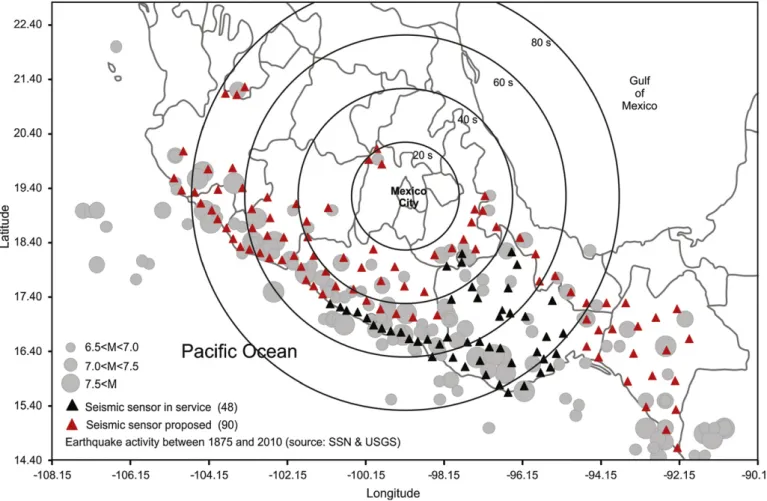
Thanks to the Oaxaca Authorities initiative, the Mexico City Mayor, with the participation of the Mexican Secretariat of the Interior, it has been agreed aSASOandSASfunction integration to constitute them as a single entity, the so-calledSistema de Alerta Sı´smica Mexicano(SASMEX). And recently Local and Federal Autho-rities have decided to increase the number of seismic sensors as necessary to provide an effective warning of impending regional seismic risk disseminating notices of seismic alert in vulnerable cities (Fig. 1). With the service rendered by EASASsystems in each sensible region, it will be possible to prevent in advance the seismic effects on the site as well as define the most suitable alert warning for each particular risk condition, and to review these factors systematically[5].
2. SAS and SASO performance
The forecast begins calculating parameters measured in the Field Stations (FS) when an earthquake is detected, an SAS uses the acceleration data of the vertical, longitudinal and transversal components to calculate the Acceleration Quadratic Integration and the rate of this integration, both measured during the 2n
(S–P) lapse, i.e., the first P wave arrives until the S wave begins. An SASO uses these parameters too, but only in the FS in cost region. In north and center of Oaxaca, it uses the dominant period, measured in the vertical component during the first 3 s after de P wave begins; in case of the S–P iso3 s, then the FS uses two additional parameters:
Fig. 1. Current distribution of SASMEX seismic sensors and a new proposal presented to Local and Federal authorities. the normal 2 tones previous to the signal advise [5].
the Maximum Acceleration and the Acceleration Quadratic Inte-gration, from the vertical component too.
The parameters are sent automatically to determine the alert range, this forecast is used to define the seismic warning range of the impending occurrence of a dangerous earthquake detected by the first two FS[6]. The first FS message defines the warning range, either strong or moderate, and with the second one, triggers the Type of Warning process, respectively, as ‘‘Public Alert’’ or ‘‘Preventive Alert’’. However the range of Public and Preventive of SASO is less than in SAS, in order to be more sensible due to a minor distance from the Oaxaca city to the danger seismic area.
The Prevention Time is defined as the time elapsed between the beginning of the warning signal and the beginning of the S phase, related to the region where it is intended to mitigate the risk[5].
AnSAShas been regarded as the first system in the world for earthquake, early warning that disseminates its notices to the public[7]. The Prevention Time is close to 60 s. This is because the major seismic effects threatening the Valley of Mexico are originated at the coastal region of the Pacific Ocean at a distance of about 320 km, and since their strongest components travel at a rate of 4 km/s, taking 80 s to arrive, whereas notices broadcasted by radio from the epicenter area can be transmitted instantaneously anticipating the seismic effects.
AnSASidentifies the strong earthquakes along the coast of the State of Guerrero with a linear layout of 12 FS spaced approxi-mately every 25 km to be able to perform an efficient survey, because many seismic foci of this region occur at similar depths.
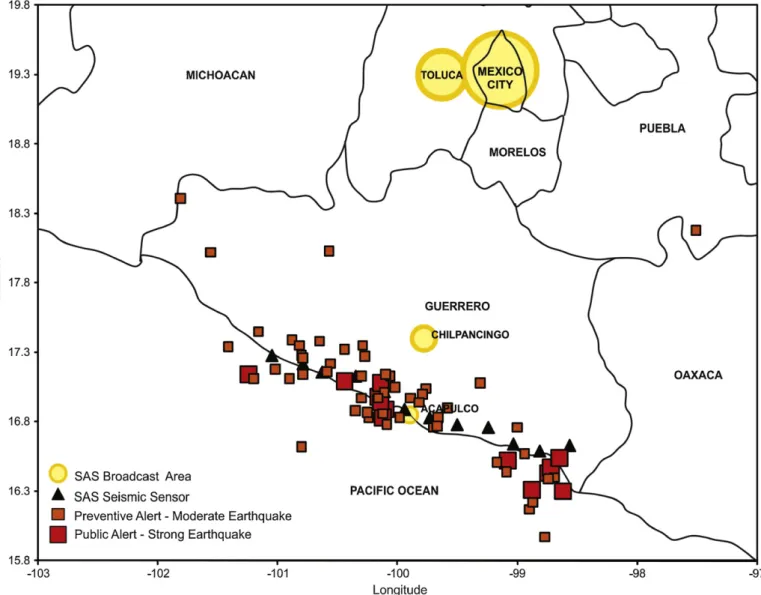
Since its experimental operational stage in 1991, an SAS has detected more than 2120 seismic events with magnitudes from M3.0 to M7.3 and it has emitted 13 earthquakes warnings as ‘‘Public Alerts’’ and 54 as ‘‘Preventive Alerts’’ (Fig. 2andTable 1). TheSASperformance showed inTable 1is accounted by the number of FS’s that registered each warned earthquake (# SENS. OP.), the Forecast (MAGNITUDE), the Type of Warning emitted (ALERT RANGE) and Prevention Time. The DISTANCE inTable 1is measured from the epicenter to the first FS, which detected the earthquake.
SASO constitutes a technological development evolved from
SAS; anSASOhas 36 FS and 11 radio relay stations to link its coastal, central, northern and isthmus regions. Since its commissioning, an
SASOhas issued 6 Public Alert and 5 Preventive Alert warnings from the detection and analysis of more than 230 sensed earthquakes (Fig. 3andTable 2, similar toTable 1).
3. SASMEX main applications
After the damages suffered in Mexico City during the 1985 earthquake, the law for Civil Protection and its bylaw were
Fig. 2.SAS network and earthquakes warned between 1991 and 2010. J.M. Espinosa-Aranda et al. / Soil Dynamics and Earthquake Engineering 31 (2011) 154–162 156
SAS historical results and evolution.
# SERVICIO SISMOLOGICO NACIONAL (SSN), UNAM Distance (km) SAS FORECAST RESULT
Region Local date–time Latitude Longitude Magnitude Depth (km) # SENS. OP. Magnitude Alert range Prevention time (s) 67 Guerrero 25–05–2010 18:36:15 17.11 101.20 5.0 15 93 4 Mo5 Preventive 69 66 Guerrero 27–04–2009 11:46:45 16.90 99.58 5.7 7 18 9 Mo6 Preventive 54 65 Guerrero 27–03–2009 02:48:16 17.35 100.82 5.3 30 90 7 Mo6 Preventive 58 64 Guerrero 11–11–2008 05:02:06 16.62 100.80 4.7 15 43 4 M45 Preventive 63 Guerrero 06–11–2007 00:35:42 17.08 100.14 5.6 9 9 9 M46 Public 68 62 Guerrero 28–04–2007 08:56:54 16.94 99.82 5.0 9 15 6 Mo6 Preventive 61 Guerrero 13–04–2007 03:43:48 17.21 100.33 5.4 25 9 8 Mo6 Preventive 56 60 Guerrero 13–04–2007 00:42:22 17.09 100.44 6.3 41 10 6 M46 Public 58 59 Guerrero 31–03–2007 00:18:56 16.90 99.91 4.7 44 4 5 Mo5 Preventive 58 Guerrero 18–09–2005 06:25:53 17.05 100.02 4.4 9 18 3 Mo5 Preventive 57 Guerrero Coast 09–01–2003 20:08:42 16.89 100.36 5.3 25 28 7 Mo6 Preventive 58 56 Guerrero 27–09–2002 02:04:58 17.16 100.59 4.9 36 5 4 Mo6 Preventive 58 55 Guerrero Coast 25–09–2002 13:14:48 16.87 100.11 5.3 5 14 4 Mo6 Preventive 57 54 Guerrero Coast 16–02–2002 22:10:19 16.94 99.93 4.7 37 7 6 Mo5 Preventive 53 Guerrero Coast 07–10–2001 21:39:20 16.93 100.16 6.1 10 8 8 M46 Public 65 52 Guerrero 06–03–2001 15:57:56 17.20 100.10 5.3 7 23 9 Mo6 Preventive 63 51 Guerrero Coast 05–03–2001 04:17:30 16.70 100.01 5.4 96 20 8 Mo6 Preventive 66 50 Guerrero Coast 14–04–2000 20:45:05 16.88 100.35 4.6 9 28 5 Mo5 Preventive 66 49 Guerrero 17–03–2000 18:50:58 17.12 99.35 4.8 50 41 7 Mo5 Preventive 68 48 Puebla–Oaxaca Border 15–06–1999 15:42:05 18.25 97.49 6.7 99 211 9 Mo5 Preventive 15 47 Guerrero 30–05–1999 04:58:42 17.33 100.79 4.4 12 12 5 Mo5 Preventive 68 46 Guerrero 24–04–1999 22:08:57 17.29 100.80 4.6 27 7 4 Mo5 Preventive 68 45 Guerrero Coast 07–09–1998 01:53:17 16.77 99.67 4.1 11 10 3 Mo5 Preventive 44 Guerrero Coast 09–08–1998 11:18:07 16.90 100.23 4.5 5 17 3 Mo6 Preventive 43 Guerrero Coast 17–07–1998 06:18:03 16.98 100.16 5.2 26 4 7 M46 Public 74 42 Guerrero Coast 05–07–1998 14:55:07 16.83 100.12 5.2 5 18 6 M46 Public 66 41 Guerrero Coast 09–05–1998 12:03:13 17.37 101.41 5.2 24 39 4 Mo5 Preventive 60 40 Guerrero 11–03–1998 08:13:12 17.04 100.12 4.2 36 5 4 Mo5 Preventive 39 Guerrero Coast 21–12–1997 23:22:00 17.25 100.90 5.6 10 12 5 M46 Public 69 38 Guerrero Coast 26–08–1997 19:13:17 16.34 100.53 4.7 17 84 6 Mo5 Preventive 45 37 Guerrero 19–07–1997 02:34:37 17.22 100.43 4.9 56 14 6 Mo5 Preventive 56 36 Oaxaca–Guerrero Coast 14–07–1997 20:26:18 16.16 98.76 4.3 25 45 3 Mo5 Preventive 35 Guerrero Coast 11–07–1997 17:23:31 16.56 99.65 4.3 10 29 3 Mo5 Preventive 34 Low Balsas River 22–05–1997 02:50:55 18.43 101.79 5.9 61 147 4 Mo6 Preventive 33 Guerrero 08–05–1997 10:58:30 17.26 100.38 5.1 14 15 5 Mo6 Preventive 55 32 Guerrero 23–03–1997 14:23:16 17.43 100.85 4.7 15 24 4 Mo6 Preventive 31 Guerrero 21–03–1997 21:49:16 17.03 99.82 4.8 27 21 7 Mo5 Preventive 55 30 Michoacan Coast 11–01–1997 14:28:29 18.09 102.86 7.3 17 212 7 Mo6 Preventive 42 29 Guerrero 27–10–1996 03:15:40 17.25 100.87 4.4 92 10 3 Mo5 Preventive 28 Guerrero 19–07–1996 04:00:54 17.37 100.30 4.8 7 27 6 Mo6 Preventive 27 Guerrero Coast 15–07–1996 16:23:39 17.45 100.92 6.5 18 21 6 Mo6 Preventive 65 26 Guerrero Coast 13–03–1996 15:04:19 16.49 99.19 5.3 35 24 6 M46 Public 74 25 Guerrero Coast 16–09–1995 10:09:00 16.59 98.63 4.3 15 8 2 Mo6 Preventive 24 Guerrero Coast 15–09–1995 21:20:05 16.32 98.62 5.0 34 4 M46 Public 23 Oaxaca–Guerrero Coast 14–09–1995 08:09:27 17.00 99.00 37 5 Mo5 Preventive 22 Oaxaca–Guerrero Coast 14–09–1995 08:04:35 17.00 99.00 7.3 45 37 9 M46 Public 72 21 Oaxaca Coast 31–05–1995 06:49:28 15.97 98.77 4.6 17 70 2 Mo5 Preventive 20 Guerrero Coast 14–04–1995 00:01:08 16.43 99.09 4.8 25 23 6 Mo6 Preventive 19 Low Balsas River 10–12–1994 10:17:40 18.02 101.56 6.3 20 97 6 Mo6 Preventive 34 18 Guerrero Coast 29–10–1994 10:44:08 16.97 99.89 5.1 24 12 9 Mo6 Preventive 58 17 High Balsas River 22–05–1994 19:41:46 18.03 100.57 5.6 23 93 8 Mo6 Preventive 30
B 16–11–1993 19:11:00 1 M46 Public (Fail)
A Guerrero Coast 24–10–1993 01:52:17 16.50 99.00 6.7 14 9 M46 (Fail)
J.M. Espinosa-Aranda et al. / Soil Dynamics and Earthquake Engineering 31 (2011) 154 –162 157
established. Among other requirements, it states that individuals and corporations must design action plans and emergency drills to mitigate vulnerability conditions and reduce the severity of dis-asters. Each action plan must be registered and certified in presence of municipal or local authorities that also supervise and enforce the regular practice of emergency response procedures[8]. The safety and security procedures, as well as the activity of each group in a certain facility, are established accordingly to the display of every building. Distribution of spaces and the identification of the risk and safety zones are considered[9,10,13].
AnSAShas been able to recognize a great number of seismic events, encode their range, and spread warnings as Public or Preventive Alerts. This service operates through three alternative technologies: remotely controlled audio switches installed in radio and TV stations operated by SAS that broadcast Public Alert warnings for strong earthquakes; radio receivers that radiate warnings when anSASemits Preventive and Public Alert signals of strong and moderate earthquakes; and beginning in December of 2008, receivers that include NWR-SAME technology capable of disseminating the Preventive and PublicSAS’s alerts, as well as other natural disasters’ warnings. These warning messages repre-sent a useful service to reduce the vulnerability against a variety of risk conditions. During 2009, in accordance to the Civil Protection of Mexico City Officials (Secretarı´a de Proteccio´n Civil del GDF), access to the use of the radio receiver makes mandatory to have an Internal Civil Protection Plan and practice emergency response procedures frequently.
Mexico City since 1992, have pioneered in the use of theSAS[1]
beginning with twenty six Elementary Schools of the Ministry of Education of Mexico City (Secretarı´a de Educacio´n Pu´blica de la Ciudad de Me´xico). Each facility has an internal plan for civil protection that is systematically practiced and executed wheneverSASsends a warning signal to the radio receiver. From 1993 till date, as stated before, more than 80 elementary, middle and higher education institutions have been furnished with this equipment.
The Public Electric Transportation System and the METRO have used theSASwarnings by means of radio receivers in their control center since 1992, but they do not share the signals with the passengers. In case of a seismic warning, the manager of the control center gives proper instructions for the train operators to stop in the nearest station, or delay their start and keep the doors open for passengers’ safety. This is an internal security and emergency procedure that has given great use to the 60 s that anSAScan offer. In Mexico, the transmission of radio and TV seismic alert signals began in 1993, through most of the partners of the Association of Broadcasters of the Mexico Valley (Asociacio´n de Radiodifusores del Valle de Me´xico A.C.) and TV channels 11, 22, 13 and 34 in Toluca Valley. To be able of properly disseminating the signals, the broadcasters accepted the use of a remotely controlled switch operated by anSAS, which substitutes the regular signal for the official alert signal during 60 s in case of a strong earthquake warning. The effectiveness of this resource is optimal in top rating periods, because a greater part of the population is warned and can start predefined preventive actions. To date, twenty eight AM, FM and TV channels spread the warnings in Mexico City and Toluca Valley as well as nine radio and two TV stations in Oaxaca City. Also, Emergency Response and Civil Protection Institutions use the radio receiver to prepare emergency vehicles and start the evacuation of their parking lots. There are 13 institutions that use this equipment, including the Red Cross and Firefighters.
Nowadays, an SAS serves more than 240 public and private buildings in Mexico City; they receive seismic alert signals through the radio receiver. To guarantee the dissemination of the warning sound, some buildings have displayed loudspeakers arrays, where their correct performance should be verified.
Table 1 ( continued ) # SERVICIO SISMOLOGICO NACIONAL (SSN), UNAM Distance (km) SAS FORECAST RESULT Region Local date–time Latitude Longitude Magnitude Depth (km) # SENS. OP. Magnitude Alert range Prevention time (s) 16 Guerrero Coast 10–09–1993 04:50:24 16.61 99.09 4.9 48 8 4 M o 6 Preventive 70 15 Guerrero 29–07–1993 14:17:01 17.39 100.66 5.0 22 23 4 M o 5 Preventive 14 Oaxaca–Guerrero Coast 15–05–1993 02:26:31 16.46 98.63 4.8 20 18 4 M 4 6 Public 13 Oaxaca–Guerrero Coast 14–05–1993 21:12:00 16.04 98.70 6.0 20 60 6 M 4 6 Public 73 12 Oaxaca–Guerrero Coast 14–05–1993 21:09:39 16.43 98.71 5.8 20 20 6 M 4 6 Public 65 11 Guerrero Coast 31–03–1993 04:18:15 17.30 100.79 5.1 8 7 4 M o 6 Preventive 10 Guerrero Coast 09–11–1992 20:13:25 16.74 100.00 4.8 21 18 3 M 4 6 Public 9 Guerrero Coast 04–11–1992 22:33:37 16.72 99.75 4.3 7 13 2 M o 5 Preventive 8 Guerrero Coast 30–10–1992 02:16:00 17.11 100.78 5.0 13 3 M o 6 Preventive 7 Guerrero Coast 16–10–1992 11:28:00 16.44 99.22 4.8 28 5 M o 6 Preventive 6 Guerrero 02–08–1992 06:54:00 17.12 100.39 4.8 5 6 M o 5 Preventive 5 Oaxaca–Guerrero Coast 07–06–1992 11:41:00 16.21 98.84 5.1 38 3 M o 5 Preventive 4 Oaxaca–Guerrero Coast 07–06–1992 03:01:00 16.15 98.87 5.2 45 3 M o 6 Preventive 3 Guerrero Coast 15–05–1992 02:35:00 16.87 99.95 4.9 4 3 M o 5 Preventive 2 Guerrero Coast 26–04–1992 14:53:00 16.75 100.07 4.8 20 4 M o 5 Preventive 1 Oaxaca–Guerrero Coast 16–10–1991 12:36:00 16.70 98.70 4.3 16 1 M o 6 Preventive
J.M. Espinosa-Aranda et al. / Soil Dynamics and Earthquake Engineering 31 (2011) 154–162 158
In addition to start preventive measures,SASsignals are used to trigger structural health recording procedures to identify possible damage in buildings.
On March 27, 2009 at 02:48:32 (local time), anSASemitted a ‘‘Preventive Alert’’ signal, anticipating the effects of the M5.3 earthquake from the coast of Guerrero (Fig. 4). Then for the first
Fig. 3.SASO network and earthquakes warned between 2003 and 2010.
Table 2
SASO historical results and evolution.
# SERVICIO SISMOLOGICO NACIONAL (SSN), UNAM Distance (km) SASO FORECAST RESULT
Region Local dte–time Latitude Longitude Magnitude Depth (km) # SENS. OP. Magnitude Alert range Prevention
time (s) 11 Oaxaca 03–06–2010 02:22:27 16.22 98.03 6 8 16 4 M45.5 Public 21 10 Oaxaca 16–04–2010 05:01:07 16.14 98.41 5.1 10 21.3 4 M45.5 Public 9 Oaxaca 08–02–2010 18:47:40 15.90 96.86 5.8 37 65.8 16 M45.5 Public 8 Chiapas 05–07–2007 20:09:21 16.95 94.04 6.2 100 105 5 Mo5 Preventive 40 7 Oaxaca 15–03–2007 07:13:00 16.07 97.24 5.1 12 20 6 Mo5 Preventive 6 Oaxaca 24–01–2007 22:23:25 16.21 97.14 4.3 6 2 Preventive 5 Oaxaca 19–08–2006 00:41:30 15.91 97.30 5.5 52 40 8 Public 4 Oaxaca 15–12–2004 02:05:14 16.05 95.43 4.5 10 8 4 Mo5 Preventive
B Oaxaca 18–08–2004 04:03:10 16.30 95.12 5.7 63 50 9 M45.5 (Comx Fail)
A Veracruz– Oaxaca
07–08–2004 06:49:12 17.06 95.44 5.9 112 89 10 (Fail)
3 Gro–Oax Coast 14–06–2004 17:54:23 16.31 98.06 5.8 10 15 6 M45.5 Public 30
2 Oaxaca Coast 13–01–2004 15:28:58 16.00 97.16 5.5 14 9 10 M46 Public
Fig. 4.First SAS service with NOAA receivers activated, March 27th 2009 Guerrero M5.3 earthquake. The accelerations of the FS correspond to a horizontal component with base line correction.
Fig. 5.Second SAS service with NOAA receivers activated, April 27th 2009 Guerrero M5.7 earthquake. The accelerations of the FS correspond to a horizontal component with base line correction.
J.M. Espinosa-Aranda et al. / Soil Dynamics and Earthquake Engineering 31 (2011) 154–162 160
time, an SAS used the NOAA-SAME technology validating the effective use of this resource. At that time, eight monitoring NOAA receivers successfully reacted and provided 58 s of Prevention Time. Thus, with a minor technical adjustment to an expedite reaction, by reducing the receiver’s response time this technology has been proposed to enhance theSASspecifications helping to mitigate the seismic vulnerability in Mexico.
On April 27, 2009 at 11:46:45 (local time), anSASemitted a ‘‘Preventive Alert’’ warning signal, anticipating the effects of the M5.7 earthquake from the coast of Guerrero (Fig. 5). An SAS
confirmed the adequacy to use the NOAA-SAME technology in the city for this purpose.
On June 30, 2010 at 02:22:46 (local time), anSASOemitted a warning signal of ‘‘Public Alert’’, anticipating with more than 20 s the effects of the M6.0 earthquake (SSN preliminar report).Fig. 6
shows this result, where 22 FS’s activated and sent their parameters to the Oaxaca city. The bottom of the figure shows a fourth accelerogram (one horizontal component) recorded in the Mexico City, where the Prevention time if theSASandSASOhave already been integrated, could have been more than 80 s, however the acceleration is low to generate damages.
SASOhas a similar range of users to the one of anSAS, with the exception of automatic powerful loudspeakers installed in public spaces, which can be heard in the public squares of the Oaxaca City.
As in the Mexico City, Oaxaca and Toluca, in Chilpancingo and Acapulco both Guerrero State cities, receivedSASwarnings in more than 100 users, among radio, TV stations, schools, emergency response institutions and others in 2007, seeTable 3.
4. Conclusion
Since damaging earthquakes are not so frequent, the develop-ment of this technological resource has deemed necessary to optimize the reliability and availability indexes of their basic elements in order to guarantee the effective dissemination of alert warnings in the occurrence of damaging events, including fore-casting criteria of seismic risk. TheSASMEXsystem has its own designs and self-evaluation procedures as well as a continuing technological improvement program aimed to have an assurance of its services.
The development of anSASMEXto the current state has had to confront other than technical issues. The lack of our previous experience of earthquake warning procedures; the initial reluc-tance of authorities to spread such an alert; the skepticism of a part of scientific community of an engineering rather than geophysical– seismological project; the sporadic nature of strong motion earth-quake phenomena masking the collective memory, thus reducing
the preventive attitude; the funds flow that usually must challenge with other priorities of the project sponsors; and even a patent troll controversy that distracted the technical effort in the early stages of this system implementation.
In the design, development and operation ofSASandSASO, it was acquired the compromise to improve continuously their subsys-tems that conform them as well as the processes of detection, computation, communication, forecast and effective broadcast of the warnings in case of earthquake. Nevertheless, other high-priority tasks must be reinforced by the authorities, like the diffusion and knowledge of the seismic danger around the city, the continuous program of prevention when the signal of seismic alert is emitted, the feasibility to acquire NOAA/SAME low-cost radios that could disseminate other natural hazards, enhance of coverage of the seismic zone, etc.
The SAS and SASO integration has started the calibration process of their seismic early warning criteria, whose could be a use to other cities with high seismic vulnerability. These criteria must consider the distance from the epicenter to the city to be warned and the seismic energy.
Public-oriented discussions together with the proper detection of the earthquake, the reliability of message transmission and the risk evaluation constitute necessary elements in the systems of early warning systems. However, if dissemination and training campaigns launched among the population exposed to natural hazards continue to be insufficiently funded, any early warning system will be exposed to failure to comply with its main objective for which it was designed[11]. The technological development of early warning systems applicable to earthquakes is continuously improving and it is convenient to analyze the full spectrum of earthquake early warning as a whole[12].
Acknowledgements
The authors deeply acknowledge the support received from the Mexico City Government Authorities since 1989, originally through its Secretarı´a de Obras y Servicios and recently, through the
Coordinacio´n GeneralandSecretarı´a Ejecutiva del Comite´ Directivo del Sistema de Alerta Sı´smica de la ciudad de Me´xico, who have decided to apply this technological development, proposed after our 1985 earthquake disaster experience, with the aim to mitigate the seismic vulnerability in the metropolitan population of the Mexico City valley. We are also grateful to the recently constituted Mexico City Secretarı´a de Proteccio´n Civil for its decision to take advantage of this earthquake early warning system, as well as to theAutoridad del Centro Histo´rico de la Ciudad de Me´xico,by its valuable sponsorship required to install the radio transmitters
system used to disclose via low-cost receivers of the EAS-SAME-Public Alert system the warnings issued by theSASsystem.
We would also like to thank theSecretarı´a de Educacio´n Publica
(Public Education Ministry), that supported theSASexperimental program since 1992 in some schools of Mexico City; the valuable support from theAsociacio´n de Radiodifusores del Valle de Me´xico, that since 1993 broadcasts the automatic warnings issued by the
SASto the general public; and, the government of Oaxaca, that in 2002, through itsUnidad Estatal de Proteccion Civil, promoted the
SASOdesign and development. Finally but not less, toTele´fonos de Me´xico(TELMEX) and ofComisio´n Federal de Electricidad(CFE) for their valuable infrastructure support that has expedited the installation and exploitation of theseSASandSASOresources.
References
[1] Espinosa-Aranda JM, Jimenez A, Contreras O, Ibarrola G, Ortega R. Mexico City seismic alert system. In: International Symposium on Earthquake Disaster Prevention. Proceedings CENAPRED-JICA. Mexico I: 1992. p. 315–24. [2] Kanamori H. Earthquake prediction: an overview. international handbook of
earthquake and engineering seismology, International Association of Seismo-logical & Physical Earth’s Interior Committee on Education 2003 (81B). [3] Espinosa-Aranda JM, Jimenez A, Ibarrola G, Alcantar F, Aguilar A, Inostroza M,
et al. Mexico city seismic alert system. Seismological Research Letters 1995;66(6). November–December.
[4] Goltz JD, Flores PJ. Real-time earthquake early warning and public policy: a report on Mexico City’s sistema de alerta sismica. Seismological Research Letters 1997;68(5). September–October.
[5] Espinosa-Aranda JM, Cuellar A, Ibarrola G, Garcia A, Islas R, Maldonado S, et al. Evolution of the Mexican seismic alert system (SASMEX). Seismological Research Letters 2009;80(5). September–October.
[6] Espinosa-Aranda JM, Rodriguez F.H. The seismic alert system of Mexico City, international handbook of earthquake and engineering seismology. Interna-tional Association of Seismological & Physical Earth’s Interior, Committee on Education 2003 (81B).
[7] Lee WHK, Espinosa-Aranda JM. Earthquake early warning systems: current status and perspectives. In: International IDNDR-Conference on Early Warning Systems for the Reduction of Natural Disasters, Potsdam, Federal Republic of Germany September 7–11; 1998.
[8] Sua´rez G, Novelo D, Mansilla E. Performance evaluation of the seismic alert system (SAS) in Mexico City: a seismological and social perspective. Seismo-logical Research Letters 2009;80(5). September–October.
[9] Official Gazette of the Federation. Ley general de proteccio´n civil (2006). Diario Oficial de la Federacio´n, Mexico, April 24; 2006.
[10] Mexico City Official Gazette Reglamento de la Ley de proteccio´n civil para el Distrito Federal. Gaceta Oficial del Distrito Federal Mexico, 21 October;1996. [11] United Nations. Global survey of early warning systems an assessment of capacities, gaps and opportunities towards building a comprehensive global early warning system for all natural hazards. United Nations Inter–Agency Secretariat of the International Strategy for Disaster Reduction (UN/ISDR)) Final Version; 2006.
[12] Malone S. Opinion. Seismological Research Letters 2008;79(5). September– October.
[13] Official Gazette of the Federation. Ley de proteccio´n civil para el Distrito Federal (1996). Diario Oficial de la Federacio´n, Mexico, 02 February; 1996. Table 3
SASMEX users.
Users Mexico D.F. (SAS) Toluca (SAS) Acapulco (SAS) Chilpancingo (SAS) Oaxaca City (SASO)
Emergency 7 5 8 3 4 School 75 10 16 19 17 Government office 116 21 17 12 13 TV and radio 25 3 6 6 9 METRO 4 0 0 0 0 Enterprises 39 3 2 2 0 Residential buildings 0 1 11 0 0 TOTAL 266 43 60 42 43
J.M. Espinosa-Aranda et al. / Soil Dynamics and Earthquake Engineering 31 (2011) 154–162 162