International DSI / Asia and Pacific DSI 2007 Full Paper (July, 2007)
ERP Success and Top Management Commitment in Large and Small to
Medium Sized Enterprises
Edward W. N. Bernroider
1), Mahshid Druckenthaner
2)1)
Vienna University of Economics and Business Administration, Institute for Information
Business ([email protected])
2)
Vienna University of Economics and Business Administration, Institute for Tourism and
Leisure Studies ([email protected])
Abstract
This article provides new insights on enterprise resource planning (ERP) success and its relationship with management commitment as well as organisational size based on an empirical survey. The results clearly show that organisational size has an effect on perceived success rates. Assessed dimensions, i.e. service and system quality as well as net benefits including financial aspects show a relatively better perception in small to medium sized enterprises (SMEs) as compared to large enterprises (LEs) while in general the results exhibit ERP investments as valuable IT strategies. The relative out performance of ERP development in SMEs is reversed to findings from literature which claim that larger enterprises have higher success rates in developing information systems. Existing literature claimed that top management support is a critical factor in information systems success for both LE and SME. However, for ERP systems, this seems only applicable to large corporations.
Key words: Enterprise resource planning, IS success, small to medium enterprises, empirical survey.
1. Introduction
Enterprise resource planning (ERP) systems are comprehensive packaged information systems (IS) comprising several configurable modules that integrate core business activities (finance, human resources, manufacturing and logistics) into one single environment based on an integrated, shared database. They are embedded with "best practices", respectively best ways to do business based on common business practices or academic theory [1]. Besides integration, the aim is to enhance decision support, reduce asset bases and costs, receive more accurate and timely information, higher flexibility or increased customer satisfaction. ERP systems are often seen as enabler for extensions such as supply-chain management and customer relationship management [2, 3].
Several authors have proposed ERP research agendas [4]. A recent agenda [5] gives three dimensions: ERP adoption, technical aspects of ERP, and ERP in information systems curricula. This research targets the first dimension proposed, in particular ERP diffusion, driver, and success according to expectations for the differential settings found in small-to-medium and large enterprises (SMEs and LEs). These issues are of particular importance due to several reasons. Success and benefits of ERP system implementation and usage in LEs has been widely analysed [6-8] with contributing critical success factors [9-12]. Research and practice interests are know more and more concerned with the usage stage of the system lifecycle to exploit potential benefits. New directions e.g. cover the areas of IS service level management, process transparency, and quality control. In the world of SMEs the situation is different; they lag behind their larger competitors in terms of IS capabilities especially concerning ERP. Nevertheless SMEs enjoy other qualities that enable them to be competitive. Despite some emerging studies on ERP adoption in SMEs [13] and the growing ambitions of ERP system provider to gain new customers (since the market for LEs is largely saturated in developed countries), it remains unclear if business management in SMEs should pay more attention to ERP. The costs and risks involved were extensively reported [10, 14]. Furthermore, by incorporating standard business processes with minimal customized software packages SMEs may lose their uniqueness or flexibility. Both are known to be crucial for SMEs. Because they face greater environmental uncertainty due to lesser influence [15], smaller organisations have the need to be more flexible. In this context, this study seeks to report on ERP success rates achieved following an independent,
empirical grounded methodology and considering the different situation faced by SMEs and LEs. In addition, this research focuses on management commitment to the ERP project and its effect on ERP success. Management skills and commitment is known as key success criteria for ERP projects in LEs, the situation is different for SMEs where management know how is underdeveloped and the role and responsibilities of upper management often unclear and dependent on the managers’ background rather than on the type of project underway.
This study represents the next step of ERP related research at our university department following previous work on the ERP decision making process [16-18]. It seeks to provide up-to-date empirical information on following system life cycle stages, more specifically on actual ERP usage success. Thereby, it utilizes a comprehensive, multivariate assessment of ERP success adopted from a widely used model (the Delone and McLean IS success model [19, 20]) that can be compared and validated in future studies.
2. Research Background 2.1 Organisational Size
Following a commission recommendation of the European Communities concerning the definition of micro, small and medium-sized enterprises [21], this research classified as SME an enterprises which employs fewer than 250 persons and which has an annual turnover not exceeding EUR 50 million. A more conceptual, semantic differentiation of an SMEs and LEs is based on the widely accepted resource-based view (RBV) of the firm [22, 23]. The RBV is in contrast to the Input / Output Model grounded in the perspective that a firm's endogenous environment, in terms of its resources and capabilities, is more critical to strategic choice than is the exogenous environment [24]. Resources are the capital, physical, human, technological, and organisational factor endowments used by the firm in its production process. A capability refers to a companies skill at coordinating its resources and putting them to productive use [25]. The resource based perception of the firm is well suited to characterize SMEs, which differ from their larger counterparts in a wide range of resource based terms. Recent findings affirm that firm factors exert a much stronger impact than industry, in both SMEs and LEs [26]. In SMEs there are a number of tangible and intangible resources known to be usually scarce or underdeveloped [27-30]: Capital or financial resources, human resources, physical resources (plant, machine, equipment, etc.), technological resources, reputation, or organisational resources (e.g., control management system, organisational climate, and internal relationships). This article places a special emphasis on two aspects in the RBV of a firm, the managerial view and the IT/IS infrastructure. Both are generally known to be underdeveloped in SMEs and should be relevant in terms of ERP adoption success. Empirical grounded research at firm level documents that SMEs and LEs possess different resources and capabilities [26]. In addition, also other independent variables can be found that influence resources and capabilities such as the industry sector or geographic region. This research controlled for both aspects. The latter was restricted by the relatively small and homogeneous Austrian federal territory.
2.2 ERP success
ERP usage in LEs has been widely analyzed [6-8]. A review of the work published in the main information systems journals and conferences showed that research conducted in the area of ERP systems has concentrated on issues related to the implementation phase of the ERP lifecycle from the perspective of large enterprises [31] in particular on implementation success [10, 11, 32]. With respect to ERP adoption success, research has provided, e.g., results pertaining to classifications of benefits [8], building of process based performance measurement systems [6], financial impact [7]. No conclusive picture of ERP impact was achieved and results were concentrated on LEs. In terms of ERP adoption in SMEs, research is slowly providing insights on various issues along the system’s lifecycle: Empirical studies reported on selection criteria or selection frameworks for system acquisition [18, 33, 34], but did not elaborate on achieved success according to the criteria assessed in decision making. A vendor specific perception of contextual issues relating to ERP implementation in acquisition of ERP in SMEs [35]. An agent-based model for coordinating the management of enterprise resources in ERP projects to meet SME specific requirements is given in [36]. Recent work based on the technology acceptance model (TAM) showed that training and communication influence the perceived usefulness and perceived ease of use during system implementation, i.e. influence technology acceptance [37]. Another article concentrating on the actual use of ERP among SMEs concludes that use of ERP is mostly for contingency, exogenous reasons rather than as a result of a strategic analysis [13].
In the more general field of IT adoption, in particular among SMEs, a number of studies have focused on different aspects of electronic data interchange (EDI) adoption [38] comprising on factors at the technological (perceived benefits), organisational (organisational readiness) and environmental (external pressure) levels. More recent work [39] has focused on factors affecting the adoption decision for EDI implementation and consequences in particular perceived direct and indirect benefits. Other related research has dealt with identifying and assessing the benefits, costs, and risks of IT adoption [40]. If considered, benefits are presented at an aggregated level and the targeted multivariate perception on actual technology success is missing. Research has provided results on the determinant factors of strategic value of IT/IS as perceived by business
management in SMEs or on key decisional criteria, e.g., for electronic commerce adoption (EC) [41]. In contrast to this work, the perspective was placed on the early stage of evaluating the technology in the screening or selection phase, not on actual usage success. Recent empirical research considering SMEs states that benefits in EC adoption develop on a stage model and points to the existence of e-commerce adoption trajectories [42].
Consequently, although studies exist on success and development of related IT strategies, scant attention has been paid to ERP success or benefit realization levels in particular in the context of SMEs. Within this line of research there seems to be no study available which systematically contrasts the utility relating to ERP in a multivariate context focusing on post-implementation stages between SMEs and LEs.
3. Research hypotheses
In terms organisational size, SMEs are accompanied by structural weaknesses in technological development [27], in particular to improve customer relationships and potentially keep out new entrants [43]. Literature suggests that SMEs should see IT/IS as a means to achieve greater competitiveness [44]. With increasing globalization, key factors determining success are to focus on rapid technological advancements. SMEs that develop specialized technological capabilities and continue to innovate are expected to have a competitive advantage over others [45]. Recent findings affirm the link between IT investment and profitability in SMEs [46]. In terms of ERP, the situation is not assumed to be different. The first hypothesis reflects the limited IS infrastructure capability found in many SMEs and the relative advantage (in comparison with LEs) than can be achieved through improving their IS infrastructures:
H1. Perceived ERP success is greater in SMEs as compared to LEs.
Business management, the central resource of a firm, can use their know-how to acquire resources either directly or indirectly by finding appropriate partners, investors, and advisors, which can supply the firm with necessary resources. Prior research has shown that SMEs often show a relatively unclear distribution of responsibilities in managerial roles [47], a lack of formal hierarchical structure [48], strategic limitations due to short-term time horizons [49], and a lack of managerial experience gained in other companies [50]. Since management skill constitutes a key issue in organisational performance, it has been proposed to place an important emphasis on building management competence in SMEs [51]. Firms with developed and diverse management skills may be able to undertake more promising competitive strategies. Literature has shown that management commitment is critical in developing ERP systems in LEs. Thus, the following hypothesis was defined:
H2. Perceived ERP success increases with top management commitment to the whole project (in SMEs and LEs). 4. Empirical survey methodology
The methodology employed is an industry independent empirical survey undertaken in the years 2003 to 2004. The target group was defined as containing Austrian SMEs as well as LEs. To avoid under representing the large enterprises in the sample, a stratified and disproportional sample with subgroups according to company size was defined. One thousand Austrian SMEs and LEs were randomly selected from firms listed in a comprehensive, pan-European database containing financial information on 7 million public and private companies in 38 European countries [52].
The questionnaire was guided by descriptive and analytical research goals in particular concentrating on ERP success as given in this article. The questions were developed based on a previously undertaken ERP related study [18], on a review of the literature, and on recommendations of a panel of ERP experts from two universities in Austria and the UK. A shortened version of the questionnaire is given in the appendix. Following an empirical design method, the panel was asked to critique the questionnaire for content validity [53]. According to their suggestions, the questionnaire was revised and used in Pre-Tests applied in the UK and Austria. Responses were examined to optimise the formulation of each question and ensure consistency in the way they were answered. All criteria were assessed through equally oriented 5-point interval scales to avoid misconceptions as given in the next section. Companies were contacted through a multi-staged procedure. A cover letter, the hardcopy questionnaire, and a self-addressed stamped return envelope were sent to business management of the 1000 companies. The package explained the purpose of the study, promoted participation in the survey, assured confidentiality, and offered an ERP-related collection of material on CD as well as a summary of the results together with an opportunity to engage in further research activities with our research department. The questionnaire was also provided in an electronic version to further strengthen the participation. Two weeks after the initial mailing, follow up calls were made to all companies that could not be identified as respondents, asking them for their interest in participating and if cooperative for an email address. Short after these calls, reminder/thank you emails were sent out. The next round of contact consisted in reminding 400 randomly selected companies via telephone calls that they had not yet responded, and again giving them the address and logins for the online questionnaire. Finally, 209 valid returns were registered, resulting in an above average response rate of
22%. Some companies could not be contacted, because they had ceased to exist, the address was wrong or could not be found, etc. These neutral dropouts (49 companies) were considered in the calculation of the response rate and therefore did not decrease the return quota. To test for non-response bias, known distributions of three variables available through the used corporate database (legal form, number of employees, number of subsidiaries) were assessed. The analysis revealed no significant different characteristics between non-respondents and respondents in terms of all three aspects as measured by chi-square (χ2) and two-sample unpaired t tests. The data was analysed using a statistical package offering the ability to work on complex samples. It should be noted that in practice, most scientific papers utilize the default significance tests generated by software packages based on the assumption of simple random sampling even if multi-stage, cluster, or other complex sampling designs were employed [54-56]. To avoid biased estimates, this work uses a SPSS module called Complex Samples where adjusted tests including chi-square (χ2) are provided. However, since the range of procedures is limited, analysis was also conducted with the use of sampling weights [57].
5. ERP success assessment methodology
Any IT strategy can be regarded as successful if it reaches or surpasses its given targets. In this kind of goal centric definition of utility, the evaluators should measure if the expectations were met. These targets can be defined in levels of ROI identified in the project approval phase or in terms of multiple attributes used in a ranking and scoring technique. In terms of ERP, many non-financial factors need to assessed which capture probably the most important potential improvements [58].
This research assesses ERP success on an atomic level with elementary success factors and through a consolidated perception based on the mentioned D&M IS [19, 20] success model. This model seemed well suited to capture the whole spectrum of possible impacts of ERP and was developed for ERP success in previous research [16]. The following section gives a short overview of both measurement approaches. The tests for construct and dimension validity of the adapted D&M IS success model were excluded due to length constraints and can be found in the original articles.
5.2 Elementary view
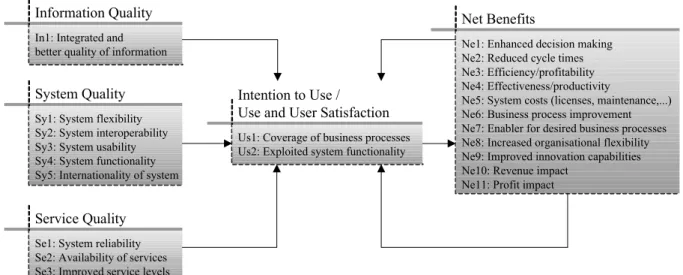
The list of ERP related success measurement criteria was defined in the course of the design of questionnaire in accordance to the research objectives of the study. All given criteria were assessed through a 5-point interval scale where a one accounted for a very negative and a 5 for a very positive valuation according to expectations. From the resulting list of elements, elementary ERP success criteria were extracted and thereafter aligned along the dimensions of the D&M IS success model given in Figure 1. This work interprets the D&M model in its original context. It is seen as a causal-exploratory model of how perceived quality affects use and user satisfaction, affecting each other reciprocally, which are direct antecedents of net benefits (in the mentioned updated version). Empirical research has provided evidence on the validity of these causal relationships [59]. One could also argue that the model has a predictive nature and helps to predict the dependent variables even though the causal explanation of the relationships is not totally clear. The quality dimensions are assessed as being independent from each other. Perceived quality affects intention to use/use and user satisfaction without a feedback loop. Criticism of the original model in terms of a missing feedback loop to the middle dimension from the former Individual Impact dimension [60] was answered in the updated version through the perception that net benefits now impacts intention to use/use and user satisfaction in the updated version. The focus is placed on assessing net benefits which is regarded as most important dimension. The causal explanations incorporated in the model induce that the consequences of IS adoption should finally be recognized through net benefits. Net benefits eventually capture the positive and negative impacts of the system. Due to the focus on net benefits and given time constraints with respect to the length of the questionnaire, a similar representation of other categories was avoided.
Information Quality In1: Integrated and better quality of information System Quality Sy1: System flexibility Sy2: System interoperability Sy3: System usability Sy4: System functionality Sy5: Internationality of system Service Quality
Se1: System reliability Se2: Availability of services Se3: Improved service levels
Intention to Use / Use and User Satisfaction Us1: Coverage of business processes Us2: Exploited system functionality
Net Benefits
Ne1: Enhanced decision making Ne2: Reduced cycle times Ne3: Efficiency/profitability Ne4: Effectiveness/productivity
Ne5: System costs (licenses, maintenance,...) Ne6: Business process improvement Ne7: Enabler for desired business processes Ne8: Increased organisational flexibility Ne9: Improved innovation capabilities Ne10: Revenue impact
Ne11: Profit impact
Fig. 1 Elementary factors alligned along DeLone and McLean’s updated IS success model
5.3 Development of the consolidated research model
Through factor analysis and testing for construct validity the single elementary variables were consolidated into a more interpretable and parsimonious outcome. Figure 2 denotes the remaining 14 variables that factor analysis concluded with. The construct was not validated entirely. The dimension “Intention to use/use and user satisfaction” was omitted from the consolidated measurement model. This exclusion was also observed in another empirical study postulating that satisfaction is not a dimension of success in the context of enterprise systems [61]. Furthermore, an assessment of “Intention to use/use and user satisfaction” makes more sense when system use is voluntary, which in the context of ERP is most often not the case.
The single dimension validity tests were performed with correlations between the dimension and general success criteria. The highest validity was achieved for the dimensions “Net benefits” (NB) and “System Quality” (SQ). In terms of “Financial Impact” (FI) and “Service Quality” (SE), the validity of ERP success was observed to be limited. The notion that financial performance can not be easily attributed to ERP investments was supported by the analysis. With the objective of receiving a valid single measure of the factor solution as composite measure of overall success, a (DA) dimension average as the average of the success dimensions in the factor analysis model was calculated. It yielded the largest correlation with all the criteria supporting the view that the dimensions are additive. Therefore, when combined the criterions yield a stronger overall measure of success than given by any single dimension.
Information Quality In1: Integrated and better quality of information System Quality Sy1: System flexibility Sy2: System interoperability Sy4: System functionality Service Quality Se1: System reliability Se2: Availability of services
Net Benefits
Ne1: Enhanced decision making
Ne5: System costs (licenses, maintenance,...) Ne8: Increased organisational flexibility Ne9: Improved innovation capabilities Financial Benefits
Ne10: Revenue impact Ne11: Profit impact
Fig. 2 Final dimensions and their criteria of the developed ERP success measurement model To summarize, the model is used as a causal-explanatory framework to explore ERP success with appropriate measures and deviates from the original D&M perception in the following ways: (i) It is used as measurement model with aggregated success metrics, (ii) it omits the middle section (“Intention to use/use and user satisfaction”), (iii) it places an emphasize on net benefits, especially organisational impact, and (iii) explicitly defines a financial impact dimension. The empirical results in terms of ERP success will not only include the consolidated view provided by the dimensions of the model, but also the inquired elementary success factors.
6. Empirical Results
6.1 Organisational size distribution
Table 1 denotes the firm size distribution of the data sample. The branch classification was grounded on the core codes of the regularly used North American Industry Classification System (NAICS), which was also applied in previous and related research in the ERP field. Concordance tables, in particular considering the formerly used (and now outdated) U.S. Standard Industrial Classification (SIC) system [62], the Classification of Economic Activities in the European Community (NACE) Revision 1.1., and the International Standard Industrial Classification of all Economic Activities (ISIC) Revision 3.1 are available online [63].
Table 1 Firm size distribution Size No. of companies
(rel. in %) No. of companies (abs. unweighted N) SMEs 92.8 129 LEs 7.2 79 Total 100 208
6.2 Considered and chosen ERP packages
The software suppliers considered for the decision process showed clearly the dominant position of SAP in the marketplace. The global contenders Oracle and BaaN show weak representations in Austria. J.D. Edwards and Peoplesoft are seldom considered, hardly ever chosen. Notable is the strong presence of other, smaller suppliers hinting at the acceptance of more specialized and less complex systems. The situation regarding the solutions chosen is similar, although the advantage of SAP is more pronounced. BaaN and Oracle are the other contenders of larger size while – again – smaller providers have captured a large market share. The given list of other vendors was comprehensive; no single provider gained a notable market share.
Table 2 Alternatives (ERP systems) considered and chosen All companies (rel. in %) SMEs (rel. in %) LEs (rel. in %) System
Chosen Considered Chosen Considered Chosen Considered SAP 33.5 46.6 24.3 34.1 59.8 78.8 BaaN 3.0 23.0 2.4 16.6 4.7 37.0 Peoplesoft 0 13.1 0 14.3 0 10.1 J.D.Edwards 0 3.7 0 .6 0 11.7 Oracle 9.5 17.3 12.3 16.4 1.6 19.6 Others 53.9 60.6 61.0 68.3 33.9 41.1 Total 100 - 100 - 100 -
Both the leading position of SAP and the relatively large cumulative market share for smaller suppliers are in accordance with the findings of a previous study [18], and an European survey of midsize companies (Everdingen et al., 2000). The analysis confirmed the significant influence of organisational size on the selected software package as given in Table 2.
6.3 Elementary view on ERP success
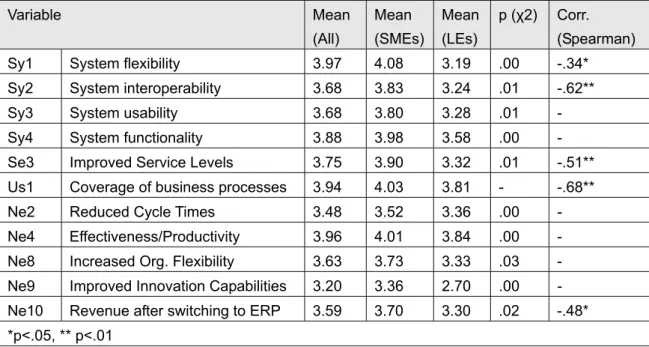
Figure 3 denotes the mean scores for every elementary ERP success criterion for the all companies as well as for SMEs respectively LEs viewed as separate classes. It can be seen that in the mean ERP success according to expectations seems to be achieved. The mean values apart from Ne9 („Improved innovation capabilities”) are all greater than three, which can be seen as the threshold between positive and negative effects. Figure 3 also indicates that the expectations of managers in SMEs were met on a higher level in terms of most criterions compared to LEs. χ2 and correlation analysis showed that the distributions of the variables were dependent on the size of the company in a number of cases.
2,50 2,70 2,90 3,10 3,30 3,50 3,70 3,90 4,10 4,30 In 1 Sy 1 Sy 2 Sy 4 Se 1 Se 2 Ne 1 Ne 2 Ne 5 Ne 6 Ne 7 Ne 8 Ne 9 Ne 10 Ne 11 Mean (All) Mean (SMEs) Mean (LEs)
Fig. 3 Mean scores (with standard deviations) of elementary ERP success factors Table 3 Identified elementary ERP success factors dependent on company size
Variable Mean (All) Mean (SMEs) Mean (LEs) p (χ2) Corr. (Spearman)
Sy1 System flexibility 3.97 4.08 3.19 .00 -.34*
Sy2 System interoperability 3.68 3.83 3.24 .01 -.62**
Sy3 System usability 3.68 3.80 3.28 .01 -
Sy4 System functionality 3.88 3.98 3.58 .00 -
Se3 Improved Service Levels 3.75 3.90 3.32 .01 -.51**
Us1 Coverage of business processes 3.94 4.03 3.81 - -.68**
Ne2 Reduced Cycle Times 3.48 3.52 3.36 .00 -
Ne4 Effectiveness/Productivity 3.96 4.01 3.84 .00 -
Ne8 Increased Org. Flexibility 3.63 3.73 3.33 .03 -
Ne9 Improved Innovation Capabilities 3.20 3.36 2.70 .00 - Ne10 Revenue after switching to ERP 3.59 3.70 3.30 .02 -.48* *p<.05, ** p<.01
6.4 Consolidated view on ERP success
The next section focuses on the factor values (for each of the four factors) generated after factor analysis for every company as well as on the average of each dimension which was validated as strong overall measure of success. A high factor value for a specific firm means that the elementary variables of the corresponding factor were also high. With respect to four of the five measures, the mean values are higher in SMEs compared to LEs. Regarding factor 4 (“Service quality”), the means are equal. Two-sample unpaired t tests revealed two different means with lesser significance (p values of around .1) for “System quality” (factor 2) and the dimension average. In both cases, the absolute size of the difference is .6, respectively .3. Thus, differences are observable, but it remains unclear if these differences are scientifically important. It has to be noted, that the weighted count of observations make this test application less powerful in terms of statistical significance.
dimension average variable (DA). The SPSS quick cluster procedure was used to group the cases efficiently into three clusters [64] and thereafter apply cross-tabulation analysis. The gained empirical classification is significantly dependent on the size of company (χ2, p<.05). While a similar proportion of SMEs and LEs was found in the group with average performers, SMEs were overrepresented in the group containing high performers (21.2% SMEs, 5.8% LEs), respectively underrepresented in the group with low performers (17.2% SMEs, 30.9% LEs).
6.5 Management commitment
Management commitment to the whole project was identified on a medium level in SMEs and LEs, while the latter experienced commitment on a slightly lower level (see Table 3). The commitment level is significantly dependent on the size of company (χ2, p<.05), but the level of difference is not pronounced. More importantly, a clear connection between management commitment and success measures of the consolidated success measurement model were only identified for LEs. Thus, affirming findings from literature. Net benefits (NB), system quality (SQ) and also information quality (IQ) correlate positively with management commitment in LEs, but no correlations were found for SMEs.
Table 4 Management commitment and correlations with success metrics
All SMEs LEs Signifance Level of top management commitment towards ERP1 3.73 3.76 3.60 .02 (χ2)
All SMEs LEs
Correlations with consolidated success metrics none none NB: .31*, SY: .33*, IQ:.43*
1 Rated on a scale between 1 (very poor) and 5 (very strong); *p<.05, ** p<.01; N (SMEs) = max 39, N (LEs) = max 59; N=0, Y=1
7. Discussion and conclusions
In this work the differential settings found in small-to-medium and large enterprises (SMEs and LEs) were considered for a possible relationship with established ERP success rates. The data showed that Austrian ERP projects are very successful and perceived success rates in all assessed dimensions lie above expectations for all companies as well as for SMEs and LEs viewed separately. One exception was observed. Perceived innovation capabilities have slightly decreased with ERP operation in LEs. Thus, this study supports the view that ERP strategies are in general more beneficial to SMEs compared to LEs (supporting hypothesis 1 – see Table 4). This overall impression is surprising since existing literature claimed that larger enterprises have higher success rates than SME in developing information systems. The observed differing achievements between LEs and SMEs in terms of expectations can have a number of reasons, may be due to a better promotion of the project, an easier to comprehend ERP system chosen, or increased training. Perhaps the most valid explanation, as motivated, are their relative structural weaknesses in technological development. In a resource based view, SMEs are often described as being resource poor in a variety of terms. On the one hand, the resource poverty is reflected in their IT/IS infrastructure. They typically lag behind their larger competitors also in terms ERP related capabilities, e.g., in the areas of order management, accounting of inventory, supply chain or business partner management. By installing an ERP environment, SMEs instantly gain access to know-how grounded on both, business and technical best practices. Especially in terms of the latter, system quality issues were classified as particularly beneficial to SMEs (as can be seen in both, the elementary and consolidated view on ERP success). The notion that ERP projects by incorporating standard business processes with minimal customized software packages endanger the uniqueness or flexibility of SMEs is contradicted by this study. In fact, SMEs reported realized organizational flexibility and innovation capabilities above expectations, again a more favorable situation compared to LEs.
Existing literature claimed that top management support is a critical factor in information systems success for both LE and SME. However, for ERP systems and in terms of hypothesis 2, this seems only applicable to large corporations, not SMEs. Again, the explanation can be found in the mentioned resource poverty which is also based on human and financial terms. Consequently, SMEs can rely on less resources, in particular organizational slack and managerial know-how, to compensate for costly problems or even failures in their ERP projects. In another perception, SMEs business management may often dominate technical projects due to the notion that business management is generally concerned with any project with the size and impact of an ERP investment. This in turn can be seen as fostering a negative effect on the achieved success level.
To conclude, this research study exhibits ERP investments as valuable IT strategies for both LEs and SMEs. Therefore, it supports the view that SMEs should pay attention to ERP as questioned in the introduction of this article. Organisational size has an effect on perceived success rates. Assessed dimensions, i.e. service and system quality as well as net benefits including financial aspects show a relatively better perception in SMEs as compared to LEs. As discussed, especially SMEs with a pronounced technical resource poverty have the opportunity to remediate the technical gap with an ERP strategy. The
achieved success rates can be increased by top management support in LEs. Among SMEs, no connection between top management support and ERP success was observed.
Table 5 Investigated hypotheses and verdict from the empirical analysis
No. Hypothesis Verdict
H1 Perceived ERP success is greater in SMEs as compared to LEs. Supported H2 Perceived ERP success increases with top management commitment to the ERP project (in SMEs and LEs). No indication for SMEs. Supported for LEs only. Appendix
The questionnaire contained a general section assessing the background information on the company especially IT/IS related and performance related questions, and a section on expended efforts for decision making and implementation. The assessed topics were structured in sections following the ERP system lifecycle: adoption decision/acquisition, implementation, use and maintenance. The key aspects of this article were covered by a comprehensive set of questions pertaining to selection criteria used in decision making, criteria used to control system operation, and performance metrics which were placed at different locations in the questionnaire. More specifically, the developed questionnaire comprised the following sections with questions:
PART 1/5 - Company Background Information: Questions considered site characteristics, organizational growth, IT
Success Criteria, Firm performance criteria, No. of customers and suppliers, IS/IT Governance aspects, and the organizations’ ERP lifecycle stage.
PART 2/5 - Time and efforts for ERP choice and implementation: Questions considered age of ERP decision and
implementation, durations, expended efforts and external man power proportions, and programming as well as customizing proportions.
PART 3/5 - Adoption decision and ERP system acquisition: Questions considered ERP initiation, main drivers for
initiation, No. of project team members engaged in ERP system acquisition, Structure of involved project team, Considered ERP software vendors in decision making, Chosen ERP system, ERP outsourcing, and information search activities, weights and outcomes of general evaluation and vendor related decision making criteria, strategic considerations, and standard financial as well as advanced investment analysis methods.
PART 4/5 - ERP System Implementation: Questions considered the desired ERP system functionality that was
implemented, effort was expended for ERP system modifications or additions, expended effort compared to estimated amount, implemented areas, chosen implementation strategy, consideration of risk mitigation, problems while implementing, other concurrent strategies implemented, possible chronological order of the ERP implementation and Business Process Reengineering (BPR), and commitment of top level management.
PART 5/5 - ERP System Usage and Maintenance: Questions considered a possible decline in organisational performance
(performance dip), competitiveness, Changes in workforce characteristics, existence of procedure/method in place for ERP controlling, effect of ERP on organisational performance, coverage of business processes, and current release levels.
References
[1] M. Kremers and H. V. Dissel, "ERP System Migrations," Communications of ACM, vol. 43, pp. 53-56, 2000. [2] N. Boubekri, "Technology enablers for supply chain management," Integrated Manufacturing Systems, vol. 12, pp.
394-399, 2001.
[3] T. H. Willis and A. H. Willis-Brown, "Extending the value of ERP," Industrial Management & Data Systems, vol. 102, pp. 35-38, 2002.
[4] J. Esteves and J. Pastor, "An ERP Lifecycle-based Research Agenda," presented at International Workshop on Enterprise Management Resource and Planning Systems (EMRPS), Venice, Italy, 1999.
[5] M. Al-Mashari, "Enterprise resource planning (ERP) systems: a research agenda," Industrial Management & Data Systems, vol. 102, pp. 166-170, 2002.
measurement systems," Business Process Management Journal, vol. 8, pp. 254-277, 2002.
[7] R. Poston and S. Grabski, "The Impact of Enterprise Resource Planning Systems on Firm Performance," presented at 21st International Conference on Information Systems, Brisbane, Australia, 2000.
[8] S. Shang, "A Comprehensive Framework for Classifying the Benefits of ERP Systems," presented at Americas Conference on Information Systems (AMCIS), Long Beach, USA, 2000.
[9] M. Al-Mashari, A. Al-Mudimigh, and M. Zairi, "Enterprise resource planning: A taxonomy of critical factors," European Journal of Operational Research, vol. 146, pp. 352-364, 2003.
[10] P. Bingi, M. Sharma, and J. Godla, "Critical Issues Affecting an ERP Implementation," Information Systems Management Decision, vol. 16, pp. 7-14, 1999.
[11] K.-K. Hong and Y.-G. Kim, "The critical success factors for ERP implementation: an organizational fit perspective," Information & Management, vol. 40, pp. 25-40, 2002.
[12] V. A. Mabert, A. Soni, and M. A. Venkataramanan, "Enterprise resource planning: Managing the implementation process," European Journal of Operational Research, vol. 146, pp. 302-314, 2003.
[13] G. Buonanno, P. Faverio, F. Pigni, A. Ravarini, and M. Tagliavini, "Exploring the use of ERP systems by SMEs," presented at 6th World Multiconference on Systemics, Cybernetics and Informatics, Orlando, Florida, 2002. [14] J. E. Scott, "The FoxMeyer Drugs' Bankruptcy: Was it a failure of ERP?," presented at Fifth Americas Conference
on Information Systems, Milwaukee, Wisconsin, 1999.
[15] G. Gable and G. Stewart, "SAP R/3 Implementation Issues for Small to Medium Enterprises," presented at Fifth Americas Conference on Information Systems, Milwaukee, Wisconsin, 1999.
[16] E. W. N. Bernroider and J. Mitlöhner, "Characteristics of the Multiple Attribute Decision Making Methodology in Enterprise Resource Planning Software Decisions," Communications of the International Information Management Association (CIIMA), vol. 5, pp. 49-58, 2005.
[17] E. W. N. Bernroider, "An Analysis of ERP decision making practice and consequences for subsequent system life cycle stages - A case study," in Decision Support for Global Enterprises - Annals of Information Systems, vol. 2, U. Kulkarni, D. J. Power, and R. Sharda, Eds., 2007, pp. 195-206.
[18] E. W. N. Bernroider and S. Koch, "ERP selection process in midsize and large organizations," Business Process Management Journal, vol. 7, pp. 251-257, 2001.
[19] W. H. DeLone and E. R. McLean, "Information Systems Success: The Quest for the Dependent Variable," Information Systems Research, vol. 3, pp. 60-95, 1992.
[20] W. D. DeLone and E. R. McLean, "The DeLone and McLean Model of Information Systems Success: A Ten-Year Update," Journal of Management Information Systems, vol. 19, pp. 9-30, 2003.
[21] EC, "Commission Recommendation of 6 May 2003 concerning the definition of micro, small and medium-sized enterprises," Official Journal of the European Union, vol. 46, pp. 36-41, 2003.
[22] J. Barney, "Firm resources and sustained competitive advantage," Journal of Management, vol. 17, pp. 99–120, 1991.
[23] M. Peteraf, "The cornerstones of competitive advantage: a resource-based view," Strategic Management Journal, vol. 14, pp. 179-191, 1993.
Productivity Measures," Journal of Management Information Systems, vol. 19, pp. 71-98, 2002.
[25] Y. v. Everdingen, J. v. Hillegersberg, and E. Waarts, "ERP Adoption by European Midsize Companies," Communications of ACM, vol. 43, pp. 27-31, 2000.
[26] Y. Caloghirou, A. Protogerou, Y. Spanos, and L. Papagiannakis, "Industry-Versus Firm-specific Effects on Performance:: Contrasting SMEs and Large-sized Firms," European Management Journal, vol. 22, pp. 231-243, 2004.
[27] N. Buratti and L. Penco, "Assisted technology transfer to SMEs: lessons from an exemplary case," Technovation, vol. 21, pp. 35-43, 2001.
[28] R. Rothwell, "The changing nature of the innovation process: implications for SMEs," in New Technology Based Firms in the 1990s, R. Oakey, Ed. London: Paul Chapman Publishing, 1994.
[29] H. Corsten and O. Lang, "Innovation Practice in Small and Medium-sized Enterprise: An Empirical Survey of the Member States of the European Community," Technovation, vol. 2, pp. 143–154, 1988.
[30] S. A. Snell and J. W. Dean, "Integrated Manufacturing and Human Resource Management: A Human Capital Perspective," Academy of Management Journal, vol. 35, pp. 467–504, 1992.
[31] J. Esteves and J. Pastor, "Enterprise Resource Planning Systems Research: An Annotated Bibliography," Communications of the Association of Information Systems, vol. 7, pp. 1-52, 2001.
[32] L. Dong, "A Model for Enterprise Systems Implementation: Top Management Influences On Implementation Effectiveness," presented at Americas Conference on Information Systems (AMCIS), Long Beach, USA, 2000. [33] P. Hallikainen, H. Kivijärvi, M. Rossi, S. Sarpola, and J. Talvinen, "Selection of ERP Software in Finnish SMEs,"
presented at Thirteenth Australasian Conference on Information Systems, Melbourne, Australia, 2002.
[34] A. Ravarini, M. Tagliavini, F. Pigni, and D. Sciuto, "A Framework for Evaluating ERP Acquisition within SMEs," presented at AIM Internatonal Conference, Montpellier, France, 2000.
[35] F. Sistach, J. Pastor, and L. Fernandez, "Towards the Methodological Acquisition of ERP Solutions for SMEs," presented at 1st International Workshop on Enterprise Management Resource and Planning Systems (EMRPS), Venice, Italy, 1999.
[36] S. F. Huin, "Managing deployment of ERP systems in SMEs using multi-agents," International Journal of Project Management, vol. 22, pp. 511-517, 2004.
[37] K. Amoako-Gyampah and A. F. Salam, "An extension of the technology acceptance model in an ERP implementation environment," Information & Management, vol. 41, pp. 731-745, 2004.
[38] C. L. Iacovou, I. Benbasat, and A. S. Dexter, "Electronic data interchange and small organizations: adoption and impact of technology," MIS Quarterly, vol. 19, pp. 465–485, 1995.
[39] F. F.-H. Nah, J. L.-S. Lau, and J. Kuang, "Critical factors for successful implementation of enterprise systems," Business Process Management Journal, vol. 7, pp. 285-296, 2001.
[40] P. E. D. Love, Z. Irani, C. Standing, C. Lin, and J. M. Burn, "The enigma of evaluation: benefits, costs and risks of IT in Australian small-medium-sized enterprises," Information & Management, vol. In Press, Corrected Proof, pp. 1-18, 2005.
[41] E. E. Grandon and J. M. Pearson, "Electronic commerce adoption: an empirical study of small and medium US businesses," Information & Management, vol. 42, pp. 197-216, 2004.
manufacturing SMEs," Technovation, vol. 25, pp. 1443, 2005.
[43] M. Levy, P. Powell, and R. Galliers, "Assessing information systems strategy development frameworks in SMEs," Information & Management, vol. 36, pp. 247-261, 1999.
[44] R. Lebre La Rovere, "Small and Medium-Sized Enterprises and IT Diffusion Policies in Europe," Small Business Economics, vol. 11, pp. 1-9, 1998.
[45] Sikka, Pawan, "Technological innovations by SME's in India," Technovation, vol. 19, pp. 317-321, 1999.
[46] M. Morikawa, "Information Technology and the Performance of Japanese SMEs," Small Business Economics, vol. 23, pp. 171–177, 2004.
[47] Y. Spanos, G. Prastacos, and V. Papadakis, "Greek Firms and EMU:: Contrasting SMEs and Large-Sized Enterprises," European Management Journal, vol. 19, pp. 638-648, 2001.
[48] D. Bourantas and V. Papadakis, "Greek management: diagnosis and prognosis," International Studies of Management and Organisation, vol. 26, pp. 12–13, 1996.
[49] J. Harvey, L. A. Lefebvre, and E. Lefebvre, "Exploring the Relationship Between Productivity Problems and Technology Adoption in Small Manufacturing Firms," IEEE Transactions on Engineering Management, vol. 39, pp. 352–358, 1992.
[50] S. Makridakis, Y. Caloghirou, L. Papagiannakis, and P. Trivellas, "The dualism of greek firms and management: Present state and future implications," European Management Journal, vol. 15, pp. 381-402, 1997.
[51] A. Hughes, "Innovation and business performance: Small entrepreneurial firms in the UK and the EU," New Economy, vol. 8, pp. 157-163, 2001.
[52] E. P. Bureau-van-Dijk, "Amadeus," Bureau-van-Dijk, 2003.
[53] D. A. Dillman, Mail and telephone surveys: the Total Design method. New York: John Wiley and Sons, 1978. [54] E. L. Korn and B. I. Graubard, "Examples of differing weighted and unweighted estimates from a sample survey,"
The American Statistican, pp. 291-295, 1995.
[55] L. Kish, "Weighting for unequal Pi," Journal of Official Statistics, pp. 183-200, 1992.
[56] G. H. Choudhry and R. Valliant, "WesVar: Software for complex survey data analysis," presented at Statistics Canada Symposium, 2002.
[57] S. Purdon and K. Pickering, "The use of sampling weights in the analysis of the 1998 Workplace Employee Relations Survey," National Centre for Social Research 2001.
[58] E. J. Umble, R. R. Haft, and M. M. Umble, "Enterprise resource planning: Implementation procedures and critical success factors," European Journal of Operational Research, vol. 146, pp. 241-257, 2003.
[59] J. Livari, "An Empirical Test of the DeLone-McLean Model of Information Success," The DATA BASE for Advances in Information Systems, vol. 36, pp. 8-27, 2005.
[60] P. B. Seddon, "A Respecification and Extension of the DeLone and McLean Model of IS Success," Information Systems Research, vol. 8, pp. 240-253, 1997.
[61] G. G. Gable, D. Sedera, and T. Chan, "Enterprise Systems Success: A Measurement Model," presented at Twenty-Fourth International Conference on Information Systems, Seattle, Washington, 2003.
[62] NAICS-Association, "NAICS - North American Industry Classification System," vol. 2003, 1997. [63] U.S.-Census-Bureau, "Concordances between Industry Classification Systems," vol. 2006, 2006. [64] J. A. Hartigan, Clustering algorithms. New York: John Wiley & Sons Inc., 1975.