Original Study
Bowel Function 14 Years After Preoperative
Short-Course Radiotherapy and Total Mesorectal
Excision for Rectal Cancer: Report of a
Multicenter Randomized Trial
Tina Yen-Ting Chen,
1Lisette M. Wiltink,
2Remi A. Nout,
2Elma Meershoek-Klein Kranenbarg,
3Søren Laurberg,
1Corrie A.M. Marijnen,
2Cornelis J.H. van de Velde
4Abstract
Very long-term bowel function after total mesorectal excision (TME) with or without preoperative short-course radiotherapy (PRT) for rectal cancer was examined. After>14 years, almost one half of 242 nonstoma patients reported severe bowel dysfunction (major low anterior resection syndrome [LARS]), which was associated with poorer health-related quality of life. PRT and age£75 years at the follow-up point increased the risk of major LARS in addition to TME. Patients should be adequately informed of such long-lasting adverse effects. Background: We investigated very long-term bowel function after total mesorectal excision (TME) with or without preoperative short-course radiotherapy (PRT) for rectal cancer, the risk factors for bowel dysfunction, and the association of bowel dysfunction with health-related quality of life (HRQL).Patients and Methods:In the TME trial (1996-1999), 1530 Dutch patients with rectal cancer were randomized to TME preceded by 55 Gy PRT or TME alone. A set of questionnaires was sent to the surviving patients (n¼583) in 2012. The questionnaires included the Low Anterior Resection Syndrome Score (LARS score), European Organization for Research and Treatment of Cancer Quality of Life Questionnaire Core (EORTC QLQ-C30) and Colorectal Module (EORTC QLQ-CR29). The LARS score range was divided into“no LARS,” “minor LARS,”and“major LARS”categories in ascending severity of bowel dysfunction. The potential risk factors for major LARS were tested on multivariable analysis. The HRQL was compared between the LARS score categories.Results:Of the 478 respondents, 242 nonstoma patients were included in the present analysis. The median interval since treatment was 14.6 years, and the median age at the follow-up point was 75 years. Major LARS was re-ported by 46% of all patients (56% PRT plus TME vs. 35% TME). PRT (odds ratio [OR], 3.0; 99% confidence interval [CI], 1.3-6.9) and age75 years at the follow-up point (OR, 2.4; 99% CI, 1.1-5.5) increased the risk of major LARS. Gender, tumor height, anastomotic leakage, type of anastomosis, interval since treatment, and comorbid diabetes were not significant. Patients with major LARS fared worse in many HRQL domains (P<.01; score difference>5% of score range).Conclusion:A considerable proportion of nonstoma patients endured major LARS years after TME. PRT and age75 years at follow-up pose further risks of major LARS in addition to surgery. Major LARS is associated with reduced HRQL.
Clinical Colorectal Cancer,Vol. 14, No. 2, 106-14ª2015 The Authors. Published by Elsevier Inc. This is an open access article under the CC BY-NC-ND license (http://creativecommons.org/licenses/by-nc-nd/4.0/).
Keywords: Defecation, Follow-up studies, Patient outcome assessment, Quality of life, Questionnaires
This study was presented at the 2013 European Cancer Congress, September 27 to October 1, 2013, Amsterdam, The Netherlands
1Department of Surgery P, Aarhus University Hospital, Aarhus, Denmark 2Department of Clinical Oncology (Radiotherapy)
3Surgical Datacenter 4Department of Surgery
Leiden University Medical Center, Leiden, The Netherlands
Submitted: Nov 4, 2014; Accepted: Dec 19, 2014; Epub: Dec 31, 2014 Address for correspondence: Prof Cornelis J. H. van de Velde, MD, PhD, FRCPS (hon), FACS (hon), Department of Surgery, Leiden University Medical Center, PO Box 9600, 2300 RC Leiden, The Netherlands
E-mail contact:[email protected]
The introduction of total mesorectal excision (TME) was a major breakthrough in the treatment of rectal cancer, leading to sub-stantially improved local control and survival.1,2 The additional benefit of preoperative short-course radiotherapy (PRT) has been confirmed in the TME and Medical Research Council CR07 trials: PRT greatly reduces local recurrence when used in addition to TME, but does not change overall survival.3-6
However, both TME and PRT result in side effects, of which bowel dysfunction is the most common and serious, especially given the emphasis on sphincter preservation in rectal cancer treatment. Although numerous studies have explored the impact of rectal cancer surgery and radiotherapy (RT) on bowel function,7,8they
have often been limited by the instrument used to measure bowel function. Many of the studies used nonvalidated questionnaires,7,8
including the 5-year follow-up of the TME trial, in which irradi-ated patients reported poorer bowel function.9Even when validated questionnaires were used, most were fecal incontinence in-struments,7 which only assess the continence aspect of bowel function. However, bowel dysfunction after rectal resection (with or without RT), referred to as anterior resection syndrome or low anterior resection syndrome (LARS), can manifest itself in various symptoms other than incontinence, including frequent bowel movements, urgency, and clustering.10
tations, using validated instruments to examine LARS more comprehensively, beyond fecal incontinence.11-15The Low Anterior Resection Syndrome Score (LARS score) is 1 such instrument.16It is a concise questionnaire designed for quick evaluation of a diverse range of LARS symptoms that patientsfind the most bothersome, and is suitable for routine use in clinical settings.16 These studies found that LARS is prevalent, and identified several risk factors for severe LARS in addition to surgery, the strongest of which was PRT.11,12,15 Nevertheless, these studies were observational, and
theirfindings need to be verified in a randomized controlled trial. Moreover, the longest median follow-up period of these studies was around 5 years; however, a large proportion of the increasing number of rectal cancer survivors have been living>1 decade after treatment. The TME trial has shown that the 10-year overall sur-vival was 48% for the PRT plus TME group and 49% for the TME alone group.5 Little is known about the impact of rectal cancer treatment on bowel function after such an extended period.
Because of these evidence gaps, we performed the present follow-up study of the TME trial cohort>14 years after treatment. The primary aims were to rigorously investigate patients’very long-term bowel function using the LARS score, and to determine the risk factors for severe LARS. The secondary aim was to examine the as-sociation of severe LARS with health-related quality of life (HRQL).
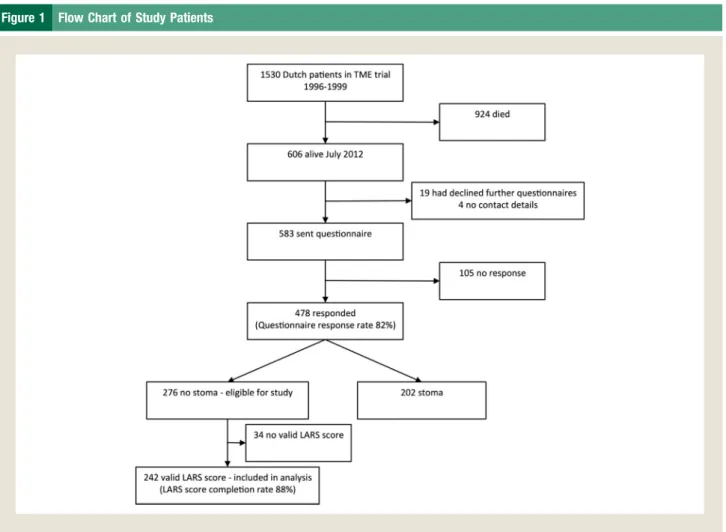
Figure 1 Flow Chart of Study Patients
Abbreviations: LARS¼low anterior resection syndrome; TME¼total mesorectal excision.
-Patients and Methods
Data CollectionThe TME trial has been previously described in detail.3-5In brief, from January 1996 to December 1999, 1861 patients (1530 from The Netherlands) with clinically resectable rectal adenocarcinoma without evidence of distant metastasis at the time of enrollment were randomized to either 55 Gy PRT (delivered using a 3- or 4-field technique over 5-7 days) followed by TME within 1 week, or TME alone. The inferior margin of the tumor had to be located below the level of S1/S2 and not farther than 15cm from the anal verge.
Because of logistic feasibility, only Dutch patients were followed up in the present study (Figure 1). In July to August 2012, at which time the median follow-up duration was 14.4 years, a set of ques-tionnaires was sent by mail to the surviving patients who had pre-viously consented to further questionnaire follow-up. Information on vital status was provided by the Central Bureau for Genealogy and patients’ general practitioners. Those who did not respond initially were sent a second questionnaire set in September 2012.
Only patients without a stoma were eligible for the present study (Figure 1). Stoma status was ascertained in the questionnaire set. Measures
The questionnaire set contained the following instruments.
LARS Score.The LARS score was developed from and validated on a large, nationwide cohort of 961 Danish patients.16 It has subsequently been translated into other languages, including Swedish, Spanish, German, English, and Dutch. Through the standardized validation of the former 3 translated versions (Swedish, Spanish, and German), it was found that the LARS score performs equally well in several different European coun-tries, and that as long as the proper translation procedure is fol-lowed, validation of a newly translated version would only be necessary if the score is intended for use in cultures dissimilar to the European culture.17 Despite this, the latter 2 translated ver-sions (English and Dutch) are being validated to fully confirm
Figure 2 The Low Anterior Resection Syndrome Score (LARS score)
Bowel Function of TME Trial Patients 14 Years After Treatment
-the validity and reliability of -the LARS score for -these populations (validation of the English version has just been completed and will be published shortly; validation of the Dutch version is in prog-ress). The items and scoring algorithm of the LARS score are shown inFigure 2. All items must be completed for a valid score to be generated. Only patients with a valid LARS score were included in the present analysis (Figure 1).
European Organization for Research and Treatment of Cancer Quality of Life Questionnaire Core and Colorectal Module.The Eu-ropean Organization for Research and Treatment of Cancer Quality of Life Questionnaire Core (EORTC QLQ-C30) and Colorectal Module (EORTC QLQ-CR29) are well-established HRQL instruments.18,19All 15 scales of the EORTC QLQ-C30 and 22 of
the 28 EORTC QLQ-CR29 scales (stoma-related scales were excluded) were analyzed.
Statistical Analysis
The proportion of patients in each LARS score severity category was compared between the treatment arms (PRTþTME vs. TME) using the
c
2 test. Also, the proportion of patients choosing eachresponse option in the individual LARS score items was similarly compared. Using clinical judgment and research to date, the po-tential risk factors for severe LARS (major LARS vs. minor or no LARS) were tested using multiple logistic regression analysis: PRT (yes vs. no), age (median vs.>median age), gender (female vs. male), distance of the tumor from the anal verge (<5, 5-9.9, and 10 cm), anastomotic leakage (yes vs. no), type of anastomosis (endeside, endeend, and pouch), interval since treatment (years), and the presence of comorbid diabetes (yes vs. no).
The EORTC HRQL instruments were scored according to guidelines. These scores were compared between the LARS score categories (major LARS vs. minor or no LARS) using the Mann-WhitneyUtest.
Statistical significance was set atP<.01 to correct for multiple testing. In line with current evidence, a HRQL score difference of > 5% of the total score range was considered clinically sig-nificant.20,21A difference in HRQL had to be both statistically and clinically significant to be deemed significant. The analyses were conducted using SPSS Statistics, version 21 (IBM Corp, Armonk, NY).
Results
PatientsA total of 242 patients were included in the present analysis (Figure 1). The median interval since treatment was 14.6 years (range, 12.6-16.6 years), and the median age at the follow-up point was 75 years (range, 39-95 years). The patients were equally distributed between the 2 treatment arms (Table 1).
LARS Score
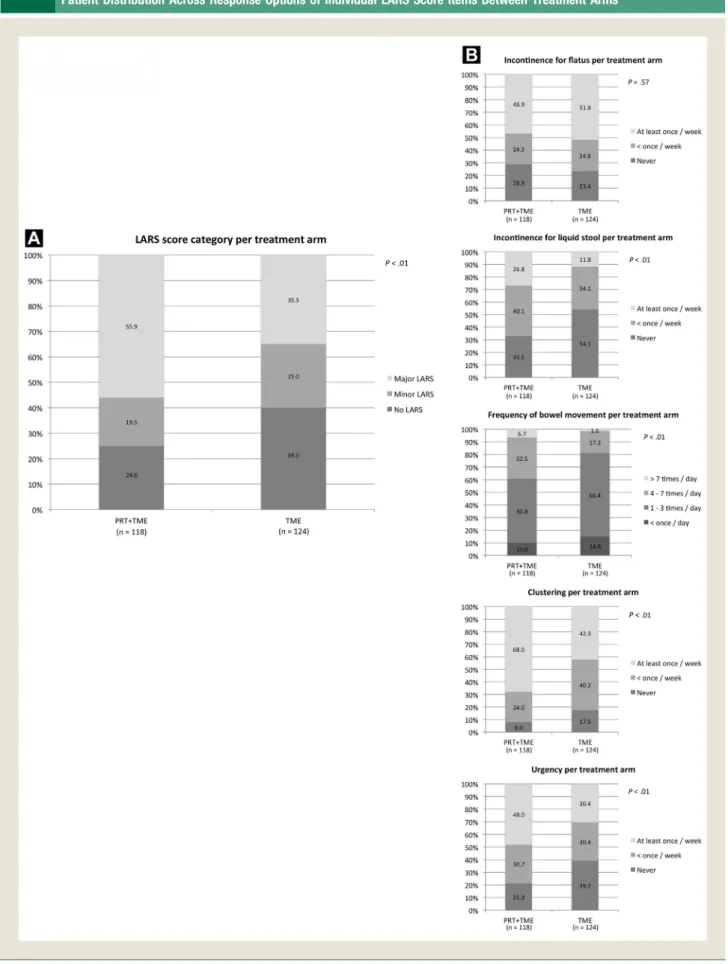
Overall, major LARS was experienced by 110 of the 242 patients (46%), while 54 (22%) had minor LARS, and 78 (32%) reported no LARS. A greater proportion of irradiated patients experienced major LARS (56% vs. 35%; Figure 3A). Irradiated patients also fared worse on all individual LARS score items, apart from incon-tinence forflatus (Figure 3B).
Risk Factors for Major LARS
Of all the factors tested on multivariable analysis, PRT (odds ratio [OR], 3.0; 99% confidence interval [CI], 1.3-6.9) and age
75 years at the follow-up point (OR, 2.4; 99% CI, 1.1-5.5) were found to increase the likelihood of major LARS (Table 2). HRQL and LARS Score
Patients with major LARS had worse scores than those of patients with minor or no LARS in many of the HRQL domains measured using the EORTC QLQ-C30 and EORTC QLQ-CR29 (Table 3).
Discussion
Numerous studies have already explored the impact of rectal cancer surgery and RT on bowel function, with 2 systematic review and meta-analysis reports concluding that TME and PRT negatively affect long-term bowel function.7,8The report by Scheer et al7derived a 35% pooled incidence of fecal incontinence after curative anterior resection, and pinpointed that PRT was associated with higher rates of post-resection incontinence (P¼.006). The report by Loos et al8found a higher rate of stool incontinence after preoperative radio(chemo) therapy and TME than TME alone (risk ratio, 1.67; 95% CI, 1.36-2.05). Nevertheless, the various studies included in these 2 systematic review and meta-analysis reports adopted different definitions and severity measures of bowel dysfunction. More importantly, the quality of the vast majority of the studies was limited by the instrument used to examine bowel function. Many of the studies used nonvalidated questionnaires; also, among the studies that did use validated
Table 1 Comparison of Patient Characteristics Between Treatment Arms Characteristic PRTDTME (n[118) TME (n[124) PValue Age (years) .12 Median 77.0 73.5 Range 43-95 39-93 Gender .83 Male 64 (54.2) 69 (55.6) Female 54 (45.8) 55 (44.4) TNM stage .29 0 1 (0.9) 6 (4.9) I 48 (40.6) 48 (38.7) II 30 (25.4) 35 (28.2) III 38 (32.2) 35 (28.2) IV 1 (0.9) 0
Tumor distance from anal vergea(cm)
.02
<5 3 (2.5) 14 (11.4)
5-9.9 58 (49.2) 60 (48.8)
10 57 (48.3) 49 (39.8)
Interval since treatment (years) .21
Median 14.4 14.7
Range 12.6-16.6 12.6-16.5
Data presented as n (%), unless otherwise noted.
Abbreviations: PRT¼preoperative short-course radiotherapy; TME¼total mesorectal excision.
aFor 1 TME only patient, the tumor distance from the anal verge could not be determined.
-Figure 3 (A) Comparison of Patient Distribution Across LARS Score Severity Categories Between Treatment Arms (B) Comparison of Patient Distribution Across Response Options of Individual LARS Score Items Between Treatment Arms
Abbreviations: LARS¼low anterior resection syndrome; PRT¼preoperative short-course radiotherapy; TME¼total mesorectal excision.
Bowel Function of TME Trial Patients 14 Years After Treatment
-questionnaires, most used a fecal incontinence instrument, such as the Wexner score or Kirwan score.7,8However, LARS is a disorder with heterogeneous symptoms involving more than just incontinence, and even validated fecal incontinence instruments cannot fully capture the complexity of the problem.16It has been revealed that urgency and
clustering are the most bothersome LARS symptoms for patients; however, clinicians have tended to underestimate their impact, placing more emphasis on incontinence and frequent bowel movements instead.22Therefore, any assessment of LARS that uses either a non-validated questionnaire or a non-validated one that only focuses on incontinence cannot be considered a truly sound assessment.
Our study is among the few that used validated instruments to comprehensively examine the spectrum of LARS symptoms after rectal cancer treatment.11-15 However, the other studies were observational, with a longest median follow-up period of around 5 years. Our study stands out for the robust TME trial design and the exceptionally long follow-up period. The TME trial was not only randomized and controlled, but also included treatment standardization and quality control measures.3The long follow-up
duration enabled insight into the long-lasting impairment of bowel function>1 decade after treatment. Furthermore, our study adopted a more stringent significance level (P<.01).
Although our study provided a stronger level of evidence than did the earlier studies, our results should be interpreted in light of other evidence. Two studies have previously used the LARS score to evaluate bowel function after rectal cancer treatment.11,12The study by Emmertsen et al11revealed that 46% of patients reported major LARS at 12 months, with neoadjuvant therapy and TME (vs. partial mesorectal excision) being the risk factors. In the population-based study by Bregendahl et al,12 41% of patients experienced major LARS after a median follow-up of 54 months. Neoadjuvant therapy, TME, anastomotic leakage, age64 years at surgery, and female gender were identified as risk factors.12Ourfindings were
mostly in keeping with thefindings from these studies. In terms of discrepancies, our female gender OR closely resembled that reported by Bregendahl et al12(1.7 vs. 1.35, respectively) and the narrow CIs overlapped (99% CI, 0.8-3.7 vs. 95% CI, 1.02-1.79, respectively), suggesting that our nonsignificant female gender result might not be definitive. Bregendahl et al12 concluded that anastomotic leakage should be considered a risk factor (OR, 2.06; 95% CI, 0.93-4.55), with the justification that infrequent occurrences (n ¼ 29) accounted for the borderline nonsignificance. The occurrence of leakage was also few in our study (n¼ 16), yet it could not be deemed a risk factor owing to the wide, nonsignificant CI (OR, 1.6; 99% CI, 0.3-8.3). The same applies to tumor height. Few patients had a tumor distance< 5 cm in our study (n¼17), and despite yielding the highest OR (OR, 3.6; 99% CI, 0.7-18.2), the CI was very broad and nonsignificant. Although not directly comparable, it is worth mentioning that tumor height was previously found in the TME trial to be associated with fecal incontinence at 5 years, but only in patients treated with PRT.23 The role of female gender, anastomotic leakage, and tumor height in the occurrence of major LARS requires additional clarification.
Only nonstoma patients were included in the present study. However, it is known that some patients will subsequently receive a colostomy, even after initial restoration of intestinal continuity, because of severe bowel dysfunction. These patients would have been excluded from the present study, and it is likely that the patients in the PRTþTME group would have been more affected by this effect, which might have reduced the difference in major LARS rates observed between the 2 treatment groups.
The finding of younger patient age increasing the risk of major LARS seems to be against the natural deterioration of bowel function with age. Selection bias could have been at play, with younger patients receiving more sphincter-preserving pro-cedures. However, this was not the case in our study, because the age at treatment between the patients undergoing low anterior resection and abdominoperineal resection, as well as age at follow-up between those with and without a stoma, were not different (data not shown). One plausible explanation is that elderly individuals have poorer bowel function at baseline and hence would be less perceptive to changes after treatment.12This can be verified in future longitudinal studies by obtaining the baseline LARS score.
Our study is not thefirst to show an association between bowel dysfunction, measured using the LARS score, and HRQL, measured using the EORTC QLQ-C30. The study by Emmert-sen et al11 demonstrated a close relationship between the 2,
focusing on the comparison of the EORTC QLQ-C30 scores Table 2 Potential Risk Factors for Major LARS
Risk Factor Patients (n) OR (99% CI) PRT
Yesa 118 3.0 (1.3-6.9)
No 124 Reference
Age at follow-up (years)
75a 127 2.4 (1.1-5.5)
>75 115 Reference
Gender
Female 109 1.7 (0.8-3.7)
Male 133 Reference
Tumor distance from anal vergeb(cm)
<5 17 3.6 (0.7-18.2) 5-9.9 118 1.4 (0.6-3.1) 10 106 Reference Anastomotic leakage Yes 16 1.6 (0.3-8.3) No 226 Reference Type of anastomosisc End to side 145 2.5 (1.0-6.6) End to end 26 2.7 (0.6-11.2) Pouch 68 Reference
Interval since treatment (years) 242 1.0 (0.7-1.5)
Comorbid diabetesd
Yes 34 1.8 (0.6-5.6)
No 197 Reference
Abbreviations: CI¼confidence interval; LARS¼low anterior resection syndrome; OR¼odds ratio; PRT¼preoperative short-course radiotherapy.
aSigni
ficant risk factor.
bTumor distance from anal verge could not be determined for 1 patient. cType of anastomosis could not be determined for 3 patients. dComorbid diabetes could not be determined for 11 patients.
-between the major LARS and no LARS groups. In another study by Juul et al,24the EORTC QLQ-C30 scores were significantly
(both statistically and clinically) different between the major LARS and no LARS groups, and between the major LARS and minor LARS groups, but not between the no LARS and minor
LARS groups. Thefindings by Juul et al24support our rationale of comparing the EORTC QLQ-C30 scores for patients with major LARS versus no or minor LARS.24The conjoint application of the
more disease-specific EORTC QLQ-CR29 adds rigor to our assessment.
Table 3 Comparison of EORTC QLQ-C30 and EORTC QLQ-CR29 Scores Between LARS Score Severity Categories
Domains/scales
Mean Score
PValue CS
Major LARS Minor or No LARS
EORTC QLQ-C30a
Global health status/QOLb,c 73.4 80.3 <.01 Yes
Physical functioningc 80.1 82.0 .35 No
Role functioningc 79.0 85.5 .03 Yes
Emotional functioningc 81.8 87.5 .02 Yes
Cognitive functioningb,c 80.9 87.7 <.01 Yes
Social functioningb,c 83.3 91.2 <.01 Yes
Fatigueb,d 27.0 18.6 <.01 Yes
Nausea and vomitingd 2.1 2.3 .99 No
Paind 14.5 9.7 .04 No Dyspnead 15.0 13.6 .89 No Insomniad 26.0 19.8 .05 Yes Appetite lossd 5.6 6.9 .92 No Constipationd 20.8 12.1 .02 Yes Diarrheab,d 24.8 4.6 <.01 Yes
Financial difficultiesd 6.1 3.6 .20 No
EORTC QLQ-CR29a
Body imageb,c 85.2 94.4 <.01 Yes
Anxietyb,c 77.0 85.9 <.01 Yes
Weightc 85.6 88.5 .26 No
Sexual interest (men)c 68.0 70.6 .81 No
Sexual interest (women)c 80.6 78.4 .82 No
Urinary frequencyd 33.3 25.3 .01 Yes
Blood and mucus in stoolb,d 5.7 0.6 <.01 Yes
Stool frequencyb,d 34.1 13.8 <.01 Yes
Urinary incontinenceb,d 17.1 10.1 <.01 Yes
Dysuriad 2.2 1.3 .51 No
Abdominal painb,d 13.3 3.4 <.01 Yes
Buttock painb,d 13.3 3.9 <.01 Yes
Bloatingb,d 19.1 7.6 <.01 Yes
Dry mouthd 26.0 17.2 .03 Yes
Hair lossd 3.2 2.8 .98 No
Tasted 4.8 2.8 .45 No
Flatulenceb,d 46.3 23.2 <.01 Yes
Fecal incontinenceb,d 27.5 7.6 <.01 Yes
Sore skinb,d 17.5 3.9 <.01 Yes Embarrassmentb,d 36.6 11.1 <.01 Yes Impotenced 66.7 62.2 .39 No Dyspareuniad 22.2 6.1 .21 Yes
Abbreviations: CS¼clinically significant; EORTC QLQ-C30¼European Organization for Research and Treatment of Cancer Quality of Life Questionnaire Core; EORTC QLQ-CR29¼European Organization for Research and Treatment of Cancer Quality of Life Questionnaire Colorectal Module; LARS¼low anterior resection syndrome; QOL¼quality of life.
aScore range 0 to 100.
bDomains/scales that were both statistically and clinically signi
ficant.
cHigher score indicates better health-related quality of life. dHigher score indicates worse health-related quality of life.
Bowel Function of TME Trial Patients 14 Years After Treatment
-The TME trial has established that PRT decreases local recur-rence by more than one half (10-year cumulative incidence, 5% vs. 11%).5 The present very long-term follow-up study has demon-strated that such benefit is achieved at the expense of a threefold increase in the odds of severe bowel dysfunction that persists even
> 14 years after treatment. Local recurrence causes disabling symptoms, is challenging to treat, and treatment is associated with substantial morbidity. It would be hard to argue that LARS is more detrimental than local recurrence or that PRT should not be offered to those at higher risk of LARS. The definitive prevention and treatment of LARS is colostomy. Although the common impression is that HRQL will be superior with sphincter preser-vation than with colostomy after rectal cancer resection, a Cochrane review could not draw firm conclusions about this,25 and the compromised HRQL in patients with major LARS could have been the reason. It has been revealed that the presence of a stoma and fecal incontinence can be similarly troublesome for patients.26 However, a large number of nonstoma patients with fecal incon-tinence still prefer this to life with a stoma.27Therefore, patient communication is key. Our study findings can be used to better inform patients of the possible long-term consequences of PRT. Ultimately, treatment decisions must be based on both patient preference and clinical judgment, after a thorough deliberation of treatment benefits and risks of adverse effects. Bowel function should be routinely and systematically assessed at the follow-up visits, and patients should be educated about LARS. Several options for managing LARS are available before resorting to colostomy, including transanal irrigation and sacral neuro-modulation, which are showing promising results. However, more research is required to consolidate their effectiveness. Finally, additional research is needed to corroborate whether enhanced ra-diation and surgical techniques can lead to less long-term bowel dysfunction.
Conclusion
The present study has illustrated long-term survivorship issues in rectal cancer. At 14.6 years, almost one half (46%) of the Dutch TME trial patients without a stoma experienced major LARS. Although a greater proportion of irradiated patients experienced major LARS (56% vs. 35%), the finding that one third of the nonirradiated patients had major LARS indicates that TME surgery was most probably the main contributing factor, with PRT and age75 years at the follow-up point posing additional risks. Major LARS was associated with poorer HRQL.
Clinical Practice Points
TME is the reference standard surgical technique in treating rectal cancer. The additional benefit of PRT in decreasing local recurrence combined with TME has been demonstrated in the TME trial.
In assessing the bowel function of the Dutch TME trial cohort> 14 years after treatment, we found that 46% of all patients (56% PRTþTME vs. 35% TME) experienced major LARS, which was associated with reduced HRQL.
TME is probably the main contributing factor to major LARS, with PRT and age75 years at follow-up posing further risks.
The additional benefit of PRT in reducing local recurrence is achieved at the expense of a threefold increase in the odds of major LARS.
The relative benefits and risks of long-lasting adverse effects of TME and PRT should be fully disclosed to patients to reach a mutual treatment decision, especially given the emphasis on sphincter preservation and improved survival.
Bowel function should be routinely and systematically assessed at the follow-up examinations, and patients should be educated about LARS, including strategies to lessen the impact of symptoms.
Acknowledgments
The authors would like to thank all patients involved in the study. The TME trial was supported by a research grant of the Dutch Cancer Society (CKVO 95-04) and the Dutch National Health Council (OWG 97/026). These funding sources did not have any role in the conduct of the present follow-up study.
References
1.Enker WE. Total mesorectal excision—the new golden standard of surgery for rectal cancer.Ann Med1997; 29:127-33.
2.Kapiteijn E, Putter H, van de Velde CJ, et al. Impact of the introduction and training of total mesorectal excision on recurrence and survival in rectal cancer in The Netherlands.Br J Surg2002; 89:1142-9.
3.Kapiteijn E, Marijnen CA, Nagtegaal ID, et al. Preoperative radiotherapy com-bined with total mesorectal excision for resectable rectal cancer.N Engl J Med
2001; 345:638-46.
4.Peeters KC, Marijnen CA, Nagtegaal ID, et al. The TME trial after a median follow-up of 6 years: increased local control but no survival benefit in irradiated patients with resectable rectal carcinoma.Ann Surg2007; 246:693-701. 5.van Gijn W, Marijnen CA, Nagtegaal ID, et al. Preoperative radiotherapy
combined with total mesorectal excision for resectable rectal cancer: 12-year follow-up of the multicentre, randomised controlled TME trial.Lancet Oncol2011; 12: 575-82.
6.Sebag-Montefiore D, Stephens RJ, Steele R, et al. Preoperative radiotherapy versus selective postoperative chemoradiotherapy in patients with rectal cancer (MRC CR07 and NCIC-CTG C016): a multicentre, randomised trial.Lancet
2009; 373:811-20.
7.Scheer AS, Boushey RP, Liang S, et al. The long-term gastrointestinal functional outcomes following curative anterior resection in adults with rectal cancer: a systematic review and meta-analysis.Dis Colon Rectum2011; 54:1589-97. 8.Loos M, Quentmeier P, Schuster T, et al. Effect of preoperative radio(chemo)
therapy on long-term functional outcome in rectal cancer patients: a systematic review and meta-analysis.Ann Surg Oncol2013; 20:1816-28.
9.Peeters KC, van de Velde CJ, Leer JW, et al. Late side effects of short-course preoperative radiotherapy combined with total mesorectal excision for rectal can-cer: increased bowel dysfunction in irradiated patients—a Dutch colorectal cancer group study.J Clin Oncol2005; 23:6199-206.
10.Bryant CL, Lunniss PJ, Knowles CH, et al. Anterior resection syndrome.Lancet Oncol2012; 13:e403-8.
11.Emmertsen KJ, Laurberg S. Rectal Cancer Function Study Group. Impact of bowel dysfunction on quality of life after sphincter-preserving resection for rectal cancer.Br J Surg2013; 100:1377-87.
12.Bregendahl S, Emmertsen KJ, Lous J, et al. Bowel dysfunction after low anterior resection with and without neoadjuvant therapy for rectal cancer: a population-based cross-sectional study.Colorectal Dis2013; 15:1130-9.
13.Temple LK, Bacik J, Savatta SG, et al. The development of a validated instrument to evaluate bowel function after sphincter-preserving surgery for rectal cancer.Dis Colon Rectum2005; 48:1353-65.
14.Barisic G, Markovic V, Popovic M, et al. Function after intersphincteric resection for low rectal cancer and its influence on quality of life.Colorectal Dis2011; 13: 638-43.
15.Murata A, Brown CJ, Raval M, et al. Impact of short-course radiotherapy and low anterior resection on quality of life and bowel function in primary rectal cancer.
Am J Surg2008; 195:611-5.
16.Emmertsen KJ, Laurberg S. Low anterior resection syndrome score: development and validation of a symptom-based scoring system for bowel dysfunction after low anterior resection for rectal cancer.Ann Surg2012; 255:922-8.
17.Juul T, Ahlberg M, Biondo S, et al. International validation of the low anterior resection syndrome score.Ann Surg2014; 259:728-34.
18.Aaronson NK, Ahmedzai S, Bergman B, et al. The European Organization for Research and Treatment of Cancer QLQ-C30: a quality-of-life instrument
-for use in international clinical trials in oncology.J Natl Cancer Inst1993; 85: 365-76.
19.Whistance RN, Conroy T, Chie W, et al. Clinical and psychometric validation of the EORTC QLQ-CR29 questionnaire module to assess health-related quality of life in patients with colorectal cancer.Eur J Cancer2009; 45:3017-26. 20.Osoba D, Rodrigues G, Myles J, et al. Interpreting the significance of changes in
health-related quality-of-life scores.J Clin Oncol1998; 16:139-44.
21.Ringash J, O’Sullivan B, Bezjak A, et al. Interpreting clinically significant changes in patient-reported outcomes.Cancer2007; 110:196-202.
22.Chen TY, Emmertsen KJ, Laurberg S. Bowel dysfunction after rectal cancer treatment: a study comparing the specialist’s versus patient’s perspective.BMJ Open2014; 4:e003374.
23.Lange MM, den Dulk M, Bossema ER, et al. Risk factors for faecal incontinence after rectal cancer treatment.Br J Surg2007; 94:1278-84.
24.Juul T, Ahlberg M, Biondo S, et al. Low anterior resection syndrome and quality of life: an international multicenter study.Dis Colon Rectum2014; 57:585-91. 25.Pachler J, Wille-Jorgensen P. Quality of life after rectal resection for cancer, with or
without permanent colostomy.Cochrane Database Syst Rev2012; 12:CD004323. 26.Bossema ER, Seuntiëns MW, Marijnen CA, et al. The relation between illness cognitions and quality of life in people with and without a stoma following rectal cancer treatment.Psychooncology2011; 20:428-34.
27.Bossema ER, Marijnen CA, Baas-Thijssen MC, et al. Evaluation of the treatment tradeoff method in rectal cancer patients: is surgery preference related to outcome utilities?Med Decis Making2008; 28:888-98.