EPRC
Case-based Impact Evaluation
of the Interact Programme
2014-2020
Final Report
Irene McMaster, Nathalie Wergles, Heidi Vironen
European Policies Research Centre School of Government & Public Policy
University of Strathclyde 40 George Street Glasgow G1 1QE United Kingdom Tel: +44 (0) 141 548 3672 Fax: +44 (0) 141 548 4898 Email: [email protected]
The place of useful learning
CONTENTS
1. Introduction ... 12
2. Context and background... 14
2.1 Understanding impact ... 15
2.2 Measuring impact ... 16
3. Methodology ... 18
3.1 Theory of change ... 18
3.2 Case study approach ... 19
3.3 Methodological Approaches ... 20
3.4 Evaluation tasks ... 21
4. Harmonised Implementation Tools (HIT) ... 30
4.1 Context ... 30
4.2 Use of HIT in programmes ... 30
4.3 Immediate results ... 33
4.4 Impacts ... 36
4.5 Conclusions and recommendations ... 40
5. Electronic Monitoring System (eMS) ... 48
5.1 Context ... 48
5.2 Use of eMS in programmes ... 48
5.3 Immediate results ... 51
5.4 Impacts ... 54
5.5 Conclusions and recommendations ... 59
6. keep.eu ... 68
6.1 Context ... 68
6.2 Use of keep.eu ... 69
6.3 Immediate results ... 71
6.4 Impact ... 75
6.5 Conclusions and recommendations ... 78
7. Harmonised Interreg Branding ... 86
7.1 Context ... 86
7.2 Use of the harmonised Interreg branding in programmes and by other Interreg stakeholders 86 7.3 Immediate results ... 89
7.4 Impact ... 91
7.5 Conclusions and recommendations ... 94
8.1 Context ... 100
8.2 Use of support for macro-regional strategies ... 101
8.3 Immediate results ... 103
8.4 Impact ... 107
8.5 Conclusions and recommendations ... 109
9. Conclusions ... 115
9.1 Overall conclusions ... 116
9.2 Contribution to Interact’s specific objectives. ... 122
9.3 Cross-cutting recommendations ... 125
9.4 Specific recommendations per case study ... 127
List of abbreviations
CBC Cross-border cooperation
CLLD Community-led local development
EC European Commission
EGTC European Groupings of Territorial Cooperation eMS Electronic monitoring system
ENI European Neighbourhood Instrument
ETC European Territorial Cooperation EPRC European Policy Research Centre
FG Focus group
HIT Harmonised Implementation Tools
IPA Instrument for Pre-Accession Assistance IRC Interregional cooperation
ITI Integrated Territorial Investment
JS Joint Secretariat MA Managing Authority MRS Macroregional strategy MS Member State TNC Transnational cooperation TO Thematic objective
EXECUTIVE SUMMARY
The Interact programme has a distinct role in reinforcing the effectiveness of cohesion policy by promoting exchange of experience and best practice in relation to the implementation of cooperation programmes and actions. For the 2014-2020 period Interact’s overall objective is broken down into three programme-specific objectives to inprove: i) the management and control capacity of Interreg programmes; ii) Interreg capacity in capturing and communicating programme results; and iii) cooperation management capacity to implement innovative approaches.The Impact Evaluation of the Interact programme assesses the effect of Interact’s services on Interreg programmes and other relevant stakeholders, particularly macro-regional strategy actors. It aims to answer “How has Interact
contributed to supporting Interreg programmes, and in the case of macro-regional strategies other relevant stakeholders, and to improving/changing practices?” The evaluation is based on case studies of five specific Interact projects:
1) Harmonised Implementation Tools (HIT); 2) Electronic monitoring system (eMS); 3) keep.eu;
4) Harmonised Interreg branding; and
5) Support to the implementation of macro-regional strategies.
Specifically, the evaluation establishes how the products and services of the selected projects are used by target groups and what effect their use has on strengthening management capacities, changing organisational culture and management practices and, related, their efficiency and effectiveness. The methodology for the implementation of the impact evaluation is based on theory-of-change1 and case-based approaches, as defined in the Interact programme’s evaluation plan. The
methodological approach builds on a mix of different data gathering, evaluation and visualisation methods tailored to the needs of each of the five main evaluated projects and to the availability of data from Interact sources. Methods used include surveys, in-depth interviews and focus group meetings. By mixing qualitative (focus groups, interviews) and quantitative (survey) methods the constraints of both are mitigated.
The evaluation notes ‘conditioning factors’ which can influence the level change that is possible, the complex management structures and decision-making in Interreg programmes; the diversity of Interact’s target group; the strategic sensitivity of some areas of intervention; the time needed for impacts to develop (the ‘seeds’ of Interact’s work in one programming period are only ‘harvested’ in the following period); limitations to what can be achieved lined to staff and financial reources, and innovation in involves an element of trial and error.
Despite these challenges and tensions, this evaluation shows there are positive results and impacts. The evaluation finds sound evidence that the five Interact projects generated immediate results, in terms of changed practices in programme authorities and cultures (‘mindsets’) and improved systems and tools. Further, the case studies also demonstrate that Interact has an impact on programmes that goes beyond capacity building. There is sound evidence that the selected services have tangible effects on the efficiency and effectiveness of
1 DG Regio (2015) Monitoring of European Cohesion Policy (ERDF, ESF and CF), Guidance Document on
Evaluation Plans. Terms of Reference for Impact Evaluations, Guidance on Quality Management of External Evaluations, CEC, DG Regio, February 2015
programme delivery, on programmes’ resilience to change, and also on the programmes’ stakeholders, in particular applicants/beneficiaries.
Main outcomes of the case-based impact evaluation
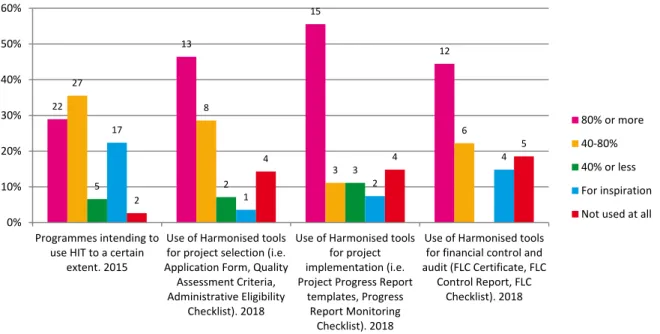
1.) Impact of the Harmonised Implementation Tools (HIT) - Around 57 Programmes, i.e. 66 percent of CBC, TNC, IRC and IPA CBC programmes, are using the Harmonised Implementation Tools to at least some extent.2 There are differences in the intensity of use between strands: 35 out of
60 (58 percent) cross-border programmes, 12 out of 15 (80 percent) transnational programmes, 2 out of 4 (50 percent)3 interregional programmes, and 8 out of 10 (80 percent) IPA CBC programmes are
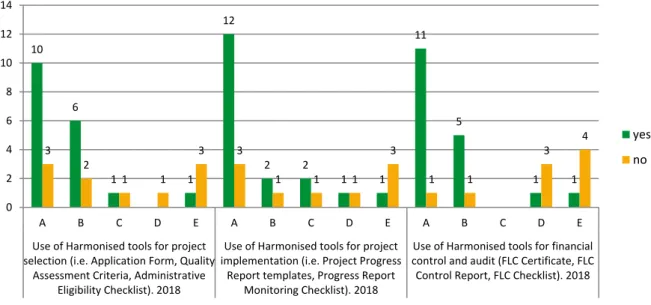
using HIT to various degrees. HIT also has a reach beyond the programmes which actively participated in its development: out of the 46 programmes that did not participate in the HIT development, 26 (9 of which have signed the eMS licence) are using HIT. Another nine programmes have declared that HIT has served them as inspiration. The use of HIT has produced a number of immediate results.
Result Observation
Changes to structures and processes
Harmonised templates and guidance helped develop and shape programme management provisions and processes.
HIT fosters peer learning and self-reflection in programme bodies, which contributed to a simplification of programme processes and a greater focus on reducing the administrative burden for applicants/beneficiaries.
HIT facilitates a common basis for discussion and exchange on programme management processes beyond HIT and prepared the ground for a number of ensuing harmonisation efforts.
Changes to staff skills and organisational culture
HIT strengthens the ties between programmes and builds confidence in programmes that harmonisation is feasible and capacities in how to approach it.
HIT affects organisational culture in programmes in terms of capacity to innovate, agility to adapt to change and readiness to compromise.
HIT supports a shift towards greater focus on simplification for applicants/beneficiaries. Changes to
systems and tools
HIT supplies programmes with readily-available harmonised implementation tools and enabled the development of a community monitoring system.
HIT are a useful, complete, and coherent set of programme templates, checklists and auxiliary documents
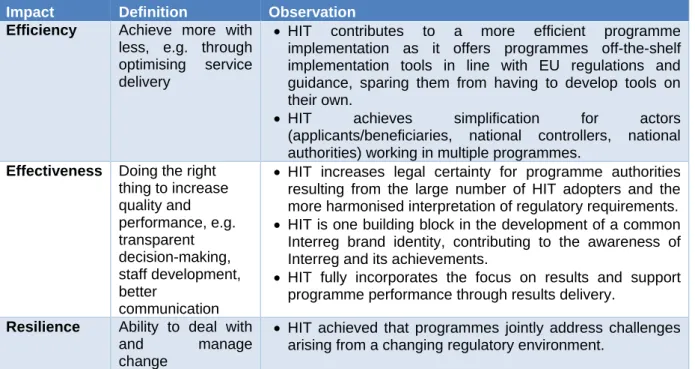
The evaluation provides evidence that HIT has benefitted programme authorities and applicant/beneficiaries. HIT has helped increase the efficiency and effectiveness of programme management in a substantial number of programmes. It enabled the development of the eMS, and cricually led to a more uniform interpretation of regulatory requirements across programmes, increasing legal assurance. For applicants and beneficiaries, it has positively affected the efficiency and effectiveness of applying for project funding and implementing a project, especially for those working in multiple programmes.
2 This figure is based on the replies to the HIT surveys carried out in 2015 and 2018 as well as the statistics on
the use of electronic monitoring system (eMS).
3 The two interregional programmes using HIT (at least to some extent) are Interreg Europe and the ESPON
Impact Observation
Efficiency HIT offers programmes off-the-shelf implementation tools in line with EU regulations and guidance, sparing them from having to develop tools on their own.
HIT achieves simplification for actors working in multiple programmes. Effectiveness
HIT increases legal certainty for programme authorities due to the large number of HIT adopters and the more harmonised interpretation of regulatory requirements.
HIT is a building block in the development of a common Interreg brand identity, contributing to the awareness of Interreg and its achievements.
HIT fully incorporates the focus on results and support programme performance through results delivery.
Resilience Programmes jointly address challenges arising from a changing regulatory environment.
Based on the analysis, a number of recommendations for the future are made:
Greater focus on planning: The development next generation of HITs should draw on the experience from the past HIT development (and other harmonisation initiatives) and be based on a greater degree of planning, including an indicative timeline and interim targets.
Greater focus on simplification of tools: There is room to make the tools more user-friendly and less redundant.
Improved guidance and documentation: More attention should be paid to documenting the process and developing guidance to build institutional memory.
Better integration of HIT and eMS development: In the future, there needs to be a better coordination between HIT and eMS and each project’s timeline.
Appropriate resource allocation: Given the high added value of HIT for programmes and importance of a timely delivery for the development of eMS, Interact is advised to allocate appropriate resources to the development of the next HIT package.
Agreement on the degree of harmonisation needed: A meaningful approach to this discussion would be to start with clarifying what the main objective/s of harmonisation is/are and use these as yardstick/s when weighing ambitions for greater harmonisation against programmes’ wishes and need for flexibility.
Involvement of all strands and IPA CBC on equal footing: Having separate sets of templates for TNC and CBC reduces the potential benefit of harmonisation for applicants, beneficiaries and controllers and increase the number of optional elements that had to be included in the eMS and should therefore be avoided. Given that IPA CBC programmes have shown a lot of interest in HIT, they should be involved from the start.
2.) Impact of the electronic monitoring system (eMS) - 34 Interreg programmes have signed the eMS license agreement, representing 38 percent of all cross-border, transnational, interregional and IPA CBC programmes.4 The adoption level per programme strand is nearly the same across all
strands. The license to use the eMS was also signed by three ENI Programmes, despite considerable
4 Note that not all programmes having signed the licence agreement are also actively using eMS as programme
differences in regulatory requirements between Interreg and ENI programmes.The use of eMS has produced a number of immediate results.
Result Observation
Changes to structures and processes
eMS required programmes to rethink and redesign management processes and structures. 39 percent of programmes using eMS say that eMS has led to a simplification of programme processes. Changes to staff skills and organisational culture
eMS significantly contributed to community building and a culture of mutual support and sharing.
eMS has positively influenced the capacity to innovate, organisational flexibility and readiness for accepting and managing change.
eMS increases transparency Changes to
systems and tools
eMS is a solid system with a well-designed core
Procedures based almost fully on electronic data processing and transmission.
Programmes using eMS have a free of charge, high-end software. Evidence from surveys, focus group and interviews shows that eMS has resulted in resource savings and increased efficiency and effectiveness of programme management. For applicants and beneficiaries, it positively affects the efficiency and effectiveness of applying for project funding and implementing a project.
Impact Observation
Efficiency eMS saves costs as software development was procured and managed by Interact.
eMS saves staff resources thanks to increased efficiency in programme management as a result of electronic data management
eMS simplifies the application/reporting process
Effectiveness eMS facilitates communication between programme authorities and improves transpareny. This enhances accountability.
eMS promotes legal certainty for programmes.
eMS reduces errors
eMS has positive effects on programme external communication as it enables the automatic export of data for keep.eu, automatic update of the programme website, and contributes to Interreg being perceived as a family of programmes.
Resilience eMS was a big change in programmes introducing the system and required them to adopt a proactive approach to change management.
Based on the analysis, a number of recommendations for the future are made:
Project management structure proved efficient & effective, but communication could be further improved: The development of eMS by means of a core group and observer group of programmes was efficient. However, the effectiveness of the structure hinges upon the good communication between core group and observer group so that the latter feels sufficiently involved
Improve communication with the eMS user group: There is a need to provide more regular status updates and outlook, give personalised feedback on received comments/suggestions, and provide more advance information before user group meetings.
Appropriate resources (incl. for communication): Resources allocated to the project proved o low given the number of programmes using the system. The high tangible impact of eMS and the high financial risk involved justifies more staff resources.
Capitalise on experience gained: It is anticipated, that time spent on developing eMS for the next programme period will be lower, due to the scope to draw on experience. Thorough feedback on the current system should be gathered before initiating the development of the next eMS.
Develop additional functionalities and services, and improve the user-friendliness of the system:
There is the potential for enhancing the user-friendliness of the eMS interface and developing additional functionalities (e.g. linking eMS with the Commission’s single beneficiary passport system).
Introduced automatic testing: eMS suffered from many bugs during the development process. Automatic testing is a major quality assurance measure and should be implemented from the beginning for the new software.
Periodic training sessions & DG REGIO information campaign: Lack of training was described as a major stumbling block to the smooth implementation and use of eMS. Interact could offer periodic (e-)training sessions. For DG REGIO desk officers to more actively promote the use of eMS among their programmes, they need to receive more information on eMS and its benefits. Communicate eMS as good practice: Better communicating the joint achievement would instil a
sense of pride in the eMS user community and boost motivation.
3.) Impact of keep.eu - Use of the keep.eu database has increased significantly in recent years. Between 2012 and 2018, the number of keep.eu users increased almost fourfold (11,530 users – 45,236 users).5 Keep.eu has produced a number of immediate results.
Result Observation
Changes to structures and processes
Access to pre-processed information has changed how some implementation tasks are carried out.
Keep.eu allows benchmarking and looking beyond a single programme Changes to
staff skills and
organisational culture
Keep.eu helps build institutional/programme memory
Keep.eu builds knowledge and know-how in project promoters who can use the resource to get ideas or find potential project partners.
Changes to systems and tools
Provides a valuable resource supporting communication and dissemination activities
Keep.eu is the only resource that allows looking beyond single programmes for thematic/territorial analysis.
Keep.eu has a combined impact on the efficiency, effectiveness and resilience of programme. In terms of the wider group of programme stakeholders, there is evidence that keep.eu has contributed to capitalisation efforts and supports (potential) project partners in their search for good practice and inspiration. In particular, keep.eu is increasingly emerging as a tool that is boosting programme and policy effectiveness, supporting effective decision making on project funding, supporting the
development and pursuit of synergies and territorial collaboration, contributing to evaluation activities and, in particular, promoting communication and dissemination. The resource is also playing an important role in increasing the profile, visibility and understanding of Interreg programmes and the projects they fund.
Impact Observation
Efficiency keep.eu is delivering ways for various stakeholder organisations to save time and resource across a range of activities.
Effectiveness Keep.eu supports and informs programme and project decision making.
Keep.eu is a resource for project partners/potential partners to look at good practice, develop project ideas etc.
Keep.eu supports evidence based strategic planning.
Keep.eu provides a comparative perspective for benchmarking and improving performance of programmes.
Keep.eu is a resource to support building synergies and collaboration, with a view to project development or capitalisation.
Keep.eu facilitates the territorial view of participation and engagement
The link between keep.eu and eMS has positive effects on programme external communication
Resilience keep.eu is a means of retaining institutional memory and reinforcing the idea of a ‘community’/bigger picture around territorial cooperation.
Based on the analysis, a number of recommendations for the future are made:
Continue to improve data coverage: Despite significant improvements in data quality, the comprehensiveness and completeness of the database remains a key issue.
Connections between keep.eu with eMS: As both keep.eu and eMS develop and evolve, maintaining and continuing to develop mutually beneficial links between the systems will strengthen both.
Develop new tools/facilities to support programme management: Projects and programmes face increasing demands on reporting on results and impact.. Keep.eu could play a key role in this area and should be promoted as capitalisation tool.
Refinements to website: Continue to improve the visibility and usability of the web-site and resources on it.
Continue to disseminate and publicise the role/value of keep.eu: Reinforce clear communication of the vision of what keep.eu is for.Further coordination and collaboration on future developments of other platforms, or better/more visibly connecting keep.eu into the wider ‘family’ of information resources on territorial cooperation programmes and vice versa. Improve perception issues and lack of awareness: Developing an even stronger identity with
4.) Impact of harmonised Interreg branding - 78 percent of programmes, cross-border, transnational, interregional strand and IPA programmes, have adopted the harmonised Interreg logo. The adoption rate is highest among IPA programmes, which have all adopted the harmonised branding, and lowest in the interregional cooperation strand where 2 out of the 4 programmes have adopted the harmonised branding. The harmonised Interreg branding has produced a number of immediate results. Result Observation Changes to structures and processes
Change away from dealing with corporate branding in isolation to dealing with it collaboratively
Harmonised Interreg branding expanded cooperation into other communication areas. Changes to
staff skills and
organisational culture
Community-building among Interreg communication managers
Process boosted confidence and built capacities for initiating and organising joint communication activities
Changes to systems and tools
Rich resource of branding-related material and contribution to innovation in project communication tools
There is sound evidence that the harmonisation of the Interreg branding had a wider positive impact on the efficiency and effectiveness of programme implementation and the territorial cooperation policy as a whole.
Impact Observation
Efficiency Savings in terms of time, money and staff due to the fact that the branding was centrally procured and paid by Interact.
Resource savings and simplification for projects working in programmes which introduced the use of standard project logo templates and/or centrally hosted project websites.
Effectiveness Community-building among Interreg communication managers
Boosted confidence and built capacities in programmes for initiating and organising joint communication activities.
Resilience Building capacity for programmes work together as proactive promoters of change. Capacities in programmes on how to initiate and manage joint communication efforts were enhanced as a result.
Based on the analysis, a number of recommendations for the future are made:
Provide greater support grass-root level initiatives: The harmonised branding is essentially a grass-route initiative by Interreg programmes, but Interact played key role in its operationalisation and implementation. This approach canbe carried forward in the future.
Improve project management: In the future, a more systematic approach with a clear timeline and planned milestones would be preferable.
Find a good balance between flexibility and harmonisation: It is important to weigh ambitions for greater harmonisation against programmes’ wishes and need for flexibility which also enhances the satisfaction with and uptake of the final product, without losing sight of the overall objective of harmonisation, which should be the ultimate yardstick.
Communicate the flexibility in using the branding: Possibilities to adapt the logo need to be better communicated, while at the same time preserving the main look and feel of the harmonised logo. Increase the usability of the logo: Changes in EU publicity requirements will make adaptations to
the logo necessary. Careful modifications to the logo/s should be made to increase its usability following comments from programmes.
Put the branding to use in joint communication activities: There is a wide-spread wish among programmes to focus on the opportunities that a harmonised brand provides for joint communication activities.
5.) Impact of the support to macro-regional strategies (MRS) - The survey targeting MRS stakeholder groups carried out as part of the impact evaluation showed high levels of awareness of Interact’s work, with around 70% of respondents stating that they are aware of Interact’s support activities, 78% of which have also made use of the resource. The support to MRS has produced a number of immediate results.
Result Observation
Changes to structures and processes
Valuable platforms and networks for exchange and learning, all of which widen and deepen collaboration between MRS, between MRS and Interreg programmes and across Interreg programmes working with the MRS.
Exchange and learning has influenced the development and evolution of MRS systems and processes. Changes to staff skills and organisational culture
Support to MRS contributes to the development of human resources and institutional capacity regarding MRS in Interreg programmes and vice versa.
Support to MRS fulfils a valuable role in retaining and sharing information, e.g. by providing comparative perspectives across MRS/Interreg programmes working with MRS or disseminating information on legal change.
Evidence shows that Interact support to macro-regional strategies has positively impacted programme authorities and macro-regional stakeholders in that it contributed to increasing efficiency, effectiveness and resilience.
Impact Observation
Efficiency New ideas, contacts and approaches that have resulted from Interact interventions have saved time and resources.
Effectiveness The support to MRS has increased awareness and understanding of the overall MRS concept, the related issues, and opportunities of macro-regional strategies, which is a key to the success of the approach.
The support to MRS contributes to open exchanges on MRS development and approaches across stakeholder groups, which improves communication and may contribute to a smoother implementation.
Resilience Support to MRS has led to community building and momentum are a valuable ‘by products’ of Interact activities in relation to the MRS. It has instilled a more proactive role in MRS and Interreg actors in address common concerns and themes jointly.
Based on the analysis, a number of recommendations for the future are made:
Keep developing cross MRS and cross-stakeholder exchanges: The current work should be continued and developed. For example, more thematic meetings could be undertaken, with a view to developing these as self-sustaining activities led by the MRS themselves.
Recognition of Interact’s evolving role in relation to MRS: The mandate for Interact in relation to the MRS support should be clarified to ensure greater transparency and focus, potentially with MRS taking on more ‘ownership’ of some processes themselves.
Perceived need for practical outputs: The practical/operational focus of Interact’s work is
appreciated and should be pursued further, particularly as there are numerous studies on the more strategic aspects of MRS.
Support for communications: Communication is identified as a particular challenge for MRS stakeholders because they involve: complex multi-level, multi-sectoral structures and systems; transnational geographies; operations that can be comparatively small/niche; and interventions which cover topics with long term horizons. Interact could provide practical and strategic dialogue and support on communication and dissemination is needed, recognising the specific challenges and audiences for MRS.
The scope to refine, clarify and evolve Interact’s role post 2020: The future directions of Interact’s engagement and levels of impact must be informed by strategic dialogue and debate on ‘big’ issues, e.g. link between Interreg and MRS.
Overall Recommendations - In addition to case-specific recommendations, the evaluation sets out recommendations drawn from across the case study projects:
1) Keep up the participatory and inclusive approach to developing products and services, with more top-down decisions by Interact taken in a transparent way after a period of extensive consultations with programmes.
2) Ensure that sufficient resources are allocated to projects with a high tangible impact; securing sufficient staff resources for facilitating the development and maintenance of the product or service and for the accompanying communication measures.
3) Ensure an equitable participation of large and small programmes and that outcomes cater to the needs of different types of programmes.
4) Ensure that informal, people-based knowledge is maintained and turned into institutional knowledge; preserve the Interact institutional memory to capitalise on lessons learned. 5) Apply project management techniques to facilitate programmes' involvement, with timelines
and interim targets as much as possible.
6) Avoid re-inventing the wheel by introducing process thinking where appropriate, especially for projects that include repeated steps (e.g. the maintenance of eMS or keep.eu).
7) Support creating tangible outputs as they install a sense of achievement in programmes; move cooperation to a more practice-oriented level and help putting ideas into practice.
1. INTRODUCTION
In the context of Interreg, the Interact programme has a special and distinct role in “reinforcing the effectiveness of cohesion policy by promoting exchange of experience concerning the identification, transfer and dissemination of good practices and innovative approaches in relation to the implementation of cooperation programmes and actions as well as to the use of EGTCs (Article 2 of the ETC Regulation).”6
This is achieved by providing a large range of free-of-charge products and services to Interreg stakeholders and beyond that aim above all at capacity building through the exchange of experience and coordination. Thus, Interact differs from other Interreg programmes in that its main target group are the territorial cooperation programmes.7 Interact aims at enhancing cooperation of territorial
cooperation programmes, as the brokers of European regional development, rather than targeting the cooperation capacity of regional development actors. The geographical area targeted by Interact services includes all European Union Member States, Norway and Switzerland. In addition, the programme supports cooperation at the external borders of the European Union (Interreg-IPA CBC and ENI CBC).
Since its inception in 2002, Interact has developed into a widely recognised knowledge hub for all matters related to Interreg programme management. In the 2014-2020 programming period, this role has further solidified and has been expanded to best respond to new and on-going developments. The Interact Programme aims to contribute to thematic objective 11 “Enhancing institutional capacity of public authorities and stakeholders and efficient public administration”. This overall objective is broken down into three programme-specific objectives to:
1) improve the management and control capacity of Interreg programmes;
2) improve Interreg capacity in capturing and communicating programme results; and 3) improve cooperation management capacity to implement innovative approaches.
These three specific objectives define the rationale behind Interact services that is; events and tools implemented for the benefit of all strands of Interreg programmes and other target groups of the programme. In analysing Interact’s contribution to these objectives, the evaluation recognises that:
Interreg programmes face unique management and implementation challenges due to their cross-border and transnational geographies and regulatory complexities;
engagement and take up of support and tools depends on the wider quality of government, programme management and levels of engagement in Interreg across the EU, and participating non-EU Member States; and
target groups/beneficiaries are not limited to Interreg programme managers and national authorities involved in Interreg.
6 Regulation (EU) No 1299/2013 of the European Parliament and the Council of 17 December 2013 on specific
provisions for the support from the European Regional Development Fund to the European territorial cooperation goal
7 Interact has a host of other stakeholders, e.g. , EU-wide strategic players and decision-makers, in particular the
European Commission, but also others such as the European Parliament, the Committee of the Regions, etc., and national and regional actors of territorial cooperation, also beyond Interreg, in particular, actors involved in the implementation of the EU macro-regional strategies, actors involved in the implementation of ‘mainstream’ ERDF programmes, national ETC networks,
2. CONTEXT AND BACKGROUND
The scope of this evaluation is to conduct a case-based evaluation of the impact of Interact’s programme interventions, focusing on five selected projects implemented by the programme:
1) Harmonised Implementation Tools (HIT) 2) Electronic monitoring system (eMS) 3) keep.eu
4) Harmonised Interreg branding
5) Support to the implementation of the EU macro-regional strategies (MRS).
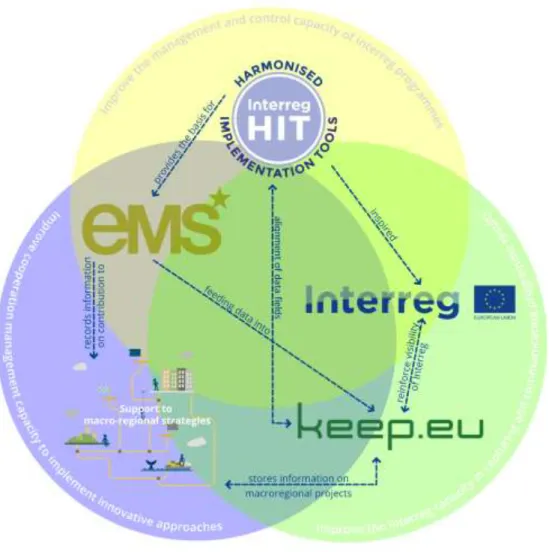
It also recognises the number of direct and indirect interlinkagesbetween the five projects (see ). Figure 1: Interlinkages between the five Interact projects to be evaluated
2.1 Understanding impact
The aim is to establish how selected Interact products/ services are used by the programme’s target groups and what effect their use has on management capacities and (the efficiency and effectiveness of) programme management practices.
Capacity is an ‘elastic’ concept understood in different ways. It is generally understood that capacity building is a learning process on the level of individuals or organisations, through increasing knowledge and skills and being able to apply these to problem solving. This results in strengthened organisations that are better run and more efficient, effective, resilient.8 Efficiency, effectiveness and
resilience in the context of programme management are closely connected:
Efficiency refers to the ratio between input invested and output achieved. The aim is to achieve more with less (staff, time, money, etc.). Higher efficiency, e.g. through a reduction in bureaucracy and paperwork, does not necessarily equal savings in terms of resources needed to implement the programme, but rather frees up resources that can be devoted to tasks other than administration in order to improve the quality of programme implementation (cf. effectiveness). Efficiency gains can accrue from optimising service delivery, e.g. through the use of electronic systems, streamlining and simplification of processes, clearer splitting of tasks and functions, better skilled and motivated staff.
Effectiveness refers to the extent to which an intended result can be achieved, or a targeted problem solved. In contrast to efficiency, which focuses on “doing the thing right”, effectiveness means “doing the right thing”. Thus, it refers to different dimensions of the quality of programme management such as enhanced user-centricity, the ease of access to programme funding (e.g. availability of support and information, usability of programme tools, possibilities for lodging complaints, etc.), transparency of decision-making, and legal certainty. Effectiveness gains can accrue from re-engineering processes, the introduction of a quality/ risk management system, staff development and training, etc.
Resilience refers to the ability of the organisation to deal with and warrant quality in a changing environment, e.g. in the course of a political or legal change, the restructuring of the organisation.
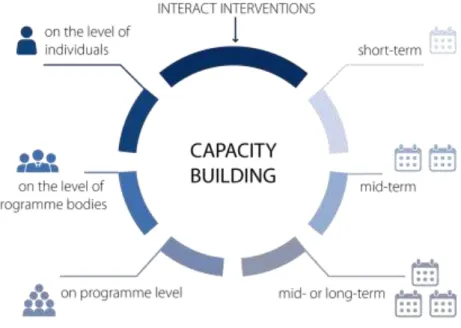
Capacity building in organisations has to start with building the skills of the individual professionals who make up the organisation. However, the implementation of Interreg programmes requires a number of organisations to work together in a complex system. Therefore, efficient and effective programme implementation is achieved only if these organisations pull together. Capacity building also has a time dimension as, in the short-term, measures can achieve knowledge and skills gains of individuals but the inherent inertia of organisations means that capacities can only be built in the medium-term. In networks of organisations that have to work together, such as those that make up an Interreg programme, capacity building has to bring about a system change, and thus tends to be a longer-term process.
8 Better run programmes benefit both the organisations managing the programmes as well as programmes’
Figure 2: Capacity building levels
Source: Evaluation team
2.2 Measuring impact
Capacity is not an easy concept to operationalise and increases/improvements in programme management in terms of administrative capacity are not easy to measure. Interact measures the result of its interventions in terms of the number of programmes which are using its products and services and the level of satisfaction with them. This focuses on the level of “enablers” of
administrative capacity or performance and the establishment of what immediate (“results”) and mid-term effects (“impacts”) those “enablers” have is left to the evaluation. Enablers are understood as key factors that determine what an organisation does and how it approaches its tasks (“practices”). Investing in enablers, thus building up capacity, has expected effects (“impacts”) within programme (but also EU macro-regional strategies) management bodies (e.g. efficiency, effectiveness, resilience) as well as among programmes’ stakeholders (i.e. quality of project applications, result delivery).
In the context of ESI Fund implementation, a number of EU-level tools and guidance are available, from which dimensions of “administrative capacity” can be derived.9Threekey factors, or enablers,
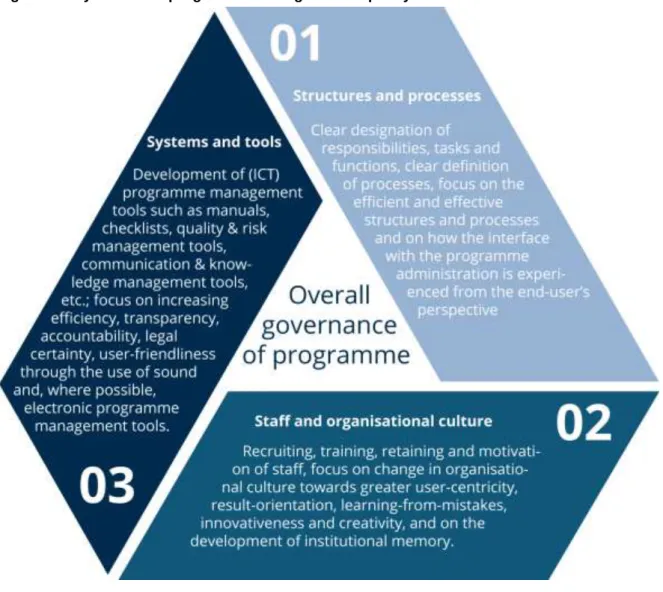
can be identified for administrative capacity: (i) structures and processes10, (ii) human
resources; and (iii) systems and tools, (see ). Interact addresses all three types of enablers and thus contributes to improving the overall governance of Interreg programmes.
9See http://ec.europa.eu/social/main.jsp?catId=738&langId=en&pubId=8055&type=2&furtherPubs=no; https://www.eipa.eu/,
http://ec.europa.eu/regional_policy/sources/docgener/informat/2014/guidance_fiche_thematic_objective_11_en.pdf
10 It is important to distinguish between processes and practices. Processes are fundamentally an abstraction of
how work should be done. Practices is how the process design is interpreted and how work is actually done in under any given circumstances, i.e. how staff responds to the real world of work and accomplish their assigned tasks.
Figure 3: Key factors of programme management capacity
Source: Evaluation team drawing on
https://ec.europa.eu/regional_policy/sources/docgener/informat/2014/guidance_fiche_thematic_objective_11_en. pdf
On this basis, it is reasonable to expect that Interact activities deliver on both:
immediate results, in terms of changes in management practices and cultures, and mid-term impacts, in terms of increases in efficiency, effectiveness and resilience of
management bodies and programmes, and impacts on programme stakeholders, in terms of access to programme funding as well as project performance (i.e. results delivery).
Even though impacts may not be either directly measurable, for example in terms of financial savings or delivery on programme results, or directly attributable to Interact interventions, the evaluation is likely to demonstrate anecdotal evidence of Interact’s impact.
3. METHODOLOGY
The methodology for the impact evaluation is based on a theory-of-change11 and case-based
approach, as required by the terms of reference for the project.
3.1 Theory of change
The theory of change approach reflects the unique character of the Interact programme, its impacts, and external factors affecting programme management capacities.
Theory-based evaluation requires programmes to consider four key questions:
What does the programme aim to influence/change (objectives expressed as outcomes)? How can it be ensured that interventions will contribute to achieving the objectives of the
programme?
How does the programme contribute to intended or observed outcomes? How will it be evident whether and when the programme has been successful?
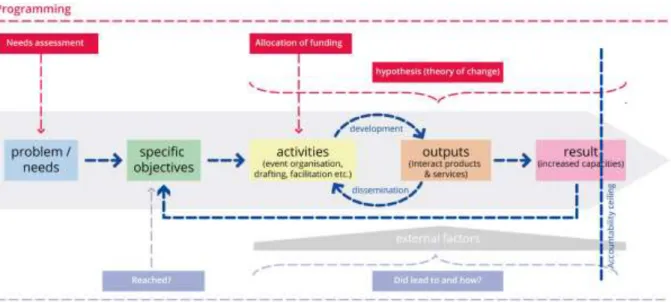
Theory-based impact evaluation uses the ‘theory’ behind an intervention to evaluate whether the intervention is implemented according to this theory, in order to evaluate the contribution of the intervention to observed effects. It offers a way of looking at how and why a complex change process succeeded under specific circumstances by tracking results chains with the addition of context, explanations & hypotheses (see ). In doing so, theory-based approaches address the question ‘why an intervention works’, as well as ‘what is the impact’, both of which are key questions for informing future project and programme development. Theory-based impact evaluation also provides room for learning that the European Commission views as ‘an overarching objective of all evaluations’.12
Furthermore, it can support the understanding of reasons for underperformance, where this is an issue.13
11 DG Regio (2015) Monitoring of European Cohesion Policy (ERDF, ESF and CF), Guidance Document on
Evaluation Plans. Terms of Reference for Impact Evaluations, Guidance on Quality Management of External Evaluations, CEC, DG Regio, February 2015
12 European Commission (2014) The programming period 2014-2020. Guidance document on monitoring and
evaluation, European Cohesion Fund, European Regional Development Funds, Concepts and Recommendations, March 2014
13 Polverari L (2015) ‘The monitoring and evaluation of the 2014-20 Cohesion policy programmes’ IQ-Net
Figure 4: Indicative theory of change of the Interact programme
Source: Evaluation team
In line with these guidelines, the approach of this evaluation is based on the assumptions made in the Interact programme’s own theory of change (intervention logic) about how the programme intends to produce the anticipated results. In addition, the evaluation identifies externalfactors that influence the achievement of programme results, but which are beyond the realm of influence of the programme.
The following sections provide an overview of key elements of the approach and the range of different methods that were employed including data gathering, evaluation, and presentation.
3.2 Case study approach
All five cases are on-going projects or continuous services that were launched under the Interact II programme (2007-2013), or, in the case of keep.eu, even earlier demonstrating that Interact III is able to reap the rewards of efforts that reach far back into the previous programming period. Some Interact services are one-off services based on (sometimes ad hoc) programme requests to meet concrete needs that emerge during the programming period. The five interventions chosen for the evaluation are long-term projects and therefore they represent only a segment of the range of Interact interventions. However, the focus on projects with a long time horizon takes account of the fact that Interact impacts the capacities of Interreg programmes (and key macro-regional stakeholders) which are part of a slow but steady process of change, and that actual impacts can only be established when adopting a longer-term perspective. It also acknowledges the fact that ad hoc requests can sometimes trigger the development of a continuous service that eventually becomes a fixed element in Interact’s product and service portfolio. The selection of case studies is further justified by the fact that the five selected projects account for a significant share of Interact’s human resources.
Nevertheless, as is widely noted, the scope to generalise from a case study can be questioned and thus a case-study approach for evaluating the programme’s impact has some potential drawbacks connected primarily to the limited representativeness of case studies. To overcome possible limitations of a case study approach, and in line with Interact’s evaluation plan, methods of data
collection have focused on those which can reach a large target group in an efficient way and comprise surveys and focus groups, complemented with selected interviews.
The general methodological approach builds on a robust mix of different data gathering, evaluation and visualisation methods that were be tailored to the needs of each of the five main evaluation tasks (as described in the corresponding task descriptions under chapter 3). Each of the case studies has specific elements, which are more/less suited to particular methods, depending on the availability of data from Interact's own sources. By combining different data sources and applying different methods with equal rigour, triangulation of information and opinions becomes possible. This generates different vantage points from which to answer the evaluation questions and enhances the validity of the evaluation conclusions and results. The approach also has the advantage that qualitative (focus groups, interviews) and quantitative (survey) methods can be mixed and complemented in order to avoid the constraints of both: the less objective and resource intensive limitations of qualitative methods and the limited insight into causal relationships and mechanisms of quantitative approaches.
Given the limited budget and time available for the implementation of the evaluation, the efficiency of the approach is paramount. As a general principle, the evaluators drew on and made best use of all available sources of information and existing data but additional data collection was also employed selectively to fill data gaps or decide on ambiguous findings. The exact scope of data collection was defined in close coordination with the programme.
According to the terms of reference and programme evaluation plan, the impact evaluation should focus primarily on the effect of Interact interventions on Interreg programmes and, in the case of the EU macro-regional strategies, other relevant stakeholders as the main users of Interact products and services. They are, therefore, the main target group of the evaluation activities. However, in order to fully evaluate the impact of Interact services, it is also important to consider the wider group of ‘indirect’ beneficiaries of Interact products and services, in particular Interreg applicants, beneficiaries, and stakeholders working with multiple programmes and other key programme partners such as the European Commission. Therefore, wherever feasible, these groups were considered in the evaluation, although the main focus remained on the key user groups for each project.
3.3 Methodological approaches
A tailored approach to the research for each of the main research tasks was developed, in consultation with Interact and based on the specific nature of the project.
Desk research Focus Group Survey Interviews
Task 0: Inception
Task 1: Evaluation of Harmonised Implementation Tools (HIT)
Task 2: Evaluation of electronic monitoring system (eMS)
(5)
Task 3: Evaluation of keep.eu.eu (5)
Task 4: Evaluation of Harmonised Interreg Branding
(10)
Task 5: Evaluation of support to the implementation of the EU macro-regional strategies
(5)
Task 6: Conclusions Source: Evaluation team
The evaluation team have kept in regular contact with Interact throughout the evaluation process. Access to data and research opportunities have been greatly facilitated and supported by the willingness of the Interact team to engage with the work, help with organising focus groups and meetings, and in obtaining data and reports.
3.4 Evaluation tasks
3.4.1 Task 0: Inception
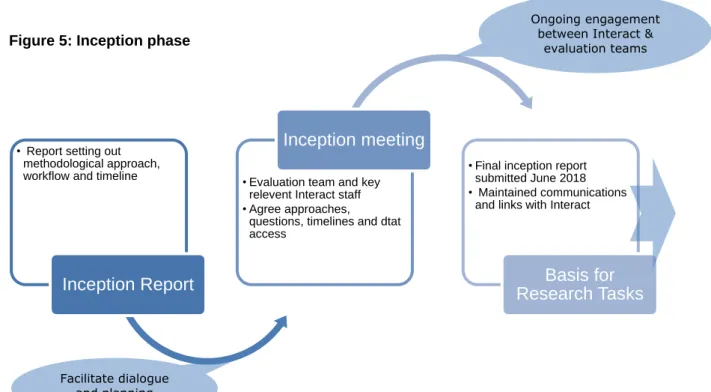
The inception phase involved a number of stages and liaison with Interact on the key research questions and methodologies.
Figure 5: Inception phase
Source: Evaluation team
• Report setting out methodological approach, workflow and timeline
Inception Report
• Evaluation team and key relevent Interact staff • Agree approaches,
questions, timelines and dtat access
Inception meeting
• Final inception report submitted June 2018 • Maintained communications
and links with Interact
Basis for
Research Tasks
Facilitate dialogue and planning
Ongoing engagement between Interact &
3.4.2 Task 1: Evaluation of the Harmonised Implementation Tools (HIT) The evaluation process of HIT involved a number of interrelated stages as illustrated in .
Figure 6: Evaluation steps Harmonised Implementation Tools (HIT)
Method Steps
Inception
Evaluation questions were agreed at the project inception meeting and set out in the inception report.
Initially planned interviews replaced by focus group.
Reviewed relevant documentation and reports. Early liaison with HIT project lead to agree on a focus group concept that fits into the overall event concept of the HIT launch event.
Metho
d
An on line questionnaire was developed in consultation with the Interact project lead for HIT, taking into consideration questions from the 2015 survey on HIT to ensure comparability of results.
+ Access to a large number of programmes
+ Quantitative results
- Low response rate meant that user figures of HIT had to be estimated - The survey combines questions that are
of the evaluators’ and of Interact’s interest; it therefore got too long, putting off potential respondents
- Those in favour of HIT are more likely to respond which may reduce the representativeness of results.
A focus group (FG) concept was developed in close cooperation with INTERACT so as to fit well into the overall event concept of the HIT launch event in December 2018 in Berlin. In preparation of the FG, a facilitation script was developed, shared and discussed with Interact.
+ Obtain qualitative input from a large number of programmes
- For practical reasons and to avoid additional travel costs for FG members, the FG was organised as part of an Interact event, which meant that discussion groups were very large. True discussion was not possible.
- The group of programmes not using HIT (or not content with HIT) was not represented in the FG.
The survey was launched on 1st November
and personalised survey invitations sent to all Interreg, IPA and ENI Programmes. Two rounds of reminders sent out, and the
survey deadline extended by one month, until 31st of December, to increase the
number of replies.
Interim survey results, based on 26 valid responses, were analysed in the beginning of December, in preparation of the focus group, and final results, based on 28 valid responses, in January 2019.
The focus group was attended by 42 participants from 30 Interreg programmes (excluding Interact). It was organised in the form of table discussions in three sessions, which were facilitated by Interact and the two evaluators. Discussions aimed at digging deeper into the results of the survey and focused on the following topics:
o Reflections on the collaborative HIT development process;
o Programme experience with the harmonised tools;
o The impacts of the use of HIT on programme management bodies,
including control bodies,
applicants/beneficiaries;
After the focus group, table discussions were summarised and shared with Interact and with participants as part of the minutes of meeting.
Overv
ie
w
Strengths and weaknesses of key methods acknowledged and clearly set out Mixed methods applied, as a means to improve data reliability and validity
Interviews replaced by focus group in order to kick-off the HIT launch event with a reflection on past achievements and shortcomings. The focus group provided a lot of input, but interviews might have been more complementary to the survey by providing rich contextual information (“narratives”) necessary for interpreting the survey results.
Response rate to survey was below expectations (~30 percent of programmes), but survey results are nonetheless representative.
Presentation of initial results for discussion with Interact
3.4.3 Task 2: Evaluation of the electronic monitoring system (eMS)
The evaluation process of eMS involved a number of interrelated stage as illustrated in .
Figure 7: Evaluation steps electronic monitoring system (eMS)
Method Steps
Inception
Evaluation questions were agreed at the project inception meeting and set out in the inception report.
Desk research on position papers of EU institutions on eCohesion.
Reviewed relevant documentation (e.g. monitoring system survey 2018) and EU-level reports.
Metho
d
Initial interviews, based on contacts proposed by INTERACT as having engaged with the keep.eu development process.
+ Expert well-informed views, providing also a lot of contextual information which enhances evaluators’ understanding - Interviewees ‘close’ to the project
- No interviews with programmes not using eMS.
A focus group (FG) concept was developed in close cooperation with INTERACT so as to fit well into the overall event concept of the eMS User Group Meeting in October 2018 in Vienna. In preparation of the FG, a facilitation script was developed, shared and discussed with Interact.
+ Obtain qualitative input from a large number of programmes
- For practical reasons, and to avoid additional travel costs for FG members,
o Interview questions developed for different potential interview target groups (i.e. European Commission, High-Level Group of Experts on Simplification, European Parliament, European Court of Auditors, European Committee of the Regions, Interreg Programmes participating in the eMS Core or User Group, Interact Monitoring Committee) in consultation with the Interact project lead for eMS.
o With the help of Interact, suitable interview partners identified and contacted in the early autumn 2018. Eight interviews carried out over the period September 2018-January 2019 and interview summaries and quotes shared with the interviewees for approval.
o The focus group was attended by 38 participants from 28 programmes (excluding Interact). It was organised in the form of a knowledge café with three rounds of table discussions and six
the FG was organised as part of an Interact event, which meant that discussion groups were very large. True discussion was not possible.
- The group of programmes not using eMS was not represented in the FG.
different discussion topics. Interact helped with facilitation. Discussions aimed at digging deeper into the results of the Monitoring systems survey 2018 and focused on the following topics:
o eMS impacts on programme processes and structures;
o eMS impacts on the organisational culture in programmes;
o eMS impacts on applicants and beneficiaries;
o eMS impacts on audit authorities and national control bodies;
o eMS impacts on programme
communication / capitalisation and the positive image of Interact;
Reflections on the collaborative eMS development process.
After the focus group, table discussions were summarised and shared with Interact and with participants as part of the minutes of meeting.
Overv
ie
w
Strengths and weaknesses of key methods acknowledged and clearly set out Mixed methods applied, as a means to improve data reliability and validity
Elite interviews are used, meaning that although the number of interviewees was small, the feedback provided high-level/relevant recommendations, which can form the basis of formal recommendation when used alongside desk research and survey evidence.
The focus group yielded a lot of input, but a smaller group of people would have allowed more discussion
3.4.4 Task 3: Evaluation of keep.eu
The evaluation process of keep.eu involved a number of interrelated stages as illustrated in .
Figure 8: Evaluation steps keep.eu
Method Steps
Inception
Evaluation questions were agreed at the project inception meeting and set out in the inception report. Desk Research
Reviewed relevant
documentation and reports Met with project lead Turku
and maintained on-going dialogue
Metho
d
Initial interviews, based on contacts proposed by INTERACT as having engaged with the keep.eu development process.
+ Expert well-informed views
- keep.eu has a wide range of potential users who are not represented
- Interviewees ‘close’ to the project
On line questionnaire was developed in consultation with the Interact project lead for keep.eu
+ Access to a broader range of respondents and views
+ New ‘outside the box’ suggestions Low response rates
Those familiar with the resource more likely to respond
For those respondents that are less familiar with the resource, due to lack of familiarity, some suggestions/recommendations may not be feasible Keep.eu has a wide range of potential user groups,
which may not be represented in a balanced way in a survey with a low response rate.
Key elite interviews with
European Commission,
Programme Managers,
Survey circulated via anonymous link by Interact using their data bases and in line with GDPR guidelines. The survey was also publicised in relevant communications.
Reminders sent out.
90 surveys have been completed.
Overv
ie
w
Strengths and weaknesses of key methods acknowledged and clearly set out Mixed methods applied, as a means to improve data reliability and validity
Elite interviews are used, meaning that although the number of interviewees was small the feedback provided high-level/relevant recommendations, which can form the basis of formal recommendation when used alongside desk research and survey evidence. Presentation of initial results for discussion with Interact
Account was taken of the type of user responding to the survey – in order to ensure that the views of key user groups were given sufficient weight
3.4.5 Task 4: Evaluation of the Harmonised Interreg Branding
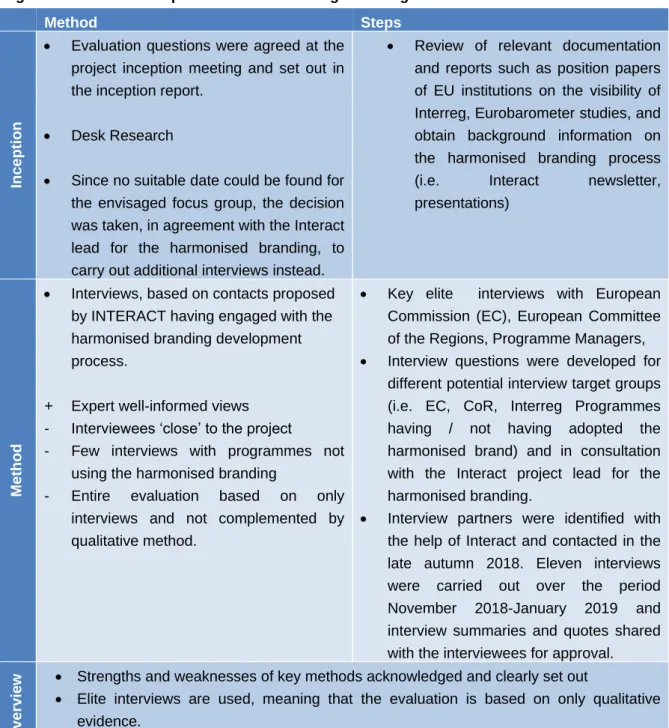
The evaluation process of the harmonised Interreg branding involved a number of interrelated stages, see .
Figure 9: Evaluation steps Harmonised Interreg Branding
Method Steps
Inception
Evaluation questions were agreed at the project inception meeting and set out in the inception report.
Desk Research
Since no suitable date could be found for the envisaged focus group, the decision was taken, in agreement with the Interact lead for the harmonised branding, to carry out additional interviews instead.
Review of relevant documentation and reports such as position papers of EU institutions on the visibility of Interreg, Eurobarometer studies, and obtain background information on the harmonised branding process (i.e. Interact newsletter, presentations)
Metho
d
Interviews, based on contacts proposed by INTERACT having engaged with the harmonised branding development process.
+ Expert well-informed views - Interviewees ‘close’ to the project
- Few interviews with programmes not using the harmonised branding
- Entire evaluation based on only interviews and not complemented by qualitative method.
Key elite interviews with European Commission (EC), European Committee of the Regions, Programme Managers, Interview questions were developed for
different potential interview target groups (i.e. EC, CoR, Interreg Programmes having / not having adopted the harmonised brand) and in consultation with the Interact project lead for the harmonised branding.
Interview partners were identified with the help of Interact and contacted in the late autumn 2018. Eleven interviews were carried out over the period November 2018-January 2019 and interview summaries and quotes shared with the interviewees for approval.
Overvi
ew Strengths and weaknesses of key methods acknowledged and clearly set out
Elite interviews are used, meaning that the evaluation is based on only qualitative evidence.
Presentation of initial results for discussion with Interact
3.4.6 Task 5: Evaluation of the support to the implementation of EU macro-regional strategies
Figure 10: Evaluation steps support to EU macro-regional strategies
Method Steps
Inception
Evaluation questions were agreed at the project inception meeting and set out in the inception report. Desk Research
Reviewed relevant
documentation and reports Met with project lead Turku
and maintained ongoing dialogue
Metho
d
Initial interviews, based on contacts proposed by Interact as having engaged with the keep.eu development process.
+ Expert well-informed views
- Interact services have an extremely wide base of users in this field (well beyond the Interreg/ENI community)
On line questionnaire was developed in consultation with the Interact project lead for MRS
+ access to a broader range of respondents and views + new ‘outside the box’ suggestions
- Low response rates
- Those familiar with the resource more likely to respond
- Due to lack of familiarity with the resource, some suggestions/recommendations may not be feasible
Key elite interviews with
European Commission,
Programme Managers,
Priority Area Coordinators, National Contact Point, Thematic Contact
Survey circulated via anonymous link by EPRC using publically available contact details and data bases.
Reminders sent out January 2019and survey deadline extended
57 surveys have been completed
Overv
ie
w
Strengths and weaknesses of key methods acknowledged and clearly set out Mixed methods applied, as a means to improve data reliability and validity
Elite interviews are used, meaning that although the number of interviewees was small the feedback provided high-level/relevant recommendations, which can form the basis of formal recommendation when used alongside desk research and survey evidence. Presentation of initial results for discussion with Interact
Table 1: Macro-regional governance: varying terminology and governance
MRS EUSBSR EUSDR EUSAIR EUSALP
Strategic bodies National Coordinators Group National Coordinators Group Governing Board General Assembly Executive Board
Implementation support
Danube Strategy Point Facility Point
National National Coordinator National Coordinator National Coordinator National Coordinator
National/Thematic Policy Area
Coordinator
Priority Area Coordinator
Pillar Coordinator Action Group leader
Thematic/objectives implementation
Policy Area/Horizontal Action Coordinator, Steering group and Policy Area Focal Points
Priority Area Coordinator and Steering group
Pillar Coordinator and Thematic Steering Group
Action Group (steering group)
Objective coordinator
Source: Evaluation team
3.4.7 Task 5: Analysis and final reporting
Each of the following sections is structured taking into account the theory-based approach taken by the research and the core analytical pillars outlined in the methodology. Crucially, in the final conclusions the evaluation will look across the five main research tasks and highlight complementarities, cumulative impacts and any possible inconsistencies/challenges.
Figure 11: Overall analysis
Source: Evaluation team