Middlesex University Research Repository
An open access repository of
Middlesex University research
http://eprints.mdx.ac.uk
Tuysuz, Mehmet Fatih and Trestian, Ramona (2017) Energy-efficient
vertical handover parameters, classification and solutions over wireless
heterogeneous networks: a comprehensive survey. Wireless Personal
Communications, 97 (1). pp. 1155-1184. ISSN 0929-6212
http://dx.doi.org/10.1007/s11277-017-4559-7
Final accepted version (with author's formatting)
Available from Middlesex University’s Research Repository at
http://eprints.mdx.ac.uk/22128/
Copyright:
Middlesex University Research Repository makes the University’s research available electronically.
Copyright and moral rights to this thesis/research project are retained by the author and/or
other copyright owners. The work is supplied on the understanding that any use for
commercial gain is strictly forbidden. A copy may be downloaded for personal,
non-commercial, research or study without prior permission and without charge. Any use of
the thesis/research project for private study or research must be properly acknowledged with
reference to the work’s full bibliographic details.
This thesis/research project may not be reproduced in any format or medium, or extensive
quotations taken from it, or its content changed in any way, without first obtaining permission
in writing from the copyright holder(s).
If you believe that any material held in the repository infringes copyright law, please contact
the Repository Team at Middlesex University via the following email address:
[email protected]
Energy-efficient Vertical Handover Parameters,
Classification and Solutions over Wireless Heterogeneous
Networks: A Comprehensive Survey
Mehmet Fatih Tuysuz
Department of Computer Engineering, Harran University, Turkey [email protected]
Ramona Trestian
School of Science and Technology, Middlesex University, London, UK
Abstract—In the last few decades, the popularity of wireless networks has been growing dramatically for both home and business networking. Nowadays, smart mobile devices equipped with various wireless networking interfaces are used to access the Internet, communicate, socialize and handle short or long-term businesses. As these devices rely on their limited batteries, energy-efficiency has become one of the major issues in both academia and industry. Due to terminal mobility, the variety of radio access technologies and the necessity of connecting to the Internet anytime and anywhere, energy-efficient handover process within the wireless heterogeneous networks has sparked remarkable attention in recent years. In this context, this paper first addresses the impact of specific information (local, network-assisted, QoS-related, user preferences, etc.) received remotely or locally on the energy efficiency as well as the impact of vertical handover phases, and methods. It presents energy-centric state-of-the-art vertical handover approaches and their impact on energy efficiency. The paper also discusses the recommendations on possible energy gains at different stages of the vertical handover process.
IndexTerms—Wireless Heterogeneous Networks, Vertical Handover, Energy efficiency
1.
I
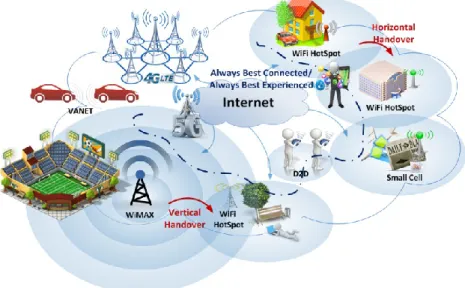
NTRODUCTIONAs wireless networks (a.k.a. Wi-Fi) and mobile devices have been experiencing an out-standing progress, users demand uninterrupted, continuous, and seamless services with Quality of Service (QoS) from any source to any device at any time while on the move or stationary. Cisco forecasts that the Wi-Fi and mobile devices will account for 66% of the IP traffic and the Internet traffic will reach 18 GB per capita by 2019 [1]. In order to satisfy the increasing traffic demands and the service requirements, the next generation of wireless infrastructures (5G networks) paradigm will include a high deployment of base stations and several different radio access technologies (RATs), such as: Wireless Local, Metropolitan and Wide Area Networks (WLAN, WMAN, WWAN), Long Term Evolution (LTE, LTE-A), Worldwide Interoperability for Microwave Access (WiMAX), Wireless Broadband (WiBro) etc. as illustrated in Fig. 1. However, there is no single RAT that can simultaneously offer high amount of bandwidth, low-latency, wide coverage and high QoS levels for mobile users. Therefore, the next generation wireless systems will make use of various interworking solutions and technologies. For example, the integration of Software Defined Networks (SDN) and Network Function Virtualization (NFV) could help the mobile operators to reduce their CAPEX intensity by transferring their hardware-based network to software- and cloud-hardware-based solutions. Another option could be Cloud-Radio Access Networks (C-RAN) which offers a centralized, cooperative, clean (green) and cloud computing architecture for radio access networks. A popular solution is the hyper-dense small cell dynamic cooperation of different RATs and Wi-Fi and Femtocell opportunistic offloading techniques of the mobile traffic. These solutions will enable a cooperative heterogeneous wireless environment where the users will be always best connected (ABC) at anytime and anywhere [2]. Thus, this heterogeneous wireless environment, as illustrated in Fig. 1, can be defined as a technology, multi-terminal, multi-application, multi-user environment within which mobile users can roam freely. In this context, the main
promise of the heterogeneous network integration is to increase the wireless capacity ensuring seamless mobility and to add support for high data rates and low latency to the mobile users.
Until recently, the aim of Information and Communication Technology (ICT) was mainly focused on performance and cost and insufficient effort was allocated towards the energy consumed by ICTs and their impact on the environment. Current trends, such as increasing costs of electricity, reserve limitations, and increasing emissions of carbon dioxide (CO2) are shifting the focus of ICT towards energy-efficient well-performed solutions. Even though governments and
companies are now aware of the massive carbon emissions and energy requirements, it is obvious that carbon emissions and the amount of energy consumption will continue to increase [3]. As stated by the SMART 2020 study [4], ICT-based CO2 emissions are rising at a rate of 6% per year being expected to reach 12% of worldwide emissions by 2020.
Fig. 1. Next Generation Communication Scenario
The dense deployment of various RATs, which may differ in terms of technology, protocols, coverage, bandwidth, latency, or even service providers, is essential to handle the ever-growing demand of performance and coverage. However, these increases have led to the increase in wireless network’s energy consumption that represents one of the main current challenges that has received remarkable attention from both industry and academia [5–7]. In order to decrease the overall energy consumption, the Greentouch consortium [8] and major European projects like EARTH [9] and Mobile VCE [10] focus on infrastructure-based energy savings for wireless networks at the system level. The major aim of these projects is to design and implement pioneering approaches for green operation of wireless networks. However, these projects have only examined the optimization of homogeneous wireless systems. Since current mobile devices are equipped with several network interface cards to operate within the existing heterogeneous wireless infrastructure in a flexible way, energy-centric optimization solutions for heterogeneous networks represent an important issue that needs to be investigated carefully to reduce the energy consumption and carbon emissions.
Interworking of heterogeneous networks may increase network performance and pro-vide seamless mobility for mobile devices. Nevertheless, this flexibility may cause additional energy consumption on the mobile device, which in turn will decrease the communication time. Mobile devices deeply depend on the energy provided by their batteries, and hence their running time is limited. Furthermore, processing power doubles almost every two years according to the Moore’s law. However, the progress in batteries did not even double over the last decade [11]. In this regard, the design concept of protocols, networks and hence mobile devices have started to change in both academia and industry by keeping the energy-efficiency in mind. Therefore, the bottleneck of up-to-date mobile system design is not only the transmission rate, but even more the energy limitation of the mobile devices, as users demand for more interactive multimedia-based services which in turn are known to be energy-hungry services [12].
Within a heterogeneous wireless network environment, handover, also known as handoff, is the procedure of shifting an ongoing call or a data session from one Point of Attachment (PoA) (the connection between the mobile device and the network) to another. Consequently, the handover procedure allows mobile stations to dynamically associate with the most suitable PoAs among available ones. If a handover occurs within the domain of a single RAT, the process is known as horizontal handover. On the contrary, vertical handover (VHO) takes place among different RATs. Figure 1 demonstrates both horizontal and vertical handover procedures.
As stations in heterogeneous wireless networks continuously seek channels to initiate horizontal or vertical handovers, designing an energy-aware well-performed vertical handover procedure is significant to minimize the energy consumption while still supporting essential quality of service. Handover duration and its accuracy is also essential for the energy efficiency. It is because, a possible improper association to a new network may let stations consume even more power than before until a proper association, if ever, is selected [13].
There have been many reviews in the literature focusing on the vertical handover process as in [14–16]. However, to the best of our knowledge, not much focus has been put on the energy-centric vertical handover solutions. Moreover, existing vertical handover reviews have no parameter-based (obtained locally or remotely) gain/cost analysis. To this extent, this paper aims at three-dimensional analysis of energy-efficient wireless communication, such as: (1) presents the energy gain/cost analysis of network-assisted and mobile-initiated parameters, (2) examines vertical handover phases taking the energy efficiency into account and (3) evaluates state-of-the-art energy-centric vertical handover approaches proposed in the literature. A brief comparison of possible energy gain ratios of existing approaches is also presented.
The rest of the paper is organized as follows. Section 2 presents background information related to the vertical handover concept (e.g., definition, classification and procedure), describes the handover process in various radio access technologies (e.g., WiFi, 3G, LTE, WiMAX) and summarizes several energy-efficient vertical handover standards and industry solution approaches. Section 3 examines the impact of specific parameters, methods and vertical handover approaches on the energy efficiency. Section 4 presents a comprehensive comparison of the existing handover approaches from the literature in terms energy-gain. Section 5 provides recommendations for an energy efficient vertical handover. Finally, the conclusions are presented in Sect. 6.
2.
H
ANDOVERC
ONCEPT,
S
TANDARDS ANDI
NDUSTRYS
OLUTIONSIn order to be familiar with energy-efficient vertical handover parameters, classification and solutions, this section first presents brief information of vertical handover procedures, handover process in various radio access technologies and possible energy saving methods for vertical handover over wireless heterogeneous networks.
2.1. Vertical Handover Definition, Classificatiton and Procedure
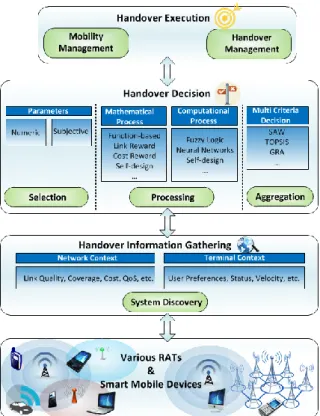
The handover process [17] enables the link between communication and user mobility. A good definition of handover is given by ETSI and 3GPP [18] which define handover as being the process by which the mobile device keeps its connection when changing the PoA (base station or access point). In terms of technologies, if both the source and target system employ the same RAT and reply on the same specifications, then the handover process is referred to as Horizontal Handover [17]. If the target system employs a different RAT, the handover process is called Vertical Handover (VHO) [19], which is the focus of this paper. The main objective of the handover process is to minimize the service disruption, which can be due to data loss and delay during the session transfer. The handover procedure can be divided into three phases: (1) information gathering, (2) decision, and (3) execution. Figure 2 illustrates the relation among these phases required to perform handover in wireless heterogeneous networks.
Throughout the information gathering phase, mobile devices periodically scan the available networks to be able to associate with a more suitable PoA when the service quality drops below the required QoS level. The mobile devices gather information received locally or remotely. The reliability of the gathered information is essential for the vertical handover process as the decision-making procedure depends on it.
Traditionally, the handover process is performed based on the Received Signal Strength Indicator (RSSI) [20], such that stations select a PoA that has the strongest RSSI. Existing energy-efficient handover methods save energy by either reducing the overall channel scanning duration or connecting to a better energy-efficient PoA in relation to the RSS levels. Nevertheless, as each RAT has specific features, to increase the energy efficiency and the handover accuracy, a vertical handover method has to evaluate each RAT separately, making use of as much as local and network related parameters. In this context, main parameters that can be received remotely (network-side assisting) are: overall throughput, network connectivity graph, probability of collision, cost, packet loss ratio, frame error rate, latency, security, bandwidth available, offered bandwidth, jitter, number of users, link capacity, mobility, coverage, handoff rate, RSSI, noise signal ratio (NSR), bit error rate, distance, location, QoS parameters, transmission power, channel busy time (CBT), etc. All of the aforementioned parameters might assist mobile devices to save energy. However, most of these parameters require message exchanges, which cause additional overhead on the network and extra processing-based energy consumption for mobile devices.
Similarly, the parameters that can be received locally (mobile-side assisting) are: user preferences, battery status, handover thresholds, resources, channel scanning results, speed, historical information, service class, accelerometer, GPS, probability of local packet loss, local latency, local throughput, scanning frequency, specific application requirements, and etc. These parameters can also assist mobile devices for energy saving. However, they may also introduce extra processing-based power consumption for mobile devices. Consequently, the parameters received by information gathering, either remotely or locally, are very important for an energy-efficient vertical handover process and its accuracy. However, a trade-off between accuracy and overhead needs to be considered, as keeping accurate estimates for the more dynamic parameters depends on their frequency of change and can be data intensive, adding to signaling, processor and memory burden and could lead to introducing extra-energy consumption for mobile devices. Moreover, the energy consumption is also affected by the type of wireless access technology used by the mobile device and the users’ location relative to the access point [21]. A dense HetNet environment results in an increased number of handovers at the mobile device side that introduces a further increase in the energy consumption [22]. Therefore, all of the afore-mentioned parameters must be first analyzed in terms of energy versus performance trade-off.
The handover decision phase is in charge of deciding whether a handover is necessary or not. If so, when and where to trigger the handover are essential information in the process. The when decision refers to the exact time of the handover initiation and the where decision refers to the selection of the most suitable PoA that satisfies the optimal requirements. In homogeneous networks, deciding when to handover generally depends on the RSSI values, while the where is not an issue, as there is only one RAT. The traditional handover decision policy [20, 23] that is mainly based only on RSSI is as follow. If the RSSI is the only parameter, a handover is performed whenever RSSInew > RSSIold. If a threshold T is
considered, a handover is performed whenever RSSInew > RSSIold and RSSIold < T. If a hysteresis H is considered, a
handover is performed whenever RSSInew > RSSIold + H. If both a hysteresis and a threshold are considered, then a
handover is performed whenever RSSInew > RSSIold + H and RSSIold < T.
In heterogeneous networks, the handover decision is more complex. To be able to perform the best decision, the data collected in the information gathering phase must contain as many essential parameters as possible obtained from various sources, such as the device, network and user preferences. However, redundancy of the information gathered not always leads to energy efficiency, as this process may take significant time and pro-cessing overhead for devices. The decision phase also consists of three sub-phases: (1) parameter-selection, (2) parameter-processing, and (3) parameter-aggregation. In order to evaluate and weight a candidate association, only the parameters that the algorithm requires are selected in the parameter-selection phase. In order to extract relevant data, all the selected parameters are normalized in the parameter-processing phase. Additionally, neural networks, fuzzy logic and specific utility functions are used to merge value parameters with diffuse information. Finally, the best candidate RAT is selected with the help of the network selection algorithm that aggregates and evaluates the load/cost of each parameter in the parameter-aggregation phase.
Once the information is gathered (phase 1), processed and a network candidate is selected (phase 2), handover execution phase performs the handover itself. This phase also handles the security, control, mobility and session issues to achieve a seamless handover operation [14].
Figure 2.Handover phases and relations among these phases
2.2.
Handover process in Vaious Radio Access Technologies (RATs)
This sub-section presents brief information about handover process in four different, widely-used, radio access technologies; WiFi, 3G, LTE and WiMAX, respectively.
2.2.1. Handover in Wireless Fidelity (WiFi)
WiFi is a local area wireless computer networking technology that mainly uses the 2.4 and 5 GHz radio bands. The traditional procedure used for a WiFi handover starts with the channel-scanning phase. In order to detect available networks, stations initially transmit Probe Request Frames and wait for Probe Response Frames on each channel. With the end of the channel-scanning phase, stations obtain a list of PoAs, their signal strengths, available transmission modes, etc. [24]. After the channel scanning, Re-authentication phase, the procedure of transferring associations from one PoA to another, starts. Authentication is essential to associate to the next PoA. As soon as the station has been authenticated with the next PoA, the re-association phase starts. With the end of this phase, the station associates to the next PoA. It should be noted that, channel scanning is the main factor that dramatically affects the handover latency and the power consumption. There-fore, it has to be limited to provide seamless and energy-efficient handover operation. 2.2.2. Handover in 3G
3G is the third generation of mobile telecommunications technology. 3G networks mainly have three types of handover operation; (1) hard handover, (2) soft handover and (3) 3G-GSM inter RAT handover. In hard handover, connections are first broken and then re-established. Hence, users sometimes may notice a short communication break. In soft
handover, the device is connected to more than one cell throughout the handover process. As it has more than one connection active, soft handover leads to more consistent communication opportunity. In addition to the hard and soft handover, handover between a 3G and a 2G GSM network is called inter-RAT handover [25].
The Radio Network Controller (RNC) manages the 3G handover decision. As in WiFi environment, RNC initiates a handover if the RSSI of a specific communication channel reduces below a certain threshold and a different channel that has a better RSSI exists.
2.2.3. Handover in LTE
LTE, usually advertised as 4G, is a standard for wireless communication of high-speed data for mobile phones and data terminals. LTE does not support soft handover that is one of the big technical features of 3G. The reason is, soft handover is possible in Code-Division Multiple Access (CDMA) as adjacent cells can operate on the same frequencies as long as they use different scrambling codes. Hence, a device can listen to two different cells by decoding the received signals twice. However, LTE is based on Orthogonal Frequency-Division Multiple Access (OFDMA), which is essentially a frequency division method. It means a mobile device has to re-sync to a different set of frequency subcarriers when it hands over between cells, which removes the possibility of a soft handover [26].
Although LTE does not support a soft handover process, it still maintains seamless mobility using hard handover. LTE has three different types of handover: (1) Intra-LTE Handover, (2) Inter-LTE Handover and (3) Inter-RAT Handover. In Intra-LTE Handover, source and target cells are part of the same LTE network. In Inter-LTE Handover, handover occurs towards other LTE nodes. In Inter-RAT Handover, handover occurs between different radio access technologies. 2.2.4. Handover in mobile WiMAX
WiMax (IEEE 802.16) is the Worldwide Interoperability for Microwave Access. Handover procedure in WiMax is classified in two main categories; (1) hard handover and (2) soft handover. Macro Diversity Handover (MDHO) and Fast Base Station Switching (FBSS) methods are two types of optional soft handover mechanisms, whereas the hard handover is mandatory [27].
Handover process in WiMax can be summarized as follows. The current PoA periodically broadcasts MOB NBR-ADV [28] messages that contain information of neighbor PoAs. Mobile device scans the neighbor PoAs and selects the next proper PoA. Afterwards, the device transmits a handover request to the current PoA. The current PoA then exchanges the handover messages with the target PoA candidates and finally selects the next PoA. The next PoA sends the handover response to the mobile device. With the reception of this message, the device breaks the connection with the current PoA and associates with the next PoA [29].
2.3.
Standards which Support Energy-efficient Network Selection
As background information, this sub-section summarizes three standards (IEEE 802.21 MIH, ANDSF and IEEE 802.11u) that are able to support energy efficient network selection. The impact of each parameter, method and standard on the energy efficiency will be addressed in the next section in detail.
2.3.1. IEEE 802.21 Media Independent Handover (MIH)
Media Independent Handover (MIH) standard is part of the IEEE 802.21 protocol [30, 31]. It provides mobile devices with link-layer information of different Radio Access Networks (RANs) and battery-level status. Hence, it improves not only the vertical handover process and user experiences, but also energy efficiency, assisting both mobile and network-initiated handovers.
MIH provides stations with the abstract services that enable the information exchange between higher and lower layers by utilizing a media independent framework and associated services [32]. MIH standard has three key services that support the handover operation: (1) Media Independent Event Services (MIES) states events, such as Link_Up and Link_Down that signify the variations in the link quality, (2) Media Independent Command Service (MICS) provides commands to control the link state, (3) Media Independent Information Service (MIIS) provides mobile devices with energy-aware and rapid channel scanning results [12].
2.3.2. Access Network Discovery and Selection Function (ANDSF)
The Access Network Discovery and Selection Function (ANDSF) is an entity in the 3GPP standard 23.402 [33]. The aim of the ANDSF is to assist for the detection of non-3GPP radio access networks. In order to connect to non-3GPP networks, it also provides mobile devices with the information regarding policies and operator requirements.
The ANDSF mainly provides three types of information: (1) Inter system mobility policy (provides interface selection rules for mobile devices with only one active access network connection), (2) Inter system routing policy (provides interface selection rules for mobile devices with potentially more than one active access network connection) and (3) Discovery information (provides list of available access networks including radio access networks identifier, access type technology, etc.) [34]. As in Media Independent Information Service (MIIS), discovery information in ANDSF can also be used for an energy-efficient vertical handover.
2.3.3. IEEE 802.11u
IEEE 802.11u [35] is an amendment to the base IEEE 802.11-2007 standard. IEEE 802.11u protocol enables interworking of 802.11 networks with external networks. The standard defines an Access Network Query Protocol (ANQP) that provides the mobile device with information related to the neighboring networks that is not advertised in beacons [13]. The ANQP enables the pre-association services and it facilitates the network selection process even prior to network association.
2.4.
Industry Solutions for Network Selection
The mass-market adoption of the high-end mobile devices has led the network operators to adopt various solutions to help them cope with the explosion of mobile broadband data traffic. One promising solution is the mobile data offloading technique that has become a popular solution for the network operators, especially in the 3GPP Release-10 [36]. This enables the network operators to accommodate more mobile users and keep up with their traffic demands by transferring some of the traffic from the core cellular network to Wi-Fi or femtocells at peak times and key locations (e.g., home, office, public HotSpot, etc.). Even though this solution presents advantages for the network operators with improved capacity at low cost, a HetNet dense-small cell environment results in an increased number of handovers for the mobile user. Two handover strategies could be identified in this context: (1) proactive handover where the handover is triggered well in advance and (2) reactive handover where the handover is postponed as long as possible. It has been shown that the proactive handover reduces the packet loss probability when compared to the reactive handover [37], making it more suitable for real-time applications and more energy efficient.
Qualcomm presented a study [38], which shows that the LTE-Advanced HetNet with LTE pico-cell solution is the best option over the HetNet with Wi-Fi cells in terms of throughput gain, handover mechanism, QoS guarantee, security, and self-organizing features. Moreover, the LTE-Advanced HetNet with LTE picocells already achieves seam-less handover between the two networks whereas for HetNet with Wi-Fi cells seamless handover is not possible yet as it requires an inter-RAT handover. However, in terms of CAPEX and OPEX, HetNet with Wi-Fi cells is a better option for network operators.
The HetNets Wi-Fi offload solution is already adopted by many service providers. For example, the main service providers in United Kingdom, such as EE, Vodafone, O2 and Three offer WiFi-calling letting their customers to make and receive calls and send and receive texts over WiFi using their mobile number. The O2 and Three service providers enable WiFi calling by using an app, such as O2 TU Go1 app and inTouch2 app, respectively. Whereas EE3 and
Vodafone4 offer a seamless approach without the need for a separate add by using the standard dialer and SMS apps of the mobile phone. In this way, customers can avail of a wider service offering.
1O2 TU Go—http://www.o2.co.uk/apps/tu-go. 2Three inTouch—http://www.three.co.uk/Discover/Three_inTouch. 3EE WiFi Calling—http://ee.co.uk/ee-and-me/why-ee/uks-no1-network/wifi-calling.
A white paper published by 4G Americas [39] provides recommendations for an Intelligent Network Selection (INS) that will enable the mobile device to select between WiFi and cellular networks. The INS is based on the ANDSF and IEEE 802.11u standards and the selection decision makes use of the RSSI, QoS parameters such as RTT delay, jitter, packet loss and UE local information like battery and data usage or the mobile device motion state relative to the WiFi Access Point position.
Another solution based on the ANDSF standard is proposed by InterDigital [40] referred to as Smart Access Manager (SAM). The proposed solution is distributed and consists of a SAM client residing at the mobile device side that monitors the network environment and the services and applications running on the device, whereas a mobile-network-based ANDSF server integrates all the cost/revenue policy rules and the decision-making intelligence.
A leading wireless, wireline, broadband and cable TV operator in South Europe adopted the solution offered by Openet5
that provides intelligent Wi-Fi management and offload capabilities in real-time on a subscriber-by-subscriber basis. The solution enables the network operator to optimize the mobile data experience for its customers and reduce the network costs based on policy and charging controls combined with user profiles and service information.
The Wi-Fi network database provider WeFi6 launched the WeFi enhanced Access Network Discovery and Selection
Function (WeANDSF) that is ANDSF 3GPP compliant, supporting Wi-Fi and all 2G/3G/4G cellular technologies. The selection decision is based on weighted factors taking into consideration the real-time and historical network per-formance parameters for all networks within the user’s location. The solution enables the operators to save investments costs in CAPEX/OPEX by maximizing the utilization of all existing and potential resources.
Data offloading solution is a promising solution for the network operators. However, the key problem is the lack of integration between the cellular network and the carrier Wi-Fi networks. To this extent, the new 3GPP Rel-13 considers several key features and technologies including LTE Wireless Local Area Network Radio Level Aggregation (LWA) and the LTE Unlicensed or Licensed Assisted Access for LTE (LTE-U/LAA) which utilises the unlicensed spectrum (e.g., 5 GHz) to provide additional radio spectrum for the network operators.
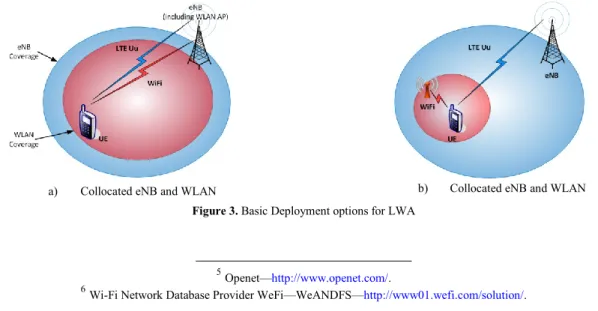
According to 4G Americas white paper [41] there are two basic deployment scenarios for LWA as illustrated in Fig. 3: (1) a collocated scenario where the LTE eNB integrates one or multiple WLAN Access Points (APs), and (2) a non-collocated scenario where the LTE eNB connects to WLAN via an interface that is being standardized by 3GPP in Rel-13. In this scenario the eNB is an anchor node that enables the Core Network connectivity and forwards the data packets to WLAN. However, these deployment scenarios consider the LTE and WLAN networks deployed and controlled by an operator and its partners. In this way, the operators can have more control over the offloading techniques and the quality experienced by their customers over the Wi-Fi network.
a) Collocated eNB and WLAN b) Collocated eNB and WLAN
Figure 3. Basic Deployment options for LWA
5Openet—http://www.openet.com/.
3.
T
OWARDSE
NERGYE
FFICIENTV
ERTICALH
ANDOVERSThis section examines the impact of specific parameters, vertical handover decision strategies and proposed approaches on the energy efficiency.
3.1.
Impact of Local and Network-related Parameters on the Energy efficiency
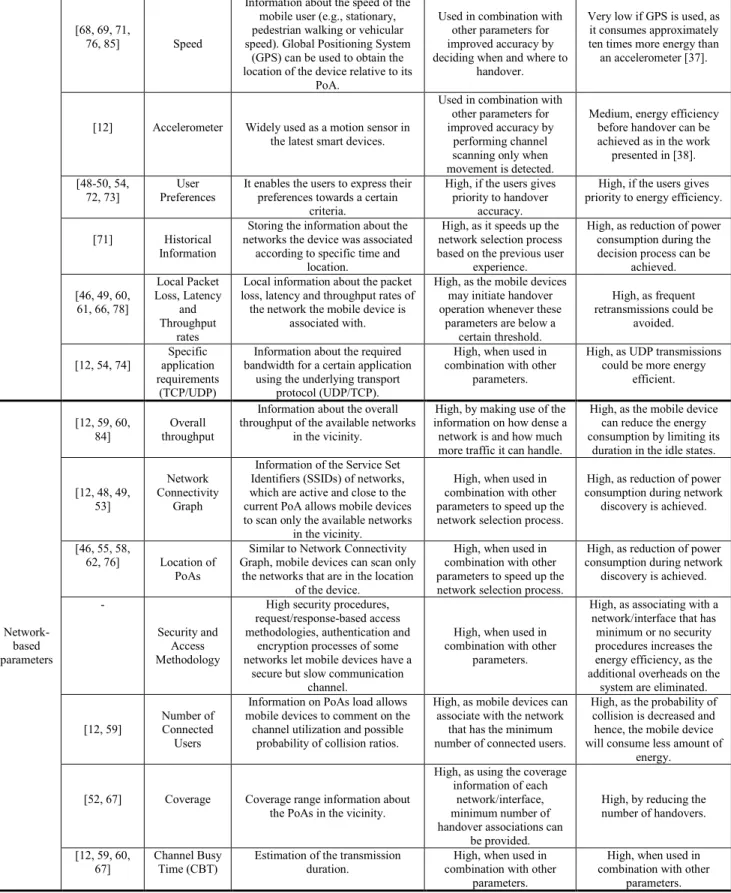
To increase handover accuracy, vertical handover approaches utilize a large set of local and network-related parameters. However, this comes at the cost of higher network overhead that could lead to increase in delay, handover duration, processing power and finally more energy consumption. On the other side, considering a small set of parameters might improve the energy efficiency but at the cost of handover accuracy. Thus, in order to maintain a good trade-off between the energy efficiency and the handover accuracy a balanced number of parameters need to be considered. In this context, this section presents the impact of specific parameters on the handover accuracy and the trade-off they provide in terms of energy efficiency. The parameters are classified into two groups: (1) mobile-based parameters that can be collected locally on the mobile device side and (2) network-based parameters that are received remotely from the network side. Both categories are summarized in the table below.
As seen in Table 1, most of the parameters present a high energy-efficiency trade-off, depending on the specific problem they are addressing. For example, energy savings might be achieved by reducing the number of handovers when making use of the coverage range information about the PoAs in the vicinity. Avoiding frequent retransmissions could also lead to energy savings. By using the information about the application requirements and the underlying transport protocol energy savings could be achieved by selecting an energy efficient transmission, such as UDP. An important aspect to consider is what information is readily available to the decision maker and how accurate and/or dynamic that information is. For example, because of the dynamics of the wireless environment the received signal strength or the available band-width can present major fluctuations for short periods of time. On the other side, the coverage and the PoAs location are less dynamic and they do not present changes on a daily basis. Whereas the security level and access methodology are parameters that are more static. Note that the parameters presented above do not represent an exhaustive list and are possible choices that might be used as input into the handover decision strategy. Some solutions may use only a subset of these parameters, or may include additional parameters as well.
It should be noted that most of local and network-related handover decision parameters are extremely related to each other and cannot be addressed individually. For instance, network connection time is closely related to the RSSI, location and speed of the device. Therefore, a multi-criteria based handover procedure is more suitable as it has a higher potential to fulfill an energy-efficient network/interface selection.
Category Ref. No. Parameter Description Handover Accuracy Energy-efficiency trade-off Mobile-based parameters [12, 46-51, 64-69,84,85]
RSSI Measurement of the received signal power level, and is directly related
to the service quality.
High accuracy High
[66, 71] Bit Error Rate (BER)
Offers information about the link reliability.
High accuracy High
[12, 70, 76, 77]
Network Connection
Time
Gives information about the time taken to initiate and execute a handover that is essential for the
network/interface selection procedure.
High accuracy High
[12, 66, 72,
74, 75, 85] Battery Status
Indicator of the lifetime of a mobile device’s battery until the next
charge.
Used in combination with other parameters for improved accuracy by selecting an energy-efficient PoA. High [55, 62, 84] Resources
Any physical or virtual component of limited availability within a device: CPU, memory, Input/Output
operations, electrical power, etc.
Used in combination with other parameters for improved accuracy and to avoid resource contention when demand exceeds
supply for a limited resource.
[68, 69, 71,
76, 85] Speed
Information about the speed of the mobile user (e.g., stationary, pedestrian walking or vehicular speed). Global Positioning System
(GPS) can be used to obtain the location of the device relative to its
PoA.
Used in combination with other parameters for improved accuracy by deciding when and where to
handover.
Very low if GPS is used, as it consumes approximately ten times more energy than an accelerometer [37].
[12] Accelerometer Widely used as a motion sensor in the latest smart devices.
Used in combination with other parameters for improved accuracy by
performing channel scanning only when movement is detected.
Medium, energy efficiency before handover can be achieved as in the work
presented in [38]. [48-50, 54,
72, 73]
User Preferences
It enables the users to express their preferences towards a certain
criteria.
High, if the users gives priority to handover
accuracy.
High, if the users gives priority to energy efficiency. [71] Historical
Information
Storing the information about the networks the device was associated
according to specific time and location.
High, as it speeds up the network selection process based on the previous user
experience.
High, as reduction of power consumption during the decision process can be
achieved. [46, 49, 60, 61, 66, 78] Local Packet Loss, Latency and Throughput rates
Local information about the packet loss, latency and throughput rates of
the network the mobile device is associated with.
High, as the mobile devices may initiate handover operation whenever these
parameters are below a certain threshold. High, as frequent retransmissions could be avoided. [12, 54, 74] application Specific requirements (TCP/UDP)
Information about the required bandwidth for a certain application
using the underlying transport protocol (UDP/TCP).
High, when used in combination with other
parameters.
High, as UDP transmissions could be more energy
efficient. Network-based parameters [12, 59, 60, 84] Overall throughput
Information about the overall throughput of the available networks
in the vicinity.
High, by making use of the information on how dense a network is and how much more traffic it can handle.
High, as the mobile device can reduce the energy consumption by limiting its
duration in the idle states. [12, 48, 49,
53]
Network Connectivity
Graph
Information of the Service Set Identifiers (SSIDs) of networks, which are active and close to the current PoA allows mobile devices to scan only the available networks
in the vicinity.
High, when used in combination with other parameters to speed up the network selection process.
High, as reduction of power consumption during network
discovery is achieved.
[46, 55, 58,
62, 76] Location of PoAs
Similar to Network Connectivity Graph, mobile devices can scan only
the networks that are in the location of the device.
High, when used in combination with other parameters to speed up the network selection process.
High, as reduction of power consumption during network
discovery is achieved. -
Security and Access Methodology
High security procedures, request/response-based access methodologies, authentication and
encryption processes of some networks let mobile devices have a
secure but slow communication channel.
High, when used in combination with other
parameters.
High, as associating with a network/interface that has minimum or no security procedures increases the energy efficiency, as the additional overheads on the
system are eliminated.
[12, 59]
Number of Connected Users
Information on PoAs load allows mobile devices to comment on the
channel utilization and possible probability of collision ratios.
High, as mobile devices can associate with the network
that has the minimum number of connected users.
High, as the probability of collision is decreased and hence, the mobile device will consume less amount of
energy. [52, 67] Coverage Coverage range information about
the PoAs in the vicinity.
High, as using the coverage information of each
network/interface, minimum number of handover associations can
be provided.
High, by reducing the number of handovers. [12, 59, 60,
67]
Channel Busy Time (CBT)
Estimation of the transmission duration.
High, when used in combination with other
parameters.
High, when used in combination with other
parameters.
3.2.
Impact of Handover Decision Strategies on the Energy Efficiency
The parameters collected from the existing wireless networks and interfaces are weighted based on their importance during the vertical handover decision stage. The result of this stage is the selection of a network/interface, considering the information gathered throughout the channel scanning phase. Some of the existing vertical handover decision strategies that are widely used in the network selection process are: function-based decision, user-centric decision, fuzzy logic based decision, game theoretic decision and reputation-based decision.
The proposed handover decision strategies from the literature are trying to find the best trade-off between various parameters and are not entirely focused on one parameter only. For example, the function-based decision selects the network/interface that maximizes an objective function. In most of the cases, the objective function is represented by a weighted sum of different parameters, such as QoS, cost, trust, power consumption, compatibility, user preferences, capacity, etc. Consequently, the energy efficiency when adopting this handover decision strategy will vary according to the power consumption’s weight value.
In the case of user-centric decision solutions, the user satisfaction plays an important role in the decision criteria. Therefore, energy efficiency when using these strategies will vary according to users’ preferences in terms of performance, QoS, cost and power consumption. Fuzzy logic based decision deals with uncertainties. It analyzes vague data, such as the behavior of the RSS, channel utilization, energy consumed per bit or the BER. This information is then combined with other decision strategies to select the network/interface that finds the best trade-off between these parameters. Vertical handover decision problem can also be modeled by using some of the game theory approaches, such as cooperative games, non-cooperative games, hierarchic games and evolutionary games [16, 44]. Finally, reputation-based decision makes use of a new subjective metric that relies on earlier experiences and observations of users in similar situations. Reputation-based decision strategies compute global reputation values based on previous experiences of users. This might speed up the overall handover process and it might enable the mobile devices to perform fast and energy-efficient VHO operations. Thus, decision strategies select a net-work/interface, considering the information gathered throughout the network discovery phase. Moreover, the decision strategy selected has a direct impact on the data processing intensity and memory usage that in turn could introduce delay and extra energy consumption to the overall handover process. An optimal energy-efficient vertical handover could be achieved by employing a decision strategy that gathers only the most significant local and network-related information and selects the network/interface that is expected to find the best trade-off between performance and energy efficiency. Comprehensive anal-ysis of vertical handover decision strategies can be found in [16, 23, 44, 45].
3.3.
Impact of Vertical Handover Standards on the Energy Efficiency
Depending on the type of architecture, and protocol in use, and whether it is a centralized or decentralized decision, different information will be available in different forms and accuracy levels. For example, for a decentralized approach, the mobile device could collect the network state information as statistics, usually represented by mean values of previous sessions, or could obtain some estimates through the use of IEEE 802.21.
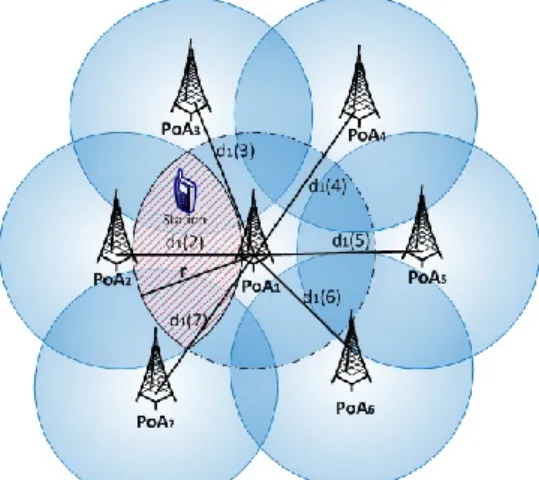
The IEEE 802.21 MIH Information Server (IS) provides mobile devices with fast and energy-efficient channel scanning results. The IS supports the distribution of network information and may provide information about: the available PoAs list and their coordinates (connectivity graph), the services they can provide, channel utilization ratios of each PoA, etc. Figure 4 shows an example of a distance-based connectivity graph provided by the IEEE 802.21 IS, where r is the transmission range of each PoA, di(n) is the lineal distance between the PoAi and PoAn. Making use of this information,
mobile devices can perform unicast scanning (scanning only the PoAs the IS provides) and decrease the total scanning time, removing the channels that are not in the connectivity graph. Consequently, using the IEEE 802.21 MIH standard, mobile devices will be able to scan less than n (total number of channels) channels and decrease the total amount of energy consumed in the network discovery phase.
As mentioned earlier, the aim of the ANDSF protocol is to assist mobile devices to discover non-3GPP radio access networks. Discovery information defined in ANDSF protocol provides list of available access networks including access type technology, radio access networks identifier, etc. Consequently, ANDSF protocol enables mobile devices that are associated with an UMTS interface to discover other RATs, such as WiFi and WiMAX in the vicinity without
switching their interfaces on. Hence, this procedure also reduces both the total channel scanning time and the energy consumed in the scanning phase as the IEEE 802.21 protocol.
Thus, the existing standards and protocols could assist the mobile device during the handover process speeding up the overall handover duration and consequently reducing the energy consumption.
Figure 4. An example of a distance-based connectivity graph
3.4.
Existing Energy Efficient Handover Approaches
There have been many works [45–78] proposed in the literature that focus on energy-efficient interface/network selection. These works are either network-assisted [45–73] or mobile-initiated [74–78] and mainly utilize specific decision strategies to provide energy efficient interface/network selection, such as reputation-based [46], cost-function [47–49], fuzzy-logic [50, 53], context-aware [52, 55, 58, 72], location-assisted [68, 69], history-based [71], etc.
An important amount of interface/network selection algorithms proposed in the literature makes use of the IEEE 802.21 MIH and ANDSF protocols. Some of these works [43–55] summarized below. Sukyoung et al. in [45] propose an IEEE 802.21 MIH-assisted VHO algorithm that aims at balancing the overall load among all PoAs and maximize the collective battery lifetime of mobile devices. Celenlioglu et al. in [46] propose a reputation based VHO algorithm that makes use of the user location pattern. The algorithm also makes use of MIH and Stream Control Transmission Protocol (SCTP) for mobility management. The proposed reputation scheme lets mobile devices achieve energy-efficient vertical handover by considering previous experiences, obtained from previous visits at the same geographical location. Chowdhury et al. in [47] propose a network-assisted cost-function based VHO algorithm where the RSSI, battery status and offered QoS are the input parameters. In order to provide an energy-efficient VHO process, the proposed algorithm uses the MIH power management functionalities. In [48], Frei et al. make use of both IEEE 802.21 MIH and ANDSF protocols. The MIH is used to notify mobile devices about movements, link status, and list of available PoAs. Additionally, the ANDSF is used to get the operator policies that will assist to an energy-efficient PoA selection. Liu et al. in [49] propose a cost-function-based energy efficient network selection procedure among WLAN, WiMax and 3G networks. The proposed architecture is assisted by the IEEE 802.21 network coverage map and makes use of bandwidth, delay and the Wireless Network Interface Card (WNIC) power consumption values as input. In the proposed scheme, handover is triggered according to RSS values in WLAN networks, CINR values in WiMax networks and the application of an exponential moving-average filter.
Chamodrakas et al. in [50] propose an energy-efficient interface/network selection approach based on a modified fuzzy version of Technique for Order Preference by Similarity to the Ideal Solution (TOPSIS) that takes into account both network conditions (with the help of MIH protocol), user preferences, QoS and energy consumption requirements. Additionally, authors in [12, 51] aim to decrease the energy consumption of mobile devices by making use of a smart selective channel scanning approach and associating with a PoA that is expected to consume the least amount of energy
among all PoAs. In these works, the expected amount of energy consumption is obtained by using the channel scanning results, channel busy times (CBTs), RSS and SINR values, traffic class of the station, switching costs, the number of stations deployed in each PoA, and the power consumption of each WNIC. While an IEEE 802.21 MIH-assisted interface/network selection is aimed between 3G and WiFi in [12], an ANDSF-assisted interface/network selection is aimed between LTE-A and WiFi in [51].
Unlike the aforementioned algorithms, Coskun et al. in [52] propose a simple but not an effective interface selection algorithm. The proposed algorithm prefers to connect WLAN if all of three access technologies (WLAN, WiMAX, and UMTS) are available. If the device is not in the coverage of WLAN, then the algorithm connects to WiMAX. If neither WLAN nor WiMAX is available, then the device connects to UMTS. Simply, the order of preference is WLAN [ WiMAX [ UMTS. In addition, Lee et al. in [53] propose an efficient channel scanning scheme by utilizing the Information Element (IE) of the IEEE 802.21 MIIS. The proposed scheme aims to reduce the number of channel scanning on each NIC as full scanning in a heterogeneous wireless environment takes time and consumes an important amount of energy. Trestian et al. in [54] utilizes specific parameters (e.g., user mobility, user preferences, application requirements, and network conditions) and proposes an energy-efficient MIH-assisted network selection procedure for multimedia delivery over wireless heterogeneous networks. The proposed method increases the battery lifetime of mobile devices by selecting the network that offers the best energy-quality trade-off, while performing multimedia content delivery. In [55], a geo-referenced-based network selection that aims to increase the mobility of mobile devices is proposed. The proposed scheme makes use of GPS, power consumption values in each NIC, list of available PoAs and IEEE 802.21 protocol to decide when and where to handover.
There have been works [56–58] that focus on interface/network selection by making use of central servers or controllers. For instance, Nam et al. in [56] propose a VHO algorithm referred to as WISE, in tightly coupled systems that utilizes a centralized entity called the Virtual Domain Controller (VDC). The authors indicate that 3G network interface consumes more energy in transmission state, but less energy in receiving and idle state. Hence, in WISE, interface switching between 3G and WLAN networks operates independently on both the downlink and the uplink for the purpose of energy conservation. Lee et al. in [57] make use of Serving GPRS Support Node (SGSN) and propose a power-aware communication protocol between WLAN and WWAN networks. Whenever the device enters the idle state, the proposed method turns the WLAN interface off and maintains its connection using the WWAN interface. Whenever the number of packets in the radio network controller’s buffer reaches a certain threshold, WLAN interface is re-activated by using the existing paging of WWANs. Additionally, Zhang et al. in [58] propose an energy man-agement mechanism that increases users’ energy efficiency in non-saturated wireless heterogeneous network by making use of both a central server and the ANDSF protocol. The proposed method provides energy efficiency, balancing the user preferences and their energy requirements.
Apart from the works that utilize either VHO standards or central servers, other pro-posed solutions [59–63] aim to associate with the most energy-efficient interface/network, using an expected energy consumption model. For instance, Pons et al. in [59] dynamically estimate the network/interface that is expected to consume the least amount of energy for the uplink traffic between WLAN and LTE networks. In [60], it is shown that achievable energy efficiency can be calculated by means of a simple expression, requiring only a limited amount of local and network-related information (e.g., data rate, throughput, channel fading and network load) for the networks employing Proportionally Fair Access (PFA). Kim et al. in [61] also propose a network/interface selection method called AWNIS that is based on mathematical modeling of energy consumption and data transfer delay patterns. The proposed method chooses a PoA, taking the link quality into account and adjusting a dynamic network/interface selection interval according to the network environment. Similar to [57], Seo et al. in [62] and Lee et al. in [63] also propose an interface selection method that turns the WLAN interface completely off, without any periodic wake-up, during the idle state to save energy. In the proposed method, existing out-of-band paging channels (PCHs) of cellular networks are exploited within the mobile stations. These schemes may reduce the total energy consumption dramatically in case each duration in the idle state is known beforehand. However, it is not an easy task to predict the exact idle time of a station and hence, the station may stay in long transmission/receiving states using the proposed method. Additionally, this method is effective only for tightly-coupled systems that makes the WLAN appear to the 3G core network as another 3G access network.
Furthermore, Choi et al. in [64] and [65] propose an energy-efficient network-scanning algorithm for integrated IEEE 802.16e/802.11 networks. In order to achieve energy efficiency, 802.16e Base Stations (BSs) periodically broadcast the information about the density of 802.11 APs within their cell coverage. In this context, the proposed scheme forecasts the effective scanning probability during a given scanning time. Authors in [66] propose a multiple criteria decision method to estimate the expected lifetime of stations in a heterogeneous wireless environment (CDMA, WiBro, WLAN). The proposed method makes use of Analytic Hierarchy Process (AHP) and Grey Relational Analysis (GRA) and takes the bandwidth, BER, jitter, delay, cost, QoS, and battery lifetime as input parameters.
Petander et al. in [67] considers the handover operation between WLAN and UMTS networks on an Android mobile phone and examines energy consumption values. The results indicate that the energy consumption of UMTS is approximately equal to WLAN as a function of transfer time. However, for bulk transfers, the results indicate that transferring a byte of data using UMTS may require much more energy (over a hundred times) than using the WLAN. In this context, the proposed approach makes use of traffic load estimations according to Signal to Noise Ratio (SNR) and network load provided by the Home Agent (HA). The proposed scheme uses the aforementioned information to compute a threshold for the UMTS to WLAN handover operation. Moreover, handover from WLAN to UMTS is automatically initiated once the station leaves the coverage area of a WLAN. Additionally, Yang et al. in [68] and [69] propose an energy-efficient interface selection for integrated WiMAX-WLAN networks making use of the Geographic Mobility Awareness. The proposed method initiates a handover candidate selection based on historical handover geographic patterns, utilizing the RSS of the networks and the velocity of the station. Additionally, Desset et al. in [70] propose an energy-efficient handover decision strategy for both uplink and downlink data transmission between WLAN and WiMAX networks. In this context, the authors first examine related metrics, such as channel fading fluctuations, extraction of MAC-level behavior, packet error rates, and overall power consumption in each state. Then, authors present a handover controller to find the network that has the lowest expected power consumption for the required transmission rate.
Rahmati et al. in [71] express the selection of wireless interfaces/networks as a statistical decision problem. In this context, authors explore various context information metrics, such as the time, history, cellular network conditions, and device motion, to statistically estimate Wi-Fi network conditions without powering up the network interface. Xenakis et al. in [72] propose an energy-efficient interface/network selection algorithm that makes use of parameters such as the network congestion, SINR level, offered QoS on the target PoA, remaining battery lifetime at the mobile station, energy consumption on the current PoA, charging policy and user preferences. Nevertheless, this work mainly uses the same analytical power consumption estimation for different radio access technologies, which results in imprecise computations. In [73] Fan et al. propose an energy-efficient interface selection strategy for real-time and non-real-time applications based on fuzzy logic that considers network conditions, user preferences and QoS requirements.
All the aforementioned energy-efficient vertical handover approaches are mainly net-work-assisted approaches and they are initiated utilizing the information remotely obtained from networks. However, there are also some approaches [74– 78] that are initiated using only the local information obtained by the mobile station itself. For instance, In [74], Kanno et al. propose an energy-efficient interface selection scheme according to the traffic-type of the application running on the mobile station, as energy requirements of different traffic-types will be different. For instance, a non-real-time application, such as a file download consumes energy until the end of its process, mainly staying in the receiving state. However, a real-time application, such as a voice communication, consumes energy both in transmitting, receiving and idle state, as it does not always have a frame in its queue to transmit or receive. Additionally, Ikeda et al. in [75] propose a new way of measuring signal to interference and noise ratio (SINR) at a low level of power consumption for vertical handover. In this scheme, the SINR values of the other RANs in the vicinity are measured at a certain interval while communicating with the existing RAN. In [76], energy is saved by proposing a method that activates the network interfaces with a location-based wireless network discovery, instead of keeping them ‘‘alive’’ continuously. However, the energy saved using this method is inversely proportional to the frequency of activations of the interfaces. Besides, GPS solutions are not that practical in indoor or urban environments. In [77], Araniti et al. focus on green interface selection policies and aim to guarantee an efficient management of the power consumed by base stations (BS) and reduce the unnecessary handovers. In this context, the proposed scheme rejects the inbound handover requests from the stations with high mobility and allows only the handovers that do not increase the overall transmitted power of the BS target. Finally in [78], Harjula et al. propose an approach, referred to as e-Aware, to estimate the impact of the
application layer protocol properties on the energy consumption of mobile devices operating in 3G and WLAN networks. The proposed energy consumption model is a mathematical model that estimates the energy consumption of network operations, such as signaling and media transfers.
Apart from the energy-efficient network/interface selection approaches, there are also some works that examine the total amount of energy consumed by mobile devices from various angles, such as the architecture, operating system, available resources, etc. For example, in [79] the authors examine the energy consumption characteristics of two approaches of tight coupling architectures. While the first approach is the case when only one interface is active at a time, the second approach is the case when both interfaces may be concurrently active. Additionally, Wang et al. in [80] presents the results of real-time measurements of uplink and downlink power consumptions of EDGE, HSPA and 802.11 radio interfaces. In this regard, the authors suggest that the data must be transmitted/ received as bursts to keep the interfaces in low power-consumption mode for longer. Furthermore, power consumptions of base stations for mobile WiMAX, HSPA, and LTE are modeled, based on the coverage of the base station, in [81].
4.
E
VALUATION OFE
NERGY-E
FFICIENTV
ERTICALH
ANDOVERP
ARAMETERS ANDA
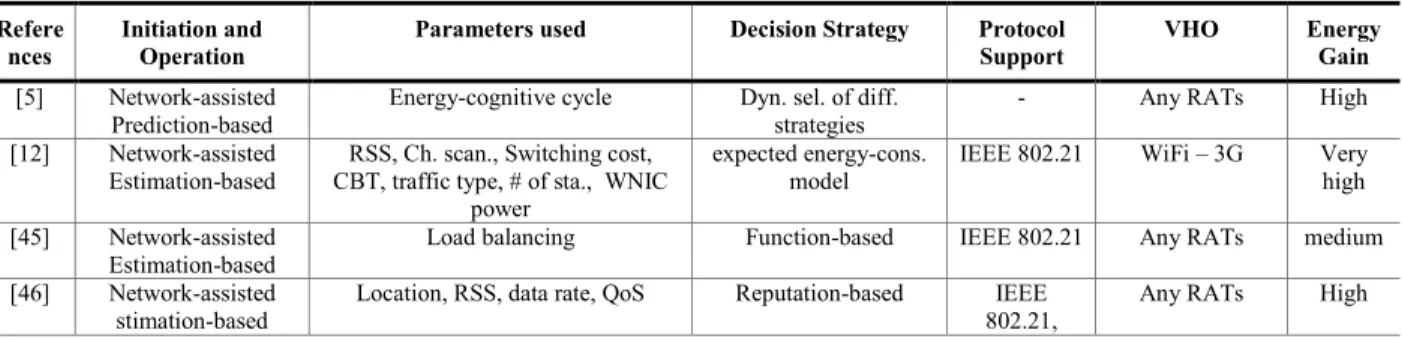
PPROACHES Previous works from the literature compare the power consumption of pairs of two net-works, such as: WiFi–3G [12], WiFi–LTE [34, 79], 3G–LTE [82] and LTE–WiMAX [83] networks. To the best of our knowledge, there is no single work that compares the power consumption of the four aforementioned RATs in the literature. Although comparisons are not performed by a single work and the results may vary due to different test-beds and simulation environments, the general and also the accepted opinion is that a station con-nected to a WiFi network consumes the least power in case the network is not highly loaded and has a good signal strength. Additionally, the works presented in [82] and [83] show that LTE and WiMAX interfaces consume similar amount of powers to transfer the same amount of throughput, whereas 3G interface mainly consumes less power than both of these interfaces.However, it should be noted that there are many factors that may affect the amount of power consumption, such as received signal strengths, RAT interference, bit error rate, channel utilization, number of connected stations, etc. Hence, a station may even save power by switching from WiFi to a 3G, LTE or WiMAX network. In this regard, a comparison is proposed in Table 2 to summarize features and amount of energy savings of the algorithms presented in the Sect. 3. Table 2 shows that high amount of energy can be saved by utilizing as many parameters and protocols as possible, unless additional message exchanges resulting from these parameters and protocols are not damaging (e.g. additional delay, power consumption, memory and CPU requirements, etc.) the ongoing network operations. In other words, vertical handover approaches may utilize a large set of local and network-related parameters. Nevertheless, higher network overhead, resulting from additional parameters and protocol support, may lead to increase in delay, handover duration, processing power and finally more energy consumption. Considering a small set of parameters might improve the energy efficiency but at the cost of handover accuracy. Thus, a balanced number of parameters need to be considered to maintain a good trade-off between the energy efficiency and the handover accuracy. As an example, IEEE 802.21 protocol support enables stations to save considerable amount of energy as the protocol broadcast up-to-date network coverage map and available PoA list, in return for limited number of message exchanges. In contrast, energy saving might be low (might be even worse than when not used) if GPS is used to locate stations, since it also consumes high amount of energy.
Refere
nces Initiation and Operation Parameters used Decision Strategy Protocol Support VHO Energy Gain
[5] Network-assisted Prediction-based
Energy-cognitive cycle Dyn. sel. of diff. strategies
- Any RATs High
[12] Network-assisted Estimation-based
RSS, Ch. scan., Switching cost, CBT, traffic type, # of sta., WNIC
power
expected energy-cons. model
IEEE 802.21 WiFi – 3G Very high [45] Network-assisted
Estimation-based Load balancing Function-based IEEE 802.21 Any RATs medium [46] Network-assisted
stimation-based
Location, RSS, data rate, QoS Reputation-based IEEE 802.21,
SCTP [47] Network-assisted
Prediction-based
energy, QoS, RSS Function-based IEEE 802.21 Any RATs High [48] Network-assisted
Prediction-based operator policies, IEEE 802.21 network information, RSS Mult. attr. dec. (MADM) IEEE 802.21 UMTS to others High [49] Network-assisted
Estimation-based
Net. coverage map, Ch. scan., RSS, bandwidth, delay, trigger time
Function-based IEEE 802.21 WiFi - 3G - WiMax
High [50] Network-assisted
Estimation-based
user pref., QoS, energy cons. Amount, RSS
Fuzzy-logic Topsis IEEE 802.21 Any RATs Very high [51] Network-assisted
Estimation-based
SINR, list of cand. PoAs, WNIC power
expected energy-cons. model
ANDSF LTE-A - WiFi Very high [52] Network-assisted
Prediction-based
Coverage, list of PoAs, min. nr. of handover
Context-aware IEEE 802.21 UMTS WiFi -WiMax
Low [53] Network-assisted
Estimation-based
link_going_down, consistency check, Inf. element
Fuzzy-logic IEEE 802.21 Any RATs Low [54] Network-assisted
Estimation-based
User mobility & preferences, app. requirements, net. condition
Utility function based IEEE 802.21 WiFi - UMTS Very high [55] Network-assisted
Prediction-based
WNIC power, list of av. PoAs, locations, GPS
Context-aware IEEE 802.21 WiMax - WiFi Medium [56] Network-assisted
Prediction-based
WNIC power, RSS, traffic load Function-based virtual domain controller WiFi – 3G Very high [57] Network-assisted Estimation-based
SSID list of PoAs, buffer threshold, paging messages expected energy-cons. model Serving GPRS Support Node
WiFi - WWANs Very high [58] Central Server
Estimation-based Users energy balance, list of av. networks, location Context-aware Central server, ANDSF
LTE – WiFi High [59] Network-assisted Estimation-based SNR, throughputs, # of sta., Ch. utilization expected energy-cons. model
- LTE – WiFi Very
high [60] Network-assisted
Estimation-based
Data rate, throughput, Ch. fading, network load
expected energy-cons. model
- Any RATs Low
[61] Network-assisted Estimation-based
Data rate, WNIC power, data transfer delay expected energy-cons. model - 3G – WiFi High [62] Network-assisted Estimation-based
requested QoS, session-timer, out of band PCHs, GPS expected energy-cons. model - 3G – WiFi Very high [63] Network-assisted Estimation-based
Out of band PCHs, RNC buffer, expected energy-cons. model
SGSN WiFi - UMTS Very high [64,
65]
Network-assisted
Consumption-based
Ch. scanning, RSS, cost, delayed traffic delivery
Function-based - WiMax - WiFi Medium [66] Network-assisted
Prediction-based
Bandwidth, jitter, BER, delay, cost, battery lifetime
Multiple attr. dec. (MADM) - CDMA, WiBro, WiFi High [67] Network-assisted Estimation-based
Traffic load, SNR, coverage Function-based - WiFi - UMTS High [68,
69]
Network-assisted Prediction-based
RSS, geographic mobility function, velocity
Location-assisted - WiFi - WiMax Medium [70] Network-assisted
Estimation-based
Ch. fading fluctuations, BER, WNIC power, Ch. scanning, VHO cost
Multiple attr. dec. (MADM)
- WiFi - WiMax Very high [71] Network-assisted
Estimation-based
Time, history, cellular net. cond., motion
Context-aware - WiFi - UMTS Very
high [72] Network-assisted
Prediction-based
SINR, net. congestion, offered QoS, battery lifetime, user preferences
Context-aware - Any RATs Medium
[73] Network-assisted Estimation-based
CINR, user pref., QoS req., Fuzzy logic - Wwan - Wman High [74] Mobile initiated
Prediction-based
battery status, QoS, App-type, energy consumed per bit
Function-based - Any RATs Medium
[75] Mobile initiated
Measurement based
SINR, SINR fluctuations, congestion, battery lifetime, QoS
SINR measurement-based
- Any RATs Low
[76] Mobile initiated Estimation-based
Periodic interface activation, GPS location
Location-assisted - Any RATs Low
[77] Mobile initiated Prediction-based
SINR, av. bandwidth, min. nr. of handover, speed
Multiple attr. dec. (MADM)
- LTE HetNets Medium [78] Mobile initiated
Estimation-based
Packet size, inactivity timers, delay between timer switches
Long term power cons. model