WORKING DOCUMENTS
W 107
ADMINISTRATIVE CAPACITY
DEVELOPMENT
A RACE AGAINST TIME?
A.J.G. Verheijen
2
33
PREFACE
This study addresses the development of the general administrative capacity in Central and Eastern European countries. Such capacity is vital for their proper functioning as members of the EU. The study identifies deficiencies both in the
candidate countries and in the administrative system of the Union itself, and subsequently it explores ways to cope with these shortcomings.
This working document has been written for the project ‘Enlargement of the EU to
Central and Eastern Europe’, which the Netherlands Scientific Council for Govern-ment Policy (WRR) is currently undertaking. As such, it contributes to answering
the central questions of this project: to what extent will enlargement cause problems for the proper functioning of the Union, and, hence, to what extent will reform of the existing institutions be needed to maintain their effectiveness, legitimacy and cohesion?
In preparing for its forthcoming report to the Dutch government on these matters, the WRR has commissioned a number of studies and assessments. Background
studies on ‘closer co-operation within the EU’ and on ‘higher education in Central
and Eastern Europe’ have recently been published. Other studies will be published in the months to come.
At the time this study was commissioned, the author, dr. A.J. G. Verheijen, was director of the International Programme at the Department of Public
Administration at the Leiden University. At present, he is working at the United Nations Development Programme in Bratislava, as Chief Technical Advisor on Governance.
Prof. Michiel Scheltema Chairman WRR.
55
CONTENTS
1 Introduction 7
2 Administrative requirements for EU
member-ship; the ongoing debate 13 2.1 EU competencies in relation to the administrative system
of (candidate) member states 13
2.2 Brief review of the experience of earlier enlargements 14 2.3 The situation for the current candidate states 14 2.4 Formal administrative capacity requirements for
functioning effectively in the EU 15
2.5 SIGMA baselines: a new step in the development of
assessment criteria 17
2.6 Conclusions 19
3 Fulfilling the requirements for functioning
in the EU 23
3.1 A world of contrast: increasing reform announcements –
continuing negative assessments 24
3.2 A comparative inventory of administrative development 26 3.2.1 Creating a professional and reliable civil service 26
3.2.2 Developing training systems 29
3.2.3 Structural reform and re-designing the policy process 32 3.2.4 Conclusion on the comparative review 38 3.3 Explaining limited progress in administrative capacity
development 39
3.3.1 The absence of ‘success factors’ 40
3.3.2 The presence of ‘interfering variables’ 43 3.3.3 Limited prospects for rapid improvement? 44
4 Ways of dealing with deficiencies: a review of
alternatives 49 4.1 The indirect effect of admitting member states with
deficient administrative systems 49
4.1.1 Administrative capacities and the principle of mutual
trust 50
4.1.2 Ensuring compatibility between EU accession and
6
4.2 Possible ways of averting threats to the EU system 53 4.2.1 Ways of addressing remaining administrative
deficiencies 53 4.2.2 Addressing administrative capacity problems as part of
an overall adaptation of the EU administrative system 55
4.3 Finding an optimal mix of measures 58
5 Conclusions 61
7
1 INTRODUCTION
This background study, prepared for the Scientific Council for Government Policy (WRR), assesses the implications of enlargement with the candidate states from
Central and Eastern Europe for the EU as a political and administrative system.
The objective of the study is threefold:
1 to provide insight into the nature of administrative capacity requirements for effective participation in the EU system. The paper will mainly focus on the
development of general or horizontal administrative capacity requirements, as these are an important but often underestimated element of the EU
member-ship requirements;
2 to analyse and assess the development of general administrative capacities in the ten candidate states from Central and Eastern Europe, as well as to identify the main factors that influence the development of modern and effective systems of public administration in these states;
3 to identify possible ways in which the implications of the ‘Eastern
Enlargement’ for the functioning of the EU as a political and administrative
system can be addressed.
The presence of adequate sectoral administrative capacities to guarantee the application of the acquis communautaire has always been part of the assessment of candidate states, even though in previous enlargement rounds this never was a key issue in the preparation and negotiations for membership. The administrative capacity of candidate states was either deemed sufficient (Austria, Finland and Sweden) or not considered a stumbling block for accession (earlier Mediterranean enlargement and the 1973 enlargement). The assessment of general or horizontal administrative capacities, however, is a rather new issue in the EU enlargement
process.
The increasing importance attached to meeting administrative capacity requirements can be seen both as an expression of general scepticism about the quality of the administrative systems of the candidate states, and as an illustration of the ever higher threshold which new member states will have to cross, mainly as a result of the completion of the Internal Market.
The increasing pre-occupation of the European Commission with sectoral administrative capacity requirements, ever more obvious in recent years, can be understood mainly as an expression of concern with enforcing Internal Market standards in an EU of 27+ member states. However, even though the presence of
adequate sectoral capacities is indeed a crucial capacity requirement, it is also important to devote adequate attention to bringing the general or horizontal administrative capacities (i.e. civil service system, policy processes) of candidate states up to the required level. The two key reasons why the development of adequate horizontal capacities is important are:
8
1 Sectoral capacities cannot develop in isolation; even if capacities in key sectoral areas are brought up to the required levels, the effect of this will be at most temporary if the overall administrative system is not functioning effectively.
2 It is important to guarantee that the European policy process will be able to function effectively with 27+ member states. A relative similarity in levels of quality of the institutional systems of the member states is a necessary requirement for this. Too much differentiation in administrative capacities between member states could pose a serious threat to the ‘modus operandi’ of the EU as a politico-administrative system, which is based on mutual
confidence between member states in each others institutions. This point has become all the more relevant in view of the already existing problems in the
EU system. Mutual confidence has been eroded as a result of the problems some member states faced in coping with the workload generated by the completion of the Internal Market, and due to recent conflicts between member states, for instance in relation to the handling of the BSE crisis.
General administrative capacity criteria were developed late in the process of defining and operationalising the EU membership criteria, which were first defined in a general way in the Copenhagen European Council Summit conclusions in June 1993. Explicit reference to horizontal administrative capacity requirements was made for the first time in the Madrid European Council Summit conclusions in December 1995. Whereas capacity requirements are relatively clear cut in matters of democracy or the Internal Market, in the area of administrative capacities a broadly shared understanding of membership requirements has been defined only very recently.
The assessment of administrative capacities has been complicated by the lack of competencies of the European Union with regard to public administration. The European Commission, which plays a central role in the enlargement process, lacks the necessary expertise, in part as a result of its lack of involvement in this area. It can therefore hardly come as a surprise that the debate on administrative criteria for EU membership has for a long time been limited mainly to a debate on
sectoral technical administrative capacities required to implement the acquis com-munautaire. Horizontal administrative capacities (professional civil service, well-developed accountability system, clear administrative structure, adequate horizon-tal management functions) were assessed in a rather general way in the Commis-sion Opinions (July 1997) and the Regular Reports on Progress (November 1998) only recently defined these in more detail. The 1999 Regular Reports on Progress are more comprehensive than the previous assessments in their analysis of hori-zontal administrative capacities.
The 1999 Reports used a new assessment system for the analysis of horizontal administrative capacities. The assessment system was developed by the SIGMA1
9 programme, which is funded mainly by the EUPHARE programme, at the request of
the European Commission. The development and application of this assessment system is the latest step in the still ongoing process of defining an ‘administrative acquis’, which could eventually lead to the definition of some form of minimum standard for administrations of EU member states.
The process of defining administrative capacity requirements could well have significance beyond the current enlargement process. For this reason alone it is an important issue in the ongoing debate on what kind of European Union will be able to deal with the accession of ten to twelve highly diverse new member states. At the same time, however, it is important to stress the special nature of the process of administrative development in Central and Eastern European states. The transformation of administrative systems, which were a key instrument of suppression in the hands of politicians under the former regime (Verheijen 1995), into professional and reliable administrations ready to function in the complex politico-administrative system of the EU is a daunting task. In this respect the
possible points of comparison with earlier enlargement processes are rather limited. The administrations of Spain, Portugal and Greece, states which had also gone through a transition to democracy just before joining the EU, were of a very different nature. Even though the administrations of Spain, Portugal and Greece, like the administrations of the current candidate states, required modernisation at the time of membership, they did not carry a similar burden of having been a key instrument of suppression under the previous regime (Verheijen 1995). Still, the problems these states faced after joining the European Union, in terms of administrative capacities, were considerable and their response to these problems was diverse. Whereas EU membership was a catalyst for administrative reform in
Spain and, even more so, in Portugal immediately after accession, the Greek response to EU membership, in terms of administrative modernisation, was for a
long time inadequate. Only during the last few years has a concerted effort been made to bring the Greek administration in line with EU requirements. It is
important to ensure that the response to EU membership in the current candidate states will bear similarity to the Spanish and Portuguese cases, rather than to the Greek case. In this respect it is imperative for the EU and the member states to
learn from this earlier experience and apply the right set of incentives to ensure that membership will be a catalyst for administrative modernisation in the states of Central and Eastern Europe. Unfortunately little research is available that could explain the difference in response to EU membership in terms of administrative modernisation between Portugal and Spain on the one hand and Greece on the other. A further reflection on this issue would be a useful step in defining an appropriate policy to stimulate administrative development in the current candidate states.
However, it is important to stress the specific background of the current candidate states in terms of administrative history, which certainly puts them in a more diffi-cult position than Spain, Portugal and Greece at the time of their accession.
10
In view of this, even if the current candidate states make the same effort in administrative modernisation as Portugal and Spain, this might still not be sufficient to bring their capacities to the required level. One should therefore consider the possibility that they will not have fully operational capacities to function in the EU after accession. Therefore, it is essential to consider possible options to enable the EU as a political system to deal with the impact of the
‘Eastern Enlargement’.
First, the incorporation of a large group of new member states with inadequate capacities to function effectively in the EU would put at risk a key principle
under-lying the EU policy-making system: the mutual confidence between member states in the capacities of each others institutions. This mutual confidence was stretched to the limit by the Southern enlargement in the 1980s, and whereas the three Southern European states have, by now, generally been able to gain the confidence of all other member states,2 one should remember that this process took some
time and that these states joined a very different EU. It is not clear whether a
system built on mutual confidence will be able to incorporate ten Central and Eastern European states, if these are perceived as having inadequate adminis-trative capacities.
Second, it would be important to take this line of reasoning one step further and address the question whether in any event the EU as a politico-administrative
system can continue to function when some twelve or more new member states will join, irrespective of the new member states’ administrative capacities. The question of the division of labour in the EU politico-administrative system between the Commission and the member states should be reflected upon as soon as possible, in order to avoid a paralysis in the EU system after enlargement. In conclusion, three key issues have been raised in this introduction: • the problem of defining administrative capacity requirements for EU
membership and the risk of neglecting them as a result of the current EU focus on sectoral requirements;
• the potential problems faced by Central and Eastern European states in meeting these requirements;
• the need to reflect on ways to address the consequences of enlargement for the EU as a political and administrative system.
Taking into account these three issues, this study is divided in three core sections. The first section focuses on the definition of administrative capacities for states to function effectively in the EU. The discussion in this study will concentrate on the
ongoing process of defining horizontal administrative capacities and the extent to which this will lead to the creation of an ‘administrative acquis’.
The second section assesses the extent to which horizontal administrative capacity requirements are currently met by the administrations of the candidate states. The
11 discussion in this section will focus on the development of civil service systems,
the creation of training capacities and the process of restructuring state adminis-tration, including the development of modern accountability systems. The section will include an analysis of factors that influence the process of creating profes-sional and reliable administrations.
The final section will review possible measures that could be taken to allow the EU
as a political system to cope with the consequences of taking in new member states which might not, at the time of entry, fully meet administrative capacity require-ments.
This study is based on material drawn from academic research on administrative capacity development in Central and Eastern Europe, publications from the European Commission, the World Bank, SIGMA and the inventory of higher
education and training programmes, carried out by the European Public Administration Association (EPAN) and the Network of Institutes and Schools of
12
NOTES
1 Support for the Improvement of Governance and Management in Central and
Eastern Europe, funded mainly by EU PHARE and implemented by the OECD. 2 With the possible exception of Greece, but confidence in Greek capacities to
function in the EU has increased significantly in the last few years.
3 Funded by the EU SOCRATES programme and the Local and Government and
Public Service Initiative under the Open Society Institute, Budapest, see bibliography for reference (Verheijen and Nemec).
13
2
ADMINISTRATIVE REQUIREMENTS FOR EU
MEMBERSHIP; THE ONGOING DEBATE
2.1 EU COMPETENCIES IN RELATION TO THE ADMINISTRATIVE SYSTEM OF
(
CANDIDATE)
MEMBER STATESThe direct influence of the EU on the administrative systems of its members is limited. In fact, the EU has almost no direct competencies in this area. The
ad-ministrative organisation of the member states is a matter of these states alone.1
However, there are several sources of indirect influence of EU membership on
member state administrations.
First, member states are obliged, under article 5 of the Treaty of Rome, to take all the necessary measures to fulfil the obligations arising out of EU membership. This
provision has serious implications for the administrative capacities of member states. Their administrations must have the capacity to ensure the ability of the state to participate in the EU decision-making process, to ensure the timely imple-mentation of EU regulations, directives and decisions. In addition, they need to
manage effectively the budgetary means provided by the EU under, for instance, the Common Agricultural Policy, the European Regional Development Fund, the European Social Fund and other EU policies and programs. Member states can be
brought before the European Court of Justice if they do not meet their Treaty obligations2 and fines can be imposed on them. This indirect provision is the most
important Treaty-derived legal basis for the EU to judge the administrative
suitability of candidate states.
The EU could also use a broad interpretation of Article 6 of the Treaty on European
Union (Former Article F), which stipulates that the Union respects the funda-mental rights, as warranted by the European Convention on the Safeguard of Human Rights. This obviously applies only if member states agree to use this pro-vision between themselves. This propro-vision has more serious potential implications for candidate states. At least in theory, a state cannot join the European Union that is unable to guarantee that in its interactions with citizens its administration acts consistently on the basis of the principles set out in this Convention.
As a last point, regardless of the limited direct influence of the EU on the
develop-ment of the public administration of its member states, it has often been argued that the long term co-operation of states inside the political system of the EU has
led to a certain approximation in the way their administrative systems operate. This long term intensive co-operation inside a political system has created what Fournier calls a ‘European Administrative Space’ (Fournier 1998). New member states must be able to function effectively inside this European Administrative Space.
14
2.2 BRIEF REVIEW OF THE EXPERIENCE OF EARLIER ENLARGEMENTS
The next question of relevance is to what extent the European Union in the past used administrative capacities as a criterion in decisions on whether or not to accept candidate states. The answer to this question is rather straightforward; in earlier enlargements the EU did not devote significant attention to administrative
capacities as a membership criterion. Certainly doubts could have been cast upon the adequacy of the administrative capacities of Greece, Spain and Portugal. These doubts are even valid if one takes into account that the Community these states joined was a very different, less complex and developed organisation when compared to the present European Union.3 In Cold War Europe, however, the
stabilisation of the new democratic systems of government in these states was considered more important than their real ability to function in the European Communities.
During the latest round of enlargement, which in 1995 brought Austria, Finland and Sweden into the EU, no questions were raised regarding their administrative
capacities. The administrative ability to operate in the EU was not a real issue in
the membership negotiations with these states, which traditionally have well-developed administrative systems. Furthermore, these states had previously been part of the European Economic Area, and therefore had at least a partial experi-ence of working inside the EU political system. It should be noted, however, that
even the states with advanced administrative systems experienced certain pro-blems in adapting their administrative systems to full participation in all aspects of the EU system. In the Swedish case these problems were mainly related to Swedish
participation in the ‘upstream’ part of the European policy process;4 to a lesser
degree this applied to Austria as well. The Austrian system also faced problems in the implementation of directives, as this required the involvement of the Länder. These problems were addressed through the inclusion of a mechanism which allowed the federal government to ‘take over’ the responsibilities of the states in implementing EU policies if they were not able to meet their obligations.
2.3 THE SITUATION FOR THE CURRENT CANDIDATE STATES
The candidate states face a very different situation when compared to the states which joined the EU in the previous rounds of enlargement. Administrative
capacities have become an increasingly important issue for the EU, not only in
relation to the enlargement with the states of Central and Eastern Europe, but also for the accession process of other candidate states, such as Cyprus, Malta and Turkey.5 A combination of factors caused this change in approach.
A first factor is the rapid progress in the development of the EU after the so-called
first (Greece) and second (Spain and Portugal) Mediterranean enlargements. The second Mediterranean enlargement led to a revision of the Treaties of the
Euro-15 pean Communities, culminating in the Single European Act adopted in 1986. The
Single European Act helped to break the decision-making deadlock, which had virtually paralysed the European Communities for almost two decades, and created the conditions for the completion of the Internal Market. The completion of the Internal Market, in turn, made adequate administrative capacities so as to be able to function in the EU into an important requirement; too wide a divergence
in administrative capacities between member states to transpose and effectively implement EU legislation could lead to serious distortions in the functioning of the
Internal Market.
A second factor which can help to explain the increased interest in adequate ad-ministrative capacities as an EU membership requirement is the change in attitude
in the European Commission brought about by the change in Commission presi-dent and the increasing ‘peer pressure’ exerted by member states on one another. The appointment of Jacques Santer as Commission president in 1995 led to the European Commission devoting more attention to the ‘performance’ of the EU as a
political system, a trend which is likely to continue under the Prodi Commission. The regular publication of league tables of member states, listing the extent to which they meet their membership obligations, has exposed significant gaps in ‘performance’ of member state administrations. Statements of Member States which generally perform well accompanied Santer’s actions in this area. These states, the UK in particular, have increasingly started to demand publicly that the
under-performers clean up their act, driven by entrepreneurs who feel that they are subject to unfair competition from companies in states which generally lag behind in implementing EU decisions.
Finally, the experience of the EU in working with the candidate states has raised questions about the level of their administrative capacities. The disbursement and absorption problems the main assistance program of the EU, the PHARE program,6
has faced, as well as the perceived limited progress in the development of new ad-ministrative systems in Central and Eastern European states, have led both EU
officials and the member states to raise questions about the administrative pre-paredness of this group of candidate states.
2.4 FORMAL ADMINISTRATIVE CAPACITY REQUIREMENTS FOR FUNCTIONING EFFECTIVELY IN THE EU
The European Union explicitly defined its membership criteria for the first time at the Copenhagen European Council in June 1993. Initially, these criteria did not include a clear reference to administrative capacity requirements. The main criteria imposed on candidate states in terms of their internal readiness7 to join
gover-16
nance, the creation of a working market economy and a proven capacity to absorb and apply the acquis communautaire.
The first more explicit indication that general administrative capacities were considered to be an important issue in the enlargement process was provided by the references made to administrative capacities in the ‘White Paper on the Pre-paration of the Associated Countries of Central and Eastern Europe for Integration into the Internal Market of the Union’. The White Paper makes extensive reference to sectoral administrative requirements, while making more limited statements on the necessary ‘horizontal’ capacities required to function in the EU.8 The
conclu-sions of the Madrid European Council, in December 1995, for the first time men-tioned adequate administrative capacities as an explicit criterion for membership, without, however, addressing the issue in more detail.
The first time administrative capacity was used as a criterion in its own right was in the Commission Opinions, issued in July 1997. In these opinions references were not only made to administrative capacities to deal with the absorption of specific elements of the acquis communautaire, but also to the need to develop general administrative capacities. Furthermore, the opinions showed the contours of what the European Commission considers to be an adequate administrative system. The criteria were developed further in the Commission Regular Reports on Progress, published in November 1998.
References to administrative capacities can be found in the Opinions and Progress Reports under the section on the executive in the chapter on political criteria and in the section on ‘Administrative Capacity to Apply the Acquis’. Even though actually the latter section largely is a sectoral evaluation of administrative capaci-ties in crucial policy areas, it also makes reference to general administrative capacities.
The Opinions and Progress reports, even though often merely implicit in their references to general administrative development, until recently provided the best insight in what the EU requires of candidate states in terms of the civil service
system. The main issues referred to in the Opinions and Progress reports in rela-tion to the general quality of the public administrarela-tion include:
• the development of an impartial and professional administration (based on a civil service law);
• the development of a training system;
• adequate policy development and policy co-ordination capacities;
• an effective accountability system (with particular emphasis on the system of Internal and External Financial Control);
• the extent to which special structures and procedures have been put in place to manage EU affairs.
17 Another question that was raised in several of the Opinions is whether states had
adopted an administrative reform strategy to deal with deficiencies identified in the Opinions. Other documents prepared by the European Commission, for in-stance the Accession Partnerships and the conclusions of the Cardiff European Council, as well as statements from Commission officials, generally affirm the above direction.
It is, however, important to consider these criteria in the right perspective. It seems inconceivable that a state could be refused entry into the EU on the basis of the administrative capacity requirements alone. Furthermore, the fact that the Commission decided to dedicate its pre-accession assistance to ‘institution buil-ding’9 almost exclusively to sectoral assistance, indicates that the main priority of
the European Commission remains the readiness of the candidate states to imple-ment the acquis communautaire in sectoral areas.
In addition to the necessity of meeting the requirements of the EU, candidate states
also have a self-interest in trying to develop an effective administration. Expe-rience from previous enlargements has shown that states which do not set up effective structures and procedures for the management of EU policy-making (defining national positions on Commission proposals, taking policy initiatives in Second and Third Pillar areas, managing the presidency etc.) tend to ‘lose out’ in the policy process and face difficulties in meeting membership obligations.
2.5 SIGMA BASELINES
:
A NEW STEP IN THE DEVELOPMENT OF ASSESSMENT CRITERIAThe preparation of the Commission Progress Reports in 1999 was, as far as ad-ministrative capacity assessment is concerned, based on inputs provided by a new assessment tool: the SIGMA baseline assessment. This system is a response to the
lack of specificity in horizontal administrative capacity assessment, combined with the perceived lack of accuracy by candidate states of previous assessments. The
SIGMA programme, which operates under the OECD Public Management Service (PUMA) and is funded mainly by the EUPHARE programme, has been one of the
main ‘tools’ of the European Commission in promoting capacity development in public administration in Central and Eastern Europe, as well as a technical assis-tance service to the candidate states. The unique position of the programme, often serving as an intermediary between the Commission and the candidate states, was used to develop an assessment system which would provide the Commission with better information while at the same time providing candidate states with assuran-ces that assessments would be fair and objective. The ‘test’ of this assessment tool in the preparation of the 1999 Progress Reports constitutes a major step forward in the definition of minimum standards for horizontal administrative capacities required to function effectively in the EU’s politico-administrative system.
18
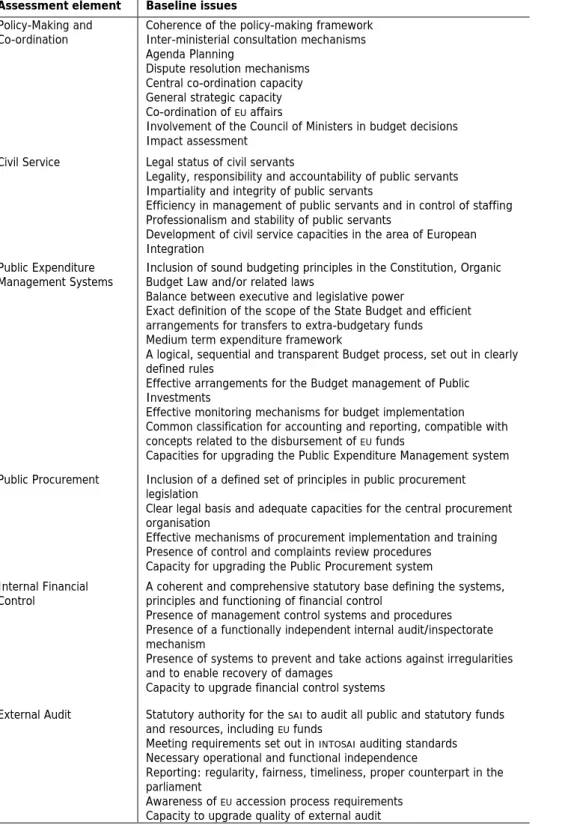
Table 1 Baseline issues for horizontal administrative capacity assessment10
Assessment element Baseline issues
Policy-Making and
Co-ordination Coherence of the policy-making framework Inter-ministerial consultation mechanisms Agenda Planning
Dispute resolution mechanisms Central co-ordination capacity General strategic capacity Co-ordination of EU affairs
Involvement of the Council of Ministers in budget decisions Impact assessment
Civil Service Legal status of civil servants
Legality, responsibility and accountability of public servants Impartiality and integrity of public servants
Efficiency in management of public servants and in control of staffing Professionalism and stability of public servants
Development of civil service capacities in the area of European Integration
Public Expenditure
Management Systems Inclusion of sound budgeting principles in the Constitution, Organic Budget Law and/or related laws Balance between executive and legislative power
Exact definition of the scope of the State Budget and efficient arrangements for transfers to extra-budgetary funds Medium term expenditure framework
A logical, sequential and transparent Budget process, set out in clearly defined rules
Effective arrangements for the Budget management of Public Investments
Effective monitoring mechanisms for budget implementation Common classification for accounting and reporting, compatible with concepts related to the disbursement of EU funds
Capacities for upgrading the Public Expenditure Management system Public Procurement Inclusion of a defined set of principles in public procurement
legislation
Clear legal basis and adequate capacities for the central procurement organisation
Effective mechanisms of procurement implementation and training Presence of control and complaints review procedures
Capacity for upgrading the Public Procurement system Internal Financial
Control A coherent and comprehensive statutory base defining the systems, principles and functioning of financial control Presence of management control systems and procedures
Presence of a functionally independent internal audit/inspectorate mechanism
Presence of systems to prevent and take actions against irregularities and to enable recovery of damages
Capacity to upgrade financial control systems
External Audit Statutory authority for the SAI to audit all public and statutory funds
and resources, including EU funds
Meeting requirements set out in INTOSAI auditing standards
Necessary operational and functional independence
Reporting: regularity, fairness, timeliness, proper counterpart in the parliament
Awareness of EU accession process requirements
19 The baseline assessment covers six core areas:
1 Policy-making and co-ordination machinery; 2 Civil Service;
3 Financial management; 4 Public Procurement; 5 Internal Financial Control; 6 External Audit.
In each of these six areas minimum standards, ‘baselines’, have been developed in consultation with the EU and, in many areas, also with the involvement of the candidate states. The assessment uses a rating scale ranging from ‘standard achieved’ to ‘standard unlikely to be achieved under present arrangements’.11
Table 1 presents a brief review of the main issues included in the baseline assessment.
A comparison of the administrative capacity chapters in the 1999 Regular Reports on Progress and the SIGMA baseline assessment reports reveals that the baseline
assessment has clearly been the basis for the administrative capacity assessment. In several country reports the text of the assessment summaries and the text of the Regular Reports on Progress are virtually the same. It is likely that the baseline assessment tool will be used in future preparations on Regular Reports on Progress, thus finally creating a well-defined tool for administrative capacity assessment for the European Commission.
2.6 CONCLUSIONS
The preparation of the 1999 Regular Reports on Progress12 on EU enlargement was
based on inputs provided by a new assessment system for horizontal administra-tive capacities. The development of this assessment mechanism marks the final stage in the process of definiting horizontal administrative capacity requirements for EU membership. The elaboration of administrative capacity requirements, in
particular horizontal capacities, has been one of the more difficult elements in the process of developing EU membership criteria, mainly due to the lack of precedents
in this area.
Even though the membership requirements on horizontal administrative capac-ities have become increasingly clear over the last years, a number of questions still remain regarding the way these criteria will be used and the manner in which they will affect the process of administrative development in the candidate states. The first question is how the Commission’s focus on sectoral administrative capac-ities will affect horizontal administrative capacity development in candidate states. This would depend to some degree on the way in which the Commission will deal with the presentation and explanation of the administrative requirements in the yearly Progress Reports. In addition, it will depend on whether there will continue
20
to be some degree of assistance in the area of horizontal capacity development, in addition to sectoral Institution Building support.13 The second question is to what
degree the candidate states have really made progress in the development of hori-zontal administrative capacities, beyond declarations of intent and the adoption of legislation. A third question is what strategies could be employed to stimulate further progress in administrative development in the candidate states. Finally, it is important to reflect on how the EU as a political system could cope with conse-quences of the possible accession of a group of states which might not have com-pleted the development of modern systems of public administration.
NOTES
1 As an illustration of the importance member states attach to regarding
ad-ministrative organisation as an internal issue, one of the basic principles on with European Integration is based, freedom of movement of workers and non-discrimination of workers from other member states, does not fully apply to the public administration. Initially, employment in the public administra-tion was fully exempted from the provisions guaranteeing the freedom of movement of workers and non-discrimination, but following a European Court of Justice ruling of 17 December 1980 certain limitations have been imposed on this exemption (see Ziller 1998, for an in-depth review of this issue).
2 Under article 169 of the Treaty.
3 The Opinion of the European Commission on the membership application of
Greece actually advised against opening membership negotiations, based on doubts as to whether Greece would be able to take on the obligations of membership. However, the Council still decided to open membership negotiations which led to Greece joining the EU on 1 January 1981.
4 The Swedish policy-making tradition was ill-adapted to the requirements of
the EU policy process, which mostly involve fast reaction to Commission
proposals and the ability to detect the most appropriate point for influence in the process.
5 Accession negotiations with Cyprus and Malta are proceeding in parallel to the
negotiation process involving the Central and Eastern European candidate states. Doubts about administrative capacities were raised in the Commission Opinions on both Malta and Cyprus but are deemed to be have been addressed sufficiently by Cyprus. It is highly likely that administrative capacity require-ments will also be an important issue in future negotiations with Turkey.
6 It should be noted that these are considered due as much to management
deficiencies in the Commission as to a lack of absorption capacities in the candidate states. Problems with the implementation of Phare programmes in the areas of Public Administration and European Integration/Law Approxi-mation are well documented in the evaluation reports commissioned by the Joint Relex Service of the European Commission. Both evaluation reports were published in 1999 (http://www.europa.int/)
7 A criterion which does not depend on the readiness of the candidates
them-selves is the EU’s internal capacity to keep up the momentum of European
Integration in an enlarged European Union, which is often called the ‘catch 22’ provision.
8 The White Paper refers to the need for the associated countries to adapt their
administrative machinery and their societies to the conditions necessary to make harmonised legislation work
9 The meaning of ‘institution building’ in Commission-speak will be discussed
in more detail later on. The use of this term in this context relates to the devel-opment of institutions, institutional arrangements, legislation and procedures to implement the acquis communautaire in the EU candidate states from
22
10 Based on the SIGMA Baseline assessments, as received from the governments of
four candidate states
11 The full rating scale is:
• Standard achieved
• Standard substantially achieved • Standard only partially achieved
• Standard not yet achieved but progress being made • Standard not yet achieved
• Standard unlikely to be achieved in the medium term
• Standard unlikely to be achieved under present arrangements
12 Hereafter: Progress Reports
13 In the first year the new PHARE approach to the candidate states was
operational, funds were allocated almost exclusively to sectoral capacity building projects, while under the 1999 PHARE allocation some (limited)
allocations for horizontal institutional development (in particular the development of training institutions) were made. On first evidence this trend appears to continue in the PHARE 2000 programming, with significant
horizontal institution building projects being considered in particular in Slovakia and Latvia.
23
3
FULFILLING THE REQUIREMENTS FOR
FUNCTIONING IN THE EU
This section provides a comparative review of the development of new systems in public administration in the candidate states. First a brief review will be given of the state of development of administrative systems as reflected in academic literature and the Opinions and Progress Reports of the European Commission. There is a strong contrast between frequent reform announcements and state-ments of intent by Central and Eastern European governments and the perceived lack of progress in this area reflected in Commission Opinions and Progress Reports as well as in academic literature.
The section will introduce a comparative analysis of trends in the development of three key areas of administrative reform. This analysis serves to examine to what degree the perception of lack of progress is correct, how the problems Central and Eastern European states have experienced can be explained, and what alternative strategies might be available to speed up the administrative development process. The three main areas of administrative development to be reviewed are the cre-ation of new civil service systems (in particular the development and implemen-tation of civil service legislation), the development of training capacities, and the reform of administrative structures and processes, including the creation of dedicated structures for the management of EU affairs.1 These three areas in the
development of professional and reliable administrations are essential require-ments for states to function effectively in the EU. Civil Service legislation and policy are crucial elements in the stabilisation, de-politicisation and professionalisation of the civil service; training is an important potential catalyst for change while the rationalisation of administrative structures and procedures is instrumental in creating a more effective and accountable administration.
The development of new systems of local self-government will not be discussed in detail. The development of new systems of Local Self Government has been the main focus of attention in academic studies on public administration in Central and Eastern Europe (see for instance Coulson 1995 and Bennet 1994). However, whereas the importance of local self-governing structures for the development of democratic systems of governance is undeniable, it is of less direct relevance to the question of EU membership. Local governments have some important tasks in EU
policy implementation, but these generally relate to sectoral policy areas, which are not the subject of this study. The involvement of local governments in decision-making is still very limited,2 though these have gained some influence
through the creation of the Committee of the Regions and through the principle of partnership as developed within EU regional policy.
24
3.1 A WORLD OF CONTRAST
:
INCREASING REFORM ANNOUNCEMENTS–
CONTINUING NEGATIVE ASSESSMENTSAfter the initial neglect of central government administration in the reform pro-grammes of Central and Eastern European states, the last few years have seen a flurry of statements of intent by governments, often ‘translated’ into reform strategy documents and, to a lesser degree, in (draft) legislation. In Bulgaria, for instance, two administrative reform and development strategies have been adop-ted in the last five years by different governments. All EU candidate states have adopted administrative reform strategies, often more than just one.
Apart from the adoption of reform strategies, most Central and Eastern European states have worked actively on the development of legislation that should provide the basis for the development of new administrative systems at central govern-ment level. However, if and when draft legislation is adopted, it is often not fully implemented; a new government often invalidates initiatives taken by its pre-decessor.
If one considers developments in administrative reform and development in Central and Eastern Europe at face value, one can notice an increasing number of statements of intent by governments, the adoption of reform strategies, and a high level of legislative activity. Statements of intent have been made ever more fre-quently since the EU explicitly defined an effective and efficient central adminis-tration as one condition for membership.
At the same time there are strong indicators that progress in horizontal adminis-trative capacity development has been limited at best. The still sparse academic publications on public administration in Central and Eastern Europe continue to focus on the need to address some of the classical issues in public administration, such as structuring politico-administrative relations, creating a system of employ-ment conditions which allows the civil service to attract and retain highly qualified staff, defining a new accountability system and developing management and policy-making capacities. A comparison of academic work on central government reform written early on in the transformation process (for instance, Hesse 1993) with more recent publications (Verheijen and Coombes 1998, Hesse 1998, Verheijen 1999) would lead one to conclude that little progress has been made in addressing these issues. A review of the last five issues of the proceedings of the Annual Conferences of the Network of Institutes and Schools of Public
Administration in Central and Eastern Europe (NISPAcee) (Jabes and Vintar 1996; Jabes 1997, 1998, 1999 and Jabes and Caddy 2000) leads to a similar conclusion.3
Another indicator of the limited progress in administrative reform in Central and Eastern Europe are the Commission Opinions and Progress Reports. The 1997 Commission Opinions highlighted serious deficiencies in the administrative
25 systems of the candidate states (European Commission 1997 and Fournier 1998).
Whereas the Opinions are, with some exceptions,4 (moderately) positive on the
development of the overall institutional system, the central public administration is singled out as a weak link in this system. What is reflected in the Opinions, with few exceptions,5 are fragmented, politicised administrations, rife with allegations
of corruption, underpaid staff, and a resulting high degree of staff turnover. Policy-making capacities are evaluated as weak and the lack of personnel development strategies is frequently pointed out.
The 1998 Commission Progress Reports again evaluated public administration capacities as weak in most of the candidate states, even in those states which belong to the first group of countries to negotiate their accession to the EU.
Whereas proress in administrative development was reported for Latvia, Lithuania and Bulgaria, the pace of administrative development in Slovenia, Estonia and Romania was criticised strongly, while in the Czech Republic and Slovakia the reform of the central administration in many ways still had to be started. The only state that obtained a good evaluation across the board was Hungary. The 1999 Progress Reports continued to signal insufficient progress in administrative capacity development, with performance in the majority of candidate states assessed as mixed at best. As in the 1998 Progress Reports the assessment of Hungary was the most positive while the assessment of Romania clearly was the most negative, SIGMA baseline criteria not being met in the overwhelming majority
of the assessment areas.
Overall the 1998 and 1999 Progress reports were significantly more harsh than the Opinions in the judgement on administrative capacity development. This leads to the conclusion that the trend in administrative development is a negative rather than a positive one. The picture emerging from a review of academic literature on public administration reform in Central and Eastern Europe and the Commission Opinions and Progress Reports is thus in stark contrast to the flurry of reform announcements over the last years.
Some further indicators point to a lack of progress in administrative development. The limited information available on public opinion towards central government administration shows continuing high levels of citizens’ distrust in central admi-nistrations.6 Levels of confidence in local self-governing authorities are much
higher without exception. Furthermore, the low quality of administrations is considered an important explanatory factor for the economic downturns and crises that several Central and Eastern European states experienced in recent years. This holds in particular for Bulgaria, where failure and corruption in the administration were considered a major factor in the severe economic crisis of 1996-1997
(Dimitrova and Verheijen 1998), for Romania (International IDEA 1997) and also
for the Czech Republic, where the economic downturn of 1997-1998 gave rise to a debate on the need for administrative reform, an issue which had been neglected until that time (see Vidlakova in Jabes 1999).
26
The picture that emerges of a consistent failure of the candidate states to develop effective, efficient and accountable central administrative structures raises two related questions:
1 have reforms really failed to produce significant results and, 2 if so, what are the causes for this failure?
The conclusions of this analysis will be used to determine alternative ways in which administrative development could be stimulated.
3.2 A COMPARATIVE INVENTORY OF ADMINISTRATIVE DEVELOPMENT
The following comparative inventory of the development of the legislative frame-work for the operation of the civil service, the development of training structures and the re-structuring of central administrations (including the development of dedicated structures for the management of EU affairs), will examine the degree of
real divergence between statements of intent and progress made in reality.
3.2.1 CREATING A PROFESSIONAL AND RELIABLE CIVIL SERVICE
In the early stage of the development of new systems of central administration in Central and Eastern Europe, the adoption of civil service legislation was generally considered the basic condition. Civil service laws were considered the main reform tool for addressing problems such as politicisation, fragmentation and instability. Civil service laws have now been adopted in six out of ten EU candidate states. In
states where no civil service law is yet in place, they generally are in the final phase of adoption. Interestingly, the Czech Republic and Slovakia are the two states which still lag behind furthest in the process of adopting civil service laws. In both states the process of drafting a civil service law was re-launched in 1998 after general elections had taken place.
Among the three elements of reform discussed in this section, the drafting and adoption of civil service legislation is the element in which most progress has been made. However, in many cases the adoption of the civil service law seems to have become an objective in itself, while this should have been a mere first step in the creation of a civil service (development) policy. Civil service laws have often been only partially implemented, if at all. In Poland, Latvia and Lithuania a process of fundamental revision was started within two years after the adoption of the civil service laws, in all three states leading to the creation of a completely new law.7
Thus, it should not come as a surprise that the impact of the adoption of civil service laws on the actual functioning of the administration has so far been limited.
Hungary, which has ‘outperformed’ the other candidate states in progress on administrative capacity development, adopted a Civil Service Law as early as 1992.
27 However, the development of a well-balanced recruitment and promotion system
still has not been completed (György in Verheijen 1999). The process of creating a permanent Civil Service was hampered by the attitude of the incoming
government in Spring 1998, which showed a reluctance to work with the civil servants in office.8 Furthermore politicians made extensive use of loopholes in the
law, such as the fact that the civil service law does not make it mandatory to publicly advertise vacancies. Hungary, however, constitutes the most positive example of administrative stabilisation. Staff turnover has been reduced signifi-cantly since the adoption of the civil service law (György in Verheijen 1999). The question that remains, and on which there is an ongoing debate in Hungary, is how the impact of the civil service law can be taken beyond stabilisation, as seven years after having adopted the law there still is no recognisable civil service policy. In Poland the incoming government halted in autumn 1997 the implementation of the civil service law that had been adopted in 1996. After a period of reflection, the new government decided to start working on the adoption of a new law, rather than working with the law adopted by the previous government. Again the reluc-tance of the incoming government to work with civil servants in office, and in this case also to work with management structures created and staffed by the previous government, seems to have been the main reason behind the decision to stop the implementation of the law. It is interesting to note that Poland was the only state in the region to have a civil service law under the previous regime. Thus, it now has a legal regime for the civil service, which consists of the old 1982 law and imple-mented elements of the new civil service law, mostly applying to higher level civil servants. A new civil service law has been adopted to replace the law that had been adopted in 1996.
Civil service laws were adopted in Estonia, Latvia and Lithuania within a relatively short time span in 1994-1995. Even though in all three cases the laws were based on a continental European tradition, the impact of civil service legislation has been very different from case to case. In Latvia and Lithuania the adopted civil service laws never were fully implemented. They have been subject to an ongoing revision process, as the adopted laws were considered inadequate for various reasons. In Latvia the implementation of the civil service law, adopted in 1994, was initially combined with a comprehensive training and re-training programme,9 which was
expected to provide the basis for a coherent, professional administration. However, the implementation of the law was stopped in 1997, after a change of government, and the training programme was abandoned, mainly for budgetary reasons. Since then the process of civil service development in Latvia has stag-nated. The process of revising the civil service law, which started late 1997, still has not been completed, though a new civil service law is expected to be adopted in 2000. The prolonged ‘transition’ between the old legal framework governing civil service employment conditions and the new law, in process of adoption, has created a highly opaque system of employment conditions for civil servants, in
28
particular in relation to remuneration. Senior officials can obtain significant bonuses on the basis of unpublished ‘management contracts’, a development which has led to increased suspicion of the state administration among citizens. Many institutions have opted to leave the civil service, in order to improve em-ployment conditions for their staff, thus creating unclear accountability relations in the administration. The current impasse in the development of a legal frame-work for civil service development certainly does not contribute to the establish-ment of a stable and professional civil service, which successive governestablish-ments have claimed they want to create.
In Lithuania the civil service law, the Law on Officials, was adopted in 1995. The law has been subject to revision and re-consideration. Here the emphasis was on the re-definition of certain elements of the civil service law, in particular of the dividing line between political and career civil servants. This dividing line had not been well-defined in the 1995 law, leading to mass dismissals after the change in the parliamentary majority in 1996, carried out within the framework of the law on officials.10 Furthermore, there was a perceived lack of balance between the rights
and obligations of officials, making civil service positions unattractive and uncom-petitive. The general concept underlying the Lithuanian administration continues to be based on the German and Spanish civil service model.11 The new Lithuanian
Civil Service Law was adopted in July 1999 and its implementation, which is scheduled to take until 2003, has only just started. The new law clarifies the rela-tions between career civil servants and political appointees and sets out transpar-ent criteria for recruitmtranspar-ent and career advancemtranspar-ent. In addition, it has adopted a very wide definition of ‘civil service’, in contrast to the predominant policy direc-tion in, for instance, Latvia. The Lithuanian Civil Service Law includes, for in-stance, local government officials under the civil service law.
In Estonia the civil service law, adopted in 1995, entered into force in January 1996. Unlike the other two Baltic States, the Estonian civil service law has been implemented. However, since the implementation of the civil service law was not enshrined in a clear public administration reform concept (the development of which was completed only in 1998), the overall impact of the law in terms of the development of a professional administration has remained limited here too. The Bulgarian Civil Service law was adopted in June 1999. As Bulgaria suffered from one of the highest rates of turnover in the administration (Verheijen 1999), this is a potentially significant step forward. However, much will depend on the degree to which the law will be fully implemented. The civil service law will enter into force in January 2000 and its implementation is likely to be completed before the next general elections, which are scheduled for early 2001. If a change of government takes place, this would obviously constitute a serious test for the durability of the new law.
29 In the other EU candidate states (Czech Republic, Romania, Slovenia and Slovakia)
civil service laws have not been adopted yet. All these states still lack a basic legal framework for the development of Human Resource Management in the central administration, which is a basic requirement for the development of a profes-sional, stable and impartial administration.
The positive picture one could have when considering the development of civil service legislation in an increasing number of Central and Eastern European states on face value becomes much more mixed when this issue is examined more in-depth. Civil service laws have seldom been the expected catalysts for the stabili-sation, de-politicisation and professionalisation of the central administration. Rather than being a starting point for the development of civil service policies, the adoption of laws has become an objective in itself. Apart from Hungary, none of the candidate states has come close to the development of a civil service policy, in addition to the necessary legal framework.
3.2.2 DEVELOPING TRAINING SYSTEMS
Training can play an important role in bringing about administrative change. A combination of the introduction of newly trained recruits in an ‘old’ adminis-tration, together with the re-training of staff already employed, if rightly applied, can be a powerful administrative reform tool.
Training can also make a contribution to the development of a coherent adminis-tration. Joint pre- or post-entry training of new recruits can help creating a sense of community among new civil servants. This sense of community could play a role in reducing the still universally high degree of fragmentation in Central and Eastern European administrations. Joint training of top level officials can have a similar effect.
However, the development of training systems has for a long time been ignored or neglected by the candidate states. In fact, the development of new training struc-tures can be considered one of the main elements of failure in the development of new administrations. A large number of training schools and institutes have been established, but most of these are involved in local government training or in university type public administration education (see, for instance, Verheijen and Nemec 2000).
At the same time there is a striking lack of training institutions and programmes that could provide training as a part of government human resource policy. The involvement of training institutions in in-service training has been ad hoc and on request, while few states have schools which are recognised by the government as providers of candidate civil servants. The recent creation of new state training institutions in Lithuania and Bulgaria might signal a long overdue change in trend.
30
In the early years of the transition, attempts were made to develop new govern-ment training institutions in a number of Central and Eastern European states. The National School of Public Administration in Poland, established in 1991, is one of the few remaining examples of this ‘first generation’ of initiatives. The concept of the Polish school was based on the assumption that by inserting highly qualified graduates in top positions in the administration, it would be possible to create a ‘multiplier effect’ and bring about rapid change. The high level training of young promising staff would have to be accompanied by in-service training for those already in the administration to achieve the desired effect. However, even though the Polish school was created as an integrated element of the administration (based on the model of the French Ecôle Nationale d’Administration (ENA)), it has not fulfilled its potential, mainly due to the late start of the in-service training activities. At the same time, the Polish School of Public Administration is the only remaining institution which at least to some degree fulfils the function it was created for. Even though the school has functioned better under some govern-ments than under others, its graduates are guaranteed a position in the adminis-tration and have the obligation to work for the adminisadminis-tration for a defined number of years.
A similar initiative was taken in Slovakia in 1992, when a high level pre-service training programme was started at a government funded institution, Academia Istropolitana. The School of Public Administration had a government-approved programme and government funded grants for those who gained entry. The Natio-nal School of Political Science and Public Administration in Romania, which was created in 1991, was based on the same model. The Romanian school was progres-sively marginalised after the change of government in 1996 and the Slovak school was closed down (for political reasons) by the government in 1997. The develop-ment of training structures was thus a highly politicised process.
The idea of creating a professional school of public administration, able to serve any government, has obviously not yet taken hold among Central and Eastern European politicians. At the same time new university programmes in Public Administration, which have been created in all candidate states, have not yet been able to develop sufficient links with government institutions. In the long term, however, their output of graduates could make a difference to the quality of candidates for civil service positions.
The fate of government-run or funded in-service training institutions has been slightly more positive. The Latvian School of Public Administration in particular was given a core role in the training of civil service candidates.12 However, when
the implementation of the civil service law was halted by the government in 1997, the role of training in the civil service development process was reduced signifi-cantly. Still, the Latvian school is one of the best examples of an integrated in-service training institution in Central and Eastern Europe, even though one could argue the school actually functioned as a kind of pre-entry training institution. In
31 some other states training institutions have also been established. In Estonia
government and semi-government in-service training institutions are among the most important providers of in-service training. In Bulgaria, Lithuania and Slovenia recently established state training institutions are expected to play a significant role in the preparation of national administrations for EU membership. A general problem with all the above mentioned training institutions is that very often they are little more than managers of training programmes. They do not actually have a core body of permanent trainers in their staff. Furthermore, they lack the capacities to carry out reliable analyses of training needs, often merely react to government and are dependent on foreign assistance for the provision of training programmes in key areas.
The question arises why training has been neglected as a reform tool. There are three related possible reasons for this.
The first reason is financial constraints. The creation of government training schools requires a considerable investment, if a high quality institution is to be created. In times when basic needs in key areas such as health and education can hardly be met, it is understandable that governments have been reluctant to invest in the development of public administration training institutions, regardless of the potential long-term benefits that can be gained from such institutions. The cases of Bulgaria and Lithuania show, for instance, that once external funding is available for institutional development (in both cases under PHARE 1999 allocations), governments are much more likely to create training institutions.
A second reason is that governments have generally been reluctant to use training as an element of reform programmes. The approach to public administration re-form has been mostly legislative in nature, which is not surprising considering the prevailing legalistic tradition in many Central and Eastern European states. The adoption of legislation has been emphasised rather than the application of more complex reform tools like training. Whereas in many of the candidate states new training institutions in public administration have been created, these are rarely used as an integral part of the civil service development process, mainly due to a lack of state training policies.
The generally negative experience with ‘imported’ training is a third reason for the reluctance to using training as a reform tool. ‘Imported’ training might have been useful in the early stages of the reform process, as an information and awareness raising tool, but in the current stage of development it is of much less value, unless it is tailor-made and aimed at the transfer of specific, job related skills (see also Hesse 1998). Since this has not happened so far, the availability of funded external training has in recent years been of little help to public administration reform. The inclination of foreign institutions to transfer national training models and pro-grammes to Central and Eastern European states, without taking into account
32
differences in administrative tradition, has been a further factor in limiting the value of ‘imported’ training.
For the three reasons discussed above the use of training as a reform tool has been limited. Only a sustained effort to support the development of local capacities might provide a solution to this problem.
3.2.3 STRUCTURAL REFORM AND RE-DESIGNING THE POLICY PROCESS
Even a high quality civil service can only function adequately if it is embedded in well-designed administrative structures and processes, including functioning horizontal and vertical co-ordination systems and a clear accountability system, to provide civil servants with the necessary freedom of action. This section includes an assessment of progress in the rationalisation of policy processes, the develop-ment of new accountability systems and, finally, the creation of structures and processes for the management of EU affairs.
Improving policy processes
The re-definition of the role and position of ministries, their subordinated organi-sations and the core executive unit13 in the administration is a crucial aspect of any
administrative development process. This element is of particular importance in Central and Eastern European states, since the core executive units of the adminis-tration used to ‘shadow’ line ministries under the previous regime and play a dominant role in the process of policy co-ordination. Policy processes were there-fore ‘top heavy’ and based on co-ordination at the top. Core executive units also tended to (and in many cases still do) manage large numbers of subordinated institutions. Accountability lines were directed towards the leading political party. The reform of policy-making and implementation structures and systems is one of the most difficult elements of the administrative development process, even more so in the specific historical context in Central and Eastern Europe. Considering the information available on this issue (e.g. SIGMA Centre of Government profiles on
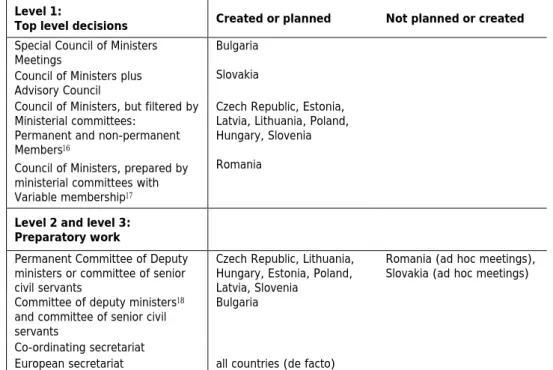
twelve states)14, the policy-making and implementation processes still show many
features of the previous systems: top heavy co-ordination, leaving little or no space for conflict resolution before issues reach the government, duplication of functions (especially in the legislative process) and a lack of clearly defined accountability structures. Even in new states, such as the Baltic States, the division of labour between ministries and the core executive unit in the policy process still shows some of the features of the former system.
In few states attempts have been made to re-define the role of the different com-ponents of the central administration in the policy process. Poland, for instance, carried out a substantial reform of the Council of Ministers’ administration, with the objective to create a small core Prime Minister’s Office, among others by