IJSRSET173873 | Received : 10 Nov 2017 | Accepted : 24 Nov 2017 | November-December-2017 [(3)8: 293-298]
© 2017 IJSRSET | Volume 3 | Issue 8 | Print ISSN: 2395-1990 | Online ISSN : 2394-4099 Themed Section: Engineering and Technology
293
ABSTRACT
In wireless sensor networks, we have lots of problems during data transmission. We focused in this thesis security and sensor node energy consumption challenges which are major challenges in current wireless networks. But, uniform power deployment approach isn't always suitable to the prevailing wi-fi sensor nodes and on this paper we're providing a secure and power efficient protocol which is called Cost-Aware Secure Routing Protocol. By implementing this protocol, we can achieve the high message delivery ratio along with security. This proposed protocol will utilize two parameters such as 1) Energy Balance Control & 2) Secure random Walk. These two are used to beat the existing disputes such as security and network life span optimization.
Keywords: Wireless Sensor Network, Sensor Node, Sensor Node life span, Network Security
I.
INTRODUCTION
Wireless Sensor Networks (WSNs) are a principle utilized for observing distributed far away situations. As a portion of the key advancements associated with WSNs, hubs blame identification is vital in most WSN applications. It is outstanding that the administered blame location conspires looks at the fizzled hubs by means of supplanting information and commonly looking at among neighbor hubs on this system. Notwithstanding, the blame discovery exactness of a plan would downsize immediately when the quantity of neighbor hubs to be analyzed is low and the hub's disappointment proportion is exorbitant. A duplicated plot is proposed through characterizing novel location basis. Reproduction comes about show that the quickened conspire performs well in the above emergency and might build up the blame recognition precision for the most part. Remote sensor-performer systems, sensors test their environment and ahead their information to on-screen character hubs. On-screen characters cooperatively answer to pick up predefined programming mission. In see that performing artists need to facilitate their operation, it's quintessential to
keep up a firmly connected system topology reliably. Furthermore, the span of the between performing artist verbal trade ways may be confined to meet dormancy prerequisite. Remote Sensor people group are intended to watch developments or condition modifications sensors are spread around a synthetic plant to watch remove, shaping a multi-bounce self-arranged system technique by methods for remote correspondence. The sensors work remote information securing instruments for the additional solid performer hubs that course the sensor readings and set ahead a correct reaction. Disappointment of Nodes may establishment the group to parcel into reestablish squares and would consequently abuse this sort of network prerequisite. The sending of further assets to trade fizzled hubs illogical and repositioning of hubs turns into the phenomenal reclamation alternative. At the point when a hub comes up short, its neighbors hubs will separately look for exhortation their conceivably incomplete steering work area to choose the suitable way of activities and layout their capacity inside the mending assuming any. In the event that the fizzled hubs is key to the group network, i.e., a hub whose disappointment makes the group parcel into restore hinders, the
Significantly Extending the Network Lifetime by Using
Secure and Energy Efficient Protocol
1
Vasanthi Kumari Chilamakuri
2Prof Nageswara Rao Sirisala
1
M.Tech, CSE Department, Vardhaman College of Engineering, Hyderabad, India
neighbor hubs that has a place with the littlest square responds. The objective is to obligingly feel, amass and strategy the learning about articles inside the hubs disappointment and in addition at that point send it to the onlooker for handling and looking at. Sensors self organization offers with fair-minded protection arrangement development in sensor group. On-screen characters are additional capable hubs with to some degree included additional vitality convey and wealthier calculation and report resources. The transmission assortment of on-screen characters is fundamentally significantly less. It is fundamental for performing artists to depend in all likelihood on existing radio connections for organizing themselves. Conveyed Actor Recovery Algorithm (DARA) and also PArtition Detection & Recovery Algorithm (PADRA) require every hub to keep up a record of their multi-jump neighbors and check the extent of the recuperating through checking regardless of whether the fizzled hubs. Cost-Aware Secure Routing (CASER) convention for WSNs to relentlessness the vitality utilization and create arrange life span. CASER has the flexibility to help different directing systems in message sending to protract the life span even as expanding steering wellbeing. Both hypothetical examination & recreation will show that, CASER has a tasteful steering execution regarding vitality adjust and directing bearing circulation for directing course security. We likewise proposed a non-uniform energy deployment (noED) plan to build the sensor arrange life span.
II.
RELATED WORK
Alshowkan et al., Have proposed a light-weight Secure-Low-vitality Adaptive Clustering Hierarchy (LSLEACH) where they right off the bat demoralize the assailant to wind up noticeably an individual from the remote sensor group using light-weight and force compelling confirmation work in which the bunch head checks the legitimacy of hubs, which make a request to join the bunch. Also, they depicted the verge for the regular hub to-hub number of associations by methods for the time. That is utilized to end up noticeably mindful of the odd interests happened between hubs. Thirdly, they portrayed the powerful utilization of time division different access (TDMA) in the LEACH with the goal that each hub can handiest send data to the bunch head. Also they depicted the instrument to utilize LS-LEACH in WSNs with the guide of decision, association, and transmission where extraordinary details are utilized.
They rely on that every hub has two mystery keys. One key's shared among all hubs, and also it is imparted to the base station. At the point when the hub transforms into a bunch head, at that point the private key can be imparted to the base station. On the other hand, the workforce key's utilized to wind up plainly an individual from groups. What's more they expect that the quantity of group heads won't be over 5% of aggregate hubs. The start of each consequent cycle after group arrangement, bunch head will be chosen. They depict that remote sensor arrange is confronting bunches of issues reminiscent of inadequate assets in control, vitality utilization and capacity. There's yet another test that the independence of the distributed medium makes the remote sensor systems in danger to various strikes. An assailant can join the remote sensor group and may simply grab, embed or communicate the data. They in examination the proficiency of LS-LEACH and LEACH making utilization of approach throughput, life span of the system and the amount of vitality they devoured.
affirmation won't be gotten, however a duplicate of learning will probably be transmitted from an additional course. Durrani et al. has offered the Trust-based Energy Efficient Secure Routing (TEESR) protocol. They highlighted the challenges, routing safety threats, specifications, and assessment of current options. This protocol has a restricted quantity of forwarding nodes, floods the neighbors expertise in a small amount of messages as in comparison with other routing protocols. Consequently, the proposed scheme reduces end-to-finish lengthen and saves tremendous energy. The design of believe-centered power effective secure routing protocol (TEESR) comprises three essential advantages. First, this protocol restricts malicious nodes in its surrounding field via making use of compatible verification and flooding system. Second, this protocol act upon resource intensive computations equivalent to assemble routing tables. Third, the protocol uses multipath overlay networks to take advantage of redundancy and endure intrusion in a specified field. This protocol has distinctive phases like cluster formation section, knowledge forwarding section. Every segment uses one of a kind NBRDET message code for clustering and forwarding. They when put next the efficiency in time period of security, energy, the number of drop messages, and finish-to-end delay with other routing protocols. The results show that the selected protocol has better efficiency.
In Chang and Tassiulas assumed that the source control level can be changed by the separation between the source and the goal. Steering was made as a straight programming issue of neighboring hub determination to boost the system life span. At that point Zhang and Shen inspected the uneven vitality utilization for frequently organized information gathering sensor systems. In this proposed, the system is parcel into numerous crown zones and every hub can perform information total. A confined zone-based directing plan was recommended to steadiness vitality utilization among hubs.
III.
FRAMEWORK
A. Network Design
In this paper, we design a protocol i.e., CASER protocol. To observe this protocol in the wireless sensor network initially we need to layout the community. In figure1, we consider that during our community we have extra
range of sensors and a single sink node. In this network might be partitioned as grids. In each grid equivalent sensor nodes are deployed. From the figure, we've four grids and in every grid have 5 sensor nodes. For finish network we have handiest single sink hub. It way the sink hub is best excursion spot for all sensor hubs. The data of the sink hub is made open. For insurance purposes, each message might be appointed a hub recognizable proof relating to the region the zone this message is started. To keep enemies from enhancing the supply area from the hub character, a dynamic distinguishing proof might be used. The substance of each message additionally can be scrambled making utilization of the key shared among the hub/lattice and the sink hub.
Figure1: CASER Protocol Network Design We also anticipate that every sensor node is aware of its relative vicinity within the sensor area and has competencies of its instant adjoining neighboring grids & their vigor levels of the grid. The understanding concerning the relative area of the sensor domain could also be broadcasted within the network for routing data replace.
B. Overview of CASER Protocol
Figure 2. CASER Protocol Overview
CASER directing conference, each sensor hub wishes to hold up the energy stages of its quick contiguous neighboring lattices notwithstanding their relative areas. Utilizing this statistics, each sensor hub can make fluctuating channels in view of the everyday define alternate off amongst safety and effectiveness. The quantitative security research well-known shows the proposed calculation can defend the source region records from the enemies. In this challenge, we will deal with steerage techniques for message sending: maximum quick way message sending, and relaxed message sending thru arbitrary taking walks to make directing manner unusualness for source safety and sticking counteractive movement.
B. Secure and Efficient Routing Strategy
The projected Secure and Efficient Routing Strategy uses the relative node approach. This employed relative location for routing. Otherwise to calculate the amount of hops to cut back flooding and varied attacks. This strategy is nice to discover routing attacks and offers the efficient support of wide device networks. Relative location causation is basically protected that opposes on varied attacks to causation the message calculation, have the additional preference for secure routing its node ID and attributes. And conjointly on top of characteristics square measure same for all relative location routing ways like the Greedy Perimeter Stateless Routing (GPSR). SESR includes successive adjacent node choice. It provides the situation of a node, low energy usage and trust or secures message routing. Energy managing is vital for decreasing all the attacks with high trust calculated price. The limiting issue is determined by the nodes energy and routing trust calculated price are going to be reduced i.e. the possibility to finish all the overall work. Due to the calculation, we've incorporated the energy calculations within the total trust price a node computes all of their adjacent nodes. Energy management permits load equalization. It plays terribly crucial to cut back the traffic analysis attacks and increase the network life price. Within the SERS each and every time an occurrence performed supported the trust metrics (packet forwarding, network Acknowledgement) happens, the consistent results placed within the trust table or uninterrupted trust table square measure updated. At identical, whenever name response messages are taken, their info is placed within the indirect trust table or uninterrupted Trust table when the
checking. Each table has info for every adjacent node. The whole node’s trust price is calculated once a brand new message has got to be sent, even supposing the trust values associate degreed name information is updated each and every time an occurrence possesses or a name response message has been taken. This event-driven theme was adopted to balance the energy and conjointly maintaining the resources. It calculates each interrupted and interrupted trust and it takes as a complete trust price and it considers the space of adjacent nodes. The ultimate price calculated and conforms whether or not the node sends the data or not.
IV.
EXPERIMENTAL RESULTS
In our experiments first we need to partition the network as grids. And after, we can view the initial energy levels of the sensor nodes. To send data, we have to calculate the average remaining energy (εa(A)) levels of the
nodes and also select the candidate grid.
Nα
A = {i € NA │εri ≥ α εa(A)}
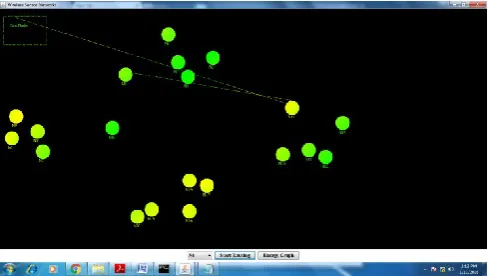
After, sending data from sender node it displays the remaining energy levels displayed.
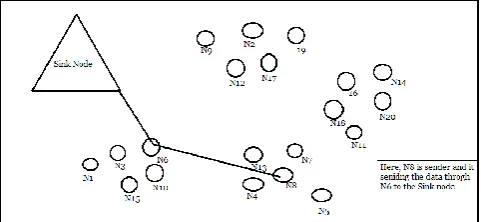
Actually, we select the sender node N7 but in the transmission it hides the N7 and display the N6 node as sender because N6 is the nearest node of the N7.
The remaining energy (εa) levels of the sensor nodes
graph. In this graph, we can observe the consumed energy levels of each sensor node in our created network.
From the experiments we can say our CASER protocol provides the high security as well as high message delivery ratio.
V.
CONCLUSION
Finally, our conclusion is in this paper, we proposed a CASER protocol. The main aim of this protocol is to optimize the network life span and provide the security to network. To reach this aim, this protocol worked through two adjustable parameters such as follows 1) Energy Balance Control & 2) Random Walk. Eventually, we achieved the network life span optimization along with security and we achieved high message delivery ratio.
VI.
REFERENCES
[1] C.-C. Hung, K.-J.Lin, C.-C.Hsu, C.-F.Chou, and C.-J. Tu, “On enhancing community-life span using opportunistic routing in wi-fi sensor networks,” in Computer Communications and Networks (ICCCN), 2010 Proceedings of 19th International Conference on, Aug.2010, pp. 1–6. [2] H. Zhang and H. Shen, “Balancing strength
consumption to maximize community life span in information amassing sensor networks,” Parallel and Distributed Systems, IEEE Transactions on, vol. 20, no. 10, pp. 1526–1539, Oct. 2009.
[3] A. Pathan, H.-W. Lee, and C. Seon Hong, “Security in wireless sensor networks: troubles and demanding situations,” in The eighth International Conference on Advanced Communication Technology (ICACT), vol. 2, 2006, pp. 6 pp.–1048
[4] Y. Li, J. Ren, and J. Wu, “Quantitative size and layout of source-area privateness schemes for wireless sensor networks,” IEEE Trans. Parallel Distrib. Syst., vol. 23, no. 7, pp. 1302–1311, Jul.2012.
[5] Y. Li, J. Li, J. Ren, and J. Wu, “Providing hop-with the aid of-hop authentication and supply privacy in wireless sensor networks,” in Proc. IEEE Conf. Comput. Commun. Mini-Conf., Orlando, FL, USA, Mar. 2012, pp. 3071–3075. [6] B. Karp and H. T. Kung, “GPSR: Greedy
perimeter stateless routing for wireless networks,” in Proc. 6th Annu. Int. Conf. Mobile Comput. Netw., New York, NY, USA, 2000, pp. 243–254. [7] J. Li, J. Jannotti, D. S. J. De Couto, D. R. Karger,
and R. Morris, “A scalable place carrier for geographic advert hoc routing,” in Proc.6th Annu. Int. Conf. Mobile Comput. Netw., 2000, pp. 120– one hundred thirty.
[8] Y. Li, J. Li, J. Ren, and J. Wu, “Providing hop-by-hop authentication and supply privateness in wireless sensor networks,” in IEEE INFOCOM 2012 Mini-Conference, Orlando, Florida, USA., March 25-30, 2012 2012.
[9] N. Bulusu, J. Heidemann, and D. Estrin, “Gps-much less low fee outside localization for terribly small gadgets,” Computer technology branch, University of Southern California, Tech. Rep. Technical report00-729, April 2000.
dissemination protocol for wi-fi sensor networks,” UCLA Computer Science Department Technical Report, UCLACSD,May 2001.
[11] J.-H. Chang and L. Tassiulas, “Maximum life span routing in wi-fi sensor networks,” IEEE/ACM Trans. Netw., vol. 12, no. Four, pp. 609–619, Aug. 2004.
[12] H. Zhang and H. Shen, “Balancing energy intake to maximise network life span in information-collecting sensor networks,” IEEE Trans. Parallel Distrib. Syst., vol. 20, no. 10, pp. 1526–1539, Oct. 2009.
[13] F. Liu, C.-Y. Tsui, and Y. J. Zhang, “Joint routing and sleep scheduling for life span maximization of wireless sensor networks,” IEEE Trans. Wireless Commun., vol. Nine, no. 7, pp. 2258– 2267, Jul. 2010.
[14] C.-C. Hung, K.-J. Lin, C.-C. Hsu, C.-F. Chou, and C.-J. Tu, “On enhancing community-life span using opportunistic routing in wi-fi sensor networks,” in Proc. Nineteenth Int. Conf. Comput. Commun. Netw., Aug. 2010, pp. 1–6.
[15] C. Ozturk, Y. Zhang, and W. Trappe, “Source-place privateness in strength-restricted sensor community routing,” in Proc. 2d ACM Workshop Security Ad Hoc Sens. Netw., 2004, pp. 88–93. [16] Y. Li and J. Ren, “Preserving supply-vicinity
privateness in wireless sensor networks,” in Proc. IEEE 6th Annu. Commun. Soc. Conf. Sens., Mesh Ad Hoc Commun. Netw., Rome, Italy, Jun. 2009, pp. 493–501.
[17] Y. Li and J. Ren, “Source-region privacy thru dynamic routing in wi-fi sensor networks,” in Proc. IEEE INFOCOM 2010, San Diego, CA, USA., Mar. 15–19, 2010. Pp. 1–9.
[18] M. Shao, Y. Yang, S. Zhu, and G. Cao, “Towards statistically sturdy source anonymity for sensor networks,” in Proc. IEEE twenty seventh Conf. Comput. Commun., Apr. 2008, pp. Fifty one–fifty five.