The Secured Cloud Storage with Efficient Key Generation in cloud
computing
K Surya Kranthi1, Kakarla Ravi kumar2
#1 M.Tech Scholar (CSE) and Department of Computer Science Engineering,
#2 Assoc.Prof, Department of Computer Science and Engineering, Kakinada Institute of Engineering and Technology for Women, Korangi, AP, India.
Abstract:
Many cloud storage encryption schemes have been acquainted with shield data from the individuals who don't approach. We make utilization of numerous schemes which expected that cloud storage suppliers are protected and secure. In any case, by and by, a few specialists (i.e., coercers) may endeavor to uncover data from the cloud without the authorization of the data proprietor. In this paper, we present that the discovery of namelessness clients with the utilization of our productive deniable encryption conspire, while the phony clients endeavors to get data from the cloud they will be given some phony files. With the goal that programmers can't hack the files from the cloud. Also, they are happy with their copy document by that way we can secure the proprietor mystery files or confidential files. Anyway by and by, a few specialists may propel cloud storage suppliers to make open client insider facts and confidential data. In this paper, we present our plan for another cloud storage encryption plot that empowers cloud storage suppliers to make persuading counterfeit client insider facts to secure client protection. Since coercers can't confess whenever acquired privileged insights are valid or not, the cloud storage supplier guarantee that client security is still safely ensured.
Keywords: Cloud storage, Integrity, Encryption, Attribute Based Encryption, Cloud Storage, Auditor. I. Introduction
Cloud storage services have quickly progressed toward becoming increasingly popular. Clients can store their data on the cloud and accesstheir data anyplace whenever. In view of client security, the data put away on the cloud is commonly scrambled and shielded from access by different clients. Thinking about the community oriented property of
the cloud data, attribute-based encryption (ABE) is viewed as a standout amongst the most appropriate encryption schemes for cloud storage. There are various ABE schemes that have been proposed,hiding stage and execution points of interest boundless virtualized assets gave to the clients as a service is a cloud computing. By and by cloud service gave to the clients offered high accessible storage and greatly parallel computing of assets at generally low expenses. In any case, the inquiry is about the cloud clients with various benefits store data on cloud is a most test issue in overseeing cloud data storage framework. Most essential issue for cloud condition is benefits Most of the proposed schemes expect cloud storage service suppliers or believed outsiders taking care of key administration are trusted and can't be hacked; be that as it may, by and by, a few substances may capture interchanges among clients and cloud storage suppliers and afterward constrain storage suppliers to discharge client insider facts by utilizing Government control or different means. For this circumstance, mixed data is believed to be known and limit providers are requested to release customer favored bits of knowledge. For example, in 2010, without illuminating its customers, Google released customer chronicles to the FBI resulting to getting a court arrange [8]. In 2013, Edward Snowden revealed the nearness of overall surveillance programs that accumulate such cloud data as messages, messages, and voice messages from some development associations [9,10,2]. At the point when appropriated storage providers are haggled, all encryption designs lose their feasibility. In spite of the way that we confide in circulated storage providers can fight against such substances to keep up customer security through legal streets, it is apparently more troublesome. As one representation, Lavabit was an email advantage association that protected all customer messages from outside weight;
amazingly, it failed and shut down its email advantage. Since it is difficult to fight against outside weight, we planned to amass an encryption plot that could help appropriated storage providers avoid this pickle. In our methodology, we offer cloud storage suppliers intends to make counterfeit client privileged insights. Given such phony client insider facts, outside coercers can just acquired manufactured data from a client's put away ciphertext. When coercers think the got privileged insights are genuine, they will be fulfilled and all the more critically cloud storage suppliers won't have uncovered any genuine mysteries. In this manner, client security is as yet ensured. This idea originates from an exceptional sort of encryption conspire called deniable encryption. Deniable encryption includes senders and collectors making persuading counterfeit proof of manufactured data in ciphertexts with the end goal that outside coercers are fulfilled. Note that deniability originates from the way that coercers can't refute the proposed proof is and in this way have no motivation to dismiss the given proof. This methodology endeavors to out and out square intimidation endeavors since coercers realize that their endeavors will be pointless. II. Related Work
As more delicate data is shared and put away by outsider locales on the Internet, there will be a need to encode data put away at these destinations. One downside of scrambling data, is that it very well may be specifically shared just at a coarse-grained level (i.e., giving another gathering your private key). We build up another cryptosystem for finegrained sharing of encoded data that we call Key-Policy Attribute-Based Encryption (KP-ABE). In our cryptosystem, ciphertexts are marked with sets of attributes and private keys are related with access structures that control which ciphertexts a client can decode. We exhibit the materialness of our development to sharing of review log data and communicate encryption. Our development bolsters appointment of private keys which subsumes Hierarchical Identity-Based Encryption (HIBE). In a few appropriated frameworks a client should just have the capacity to get to data if a client forces a specific arrangement of cre-dentials or attributes. At present, the main strategy for implementing such approaches is to utilize a believed server to store the data and intervene get to control. In any case, on the off chance that any server putting away the data is
imperiled, the confidentiality of the data will be endangered. In this paper we present a framework for acknowledging complex access control on scrambled data that we call Ciphertext-Policy Attribute-Based Encryption. By utilizing our procedures encoded data can be kept confidential regardless of whether the stor-age server is untrusted; also, our strategies are secure against conspiracy assaults. Past AttributeBased Encryption frameworks utilized attributes to depict the encoded data and incorporated arrangements with client's keys; while in our framework attributes are utilized to portray a client's accreditations, and a gathering scrambling data dissuade mines a strategy for who can decode. In this manner, our meth-ods are thoughtfully nearer to customary access control techniques, for example, Role-Based Access Control (RBAC). Also, we give an execution of our sys-tem and give execution estimations. Deniable encryption, presented in 1997 by Canetti, Dwork, Naor, and Ostrovsky, ensures that the sender or the recipient of a mystery message can "counterfeit" the message encoded in an explicit ciphertext within the sight of a forcing enemy, without the foe identifying that he was not given the genuine message. To date, developments are just known either for debilitated variations with independent "fair" and "deceptive" encryption calculations, or for single-calculation schemes with non-insignificant discovery likelihood. We propose the fundamental sender-deniable open key encryption system with a singular encryption computation and unimportant area probability. We delineate a nonexclusive natural improvement dependent on an open key piece encryption plan that has certain properties, and we give two examples of encryption plans with these properties, one dependent on the quadratic residuosity assumption and the other on trapdoor changes.
III. Issue Statement
The cloud client, who has vast measure of information documents to be put away in the cloud; the cloud server, which is overseen by the cloud specialist organization to give information stockpiling administration and has huge storage room and calculation assets (we won't separate CS and CSP from this point forward); the outsider reviewer, who has aptitude and abilities that cloud clients don't have and is trusted to evaluate the distributed storage benefit unwavering quality in the interest of the client
upon demand. Clients depend on the CS for cloud information stockpiling and support. They may likewise powerfully interface with the CS to access and refresh their put away information for different application purposes. As clients never again have their information locally, it is of basic significance for clients to guarantee that their information are in effect accurately put away and kept up. To spare the calculation asset and additionally the online weight conceivably brought by the occasional stockpiling accuracy check, cloud clients may fall back on AUDITOR for guaranteeing the capacity trustworthiness of their out sourced information, while wanting to keep their information private from AUDITOR. Utilizing outsider inspecting administration gives a savvy technique to clients to pick up trust in cloud. We accept the AUDITOR, who is in the matter of reviewing, is solid and free. Notwithstanding, it might hurt the client if the AUDITOR could take in the out sourced information after the audit[5]. Note that in our model, past clients' hesitance to spill information to AUDITOR; we likewise accept that a cloud server has no motivating forces to uncover their facilitated information to outer gatherings.
IV. Outsider Auditor
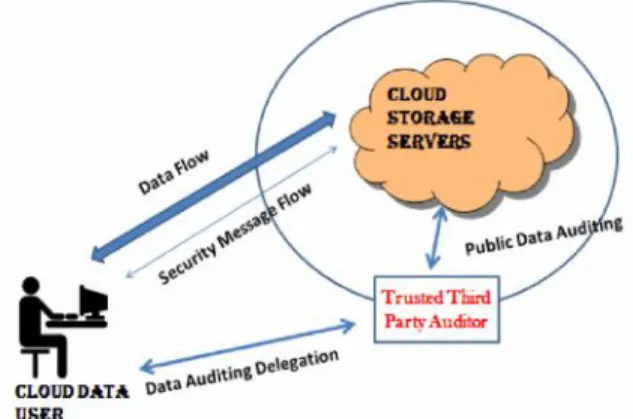
The review in distributed computing is extensively grouped into three, they are first gathering examiner or inward evaluator where the cloud client association reviews by its own, it is a self-appraisal method for interruption recognition and counteractive action framework. Second gathering evaluator is a Cloud Service Provider who has critical assets and specialists in building and overseeing conveyed distributed storage servers, possesses and works where an outer inspecting methodology is utilized for information security and quality administration in cloud administrations. The Cloud information stockpiling design comprises of three on-screen characters, the cloud client who has huge measure of information to be put away and recovered according to the necessity in the cloud. The cloud specialist co-op who keeps up the distributed storage benefits and gives cloud information stockpiling. To empower security safeguarding open examining for cloud information stockpiling appeared in the model, the convention we structured ought to accomplish the accompanying counteractive action, insurance and execution ensures;
1. Capacity exactness: To guarantee that the clients information are to be sure put away properly and kept all the time in cloud.
2. Dependable Security: To guarantee that the AUDITOR can't pick up clients information from the data gathered amid the evaluating procedure.
3. Gathering examining: To empower AUDITOR give secure and effective reviewing to conceivable vast number of various clients all the while
4. Location and Prevention: To enable AUDITOR to give reviewing least correspondence.
Figure 1: The Architecture of Cloud Data Storage Services
The Trusted Third Party (TTP) is a review based association which encourages secure collaborations between two gatherings that is cloud client and cloud supplier, where them two trust this outsider. The Third Party (AUDITOR) enlisted security specialist organization apportioned by the cloud specialist co-op with solid Authentication and Authorization. The AUDITOR can play out Multiple Auditing Tasks for single or various mists in branch way for better proficiency and security [6].Public review capacity: to enable AUDITOR to confirm the rightness of the cloud information on interest without recovering a duplicate of the entire information or acquainting extra online weight with the cloud clients.
V. Framework Model Cloud Server
A nearby Cloud which gives estimated copious capacity administrations are been made in this module. The clients can transfer their information in the cloud. This module can be produced where the
distributed storage can be made secure. The cloud isn't completely decent by clients since the CSPs are probably going to be outside of the cloud clients' confided in space. Like that the cloud server is veritable however inquisitive. That is, the cloud server won't malignantly erase or change client information because of the assurance of information researching plans, however will attempt to take in the substance of the put away information and the characters of cloud clients. This basically implies the proprietor (customer) of the information moves its information to an outsider distributed storage server which should apparently for an expense genuinely store the information with it and give it back to the proprietor at whatever point required.
The cloud server gives benefit to create secure multi-proprietor information sharing plan called MONA. It signifies that any client in the gathering can safely impart information to others by the cloud. This plan can bolster dynamic gatherings easily. Separately, new conceded clients can straightforwardly unscramble information records transferred before their cooperation without reaching with information proprietors however inside the gathering.
Intermediary Server Deployment
Gathering director assumes responsibility of followings,
1. Mark Generation 1) Signature Verification 2) Content Regeneration
An intermediary operator follows up for the information proprietor to recover authenticators and information obstructs on the servers amid the fix method. Notice that the information proprietor is confined in computational and capacity assets contrasted with different substances and may wind up disconnected after the information transfer strategy. The intermediary, who might dependably be on the web, should be substantially more amazing than the information proprietor however not exactly the cloud servers as far as calculation and memory limit. To spare assets and the online weight possibly brought by the intermittent examining and incidental fixing, the information proprietors resort to the AUDITOR for uprightness check and representative the reparation to the intermediary. Taking into account
that the information proprietor can't generally remain online by and by, so as to other gathering content he will be repudiated by the cloud server.
Fig. 2 Cloud Regeneration Architecture VI. Proposed System Architecture
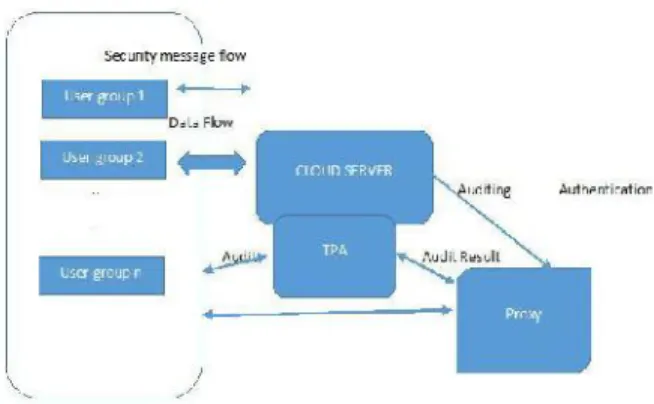
This paper involves three parties: the cloud server, the third party auditor (AUDITOR) and users is shown in Figure 3. There are two types of users in a group: the original user and a number of group users. The original user and group users are both members of the group. Group members are allowed to access and modify shared data created by the original user based on access control polices. Shared data and its verification information (i.e. Mac code) are both stored in the cloud server. The third party auditor is able to verify the integrity of shared data in the cloud server on behalf of group members.
Fig 3: System model includes User, Cloud Server and auditor
In this paper, we just think about how to review the honesty of imparted information in the cloud to static gatherings. It implies the gathering is pre-characterized before shared information is made in the cloud and the enrollment of clients in the gathering isn't changed amid information sharing.
The first client is in charge of choosing who can share her information before redistributing information to the cloud. At the point when a client (either the first client or a gathering client) wishes to check the respectability of shared information, she initially sends an examining solicitation to the AUDITOR. In the wake of accepting the evaluating demand, the AUDITOR creates an examining message to the cloud server, and recovers a reviewing confirmation of shared information from the cloud server. At that point the AUDITOR confirms the accuracy of the evaluating verification. At long last, the AUDITOR sends a reviewing report to the client dependent on the consequence of the confirmation. Proposed Algorithm
Confirmation, Authorization and Auditing for secure distributed storage is executed based on the accompanying key focuses
• Our System Supports an External evaluator to review clients redistributed information in the cloud without learning on the information content.
• The AUDITOR underpins adaptable on demand by cloud specialist co-op for productive open inspecting in the distributed computing
• Auditing is the procedures which is improved the situation the cloud to accomplish group inspecting where various appointed evaluating undertakings from various clients can be performed all the while by the AUDITOR
• The examining is the insight based Dynamic information process for the information and data security in distributed computing
• data respectability calculation, for example, Message Authentication Code (MAC code) by methods for Hash Based Message Authentication Code (HMAC code) to check the trustworthiness of the information being put away in the cloud.
• By methods for MAC code, we upgrade the information honesty of the cloud information. Stage 1: Start of an Algorithm
Stage 2: Key Generation by Advanced Encryption Standard (AES) Algorithm
16-bit Hexa Decimal keys are created
Stage 3: Map the Key to the documents Stage 4: Divide the documents into the squares Stage 5: Each Encrypted Block is Associated with Key
Stage 6: Store the information squares to the Cloud Storage Server
Stage 7: Simultaneously Intelligent framework sends a duplicate of keys to AUDITOR
Stage 8: On ask for of Cloud Service Provider (CSP) the Auditing forms with be finished by AUDITOR Stage 9: Validate the information by marks and information trustworthiness proofs
Stage 10: Successful approval, confirmation will be improved the situation dynamic examining by AUDITOR End of Algorithm.
VII. Conclusion
In this paper, we propose an evaluating framework for information stockpiling security in distributed computing. In spite of the fact that the computational time is expanded however the security is saved. Where information is put away in the cloud by utilizing the most unmistakable calculation AES. We use the holomorphic straight authenticator and irregular concealing to ensure that the examiner would not take in any learning about the information content put away on the cloud server amid the effective inspecting process, which not just takes out the heap of cloud client from the monotonous and conceivably costly evaluating assignment, yet additionally diminishes the clients dread of their redistributed information spillage. Considering reviewer may simultaneously deal with various review sessions from various clients for their redistributed information records, we further expand our protection saving open inspecting convention into a multi-client setting, where the evaluator can play out numerous examining assignments in a group way for better effectiveness. We had beaten a large portion of disadvantages of the current framework by anchoring information elements and execution enhancement. General investigation demonstrates that our plans are provably secure and very proficient. Our primer examination led case further exhibits the quick execution of our structure on both
the cloud and the examiner side. We leave the undeniable execution of the system on business open cloud as an essential future extension.
References
[1] Chi PW, Lei CL. Audit-Free Cloud Storage via Deniable Attribute-based Encryption. IEEE Transactions on Cloud Computing. 2015 Apr 21. [2] Aparna, P. and Murthy, K.S.N., 2016. A Deniable Cp-Abe Scheme For An Audit-Free Cloud Storage Service. IJSEAT, 4(10), pp.602-604.
[3] Greenwald, G. and MacAskill, E., Boundless
Informant: the NSA’s secret tool to track global
surveillance data. The Guardian, 11. 2013.
[4] Edward snowden. [Online]. Available:http://en.wikipedia.org/wiki/Edwar d Snowden (2014)
[5] Canetti, R., Dwork, C., Naor, M. and Ostrovsky, R., 1997, August. Deniable encryption. In Annual International Cryptology Conference (pp. 90-104). Springer Berlin Heidelberg.
[6] Chi, Po-Wen, and Chin-Laung Lei. "AuditFree Cloud Storage via Deniable Attributebased Encryption." IEEE Transactions on Cloud Computing (2015).
[7] Sahai, A., Seyalioglu, H. and Waters, B., 2012. Dynamic credentials and ciphertext delegation for attribute-based encryption. In Advances in Cryptology–CRYPTO 2012 (pp. 199-217). Springer Berlin Heidelberg.
[8] Dr. T Ramaprahu, S priya. An Auditing-free Cloud Storage Using Control Attribute Based Encryption, in © IJIRCCE 2016, DOI: 10,15680/IJIRCCE.2016.0407141.
[9] Cheng-Chi Lee, Pei-Shan Chung and MinShiang Hwang, A Survey on Attribute Based Encryption Scheme of Access Control in Cloud Environment, in international journal of Network Security, 2013, pp. 231-240.
[10] P. Lokesh Kumar Reddy, B. Rama Bhupal Reddy, S. Rama Krishna, Deniable Encryption key, IOSR-JCE, 2013, pp. 08-12.
Authors
K Surya Kranthi is pursuing M.Tech(CSE), in the department of CSE from Kakinada Institute of Engineering and Technology for Women, Korangi,.
Kakarla Ravi kumar is working as an Associate Professor in Department of C.S.E, Kakinada Institute of Engineering and Technology (KIET-W), korangi, Kakinada. He has 11 years of teaching experience. He has supported many students to publish many papers in both National & International Journals. His area of Interest includes image processing and bioinformatics.