(IJSBAR)
ISSN 2307-4531
(Print & Online)
http://gssrr.org/index.php?journal=JournalOfBasicAndApplied
---
231
Design Development and Performance Evaluation of Solar
Dryer for Drying Onion used as powder in Food
Abdulahi Umar
a, Solomon Abera
b, Dubale Befikadu
c*
a
Fedis Agricultural Research Center, Harar, Ethiopia
b
School of Natural Resource and Environmental Engineering, Haramaya University, Dire Dawa, Ethiopia
c
Oromia Agricultural Research Institute, Food Science Research Directorate, Addis Ababa, Ethiopia
aEmail: [email protected] bEmail: [email protected]
cEmail: [email protected]
Abstract
Solar dryer was designed and manufactured at Fadis Agricultural Research Center workshop of Oromia Agricultural Research Institute. The framework of all the parts of the dryer were built by joining perforated angle irons of 40 mm
×
40 mm×
4 mm and 20 mm×
20 mm×
4 mm by means of bolts and nuts. The dryer covers 3.0 m×
3.0 m area of the ground of which the 1m2 was used for drying chamber while the rest was saved for collecting solar radiation. The drying chamber surrounded by the collector from three sides, had five shelves positioned one on the top of another with 10 cm clearance in between. The roofs and walls of the dryer were covered with the flexible transparent plastic leaving the three sides of the solar collector open to allow air in. Preliminary tests with no load to the dryer showed that the solar collector raised the ambient air temperature of 20°C to 41°C to a warm air of 28°C to 64°C between the morning and midday. This lowered the relative humidity of air from average 26% in the morning to 5% at midday. The onion slices of 3 mm thickness, was loaded on the dryer, at a rate of 4 kg/m2, and dried from 87.10% (w.b) initial moisture content to 9.1% (w.b) final moisture content in 10 hours. The open air-sun drying tests conducted side by side with solar drying needed an average of 20 hours to reach the same final moisture contents. The maximum drying rate of onion slices attained was 2.6 kg of water per kg of dry matter-hr. while in the open-air sun drying, the maximum drying rate was 0.82 kg of water per kg of dry matter-hr.--- * Corresponding author.
232
Drying onion slices to its final moisture contents took two and three days in Natural convection solar drying (NCSD) and Open-air sun drying (OASD) of onion respectively. Drying rate coefficients ‘k’ (-1hr) of Lewis model were statistically significantly different and could be used to describe solar and open-air sun drying characteristics of solar and open-sun drying of onion slices. From economic feasibility and payback analysis of the solar dryer, the payback period was determined and was very small (1.20 months) compared to the life of the dryer, so the dryer will dry product free of cost for almost its life period of 15 years.
Keywords: Solar; Drying; Efficiency; Temperature; Humidity; Onion Slices; Postharvest; Loss.
1.Introduction
Drying is a common method for preservation of food products. The main purpose of drying is the reduction of moisture content to a safe level for extending the shelf life of products. The removal of water from fruit and vegetables provides microbiological stability and reduces deteriorative bio-chemical reactions. In addition, the process allows a substantial reduction in terms of mass, volume and packaging requirement, which reflects on handling, storage and transportation costs with more convenience [1]. Use of solar dryers is a much-preferred alternative in view of its low initial capital and running costs, and free and ample supply of solar energy in the country. However, no information is available on solar drying of fruit and vegetables under Ethiopian climatic conditions in general and particularly under the local conditions of the eastern part of the country.
Onion, Allium cepa L., is considered as one of the most important crops in all countries. Domestic onion is the round, edible bulb of Allium cepa L., a species of the lily family, and one of the world’s oldest cultivated vegetable crops. Onion has a universal appeal in the Ethiopian diet and dehydrated onion is well accepted by consumers. The technique for sun drying onion is a simple one and the dry product has good storage life. There is a good export market for dehydrated onion. Therefore, this study was to design, manufacture and conduct performance evaluation of a solar dryer for drying onion. Furthermore, onion was used as the study crop, based on ease of supply during the pick period of its production. The manufactured solar dryer was tested for its drying capacity and efficiency with natural convection air movement.
2. Materials and Methods
2.1 Description of the Study Site
The dryer was designed and manufactured at the Fadis Agricultural Research Center Workshop, Oromia Agricultural Research Institute, Ethiopia. The drying experiment was conducted at Bate Peasant Association located at 09° 25` 03``N and 42° 02`58``E as determined by GPS. The site has an altitude of 2051meters above sea level. It is located 1.50 km to the east of main campus of the Haramaya University, which is located in eastern Ethiopia.
2.2 The Design of the Solar Dryer
233
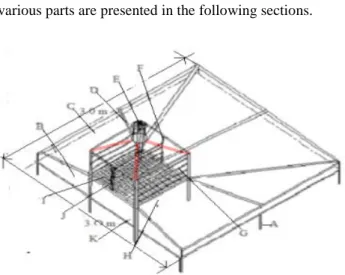
shows the general framework of the dryer, which is built using perforated steel angle irons of 20 mm
×
20 mm×
4 mm and 40 mm×
40 mm×
4.0 mm thick joined by bolts and nuts. All the sides and top surfaces, except the chimney, are covered with transparent plastic (PE), 0.2 mm thick in order to allow the solar radiation in to the unit covering an area of 3.0 m×
3.0 m. The lower side of the floor is off the ground by 0.3 m supported on eleven legs. The designs of various parts are presented in the following sections.Figure 1: Framework of the solar Dryer
(A) collector support; (B) collector; (C) plastic cover; (D) support for plastic cover; (E) saturated air out let (chimney); (F) drying chamber (cabinet); (G) drying cabinet layer (shelves); (H) Drying chamber air inlet; (I) Tray wire mesh; (J) Doors (product out let and inlet) I, H and E are some of the respective measuring points of temperature, relative humidity and air velocity.
Figure 2: Photo of solar dryer
2.3 Performance Evaluation of Solar Dryer
Measuring instruments
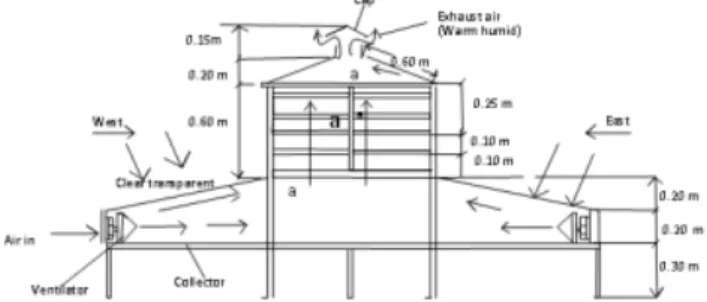
Thermo-hygrometer (Compu Flow- 8612), temperature and humidity meter, with accuracy level of ±0.10°C and ±2.0 %RH, was used to measure temperatures and humidity at various points inside the collector and drying chamber of the solar dryer. The locations of the sensors are shown in Fig.3 at points “a”s. Both the temperature and humidity of air were measured at these points. The temperature and humidity data were recorded at one-hour interval. The air speeds (ms-1) inside the dryer and, at the exit of the moist air (chimney), were measured with a vane type digital anemometer (Testo model 21-63, accuracy ±0.03 m s-1). Weight measurement was done
234
with a digital balance DHAUS of model – CT 6000-s, accuracy (±0.0 g) it was done by removing trays from the drying cabinet for few seconds. The dryer door was opened and closed during the time required to remove each tray, weigh it, record it, and return it to the appropriate location in the shelves of the drying chamber.
Figure 3: Diagram showing the locations of the sensors
2.3.1 Preliminary test of the solar dryer
The dryer was placed on a raised platform, far from the shade of trees and buildings during the whole duration of the experiment. Preliminary tests were conducted to evaluate the performances of the dryer at no-load (empty) conditions. The degrees of opening of the vent (chimney) were calibrated and marked for three levels (quarter, half and fully open) positions of inside air temperature, relative humidity and velocities were measured and recorded.
2.3.2 Efficiency of solar dryer
The study of the solar dryer efficiency provides a means of assessing just how well (or poorly) a dryer operates under certain conditions. Collector efficiency of solar energy absorption and conversion to heat is defined as the
ratio of energy output of the collector to energy input to the collector and is calculated as:
𝜂𝜂𝜂𝜂=𝐴𝐴𝐴𝐴𝐴𝐴𝑄𝑄𝑄𝑄 Where,
η
C is collector efficiency (%), Qu is useful heat flow rate (J/s), Ac is collector area (m2) and G is global solar radiation (W/m2))
(
c,out c,inU
mCp
T
T
Q
=
−
, where m is air mass flow rate (kg/s), Cp is specific heat of air (1007 J kg -1 °K-1 for air), Tc.out is output collector temperatures (°C) and Tc,in is input collector temperatures (°C)
q
m
=
ρ
.
,
ρ
is density of air (kg/m 3) and q = AV, where q is volume flow rate of air (m3/s), A is the collector
G
A
T
T
mC
c in c out c P C . , ,)
(
−
=
η
235
exit area (m2) and V is air velocity (m/s)
2.3.3 Preparation of Onion Samples
Freshly harvested and known variety of onion Adama Red, which were grown in Fadis Agricultural Research Center and by local farmers, were procured from local market. First, the onion was thoroughly cleaned so that all dirt, soils, and mud or insecticide residues were removed. After cutting the top and root of the onion, it was peeled using sharp stainless steel knife. Cleaning was made by simply washing with a tap water. After cleaning, the onion was sliced into circular discs (thin slices) of 3 mm thickness [2; 3] using an electrical operated mechanical slicer. The sliced onion was carefully loaded on the trays without overlapping the slices or in single layer, wire mesh trays at the rate of 4 kg/m2.
2.3.4 Testing the solar dryer using onion slices with natural convection current
The dryer was placed on a raised ground, far from the shade of trees and buildings during the whole duration of the experiment. The degrees of opening of the vent (chimney) were calibrated and marked for various levels of inside temperature and air velocity, weights of drying trays were measured and recorded. The sliced onion was uniformly loaded over pairs of trays, T1, T2, T3, T4, and T5 positioned in shelves 1, 2, 3, 4 and 5 respectively, of right and left compartments of the drying chamber. During the drying, the weight of the trays with the slices was recorded at the interval of 2 hours. Drying began at 8:30 o’clock in the morning, proceeded throughout the day and ended at 5:30 o’clock. The slices on every tray were manually stirred randomly after recording the weights to facilitate the drying process. This was to help the exposure of the slice to the hot air in all direction to ensure the uniform drying. The drying process continued until the moisture content reached the target value or until the safe moisture content and onion were dried to the final moisture content of 5-7% (w.b) [2].
The initial weight of the sample used in this experiment was 1.57 kg per tray. The material holding in single batch for drying was 16 kg. The door of the dryer was properly closed to prevent air leakage. Simultaneously, similar samples were dried in open air under the direct sunlight. The trays and the loading rates were the same and were placed on the platform to lift them off the ground. Weights of samples on trays were recorded every two hours in the way done for samples in the solar dryer.
The dried products on each tray were packed in the labeled airtight plastic bags to be used for further laboratory analysis and experiments. Ambient weather data including local air temperature and relative humidity were measured. Other weather data such as solar insulation and wind velocity were obtained from weather station in the area.
Statistical Analysis
All observations were recorded as means of three replications. The data pertaining moisture contents and drying rate coefficients were statistically analyzed to determine the significant difference; if any between solar drying methods of natural convection solar drying and open-air sun drying for dried onion slices. ANOVA and the mean separation by LSD (P < 0.05) method was carried out for the drying data.
236
3. Results and Discussion
3.1 Preliminary Test Data of the Solar Dryer
In order to characterize the solar dryer, temperature and relative humidity of the air in solar collector and the corresponding data of the ambient air need to be examined. Information on the temperature rise of air is important when evaluating a solar collector especially for drying purposes. During the preliminary tests of the dryer, measurements were taken for few days at no-load. The outlet air temperature of the flat plate collector, which is also the temperature of the drying air at the inlet of the drying chamber, is important parameter for evaluating the collector performance. The collector performance could be seen from the difference in air temperature at the exit and inlet of the solar collector. During the preliminary tests with quarter, half and fully-open positions using manually operated control valve fitted in the chimney, a maximum temperature rise of 41°C above the ambient air were recorded. Due to better temperature rise and optimum air velocity, half- open position was decided and selected to operate the dryer exit in the chimney (Table 1).
Table 1: Preliminary test data at no load of the dryer at half open position of control device
Time of the day Ambient air Collector outlet Tc,o RH Tc,out-Tc,in Air velocity Solar radiation (hour) Tc,in (°C) (°C) Tc,out(% ) (°C) (m/s) (W/m²) 7 15 28 36 13 0.01 50 8 18 36 34 18 0.02 175 9 20 42 30 22 0.02 450 10 21 49 28 28 0.04 650 11 22 53 18 31 0.05 866.53 12 23 60 8 37 0.06 965 13 23 64 5 41 0.06 1035.7 14 22 61 10 39 0.05 980 15 21 50 25 29 0.05 870 16 20 42 35 22 0.03 570 17 20 31 46 11 0.04 350 18 19 27 53 8 0.03 160
Table 1 presents the variation of the ambient air temperature and that of the air leaving the collector. The rise, in air temperature after passing through the collector varied from 18°C at 8:00 o’clock in the morning to about 37°C at midday. The period starting from 10:00 am in the morning to 4:00 pm in the afternoon was where the significant rise in temperature occurred. The one-hour interval data recorded indicated that the collector absorbed the solar radiation striking its surface, converted it to heat and transferred it to the air inside it. As the solar radiation increased from 175 W/m2 in the morning to 965W/m2 at midday the temperature of the air in the collector rose from 36°C to 60°C.The data presented in Table 1, varied with the daily radiance incident on the collector. It can be noted, in the experiment, the absorbed solar energy raised the collector outlet air temperature
237
up to 64°C, just at 1:00 pm. The experiments during these months showed that during the peak afternoon hours, the average rise of air temperature (between the input and output of the collector) was equal to 41°C (varying between 15°C and 41°C). The average air velocity was 0.04 m s-1 at the drying chamber outlet.
Figure 4: Solar radiation, collector outlet & ambient air temperature
3.2 Collector Efficiency
The instantaneous efficiency of the solar collector shown in Table 2, started to rise in the morning period, was relatively constant at 77% from 12:00 hours to 13:30 hours, and dropped down in late afternoon. The variation obtained is typical for a flat plate collector and indicates strong dependence of efficiency on the meteorological data. The daily efficiency, averaged over 11 hours (7:00 to 18:00) comes out to be 51%.
Table 2: Raw data of the collector efficiency analysis for solar dryer
Time of day (hr) drying time (hr) velocity (m/s) Airflow rate ῥAV(kg/s)
Air Temp. (°C) Solar Radiation (W/m²) Energy Collector efficiency (%) Total Useful Tam Tco (Tco-Tam) (W) (W) 7 1 0.01 0.0065 15 28 13 50 400 84 21 8 2 0.02 0.0259 18 36 18 175 1400 468 33 9 3 0.07 0.0905 20 42 22 450 3600 2001 56 10 4 0.09 0.1164 21 49 28 650 5200 3275 63 11 5 0.11 0.1422 22 53 31 867 6932 4431 64 12 6 0.12 0.1552 23 61 38 965 7720 5926 77 13 7 0.12 0.1552 23 64 41 1036 8286 6393 77 14 8 0.11 0.1422 22 61 39 980 7840 5575 71 15 9 0.11 0.1422 21 50 29 870 6960 4145 60 16 10 0.09 0.1099 20 42 22 570 4560 2430 53 17 11 0.04 0.0517 20 31 11 350 2800 572 20 18 12 0.02 0.0259 19 27 8 160 1280 208 16
238
4. Testing of Solar Dryer
4.1 Test of Solar Dryer Using Onion Slice in Natural Convection Current
The initial moisture content of the onion slices was found to be 87.10% (w.b.) and dried to the final moisture content of 9.1% (w.b) (Table 2). [5] Drying data of the onion slices dried in the solar dryer under the natural convection current and that of the slices dried in the open-air sun drying. The onion slices of different trays placed in the solar dryer and that of slices dried in the open-air sun exhibited similar trends of a rapidly falling moisture content. However, slice on tray1 (the bottom tray) showed the highest moisture reduction, indicating rapid fall of the moisture content. For this tray, the slices reached the lowest level of moisture content in 10 hours. Slices on tray 5 the next rapid fall of moisture content observed reaching the final moisture content after 12th hour. Slices of trays, T2, T3 and T4, located in the mid height of the chamber, had the slowest fall of the moisture content extending to the 14th hour to reach a final moisture content value.
The position of the drying trays in the chamber had undoubtedly great influence on the speed of moisture reduction, the bottom and top position of trays favoring fast removal of moisture. The slices dried in open-air sun exhibited the least removal of the moisture throughout the drying time. Furthermore, the moisture content could not be lowered to a level equal to those of the solar dried slices even after 25thhours. Thus, the solar dryer resulted in a drying time reduced by at least half (12hrs) as compared to open-air sun drying, which is required over 24, hours. A constant rate-drying period was not observed in both the drying methods but only a long falling rate-drying period. The drying rate data of onion slices dried in the solar dryer and open-air sun drying expressed as kilogram of evaporated water per kilogram of dry matter- hour, all the records (Table 2) indicated that the initial drying rate was very high. Values of drying rate of onion slices in the solar dryer varied from 1.50 kilogram of water per kilogram of dry matter-hr on tray1 located at the bottom of chamber to 1.2 kilogram of water per kilogram of dry matter-hr of trays 2 & 3 located in the middle of the chamber.
As drying, proceeded the rate of loss of moisture decreased continuously due to reduced moisture content and later in the afternoon due to the fall of the incoming air temperature.
The values of drying rate are equal at some points and close to each other at other points indicating existence of only minor differences among themselves. The drying rate data exhibited a small increase at the start of the drying process in the following day showing a rise in the drying rate. This was attributed to the rise in the air temperature coming from the collector as the solar radiation increased towards the middle of the day. However, that rise gradually subsided in the afternoon as the moisture content reduced and with the fall of air temperature due to less solar radiation.
The drying rate data of the slices dried in the open-air sun drying remained lower in the record for most part of the drying time, exhibiting lower rate of drying. This is in harmony with the moisture content data which showed higher moisture contents than similar records of slices dried in the solar dryer. In this experimental condition, the samples show that drying took place only in the falling rate and no constant rate of drying was observed.
239
Table 3: Weight of onion, percentage moisture contents on wet basis, moisture contents on dry basis and drying rate on dry basis on Tray1,Tray2, Tray 3, Tray 4, Tray 5 and open air sun tray during onion drying using natural convection current and open-air sun drying.
Time Drying Mass of onion (g) Moisture content on dry basis Drying rate on dry basis of day time on trays in dryer Moisture content on wet basis (%) (kg of water/kg of dry matter) (kg of water/kg of dry matter) Date (hr) (hr) T1 T2 T3 T4 T5 TOS T1 T2 T3 T4 T5 TOS T1 T2 T3 T4 T5 TOS T1 T2 T3 T4 T5 TOS 8:30 0 240 271 283 282 272 286 87.0 87.0 87.0 87.0 87.0 87.0 6.7 6.7 6.7 6.7 6.7 6.7 10:30 2 144 185 197 180 176 224 47.0 55.3 56.6 50.8 51.7 65.3 3.6 4.3 4.4 3.9 4.0 5.0 1.5 1.2 1.2 1.4 1.4 0.8 12:30 4 99 148 158 139 134 174 28.3 41.6 42.8 36.3 36.3 47.8 2.2 3.2 3.3 2.8 2.8 3.7 0.7 0.5 0.5 0.6 0.6 0.7 15/10/2010 14:30 6 90 138 148 130 125 146 24.5 37.9 39.3 33.1 32.9 38.0 1.9 2.9 3.0 2.5 2.5 2.9 0.1 0.1 0.1 0.1 0.1 0.4 16:30 8 70 116 128 107 100 120 16.2 29.8 32.2 24.9 23.8 29.0 1.2 2.3 2.5 1.9 1.8 2.2 0.3 0.3 0.3 0.3 0.4 0.3 17:30 9.5 49 90 99 81 77 108 7.4 20.2 22 15.7 15.3 24.8 0.6 1.6 1.7 1.2 1.2 1.9 0.3 0.4 0.4 0.4 0.3 0.2 8:30 9.5 49 80 89 76 65 108 7.4 16.5 18.4 13.9 10.9 24.8 0.6 1.3 1.4 1.1 0.8 1.9 10:30 11.5 35 63 72 61 40 96 1.6 10.3 12.4 8.62 1.69 20.6 0.1 0.8 1.0 0.7 0.10 1.6 0.2 0.2 0.2 0.2 0.2 0.2 12:30 13.5 35 47 54 48 40 89 1.6 4.35 6.08 4.01 1.69 18.1 0.1 0.3 0.5 0.3 0.10 1.4 0.1 0.2 0.2 0.2 0.2 0.1 16/10/2010 14:30 15.5 35 44 49 39 40 76 1.6 3.25 4.31 0.82 1.69 13.6 0.1 0.2 0.3 0.1 0.10 1.0 0.0 0.0 0.7 0.1 0.0 0.2 16:30 16.5 35 37 41 38 40 69 1.6 0.66 1.48 0.46 1.69 11.1 0.1 0.1 0.1 0.10 0.10 0.9 0.0 0.1 0.1 0.0 0.0 0.1 17:30 17.5 35 37 41 38 40 66 1.6 0.66 1.48 0.46 1.69 10.1 0.1 0.1 0.1 0.10 0.10 0.8 0.0 0.1 0.2 0.2 0.0 0.04 Final dry mass 31 35 37 37 35 37.2
240
Table 4: Values of drying rate coefficients ‘k’ (h-1) for onion slices dried in the solar dryer and open-air sun drying
Drying methods Drying trays
1 3 5
Natural convection solar drying (NCSD) 0.389 0.273 0.362 Open-air sun drying of onion (OASD) 0.06 0.02 0.08
4.2 Drying methods
For the drying methods from the ANOVA table and LSD at P<0.05, mean separated were found statistically significantly (Table 5). The results obtained shows the onion slices dried by Natural convection solar drying exhibited the shorter drying time and higher drying rate compared to slices dried by open-air sun drying.
Table 5: Drying methods and mean values of the drying rates
Drying methods Means
Natural convection solar drying (NCSD), 0.67a* Open-air sun drying of onion (OASD), 0.083b*
a*, b* Means of different letter are statistically different at 0.05.
The mean values calculated for the model coefficients k (-1hr.) were statistically analyzed to describe the drying characteristics of solar and open-sun dryings of onion slices.
𝑀𝑀𝑀𝑀=𝑀𝑀𝑡𝑡𝑖𝑖−𝑀𝑀𝑀𝑀𝑀𝑀𝑀𝑀−𝑀𝑀𝑀𝑀 = exp (−𝑘𝑘𝑘𝑘); Where MR is moisture ratio, Mti is moisture content of samples at time ti, Me is equilibrium moisture content, Mo is initial moisture content of the samples and k is model coefficients k (-1hr.) [4]. Moisture ratios for the drying methods of onion slices were as follows:
Natural convection solar drying of onion (ONCSD), MR =exp (-0.34t)
Open-air sun drying of onion (OOASD), MR =exp (-0.05t)
Natural convection solar dryers has the advantage of cheap, easy construction from locally available materials and do not require any other energy during operation. Its major drawbacks are the decrease drying rates, important drying time and the very high internal temperature with the likelihood of overheating the product; all these behaviors are due to the extremely low buoyancy conduced air flow inside the dryer as reported by [7]. In natural convection solar dryer prototype, it was noticed that the poor moist air removal and some samples of
241
tomato slices in the circumference of trays were roasted.
4.3 Economic Feasibility and Pay Back Analysis of the Solar Dryer
The climatic conditions in the Eastern Hararghe allow using the solar dryer for almost the whole year (250 days). The capacity of the dryer is 16 kg of fresh onion. It can uniformly dry the product within one to two days either in forced or natural convection solar dryer.
The expected service life of the dryer is estimated to be 15 years. Assuming the capacity of the dryer per day the costs and the main economic parameters based on the local market price situation in the study area shown in Table 6. Using this data, the payback period was calculated using the formula below [7].
Payback period(PP) =ANUB =II 61200.00 = 0.098 Year6000.00
Where, II is initial investment and ANUB is annual net undiscounted benefits.
The payback period is determined as the time required for the investment cost to equal the return. In this case the payback period is very small (1.2 months) compared to the life of the dryer, 15 years, so the dryer will dry product free of cost for almost its life period.
Table 6: Payback period of the solar dryer used for drying onion
S. No Items Description Cost
1. Cost of the dryer Birr 6000.00 2. Capacity of the dryer 20 kg 3. Life of solar dryer 15 years 4. Depreciation (10%) Birr 600.00 5. Cost of maintenance Birr 300.00 6. Labor cost 50 x 250 Birr 12500.00 7. Cost of raw onion 4 x 20 x 250 Birr 20,000.00 8. Total cost Birr 38800.00 9. Total income 20 x 20 x 250 Birr 100000.00 10. Net income Birr 61200.00
5. Conclusions
From the data collected during the performance evaluation of the solar dryer and statistical analyses of the experimental data undertaken, the following conclusions were drawn.
242
thereby lowering its relative humidity. This increases the drying potential of the air considerably. The solar dryer can give a higher drying rate than open air-sun drying, thus can considerably decrease the drying time needed for any given product. Use of forced circulation in solar dryer can increase the drying rate and thus may reduce the drying time. Onion can be dried from initial moisture of 87.10% (w.b) to final moisture content of 9.1% within two and three days using NCSD and OASD respectively. The drying process of solar and open-air sun drying can be represented by Lewis model It can also be concluded that the designed and manufactured solar dryer can be used to dry other fruits and vegetables sliced in to pieces very much faster than the open-air sun drying.
6. Recommendations
It is important that The manufactured solar dryer be tested using other fruits and vegetables of different moisture content and structural make up to establish their drying pattern and generate additional information to complete its characterization.
The solar dryer was evaluated under ideal environment of long sunshine period and low humidity of the ambient air. It would be of much use to know the drying performance in seasons of low solar radiation and higher ambient air humidity. This will help to predict drying times of various products and accordingly plan their drying operations when the need arises.
The solar dryer was evaluated at a loading rate of 4 kg/m2 for onion slices that is 16 kg of onion were dried to 9.1% (w.b) moisture content levels. It appears that the capacity could be even higher and that higher loading rates must be investigated to assess its potential in favorable weather conditions.
Acknowledgements
Great deal of thanks must be given to the sponsor, Oromia Agricultural Research Institute for funding this research. Special thanks go to Fadis Agricultural Research Center and its staff for providing sincere cooperation. Special thanks go to the FARC workshop staff in manufacturing the solar dryer and for their technical support and friendly assistance during the manufacturing work at center. Special thanks go to Haramaya University Food Science and Post-harvest Technology staff for providing me materials and services.
References
[1] Okos, M.R., G. Narasimhan, R.K. Singh, and A.C. Witnaurer, 1992. Food Dehydration pp. 20-65. In: D.R. Hedman and D.B.Lund (Eds.). Hand Book of Food Engineering, NewYork, Marcel Dekker. 564p.
[2] Ife, F.J., and Bas K., 2003. Preservation of fruit and vegetables, Agromisa Foundation, Wageningen. 86p.
[3] Wang, J., 2002. A single-layer model for far-infrared radiation drying of onion slices. Drying Technology, 20(10): 1941-1965.
243
13: 427-432.
[5] Sacilik, K., R. Keskin and A. K. Elicin, 2006. Mathematical modeling of solar tunnel drying of thin layer organic tomato. Journal of Food Engineering, 73(3): 231-238.
[6] Bala, B.K., Woods, J.L., 1994. Simulation of the indirect natural convection solar drying of rough rice. Solar Energy 53, 259–266.