ISSN (e): 2250-3021, ISSN (p): 2278-8719
Vol. 08, Issue 9 (September. 2018), ||V (III) || PP 31-35
A Comparison Study of Z-H Algorithm and Genetic Algorithm
Parmita, Dr. Reecha Sharma
M.TECH Student, Assistant Professor Department of ECE, Punjabi university, Patiala
Corresponding Author: Parmita
Abstract:
A grey scale image is converted into binary image through the binarization method. The genetic algorithm is applied to optimizing the binarization threshold of binary image. In this research work, the basic algorithm is compared with the proposed algorithm and analyzed their parameters .The proposed algorithm is implemented in MATLAB and results are analyzed in terms of PSNR, MSE and Thinning rate. It is analyzed that proposed algorithm performs well in terms of all parameters.Keywords: Image binarization, Gray scale , Genetic alogorithm, Z-H algorithm
--- --- Date of Submission: 08-09-2018 Date of acceptance: 24-09-2018 --- ---
I.
INTRODUCTION
Image processing is a method to convert an image into digital form and perform some operations on it, in order to get an enhanced image or to extract some useful information from it. The 3D parametric maps are generated here and the replicable and rater-independent values must on the calculated through this approach. There have been various improvements made within the image processing techniques. Automation to a great extent is being provided within these approaches. The contrast can be improved, edges can be detected, and intensity can be quantified as well as various mathematical operations can be applied within the images with minimal cost. In order to understand the most common principles that are responsible for performing the most basic image processing routines the images are manipulated digitally by an average user [1]. ]. A grey scale image is converted into black and white image through the binarization method. Binarization is a major factor on which the result of OCR depends. Within character recognition, higher accuracy is achieved by high quality binarized image in comparison to the original image which includes noise in it [2]. A single threshold value is used for the complete image is case of global binarization techniques. The threshold value is calculated pixel by pixel or region by region in case of local binarization method. Several binarization techniques have been proposed by different researchers over time. Depending upon the shape of histogram, the automatic binarization level decision is made by Otsu’s thresholing technique. Foreground and Background are the two basic classes that collectively generate an image. To reduce the weights within class variances of these two classes, an optimal threshold value is calculated. Here, the binarization level is determined through the reduction of class variance. The clustering-based image thresholding is performed automatically or the gray level image is minimized to a binary image through this technique. The Niblack’s method is enhanced to generate this method. The problem of availability of huge amount of noise within the background regions is solved using this method [3]. There are variable of characters that cause a problem within the Kim’s method. However, the maximum input document images result in performing a good result. The Niblack method is improved to introduce Nick method. The most degraded document is handled by implementing Nick method. Genetic algorithm recognized as the unbiased optimization technique that is useful in image enhancement and segmentation. Due to this, it is very popular for GAs applications in image processing and other fields. The threshold of image binarization can be find out by the genetic algorithm. By applying genetic algorithm on any image it provide a new enhanced image which is much better than the original one that contains features of parents. The presence of noise within white pages and low contrast issue are resolved using this method. The threshold value is shifted downward to achieve these goals. Countless defects are present within the binary images. Within few scenarios, the binary regions that are generated by simple threshold include noise and textures within them. The method that includes various image processing operations such that on the basis of shapes the images can be enhanced is known as morphology [4].
International organization of Scientific Research
32 | P a g e
II.
LITERATURE REVIEW
Xiaoyu Liu et.al (2017) presents an improved OSTU scheme for illumination and binarization of pixels. There is model called Phong model which is used to illuminates the non-uniform characters and adjusts the OSTU binarized characters. This is used to identify the billet images within the binarized region of the non-uniform characters. It also introduces the detailed implementation of the engineering techniques. The experimental result of billet images shows the effective performance of the proposed algorithm. So, the research concludes that the proposed method can enhances the process of defect finding in billet images. It is also applicable to other engineered non-uniformed characters [5].
Ms.A.SAKILA et.al (2017) proposed a hybrid algorithm for image binarization. It the combination of OTSU and Niblack techniques, they are verified on the synthetic and tobacco dataset along with the proposed technique. This hybrid method is compared with the local and global threshold method which shows that the proposed approach gives better results in comparison to them. But there are some shortcomings of this technique; some of them have blurred images, misplaced handwritten manuscripts. Therefore, the study concludes that the proposed algorithm is much better than global and local threshold methods; it gives more accurate and effective results [6].
Prithwish Jana et.al (2017) proposed a K-means based clustering technique for image binarization of the degraded documents. The recent dataset of handwritten counterpart of document image binarization contest is validated using handwritten document images and summarized detailed of every image pixels. The experimental results are compared with top three wining ones in the contest and other algorithm proposed for further verification and validation. Therefore, the result of the algorithm shows that it reveals outstanding performance, more effective and valid as compared to any other proposed method. It effectively binarize the images and documents and makes them ready for further retrieval and processing[7].
Fuxi Jia et.al (2016) proposed, a novel local threshold binarization method using structural symmetry of strokes. It is very different from already existing local threshold a method which uses the whole region to evaluate the threshold. It evaluates the local threshold by using Structural Symmetric Pixels (SSP) so that the non-text pixels can maintain the text ones only. It deals with the degraded images such as low contrast images and so on. In order to prove that the proposed method is more effective, test on two public documents datasets are performed. Hence, the experimental results show that this method of local threshold binarization can be performed on both F-measure and PSNR[8].
Ms.Supriya Sunil Lokhande et.al (2015) presents a state-of-art documents image binarization method. After explaining the documents images on the various techniques for image binarization, their results are being compared with the help of different methods. Their performances are widely used for document images analysis and determination. According to this comparison, it is found that the adaptive contrast method is best used method. So the results show that this method obtains very effective results in comparison to other proposed methods. It outperforms the binarization of images in terms of F-measure, PSNR and so on [9].
Ranganatha D et.al (2015) proposed a simple and efficient binarization method to binarize the polluted and degraded documental images. It states that it is efficient in tolerating the highly inter and intra intensity variation of the degraded document images. It is based on spatial domain methods such as Laplacian operator, Adaptive Bilateral Filter and Gaussian filter and so on. They all works good on degraded images and for palm-leaf manuscript images. Hence, the result shows that the proposed method is unable to address and increase the severe degraded images [10].
Research Methodology
In this research work, the method of image binarization is connected to expel undesirable pixels from the picture. To expel undesirable pixels from the picture the strategy of Z-H Algorithm is taken after with the genetic Algorithm. The threshold value for the image binarization defined by the genetic algorithm . There are two sub-iterations engaged with the calculation of image binarization. A parallel strategy is incorporated into this calculation which demonstrates its reliance on past value.
The first step 1) 2 ≤N(Pi) ≤ 6 2) S(Pi) = 1 3) P2* P4* P6 =0 4) P4 * P6* P8 =0
The steps 3 and 4 are modified within the second iteration: 3) P2 * P4 * P8 = 0
4) P2 * P6 * P8 = 0
possible solutions are provided by GAs. Further, recombination and mutation is performed on these solutions to generate new children. Over several generations, this process is repeated further. A fitness value is then assigned to each individual. The chance to mate and generate new fitter individuals is given only to the fitter individuals. This is known as “Survival of the Fittest” theory. The following process is performed within the genetic algorithm process:
Step 1: The number of chromosomes, the generation and mutation rate as well as the crossover rate value is determined in the initial step.
Step 2: The introduction of chromosome-chromosome number of population and utilization of random value to initialize the value of genes chromosome-chromosome.
Step 3: Till the number of generations required are achieved, the steps 4-7 are processed. Step 4: Calculate objective function to evaluate the fitness value of chromosomes. Step 5: Select the appropriate chromosomes.
Step 6: Perform crossover on the value achieved. Step 7: Perform mutation.
Step 8: The solution that is, the best chromosomes are achieved as end results.
The output which is generated in the 8th step is set as the window size for the image binarization.
III.
EXPERIMENTAL RESULTS
The proposed work has been implemented in MATLAB and the results are evaluated as presented below.
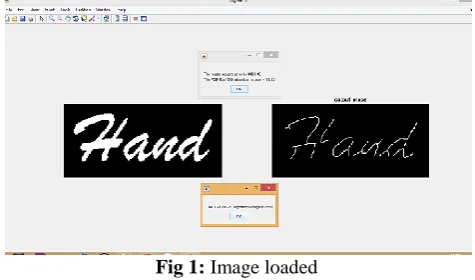
Fig 1: Image loaded
As illustrated in figure 1, the image is loaded with for the thinning. The thinning is method of expelling the unwanted information from picture. To take away the unwanted information from
The image dilution components are employed which is able to remove unwanted information. The zang and sang algorithm is utilized for thinning which gave yield in terms of MSE, PSNR and thinning rate. The value of MSE is 4403.10, value of PSNR is 11.73 and value of TR is 0.50.
Fig 2: Apply of genetic algorithm
As shown in figure 2, to enhance output of zang and sang algorithm as far as PNSR, MSE and TR enhancement is proposed which is able be based on genetic algorithm. In this figure genetic algorithm is executed with zang and sang algorithm. After applying the genetic algorithm the output of the thinning is image is shown which has better results than existing one.
International organization of Scientific Research
34 | P a g e
Table 1: Table of ComparisonParameter Zang and Sang
algorithm
Proposed algorithm
PSNR 11.73 32.11
MSE 4403.10 40.30
Thinning rate 0.50 0.99
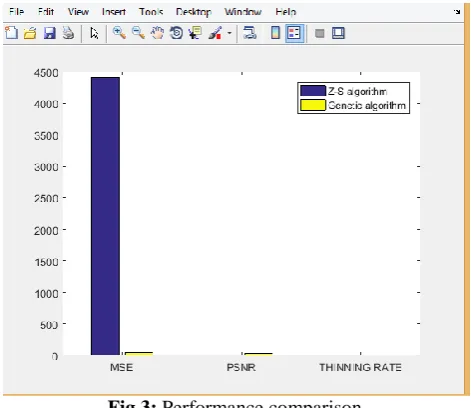
After applying the genetic algorithm the output of the thinning is image is shown that has higher results than existing one. The results after applying MSE, PNSR and TR values are 40.30, 32.11and 0.99 respectively.
Fig 3: Performance comparison
As shown in figure 3, the basic algorithm is compared with the proposed algorithm. It is analyzed that genetic algorithm performs well in terms of MSE, PSNR and Thinning rate.
IV.
CONCLUSION
The image binarization is technique which can remove unwanted pixels from the gray scale images. This technique is applied to reduce size of the gray scale images. In this research work, technique of the genetic algorithm is used to decide the image binarization threshold value. The pixels which have value above the threshold value will be removed from the image. The proposed algorithm is implemented in MATLAB and results are analyzed in terms of PSNR, MSE and thinning rate. The experimental result shows that proposed algorithm performs batter in terms of PSNR, MSE and thinning rate.
REFERENCES
[1] Jeffrey GlaisterAlexander Wong and and David A. Clausi, “Segmentation of Skin Lesions From Digital Images Using Joint Statistical Texture Distinctiveness”, 2014, IEEE TRANSACTIONS ON BIOMEDICAL ENGINEERING, 61 (4), p1220-1230.
[2] Jialiang Peng and Bian Yang, “A novel Binarization Scheme for Real-valued Biometric Feature,” 2017, IEEE.
[3] B.Vishnudharan and Mrs.K.Anusudha, “Reclamation of Information from Degraded and Damaged Document Images by Image Binarization Method,” 2017, IEEE.
[4] Sabeenian R S, Paramasivam M E and Dinesh P M, “Appraisal of Localized Binarization Methods on Tamil Palm-leaf Manuscripts,” 2017, IEEE.
[5] Xiaoyu Liu, Bi Zhang, “Phong Model Based Binarization and Its Application to Billet Images with Non-uniform Illumination,” 2017, IEEE.
[6] Ms. A. SAKILA, Dr. S. VIJAYARANI, “A Hybrid Approach for Document Image Binarization,” 2017, IEEE.
[7] Prithwish Jana, Soulib Ghosh, Suman Kumar Bera and Ram Sarkar, “Handwritten Document Image Binarization: An Adaptive K-Means Based Approach,” 2017, IEEE.
International organization of Scientific Research
35 | P a g e
[9] Ms.Supriya Sunil Lokhande, Prof.N.A.Dawande, “A Survey on Document Image BinarizationTechniques,” 2015, IEEE.
[10] Ranganatha D and Ganga Holi, “Hybrid Binarization Technique for Degraded Document Images,” 2015, IEEE.