International Journal of Practice-based Learning in Health and Social Care Vol. 5 No 2 December 2017, pages 1-18
DOI:10.18552/ijpblhsc.v5i2.361 1
Students’ Experiences and Perceptions of
Interprofessional Supervision on Placement
Kizzy YangKoorana Child and Family Services, Sydney, Australia Gillian Nisbet
The University of Sydney, Australia Lindy McAllister
The University of Sydney, Australia
Abstract
This study aimed to explore perceptions and experiences of Occupational Therapy and Speech-Language Therapy students regarding interprofessional supervision during an interprofessional rural schools placement. Eight participants were recruited to participate in three semi-structured, one-to-one interviews conducted by phone before, during, and after the placement. The interviews were transcribed verbatim for subsequent thematic analysis. Our findings indicate that whilst participants valued the interprofessional peer supervision afforded by interprofessional placements, they entered interprofessional placements with misguided assumptions and expectations regarding interprofessional supervision from supervisors. This appeared to contribute to their largely negative perceptions of interprofessional supervision resulting in the devaluing of interprofessional supervision now and possibly in the future. This exploratory study presents a unique insight into the limitations of interprofessional supervision, and the critical need for interprofessional supervisor training and student preparation before placements. Follow-up research is required to expand on these findings so the limitations are addressed. This may enable interprofessional supervisors to provide better learning experiences, increasing students’ acceptance and appreciation of interprofessional supervision.
Keywords: interprofessional student supervision; occupational therapy; qualitative research; speech and language therapy; student experiences
*Corresponding Author: Gillian Nisbet, Senior Lecturer Work Integrated Learning, Faculty of Health Sciences, The University of Sydney, PO Box 170, Lidcombe NSW 2141 Australia
Email: [email protected]
Journal URL: http://e-learning.coventry.ac.uk/ojs/index.php/pblh
Yang, K., Nisbet, G., and McAllister, L. (2017) ‘Students’ Experiences and Perceptions of Interprofessional Supervision on Placement’. International Journal of Practice-based Learning in Health and Social Care, 5 (2), 1–18
© 2017 Kizzy Yang, Gillian Nisbet, Lindy McAllister. This Open Access article is distributed under the terms of the Creative Commons Attribution Attribution-Non-Commercial No Derivatives 4.0 International License (https://creativecommons.org/licenses/by-nc-nd/4.0/ ), which permits unrestricted non-commercial use, distribution, and reproduction in any medium, provided the original work is properly cited and is unaltered.
International Journal of Practice-based Learning in Health and Social Care Vol. 5 No 2 2017, pages 1-18
Students’ Experiences and Perceptions of Interprofessional Supervision on Placement 2
Introduction
Interprofessional learning (IPL), whereby students from different professions learn collaboratively with, from, and about each other to ultimately improve health outcomes, prepares students for interprofessional (IP) practice (World Health Organization 2010). This includes both formal structured education programs and informal learning opportunities. Nisbet, Lincoln, and Dunn (2013) suggest this latter ranges from the implicit unplanned learning that occurs between professionals (or students) to a more deliberative explicit focus on learning within the workplace where learning occurs through – and is a central part of – everyday work practice.
The importance of IP practice is highlighted through various initiatives to encourage IP practice (Canadian Interprofessional Health Collaborative 2010, Centre for the Advancement of
Interprofessional Education 2007, Health Workforce Australia 2014). In the rural context, IP practice can overcome some of the challenges resulting from health professional shortages (Senate Community Affairs References Commitee 2012). When effective, IP practice enables health professionals to meet the complex health needs of patients, thus improving their quality of care and health outcomes (Bridges, Davidson, Odegard, Maki, and Tomkowiak 2011). Conversely, poor IP practice has adverse effects on patient care (Garling 2008, Stroke Unit Trialists’ Collaboration 2013, Williams et al. 2007). A variety of factors such as devaluing of team members from other disciplines, challenging power dynamics, and poor communication make achieving effective IP practice difficult (Jenkins, Fallowfield, and Poole 2001, Kvarnstrom 2008, Suter et al. 2009).
Whilst the placement setting offers students both formal and informal IPL experiences, the discipline-specific (DS) nature of most health education placement models (Lekkas et al. 2007,
Sheepway, Lincoln, and Togher 2011) limits these opportunities and therefore may hinder students’ ability to work effectively in IP teams on graduation (Baxter and Brumfitt 2008). Thus, well-designed IPL experiences are required to address these barriers and to encourage effective IP practice in the workplace. IP placements in the rural context may also encourage students to work in rural areas in the future (Mu, Chao, Jensen, and Royeen 2004). There are several studies on the overall experiences of students on IP placements (Greenstock, Molloy, Fiddes, Fraser, and Brooks 2013, Mackenzie et al. 2007, Nisbet, Hendry, Rolls, and Field 2008). These studies focus on students’ experiences of IP communication and practice,
understanding the roles of other disciplines, attitudes towards IPL, peer learning, and joint IP sessions and debriefs. Students’ reports of IP learning are typically positive (see, for example,
Jones, McAllister, and Lyle 2015). However, as supervision is key to the learning of students on placements, more focus needs to be placed on exploring the requirements for effective IP supervision in the education of health students (Diack, Gibson, Munro, and Strath 2014,
McCarthy 2006).
For the purposes of this article, we have adapted the Health Workforce Australia’s definition of clinical supervision to define placement supervision as the direct or indirect oversight “. . . of professional procedures and/or processes performed by a learner or group of learners within a (clinical) placement for the purposes of guiding, providing feedback on, and assessing personal, professional and educational development in the context of each learner’s experience of
providing safe, appropriate and high quality patient-client care” (Health Workforce Australia 2014: 22). Extending this definition, IP supervision covers “supervision from educators whose profession differs from that of the students” (Chipchase, Allen, Eley, McAllister, and Strong 2012: 5). It may include facilitating IPL activities within the placement setting, mentoring students from other professions, providing feedback and/or assessing students.
Few studies (Chipchase et al. 2012, Jakobsen and Hansen 2014, Marshall and Gordon 2010,
Mpofu, Daniels, Adonis, and Karuguti 2014, Nicol and Forman 2014) have explored students’
experiences of IP supervision. Those that have, report mixed views. Chipchase et al. (2012) examined Australian student and IP supervisor experiences of an IP placement in an
International Journal of Practice-based Learning in Health and Social Care Vol. 5 No 2 2017, pages 1-18
Students’ Experiences and Perceptions of Interprofessional Supervision on Placement 3 understanding of the different teaching and learning styles of each profession. All students commented on the need for DS supervision throughout the placement and authors emphasised the need for further research to determine the basis for this need. Likewise, Nicol and Forman (2014) in their study of facilitation practices within an IP placement in metropolitan Australia, reported students’ desire for better DS support and supervision. When discipline supervisors were present, students perceived this to be solely for assessment purposes, resulting in additional stress. Studies exploring students’ experiences of IP supervision have been part of larger studies on IP placement experiences. Marshall and Gordon (2010) explored students’
experiences of IP supervision in a National Health Service site in the United Kingdom. However, the students’ experiences of IP supervision were only briefly explored and their exposure to IP supervision was limited. Mpofu et al. (2014) investigated students’ experiences on an IP
placement in an intercultural rural South African context. Student consensus was reached on the importance of aspects of IP supervision such as role-modeling, feedback, and interpersonal skills. However, widespread student dissatisfaction was reported regarding their access to IP supervision and a minority was also not satisfied with the facilitation of IP decision-making. The presence of IP tutors was considered essential for appropriate learning in a Danish study which aimed to expand an IP program to other areas of a hospital (Jakobsen and Hansen 2014). However, students were critical of organisational aspects, for example busy schedules of allocated supervisors impacting on support available.
The dynamics between supervisor and supervisee practitioners differ to that of supervisor and supervisee students. However, studies on practitioners’ experiences of IP supervision (see, for example, Bogo, Paterson, Tufford, and King 2011, Howard, Beddoe, and Mowjood 2013,
Townend 2005) support findings from Chipchase et al. (2012) with respect to discipline
differences in supervision. In these studies, DS supervision was considered more desirable than IP supervision as IP supervision was unable to meet all the practitioners’ needs due to
differences in theory, philosophy and language use. Practitioners sought IP supervision when DS supervision was not available (Howard, Beddoe, and Mowjood 2013). Whilst some positive aspects of IP supervision have been reported, for example, increased knowledge and creativity, new perspectives and approaches, and improved critical thinking (Howard, Beddoe, and
Mowjood 2013, Townend 2005), negative attitudes towards IP supervision have arisen due to the focus on administrative duties (Bogo et al. 2011).
Supervision can also be provided by peers. Placements are rich in opportunities for peer learning. Baldry Currens (2010) has described dialogic collaborations and activity-oriented collaborations between peers in peer learning contexts. These are distinct from more formal supervision, often provided by senior students to junior students (see, for example, Burch, Guthrie, Kidd, Lewis, and Smiler 2010 and Turner, White, and Poth 2012), or across peer groups at the same level (see, for example, Dowling’s Teaching Clinic Model, Dowling 2001). Such peer supervision is typically undertaken within a discipline. We are not aware of literature reporting on IP peer supervision.
There is a gap in our understanding of IP supervision from students’ perspectives, and no studies of allied health students’ experiences of IP supervision in rural placements. Furthermore, IP supervision is poorly theorized. We therefore drew on workplace learning theories to assist our understanding. Workplace IPL is informed by socio-cultural learning theories. Here, learning is viewed as social (Kaufman and Mann 2010), participatory (Elmholdt 2004), and contextual (Hager 2008). For students on placement, learning occurs as they engage in the placement through interaction with others (peers, supervisors, and other health professionals) and through participating in IPL opportunities as they arise. Learning is reinforced through individual reflection (Sargeant 2009). Billet (2001, 2009) adds another dimension to learning within the practice setting: that of affordance and engagement. Affordance refers to:
. . . the degree by which students are invited and supported in their learning. . . [including] the experiences that are provided for them, the kind of support they receive, access to activities, and guidance from more experienced and expert practitioners (Billett 2009: 835).
International Journal of Practice-based Learning in Health and Social Care Vol. 5 No 2 2017, pages 1-18
Students’ Experiences and Perceptions of Interprofessional Supervision on Placement 4 Engagement refers to how students engage with and take up the affordances provided (Billett 2001, 2009). Billet suggests learning is not dependent upon the affordances of the workplace “. . . but on how individuals elect to engage with what is afforded them” (Billett 2009: 836). Using lenses of socio-cultural learning, reflective practice, and engagement as a theoretical frame, this study aimed to explore the IP supervision experiences and perceptions of
Occupational Therapy (OT) and Speech-Language Therapy (SLT) students in rural Australia.
Method
This exploratory qualitative study used thematic analysis of interviews to investigate participants’ experiences of IP supervision.
Context
This study was conducted with students on a well-established IP student placement in schools in rural Australia. Each year, third year OT students in a four-year Bachelor degree, and SLT students in the final year of a four-year Bachelor degree or two-year Graduate entry
Coursework Masters degree, are randomly allocated to this placement. The OT and SLT students attended the placement together over a six week (SLTs) or eight week (OTs) period.
The placement adopted a non-traditional model of student supervision incorporating IP supervision, in addition to DS supervision. There were two supervisors providing supervision. The SLT supervisor was experienced in the role and setting, and experienced in IP supervision, but the OT supervisor was supervising for the first time on this placement and had little
experience of IP supervision. The supervisors prepared for the placement through ad hoc discussions and peer mentoring on a daily basis. Students were prepared for the placement through a comprehensive pre-placement orientation involving a three-day onsite orientation school visit and skills development sessions in the first week. This allowed students to understand placement expectations, learn how to plan DS and IP sessions, practice their assessment skills, familiarise themselves with each other and their placement locations, and learn how to manage classroom environments and how to build relationships with their clients. Students were informed that they would receive IP supervision in addition to DS supervision due to the overlapping nature of the OT and SLT client goals. The IP supervision objectives were to foster an IP environment, encourage the recognition and valuing of the other discipline’s skills, recognise that the other discipline’s supervisor could offer supervision, and encourage IP practice. Interprofessional supervision was structured around what was relevant at the time. Students would receive up to 4 hours of IP supervision each week through direct observations, feedback, and/or discussions. However, this only occurred when students of both disciplines were present, thus students did not receive IP supervision every week.
Discipline-specific supervision included feedback based on direct observation as well as indirect feedback for session plans, progress reports, and reflections. Each week, students received an average of 5.5 hours of direct supervision and 1 hour of indirect supervision from their DS supervisor. Students also participated in weekly DS and IP debriefs. The purpose of DS debriefs was to discuss discipline-specific concerns, whereas the purpose of IP debriefs was to discuss peer supervision, time management, behaviour management, communication issues, and student well-being.
Occupational therapy and SLT students interacted during placement hours and out of hours. Each student had opportunities to conduct individual sessions, group sessions, and class-based sessions. Although the individual and group sessions were discipline-specific, the class-based sessions were always conducted by an OT and SLT student. These sessions ran for 45 minutes – 1 hour, and were conducted weekly. The OT and SLT students also observed and provided feedback to each other, worked from the same space, and could engage in ad hoc discussions. Individual sessions often occurred in common workspaces so students had the opportunity to observe the other discipline’s sessions. Accommodation was arranged so that OT and SLT
International Journal of Practice-based Learning in Health and Social Care Vol. 5 No 2 2017, pages 1-18
Students’ Experiences and Perceptions of Interprofessional Supervision on Placement 5 students lived together in 2-4 bed units. Interprofessional learning opportunities were therefore a combination of spontaneous learning through informal interactions, to more explicit structured encounters where students worked as a team to deliver a session.
Participants
A convenience sampling approach (Gravetter and Forzano 2012) was used whereby all OT and SLT students scheduled to attend this rural placement at the time of data collection were invited to take part in the study. To minimise coercion, a member of the research team unknown to the students made initial contact via email to provide information about the study. Informed consent was obtained from eight of the ten students on placement at the time: four OT participants and four SLT participants. Seven of the participants were female and one was male (this is typical of gender distributions in these disciplines). The participant numbers and disciplines were pre-determined by the normal university placement allocations.
Data collection
Data was collected through individual semi-structured interviews (Streubert and Carpenter 2011). These interviews were planned to be conducted as follows: Interview 1 - one week prior to placement; Interview 2 - during the third to fifth week of placement; and Interview 3 - one week after placement. Interviews ranged from 25 – 60 minutes (average of 33 minutes) depending on the phase of the study and the talkativeness of the participant. Interview 1 focused on previous experiences of supervision and assumptions about IP supervision; Interview 2 focused on current experiences and perceptions of IP supervision; and Interview 3 focused on later experiences and retrospective reflections. Interview guides were pilot-tested for suitability with an SLT student who had previously completed the IP placement. Due to
geographical factors, all participant interviews were conducted over the phone. A total of 18 separate interviews were conducted for this study. For the OT participants, timing of Interview 1 was delayed due to delays in their recruitment, and was conducted immediately prior to
Interview 2. When the SLT participants were contacted for Interview 2, three of them were unavailable. All participants were available for Interview 3.
Data analysis
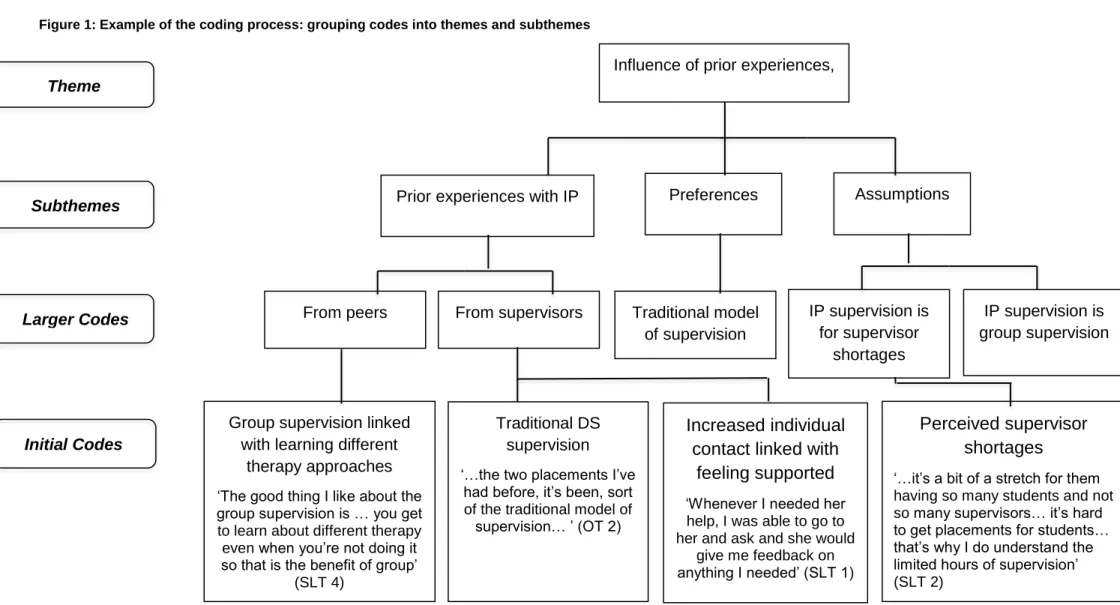
Interviews were analysed to identify patterns of meaning using a standard approach to thematic analysis (Creswell 2012). A member of the research team (KY) immersed herself in the data through transcription of the interviews and repeated reading of transcripts. The data was then coded for units of meaning that were grouped and collapsed into larger codes. Another member of the research team (GN) read and independently coded the transcripts. The research team met to achieve consensus regarding the codes and collapsed them into subthemes then overarching themes. Using an iterative process (Srivastava and Hopwood 2009), the codes identified in initial transcripts were applied to later transcripts, new codes created where appropriate, and compared with earlier transcript coding. A final coding table was developed that yielded three overlapping themes. These are presented in the results of this study. An example of the coding and theming process is outlined in Figure 1.
Rigor
Scientific rigor in this study was assured through using commonly adopted qualitative research procedures (Creswell 2012), including: bracketing of prior assumptions; repeated interviews with the same participants over several weeks, and participant validation of initial data interpretation through clarification in later interviews (for example, ‘So you told me in your last interview that you received a debrief session with your interprofessional supervisor…how did that go?’); researcher immersion in the data; preliminary analysis of early interviews to inform questions for subsequent interview questions; fortnightly documented meetings of the research team during data analysis to ensure consensus on coding and thematic analysis; and illustrating the themes with participants’ words (that is, thick description).
International Journal of Practice-based Learning in Health and Social Care Vol. 5 No 2 December 2017, pages 1-18
DOI:10.18552/ijpblhsc.v5i2.361 6
Figure 1: Example of the coding process: grouping codes into themes and subthemes
Theme
Subthemes
Larger Codes
Initial Codes
Group supervision linked
with learning different
therapy approaches
‘The good thing I like about the group supervision is … you get to learn about different therapy even when you’re not doing it so that is the benefit of group’
(SLT 4)
Influence of prior experiences,
preferences and assumptions
Preferences
Assumptions
IP supervision is
for supervisor
shortages
IP supervision is
group supervision
Traditional model
of supervision
Prior experiences with IP
supervision
From peers
From supervisors
Traditional DS
supervision
‘…the two placements I’ve had before, it’s been, sort of the traditional model of
supervision… ’ (OT 2)
Increased individual
contact linked with
feeling supported
‘Whenever I needed her help, I was able to go to her and ask and she wouldgive me feedback on anything I needed’ (SLT 1)
Perceived supervisor
shortages
‘…it’s a bit of a stretch for them having so many students and not so many supervisors… it’s hard to get placements for students… that’s why I do understand the limited hours of supervision’ (SLT 2)
International Journal of Practice-based Learning in Health and Social Care Vol. 5 No 2 December 2017, pages 1-18
DOI:10.18552/ijpblhsc.v5i2.361 7
Ethical considerations
Ethical approval was received from the Human Research Ethics Committee at The University of Sydney (# 2013/1048).
Results
There was considerable information in the interviews pertaining to informal and incidental IP peer learning arising from students living and working together. However, as the purpose of this study was to examine experiences and perceptions of the IP supervision we have restricted data analysis and presentation to IP supervision. Much of the data in the interviews relates to IP supervision from supervisors, although participants did mention IP supervision from peers and this has been included in relevant themes below. Three overarching themes emerged from the interviews. The first theme emerged from the pre-placement interviews, which focused on participants’ previous supervision experiences and assumptions about IP supervision. The second and third themes emerged from data collected in the second and third interviews (which were combined due to minimal differences in the data) where participants described their experiences of receiving IP supervision from peers and placement supervisors, and their subsequent reactions. Differences between the disciplines were noted within the themes as illustrated through exemplar quotes from the transcripts. To ensure confidentiality and anonymity, all participants were assigned codes in exemplar quotes and any other names or locations were de-identified.
Theme one: Influence of prior experiences, preferences and assumptions
Prior experiences of IP supervision
From peers
SLT participants had no previous experience with IP supervision from peers but did have prior experience of DS peer and group supervision in earlier years of their degree. Some reflected on this in their first interview:
One of them was a group setting so I had one supervisor who was um overseeing four students at the same time or two at the same time and that was in a school setting and umm so we also had, so we had a supervision in that way but we also had personal feedback as well as group feedback for that placement (SLT 3).
The good thing I like about the group supervision is that you get to hear about the other clients so you get to learn about different therapy even when you’re not doing it so that is the benefit of group (SLT 4).
However, due to curriculum design factors, the OT participants had no prior experience of DS or IP peer supervision and did not offer comments in the interviews.
From supervisors
Neither OT nor SLT participants had any previous experiences with IP supervision. All of the prior experiences described were of a traditional model of DS supervision, which included one-to-one supervision and in-depth feedback:
…the two placements I’ve had before, it’s been, sort of the traditional model of supervision… I follow someone, and observe what they do … do some aspects of their job, but still under their supervision (OT 2).
International Journal of Practice-based Learning in Health and Social Care Vol. 5 No 2 2017, pages 1-18
Students’ Experiences and Perceptions of Interprofessional Supervision on Placement 8 Whenever I needed her help, I was able to go to her and ask and she would give
me feedback on anything I needed (SLT 1).
Preferences
Participants all preferred a traditional model of DS supervision where supervision was provided by their own discipline and on a one-to-one basis. Participants linked increased individual supervision with ‘feel[ing] supported in our role’ (SLT 3). This preference for traditional
supervision was emphasised when discussing the limited hours of supervision they anticipated on the upcoming placement. However the reasons for their preference differed for each discipline. The OT participants favored more traditional supervision due to their limited overall placement experience:
I guess just having an OT as a discipline-specific supervisor … would be helpful … to get that reinforcement of the same education (OT 1).
On the other hand, the SLT participants wanted more traditional supervision as they had mainly received group feedback on previous placements:
…the group supervision I’ve had in the past, I haven’t really found them that helpful, I do prefer that one-on-one supervision (SLT 4).
Assumptions
When asked to describe what they anticipated IP supervision would entail, participants
expressed a variety of assumptions. Some SLT participants thought they might be ‘doing some OT work’ (SLT 1) and receiving ‘feedback that’s more from the group’s perspective’ (SLT 4) whereas others ‘didn’t really think about it too much’ (OT 3). Many of the participants from both disciplines assumed IP supervision would not fit their discipline’s framework:
…it’s difficult if that’s the only supervision you’re getting to put that into your framework of learning and thinking (OT 1).
Participants voiced concern that the IP supervisor would have conflicting priorities and expectations to their DS supervisor, and that this may negatively affect DS learning:
[IP supervisor] might not be able to comment or might focus on different things … wanting different expectations from the therapy … I feel it’s not in my scope of practice… even just language they’re using might be different (SLT 4).
Many participants associated IP supervision with less supervision. One participant erroneously suggested that the purpose of IP supervision was to make up for supervisor shortages
highlighting the participants’ limited understanding of IP supervision:
…it’s a bit of a stretch for them having so many students and not so many
supervisors… it’s hard to get placements for students… that’s why I do understand the limited hours of supervision (SLT 2).
Theme two: Experience of interprofessional supervision
Experience of IP supervision from peers
Having ‘interdisciplinary student peers supervising us’ (OT 1) was commonly reported by the students. Sometimes this supervision took the form of unstructured feedback provided by one peer to another, after observing the peer conduct intervention with a child or a classroom session:
International Journal of Practice-based Learning in Health and Social Care Vol. 5 No 2 2017, pages 1-18
Students’ Experiences and Perceptions of Interprofessional Supervision on Placement 9 I think in peer supervision, you can get great things, like people can be you know
affirm some things or say “you know I really didn’t think that worked very well” but sometimes there’s that “oh I didn’t think that went very well” or “something was going wrong there but I can’t put my finger on it” (OT 2).
On other occasions, peer supervision was more structured:
There's a peer supervision form that one of the OT students filled out while observing me do a half hour assessment. Then she gave that feedback in the group debrief (SLT 3).
Experience of IP supervision from supervisors
Experience of ‘generic’ feedbackParticipants frequently described IP feedback they received from supervisors as: ‘general’ (SLT 3), ‘generic’ (SLT 2), and ‘of all the same kind’ (OT 2) as it focused on behavior management and ‘professional skills’ (OT 1). One participant described it as:
…very generic, you know “great rapport building skills” … the basic kind of generalised things you need to be a health professional … it’s definitely different with discipline-specific [supervision] (OT 3).
Weekly IP debriefs were facilitated by both the OT and SLT supervisors. Some of the participants acknowledged benefits such as getting to ‘hear feedback of other sessions, how they worked, their thoughts … constructive criticism’ (OT 4). However the majority of the OT participants stressed they were not helpful and that they ‘couldn’t understand’ (OT 2) as the discussions often became SLT focused.
Limited interprofessional supervision of speech-language therapy participants
The SLT participants reported receiving limited or no IP supervision, with the IP feedback viewed as having little benefit. The participants concluded that this experience was due to the OT supervisor’s inexperience in giving IP supervision:I didn’t receive for example constructive criticism … she hasn’t really had that much time to settle into the program … I don’t think she’s had lots of experience (SLT 2).
All SLT participants expressed little benefit from having joint IP debriefs. They felt there was limited input from the OT (IP) supervisor, and preferred to focus on DS topics. This resulted in a preference for DS supervision:
I didn't find the inter-disciplinary [debriefs] that helpful (SLT 3).
…the speech [supervisor] will kind of just lead the conversation… the OT supervisor… will just say “no, I’ll talk about it in our discipline-specific debrief” so she doesn’t really say anything to the ‘speechies’ (SLT 1).
Inconsistencies in supervision
The OT participants experienced conflicting expectations from their DS and IP supervisors with OT 1 saying ‘[the IP supervisor] has such high standards that it’s intimidating’. This resulted in a prioritising of the DS supervisor’s instructions as they were viewed as ‘way more realistic’ (OT 2).
International Journal of Practice-based Learning in Health and Social Care Vol. 5 No 2 2017, pages 1-18
Students’ Experiences and Perceptions of Interprofessional Supervision on Placement 10 Theme three: Reaction to interprofessional supervision
Reaction to IP supervision from peers
Students mostly reported positive reactions to IP supervision from peers:
It was very helpful to have a peer supervise you. … So I think getting into more specific things was difficult but it was helpful to have a peer concern and help you build your confidence when your supervisor wasn't there (OT 3).
[I got] some different ideas, how to do things, I can be like “oh, that’s a lot better than how I was teaching” so that’s good, things like that, so, I’m happy to have it (OT 4).
Some students had slightly less positive reactions to peer supervision:
it became quite informal and I didn’t receive much feedback from an
interdisciplinary peer, which wasn’t due to anything [unintelligible], it was just the way it turned out, it just happened that it didn’t end up getting discussed (SLT 2).
Reaction to IP supervision from supervisors
Relationship with other discipline supervisor
The OT participants felt their IP supervisor could only provide an ‘outsider view point’ (OT 3) and an ‘outside opinion’ (OT 2), with feedback negatively received due to the belief that it did not fit their discipline’s framework, clinical reasoning and approach to care. This resulted in concerns that the IP supervisor did not have the training as an outsider to understand their discipline and thus was unable to help them improve their DS practice.
I can’t ask them what they think, like in terms of OT objectives… [the IP supervisor] still doesn’t have the background and the training to know exactly what we might be looking for, or get a feel for what the problems might be, or what the appropriate solutions might be … she can give generic feedback, but it’s not, necessarily gonna help me improve … my occupational therapy specific practice (OT 2). Interprofessional supervision seen as secondary to discipline-specific supervision As the IP supervisor wouldn’t be assessing the participants’ placement performance, the participants felt the presence of their DS supervisor was more ‘helpful … knowing that that supervisor is gonna be evaluating you at the end of prac’ (OT 3). Thus the participants ‘felt more pressure to do the [DS] stuff well’ (OT 3).
The SLT participants frequently compared their DS supervisor with their IP supervisor who was considered less experienced. This resulted in negative attitudes towards their IP supervisor, encouraging their preference for and reliance on DS supervision:
…we hadn’t gotten much, well any supervision from her… it was quite
disappointing that she didn’t just stay an extra half an hour and watch us instead of going back to the room and sitting down and wait for us to come back … with OT related [issues], we talked about it in our discipline-specific [supervision] … it’s stuff that our [SLT supervisor] was able to answer (SLT 1).
Devaluing of interprofessional supervision
Due to the generic nature of IP feedback, some participants felt it ‘wasn’t necessarily relevant’ (OT 1) or was something ‘anyone could have given’ (OT 2):
International Journal of Practice-based Learning in Health and Social Care Vol. 5 No 2 2017, pages 1-18
Students’ Experiences and Perceptions of Interprofessional Supervision on Placement 11 …it doesn’t really matter who, which disciplines [do] that … ‘cause they’re just the baseline things that you need for being a professional (OT 3).
For some participants, the benefit of IP supervision was that it was better than nothing:
…it allowed for you to get more supervision when [DS supervision] wouldn't be there (OT 1).
One participant simply viewed IP supervision as a convenience as it freed up time within her DS supervision to focus on ‘the nitty gritty’ [OT] issues:
…we didn’t have to waste our time so to speak, talking about generic stuff to our discipline-specific supervisor, ‘cause the time we had with her was really precious (OT 2).
Discussion
This study explored students’ perceptions and experiences of IP supervision provided by peers and supervisors in a rural setting, and identified three main themes: the influence of students’ prior experiences, preferences, and assumptions; students’ experiences of IP supervision; and students’ subsequent reactions to interprofessional supervision. Few studies have investigated IP supervision from students’ perspectives. By understanding students’ experiences and perceptions of IP supervision, we can identify current limitations and better prepare supervisors to provide more effective IP supervision. This may improve students’ experiences and
acceptance of IP supervision, and thus their learning. Our findings revealed that most discussion in interviews focused on IP supervision from supervisors and not IP peer
supervision. Our findings indicated that students entering IP placements had little experience with either IP peer supervision or IP supervision from supervisors. Whilst they reported positive experiences and reactions to IP peer supervision, the data revealed assumptions and
expectations regarding IP supervision from supervisors that were not aligned with the intent of the program. For example, IP supervision was used for sound educational reasons and not, as some students assumed, because of supervisor shortages. These misguided assumptions and expectations amplify students’ largely negative experiences and reactions to IP supervision, and result in a devaluing of IP supervision overall. This is significant as it may negatively impact on students’ acceptance of IP supervision now and possibly in the future.
Our findings, when viewed through a socio-cultural learning lens assist us to unpack the different experiences and reactions found between peer and supervisor IP supervision. Students likely developed a social connectedness with each other through living and working closely together within a rural placement environment. Structures were in place (for example, feedback forms) to assist students with peer supervision. Furthermore, peer supervision was already part of SLT supervisory culture, so peer IP supervision was arguably more readily accepted by the SLT students. Hence learning became situated within a participatory, social and contextual environment (Kaufman and Mann 2010). However, for IP supervision from supervisors, student connectedness was not sufficient when less desirable elements of the environment or culture prevailed. For example, having inexperienced IP supervisors or disciplinary preferences for style of supervision, negatively impacted on student experiences. Prior experiences of supervision together with the affordances offered (or in our study, not offered) within the workplace appeared to impact on students’ level of engagement with IP supervision from supervisors. However, how much one influenced the other is unclear and warrants further study to clarify Billet’s notion of agentic learners electing to engage independent of the affordances offered (Billett 2009).
Our findings of misguided assumptions and expectations regarding IP supervision from supervisors are consistent with research on practitioner perspectives of IP supervision
International Journal of Practice-based Learning in Health and Social Care Vol. 5 No 2 2017, pages 1-18
Students’ Experiences and Perceptions of Interprofessional Supervision on Placement 12 Participants on this placement were only prepared through an explanation given during a pre-placement orientation. Regular planned IP supervision with a range of agreed objectives may have facilitated more acceptance of IP supervision.
The devaluing of IP supervision, when provided by someone perceived as inexperienced in IP supervision, intensified the participants’ desire for experienced IP supervisors and for DS supervision. This is supported by previous research (Chipchase et al. 2012, Jakobsen and Hansen 2014). Although the IP placement had been running for a number of years, the
supervisors had received minimal training in IP supervision. Elements considered important for effective IP supervision include: having knowledge of health professional roles and an
understanding of current professional practice issues, understanding and responding to group dynamics, managing differences of opinion, staying professionally neutral, and supporting the process of IPL (Bray 2008, Freeman, Wright, and Lindqvist 2010, Freeth, Hammick, Reeves, Koppel, and Barr 2005, Oandasan and Reeves 2005). Had the supervisors received training and the OT supervisor been experienced in IP supervision, the outcomes of this study may have differed.
The participants’ report of conflicting IP and DS expectations may be due to the different
supervisory cultures and learning expectations of each discipline, as also noted by Chipchase et al. (2012). Preparation of supervisors for IP supervision should include understanding of the different disciplines’ supervisory cultures and learning expectations so IP supervision is tailored to each discipline. This may also improve participants’ acceptance of IP feedback and reduce their perception of receiving ‘generic’ IP feedback.
Participants’ negative responses to ‘generic’ IP feedback from supervisors, also identified by
Bogo et al. (2011), and the tendency for SLT participants to move into DS topics during IP debriefs with supervisors suggest that the current focuses of IP supervision and IP debriefs did not meet participant learning needs. Participants may hold this view due to the DS nature of the placement preparation and orientation. Including more IPL opportunities within the curriculum may begin to challenge their disciplinary culture and learning expectations, thus increasing their acceptance and appreciation of IP supervision. The students’ attitudes towards IP debriefs may also improve if supervisors provide structured IP debriefs, facilitate participant discussions on IP issues, and encourage students to make unique contributions so debriefs are viewed as
relevant to them.
This study has a number of limitations. As this study was limited in timeframe (six to eight weeks), it presents the experiences and interpretations of a small cohort of students. Similar to
Chipchase et al. (2012), this study had a small sample size with one male participant, however the gender imbalance reflects the OT and SLT workforce demographics in Australia. It was not within the scope of our study to include IP supervisors’ experiences. Had their experiences been included and triangulated with students’ experiences, our interpretations of the findings and recommendations may have been different. This could be a focus of future research. Had we been able to collect data throughout the year, we may have been able to track changing student perceptions as the OT supervisor became more experienced in IP supervision. Further research could focus how to eliminate the perception of ‘generic’ IP feedback by investigating what students think would be of benefit in IP supervision; the disciplinary differences in supervisory cultures and learning expectations; and the effects of supervisor training in IP supervision and student preparation to receive IP supervision. Our findings also highlight the potential for IP supervision from peers. This warrants further study to build on the positive experiences reported in this study.
Conclusion
This exploratory study provides insights into students’ experiences and perceptions of IP supervision before, during, and after an IP placement, and is the first study to explore this in schools and with people in their own country. This study has identified some important
International Journal of Practice-based Learning in Health and Social Care Vol. 5 No 2 2017, pages 1-18
Students’ Experiences and Perceptions of Interprofessional Supervision on Placement 13 considerations in the provision of IP supervision to IP student groups. Students need to be prepared to enter IP placements with appropriate assumptions and expectations regarding IP supervision, to avoid negative experiences of IP supervision, and devaluing and resistance towards IP supervision. These findings provide a unique insight into the potential limitations of IP supervision, and the critical need for training of IP supervisors and student preparation before placements with IP supervision.
Acknowledgements
The authors thank the Occupational Therapy and Speech-Language Therapy students who consented to being interviewed for this study.
International Journal of Practice-based Learning in Health and Social Care Vol. 5 No 2 2017, pages 1-18
Students’ Experiences and Perceptions of Interprofessional Supervision on Placement 14
References
Baldry Currens, J. (2010) ‘Preparing for learning together in fieldwork education practice
settings. in Innovations in Allied Health Fieldwork: A Critical Appraisal. ed. by McAllister, L., Paterson, M., Higgs, J., and Bithell, C. Rotterdam, The Netherlands: Sense, 309– 318
Baxter, S. K. and Brumfitt, S. M. (2008) 'Professional differences in interprofessional working'. Journal of Interprofessional Care, 22 (3), 239–251.
http://dx.doi.org/10.1080/13561820802054655
Billett, S. (2001) 'Co-Participation: affordance and engagement at work'. New Directions for Adult and Continuing Education, Vol. 92. San Francisco, CA: Jossey-Bass/Wiley Billett, S. (2009) 'Realising the educational worth of integrating work experiences in higher
education'. Studies in Higher Education, 34 (7), 827–843
https://doi.org/10.1080/03075070802706561
Bogo, M., Paterson, J., Tufford, L., and King, R. (2011) 'Interprofessional Clinical supervision in mental health and addiction: Toward identifying common elements'. The Clinical Supervisor, 30 (1), 124–140 https://doi.org/10.1080/07325223.2011.564961
Bray, J.M. (2008) 'Interprofessional facilitation skills and knowledge: Evidence from Delphi research surveys'. in Preparing for Interprofessional Teaching: Theory and Practice. ed. by Howkins, E. and Bray, J. Abingdon, Oxon: Radcliffe, 27–39
Bridges, D. R., Davidson, R. A., Odegard, P. S., Maki, I. V., and Tomkowiak, J. (2011) 'Interprofessional Collaboration: three best practice models of interprofessional education'. Medical Education Online, 16 (1), 6035,
https://doi.org/10.3402/meo.v16i0.6035
Burch, C., Guthrie, P., Kidd, M., Lewis, C., and Smiler, P. (2010) 'Near-peer learning in clinical education: A systematic review'. Focus on Health Professional Education: A Multi-Disciplinary Journal [online], 11 (3), 1–21. Available from
http://search.informit.com.au/documentsummary;dn=406684212295494;res=ielnzc> iss n: 1442-1100. [11 Sep 17]
Canadian Interprofessional Health Collaborative. (2010) A National Interprofessional Competency Framework [online] available from
http://www.cihc.ca/files/CIHC_IPCompetencies_Feb1210.pdf [11 Sep 17] Centre for the Advancement of Interprofessional Education (CAIPE) (2007) Creating an
Interprofessional Workforce: An Education and Training Framework for Health and Social Care In England. [online] available from http://caipe.org.uk/silo/files/cipw-fw-doc.pdf
Chipchase, L., Allen, S., Eley, D., McAllister, L., and Strong, J. (2012) 'Interprofessional supervision in an intercultural context: A qualitative study'. Journal of Interprofessional Care, 26 (6), 465–471 https://doi.org/10.3109/13561820.2012.718813
Creswell, J.W. (2012) Qualitative Inquiry and Research Design: Choosing Among Five Approaches. 3rd. edn. Thousand Oaks, CA: Sage
Diack, L., Gibson, K., Munro, K., and Strath, A. (2014) 'Experiences of supervision at practice placement sites'. Education Research International, 2014, 764519
International Journal of Practice-based Learning in Health and Social Care Vol. 5 No 2 2017, pages 1-18
Students’ Experiences and Perceptions of Interprofessional Supervision on Placement 15 Dowling, S. (2001) Supervision: Strategies for Successful Outcomes and Productivity. Boston:
Allyn & Bacon
Elmholdt, C. (2004) 'Knowledge management and the practice of knowledge sharing and learning at work: a case study'. Studies in Continuing Education, 26 (2), 327–339
https://doi.org/10.1080/158037042000225281
Freeman, S., Wright, A., and Lindqvist, S. (2010) 'Facilitator training for educators involved in interprofessional learning'. Journal of Interprofessional Care, 24 (4), 375–385
https://doi.org/10.3109/13561820903373202
Freeth, D.S., Hammick, M., Reeves, S., Koppel, I., and Barr, H. (2005) Effective
Interprofessional Education: Development, Delivery, and Evaluation. Oxford: Blackwell
https://doi.org/10.1002/9780470776438
Garling, P. (2008) Final Report of the Special Commission of Inquiry: Acute Care Services in NSW Public Hospitals. Sydney, Australia: State of NSW. Available from
http://www.dpc.nsw.gov.au/__data/assets/pdf_file/0003/34194/overview_-_special_commission_of_inquiry_into_acute_care_services_in_new_south_wales_publi c_hospitals.pdf [11 Sep 17]
Gravetter, F.J., and Forzano, L.B. (2012) Research Methods for the Behavioral Sciences. 4th edn. Belmont, CA: Wadsworth, Cengage Learning
Greenstock, L., Molloy, E., Fiddes, P., Fraser, C., and Brooks, P. (2013) 'Medical students' interprofessional experiences in a rehabilitation and palliative care placement'. Journal of Interprofessional Care, 27 (6), 537–539
https://doi.org/10.3109/13561820.2013.816272
Hager, P. (2008) 'Learning and metaphors'. Medical Teacher, 30 (7), 679–686
https://doi.org/10.1080/01421590802148899
Health Workforce Australia (2014) National Clinical Supervision Competency Resource. Adelaide, Australia: Health Workforce Australia. Available from
http://www.heti.nsw.gov.au/global/clinical supervision series/hwa_national-clinical-supervision-competency-resource_final.pdf [11 Sep 17]
Howard, F.M., Beddoe, L., and Mowjood, A. (2013) 'Interprofessional supervision in social work and psychology in Aotearoa New Zealand'. Aotearoa New Zealand Social Work, 25 (4), 25–40 https://doi.org/10.11157/anzswj-vol25iss4id60
Jakobsen, F. and Hansen, J. (2014) 'Spreading the concept: An attempt to translate an interprofessional clinical placement across a Danish hospital'. Journal of
Interprofessional Care, 28 (5), 407–412 https://doi.org/10.3109/13561820.2014.900479. Jenkins, V.A., Fallowfield, L.J., and Poole, K. (2001) 'Are members of multidisciplinary teams in
breast cancer aware of each other's informational roles?'. BMJ Quality & Safety, 10 (2), 70–75 https://doi.org/10.1136/qhc.10.2.70
Jones, D., Mcallister, L., and Lyle, D. (2015) 'Stepping out of the shadows: Allied health student and academic perceptions of the impact of a service-learning experience on student's work-readiness and employability'. Journal of Teaching and Learning for Graduate Employability, 6 (1), 66–87 https://doi.org/10.21153/jtlge2015vol6no1art574
Kaufman, D. M. and Mann, K. V. (2010) 'Teaching and learning in medical education: How theory can inform practice'. in Understanding Medical Education: Evidence, Theory and
International Journal of Practice-based Learning in Health and Social Care Vol. 5 No 2 2017, pages 1-18
Students’ Experiences and Perceptions of Interprofessional Supervision on Placement 16 Practice. ed. by Swanwick, T. Chichester, UK: Wiley-Blackwell, 16–36
https://doi.org/10.1002/9781444320282.ch2
Kvarnstrom, S. (2008) 'Difficulties in collaboration: A critical incident study of interprofessional healthcare teamwork'. Journal of Interprofessional Care, 22 (2), 191–203
https://doi.org/10.1080/13561820701760600
Lekkas, P., Larsen, T., Kumar, S., Grimmer, K., Nyland, L., Chipchase, L., . . . Finch, J. (2007) 'No model of clinical education for physiotherapy students is superior to another: A systematic review'. Australian Journal of Physiotherapy, 53 (1), 19–28
https://doi.org/10.1016/s0004-9514(07)70058-2
Mackenzie, A., Craik, C., Tempest, S., Cordingley, K., Buckingham, I., and Hale, S. (2007) 'interprofessional learning in practice: the student experience'. The British Journal of Occupational Therapy, 70 (8), 358–361 Https://Doi.Org/10.1177/030802260707000806. Marshall, M., and Gordon, F. (2010) 'Exploring the role of the interprofessional mentor'. Journal
of Interprofessional Care, 24 (4), 362–374 https://doi.org/10.3109/13561820903275001
McCarthy, B. (2006) 'Translating person-centred care: A case study of preceptor nurses and their teaching practices in acute care areas'. Journal of Clinical Nursing, 15 (5), 629– 638 https://doi.org/10.1111/j.1365-2702.2006.01366.x
Mpofu, R., Daniels, P., Adonis, T.A., and Karuguti, W. (2014) 'Impact of an Interprofessional education program on developing skilled graduates well-equipped to practise in rural and underserved areas'. Rural and Remote Health [online], 14 (2671), 1–11. available from http://www.rrh.org.au/publishedarticles/article_print_2671.pdf [11 Sep 2017]
Mu, K., Chao, C. C., Jensen, G. M., and Royeen, C. B. (2004) 'Effects of interprofessional rural training on students' perceptions of interprofessional health care services'. Journal of Allied Health, 33 (2), 125–131
Nicol, P. and Forman, D. (2014) 'Attributes of effective interprofessional placement facilitation'. Journal of Research in Interprofessional Practice and Education, 4 (2), 1–11
http://dx.doi.org/10.22230/jripe.2014v4n2a155
Nisbet, G., Hendry, G.D., Rolls, G., and Field, M.J. (2008) 'Interprofessional Learning for pre-qualification health care students: An outcomes-based evaluation'. Journal of Interprofessional Care, 22 (1), 57–68 https://doi.org/10.1080/13561820701722386
Nisbet, G., Lincoln, M., and Dunn, S. (2013) 'Informal Interprofessional Learning: An untapped opportunity for learning and change within the workplace'. Journal of Interprofessional Care, 27 (6), 469-475 https://doi.org/10.3109/13561820.2013.805735
Oandasan, I., Reeves, S. (2005) 'Key elements for interprofessional education. Part 1: The learner, the educator and the learning context'. Journal of Interprofessional Care, 19 Suppl 1, 21–38 https://doi.org/10.1080/13561820500083550
Sargeant, J. (2009) 'Theories to aid understanding and implementation of interprofessional education'. Journal of Continuing Education in the Health Professions, 29 (3), 178–184
https://doi.org/10.1002/chp.20033
Senate Community Affairs References Committee. (2012) The Factors Affecting The Supply of Health Services and Medical Professionals in Rural Areas. Canberra, Australia: Community Affairs References Committee. [online] available from
International Journal of Practice-based Learning in Health and Social Care Vol. 5 No 2 2017, pages 1-18
Students’ Experiences and Perceptions of Interprofessional Supervision on Placement 17 Sheepway, L., Lincoln, M., and Togher, L. (2011) 'An international study of clinical education
practices in speech-language pathology'. International Journal of Speech-Language Pathology, 13 (2), 174–185 https://doi.org/10.3109/17549507.2011.491129
Srivastava, P. and Hopwood, N. (2009) 'A practical iterative framework for qualitative data analysis'. International Journal of Qualitative Methods, 8 (1), 76–84
https://doi.org/10.1177/160940690900800107
Streubert, H.J. and Carpenter, D.R. (2011) Qualitative Research in Nursing: Advancing the Humanistic Imperative. 5th edn. Philadelphia, PA: Lippincott Williams & Wilkins Stroke Unit Trialists’ Collaboration (2013) 'Organised inpatient (stroke unit) care for stroke'.
Cochrane Database of Systematic Reviews [online], 9, CD000197 available from
https://doi.org/10.1002/14651858.cd000197.pub3 [11 Sep 2017]
Suter, E., Arndt, J., Arthur, N., Parboosingh, J., Taylor, E., and Deutschlander, S. (2009) 'Role understanding and effective communication as core competencies for collaborative practice'. Journal of Interprofessional Care, 23 (1), 41–51
https://doi.org/10.1080/13561820802338579
Townend, M. (2005) 'Interprofessional supervision from the perspectives of both mental health nurses and other professionals in the field of cognitive behavioural psychotherapy'. Journal of Psychiatric and Mental Health Nursing, 12 (5), 582–588
https://doi.org/10.1111/j.1365-2850.2005.00878.x
Turner, S.R., White, J., and Poth, C. (2012) 'Twelve Tips for developing a near-peer shadowing program to prepare students for clinical training'. Medical Teacher, 34 (10), 792–795
https://doi.org/10.3109/0142159x.2012.684914
Williams, R.G., Silverman, R., Schwind, C., Fortune, J. B., Sutyak, J., Horvath, K. D., . . . Boehler, M. (2007) 'Surgeon information transfer and communication: factors affecting quality and efficiency of inpatient care'. Annals of Surgery, 245 (2), 159–169
https://doi.org/10.1097/01.sla.0000242709.28760.56
World Health Organization (WHO) (2010) Framework for Action on Interprofessional Education and Collaborative Practice. Geneva, Switzerland: World Health Organization
International Journal of Practice-based Learning in Health and Social Care Vol. 5 No 2 2017, pages 1-18
Students’ Experiences and Perceptions of Interprofessional Supervision on Placement 18
Appendix 1
Interview 1
Tell me about the supervision you’ve had to date whilst on clinical placement
What is your preferred style of supervision?
What do you think interprofessional supervision is?
Have you had any experience with interprofessional supervision?
How does the definition/your experience of interprofessional supervision contrast with your uni-disciplinary supervision?
What are your expectations of interprofessional supervision?
What do you think might be the challenges of interprofessional supervision?
What do you think are the benefits of interprofessional supervision?
Interview 2
Can you describe an experience you’ve had of interprofessional supervision since being on this placement?
Is the interprofessional supervision you have received different to what you were expecting?
From what you’ve experienced so far, how does interprofessional supervision compare with uni-disciplinary/profession-specific supervision?
Interview 3
So now that you’ve had a lot more experience with interprofessional supervision, tell me about an incident that really illustrates your experience of interprofessional supervision?
Overall, how has this experience of supervision compared to supervision on other placements you’ve experienced?
In our first interview you talked about IP supervision as being xxxx. What do you think interprofessional supervision is now?
What advice so you have for future students who will receive interprofessional supervision?