Glasgow Theses Service
http://theses.gla.ac.uk/
Song, Yulun (2015) An authoring and presentation environment for
interactive worked examples. PhD thesis
http://theses.gla.ac.uk/6152/
Copyright and moral rights for this thesis are retained by the author
A copy can be downloaded for personal non-commercial research or
study, without prior permission or charge
This thesis cannot be reproduced or quoted extensively from without first
obtaining permission in writing from the Author
The content must not be changed in any way or sold commercially in any
format or medium without the formal permission of the Author
When referring to this work, full bibliographic details including the
author, title, awarding institution and date of the thesis must be given
An Authoring and Presentation
Environment for Interactive
Worked Examples
Yulun Song
Submitted for the Degree of
Doctor of Philosophy
School of Computing Science
College of Science and Engineering
University of Glasgow
February 2015
This dissertation describes an authoring environment, called IWE, which allows a teacher to develop computer-based interactive worked examples without
bespoke programming. The focus is on worked examples that involve
transforming one representation into another using judgments not algorithms or rules. The worked examples created are all drawn from Computing Science; for example, transforming a requirements specification into an entity-relationship diagram. Teachers model the problem-solving process as a sequence of steps demonstrating how the problem is translated step-by-step into a solution, explaining the decision-making in each step. They can incorporate questions within the examples to increase student engagement and encourage students to do active thinking. Students interact with the transformation process at their own pace to obtain experience of problem-solving. Teachers are able to evolve the examples based on feedback from students and usage data from the system. A review of educational literature identified the best practice guidelines for designing and presenting effective worked examples for novices and faded worked examples for intermediate learners. These guidelines informed the
essential requirements of IWE. A prototype authoring environment was designed, implemented and evaluated. Educational literature also recommends using
worked examples combined with practice of problem solving. A field study was conducted applying these recommendations to evaluate the usability of IWE. Evaluations were carried out with teachers to assess their ability to create and modify interactive worked examples while the teaching of their courses was in progress. Evaluations were also carried out with students to assess the usability of IWE.
The main conclusion of this research, based on analysis of the evaluations, is that the prototype of IWE is useable by both teachers and students. It allows teachers to create interactive worked examples following best practice and evolve existing examples on the basis of feedback. It allows students to use interactive worked examples independently following best practice. Finally, the dissertation identifies some possibilities for widening the scope of this research.
Table of Contents
Abstract ... i
Table of Contents ... ii
Acknowledgement ... v
Author’s Declaration ... vii
Chapter 1 Introduction ... 1
1.1 Motivation ... 1
1.2 The Scope of this Research ... 3
1.3 The Thesis Statement and Research Questions ... 6
1.4 Contribution of the Research ... 8
1.5 The Structure of Thesis ... 9
Chapter 2 Education Background ... 11
2.1 Educational Context for the Research ... 11
-2.1.1 Transformation-based Problems ... - 11 -
2.1.2 Solving Transformation-based Problems Requires Judgement ... - 12 -
2.1.3 Judgements Require Prior Successful Experiences ... - 19 -
2.2 Understanding Learning at the Cognitive Level ... 21
-2.2.1 Human Cognitive Architecture and Schema Development ... - 21 -
2.2.2 Cognitive Load, Cognitive Overload, and Learning ... - 25 -
2.3 Cognitive Apprenticeship to Develop Schemata ... 26
2.4 Current Instructional Designs for Transformationbased Problems ... 28
-2.4.1 Weaknesses in the Current Instructional Design ... - 30 -
2.5 Worked Example Research ... 36
-2.5.1 Worked Examples Effect ... - 36 -
2.5.2 Faded Worked Examples ... - 39 -
2.5.3 Guidance for Design Worked Example and Faded Worked Example ... - 41 -
2.6 Need for Interactive Worked Examples ... 44
2.7 Challenges of Interactive Worked Examples ... 47
-2.7.1 Productivity and Customization in Learning Objects ... - 47 -
2.7.2 TPACK Framework ... - 49 -
2.8 Authoring Environments and Tools ... 52
-2.8.1 Empowering the Teacher ... - 52 -
2.8.2 The Essential Features of the Teacher User Interface ... - 54 -
2.8.3 The Essential Features of the Student User Interface ... - 55 -
2.9 Summary of the Research Context ... 56
2.10 The Proposed Research Work ... 57
-2.10.1 The Concept of IWE ... - 57 -
2.10.2 The IWE Model ... - 59 -
2.10.3 IWE Requirements ... - 61 -
Chapter 3 Usability Literature Review ... 63
3.1 Usability Definition ... 63
3.2 General Methods of Usability Evaluation ... 64
3.3 Extra Work for the Usability Evaluation of Educational Software ... 68
Chapter 4 Requirements ... 73
4.1 General Requirements ... 73
-4.1.1 The Overall Structure of IWE ... - 74 -
4.1.2 Basic Concepts of IWE ... - 76 -
4.1.3 The IWE Data Model ... - 77 -
4.3 Use Case Descriptions ... 79
-4.3.1 Teacher’s Use Case Descriptions ... - 80 -
4.3.2 Student’s Use Case Descriptions ... - 86 -
4.4 Other Requirements ... 88
-4.4.1 System Requirements ... - 88 -
4.4.2 Log Requirements ... - 89 -
4.4.3 Help Function ... - 89 -
Chapter 5 Design and Implementation ... 90
5.1 The Implementation and Deployment Architecture of IWE ... 90
-5.1.1 The Implementation of IWE ... - 90 -
5.1.2 The Deployment of IWE ... - 91 -
5.2 Initial User Interface Designs ... 94
-5.2.1 Teacher User Interface Design ... - 94 -
5.2.2 Student User Interface Design ... - 103 -
5.2.3 Feedback Mechanism within IWE Design ... - 106 -
5.3 Final User Interface Implementation ... 108
-5.3.1 Teacher’s User Interfaces Implementation ... - 108 -
5.3.2 Student’s User Interfaces Implementation ... - 116 -
5.3.3 System Help User Interface ... - 121 -
5.4 Conclusion ... 121
Chapter 6 Evaluations ... 122
6.1 Timeline of Evaluations ... 122
6.2 Initial Evaluations for Testing Purposes ... 125
-6.2.1 Evaluation of Prototype Student User Interface ... - 125 -
6.2.2 Survey of Learning Needs ... - 126 -
6.2.3 Follow-up Initial Feasibility Study... - 128 -
6.2.4 Pilot Test of Teacher User Interface ... - 130 -
6.3 Teacher Evaluation ... 132
-6.3.1 Overview the Process of Teacher Evaluation ... - 132 -
6.3.2 Built Examples ... - 133 -
6.3.3 Experience of Building Examples ... - 135 -
6.3.4 Conclusions... - 136 -
6.4 Level1 Volunteer Students Survey Using IWE ... 137
-6.4.1 Motivation ... - 137 -
6.4.2 Overview of the Design of the Survey ... - 137 -
6.4.3 Results of IWE Using Survey ... - 138 -
6.5 HCI Expert Evaluation ... 146
-6.5.1 Suggestions Based on the Use of the Viewing Controls ... - 147 -
6.5.2 Suggestions Related to Ask Questions ... - 147 -
6.5.3 Suggestions for Future Improvement Work... - 148 -
6.6 Followup Onetoone Usability Investigation ... 148
-6.6.1 Overview ... - 148 -
6.6.2 Usability Investigation Questions ... - 149 -
6.6.3 Usability Investigation Process ... - 150 -
6.6.4 Results of Usability Investigation ... - 152 -
6.7 Conclusions ... 161
-6.7.1 Enhancing the User Interfaces ... - 163 -
6.7.2 Final Evaluation of an Improved Version of IWE ... - 167 -
Chapter 7 Field Study of IWE ... 168
7.1 The IWEbased Interventions ... 169
-7.1.1 Educational Context for Using IWE ... - 169 -
7.1.2 The Use of IWE in CS1CT ... - 170 -
7.1.4 Deepening Conceptual Understanding ... - 173 -
7.1.5 Practice with Exam Question Formats ... - 174 -
7.2 Users Identification for the IWE Evaluation ... 176
7.3 Usability of IWE ... 180
-7.3.1 Effectiveness of Short-term Improvements ... - 180 -
7.3.2 SUS Questionnaire Results ... - 180 -
7.4 Utility of IWE ... 182
-7.4.1 A Conceptual Discussion ... - 182 -
7.4.2 Possible Reasons for Giving IWE a Low Score in the SUS Questionnaire ... - 194 -
7.5 Teacher’s Evaluation Result ... 198
-7.5.1 Evolution of the HorizontalLinesProgram ... - 198 -
7.5.2 Lessons Learned From FindErrorExample ... - 203 -
7.6 Summary ... 203
Chapter 8 Discussion and Future Work ... 206
8.1 Verifying the Thesis Statement ... 207
8.2 Limitations ... 217
8.3 Suggested Structure of Future Work ... 218
-8.3.1 Analysis of Possible Future Work ... - 219 -
8.3.2 Possible Further Research ... - 220 -
Bibliography ... 226
Appendices ... 233
Appendix 1: Participant Consent Form: IWE Usability Survey ... 233
Appendix 2: IWE Evaluation Questionnaire ... 234
Appendix 3: Results of IWE Evaluation ... 235
Appendix 4: Onetoone Usability Investigation Questions ... 239
Appendix 5: Result of Onetoone Usability Investigation Survey ... 240
Appendix 6: Interview Results of Onetoone Usability Investigation ... 244
Appendix 7: Teacher’s Evaluation Report ... 254
Appendix 8 Lab Exercise Sheet for Week 7 ... 265
Appendix 9 Student Lab Exam Question ... 268
Appendix 10 Related Questions in Student Written Exam ... 271
Appendix 11 The Implementation Structure of IWE ... 273
Appendix 12 Extensible Markup Language (XML) Technology ... 275 Appendix 13 System Usability Scale (SUS) Questionnaire and its Benchmark Lookup Table 278
-My research work would not have been finished without the help, support and encouragement from the following people.
Firstly, I would like to express my sincerest gratitude to my three first supervisors in turn, Dr. Richard Cooper, Prof. Ray Welland and Prof. Quintin Cutts, for all their great knowledge, guidance, patience, and enormous support throughout my doctoral work. Dr. Richard Cooper offered me an opportunity to become a doctoral researcher, however, due to family reason he retired earlier and transferred me to Prof Ray Welland. Prof. Ray Welland directed and
provided scaffolding me on the right track for doing research. Even after retirement, his continuous support and advice deeply inspired me, not only in finishing the research, but also deeply influencing me on the way of doing things right. Finally, Prof. Quintin Cutts took over and his solid research experience in computing education, helpful advice, patient guidance, enlightening discussions and valuable feedback, helped me to finish this valuable research. Without their enthusiastic support and continuous encouragement, I would have never been able to stand at this point in my life.
Secondly, I would like to thank my second supervisor Dr. Helen C. Purchase for her critical suggestions, useful discussions and fruitful experience of doing the evaluation in computing science subject.
Third, I would like to thank Dr. Marilyn R McGee-Lennon for the contribution in the teacher’s evaluation of this authoring system. Mr. Philip Gray, an excellent HCI and software engineering expert, gave useful suggestions for the usability evaluation of IWE.
Fourth, I would like to express my deeply gratitude to all my family for their endless love. In particular, my father Min Song, my mother GuiYun Zhao, my father in law HuanLiang Wu and my mother in law LanYing Wang for encouraging and supporting me to achieve one of my dreams. Great thanks should also give to my wise and lovely wife XiaoHua Wu for her studying with me in Scotland, as we spent our happiness time together. Thanks for her patience, understanding,
huge encouragement, and brightening up my life. Millions of thanks give to her bringing my lovely daughter Qiancheng Song.
Thanks also give to Mr. Stewart Macneill and Mr. Douglas Macfarlane, offered technical support in setting and distributing IWE in the Level-1 student’s lab of the School of Computing Science in University of Glasgow.
I would also like to thank the people in my School, providing help and
suggestions on debugging the code during the process of development. Not only for their friendship, enjoyable times, but also for exchanging of knowledge during my years of study and research. I would like to say thanks to all the students who took the evaluations of different versions of IWE during years. Thanks to their volunteer work and useful feedback on different aspects of the system for improving IWE.
Author’s Declaration
I declare that the work presented in this thesis is my own unless otherwise stated by reference, and that the work has not been submitted for any other degree or professional qualification except as specified.
Signed: Date:
Chapter 1 Introduction
This dissertation concerns computer science education and applied computer science. It identifies a particular challenging learning and teaching area within computer science concerning the development of problem-solving skills; it presents the motivation, design and evaluation of a technology-based tool to support students' development of these essential skills.
1.1 Motivation
The motivation for this research initially came from a teacher requiring better ways of creating and presenting worked examples for teaching a database course. Teaching and learning database concepts is hard, for example designing an ER diagram to represent a customer problem. It requires the teacher to clearly explain the high-level abstract modelling concepts involved in ER diagrams first. Second, students need to see enough examples to understand how the modelling concepts are used. Third, it requires the students to map a real-world problem into a model, built out of the ER concepts, which can be used to implement a database application. Another difficulty in teaching
databases is that modern database systems provide a high-level user interface, which hides much of the implementation detail. So it is difficult to give the students practical experience of the intuitions and techniques involved[1], for example, using the Aqua Data Studio [2] in creating SQL code from ER diagrams. Problems in teaching computer science are not only in the database area, but also in other topics. Similar problems occur in programming courses. For example, the teacher can clearly explain the concepts and the students can understand and self-explain the concepts. However, when students work on their own to produce solutions to a target problem, some cannot get started or else they produce widely-varying solutions, some of which do not work.
The common factor in these areas is the nature of the problem solving process. Deciding on the solution path is a heuristic process – there is no simple rule or algorithmic process to follow. Even when students do manage to produce working solutions they can be very good, good, or just adequate. Pólya
no such simple set of rules, instead he gave over 200 pages of short essays designed to give insight into the process. Finding good solutions is based on previous experience. Students, especially novices, lack the experience to make judgments to produce a good solution. Hence, novices need support on how to make judgments and demonstrations of how to generate a good solution. Other approaches are possible, for example the use of programming patterns, e.g. as exemplified in the "Gang of Four" book [4], but even then, students will need support in understanding how and when to use patterns.
Research into worked examples has shown the value of using them in education, as the step-by-step demonstration can help novices to develop experience for supporting problem-solving later on. Best practice models of creating and using worked examples are also available to teachers, which are well explained in [5], [6] and [7]. However, current instructional designs typically used in Computing Science do not permit adequate exposure to worked examples and therefore students are required to attempt free problem solving before they have developed the necessary expertise.
Technology can support the transformation of worked examples into an interactive format, as computer-based courseware, with extra benefits. For example, an instructor can design as many steps as needed; important contents can be highlighted within a step; a question step can be added in with the aim of encouraging students to think about what will happen in the next step; and moving through the steps of the worked example is under students’ control. Hence, interactive worked examples are able to be used by novices to develop the initial experience of solving problems, shown for example in ADbC [8]. Software used in educational courses (courseware) designed to be used by
students to directly support their self-study activities after initial exposition by a teacher is typically known as secondary courseware [9]. Enthusiastic teachers want to be able to create or modify the content of secondary courseware in order to embed it within their own context according to their own pedagogical design. However, designing and delivering effective secondary courseware is a very complex and costly task which requires experts from several areas working together most of the time, e.g. experts in content, pedagogy and technology. Occasionally a teacher has enough time and programming expertise combined
with the necessary pedagogical and subject knowledge to build their own
secondary courseware but this is rare. Therefore, the majority of teachers have to rely on paying experts to develop software to their specification or, more likely, buy off-the-shelf (‘shrink-wrapped’) secondary courseware.
The dynamic nature of teaching, where for example student misunderstandings or shortcomings in a teacher's materials only surface after the course has started, requires teachers either to adjust existing secondary courseware or offer new secondary courseware in a very short time. Any modification to existing
courseware is problematic because in most instances this requires some level of editing, re-contextualization or re-purposing of existing resources for them to be useful. The fact that most off-the-shelf or shrink-wrapped secondary courseware cannot be easily adapted, either because of licensing restrictions or because it has been created or packaged using tools requiring a high level of technical expertise, limits its pedagogical value. In particular, the vast majority of
teachers do not have enough technical expertise to make changes to this type of software.
Hence, there is a need to provide teachers with the means to create and evolve their secondary courseware to fit the contextualised nature of teaching and learning. Reducing the level of technical expertise required for teachers to work on secondary courseware is a key step in meeting this need. It is a worthwhile challenge for computing scientists to work on.
1.2 The Scope of this Research
The education background in Chapter 2 argues for the effectiveness of worked examples for acquiring and developing the initial experience of problem-solving, based on a broad range of existing research. The educational value of worked examples is highlighted, and best practice principles for constructing and effectively using worked examples are identified.
Based upon this solid foundation, this dissertation focuses on the development of an interactive worked examples authoring tool, known as IWE, and a thorough evaluation of the tool with respect to teachers being able to create and modify, and students study from, worked examples following best-practice principles.
The dissertation does not aim to assess the educational value of worked examples themselves, viewing this as work already completed.
The scope of this research focusses on delivering worked examples in computing science of the kind described earlier, not only because the researcher is within and familiar with this subject, but also because there are a wealth of
challenging teaching problems in this area. The non-algorithmic process of solving this particular type of problem requires students to apply different guidelines in different steps and make judgements based on prior experience, rather than simply applying algorithms.
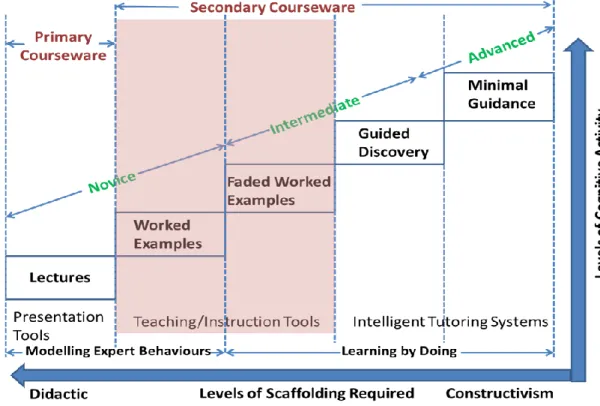
The highlighted area in Figure 1.1 indicates the educational context of this research, the detailed explanation of this figure follows.
Figure 1.1 Relationships between Cognitive Activities, Pedagogical Methods, Different Levels of Learner and Courseware
Figure 1.1 shows the different pedagogical methods used to scaffold students’ learning processes, recognising that students go through learning phases, from novice, to intermediate, to advanced. Supporting different levels of students’ learning should depend on the varying levels of cognitive activity. The diagram also distinguishes how to use technology to support the different levels of learning, due to the one-to-many relationship between teacher and students.
Prior to the worked examples phase, shaded in Figure 1, key concepts in the problem-solving domain must be introduced. In higher education, this is often achieved using lectures and presentation software such as PowerPoint, referred to as primary courseware.
Building on the core concepts, the worked examples phases are used to initially develop and then consolidate students' knowledge of recurring problem-solving procedures. Fully worked examples, where every step is fully explained to the student, are the starting point, to be followed by faded worked examples, where some steps are partially explained, or not explained at all, to challenge the student and further embed their learning. Both fully and faded worked examples follow a set of solution steps that have been developed in advance by the teacher, modelling the expert's thinking process. Multiple worked examples should be studied so that the novice/intermediate can develop an appropriately broad experience of problems in the domain.
Once a reasonable foundation of problem-solving experience has been developed via worked examples, the intermediate learner should move on to a more un-scaffolded stage where the emphasis is on attempting to solve problems, rather than studying problem solutions. This is typically carried out in two phases, the first known as guided discovery, where the student is in control of directing which solution step to pick next. The student is then given feedback on the choice, either by a human tutor or by a so-called intelligent tutoring system. It is up to the student to decide on the next course of action based on this
feedback: they may retrace their steps, realising they have made a mistake; or else they may continue, both in the case where they are moving correctly, or when they are not aware of a mistake they have made. The support system, whether human or technology-based, will continue to give them the best feedback and advice it can, in whichever case.
Finally, once the intermediate has further developed their bank of solved problems, as well as practised, with guidance, the problem-solving steps they had seen in the worked examples phase, they have reached an advanced stage and are ready to work on problems with no support at all – the minimal guidance
with each new problem solved being accommodated into their existing well-structured bank of domain problem solving knowledge.
The research in this dissertation does not concern the development of intelligent tutoring systems. Instead, the focus is on the development of technology to assist in the construction of interactive worked examples, both faded and full. To summarize, these five learning stages very clearly show that different levels of learners should be taught by using different pedagogical methods. There is no single method which could apply to all the stages of learning. As the learner’s level increases, the teacher’s guidance should be faded gradually and learner’s cognitive activity should be increased gradually. Hence, to support learners to achieve their learning target by using computing technology, the worked examples delivered should be in varied forms that fit their learning level. The role of computing technology in different levels of learning is also different. In this research project, the major focus is on promoting and leading novice learners through the second and third stages to become intermediate learners. The role of computing technology should focus on supporting the creation of full and faded interactive worked examples. Therefore, an authoring environment for teachers to produce suitable interactive worked examples to support these two learning stages has been created. This dissertation does not concern the development of intelligent tutoring systems.
1.3 The Thesis Statement and Research Questions
The thesis statement is:
A usable authoring environment for delivering interactive worked examples can be developed that:
a. delivers best practice interactive worked examples to students in a
computing science context;
b. enables teachers to create such interactive worked examples
without having to engage in bespoke programming;
c. facilitates evolution of them on the basis of feedback from the
students.
1. Can an authoring environment be built to support the production of best practice interactive worked examples?
2. Can the authoring environment be used to deliver interactive worked examples?
a. For teachers, is the system sufficiently usable that they can create examples following the best practice recommendations based on education research results?
b. For students, are these delivered examples usable?
3. Can teachers create new examples or evolve existing examples over time to match the dynamic nature of teaching, on the basis of students’
feedback and usage data?
Research Question 2a is different from Research Question 1. We could answer Research Question 1 positively but not have a system that teachers can use effectively.
The process of verifying this thesis statement comprises six activities. These are outlined below, together with an indication of how they contribute to answering the research questions.
1. Identify best practices for designing worked examples from the literature review, which is discussed in section 2.5.3 of chapter 2. This contributes to Research Question 1 (RQ 1) – identifying requirements for IWE and RQ 2a – use of best practices.
2. Review the literature about usability in order to define a suitable strategy for assessing the usability of the new authoring environment (IWE). This is a prerequisite for RQ 2b.
3. Develop a prototype of IWE and evaluate the usability of interactive worked examples during iterative development. Feedback about these examples can be collected from students and real life requirements can also be identified, which could guide further development of IWE. This contributes to RQ 1.
4. Ask 2 or 3 teachers to create interactive worked examples using IWE in order to evaluate its usability and identify real life requirements, which could guide further development of IWE. Then, ask 1 or 2 teachers to use it as part of their on-going teaching. These evaluations aim to
demonstrate that IWE can be used by teachers across different topics in computer science. This contributes to RQ 2a.
5. Deliver these interactive worked examples to students and evaluate their usability through analysing data by using the methods discussed in chapter 3. Contributes to RQ 2b.
6. Evaluate the feedback mechanisms with the aim of demonstrating that interactive worked examples can be developed and evolved over time by individual teachers based on students’ responses and their usage data. Contributes to RQ 3.
1.4 Contribution of the Research
IWE demonstrates that it is possible to create or modify interactive worked examples without bespoke programming and that the worked examples produced are usable by students. It reduces the difficulty and cost of creating and
modifying interactive worked examples.
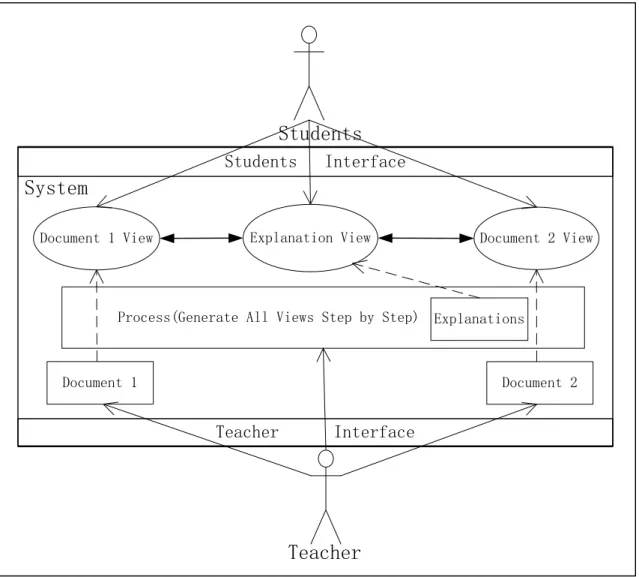
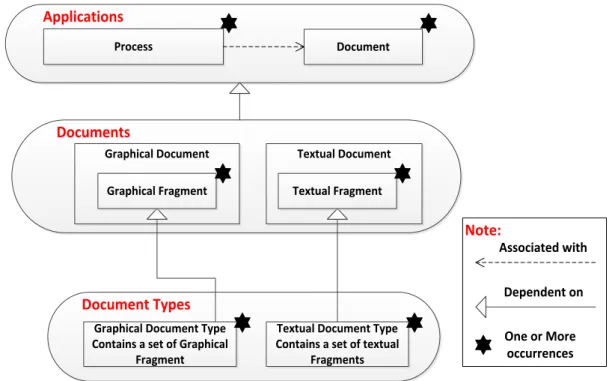
A data model to capture the textual and/or graphical detail of worked examples suitable for the kind of problems identified in this thesis is defined. A dynamic process model for how these data can be presented to students is also defined, so that they can explore the worked examples in a step-by-step fashion, with specified parts of the worked example being shown and hidden on each step as appropriate.
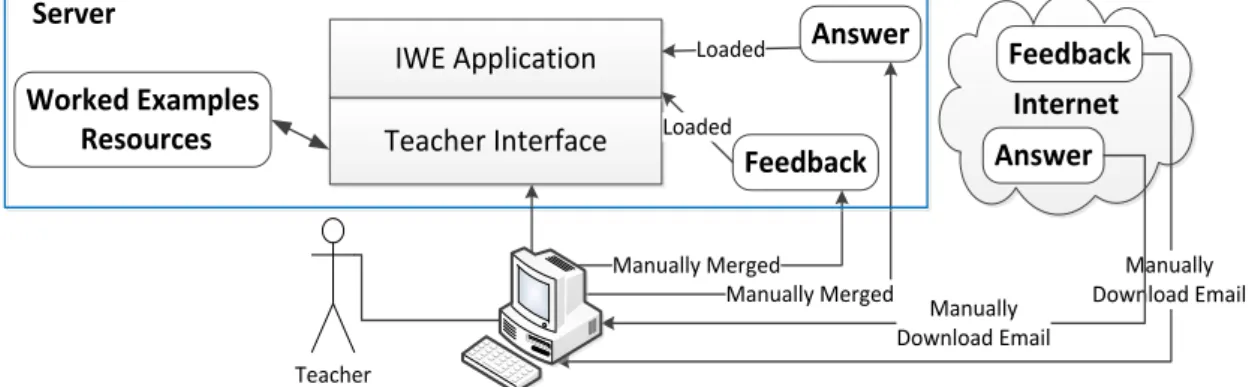
The capacity for the tool to capture data on how students are working through the worked examples enables a level of so-called learning analytics [10]. A teacher can analyse the usage data to determine how often a worked example is used, whether all of it is viewed or only a part and how long is spent at each step, which parts may be causing difficulties, and therefore what action to take. For example, if the majority of students pause for an unexpectedly long time on a particular step, or get one of the questions wrong, the teacher can adjust the worked example, discuss the issue in class, and/or change their teaching
approach for the next run of the class, as appropriate. Compared this with a standard text-book or on-line PowerPoint presentation, the former, no usage data whatsoever can be collected, beyond perhaps borrowing figures in a library;
the latter, the best a teacher can expect is a count of the number of downloads of the resource.
The intended teacher users of IWE will benefit by being able to create and modify interactive worked examples themselves without having to purchase ‘off the shelf’ ones or pay a third party to develop and modify examples. The disadvantage of using ‘off the shelf’ examples, even if they are free, is that teachers have to adapt their teaching to fit around these inflexible examples.
1.5 The Structure of Thesis
Chapter 2 expands on the context of the research by presenting an expert’s approach to solving a typical transformation-based problem in Computing Science, which might be presented as an interactive worked example. It then reviews research results related to problem solving, focussing on Human Cognitive Architecture, Cognitive Load Theory and the Cognitive Apprentice model. A critique of current instructional designs is given, followed by a review of research into the value of worked examples in education. The value of
interactive worked examples is discussed and the disadvantages of the current technology for producing them are highlighted. This leads to the conclusion that an authoring environment for the production of interactive worked examples would be valuable and identifies the overall requirements for such an authoring environment (IWE).
Chapter 3 reviews the literature of usability evaluation as the other part of the background. It focuses on how to use these evaluation techniques properly in order to provide theoretical guidance for evaluating IWE. As IWE is designed for education perspective, only applying traditional techniques from
human-computer interaction point of view is not enough; cognitive load theory should also be considered. Finally, the strategy for evaluating IWE is described.
Chapter 4 describes the detailed requirements for the authoring environment. It includes the architecture of this environment, the basic concepts used to build it, and the data model required together with the detailed use case descriptions for the two types of users, teachers and students.
Chapter 5 describes the design and implementation of this environment. The design part includes the initial user interface designs for the teacher and the student to access the system. The implementation part illustrates the final implementation results of the user interfaces, with comments on changes that were made to the initial designs.
Chapter 6 describes the evaluation results following the sequence of evaluations and surveys carried out during the iterative development process, from the initial feasibility study to identify the usefulness of a prototype environment, to the investigation of how target users actually used the system. It also identifies the short-term targets to be improved for carrying out a field study for further evaluating the usability of IWE. Longer–term targets for improving IWE are also reported.
Chapter 7 describes a field study which was conducted in an introductory programming course for first year university students. It demonstrates the usefulness of IWE from two aspects, which are usability and utility of IWE. It addresses the general usability of IWE by students, using the SUS questionnaire, and then investigates how useful IWE is in a real education context, for example, how the teacher can use feedback to evolve the worked examples that were delivered.
Chapter 8 addresses the research questions presented above and discusses how well IWE and its evaluations provide support for the thesis statement. It also identifies possible future directions for widening the scope of this research.
Chapter 2 Education Background
2.1 Educational Context for the Research
Teaching and learning computing science knowledge and skill is recognised to be challenging. For students, it requires correct understanding of abstract concepts. For teachers, it not only requires effective explanation of abstract concepts, but also demonstration of how to apply these abstract concepts to solve problems [11].
2.1.1 Transformation-based Problems
Problems to be solved in computing science often involve the analysis and transformations of representations, for example, text and diagrams, into alternative formats. For example, a database system is built from specific requirements described in human language. The requirements are analysed by a human first, and then transformed, for example, into a graphical design
language, such as ER diagrams. Later on, these diagrams will be transformed into SQL language, to become readable by machines. In the programming context, in order to solve a problem described in human language, a plan is required based on analysing the problem text logically, and then a programming language is used to implement this plan. In a software engineering context, requirements are transformed into a Use Case diagram and definitions first, and then the Class diagram can be designed based on the use case analysis. Later on, the designed Class diagram will be implemented using a programming language, which is another transformation. These are all typical problems in computing science, involving the transformation of the real world representations of the problem into representations in formalised language, or between
representations in formalised language. The arrow in figure 2.1 depicts this fundamental aspect of all computation.
Figure 2.1. Transformation Problems in Computing Science
Real World Domain: Problem expressed in natural language
The processes involved in developing a model, including generating abstractions and making decisions, do not follow a formulaic thinking process. Instead, a number of guidelines are typically produced to aid the transformation process, but previous experience also plays a crucial role during the process.
To explore this kind of problem solving in more detail, a typical computing science example is used to explain and demonstrate in detail an expert’s
thinking process while solving a problem. By doing this, it should be clearer why some of the steps in the transformation process require judgement and hence cannot be completed algorithmically.
2.1.2 Solving Transformation-based Problems Requires
Judgement
Building an ER diagram is an essential skill for students in a database course to develop. Consider the following example that might be given to a student: “A company has a set of departments. Each department has a name, number, manager and possibly several locations. The manager started managing the department on a given date. A department controls several projects, each with a name, number and location. Each employee has a name, address, salary, supervisor, department, gender, date of birth and national insurance number. An employee may work on many projects, not all in their own department, and works a numbers of hours on each of these projects. Please draw an ER diagram to represent the structure of the company. State any assumptions that you make.”
To explore the expert’s thinking process in building an ER diagram for this
scenario, an expert with experience in building commercial database models and experience of teaching database courses was asked to work through this example and explain his thinking. He wrote notes on a whiteboard while talking through the steps he was taking. The researcher recorded the expert’s reasoning as he solved the problem, but also asked questions to clarify points that were made, if necessary. In the following record of the process, the expert’s comments are shown in italics, with the researcher’s commentary on the expert’s comments added afterwards.
A common guideline suggested for starting the process of creating an ER diagram from a problem description is to identify the nouns, which are possible entities or attributes of entities, and the verbs which are possible relationships. However, these are only guidelines not rules. Listing every noun and verb found in the description is laborious and is often more confusing than helpful.
It is clear that the expert is aware of the difference between rules and guidelines, and that the rule, commonly used in education to get novice
database designers started, of writing down all the nouns as possible candidates for entities, is not that helpful. In particular, the list can become long and unwieldy.
The recommended approach to this type of problem is to read the whole scenario right through and get an overview of exactly what is required. In this example, it is the penultimate sentence that gives us this: we must build a database model for the company described earlier in the problem text. The final sentence suggests that the scenario is not precise and there may be the need to identify ambiguities and makes assumptions to complete the exercise. This will probably only be picked up by the best students.
This is more than expert teacher speaking, recognising that novices often are not clear about exactly what it is they've been asked to do. The recommended
approach can be found in, for example, [12] pp 1326-1327.
Start by looking for the possible major entities in the description.
An entity is defined as a group of objects with the same properties, which are identified by the enterprise as having an independent existence, which can be objects with a physical (or 'real') existence or objects with a conceptual(or 'abstract') existence [12] (p 343). Determination of what is a major entity is made partly on the basis of the definition given above and partly by experience, recognising, or having a feel for the kinds of items that should be modelled as entities.
Starting from the beginning of the problem description and looking for physical (real) objects in the scenario that could be entities. The first possible entity is ‘company’, but this is not an entity because it is the context for the data model, the ER diagram should represent the structure of this company.
In discussion, the expert noted that another way of determining whether this is an entity is to consider how many instances of this entity there would be in the final database – and if there is only one, then it is typically not an entity. For company there is clearly only one.
The next potential entity is ‘department’, which relates to a real thing and because there are several of them. The next sentence suggests a number of possible candidate attributes: name, number, manager and one or more locations. Locations will be a multi-valued attribute.
Items such as name and number help describe, or are a part of, the larger thing – the department – and don't have an existence in isolation. How does the expert know that name does not have a separate existence? Contributing evidence is: a department typically has just one name; one might write "the name of the
department is", showing that the name belongs to the department; and the expert will have seen countless examples like this before.
Assume that each instance of a department can be uniquely identified by its number (the primary key), another essential property of an entity. For the time being, ignore the next sentence, it doesn’t identify another possible entity.
In fact, this next sentence is describing a relationship between managers and departments but manager is unlikely to be an entity because normally managers are employees and likely to be a subset of a larger entity.
Moving on, the next interesting thing is ‘project’, which is a possible entity with attributes: name, number and location and assume that project number is the primary key.
This one seems straightforward.
The next sentence identifies ‘employee’ as another potential entity with possible attributes: name, address, salary, supervisor, department, gender, date of birth and national insurance number. Name, address and date of birth might be composite attributes, consisting of a number of components. It isn’t possible to guarantee that employee’s names are unique but the national insurance number will be a unique identifier for each employee.
The thought-process of the expert is clearly shown here, in the way that they are imagining the need to uniquely identify the instances of an entity.
The final sentence describing the company structure (“an employee may work …”) does not identify any new entities but will be important for identifying relationships.
So the current thinking can be summarised as that there are three major entities with their possible attributes listed in the brackets:
Department (Name, Number – primary key, Manager, Location –"possibly several" – multi-valued)
Project (Name, Number – primary key, Location)
Employee (Name – probably composite, Address – probably composite, Salary, Supervisor, Department, Gender, Date of birth – probably composite, NI number – primary key)
Note how the descriptions of the three major entities (as written on a whiteboard as the expert worked through the problem) contain further information in the form of notes: primary keys are noted; "possibly several" indicates that this could be a multi-valued attribute. So, the expert is thinking at many levels simultaneously, recording detail that will be required later.
The guidance that verbs represent relationships between entities is useful but not all verbs define relationships and not all relationships are identified by verbs! So, work through the problem description again from the beginning.
This again identifies the need for experience, and that there is no easy rule such as "verbs identify relationships" that can be followed by a novice.
The fact that the company is organised into departments gives no information about relationships. In the next sentence, the verb ‘has’ identifies the attributes of Department. Again, the next sentence will be skipped for the time being as it does not explicitly link two of the candidate entities identified. The next interesting verb is ‘controls’; this identifies a straightforward relationship between one Department and a number of Projects, so controls is a 1-N relationship.
The expert notes that certain words are interesting – and this will be on the basis of experience having seen problems of this kind. He knows that controls is exactly the kind of word that defines a relationship between two entities.
Furthermore, he knows to ignore some sentences as irrelevant to describing relationships – here, the first two sentences. The third sentence is skipped for now – the expert knows it is important, but is choosing to focus on finding relationships that directly link the main entities. This is a clear guideline, though probably often unstated.
‘Each employee has a name, …’ simply gives information about the possible attributes of an entity. In the next sentence, ‘work on’ identifies another relationship, between the entities Employee and Project, define works_on as a M-N relationship because an employee may work on a number of different projects and a project may involve several employees. The hours an employee works on a particular project will be an attribute of the relationship. The statement ‘not all in their own department’ means that the relationship works_on is independent of any relationship between Employee and Department.
Identifying this relationship is quite straightforward, but there is subtlety to it. Picking up on the clause "not all in their own department" is essential to properly modelling the company.
However, there are still some further questions to resolve. There should be a relationship between the entities Employee and Department.
The expert is recognising, based on experience of this kind of problem, that the ER model needs an additional relationship, although it does not jump out of the problem text. It will not always be the case that this third relationship will be present, but the expert's intuition, based on experience, is that it should be there.
In the current state of the ER model the relationship between Department and Employee is represented by department (number or name) being an attribute of Employee and the statement ‘not all in their own department’ indicates that each Employee belongs to a single Department. A 1-N relationship Has_staff should be defined between Department and Employee, and the attribute department deleted from Employee. Storing the department as an attribute of Employee could cause problems because there could be values for the department attribute that do not relate to any Department entity.
Note here that the expert is able to discern the necessary relationship from the possible attributes so far defined, made easier by the fact that the attribute name is the name of one of the main entities.
Now return to the third sentence where the verb ‘managing’ identifies a relationship between manager and Department but currently manager is an attribute of Department. Assume that every manager of a Department is an employee of the company and each manager manages only one Department. A relationship manages between an Employee and a Department can represent the role of the manager; it will be a 1-1 relationship and the date the manager started managing the Department
will be an attribute of the relationship. Delete manager from attributes of Department.
The expert is drawing on experience either of companies in general, or having seen problems similar to this one before. He knows that a manager will typically be an employee, and therefore that managing is a relationship between
particular employees and particular departments.
One remaining problem is the attribute supervisor of Employee. Assuming that all supervisors are also employees of the company this will generate a recursive relationship between Employee entities. An employee may be the supervisor of a number of other employees (supervisees), so a 1-N relationship supervises can be created from Employee to Employee. Supervisor can be deleted from the attributes of Employee.
Again, the expert makes a sensible assumption about supervisors.
At this point, three entities and five relationships have been identified:
Department (Name, Number – primary key, Location –"possibly several" – multi-valued)
Project (Name, Number – primary key, Location)
Employee (Name – probably composite, Address – probably composite, Salary, Gender, Date of birth – probably composite, NI number – primary key)
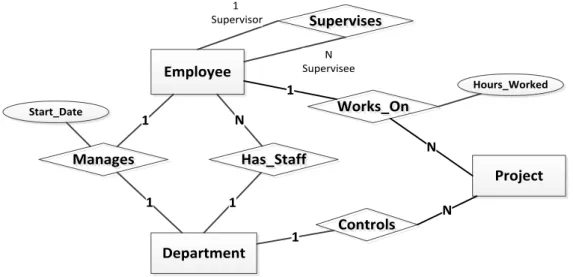
Department Controls Project: 1-N
Employee Works_on Project: M-N with attribute hours_worked
Department Has_staff Employee: 1-N
Employee Manages Department: 1-1 with attribute start_date
Employee Supervises Employee: 1-N
So a draft ER diagram to represent the analysis above can be produced, [which is shown in Figure 2.2]. Note that role-names have been added to the relationship Supervises to clarify that 1 supervisor Supervises N supervisees. Attributes of entities have not been added to the diagram as they obscure the structure of the diagram. However, the attributes of the relationships Manages and Works_On have been shown as these will affect the transformation of the ER Diagram into tables.
Figure 2.2. A Draft Design ER Diagram
This ER diagram [given in Figure 2.2], together with the definitions of the three main entities and their attributes, would be a reasonable answer from a novice student. However, to fully define the database model, there are still issues to resolve, for example, optional versus mandatory relationships. Points that might be raised here are:
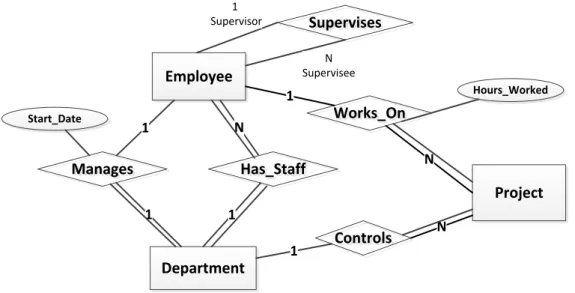
Does every Department control at least one Project? There may be administrative departments that do not control projects but we
assume that every project is controlled by a Department. So, controls
is probably optional – mandatory.
Does every Employee work on at least one Project? Again, there may be administrative staff members in a Department who are not involved in Projects. However, each Project is assumed to have at least one Employee working on it. So, works_on is optional – mandatory.
Assume that every Department has Employees and all Employees
belong to a Department. So, has_staff is mandatory – mandatory.
Not all Employees will be managers but every Department has a
manager. So, manages is optional – mandatory.
It is not possible for every Employee to be a supervisor nor can every
Employee be supervised by another Employee. So, supervises must be
optional – optional.
Based on these assumptions, a second draft design with participation constraints can be produced, as follows [shown in Figure 2.3]. This would be an excellent answer from students.
Employee
Project
Department
Hours_Worked
Manages
Manages Has_StaffHas_Staff
Works_On Works_On Controls Controls 1 N Supervises Supervises 1 N 1 1 1 N Start_Date 1 Supervisor N Supervisee
Employee
Project
Department
Hours_Worked
Manages
Manages Has_StaffHas_Staff
Works_On Works_On Controls Controls 1 N Supervises Supervises 1 N 1 1 1 N Start_Date 1 Supervisor N Supervisee
Figure 2.3 A Second Draft Design ER Diagram with Participation Constraints
There is one other possible complication with this model (based on my experience but students would not be expected to identify this) concerning the attribute location of Department and Project. If the company is a service company with several service departments that provide technical support at client locations then there will be no overlap between the values of these attributes. Alternatively, all projects might take place at sites where Departments are located, in which case there is only one set of location values for the two attributes. Other decisions about the exact formats of possible composite entities would need to be considered when database queries are specified.
The expert also added that the next stage in the process, transforming the ER diagram into a set of SQL tables is more straightforward because it involves transforming one formalised description into another. An expert will know patterns for transformations of: composite attributes, multi-valued attributes and relationships (1-1, 1-N and M-N) possibly with attributes, into tables.
2.1.3 Judgements Require Prior Successful Experiences
This example highlights many of the issues in the transformation process of solving problems in computing science. The demonstration of an expert’s thinking process shows that the whole process of solving problems requires judgments and decision-making. Problem descriptions are written in natural language and imprecise. So, an algorithmic approach to creating a solution is not possible and a heuristic approach has to be used. Complex decisions are taken on the basis of previous experience: an expert will have seen many problems
problem to previous related problems, which have already been solved, and reuse whatever solution methods were used there.
Examples of such decision-making are:
The company is not an entity, as it is the context of this problem.
Manager is not an entity as it is assumed all managers will be employees. Therefore manager is not an attribute of the department, and “manages” will be a relationship between department and employee. Creating an entity called “Manager” would not be wrong but in this case it is unnecessary. It would create two one-to-one relationships between Manager - Employee and Manager – Department. When implemented Manager will contain the same values as the relationship manages.
The decision on how to model the location of Department and Project depends on how locations for departments and locations for projects are related to one another, which is not specified in the scenario given.
Note in particular that it would be hard to codify the knowledge needed to make these decisions into a set of rules. Take the first example, concerning the
observation that some items that look as though they might be entities, such as company, but are not. The rule might be: “Discard a candidate entity that appears to have only one instance and captures the entire system being
modelled.” This is much more easily understood with the aid of several examples, until the rule alluded to above is formed. The issue with manager could be
formulated as “if an attribute of an entity is also an instance of another entity then this should be represented as a relationship”. The issue with locations could be formulated as “If any attribute name appears twice, determine
whether they are the same or different attributes, depending on the context.” Again, these are much more easily understood with several examples. Finally, a rule widely used in database system teaching is to “make a list of all nouns and consider these as possible entities or attributes.” The example shows that this is not a good rule, since the context in which a noun is used is very important. For example, in the above scenario there are three occurrences of the noun ‘name’, but from the context it is obvious that they are different: the Department name, the Project name and the Employee name, which are independent sets of values. The other widely-used rule is that “verbs can be used identify relationships
between entities”. In the example, only two of the verbs identified relationships and three other relationships were identified by analysing the implicit
relationship between attributes and entities.
Therefore, the challenge of the transformation from a representation to another representation is that it is non-formulaic. There is some guidance that can be followed, but proper use of the guidance to generate abstractions and make decisions is highly affected by previous experience. Experts have seen enough prior examples of relevant problems that they have developed generic patterns for each related category of problems.
A key aspect of educating students therefore is to help students to build up successful problem-solving experience. But how are the generic patterns
necessary for problem-solving developed and stored by students? To explain this, it is necessary to understand the process of learning at a cognitive level, and this in introduced next.
2.2 Understanding Learning at the Cognitive Level
In this section, the human cognitive architecture is described in order to
understand the processes occurring in the human memory system that contribute to learning. Cognitive Load Theory (CLT) builds on the human cognitive
architecture model to demonstrate why some learning designs are more
effective than others, with reference to the limitation of the human cognitive architecture.
2.2.1 Human Cognitive Architecture and Schema Development
The process of learning involves gaining new knowledge and skills, and
assimilating them alongside existing knowledge and skills. This means that the brain needs both to store items and then reuse them in the right situation. Hence, it is worth knowing at the outset how the brain processes information in order to store and reuse stored information. Atkinson and Shiffrin [13] proposed a psychological model which describes the structure of the human memory. In the Atkinson-Shiffrin model, the human memory is divided into three
sub-components, which are sensory memory, working memory and long-term memory.
Sensory memory is the shortest-term element of memory and retains the impressions of sensory information, which come from the human senses. It is considered to be outside of cognitive control and is instead an
automatic response, and is not considered here.
Working memory is generally considered to have limited capacity. It has the ability to remember information over a brief period of time, but it is long enough to be used for further information processing, such as
internally repeating or refreshing the information in working memory, or then passing it on to the long-term memory, described below.
Long-term memory is the element of memory in which associations among items are stored. It provides the lasting retention of information, from minutes to a lifetime and seems to have an almost limitless capacity. Sweller introduced the concept of a schema as a cognitive structure for storing information in long-term memory [14]. A schema is a particular structuring of information and experts in a discipline have structuring that enables highly effective retrieval of the stored information. They associate elements together so that the collection can be remembered as a single element. For example, the number 100 is recognized as a single element, not as three separate digits. The same principle underlies the mind-mapping revision technique [15] of condensing written notes repeatedly, using a tree structure of headings to remember a large body of related elements.
Sweller [16] also gave his definition of working memory, long-term memory and schemata from the angle of learning and proposed a natural information
processing system. Working memory is a structure that processes information coming from either the environment or long-term memory and that transfers learned information for storage in schemata into the long-term memory. Long-term memory has a massive capacity for information storage. It contains cognitive schemata that are used to store and organize knowledge by
incorporating multiple elements of information into a single element with a specific function.
Cowan proposed an integrated model of working memory in which some of the representations (schemata) held in working memory are an activated subset of the representations held in long-term memory. In Cowan's model, working memory was organized in two embedded levels. The first level, called activated memory, consists of an unlimited set of long-term memory representations that are activated. The second level, called the focus of attention, holds up to four items or chunks of information from the environment [17]. This second level is the central limitation of the working memory system.
In the problem solving domain, a schema represents a category of problems as a set of key characteristics of such problems and captures the variations that have been seen before. Each new problem belonging to this category can be stored under the same schema. Furthermore, the method for solving problems of this category is also stored with the schema[18].
With such schemata, problem solving is a process of recognizing the essential characteristics of the new problem, and then matching these against the characteristics held within each problem category schema. Cowan’s model indicates that an expert can hold the activated schemata of a very large number of previously seen problems in working memory alongside the relatively few key characteristics of the new problem, and therefore perform the necessary pattern matching, as all necessary data is in the working memory.
Studies of chess grandmasters [19] and also Soloway’s work on programming comprehension [20] back up this view by showing that experts solve problems better that novices when those problems follow well-known patterns, but not when they are random problems adhering to no commonly-seen pattern. It is this pattern-recognition based on acquired schema that makes for expert behaviours. If the learning result is to alter the long-term memory, it is important to know how the learning process is achieved. Kirschner and Van Merrienboer [21] described learning in terms of four processes involving the creation and modification of schemata. This can be combined with Adaptive Control of Thought-Rational (ACT-R) framework [22] to give five stages in schemata development.
1. Prior to schema construction: many separate examples are seen and recorded in long-term memory independently. A new example is related to these stored examples in an attempt to recognize by analogy. Learners’ performance is slow, error prone and working memory load is high,
because the details of the new example must be compared with the details of every stored examples. For instance, the experiences of seeing many different animals are all stored separately, and when a horse is seen it is compared against all examples of animals.
2. Schema construction: repeatedly seeing related examples and recognising features common to all causes a new schema to be formed. For example, the numerous instances of different horses (e.g. with different sizes and colours and names) are stored under a schema for 'horse' with the
common characteristics of e.g. four long thin legs, long straight-haired tail, long neck and nose, long-haired mane, can be ridden, with hooves, and so on.
3. Schema assimilation: new elements of information are incorporated into existing schemata. For example, a child seeing a zebra for the first time and calling it a horse, associating it with the horse schema.
4. Schema elaboration: elements consisting of lower level schemata are combined into higher level schemata building increasing numbers of ever more complex schemata. The child takes into consideration the different properties of a zebra compared to a horse, perhaps calling a zebra a horse with stripes. In this case, the horse schema would have a sub-schema of horse with stripes. Of course, the child may choose other classifications, for example, wild animal, separating out common and different features of a zebra compared to the more generic wild animal.
5. Schema accommodation: existing schemata based upon recurring new information which are incongruous or inconsistent with existing schemata are adapted. When the child eventually learns the name of zebra, this information is accommodated, perhaps adjusting learning information about horses to now have a "horse-like" schema, with sub-schemata for horses and zebras.
Because a schema can be treated by working memory as a single element if a schema has become sufficiently automated after long and consistent practice, the limitations of working memory disappear for more knowledgeable learners
when dealing with previously learned information stored in the long-term memory.
2.2.2 Cognitive Load, Cognitive Overload, and Learning
Cognitive Load Theory (CLT) [14] builds on the notion of a limited working memory capacity and a vast long-term memory capacity as the model used for understanding the human cognitive architecture. It is a set of learning principles that deals with the optimal usage of the limited working memory. Sweller [14] and Cowan’s work [17] proposes that since working memory for new information is limited, if the complexity of instructional materials is not properly managed, this could result in cognitive overload for learners. Tuovinen and Sweller [23] and Pass et al. [24] further develop this theory and suggest the free exploration of a highly complex environment may generate a heavy working memory load which is harmful for learning. Especially it is not good for novice learners, due to their lack of proper schemata, which are needed for the integration of the new information with their prior knowledge. Novices, not possessing appropriate schemata, are not able to recognize and memorize particular problem
configurations. Sweller et al.[25] also found that cognitive overload can impair schema acquisition, later resulting in a lower performance.
CLT [16] distinguished three types of cognitive load that occur in working memory during learning, which are:
Intrinsic Cognitive Load refers to the number of elements that must be present simultaneously in working memory for a concept that is to be learned to be understood. For a particular learning task, the relative numbers of new elements and elements drawn from long-term memory are dependent on the learner’s degree of prior experience (what is complex for a beginner is simple for an expert).
Germane Cognitive Load results from active schema construction
processes and is the result of beneficial cognitive processes for learning. It is effective cognitive load. For example, explaining the material to oneself, or rehearsal from practice repetitions.
Extraneous Cognitive Load is the result of instructional techniques that require learners to engage in working memory activities that are not
directly related to schema construction. It can be caused by an inappropriate presentation of the learning material or by requiring students to perform activities that are irrelevant to learning. It is ineffective cognitive load, from the point of view of learning. For example, visual search processes for information during learning.
Based on CLT, learning outcomes are optimized when cognitive load fully utilizes the capacity of working memory with elements that allow for optimal schema acquisition. Too little or too much cognitive load results in low learning outcome. Optimising learning is a question of balancing, not minimizing or maximizing cognitive load. However, a reduction of extraneous cognitive load frees working memory capacity to be used for germane learning processes. If intrinsic load is low, learning can be successful despite a high extraneous load, although the exercise may seem tedious or boring. The total amount of cognitive load required for a learning activity needs to remain within the working memory capacity.
Based on this review of human cognitive architecture and cognitive load theory, supporting novice students to develop schemata in an efficient way should be the target for instructional design. Problems cannot be solved without proper and sufficient schemata; students must see enough problems and solutions and build enough experience in order to develop generic schemata. However, how can students develop these generic schemata efficiently, and crucially, how can cognitive overload and consequent wasted effort be avoided? This leads to an exploration of apprenticeship models.
2.3 Cognitive Apprenticeship to Develop Schemata
Traditional apprenticeship learning is based on learners gaining significant experience of problem solving before being asked to solve problems themselves. The master guides the apprentice through a series of experiences that enable them to develop the necessary schemata to become a master[26]. However, apprenticeship, as a form for producing knowledgeable and skilled persons, has been overlooked in the modern education system, although it is still a key learning mechanism[27].
![Figure 2.5 TPACK Framework Diagram [63]](https://thumb-us.123doks.com/thumbv2/123dok_us/10995401.2987201/60.892.290.710.77.479/figure-tpack-framework-diagram.webp)