Reconstructing Student Conceptions of Climate Change; An Inquiry Approach
A DISSERTATION
SUBMITTED TO THE FACULTY OF UNIVERSITY OF MINNESOTA
BY
J Collin McClelland
IN PARTIAL FULFILLMENT OF THE REQUIREMENTS FOR THE DEGREE OF
DOCTOR OF PHILOSOPHY
Gillian H. Roehrig, Advisor
Acknowledgements
The journey through my doctoral program was long and arduous, accompanied by growth beyond my expectations. Sustaining me through this journey and adding to my personal growth are many individuals to be named here. Though not exhaustive, I hope to give ample credit where it is due.
I entered this program the fall of 2009, encouraged by some graduate students in the middle of their own journey through the program. Brant Miller and Tom Meagher both spoke to me at length about what I was potentially getting into. They assured me that under the guidance of Gill Roehrig I would have a clear trajectory to success. They were right.
I will be forever grateful for the guidance and coaching offered by my adviser Gill Roehrig. She not only mapped out a clear pathway for me, she also presented me with other opportunities to grow professionally beyond what I had expected. It was a gift to be invited to participate on so many professional development teams, and explore the role of being a student teacher supervisor and methods instructor. Even more powerful for me was the realization that I could write academic works. She continually challenged me to reassess my writing and make it more academic. The product before you only exists by her persistent and ongoing feedback.
I was also blessed with a very supportive committee, which inspired me and challenged me in many ways. Fred Finley couldn’t stay on due to travel duties to
Thailand, but he helped me evaluate my notion of the “nature of science” and develop my inner philosopher. Frances Lawrenz introduced me to qualitative research in a way that finally made sense to me, through great readings, discussion, and “coffee shop coding”. Julie Brown stepped in last minute as part of the team, challenging me with insightful questions during my defense and follow-up advice to strengthen my writing. Sarah Hobbie inspired the topic for my dissertation, training me more in global climate change content and giving me a thirst for even greater understanding.
I have had many peers that walked a journey similar to mine over these six years. They all played a support role in some capacity, by the ideas they shared during class and time spent working together. There are too many to name in this one paragraph, but two must be said. Barb Billington was an inspiration to me, the way she managed her duties as a full time instructor and graduate student. She taught me so much about teaching and mentoring student teachers. Devarati Bhattacharya was my biggest supporter at work on a regular basis. She always managed to inspire and uplift me when I was mired in the process, or at least found a way to make me laugh.
Lastly, I must credit my family for their endless support and encouragement. My journey with the University was often at the expense of time with my family. Their patience and understanding were critical to my success, as were their sacrifices. My wife Angie gave up much for me to complete this program, often pulling double duties on the home front. My daughters Eva and Anna began their school journeys as Dad began his. I am grateful for their endless hugs and kisses, reminding me that I’m forgiven from my absenteeism. I must thank them officially here.
Dedication
Abstract
No other environmental issue today has as much potential to alter life on Earth as does global climate change. Scientific evidence continues to grow; indicating that
climate change is occurring now, and that change is a result of human activities (National Research Council [NRC], 2010). The need for climate literacy in society has become increasingly urgent. Unfortunately, understanding the concepts necessary for climate literacy remains a challenge for most individuals. A growing research base has identified a number of common misconceptions people have about climate literacy concepts
(Leiserowitz, Smith, & Marlon 2011; Shepardson, Niyogi, Choi, & Charusombat, 2009). However, few have explored this understanding in high school students.
This sequential mixed methods study explored the changing conceptions of global climate change in 90 sophomore biology students through the course of their participation in an eight-week inquiry-based global climate change unit. The study also explored changes in students’ attitudes over the course of the study unit, contemplating possible relationships between students’ conceptual understanding of and attitudes toward global climate change. Phase I of the mixed methods study included quantitative analysis of pre-post content knowledge and attitude assessment data. Content knowledge gains were statistically significant and over 25% of students in the study shifted from an expressed belief of denial or uncertainty about global warming to one of belief in it. Phase II used an inductive approach to explore student attitudes and conceptions. Conceptually, very few students grew to a scientifically accurate understanding of the greenhouse effect or the relationship between global warming and climate change. However, they generally made progress in their conceptual understanding by adding more specific detail to explain their understanding. Phase III employed a case study approach with eight purposefully selected student cases, identifying five common conceptual and five common attitude-based themes.
Findings suggest similar misconceptions revealed in prior research also occurred in this study group. Some examples include; connecting global warming to the hole in the ozone layer, and falsely linking unrelated environmental issues like littering to climate change. Data about students’ conceptual understanding of energy may also have implications for education research curriculum development. Similar to Driver & While no statistical relationship between students’ attitudes about global climate change and overall conceptual understanding emerged, some data suggested that climate change skeptics may perceive the concept of evidence differently than non-skeptics. One-way ANOVA data comparing skeptics with other students on evidence-based assessment items was significant. This study offers insights to teachers of potential barriers students face when trying to conceptualize global climate change concepts. More importantly it reinforces the idea that students generally find value in learning about global climate change in the classroom.
Table of Contents Acknowledgements……….……i Dedication………..…….ii Abstract……….….…iii List of Tables……….…vii List of Figures……….…..viii Chapter I Introduction……….………..…..1
Chapter II Literature Review……….…10
Scientific Literacy………..10
Climate Literacy……….13
Study Types………...14
Inquiry-based Instruction………..……….21
Attitudes and Learning………..23
Chapter III Methodology………..27
Research Questions & Overall Design……….…….27
Theoretical Framework……….…28
Study Setting………29
Curriculum………30
Study Timeline………..33
Data Collection & Analysis………..36
Phase I………..36
Phase III……….40
Limitations……….42
Chapter IV Whole Group Analysis & Results………..46
Phase I Quantitative Analysis………47
Descriptive Statistics……….47
Statistical Testing………..48
Attitude Survey Trends……….49
Categorization Process & Cross-Category Comparison………53
Phase II Qualitative Analysis………62
Trends in Conceptual Growth………..63
Trends in Attitudes & Beliefs……….……..67
Chapter V Purposeful Sample & Cross-case Analysis……….………75
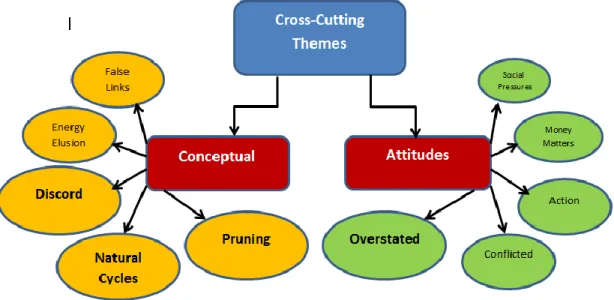
Purposeful Sampling……….……76 Student Cases……….……..79 Cross-case Analysis……….….……92 Conceptual Themes………..………94 Attitude Themes……….………101 Chapter VI Discussion……….……..111 Results Summary……….………..111 Question 1………..………111 Question 2………..…………115 Question 3………..………118
Limitations……….……….120 Implications……….………...123 References……….……….126 Appendix A……….………...137 Appendix B……….………...140 Appendix C……….………...141 Appendix D……….…………..156 Appendix E……….………..160 Appendix F……….………..161 Appendix G……….……….162
List of Tables
Table 3.1 Class Period Timing, Student Numbers, and Gender Breakdown…….……..30 Table 3.2 Curriculum Concepts and Scientific Practices Developed by Week of Study
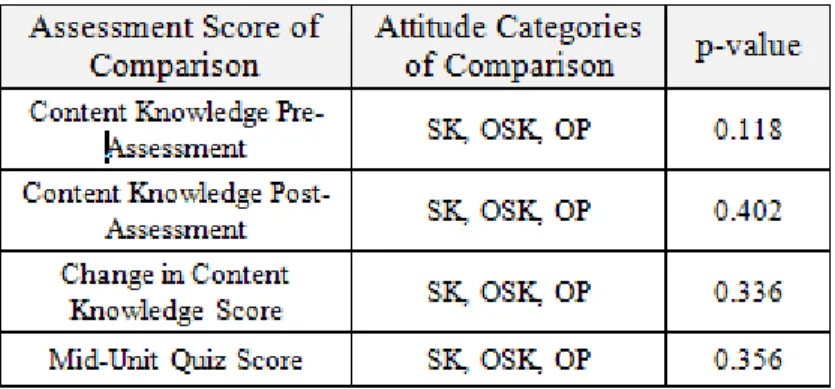
Unit………..…..32 Table 3.3 Student Artifacts, Descriptions and Collection Times………...…35 Table 4.1 Pre and Post Attitude Assessment Items and Answer Selection Choices…….50 Table 4.2 Pre and Post Unit Percentages of Student Beliefs from Attitude Survey….…51 Table 4.3 Final Attitude Categorization of Students……….……..…..54 Table 4.4 Average Content Knowledge Assessment Scores by Student Category….…..55 Table 4.5 Resulting p-Values from ANOVA Comparing Assessment Mean Scores by
Student Attitude Category………...……..55 Table 4.6 Assessment Item Categories, Frequency, and Examples………..……58 Table 4.7 Resulting p-Values from ANOVA Comparing Mean of Wrong Answers from
Assessment Item Categories by Student Attitude Category……….……59 Table 4.8 Coded Continuum of Conceptual Understanding……….64 Table 4.9 Frequency Table of Students’ Conception Codes by Student Attitude
Category……….……65 Table 4.10 Pre and Post Unit Percentages of Student by Attitude Category Expressing
Beliefs of: Human Cause of Global Warming, Scientific Perspective, and Personal Worry………...……..67 Table 4.11 Percentage of Students Believing Teaching of Global Climate Change has
Table 4.12 Attitude Language Codes, Definitions, Data Examples, and Frequency…...70 Table 4.13 Number of Different Attitude Language Codes and Frequency of Positive to
Negative by Student Attitude Category……….…..71 Table 5.1 Student Interviewees, Pre-Post Content Knowledge Scores, and Unique
Insight……….….78 Table 5.2 Emergent Themes Shared by Students Across Attitude Categories……..…..93 Table 5.3 Theme of Pruning Evidenced in Student Explanations about the Greenhouse
Effect………..…….95 Table 5.4 Evidence of Conflicted Theme from Student Artifacts……….…103
List of Figures
Figure 3.1 Timeline overview outlining unit preparation, teaching unit, and follow-up analysis leading to further data collection………..…...34 Figure 4.1 Normal QQ Plot showing student score distribution relative to a normal
distribution……….48 Figure 4.2 Boxplot comparison of student pre-assessment scores to post-assessment
scores………..…...…….49 Figure 4.3 Two-group pair-wise test plots from Tukey’s HSD, comparing content
knowledge pre-assessment scores……….…………57 Figure 4.4 Two-group pair-wise test plots from Tukey’s HSD, comparing pre-assessment
number wrong Evidence scores………60 Figure 4.5 Two-group pair-wise test plots from Tukey’s HSD, comparing post
assessment number wrong Evidence scores……….61 Figure 4.6 Two-group pair-wise test plots from Tukey’s HSD, comparing pre-assessment number wrong Earth History scores………62 Figure 5.1 Relative theme frequencies across purposeful sample………..93
Chapter I: Introduction
No other environmental issue today has as much potential to alter life on Earth as does global climate change (GCC). Scientific evidence continues to grow; indicating that climate change is occurring now, and that change is a result of human activities
(Intergovernmental Panel on Climate Change [IPCC], 2014; National Research Council [NRC], 2010). A business as usual response to this issue is predicted to have dire consequences for global ecosystems and human societies which depend upon them (NRC, 2010). Despite the gravity of the situation hope exists in a belief that concerted human action toward current solutions can mitigate and minimize the effects of global climate change (Jervey, 2012; Socolow, Hotinski, Greenblatt, & Pacala, 2004).
The most comprehensive analysis of global scientific research on climate is reflected in the summary developed for world leaders and policy makers by the IPCC. In their most recent 2014 report, scientists state that, “warming of the climate system is unequivocal, and since the 1950s, many of the observed changes are unprecedented over decades to millennia. The atmosphere and ocean have warmed, the amounts of snow and ice have diminished, and sea level has risen” (p. 2). The panel attributes this warming to increased greenhouse gases emitted by human activities; primarily fossil fuel combustion (IPCC, 2014). These conclusions are echoed by the National Academy of Sciences and public declarations of “all major scientific bodies in the United States whose members’ expertise bears directly on the matter” (Oreskes, 2004, p. 1686). A decade’s worth of scientific study of global climate change reveals that “there is a scientific consensus on the reality of anthropogenic climate change”, demonstrated by an analysis of 928
peer-reviewed papers, none of which “disagreed with the consensus position” (Oreskes, 2004, p. 1686).
Many organizations are involved in educating the public on GCC, sharing web sites with updated scientific evidence on climate change, predicted consequences of social inaction, and potential solutions to alleviate this growing problem. Some of these organizations are as follows: the Union of Concerned Scientist (UCS), the National Oceanic and Atmospheric Administration (NOAA), the National Aeronautics and Space Administration (NASA), the Will Steger Foundation (WSF), and the Climate Change Science Program (CCSP). Most reflect the ideas shared by the IPCC, but in language that is less technical and more user-friendly for a mass audience. The general message is the same: climate change is occurring, humans are responsible, the consequences will impact global ecosystems and human societies in negative ways, and we have the technology and scientific knowledge necessary to respond to this issue.
Unfortunately, a growing body of evidence indicates persistent and widespread misconceptions of global climate change (Andersson & Wallin, 2000; Boyes &
Stanisstreet, 1992; Fortner, 2001; Gowda, Fox, & Magelky, 1997; Hestness, McGinnis, & Marbach, 2011; Koulaidis & Christidou, 1999; Leiserowitz, Smith, & Marlon, 2011; Meadows & Wiesenmayer, 1999; Pruneau, Gravel, Bourque, & Langis, 2003; Rebich & Gautier, 2005; Rye, Rubba, & Wiesenmayer, 1997; Shepardson, 2009). Global climate change (GCC) is a complex interdisciplinary topic requiring strong student
comprehension of the implications and mitigation solutions possible for GCC, in order that well-informed decisions are made in response to this critical environmental issue.
These misconceptions extend well beyond the classroom, being shared by much of the public (Leiserowitz et al., 2011; Shepardson, Niyogi, Choi, & Charusombat, 2009). This may be due in part to a lack of GCC education in schools (Hoffman & Barstow, 2007). Recent reform initiatives call for greater inclusion of GCC education in classrooms (NRC, 2012; U.S. Global Change Research Program, 2009), and a majority of American students express interest in knowing more about this topic (Leiserowitz et al., 2011). In order to take effective steps toward mitigating this environmental problem, students will first need to have an accurate scientific understanding of the issue (Meadows &
Wiesenmayer, 1999; Sadler, 2004). Teaching students explicitly about GCC, challenging their conceptions, is required. This study analyzes changes in student conceptions and attitudes of GCC through the course of an inquiry-based teaching unit on the topic.
Educational Reform Efforts
There has been a growing response to the pressing need for GCC education through a number of educational reform efforts. Early responses were rather general, with an increasing emphasis on scientific literacy, promoted by the American Association for the Advancement of Science (AAAS) in 1989 in Science for All Americans, then later in Benchmarks for Science Literacy (1993). In 1996, the National Research Council (NRC) published the national science education standards (NSES). These standards also called for a greater emphasis on developing students’ scientific literacy including
attention to: scientific inquiry, the nature of science, and making social decisions based on scientific knowledge and data. The NSES also state that “an important purpose of science education is to give students a means to understand and act on personal and social
issues” (NRC, 1996, p. 107). These early national efforts to bolster scientific literacy provided a clear grounding for GCC education; however, they were not explicit in outlining standards and benchmarks specific to climate literacy (CL). Indeed, the NSES mentioned the word climate only nine times, but failed to once acknowledge human impacts on it (McCaffrey & Buhr, 2008). Analysis of state standards indicates that most states either ignore climate change or only touch on it indirectly in their frameworks (Hoffman & Barstow, 2007).
Recently, the NRC published A Framework for K-12 Science Education: Practices, Cross Cutting Concepts, and Core Ideas (2012), which serves as the
framework for the Next Generation of Science Standards which were released in April 2013. Analysis of the NRC “Frameworks” revealed a much more comprehensive
emphasis on climate change; referring to it 33 times across different science disciplines, explicitly connecting it to human activities, and making GCC one of four sub-strand core disciplinary ideas under Earth and Space Sciences (NRC, 2012).
In addition to the specific inclusion of GCC in the new Next Generation Science Standards, a group of researchers and educators worked with the support of NOAA, AAAS, and the National Science Teachers Association (NSTA) to craft a framework for climate literacy. This effort produced the Essential Principles of Climate Literacy, which provided the structure necessary for teachers to see the “explicit alignment between climate science and the National Science Education Standards” (McCaffrey & Buhr, 2008, p. 516).
The State of GCC Education
Although current reform efforts address climate literacy more comprehensively than in previous reforms, there has been a lag in implementation of GCC education in schools. Research suggests that GCC education remains a low priority in American schools, with minimal teaching of climate change and poor curricular support (Dupigny-Giroux, 2011; Leiserowitz et al., 2011; McCaffrey & Buhr, 2008). Yet, despite its minimal presence in American classrooms, GCC is an important issue to the majority of Americans and one that many feel should be taught (Fortner, 2001; Leiserowitz et al., 2011).
Most of the research on GCC education targets student conceptions. Generally the research has described the conceptions students hold in contrast to the conceptions portrayed by the scientific community. Student conceptions are typically incomplete or inaccurate (Andersson & Wallin, 2000; Boyes & Stanisstreet, 1992; Fortner, 2001; Gowda et al., 1997; Hestness et al., 2011; Koulaidis & Christidou, 1999; Leiserowitz et al., 2011; Meadows & Wiesenmayer, 1999; Pruneau et al., 2003; Rebich & Gautier, 2005; Rye et al., 1997; Shepardson, 2009). The purpose of this student misconception research has been to advise teachers in the development of curriculum that can facilitate conceptual change (Pruneau et al., 2003; Shepardson, 2009). In order to foster conceptual change, it is suggested that students should display their conceptions in some public forum, discuss in groups the variety of public conceptions, be exposed to scientific ideas through lessons which can be compared to the groups’ conceptions, and have
Khourey-Bowers, 2011; Posner, Strike, Hewson, & Gertzog, 1982). Inquiry-based teaching has potential to utilize the components necessary to promote conceptual change; using elements of scientific inquiry as a platform for learning science (Anderson, 2002).
Most studies on students’ conceptions of GCC have been focused overseas and on younger students, leaving a research gap on secondary science students in the U.S.
(Shepardson et al., 2009). Also, very few studies have been conducted on instructional approaches that challenge students’ misconceptions and address students’ climate literacy. There is an urgent need for research on curricular approaches that challenge students’ misconceptions surrounding GCC (Andersson & Wallin, 2000; Pruneau et al., 2003; Shepardson et al., 2009).
Purpose
The focus of this study is on a secondary science classroom during the teaching of GCC. Given the recent GCC education initiatives (NOAA, 2009; NRC, 2012) and the concerns over the lack of public understanding of GCC (Dupigny-Giroux, 2010;
Leiserowitz et al., 2011), the underlying goal of this study is to explore the development of students’ climate literacy (CL). The following research questions guide the study:
1. To what extent and in what ways do students’ conceptions change in association with an 8-week inquiry-based unit on climate change? 2. In what ways do student attitudes change in association with an 8-week
inquiry-based unit on climate change?
3. How does growth in content knowledge and conceptual understanding correspond with attitudes about climate change?
Overview of Remaining Chapters
Chapter II offers an overview of literature relevant to this study, beginning with research used to shape its theoretical framework. It then outlines education research on students regarding scientific literacy, climate literacy, and scientific inquiry. Chapter III outlines the basic methodology for the study; describing the theoretical framework, study context, curriculum features, and general data collection procedures. Quantitative and qualitative data analysis and findings for the entire group are outlined in chapter IV. Chapter V reveals more in depth qualitative analysis and findings from a purposeful sample of eight students. The study concludes with chapter VI; summarizing findings, study limitations, research implications, and possibilities for future research.
Definitions
What follows are operational definitions for concepts as they apply to this study. Each is elaborated on more fully in chapter II.
Global climate change (GCC). GCC is commonly used synonymously with “global warming”; however for this study it must be clarified that these two concepts are distinctly different. GCC refers to long-term changes to Earth’s climate patterns, as a whole or regionally (Conway, 2012).Global warming is one aspect of Earth’s changing climate; defined as an increase in Earth’s average surface temperature in response to increased concentrations of greenhouse gases (GHG’s) in our atmosphere.
Scientific literacy. For the purposes of this study, scientific literacy refers in part to what students should know and be able to do following science instruction. This not only includes science content and process skills, but also having the social capabilities to
use scientific knowledge and understanding to make critical decisions affecting society (AAAS 2009).
Climate literacy. This is considered a sub-concept within scientific literacy. To be climate-literate a person: 1) understands the essential principles of Earth’s climate system, 2) knows how to assess scientifically credible information about climate, 3) communicates about climate and climate change in a meaningful way, and 4) is able to make informed and responsible decisions with regard to actions that may affect climate (U.S. Global Change Research Program, 2009, p. 1).
Inquiry-based instruction. Inquiry teaching involves pedagogical practices similar to those outlined by constructivists, with the teacher acting as a facilitator of knowledge construction (Anderson, 2002). Instead of telling students what they need to know, teachers help students move through conceptual change. Some elements of inquiry teaching are; helping students to process information, communicating with groups, coaching student actions, facilitating student thinking, modeling the learning process, and flexibly making use of materials (Anderson, 2002).
Scientific practices. The NRC’s A Framework for K-12 Science Education: Practices, Cross Cutting Concepts, and Core Ideas outlines eight components of an operational definition for scientific practices: engagement in scientific questions,
development and use of models, planning and implementing investigations, analysis and interpretation of data, applying mathematical and computational thinking, explanation development, evidence based argumentation, and collection and communication of ideas (NRC, 2012). Scientific practices offer a context for applying inquiry teaching, but are
Chapter II: Literature Review
This study is framed by the concepts of climate literacy and scientific inquiry. Climate literacy is a sub-set of ideas within the broad concept of scientific literacy. Scientific inquiry is also a key component of scientific literacy. What follows is a description of some of the education research on students regarding scientific literacy, climate literacy, scientific inquiry, and attitudes and learning. The chapter also describes the contextual significance of these ideas, relative to major reform efforts.
Scientific Literacy
Generally speaking scientific literacy can be defined as what students should know and be able to do upon completing their science education. The state of scientific literacy in American society has long been a source of frustration and concern. It gained special significance in the U.S. following the 1957 Soviet launch of Sputnik (Hodson, 1988; Laugksch, 2000). Soon after, reform efforts developed science curriculum to be more fun and engaging, increasing the likelihood that students would become
professional scientists (Hodson 1988). Reform curricula emphasized practical process skills in conjunction with science content knowledge.
Following the 1983 publishing of A Nation at Risk, science became an area of emphasis in America once again. It revealed that overall U.S. students were
academically falling behind other industrialized nations of the world. According to the National Assessment of Science measures, seventeen year old students showed a steady decline in science achievement scores from 1969 to 1977 (NCEE, 1983). Comparatively, many other industrialized nations were spending three times as much class time on
science and math as the U.S. (NCEE, 1983). What followed was the formation of science standards to boost SL in America. In 1989, the American Association for the
Advancement of Science published standard in Science for All Americans, then later in
Benchmarks for Science Literacy (1993). In 1996, the National Research Council (NRC) published the National Science Education Standards (NSES). These standards called for greater emphasis on developing students’ scientific literacy; particularly as it relates to scientific inquiry, the nature of science, and dealing with social decisions based on scientific findings. They also state that “an important purpose of science education is to give students a means to understand and act on personal and social issues” (NRC, 1996, p. 107).
In more recent decades national assessments on student scientific literacy indicate that student comprehension of science has generally remained stagnant (NRC, 2006). Data from the Trends in International Mathematics and Science Study (TIMSS) and the Program for International Student Assessment (PISA) support the NRC conclusion. From 1999 to 2007, TIMSS data shows that U.S. eighth grade students were significantly below an average of 10 other industrialized nations on science measures (National Center for Education Statistics, 2012). PISA (2006) assessments reveal that U.S. fifteen year olds ranked 29th out of 40 developed countries in science, falling slightly since the previous 2003 assessment (Darling-Hammond, 2010; Organization for Economic Cooperation and Development, 2007).
More recently, the NRC published A Framework for K-12 Science Education: Practices, Cross Cutting Concepts, and Core Ideas (2012), which served as a template
for the Next Generation of Science Standards released in 2013. Here the emphasis has moved toward integrating engineering into the teaching and learning of science. This becomes apparent in the following passage from A Framework for K-12 Science Education:
The overarching goal of our framework for K-12 science education is to ensure that by the end of 12th grade, all students have some appreciation of the beauty and wonder of science; possess sufficient knowledge of science and engineering to engage in public discussions on related issues; are careful consumers of
scientific and technological information related to their everyday lives; are able to continue to learn about science outside school; and have the skills to enter careers of their choice, including (but not limited to) careers in science, engineering, and technology. (NRC, 2012)
This expands the earlier vision of scientific literacy beyond the early post-Sputnik reforms. It goes beyond just learning science content and processes necessary for development of future scientists. Instead, the vision focuses on developing a conceptual understanding of the nature of science and how it works, while working with these scientific concepts and processes in a relevant social context. These different
perspectives on scientific literacy are described by Roberts (2007) in the Handbook of Research on Science Education, calling them Vision I and Vision II respectively (Sadler & Zeidler 2009).
For this study, scientific literacy is defined using Robert’s Vision II model. This model of scientific literacy ties most closely to the NRC’s broad educational goals of
generating citizens capable of using scientific knowledge and understanding to make critical decisions affecting society (AAAS 2009). As scientific understanding regarding GCC and the influence of human activities increases, there is an ever-growing need for everyday citizens to understand these concepts. An accurate understanding of GCC is imperative so that citizens make well-informed personal decisions that impact our environment, politics, legal policies, and funding allocations. This broad view for scientific literacy brings greater relevance for more students.
Climate Literacy
To be climate-literate a person should: 1) understand the essential principles of Earth’s climate system, 2) know how to assess scientifically credible information about climate, 3) be able to communicate about climate and climate change in a meaningful way, and 4) be able to make informed and responsible decisions with regard to actions that may affect climate (U.S. Global Change Research Program, 2009, p. 1). Thus far, education research has focused heavily on item one and there is a growing body of research targeting student conceptions of GCC to assess their climate literacy. Generally the research has described qualitatively the conceptions students hold in light of the conceptions portrayed by the scientific community. Student conceptions are typically incomplete or inaccurate, with respect to scientific understanding. The goal of much of this work has been to advise teachers in the development of curriculum that can facilitate conceptual change in students (Shepardson et al., 2009).
General overview. Research on student conceptions about GCC has revealed some interesting patterns of misconception. One recurring example has students
believing that depletion of the ozone layer is the cause of global warming (Andersson & Wallin, 2000; Boyes & Stanisstreet, 1992; Fortner, 2001; Gowda, Fox, & Magelky, 1997; Hestness, McGinnis, & Marbach, 2011; Meadows & Wiesenmayer, 1999; Rebich & Gautier, 2005). Many students perceive the atmosphere to have a distinct boundary, like an inflated balloon, and holes in it cause more sunlight to reach Earth and warm it up (Leiserowitz et al., 2011; Meadows & Wiesenmayer, 1999). It’s also common for students to believe that they can perceive a changing climate personally,
misunderstanding the distinction between weather and climate (Fortner, 2001; Gowda et al., 1997; Pruneau et al., 2003). Some students cling to the notion that anything that harms the environment causes global warming; for example littering or water pollution (Fortner, 2001; Gowda et al., 1997). It is also a strongly held belief that climate science is highly uncertain, with scientists often in disagreement about whether or not climate change is occurring (Leiserowitz et al., 2011). Some studies indicate that greater uncertainty surrounding an environmental issue leads to a greater chance of student misconception (Boyes & Stanisstreet, 1992; Fortner et al., 2000; Gowda et al., 1997; Rye, Rubba, & Wiesenmayer, 1997). Without an accurate understanding of the
environmental problem, students cannot be expected to see a need for or commit to actionable solutions.
Study types. Research studies in GCC education can be generally categorized into types by focus. The most prominent type already mentioned is placed in the
“Conceptions” category. The other less common study types are: 1) Teaching Strategies, 2) Review & Theory, and 3) Attitudes. Teaching Strategies studies investigate the impact
of a particular teaching intervention on student understanding of GCC. Review & Theory studies are not investigating the effect of any specific variable on student GCC
understanding. Instead, Review & Theory studies are interested in posing theories based on current literature and offering suggestions for those who might be interested in
challenging those theories. Finally, an Attitudes study investigates a person’s perception of GCC to better understand it as a social and political topic.
Conceptions research. As GCC began to emerge as a significant environmental issue, educational researchers sought to better understand student conceptions
surrounding the topic. Boyes and Stanisstreet (1992) used an open-form questionnaire on 60 British students (ages 13-14) to identify the most common student misconceptions. Based on those findings, they developed a closed-form questionnaire to obtain data on a larger scale. Their work reveals that most students understood some of the causes, consequences, and solutions of global warming (Boyes, Chuckran, & Stanisstreet, 1993). Beliefs that using unleaded gasoline helps reduce global warming and global warming increases the rate of skin cancer are persistent and widespread misconceptions through and beyond high school (Boyes & Stanisstreet, 1992; Boyes et al., 1993).
Gowda, Fox, & Magelky (1997) used open-ended survey questions to investigate students’ conceptions and attitudes of climate change. The ninth grade student
participants (n=99) were sampled from two areas, Hawaii and Oklahoma. Findings suggest that students do reveal many correct conceptions of climate change, but some prevalent misconceptions persist, echoing much of the work described by Boyes & Stanisstreet. The five misconceptions identified were: 1) student inflation of temperature
estimates, 2) confusion between chlorofluorocarbons, the ozone hole, and climate change, 3) belief in the ability to perceive the changing climate firsthand, 4) the idea that all environmental harms cause climate change, and 5) confusing weather with climate
(Gowda et al., 1997). The study authors assume that the sources of information are partly to blame for these misconceptions, and use some of their survey data to support greater inclusion of climate change in the classroom (Gowda et al., 1997).
Based on the persistent confusion between global warming and ozone layer depletion, Rye, Rubba, & Wiesenmayer (1997) developed open ended interview questions to better understand students’ conceptions of global warming following a global warming unit. They sampled twenty-four students from four middle schools in rural Pennsylvania, each of which had a teacher who attended a Science Technology and Society (STS) Institute where curriculum on global warming was developed.
Conclusions of their qualitative analysis matched previous work, outlining different types of student confusion between global warming and ozone layer depletion (Rye et al., 1997). They noted that three of the four teachers in the study taught about the ozone layer while teaching the global warming issue despite suggestions by researchers to keep the two issues separated. The study authors suggest that student conception data prior to instruction could have strengthened their study.
Research on eleven and twelve year olds in Greece took a more focused look at students’ conceptions of GCC. Koulaidis & Christidou (1999) used semi-structured interviews to develop models of student conceptions of the greenhouse effect. They call attention to some very basic science concepts that students repeatedly struggled with.
These concepts underlie the larger concept of the greenhouse effect and are as follows: 1) uniform diffusion of atmospheric gases, 2) conceptual distinction between UV and other forms of solar radiation, 3) conceptual distinction between sunlight and terrestrial radiation, and 4) conceptual distinction between the role of the ozone layer and that of greenhouse gases (Koulaidis & Christidou, 1999). This indicates a need to address more basic misconceptions before tackling concepts like the greenhouse effect that requires understanding of multiple interacting concepts to understand.
Work by Andersson & Wallin (2000) began in Sweden as part of a national evaluation of some new methods and content being considered for schools. They explored students’ explanations for the greenhouse effect, explanations for depletion of the ozone layer, and what they believed would happen as a result of reducing CO2 emissions. Four hundred twenty-three 9th or 12th grade students were given open-ended prompts to write from, and their responses were categorized thematically through inductive qualitative analysis. They developed five models of how students
conceptualize the greenhouse effect; each successive one building in complexity and demonstrating a higher degree of concept integration. Their data indicates continued confusion between the issue of ozone layer depletion and the greenhouse effect. A sample response to explain what the greenhouse effect is can be seen here:
It is when poisonous gases that are let out thin the ozone layer and in this way increase the letting in of radiation from the sun and space. This makes it get warmer and the ice, especially at the north and south poles, melt (Andersson & Wallin, 2000, p. 1101).
They concluded that despite this confusion, students still have a strong understanding of the consequences of a depleted ozone layer for humans (increased skin cancer), but lack good understanding of societal consequences for drastically reducing CO2 emissions (Andersson & Wallin, 2000).
More recent conceptions work on 91 seventh graders from rural Midwestern schools was done by Shepardson et al. (2009) also using an inductive approach. Students were given five open-ended prompts to respond to relating to global warming and climate change. Their data reflects some previous findings such as: 1) global warming happening because of air pollution in general, 2) greenhouse gases form a shield-like layer around Earth, and 3) global warming and climate change will not have a major impact on people or society (Shepardson et al., 2009). Most striking is how the data deviate from earlier studies. Most of the students here did not link the ozone layer depletion to global warming (Shepardson et al., 2009). They also suggest that conceptual understanding of the greenhouse effect is pivotal for developing an understanding of global warming and climate change.
Leiserowitz et al. (2011) found that relatively few American teens have a deep understanding of climate change, ranking over half as failing in their content
understanding. Their data were gathered using a closed survey on a randomly selected nationally representative sample of teens (ages 13-17) during the summer of 2010. They noted a common misconception; confusing climate change with the hole in the ozone layer (Leiserowitz et al., 2011). This of course echoes most of the conceptions research to this point. The Leiserowitz et al. survey data also captured a student recognition of
their own limited understanding, stating that “fewer than 1 in 5 (teens) say they are ‘very well informed’ about how the climate system works or the different causes,
consequences, or potential solutions to global warming” (Leiserowitz et al., 2011, p. 3). More importantly, students overwhelmingly stated that they would like to know more about global warming (Leiserowitz et al., 2011).
Teaching strategies research. As it became more evident that students were not grasping the science content of GCC, research efforts sought to remedy this. Two
seventh grade classes from coastal communities in Eastern Canada participated in a study that integrated climate change education over the course of a school year (Pruneau et al., 2003). Scientists and other experts were brought in to teach the climate change
curriculum which emphasized experiential learning activities. Data were obtained through semi-structured interviews before and after climate change instruction. They qualitatively analyzed student conceptions of climate change, determining that students improved in their understanding but not to a high degree. The interview data also
indicated that students do not believe they have power to make significant change toward mitigating climate change (Pruneau et al., 2003).
Two related studies analyzed college students’ conceptions of climate change pre and post-instruction, using concept mapping (Rebich & Gautier, 2005) and open-ended essay questions (Gautier, Deutsch, & Rebich, 2006). Concept mapping scores provide evidence of “significant learning and conceptual change” based partly on percent gains in concepts and propositions (Rebich & Gautier, 2005, p. 355). Some of the students continued to manifest the misconception linking ozone depletion with global warming,
even post-instruction (Rebich & Gautier, 2005). Open-ended essay data suggests the difficulty in overcoming misconceptions (Gautier et al., 2006).
Review & theory research. While some studies challenged student
misconception with teaching strategies, others tried to connect current research on global climate change education and offer possible solutions to combat these misconceptions. All studies reviewed here emphasize the need to increase climate literacy by challenging recurring student misconceptions (Dupigny-Giroux, 2010; Fortner, 2001; Harrington, 2008; McCaffrey & Buhr, 2008; Meadows & Wiesenmayer, 1999; Niepold, Herring, & McConville, 2008). Two studies highlighted the importance of teacher training on GCC through professional development programs; helping teachers identify common student misconceptions and find useful tools and resources to help combat them (Fortner, 2001; McCaffrey & Buhr, 2008). There is also concern as to where GCC education belongs in schools. Repeatedly it was suggested that core GCC concepts should be integrated across disciplines, extending beyond science classrooms (Dupigny-Giroux, 2010; Fortner, 2001; Niepold et al., 2008). The teaching environment should foster peer communication that challenges and questions students’ ideas against observed evidence and compares them explicitly against scientifically accurate GCC conceptions (Harrington, 2008; Meadows & Wiesenmayer, 1999).
Attitudes research. The political and social nature of the issue of GCC led to some studies trying to capture and understand the attitudes of people toward GCC. There seems to be a specific interest in the concept of uncertainty. The media often portrays the science of GCC as being very tentative, yet within the scientific community there is a
nearly unanimous consensus (Oreskes, 2004). One study determined that 31% of American teens believe there is a lot of disagreement among scientists about global warming (Leiserowitz et al., 2011). The media seems to be playing a role in this
perceived uncertainty (Adams, 2001; Leiserowitz et al., 2011). Other research on media uncertainty suggests a connection between the degree of perceived uncertainty in GCC and the high level of misconceptions associated with it (Fortner, Lee, Corney, Romanello, Bonnell, Luthy, Figuerido, & Ntsiko, 2000).
Inquiry-based Instruction
Inquiry has been a buzzword in science education for several decades. Amidst all the attention during this time, there is still a problem defining inquiry. It is as a key element to educational reforms in science, yet it is often not clearly defined or the definition varies from one context to another (Abd-El-Khalick 2003; Anderson, 2002). Current research on inquiry in science classrooms delineates different types of inquiry. The NSES frame an operational definition for scientific inquiry, outlining five essential features; engagement in scientific questions, giving priority to evidence, developing explanations from evidence, connecting explanation to scientific knowledge, and communicating and justifying those explanations (Asay & Orgill, 2009; NRC, 2000).
Scientific inquiry should be distinguished from inquiry teaching and learning. Inquiry teaching involves pedagogical practices similar to those outlined by
constructivists, with the teacher acting as a facilitator of knowledge construction (Anderson, 2002). Instead of telling students what they need to know, teachers help students move through conceptual change. Some elements of inquiry teaching are;
helping students to process information, communicating with groups, coaching student actions, facilitating student thinking, modeling the learning process, and flexibly making use of materials (Anderson, 2002). Scientific inquiry offers a context for applying inquiry teaching, but is not a requirement for it. Inquiry learning is when students are actively engaged in identifying their current conceptions about some topic, challenging those conceptions in light of new information, and restructuring their personal
conceptions into something new (Anderson, 2002).
As mentioned previously, early post-Sputnik reform efforts developed inquiry-based science curriculum with an emphasis on students doing laboratory work, with hopes of those courses being more fun and engaging with an increased likelihood that students would become professional scientists (Hodson 1988). These laboratory exercises (inquiry) were typically linear in nature, helping students develop procedural skills while confirming already known theories (Tobin, Tippins, & Gallard, 1994). Over time, it became clear that confirmatory laboratory activities did not reflect the actual practice of science and fell short of developing an accurate nature of science view, leading to the more comprehensive NSES definition.
Teaching science through inquiry has produced mixed results. Some studies indicate an increase in student understanding of science within an inquiry context, while in other studies the opposite holds true, with inquiry resulting in a decrease in student understanding (Hodson, 1990). Successful implementation of inquiry seems to be rooted soundly within three realms; psychology, philosophy, and pedagogy (Duschl, 2003). Scientific inquiry should be relevant and meaningful, reflective of authentic science, and
employ teaching practices that promote conceptual change. Scientific inquiry should include activities that boost student content knowledge while also developing student understanding about how science works (Schwartz, Lederman, & Crawford, 2003). A complete definition for inquiry in the classroom should be founded upon pedagogically sound methods; requiring students to engage in student-centered projects, practice hypothesis testing, solve problems, develop models, and defend their understanding, all while constructing a more scientifically accurate understanding of key scientific concepts (Schwartz et. al, 2003; Windschitl, 2001).
Research in cognitive science is beginning to show support for a teaching approach that stresses depth of understanding around focused science concepts as opposed to a broad and superficial understanding of a greater diversity of science topics (Schwartz, Sadler, & Tai, 2008). Evidence is growing in support of inquiry teaching leading to positive results (Anderson, 2002).
Attitudes and Learning
When people learn new skills, ideas, and concepts it is inevitable that some level of meaning is associated with them. That meaning links to the affective domain of learning and includes attitudes, beliefs, interests, and motivations (Bloom, Engelhart, Furst, Hill, & Krathwohl, 1956; Clark, 2000). Some argue that affect is, “a necessary condition for learning” (Koballa, 2007; Perrier & Nsengiyumva, 2003). There is no doubt that learning is linked to the affective domain, including personal attitudes. In fact some suggest that attitude as a construct includes cognitive and behavioral components as well (Simpson, Koballa, Oliver, & Crawley, 1994). Despite this link, studies on the
influence of affect on learning are underrepresented in education research (Fortus, 2014; Nieswandt, 2006). Research efforts to describe the relationship between attitudes and learning present mixed findings (Mattern & Schau, 2002).
Attitudes are typically described as one’s personal feelings toward some person, place, thing or idea; usually judged as positive or negative (Koballa, 2007; Zimbardo & Boyd, 1999). It could be hypothesized that the more positive a person’s attitude is toward particular ideas, the easier it would be to learn them. Some research in science education suggests a positive relationship between student attitudes and science achievement (Lawrenz, Wood, Kirchhoff, Kim, & Eisenkraft, 2009; Mattern & Schau, 2002). One study struggled to measure the relationship between student attitudes toward the subject of chemistry and conceptual understanding of chemistry concepts, finding no statistically significant effects on understanding (Nieswandt, 2006). A clear
understanding on how attitudes and learning interact remains elusive.
One issue raised about research into measuring attitudes is lack of consistency. Up to a quarter of the research articles measuring attitudes in three education journals over the past decade developed their own instruments, leaving some to argue for more standardization in developing attitude measurement instruments (Fortus, 2014). Different ways of operationalizing attitudes for research also presents a roadblock for clear cross-study comparison (Mattern & Schau, 2002). Consistency in how attitudes are measured and operationally defined would strengthen attitudes research, making results of different studies more comparable and increase generalizability of findings.
Mattern & Schau (2002) suggest that there is a positive relationship between students’ attitudes toward a science course and achievement in science over time. However, each variable has an effect on the other. A causal link between these variables has not been determined. If increased achievement in science can lead to stronger positive attitudes toward that particular science subject, this may lead to behavioral changes. This assumption has guided research into environmental programs, aiming to improve attitudes toward an issue in hopes that it leads to actionable responses (Kraus, 1995; Primack, 1998; Thompson & Mintzes, 2002). For example growth in conceptual understanding about sharks over time seemed to correlate positively with naturalistic and ecologic attitudes toward them (Thompson & Mintzes, 2002), where students believed in the significance of sharks for maintaining stable marine ecosystem and cared about protecting them.
Belief that attitudes improve toward subjects, ideas, or issues learned which in turn results in behavioral change, frames much of the research done on environmental issues. The knowledge-deficit model is often used to describe this (Hansen, Holm, Frewer, Robinson, & Sandoe, 2003). It assumes that knowledge and attitudes operate hand-in-hand to catalyze environmentally conscious behavior. Like education research into attitude/knowledge relationships, studies exploring within the context of
environmental issues have had mixed results: while some research suggests a strong conceptual understanding of environmental issues may be a predictor of subsequent actions to help those issues (Papadimitriou, 2004), others found knowledge level to be a weak predictor (Hines, Hungerford, and Tomera, 1986). Even more, studies argue that
knowing much about an environmental problem or issue does not guarantee that individuals will adopt behaviors to mitigate that problem (Hwang, Kim, & Jeng, 2000; Monroe, 1993).
A study exploring the relationship between teacher attitudes and knowledge of global climate change over the course of a professional development workshop concluded that attitudes were not a strong indicator of knowledge (Liu, Roehrig, Bhattacharya, & Varma, in press). They found that teachers could have very strong conceptual understanding of global climate change and remain skeptical about a societal need to act in response. Likewise, teachers with high concern about global climate change could have poor conceptual understanding. These results cast some doubt on the knowledge-deficit model. It is likely that pro-environmental action to fight climate change will require more than just conceptual understanding of the underlying science.
Chapter III: Methodology
This chapter details the study’s design and methodology used to address the research questions, restated again to help frame this chapter.
1. To what extent and in what ways do students’ conceptions change in association with an 8-week inquiry-based unit on climate change?
2. In what ways do student attitudes change in association with an 8-week inquiry-based unit on climate change?
3. How does growth in content knowledge and conceptual understanding correspond with attitudes about climate change?
What follows is first, a brief overview of the study. Second, the underlying theoretical framework is elaborated upon. Third, the study setting and researcher
background are detailed. Fourth, the curriculum and its linking to the overall procedural framework are described. The chapter concludes with an overview of data collection and analysis procedures. A more detailed description of analysis procedures are outlined in chapters IV (whole group) and V (cases).
Research Design
This sequential phase mixed methods study (Greene, 2007) was conducted with a group of 90 sophomore students as part of their high school biology curriculum. It involved an 8-week inquiry-based unit on global climate change (GCC), outlined in Appendix A. The unit duration was based in part on research by Clark & Linn (2003), which demonstrated a significant link between instructional time on a topic and increased “knowledge integration” (stronger conceptual understanding) around complex concepts.
Work by Schwartz, Sadler, & Tai (2008) also influenced the choice to study GCC in depth. All participating students were assessed before and after instruction to measure quantitative changes in content understanding and attitudes; using a pretest-post-test pre-experimental design (Cohen, Manion, & Morrison, 2000). Student artifacts including concept maps, journal entries, mid-unit survey responses, prompted essays, inquiry projects, and open-ended assessment question responses were then analyzed qualitatively from a smaller sub-sample of participants. This process led to the formation of a group of eight purposefully selected students. Each of these eight students granted a post-unit interview. The study design reflects convergence described by Greene (p. 122) similar to Creswell & Clark’s convergent parallel design (Greene, 2007; Creswell & Clark, 2011).
Theoretical Framework
A constructivist view of learning framed this study. Constructivism assumes that people’s knowledge is built up based upon their social interactions and experiences with the world (Hewson, 1992). Learning is an active process, requiring engagement of the learner with material to be learned. According to Piaget, cognitive understanding of the world develops “through the coordination and internalization of a person’s actions on the world” (Driver, Asoko, Leach, Mortimer, & Scott, 1994, p. 6, Piaget, 1970). This
cognitive understanding evolves with personal experiences, constructed “in ways that to them are coherent and useful” (Hewson, 1992, p.7). In formal learning environments, it becomes evident that students’ conceptual understanding often conflicts with that of the greater scientific community. These conflicting views are often termed alternative conceptions or misconceptions (Hewson, 1992).
To address student misconceptions in the classroom, this study made use of the model for conceptual change (CCM) outlined by Posner, Strike, Hewson, and Gertzog (1982). It considers learners’ conceptual ecology; involving prior knowledge, social setting, epistemological beliefs, awareness and degree of satisfaction regarding one’s own understanding, and motivation (Gautier, Deutsch, & Rebich, 2006; Hewson, 1992;
Posner, Strike, Hewson, & Gertzog, 1982). Within their conceptual ecology, learners determine if new concepts to be learned are intelligible, plausible, and fruitful (Hewson, 1992, Posner et al., 1982). When those conditions around a new concept are met, learning occurs without difficulty.
Under circumstances where the CCM conditions are not met, there is a resistance to internalizing the new concept. This is especially true when the new concept conflicts with a learner’s existing conceptions (Hewson, 1992). The three CCM conditions cannot be met until the learner becomes dissatisfied with their current understanding (Hewson, 1992; Driver et al., 1994). Learning the new concept then requires a restructuring of existing conceptions or replacing the old with the new.
Setting
The study took place in a small rural community in Minnesota. It tends to lean politically conservative, with sixty percent registered Republicans. Students are
primarily of Caucasian descent, many having grown up with an agricultural background. They were high school students ranging from 15-16 years of age and enrolled in general biology, a required course for all sophomores. The participating students were divided among five sections, broken down for display in Table 3.1. Their most recent formal
encounter with climate-related concepts in school was during their 8th grade Earth Science course.
Table 3.1
Class Period Timing, Student Numbers, and Gender Breakdown Class Period Time Number of Males Number of Females Class Total 1st 8:19-9:14 10 7 17 2nd 9:18-10:06 7 12 19 4th 11:02-11:50 6 9 15 6th 1:15-2:03 11 10 21 7th 2:07-2:55 12 6 18
The researcher was also the classroom teacher. On one hand, this allowed prolonged opportunity to build trust and gain firsthand understanding of the classroom culture (Creswell, 2007). However, the dual role also presented some unique challenges to the study. Priority one was teaching students, tending to the day to day responsibilities of the classroom. As such, the research process was hindered, particularly timing of analysis and the ability to be fluid as a researcher in response to student data.
The study began during the fall semester of 2012. Time during the preceding Nature of Science teaching unit was used to establish familiarity with inquiry teaching and
assessment practices. The eight week study unit spanned October 25 through December 20, concluding as Holiday break began.
The Curriculum
Much of the curricular content information was derived from two sources; lesson plans from the Will Steger Foundation (GlobalWarming 101 & Minnesota’s Changing
Climate) and reading excerpts from Tim Flannery’s book We are the Weather Makers
(2006). Discussion questions were developed from the Flannery excerpts to highlight and reinforce concepts framing the GCC unit. Curriculum notes for class discussion were developed as a scaled down version of those taken by the teacher during a university course titled “The Science and Policy of Global Climate Change”. These notes were reflective of ideas outlined in Climate Literacy: The Essential Principles of Climate Science developed by the U.S. Global Change Research Program. For a summary outline of the curriculum see Table 3.2.
Table 3.2
Curriculum Concepts and Scientific Practices Developed by Week of Study Unit
Week Scientific Practices Key Concepts
1
Analyzing and Interpreting Data; Evaluating and Communicating Information; Developing Models; Using
Mathematics
MN's climate parameters for various biomes; Distinguishing between weather and climate;
Longitudinal data trends in MN
2
Analyzing and Interpreting Data; Asking Scientific Questions;
Constructing Explanations
Proxy data used by climate scientists; Abiotic factors influencing pond water ecosystems
3
Obtaining, Evaluating, and Communicating Information; Developing Models; Analyzing and
Interpreting Data
Climate trends of Earth's past & impacts on biological communities; The Greenhouse Effect
4
Obtaining, Evaluating, and Communicating Information; Analyzing and Interpreting Data
Connecting the Greenhouse Effect to Global Warming; Greenhouse Gas Sources; Climate
Determiners
5
Engaging in Argument from Evidence; Obtaining, Evaluating, and Communicating of Information; Planning & Carrying out Investigations;
Asking Scientific Questions
Climate Determiners; Current evidence of Climate Change; Global Predictions; Possible
Solutions
6
Obtaining, Evaluating, and Communicating of Information; Analyzing and Interpreting Data; Engaging in Argument from Evidence
More evidence of Climate Change; Impacts of Climate Change in today's biological
communities (including humans)
7
Obtaining, Evaluating, and Communicating of Information; Analyzing and Interpreting Data; Engaging in Argument from Evidence
Climate Models and Predictions; Corroborative Evidence & Predicted Impacts of Climate
Change on MN
8
Obtaining, Evaluating, and Communicating of Information; Engaging in Argument from Evidence
Solutions; Concepts Review
Teaching science through inquiry required a non-traditional approach to curriculum design and lesson implementation. Traditional lecture was replaced by
discussion; leading with questions to guide students toward science content objectives (Trowbridge, 2004). Students were engaged in collaborative small group work each week, and regularly asked to communicate their understanding orally, in writing, and by using diagrams. The scientific practices outlined in the NRC’s A Framework for K-12 Science Education: Practices, Cross Cutting Concepts, and Core Ideas were also incorporated; engagement with scientific questions, development and use of models, planning and implementing investigations, analysis and interpretation of data, applying mathematical and computational thinking, explanation development, evidence based argumentation, and collection and communication of ideas (NRC, 2012). For a more detailed look at these scientific practices, see Appendix B.
Data Collection
Assessment measures focused on content understanding of global climate change and attitudes toward the topic. The content knowledge assessment and attitude survey were combined as part of one assessment instrument based on the format presented by Leiserowitz et al. (2011). Student classroom artifacts and post-unit interview transcripts were also gathered for analysis. Further detail about the data collection instrument is provided later in the quantitative data collection and analysis section.
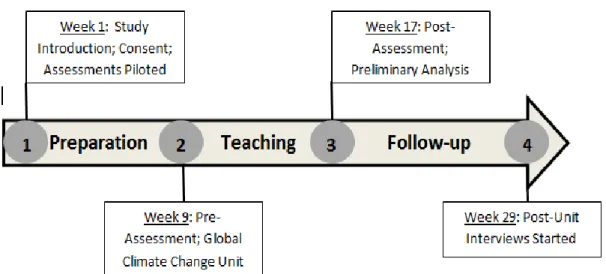
Timeline. Figure 3.1 below outlines the basic timeline for the study; preparing students for participation, the global climate change teaching unit, and follow-up analysis resulting in further data collection. During week one of the school year, the research study was explained to students and consent forms distributed. The first eight weeks of the school year students were engaged in an introductory nature of science (NOS) unit.
During this acclimatization time students became familiar with various scientific practices and assessment formats prior to the global climate change study unit. Piloting of the study assessment instruments occurred during week one of the school year with another section of high school science students.
Figure 3.1. Timeline overview outlining unit preparation, teaching unit, and follow-up analysis leading to further data collection
The global climate change unit followed the Nature of Science unit. Students took a concept mapping assessment on day one. Day two, students took the attitude and content knowledge assessment. Over the course of the study unit, students participated in a variety of lessons; many of which resulted in student artifacts. Those artifacts with high potential to express students’ changing understanding and attitudes were taken as
supplementary artifacts for qualitative analysis. These classroom artifacts are outlined on Table 3.3. The teaching unit concluded with two days of post-assessment, using the same instruments as day one and two. Preliminary analysis of the data resulted in a decision to develop follow-up interview questions and request student volunteers.
Table 3.3
Student Artifacts, Descriptions, and Collection Times
Student Artifact Description Collection
Times Concept Map List of climate change concepts to be
connected with propositions
Day 1 and Day 38 Open-Ended Content
Knowledge Assessment Responses
Explanatory; describing understanding of the greenhouse effect, global warming vs. climate
change, and proxy data
Day 2 and Day 37
Mid-Unit Survey Question Responses
Open-ended responses to questions about the value of learning about climate change in the
classroom
Day 16
Predictive Essay Describing the predicted climate trends of MN
and how that would impact them personally Day 31
Open Inquiry Project
Development of a study to a) measure the impact of behavior changes on emissions, or b) study the impacts of different temperature
settings on organisms
Day 38
Post-Unit Journal Entry
Open-ended responses to questions about GHE, GW, and CC, predicted consequences,
possible solutions, and unit critique
Day 37
Interview Transcripts
Six open-ended face-to-face interview questions about conceptual relationships (GHE, GW, CC), evidence of GW & CC,
scientific consensus, personal changes in viewpoint and value in learning about CC, and
most interesting or useful lesson from unit
3 to 6 months after teaching unit
Data Collection and Analysis
The study followed a three-phase analysis: 1. Quantitative analysis of content and attitude surveys from all participants (n=90), 2. Qualitative analysis of content and attitude assessments (n=50), and 3. Qualitative analysis of eight student cases.
Phase I: Quantitative Data Collection and Analysis. The content knowledge assessment and attitude survey responses were initially used for quantitative analysis of all ninety student participants. The combined assessments were primarily closed-survey questions developed using Google.doc forms. Students were given a question and then asked to determine which answer(s) they believed to be true or which description best fit their own view. The questions and format were modeled after Leiserowitz et al.’s instrument outlined in American Teens’ Knowledge of Climate Change (2011). The content knowledge items were scored relative to the correct scientific answer. Attitude-based survey items were compared using frequency tables. These tables outlined the percentage of students expressing particular beliefs assumed by their answer selection choice. Attitude survey items are also discussed in detail and displayed in chapter IV. The complete assessment instrument can be viewed in Appendix C.
Pre and post assessment scores were matched samples, analyzed using a paired t-test to measure the statistical significance of gains in content knowledge. The
assessments were piloted prior to the study, using junior and senior students taking the General Science elective. Piloting helped identify formatting errors and ruled out