Theses & Dissertations Boston University Theses & Dissertations
2016
Gesture passwords: concepts,
methods and challenges
https://hdl.handle.net/2144/17090 Boston University
COLLEGE OF ENGINEERING
Dissertation
GESTURE PASSWORDS:
CONCEPTS, METHODS, AND CHALLENGES
by
JONATHAN WU
B.S./M.S, Carnegie Mellon University, 2011
Submitted in partial fulfillment of the
requirements for the degree of
Doctor of Philosophy
2016
First Reader
Prakash Ishwar, PhD
Associate Professor of Electrical and Computer Engineering Associate Professor of Systems Engineering
Second Reader
Janusz Konrad, PhD
Professor of Electrical and Computer Engineering
Third Reader
Vivek Goyal, PhD
Associate Professor of Electrical and Computer Engineering
Fourth Reader
Margrit Betke, PhD
Andrew Carnegie
I would first like to thank both my research advisors, Prof. Prakash Ishwar, and Prof. Janusz Konrad for their support and guidance over the last 5 years. I was fortunate to receive their mentorship and advice, which ultimately helped sculpt and refine my methodology and perspective towards research. I truly appreciate the opportunities they’ve given me, as well as their encouragement over the years to pursue excellence in research. I would like to thank them for their patience and willingness to spend the extra time and effort to encourage and aid me throughout my doctoral studies. Truly, without their support, none of this would have been possible. I also would like to thank my committee members, Prof. Vivek Goyal, and Prof. Margrit Betke for contributing time from their schedules and giving feedback and suggestions. Additionally, I would like to thank Prof. Stan Sclaroff for letting us borrow his GTX Titan Z, as well as the Nvidia Hardware Grant for providing us with a GTX Titan X.
From the Information Data Science (IDS) group, I would also like to acknowl-edge some current and former members: Weicong Ding, Tolga Bolukbasi, Wenbo He, Amanda Gaudreau, Ji Dai, Feng Nan, Jiawei Chen, and Andrew Cutler. I would also like to make note of my high school and undergraduate collaborators: Luke Sorenson, Lucas Liang, James Christianson, Jonathan Kim, and Kristi Richter. Fi-nally, I would like to thank my family for providing and supporting me all my life. This work was not possible without the support of the National Science Foun-dation (NSF) under award CNS-1228869. The views in this document are those of the author’s and does not represent the NSF.
CONCEPTS, METHODS, AND CHALLENGES
JONATHAN WU
Boston University, College of Engineering, 2016
Major Professors: Prakash Ishwar, PhD
Associate Professor of Electrical and Computer
Engineering
Associate Professor of Systems Engineering
Janusz Konrad, PhD
Professor of Electrical and Computer Engineering
ABSTRACT
Biometrics are a convenient alternative to traditional forms of access control such as passwords and pass-cards since they rely solely on user-specific traits. Un-like alphanumeric passwords, biometrics cannot be given or told to another per-son, and unlike pass-cards, are always “on-hand.” Perhaps the most well-known biometrics with these properties are: face, speech, iris, and gait. This dissertation proposes a new biometric modality: gestures.
A gesture is a short body motion that contains static anatomical information and changing behavioral (dynamic) information. This work considers both full-body gestures such as a large wave of the arms, and hand gestures such as a subtle curl of the fingers and palm. For access control, a specific gesture can be selected as a “password” and used for identification and authentication of a user. If this particular motion were somehow compromised, a user could readily select a new
This thesis describes a novel framework for acquiring, representing, and evalu-ating gesture passwords for the purpose of general access control. The framework uses depth sensors, such as the Kinect, to record gesture information from which depth maps or pose features are estimated. First, various distance measures, such as the log-euclidean distance between feature covariance matrices and distances based on feature sequence alignment via dynamic time warping, are used to com-pare two gestures, and train a classifier to either authenticate or identify a user. In authentication, this framework yields an equal error rate on the order of 1-2% for body and hand gestures in non-adversarial scenarios. Next, through a novel decomposition of gestures into posture, build, and dynamic components, the rela-tive importance of each component is studied. The dynamic portion of a gesture is shown to have the largest impact on biometric performance with its removal caus-ing a significant increase in error. In addition, the effects of two types of threats are investigated: one due to self-induced degradations (personal effects and the pas-sage of time) and the other due to spoof attacks. For body gestures, both spoof at-tacks (with only the dynamic component) and self-induced degradations increase the equal error rate as expected. Further, the benefits of adding additional sen-sor viewpoints to this modality are empirically evaluated. Finally, a novel frame-work that leverages deep convolutional neural netframe-works for learning a user-specific “style” representation from a set of known gestures is proposed and compared to a similar representation for gesture recognition. This deep convolutional neural network yields significantly improved performance over prior methods.
A byproduct of this work is the creation and release of multiple publicly avail-able, user-centric (as opposed to gesture-centric) datasets based on both body and
1 Introduction 1 1.1 Motivation . . . 1 1.2 Contributions . . . 3 1.3 Layout of Thesis . . . 5 2 Background 7 2.1 Gesture Recognition . . . 7 2.2 Biometrics . . . 8 3 Framework 11 3.1 Evaluating Access Control . . . 11
3.1.1 Recognition Algorithm . . . 11 3.1.2 Authentication . . . 12 3.1.3 Identification . . . 14 3.2 Representation . . . 15 3.2.1 Silhouette Features . . . 16 3.2.2 Skeletal Features . . . 17 3.2.3 Normalization . . . 18 3.2.4 Covariance Descriptor . . . 19 3.3 Distance Measures . . . 19
3.3.1 Distances between Covariance Matrices . . . 20
3.3.2 Dynamic Time Warping . . . 21
4.2 Acquisition Methodology . . . 25
4.3 BodyLogin Dataset: Silhouettes and Skeletons . . . 26
4.4 BodyLogin Dataset: Posture, Build and Dynamics . . . 29
4.5 BodyLogin Dataset: Multiview . . . 31
4.6 HandLogin Dataset: In-air Hand Gestures . . . 33
4.7 Dataset Statistics . . . 35
5 Body Gestures 38 5.1 Introduction . . . 38
5.2 Value of Posture, Build, and Dynamics . . . 39
5.3 Gesture Components . . . 40
5.3.1 Extraction . . . 40
5.3.2 Suppression . . . 42
5.4 Intrinsic Threat Model: Performance Under Degradations . . . 48
5.5 Extrinsic Threat Model: Performance Under Spoof Attacks . . . 55
5.6 Value of Multiple Viewpoints . . . 57
5.6.1 Score Fusion . . . 58 5.6.2 Feature Fusion . . . 58 5.7 Effects of Multiview . . . 59 5.8 Concluding Remarks . . . 63 6 Hand Gestures 66 6.1 Introduction . . . 66 6.2 Related Work . . . 67
6.3 Extended Silhouette Representation . . . 67
6.4 Covariance Descriptor . . . 68 x
6.7 Concluding Remarks . . . 72
7 Deep Learning and Gesture Styles 73 7.1 Motivation for Learning Gesture Style . . . 73
7.2 Related Work . . . 74
7.3 Convolutional Neural Networks . . . 74
7.3.1 CNNs for Identification and Authentication . . . 79
7.3.2 Network Implementation Details . . . 80
7.4 On Gesture Datasets . . . 81 7.5 Concluding Remarks . . . 94 8 Conclusions 96 8.1 Contributions . . . 96 8.2 Future Work . . . 98 References 100 Curriculum Vitae 106 xi
4.1 Comparison of gesture datasets . . . 26
4.2 Recording procedure for BLD-SS and BLD-MM . . . 29
4.3 Dataset downloads . . . 37
5.1 Possible combinations of information suppression . . . 46
5.2 EERs with various skeletal components suppressed . . . 46
5.3 Authentication EERs for silhouette and skeletal features . . . 50
5.4 Identification CCEs for silhouette and skeletal features . . . 51
5.5 EERs showcasing zero-effort vs spoof attacks . . . 56
5.6 EERs when using multiple camera viewpoints . . . 60
5.7 CCEs when using multiple camera viewpoints . . . 61
6.1 User authentication results for HandLogin . . . 70
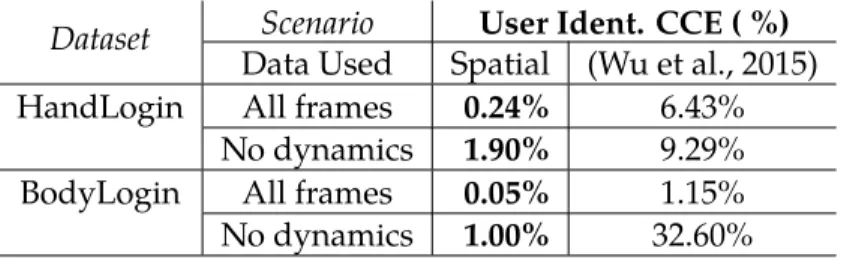
7.1 User identification results for BodyLogin and HandLogin . . . 83
7.2 User identification on MSRAction3D . . . 83
7.3 User identification with dynamic suppression . . . 86
7.4 User authentication results for BodyLogin and HandLogin . . . 86
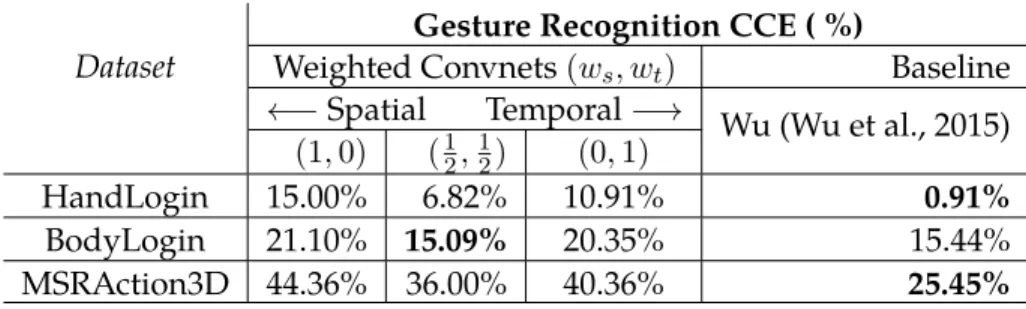
7.5 Gesture recognition results . . . 88
1·1 Sample hand and body gesture . . . 1
1·2 Authentication and identification . . . 3
2·1 Common biometrics . . . 9
3·1 System diagram of a user performing authentication . . . 12
3·2 System diagram of a user performing identification . . . 15
3·3 Illustration of a silhouette tunnel . . . 16
3·4 Example of a skeleton produced by the Kinect SDK . . . 18
3·5 Visualization of the pathP between two sequences . . . 22
3·6 Visualization of the modified DTW cost function . . . 23
4·1 BLD-SS gestures . . . 27
4·2 BLD-SS intrinsic degradations . . . 28
4·3 BLD-PBD gestures . . . 30
4·4 BLD-M multiple viewpoint camera setup . . . 32
4·5 HandLogin gestures . . . 33
4·6 HandLogin camera setup . . . 34
4·7 BodyLogin dataset statistics . . . 36
4·8 HandLogin dataset statistics . . . 36
5·1 Before/after body pose suppression . . . 43
5·2 Before/after body build suppression . . . 44
5·3 Before/after dynamics suppression . . . 44 xiii
5·6 ROC curves for multiple camera viewpoints . . . 65
6·1 HandLogin depth images . . . 66
6·2 Hand silhouette depth partitioning . . . 69
7·1 Optical flow for BodyLogin, HandLogin, and MSRAction3D . . . 76
7·2 Deep network pipeline for identification and authentication . . . 77
7·3 HandLogin t-SNE embeddings . . . 90
7·4 BodyLogin t-SNE embeddings . . . 91
7·5 MSRAction3D t-SNE embeddings . . . 92
ASL . . . American Sign Language BLD . . . BodyLogin Dataset
BLD-M . . . Body Login Dataset: Multiview
BLD-PBD . . . Body Login Dataset: Posture, Build, Dynamics BLD-SS . . . Body Login Dataset: Silhouettes vs Skeletons CCE . . . Correct Classification Error
CCR . . . Correct Classification Rate CNN . . . Convolutional Neural Network CRF . . . Conditional Random Field DCT . . . Discrete Cosine Transform DTW . . . Dynamic Time Warping EER . . . Equal Error Rate
FAR . . . False Acceptance Rate FRR . . . False Rejection Rate GEI . . . Gait Energy Image GMM . . . Gaussian Mixture Model
HOG . . . Histogram of Oriented Gradients HMM . . . Hidden Markov Model
LOP . . . Local Occupancy Patterns
LOOCV . . . Leave-One-Out Cross Validation LDS . . . Linear Dynamical System
MKL . . . Multiple Kernel Learning NN . . . Nearest Neighbor
PC . . . Personal Computer
RGB . . . Red Green Blue Color Model ROC . . . Receiver Operating Characteristic SDK . . . Software Development Kit
SVM . . . Support Vector Machine
t-SNE . . . t-Distributed Stochastic Neighbor Embedding
Chapter 1
Introduction
1.1
Motivation
Traditional biometrics have been plagued by the use of inherently nonrenewable information. For instance, having to change or replace a person’s face, iris, fin-gerprint, or speech is inconvenient and difficult. A compromised biometric is not necessarily rare. Faces are open public information and are vulnerable to being photographed, fingerprints are easily left on surfaces, and speech can be recorded and replayed. Thus, a renewable biometric, one that could be easily changed if compromised, would be invaluable.
Figure 1·1: Example depth map sequences of a body and a hand ges-ture as capges-tured by a Kinect camera.
gesture is a short, few seconds long, body motion that contains static anatomical information, and changing (dynamic) information. This thesis considers both full-body gestures, such as a wave of the arms, and hand gestures, such as a subtle curl of the fingers and palm. These gestures are typically only a few seconds long and are performed in front of a stationary camera starting from a resting, neutral position. Should a gesture ever be compromised, a user can intentionallyselect a new gesture.1 As a gesture consists of both static and dynamic information, the
dynamic portion can be altered. These gesture “passwords” can be presented to an access control system to eitheridentifywho a person is, or toauthenticate(verify) whomever he/she claims to be (see Figure 1·2). These two primary access scenarios which we consider for evaluating biometric performance, are commonly known as: identification and authentication (verification).
Further, ongoing advances in depth capturing technologies, such as the Kinect v1 and v2 (Kin, 2014), have made acquiring quality biometric information based on body gestures widely accessible. In fact, ubiquitous depth sensor integration is expected in next-generation devices (smartphones, PCs, and tablets). One signifi-cant advantage of a depth sensor is its resistance to spoofing and evasion since 3-D information is required from its users. For example, unlike in face recognition, a photograph for spoofing would no longer work (due to its flat surface) and instead a 3-D molded mask would be required (much to the inconvenience of would-be attackers). This combination of renewability and inherent spoofing resistance has motivated us to carry out research in gesture passwords.
Authentication access scenario.
User provides gesture password (shown as a skeletal joint sequence) and purported identity.
Identification access scenario.
User only provides gesture password (shown as a skeletal joint sequence).
Figure 1·2: Two of the most common access control scenarios we con-sider.
1.2
Contributions
At the highest level, this dissertation introduces and validates a new modality, in-tentional body gestures, for the purpose of authenticating or identifying a person. Since this problem has not been tackled before, it necessitated both the generation of new datasets and a systematic quantitative study of the security performance of the proposed algorithms.
Contribution 1 - Gesture Representations: We introduce a novel framework for ac-quiring, representing and evaluating gesture passwords for either authentication or identification. This framework leverages information obtained by an RGB/depth-sensing camera, such as the Kinect, from which silhouette or skeletal features are extracted. We propose two distance metrics for comparing gestures: the log- eu-clidean distance between feature covariance matrices and distance based on fea-ture sequence alignment via dynamic time warping. This contribution has been reported in the following works: (Wu et al., 2013; Wu et al., 2014a; Wu et al., 2015).
Contribution 2 - Gesture Component Decomposition and Valuation Framework:
We propose a novel framework for first decomposing gestures into posture, build, and dynamics and then realistically re-synthesizing them with one or more com-ponents suppressed. This framework enables a fair evaluation of the contributions of different gesture components to authentication and identification performance. This contribution has been reported in the following work: (Wu et al., 2014b).
Contribution 3 - Gesture Degradations and Threats: Models and Performance Evaluation Framework: We study two major classes of threats to gesture-based authentication and identification with the help of real-world test subjects. The first class, intrinsic threats, contains self-induced degradations to the gesture password. This can be due to personal effects (outerwear or belongings) or due to a user’s in-ability to accurately reproduce a gesture after a long period of time. The second class, extrinsic threats, focuses on spoof attacks. This contribution has been re-ported in the following works: (Wu et al., 2014a; Wu et al., 2014c).
Contribution 4 - User-centric Datasets: We create four new real-world datasets for the express purpose of evaluating the identification and authentication perfor-mance of body and hand gestures. Unlike datasets for gesture recognition that are gesture-centric and contain a high number of gestures per user, our datasets uniquely focus on being user-centric, and all contain a high number of users per gesture. In addition to this trait, we collect gesture samples under a multitude of conditions such as: personal effects, the passage of time, inclusion of copycats, and the usage of multiple camera sensors. This contribution has been reported in the following works: (Wu et al., 2014a; Wu et al., 2014b; Wu et al., 2014c; Wu et al., 2015).
Contribution 5 - User Gesture Style for Authentication and Identification:We de-velop a novel framework for authentication and identification based on a user’s ges-ture style which is a set of common traits to gesges-tures by the same user. This frame-work is based on deep convolutional neural netframe-works, specifically, a two-stream convolutional network which uses both the spatial and the temporal information in a gesture. This contribution has been reported in the following work: (Wu et al., 2016).
1.3
Layout of Thesis
The following is the outline of the rest of the thesis.
Chapter 2 provides a brief overview and background of topics related to the gesture modality.
Chapter 3introduces and defines the proposed user recognition framework and the metrics that are used to evaluate it.
Chapter 4discusses the datasets that were collected to support the experimental evaluations in this work.
Chapter 5focuses on studies dealing withbodygestures. These studies pertain to the importance of dynamics, the robustness of the modality towards threats and degradations, and the value of additional viewpoints.
Chapter 6evaluates the biometric performance ofhandgestures.
Chapter 7 explores learning user-specific gesture “style” using deep convolu-tional networks.
Chapter 8 summarizes the conclusions and contributions of this dissertation and outlines possible directions for future work.
Chapter 2
Background
In this chapter, works are reviewed that are similar in nature to gesture-based au-thentication. As there is fundamentally no prior work in this biometric modality, instead, techniques that can be adapted or reapplied for gesture access control are described. The following is a short overview of these topics.
2.1
Gesture Recognition
Gesture authentication is perhaps most similar to gesture (action) recognition. In both problems, users perform a gesture withintentin front of a sensor. In authen-tication, the goal is to find or authenticate the user (analyze information specific to a user), and in recognition, the goal is to find the gesture (analyze information specific to a gesture). For example, in gesture recognition, information related to the angular velocities of the joints holds much more importance than information pertaining to a user’s body build and shape. This is because the angular velocities of the joints are moregesturespecific, thanuserspecific.
First, we discuss methods for gesture recognition based on depth sensors. One particular advantage of the Kinect is that skeletal joint information can be estimated directly from the depth maps through pose estimation (Shotton et al., 2011; Shotton et al., 2013). As a result of this, many features have been proposed for recognition based on skeletal joints.
coordinate bins, which could be used as a histogram feature. Wang et al. (Wang et al., 2012b) proposed using local occupancy patterns (LOP) as features which are computed by binning point-cloud values around calibrated skeletal joints. Ohn-Bar and Trivedi (Ohn-Ohn-Bar and Trivedi, 2013) proposed using histogram of oriented gradients (HOG) around each skeletal joint and pairwise affinities between skeletal joint angles as features. Ofli et al. (Ofli et al., 2013) proposed using linear dynamical systems (LDSs) to model 3-D joints at several spatio-temporal scales on skeletal joints.
To compare or classify these features, methods such as dynamic time warping (DTW) (Reyes et al., 2011), hidden Markov models (HMMs) (Lv and Nevatia, 2006), conditional random fields (CRFs) (Han et al., 2010), and multiple kernel learning (MKL (Ofli et al., 2013), have been applied.
2.2
Biometrics
There are two categories of biometrics: physiological and behavioral.
Physiological biometrics are based on a person’s physical traits. These are the well-known, “traditional” biometrics such as face, fingerprint, and iris.
Behavioral biometrics are based on a person’s habits (their trends, patterns and “style”). These are signatures, keystrokes, or gait (walking) of an individual. Be-havioral biometrics are quite similar to gestures and we discuss them in some detail below.
Gait
Gait is the unique shape and motion of an individual walking that can be used for identification. Using gait as a biometric has in recent years gained traction due to its properties being recognizable from a distance. This long-range recognition is
Figure 2·1: A listing of a few common biometrics (both physical and behavioral). Figure from (Jain et al., 2011).
desirable as it does not require the subject to be cooperative (or aware) of the iden-tification. The most common approach for gait recognition is to perform silhouette extraction (through background subtraction), and extract various features that can be used for classification (such as through HMMs, and GMMs). Features such as optical flow (Little and Boyd, 1998), GEI (Han and Bhanu, 2006) (gait energy image – the averaged silhouette intensity), and biped models (Zhang et al., 2004) (coarse pose estimation of the lower body) are among the most popular.
On-line Signature
On-line signatures expand upon the classic pen and paper signature for authen-tication. Instead of only considering the static image of a signature, dynamic in-formation such as pen x-y position, x-y speed, and tip pressure (how hard a hand is pressing) can be captured when a signature is performed on a touchscreen or tablet. There are primarily two classes for on-line signature features. The first class consists of “feature-based” scalars of global properties such as: the maximum and minimum x-y pen velocity, or the standard deviation of the pen’s x-y acceleration. The second class consists of “function-based” vectors of time-dependent sequences: pen trajectory, velocity, acceleration, force, or pressure (Lei and Govindaraju, 2005). “Feature-based” information can be compared using distances such as weighted Euclidean distance and Mahalanobis distance. Elastic matching (predominantly, variants of DTW (Faundez-Zanuy, 2007; Kholmatov and Yanikoglu, 2005)) and sta-tistical modeling (HMMs) have also been used to match “function-based” informa-tion.
Chapter 3
Framework
This chapter presents a framework for access control through authentication or identification. First, we discuss types of access control and their performance met-rics. Next, we detail the framework used to represent, and compare gesture se-quences that have been captured from the Kinect. We use two features for gestures: silhouette shapes and skeletal joints. After defining these features, we propose var-ious distances to compare pairs of gesture samples. Finally, we use an authorized set of samples to train a classifier to determine access.
3.1
Evaluating Access Control
The performance of an access control system can be evaluated in one of two sce-narios: authentication oridentification (Jain et al., 2011). This section describes each of these access scenarios and their associated performance metrics.
3.1.1 Recognition Algorithm
A simple yet powerful recognition algorithm such as nearest-neighbor (1-NN) can be used to determine access based on suitable distance measures. If a query sample is sufficiently close in distance (falls within a determined cutoff threshold) to an en-rolled sample, access or identity can be granted. Based on this algorithm, measures of security can be calculated for a given access scenario.
Figure 3·1: System diagram of a user performing authentication.
3.1.2 Authentication
This thesis primarily considers access control performance for authentication. In authentication, a user provides two pieces of information: his/her claimed iden-tity and a biometric (see Figure 3·1). If the biometric closely matches an enrolled sample of the given identity (one-to-one-user match), the user is allowed access. Otherwise, he/she is rejected.
re-jection. The false acceptance rate (FAR) is the rate at whichunauthorized users are allowed access. The false rejection rate (FRR) is the rate at which authorizedusers are denied access. In any practical system, FAR and FRR will have trade-offs. One can find these trade-offs by applying various acceptance thresholds across the sys-tem. A common metric of performance is the equal error rate (EER) which occurs when FAR and FRR are equal. This process is briefly recapped below.
LetAi ={S1, . . .Sm}be a set containingmgesture samples from a single
autho-rized useri. Let Ui be a set of gesture samples that do not come from authorized
user i. The FRR is found by comparing samples inAi amongst themselves (each
sample inAiis treated as a query sampleQ). This is done using leave-one-out cross
validation (LOOCV) such that each sample is compared to the setAi\{Q}, i.e., with
the query itself removed. The FAR is found by comparing samples inUito samples
inAi(each sample inUiis treated as a query sample). A nearest-neighbor criterion dN N(·,·)is used to compare a single query sampleQto the authorized setA.
dN N(Q,Ai) = minS∈Aid∗(Q,S).
whered∗ is one of the following distances (discussed in Section 3.3):
• dU.tri.Eucl (Upper Euclidean)
• dHier.Eucl (Temporal Hierarchy Euclidean Distance) • dLog−Eucl(Log Euclidean Distance)
Then, for a given threshold valueθ, the FAR and FRR are calculated by: F RR(Ai, θ) = P Q∈Ai1(dN N(Q,Ai\{Q})≥θ) |Ai| F AR(Ai,Ui, θ) = P Q∈Ui1(dN N(Q,Ai)< θ) |Ui|
where the indicator function 1(condition) equals 1 if the ‘condition’ is true and equals0otherwise.
EER for the pair(Ai,Ui)is found by first computing the FAR-FRR pairs for
dif-ferent thresholdsθ. Then, the EER is determined as the location on the boundary of the convex hull of the FAR-FRR pairs where FAR equals FRR. In practice, this EER does not lie directly on a FAR-FRR pair that corresponds to a single classifier (e.g., a 1-NN decision rule with a single decision threshold). Rather, the EER reflects two classifiers (e.g., two 1-NN decision rules with two different decision thresholds), where each classifier is chosen at random with a fixed probability (Scott et al., 1998). This computation is repeated for each authorized user who each has his/her own unique set(Ai,Ui). Effectively, each user in a dataset will have their own EER.
If these values are averaged across users, an average EER can be computed. Such a score can be considered to represent the scenario where each user has their own accept/reject thresholdθi. If a global accept/reject thresholdθglobalis desired across
allusers, a “global” EER can be computed. In this case,θis taken across all(Ai,Ui)
pairs simultaneously.
3.1.3 Identification
Access control can also be considered in the context of identification. In identifica-tion, a user presents his/her biometric sample to a system which retrieves an en-rolled identity through a one-to-many-user match (see Figure 3·2). This is called the closed-set identification problem, i.e., classification under the assumption that
Figure 3·2: System diagram of a user performing identification.
the query user’s identity is enrolled, i.e., no possibility of rejection. The correct classification rate (CCR), and its complement error, CCE = 1-CCR, can be used to express accuracy. This value is also computed with LOOCV, where each user is labeled with the identity of his/her nearest-neighbor match.
3.2
Representation
The following sections describe how silhouette or skeletal feature matrices Fare computed. These features are used to represent each gesture sample, and will later
be used to compute distances between pairs of samples.
3.2.1 Silhouette Features
A compact silhouette representation can be extracted from any gesture sequence consisting of depth frames.
Figure 3·3: Each silhouette pixeln has an associated 13-dimensional feature vector which consists of the pixel position(x, y, t)and 10 di-rectional distancesδ∗to the silhouette boundary.
First, a sequence of binary silhouettes of a user performing a gesture is extracted from a sequence of depth frames. This is accomplished by differencing each depth map from a known depth map background. The largest 3-D connected component with 18-connected pixel connectivity in the 3-D sequence of binary silhouettes is taken to be a user’s silhouette tunnel.
In order to extract features from this silhouette tunnel, an approach similar to the one used by Lai and Guo et al. (Lai et al., 2012; Guo et al., 2013) is adopted. Let
n= 1, ..., Nindex allNpixels within the silhouette tunnel and let(x, y, t)denote the space-time coordinates of pixel number n. The following 13-dimensional feature vectorfnis computed at each silhouette pixel and captures the shape and dynamic
characteristics of a gesture (Figure 3·3):
fn = f(x, y, t) := [x, y, t, δE, δW, δN, δS, δN E, δSW, δSE, δN W, δT+, δT−]′ (3.1)
whereδDIRdenotes the Chebyshev distance between the space-time coordinates of pixelnand those of the farthest silhouette boundary pixel in directionDIR. The first
8 directions are in thex, yspatial domain (4 cardinal directions and 4 inter-cardinal directions), and the last 2 are in the temporal domain (forward and backward in time).
The above procedure, after visiting allN pixels of a silhouette tunnel, produces a13byN matrixF= [f1,f2, . . . ,fN]as the final representation.
3.2.2 Skeletal Features
A gesture can also be described as a sequence of a user’s skeletal joints in rectan-gular coordinates across time. The advantages of using skeletons (pose estimation) over silhouettes, are two fold: (i) skeletal data is sparse yet informative and (ii) skeletal data is relatively insensitive to changes in clothing, personal effects, and lighting conditions. Conveniently, the Kinect SDK (Kin, 2014; Shotton et al., 2011) provides rectangular coordinates of 20 skeletal joints of the human body for each frame at 30 frames per second. These coordinates are extracted from each depth frame and correspond to the following locations: head, neck, spine, center hip, and left and right versions of the hand, wrist, elbow, shoulder, hip, knee, ankle and foot (Figure 3·4). A skeleton’s evolution in time can be represented as a sequence of featuresftas follows:
Figure 3·4: Example of a skeleton produced by the Kinect SDK. where st
i = (xti, yit, zit) ∈ R3 is a 1× 3 row vector which denotes the x − y − z
coordinates of thei-th skeletal joint in frame numbertandT is the total number of frames.
LetF= [f1,f2, . . . ,fT]denote a60byT matrix that becomes the final
represen-tation of this procedure.
3.2.3 Normalization
Due to the nature of gesture dynamics and body build, individual feature elements (e.g., coordinatessti, and distances along cardinal directionsδDIR) may have signif-icantly different dynamic ranges. A feature element with a large amplitude would then influence an overall error metric more than a feature with a small amplitude. In order to avoid developing a complicated metric with unequal weights for indi-vidual elements, the approach of Hussein et al. (Hussein et al., 2013) is adopted where the matrixFis normalized along rows (the time-wise or pixel-wise dimen-sion) as follows: Fnorm[i, j] = F[i, j]−min k F[i, k] max k F[i, k]−mink F[i, k] (3.3)
where F[i, j] denotes the value in the i-th row and j-th column of F. The above normalization ensures that the values of all feature elements are contained within the dynamic range[0,1].
3.2.4 Covariance Descriptor
A gesture sequence can be also viewed as a “bag of features,” where each pixel (silhouette) or frame (skeleton) is associated with anh×1feature vector. Anh×h
empirical covariance matrixCof a collection of feature vectors (normalized accord-ing to (3.3)) provides a low-dimensional, second-order representation of the entire feature vector collection:
C := 1 N N X 1 (fnormn −µ)(fnormn −µ)T, (3.4)
whereµis the empirical mean of normalized feature vectorsfnormn . For silhouettes, h = 13, and N is the total number of pixels in the silhouette tunnel. For skele-tons, h = 60 and N is the number of frames in the skeletal sequence. Since C is a symmetric matrix, its upper-triangular part of size(h2 +h)/2can be used as an
independent gesture descriptor.
3.3
Distance Measures
There are numerous ways to measure distances between two gesture sequences. In the following section, we describe how to compute the distance between pairs of covariance matrices and how to compute dynamic time warping distance. These distances represent the possibilities ford∗ as used in Figure 3·1 and 3·2, which are
3.3.1 Distances between Covariance Matrices Upper-Triangular Euclidean Distance
Perhaps the simplest way to measure the distance between two covariance matrices of normalized features is to compute the Euclidean distance (Frobenius norm) be-tween them. Since covariance matrices are symmetric, the upper-triangular portion contains all the information. Hence, one basic distance function between (normal-ized) covariance matrices that is considered is the Euclidean distance between their upper-triangular parts. This is denoted bydU.tri.Eucl(·,·).
Euclidean Distance with Temporal Hierarchies
A key problem with the covariance descriptor is that theorderingof pixels or frames does not matter or is irrelevant. If this order were to be scrambled, the covariance matrix would remain unchanged. In order to emphasize the importance of frame ordering in a gesture, Husseinet al. (Hussein et al., 2013) suggested using a hierar-chical computation of covariance descriptors across temporal windows at various scales. In this way, given any scrambling of the frames, the covariance matrices across smaller time windows would be different. For example, consider this idea for 3 temporal levels. At level i, 2i−1 equal-length, non-overlapping windows are
computed across the entire sequence. For example, at the3rdlevel in hierarchy there
would be 4 equal-length windows each of lengthN/4(temporal ranges: 1 to N 4 , N 4 + 1toN 2 ,N 2 + 1to3N 4 , and3N 4
+ 1toN). All these covariance matrices can be computed quickly through the use of integral signals(Hussein et al., 2013; Tuzel et al., 2008).
For each covariance matrix that is computed from the temporal hierarchy, the upper triangular portion serves as our gesture descriptor, and all these descrip-tors are concatenated into one long gesture descriptor vector. For the case of 3
layers, there are 7 covariance matrices. Each upper triangular matrix is of length
(602 + 60)/2 = 1,830, which concatenated together, yields a total length of 7 × 1,830 = 12,810. Thus, for a single gesture sequence from one Kinect camera using a 3-layer temporal hierarchy a descriptor of length 12,810 will be generated. A Eu-clidean norm between these concatenations of upper-triangular parts can be used as a distance. This is denoted bydHier.Eucl(·,·).
Log-Euclidean Distance
The log-Euclidean distance between two covariance matricesC1, andC2 proposed
by Arsingyet al.(Arsigny et al., 2006) is defined as follows:
dLog−Eucl(C1, C2) :=||log(C1)−log(C2)||2, (3.5)
where|| · ||2 denotes the matrix Frobenius norm andlog(C) := VDV˜ ′ whereC = V DV′ is the eigen-decomposition of covariance matrixC and D˜ is obtained from
D by replacing its diagonal entries with their logarithms. This distance is a Rie-mannian metric on the manifold of covariance matrices. The basic intuition of this distance is to convert the space of covariance matrices (forms a convex cone) to a vector space, and then take a norm in the transformed Euclidean space. Additional properties of this distance can be found in (Arsigny et al., 2006).
3.3.2 Dynamic Time Warping
Dynamic time warping (DTW) can be used to measure the distance between two gesture sequences of possibly different durations. DTW is a non-linear alignment algorithm that is relatively popular and has been extensively used in the literature (Ding et al., 2008; Keogh, 2002; Ratanamahatana and Keogh, 2004). For skeletal features, a modified version of this algorithm has been designed for this problem
as detailed below.
Figure 3·5: Visualization of the pathP between two sequences. LetFg1 = [f 1 g1,· · · ,f T1 g1]andFg2 = [f 1 g2,· · · ,f T2
g2 ]be two feature matrices of skeletal
features corresponding to gesturesg1 (T1 frames long) andg2 (T2 frames long). A
distance based on the cost ofaligningFg1 andFg2 can be computed from aT1×T2
cost matrix. Let the cost matrix’s (i, j)-th entry be the cost of aligning the skeletal feature in frame-iof gestureg1with the skeletal feature in frame-j of gestureg2:
cost(fgi 1,f j g2) = 20 X p=1 ||sip,g 1 −s j p,g2||2.
An admissible alignment scheme is a pathP through the cost matrix defined as follows
P={(ik, jk), k= 1, . . . , K :i1 =j1 = 1, iK =T1, jK =T2,∀k, ik+1−ik, jk+1−jk ∈ {0,1}}
Figure 3·6: Visualization of the modified DTW cost function. as follows: pathcost(P,Fg1,Fg2) = X (ik,jk)∈P cost(fik g1,fj k g2)
The path of interest is the one with the least cumulative cost. This path can be solved recursively using dynamic programming in quadratic time. The final cost is defined as follows:
dDT W(Fg1,Fg2) = min
Chapter 4
Gesture Datasets
4.1
Motivation for New Datasets
The problems of gesture recognition and gesture-based authentication are similar in the sense that they both involve users performing gestures. However, in the former problem the goal is to recognize the gesture regardless of the user, whereas in the latter problem the goal is to recognize the user regardless of the gesture. Although it might seem that a given dataset of gestures can be used interchangeably for studying both problems, e.g., analyzing user authentication performance using a gesture recognition dataset, this is not the case.
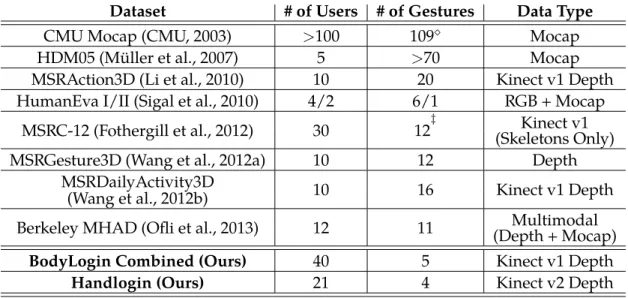
Datasets for gesture recognition are typically gesture-centric meaning that they have high number of gestures per user (many gestures to classify, few users per-forming them) whereas studying authentication requires the opposite, namely a user-centric dataset which has a high number of users per gesture. This issue is highlighted in Table 4.1, where we compare gesture recognition datasets. Notably, many of these datasets contain less than 20 users. In cases where there are more than 20 users, the data has been collected in such a way that there is either not enough users performing each gesture or the data contains dataset bias due to ges-tures being performed continuously standing in-place. By standing in-place, each user’s lower body posture does not significantly change which can cause dataset bias. In gesture recognition, this is typically not an issue, as the same user will
never be seen inboth training and testing. However, for cases of user recognition, this causes a significant issue, as the same user is almost always seen inboth train-ing and testtrain-ing.
With these goals and issues in mind, three datasets were collected:
• BodyLogin Dataset: Silhouettes vs Skeletons (BLD-SS) (Wu et al., 2014a) • BodyLogin Dataset: Posture, Build, Dynamics (BLD-PBD) (Wu et al., 2014b) • BodyLogin Dataset: Multiview (BLD-M) (Wu et al., 2014c)
• HandLogin Dataset: In-air Hand Gestures (Wu et al., 2015)
Each of these datasets focuses on a different aspect of gesture-based user recog-nition, and thus have been recorded under different scenarios as detailed in the following sections.
4.2
Acquisition Methodology
Three of the aforementioned datasets (BodyLogin) have been collected with a Kinect v1 sensor. These three datasets each recorded a subject from a forward-facing Kinect sensor approximately 2 meters away. The Kinect v1 sensor captures a 640×480 depth image and skeletal joint coordinates (pose estimation through the SDK (Kin, 2014)) at 30 fps.
The last dataset, HandLogin, has been collected with a Kinect v2 sensor fac-ing the ceilfac-ing. The Kinect v2, a time-of-flight depth sensor, is used to acquire a 512x424 depth image of each gesture sample at 30 fps. Eachhandgesture sample is recorded in near proximity to the sensor (approximately 50 cm) so as to maximize hand detail.
Table 4.1: A comparison of mostlybodygesture recognition datasets using either depth or mocap (motion capture) sensors. ⋄In CMU Mo-cap, all users do not perform all gestures (some gesture types only have a single user performing it). ‡In MSRC-12, gestures are
per-formed continuously in a long sequence, one after another causing inherent biases.
Dataset # of Users # of Gestures Data Type
CMU Mocap (CMU, 2003) >100 109⋄ Mocap
HDM05 (M ¨uller et al., 2007) 5 >70 Mocap
MSRAction3D (Li et al., 2010) 10 20 Kinect v1 Depth
HumanEva I/II (Sigal et al., 2010) 4/2 6/1 RGB + Mocap
MSRC-12 (Fothergill et al., 2012) 30 12‡ (Skeletons Only)Kinect v1
MSRGesture3D (Wang et al., 2012a) 10 12 Depth
MSRDailyActivity3D 10 16 Kinect v1 Depth
(Wang et al., 2012b)
Berkeley MHAD (Ofli et al., 2013) 12 11 (Depth + Mocap)Multimodal
BodyLogin Combined (Ours) 40 5 Kinect v1 Depth
Handlogin (Ours) 21 4 Kinect v2 Depth
At some point in each dataset, users were instructed to perform a pre-defined gesture. Each user was instructed how to perform each gesture type through a text and video prompt (a multi-modal instruction scheme). In the literature, a multi-modal instruction scheme is known to improve gesture reproducibility over a single-modal instruction scheme (e.g., text or video only) (Fothergill et al., 2012). In order to strive for realistic intra-class variability and reduce pose bias, users were instructed to leave (for approximately one minute) and re-enter the recording area between gesture samples.
4.3
BodyLogin Dataset: Silhouettes and Skeletons
The BodyLogin Dataset: Silhouettes and Skeletons (BLD-SS) is used to compare the performance of silhouette and skeletal features in real world scenarios. Over
a two week, two session period (one session per week), gesture samples from 40 different college-affiliated users (27 males, 13 females) primarily 18-33 years old were collected. Each subject was asked to perform 2 unique short gestures (ap-proximately 3 seconds long), each with 20 samples. In total, about 1.4 hours of data were recorded, with each user averaging 2 minutes of data (each sample about 3 seconds long). Both gestures involved motion in the upper and lower body (Fig-ure 4·1):
• S gesture: drawing an “S” shape with both hands,
• User-defined gesture: user chooses his/her own gesture (no instruction).
S gesture (common to all users)
User-defined gesture: knee lift (will vary between users)
Figure 4·1: Snapshots of the gestures each user performed in our dataset (Kinect depth shown).
Degradations
Four different types of gesture scenarios were considered in BLD-SS: • No degradations
• Personal effects • User Memory
Before/after user wearing backpack
Before/after user wearing a sweatshirt
Figure 4·2: Views of users wearing personal effects. Left two im-ages are before personal effects (front and back Kinect views shown), the right two images are after personal effects (front and back Kinect views shown).
In the case ofpersonal effects, users either wear or carry something during their gestures. Half of our users were told to wear heavier clothing, and the other half were told to carry some type of a bag. Users wore a variety of heavier clothing: sweatshirts, windbreakers, and jackets. They carried backpacks (either on a single shoulder or both), messenger bags, and purses.
The impact ofuser memorywas tested by collecting samples a week after a user first performed a gesture. Users were first asked to perform the gesture without any video or text prompt. After a few samples were recorded, the user was shown a prompt and asked to perform the gesture again. These last samples measured
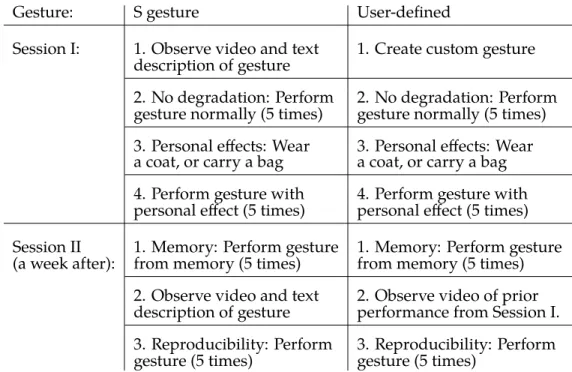
reproducibility. Of the 20 samples recorded for each gesture, each of the described scenarios had 5 samples recorded. Table 4.2 shows a summary of the degradation scenarios that were used for each gesture.
This dataset has been made available at http://vip.bu.edu/projects/hcis/ body-login/datasets/silhouettes-vs-skeletons/
Table 4.2: Details of recording procedure for BLD-SS and BLD-M. Users were instructed to “reset” initial position between gesture per-formances. Half of the users wore coats, and the other half carried bags.
Gesture: S gesture User-defined
Session I: 1. Observe video and text 1. Create custom gesture
description of gesture
2. No degradation: Perform 2. No degradation: Perform
gesture normally (5 times) gesture normally (5 times)
3. Personal effects: Wear 3. Personal effects: Wear
a coat, or carry a bag a coat, or carry a bag
4. Perform gesture with 4. Perform gesture with
personal effect (5 times) personal effect (5 times)
Session II 1. Memory: Perform gesture 1. Memory: Perform gesture
(a week after): from memory (5 times) from memory (5 times)
2. Observe video and text 2. Observe video of prior
description of gesture performance from Session I.
3. Reproducibility: Perform 3. Reproducibility: Perform
gesture (5 times) gesture (5 times)
4.4
BodyLogin Dataset: Posture, Build and Dynamics
BodyLogin Dataset: Posture, Build and Dynamics (BLD-PBD) is a Kinect dataset that contains gestures across two sessions. In the first session, users recorded ges-tures under normal conditions. In the second session, users were matched to at-tack targets and were made to spoof another’s gestures. This dataset was used to evaluate the effects of user-specific posture, build and dynamics in the context of authentication.
In total, about 1.8 hours of data were recorded, with each user averaging 3 min-utes of data (each sample about 3 seconds long). There are 20 samples per gesture (10 own and 10 attack) for each user. Users were all college-affiliated (25 males, 11 females) mostly in the age range of 18-33 years. The three gestures, designed to be
of increasing complexity, involved movement in both the upper and the lower body (Figure 4·3):
• Left-right gesture: user reaches right shoulder with left hand, and then reaches left shoulder with right hand,
• Double-handed arch gesture: user draws an arch from left to right with both hands,
• Balancing gesture: user first raises right arm forward while pulling left arm back, then balances by forward sweeping left leg while simultaneously tuck-ing left arm in and brtuck-ingtuck-ing right arm to rest.
Left-right gesture
Double-handed arch gesture
Balancing gesture
Figure 4·3: Snapshots of the gestures each user performed in our dataset (Kinect depth shown).
In order to facilitate our gesture spoofing study (Section 5.5 where extrinsic at-tacks are considered), each of the 3 gestures of each user was matched to anattack targetafter the first session. Attack targets were found by comparing the “centroid” samples of each user. IfA:={S1, . . . ,Sm}denotes a set of user’s first-session
sam-ples (feature matrices) of a given gesture, then the user’s “centroid” sample is de-fined for that gesture as follows:
Scentroid= arg min S∈A
m X
i=1
dDT W(S,Si). (4.1)
A user’s attack target (in the second session), for a given gesture, is the owner of the closest centroid sample (nearest-neighbor) for that gesture. The aim of match-ing attackers to their ”easiest victims” is threefold: 1) all participants can serve as attackers in the study 2) no participant is asked to attack more than one user which balances the burden across all participants, and 3) the odds of users suc-ceeding as attackers are improved, which somewhat compensates for the lack of experience and the limited practice-time available for an attack. Under this match-ing scheme, vulnerable users get attacked more often than others and very distinct users never get attacked. Furthermore, attackers may end up attacking up-to three distinct users (one for each gesture). Most users had at least one attacker. The most attackers a user had was seven.
This dataset has been made available at http://vip.bu.edu/projects/hcis/ body-login/datasets/posture-build-dynamics/
4.5
BodyLogin Dataset: Multiview
BodyLogin Dataset: Multiview (BLD-M) is a multiple-viewpoint Kinect dataset that contains gestures recorded under various degradations. This dataset was used to evaluate the value of additional Kinect viewpoints in gesture authentication.
This dataset is an extension of BLD-SS to multi-view. As with BLD-SS, over a two week, two-session period (one session a week), gesture samples from 40 dif-ferent college-affiliated users (27 males, 13 females) primarily 18-33 years old were collected. Subjects were asked to perform 2 unique short gestures (approximately
Figure 4·4: A setup with four Kinect cameras. Three Kinects (left, center, and right) were placed in front of the user, at offset angles, and one was placed behind the user (back). Skeletal estimation can be performedindependentlyfrom each viewpoint.
3 seconds long), each with 20 samples. In total, approximately 1.4 hours of data were recorded, with each user averaging 2 minutes of data (each sample about 3 seconds long). As with BLD-SS, they performed the S gesture and User-defined ges-ture, each with the same degradations. However, the main differenceis that the dataset was captured with 3 additional Kinects. 3 Kinects were placed facing the user and 1 Kinect was directly behind (Figure 4·4). Of the forward-facing Kinects, 2 were offset by about 35 degrees to the side, with 1 device directly in front. All devices were set up approximately 2 meters away from the user. Users were pri-marily facing the center camera for the duration of the performed gesture. All the Kinects were connected to a single PC to assure time synchronization. Captured frames were synced to the frame-rate of the center Kinect.
This dataset has been made available at http://vip.bu.edu/projects/hcis/ body-login/datasets/multiview/
Compass gesture (flat translation)
Piano gesture (subtle finger movements)
Push gesture (change in distance to sensor)
Flipping Fist gesture (occlusions in fingers)
Figure 4·5: Kinect v2 depth images of the 4 gestures used for authen-tication. For visualization, images have been cropped, and only show the lower 4-bits of the 16-bit depth image.
4.6
HandLogin Dataset: In-air Hand Gestures
The HandLogin dataset was collected to evaluate the biometric performance of in-air hand gestures. Aiming to create a user-centric dataset (as the dataset from a re-lated work was not publicly available (Aumi and Kratz, 2014)), hand gestures were collected from 21 college-affiliated users consisting of 15 males, and 6 females. Each user was asked to perform 4 unique types of hand-gestures, each type designed to be a few seconds in duration. Ten samples of each gesture type were recorded, with users instructed to leave and re-enter the recording area to reduce arm- and
hand-pose biases between samples. In total, approximately 0.7 hours of data were recorded.
Figure 4·6: Visualization of HandLogin camera setup. Kinect v2 cam-era points towards the ceiling.
All 4 gestures were performed with the right hand starting in a “rest” posi-tion: the hand extended downwards on top of a ceiling-facing Kinect sensor, with fingers spread comfortably apart. This avoids the notorious “gorilla arm” issue, where users would need to maintain their hand in a vertical front-to-parallel po-sition, instead using a more comfortable horizontal down-to-parallel position (see Figure 4·6). The orientation of our sensor was designed to mimic an authentication terminal, where typically only a single user is visible. The gestures that have been recorded:
Compass: users trace the compass directions of North, East, South and West with an open hand with the restriction that after each compass direction has been reached, the user must return to the center position before tracing a subsequent
direction; this gesture evaluates planar translation,
Piano: users use their fingers to “press” the keys of an imaginary keyboard – fingers are pressed one-by-one starting from the thumb and ending with the pinky; this gesture evaluates subtle fingertip movements,
Push: users pull the arm back, and push towards the sensor; this gesture eval-uates depth translation,
Flipping Fist: users first flip the hand over and close it into a fist, and then flip the fist over and open it back to the starting hand pose in front of the sensor; this gesture evaluates the effect of occlusions and more sophisticated fingertip motion. This dataset has been made available at http://vip.bu.edu/projects/hcis/ hand-login/dataset/
4.7
Dataset Statistics
In both the aforementioned datasets, the duration of a single gesture sample is usu-ally only a few seconds long. User-specific durations for fixed gesture types are shown in Figure 4·7 and 4·8 as stacked histograms. For the most part, these datasets consider gestures that are intentionally short. This is useful as performing a ges-ture that is too long becomes harder to remember and repeat. Further, having to perform a long gesture can become too prohibitive and too inconvenient over other alternative forms of access control. It is important to note that gestures that are of longer duration do not necessarily yield better performance. There can be scenar-ios where a gesture is too hard to remember, or too hard to replicate consistently, which can result in poor biometric performance relative to a shorter and simpler gesture.
All of the four aforementioned datasets have been made publicly available on the lab website. Table 4.3 shows the most recent snapshot of public access to this
0 50 100 150 200 250 300 350 0 50 100 150 200 250
length of sequence (in frames)
frequency counts S Gesture 0 50 100 150 200 250 300 350 0 50 100 150 200 250
length of sequence (in frames)
frequency counts Left Right 0 50 100 150 200 250 300 350 0 50 100 150 200 250
length of sequence (in frames)
frequency counts Dbl. Handed Arch 0 50 100 150 200 250 300 350 0 50 100 150 200 250
length of sequence (in frames)
frequency counts Balancing 0 50 100 150 200 250 300 350 0 50 100 150 200 250
length of sequence (in frames)
frequency counts
User Defined
Figure 4·7: Stacked histograms representing the lengths of the 5 ges-tures in BodyLogin. Gesges-tures were collected at 30 frames per second.
0 50 100 150 200 250 300 350 0 5 10 15 20 25 30 35 40 45 50
length of sequence (in frames)
frequency counts Compass 0 50 100 150 200 250 300 350 0 5 10 15 20 25 30 35 40 45 50
length of sequence (in frames)
frequency counts Piano 0 50 100 150 200 250 300 350 0 5 10 15 20 25 30 35 40 45 50
length of sequence (in frames)
frequency counts Push 0 50 100 150 200 250 300 350 0 5 10 15 20 25 30 35 40 45 50
length of sequence (in frames)
frequency counts
Flipping Fist
Figure 4·8: Stacked histograms representing the lengths of the 4 ges-tures in HandLogin. Gesges-tures were collected at 30 frames per second.
resource.
Table 4.3: Current dataset downloads as of April 2016. Downloads are a count of unique and registeredusers not originating from a BU domain.
Dataset # of Downloads Year Released
BodyLogin: Silhouettes and Skeletons 8 Fall 2014
BodyLogin: Posture, Build, and Dynamics 11 Fall 2014
BodyLogin: Multiview 15 Summer 2014
Chapter 5
Body Gestures
5.1
Introduction
In this chapter, three studies pertaining tobody gesturesare explored. First, a body gesture is decomposed into components – posture, build and dynamics. Subse-quently, the impact of each component on biometric performance is evaluated. Next, various potential performance-reducing “threats” are discussed. One threat that is considered are the user induced degradations to the gesture sample. For example, these are cases where a user performs a body gesture while carrying a bag or wearing a heavy coat, or needs to recall and perform a gesture again after a period of time. Other threats considered are those caused by otherusers through spoof attacks. The impact on performance is evaluated when users are able to have access to one’s personal gesture information, and attempt to “replay” one’s ges-ture in front of a sensor. These threats are primarily investigated by changing the testing samples to magnify the threat under consideration. Finally, the biometric performance of additional camera viewpoints is explored. This analysis of multiple viewpoints also considers situations with user-induced threats.
5.2
Value of Posture, Build, and Dynamics
This section seeks to answer the following questions:
Which component of a gesture carries the weight of security performance? Is it the static information of the user (pose and build), or is it the dynamics (style of move-ments) the user performs and has full control over?
In this section, a novel method is developed to suppress the effects of specific types of information in a gesture. A gesture can be represented as containing three types of user-specific information: initial body posture, limb proportions (build) and controlled user-dynamics. Each of these components can be isolated and sup-pressed by using a spherical coordinate representation of skeletal limb vectors. Ini-tial posture can be suppressed by setting the iniIni-tial limb vectors to astandard ini-tial postureobtained by averaging the initial posture across all users. Build can be suppressed by setting all limb proportions tostandard limb proportionsobtained by averaging the limb proportions across all users. Finally, dynamics can be removed by ignoring all but the first frame of a gesture sequence. In the following sections, these information suppression processes are detailed. Further, by suppressing sin-gle or combination of components in a gesture, component-by-component security performance can be evaluated to see which component(s) are the most valuable. The analysis will show that the components rank in the order: dynamics, posture, build in terms of best authentication performance. The empirical results shown in this section are based on BLD-PBD dataset as discussed in Chapter 4.
5.3
Gesture Components
5.3.1 Extraction
A skeleton can be represented in multiple ways. The simplest and most direct rep-resentation is as a tuple of 20jointvectors in rectangular coordinates as discussed in Section 3.2.2. An alternative representation which is more convenient for isolat-ing the individual effects of initial posture, limb proportions, and dynamics, is as a tuple of 19limbvectors together with one reference joint vector (see Figure 3·4). In this context, it is useful to view the skeleton as a rooted tree with, for concreteness, the spine joint (joint number 1) as the root (or the reference joint) of the tree and the outgoing connected joints as the children. By knowing the coordinates of root at timetasstspine :=st1, and the outgoing edge vectors from the root, the entire skele-ton can be reconstructed. If the limb connecting jointsiand j at timetis denoted by the limb vectorvt
i,j :=stj −sti, then the feature vector (see Equation 3.2) can be
alternatively represented as follows:
ft≡ {stspine,vi,jt , i, j = 1, . . . ,20 :i < j,(i, j) =limb}. (5.1) To ensure that the initial position of the reference joint remains the same across different repetitions of a gesture,s1spineis subtracted from all the joint vectors across all the frames, or equivalently,s1spineis subtracted from only the reference joint vec-tor across all frames in the limb vecvec-tor representation (5.1). By doing this, the spine joint in the first frame is ensured to always be at the origin of the coordinate system.
Let rt
i,j, θi,jt , andφti,j denote, respectively, the radius, azimuth angle, and
eleva-tion angle of the limb vectorvt
i,j, i.e., the spherical coordinates ofvi,jt . Rectangular
and one can readily convert from one set of coordinates to another, i.e. vi,jt = (xt i −x t j, y t i −y t j, z t i −z t j)↔(r t i,j, θ t i,j, φ t i,j).
Theinitial posturefor each gesture can be thought of as the unintentional, ha-bitual orientation of one’s body parts. This orientation can be described via the azimuth and elevation angles of all skeletal edges in the first frame:
{(θi,j1 , φ1i,j), i, j = 1, . . . ,20 :i < j,(i, j) = limb}.
Subsequent postures in the sequence pertain to the gesture’sdynamics. Thelimb proportionsdescribe the shape of a user’s body (user build) regardless of the ges-ture that he/she performs. Ideally, limb lengths should not change across frames. However, the estimates of joint coordinates produced by the Kinect SDK are not perfect. This issue is addressed by computing theaveragelength of each limb in a gesture across all frames and dividing it by the average length of the spine limb as follows: ¯ ri,j = PT t=1ri,jt PT t=1rspinet (5.2) wherert
spine =r1t,2is the spine limb length (Figure 3·4) andri,j¯ is the limb proportion
for limb(i, j). Thus, for a given gesture sequence with 20 skeletal joints, there will be 19 limb proportions,
¯r:={¯ri,j, i, j = 1, . . . ,20 :i < j,(i, j) = limb},
wherer¯1,2 = 1. From the above discussion it follows that any gesture can be
repre-sented as the combination of three sets of values: initial posture,{(θ1
i,j, φ1i,j),∀i, j :
(i, j) = limb}, limb proportions¯r, and dynamics{(θt
2, . . . T}.
5.3.2 Suppression
This approach to study the individual and combined effects of initial posture, limb proportions and dynamics on user authentication performance is to first transform a given set of gestures to new ones (in rectangular coordinates) in which one or more gesture components (initial posture, limb proportions, dynamics) are either retained or suppressed and then evaluate the authentication performance on the transformed set of gestures.
The advantage of this approach, is that it allows us to use a single classifier and a single common feature space, namely the rectangular skeletal coordinates, for all the component combinations. If separate classifiers were developed for each combination of components (which live in different feature spaces), it would be unclear whether any performance differences are due to the components or/and the specific classifiers.
Suppressing Initial Posture
To remove the effects of user-specific initial posture, a limb-specific angular offset is introduced,(∆θi,jof f set,∆φof f seti,j ), to every single frame. The goal of this is to orient the initial posture (1st frame), to astandardinitial posture. As a result, this also re-orients subsequent frames in a sequence. The standard initial posture can be found by averaging the initial posture angles across all samples of all the users to yield
(θ1i,j,standard, φ
1,standard
i,j ). The angular offsets are then the angular differences between
the standard initial posture and the user’s initial posture:
(∆θi,jof f set,∆φ of f set i,j ) = (θ 1,standard i,j −θi,j1 , φ 1,standard i,j −φ1i,j) (5.3)
Figure 5·1: A skeletal sequence before and after initial body posture suppression. Note the change in leg posture.
A transformed gesture (in rectangular coordinates) with the initial posture sup-pressed (i.e., standardized) is then obtained by adding the angular offsets to the spherical coordinates of all frames and converting the result back to rectangular coordinates: (¯ri,j, θt i,j+ ∆θ of f set i,j , φ t i,j + ∆φ of f set i,j )→(v t,noposture i,j ). (5.4)
A typical effect of initial posture suppression is shown in Figure 5·1.
Suppressing Limb Proportions (Build)
To remove the effects of limb proportions, the radial distances (limb length propor-tions) are replaced with a set ofstandardlimb proportions. Standard limb propor-tions are found by averaging the limb proporpropor-tions across all samples of all users to obtain¯rstandard. A transformed gesture (in rectangular coordinates) with the limb
proportions suppressed (i.e., standardized) is then obtained by replacing the radial distances (limb length proportions) with the standardized limb length proportions
Figure 5·2: A skeletal sequence before and after body build suppres-sion. Note the change in user height.
in all frames and converting the result back to rectangular coordinates:
(¯rstandardi,j , θ t i,j, φ t i,j)→(v t,nobuild i,j ) (5.5)
A typical effect of body build suppression is shown in Figure 5·2.
Suppressing Dynamics
Figure 5·3: A skeletal sequence before and after dynamics suppres-sion.
The suppression of dynamics is quite straightforward: just keep the first frame and discard the others. The effect of this suppression is visualized in Figure 5·3.
Initial postures (1st frame)
Intermediate posture.
Figure 5·4: Skeletons with various components suppressed. Top row suppressions (left to right): Dynamics, Dynamics+Posture, Dynam-ics + Build, Dynamics + Posture + Build (standard initial posture and standard build). Bottom row suppressions (left to right): Noth-ing, Posture, Build, Posture+Build.
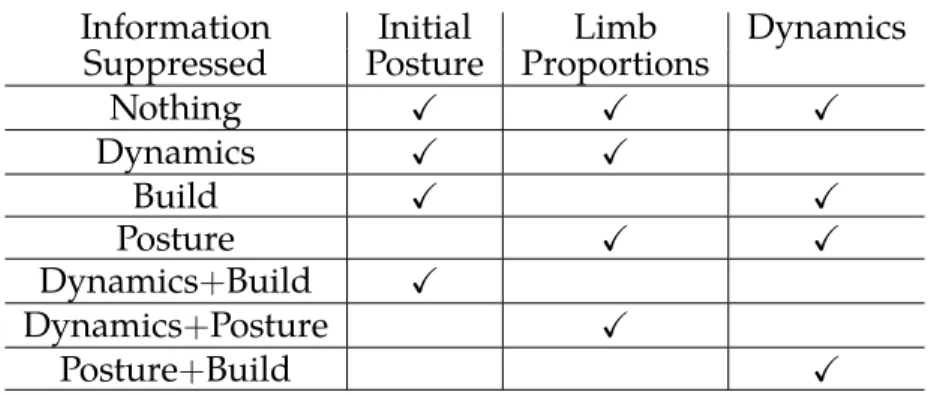
Suppressing Component Combinations
Above, we described how to remove each of the three types of information. To remove more than one type of information at a time, one only needs to combine the procedures proposed above for the information that is to be removed. Table 5.1 describes various combinations of information that are evaluated. The case where all components are suppressed is not evaluated as all gesture samples would be identical. Figure 5·4 shows a few samples of skeletons for gestures constructed using this methodology.