Knowledge Management Capability and
Organizational Performance: A Theoretical
Foundation
Satyendra Singh Yolande E Chan* James D McKeen* Queen’s School of BusinessQueen’s University Kingston, Canada
Submitted to OLKC 2006 Conference at the University of Warwick, Coventry on 20th - 22nd March 2006
* Both authors have contributed equally. They are listed in alphabetical order.
1. Introduction
Despite the fact that interest in the source, nature, and quality of knowledge has been expressed since the times of Socrates, Plato, and Aristotle (Nonaka and Takeuchi, 1995), the idea of knowledge management (KM) is very recent (Alvesson and Karreman, 2001; Davenport and Prusak, 1998). However in a very short time, managers and academics from a variety of disciplines have come to view KM as a legitimate business issue. Hull (2000) suggests that the phenomenon of KM is “not merely some passing fad, but is in the process of establishing itself as a new aspect of management and organization, and as a new form of expertise” (p.49). To some extent, KM has gained this legitimacy in academia as a result of Nonaka’s work, and in practice because of consulting companies who have sought to capitalize on the enormous potential of information technology (Easterby-Smith and Lyles, 2003).
The academic interest in KM has grown considerably, as evidenced by the proliferation of books, articles and special issues recently published on the topic (Argote, et al., 2003). The investment in KM has grown too as it is considered a competitive necessity (Brusoni, et al., 2001; McAdam and McCreedy, 2000), a strategic resource (Cabrera and Cabrera, 2002), and the source of competitive advantage (Chakravarthy, et al., 2003; Nonaka and Takeuchi, 1995). Thus, the development of KM has been rapid, but at the same time it has been equally chaotic (Easterby-Smith and Lyles, 2003). There is much debate in the literature on (a) what constitutes KM and (b) how does KM affect organizational performance.
There are a variety of KM definitions (Hlupic, et al., 2002), classification schemes, methods, models and approaches (Earl, 2001) in the literature. The majority of work that has appeared on KM has been in the IS literature. For example, nearly 70% of KM articles in 1998 and 50% of all the KM articles over the 1993 and 1999 period appeared in IS journals (Scarbrough and Swan, 2003). However, much of the literature that has appeared in IS (or elsewhere) is practice driven, rather than theory driven, with many articles appearing in practitioner-oriented journals (Scarbrough and Swan, 2003). Given the scarcity of studies on the underlying paradigms of KM, there is a need for more comprehensive studies that look at the theoretical underpinnings of what constitutes KM (Alvesson and Karreman, 2001; Hazlett, et al., 2005).
Further, based on the notion that knowledge is the key organizational asset, researchers have argued that KM leads to positive organizational performance. However, the impact has not been carefully demonstrated (Chakravarthy, et al., 2003; Foss and Mahnke, 2003). Numerous organizations have experimented with KM to improve their performance but have not fully succeeded (Leidner, 2000; Nidumolu, et al., 2001). Researchers have written about “knowledge management as a double edged sword” (Schultze and Leidner, 2002), the “deadliest sins of knowledge management” (Fahey and Prusak, 1998), the “vicious circle” of knowledge management (Garud and Kumaraswamy, 2005) and “knowledge traps” (Soo, et al., 2002). There is a challenge in the field to demonstrate how to manage organizational knowledge for performance (Argote, 2005).
In this paper, an attempt is made to build a theoretically rigorous and practically relevant framework for understanding KM and its impact on organizational performance. Hazlett et al. (2005) suggest that we need to build theories in KM. We engage this call by attempting to build a theory that explicates KM and its effect on performance. As a theory, it integrates and builds upon prior research to propose specific constructs, and relationship among those constructs. We believe our work will contribute to the development of deep and rich theories in the field of KM. The next section briefly reviews the existing literature on KM.
2. Knowledge Management: A Field Looking for a Theory
2.1 What constitutes KM
The literature has been unable to agree on a definition or the concepts behind KM (Bhatt, 2001; Hlupic, et al., 2002; Neef, 1999). For instance, Snowden (1998) defines KM as the identification, optimization and active management of intellectual assets, either in the form of explicit knowledge held in artifacts or tacit knowledge possessed by individuals or communities; Hedlund (1994) suggests that KM addresses the generation, representation, storage, transfer, transformation, application, embedding, and protecting of organizational knowledge; Brooking (1997) suggests that KM is the activity which is concerned with strategy and tactics to manage human centered assets; De Jarnet (1996) defines KM as knowledge creation, which is followed by knowledge interpretation, knowledge dissemination and use, and knowledge retention and
refinement; and Laudon and Laudon (1999) suggest that KM is the process of systematically and actively managing and leveraging the stores of knowledge in an organization. From these definitions, it appears that KM is regarded as the set of various processes to manage organizational knowledge.
There is another set of definitions where KM has been defined primarily in terms of its assumed relationship with an organizational objective. For instance, Bassi (1999) defines it as “the process of creating, capturing, and using knowledge to enhance organizational performance” (p. 423); Van der Spek and Spijkervet (1997) define it as “the explicit control and management of knowledge within an organization aimed at achieving the company’s objectives” (p. 43); Davenport and Prusak (1998) define KM as an attempt to do something useful with knowledge, to accomplish organizational objectives through the structuring of people, technology and knowledge content; von Krogh (1998) refers to KM as identifying and leveraging the collective knowledge in an organization to help the organization compete; Wiig (1998) argues that KM is the systematic, explicit and deliberate building, renewal and application of knowledge to maximize an enterprise’s knowledge-related effectiveness and returns on its knowledge assets and to renew them constantly; Scarbrough and Swan (1999) define KM as any process or practice of creating, acquiring, capturing, sharing and using knowledge, wherever it resides, to enhance learning and performance in organizations. From these definitions, KM is largely regarded as a set of various processes that manage organizational knowledge to attain performance1.
The literature offers many more definitions of KM. An exhaustive list of KM definitions is beyond the scope of this paper but these definitions highlight the lack of convergence and rigor in the field of KM. Hlupic et al. (2002) argues that this lack of rigor arises from the fact that the KM field is emerging, subjective and eclectic in nature. The vagueness and ambiguity in the KM field also arises from the word “knowledge” because it means different things to different people. There are two dominant and distinct approaches to knowledge – knowledge as an action and knowledge as a belief and a value (Hargadon and Fanelli, 2002). The approaches that focus on
1
Management of organizational knowledge is not always about the performance improvement. There are four discourses in KM – normative, critical, dialogical and interpretive (Schultze and Leidner, (2002)). Only normative discourse assumes that KM could be about organizational performance.
action deem that knowledge exists in the organization’s actions such as the physical and social artifacts of the organization including, for example, technologies, routines and databases (Cohen and Bacdayan, 1994; Huber, 1991; Levitt and March, 1988; Nelson and Winter, 1982). Here the phenomenon of interest is how organizations and their participants acquire, store, retrieve, process, distribute, learn, unlearn, encode and replicate existing knowledge. On the other hand, approaches that focus on beliefs and values deem that knowledge exists as the possibility for generating novel organizational artifacts (Kogut and Zander, 1992; Leonard-Barton, 1995; Nonaka and Takeuchi, 1995). Here the phenomena of interest involve how organizations and their participants generate, create, innovate, deviate, and in other ways produce new knowledge where it had not existed before.
Due to the dissonance of views, opinions, and ideas, various authors have proposed that it is necessary to identify a set of structures with which to make sense of the KM field. One of the most frequently cited structures is provided by Earl (2001). He proposed seven schools of knowledge management: systems, cartographic, engineering, commercial, organizational, spatial and strategic. These schools identify the types of KM undertaken by organizations. An alternative structure for understanding KM is provided by McAdam and McCreedy (1999). The authors propose three models of KM – intellectual capital models in which knowledge is seen as a tangible asset, knowledge category models in which knowledge is identified through categories, and social constructionist models in which knowledge is intrinsically linked to social and learning processes.
2.2 How does KM affect organizational performance
The relationship between KM and organizational performance is implicit in some KM definitions (as described earlier). The assumption that KM is needed for knowledge accumulation to result in improved organizational performance possibly arises from the fact that researchers have opposing views about the impact of knowledge on organizational performance (McEvily and Chakravarthy, 2002; Vera and Crossan, 2003). From the perspective of the knowledge based view, a positive link between knowledge and performance is stressed. It is expected that a particular category of knowledge, which is valuable, rare, inimitable and non-substitutable
(Barney, 1991), would lead to performance. On the other side of the discussion are authors who do not see a direct relationship between knowledge and performance. Organizations can always attain knowledge that may not lead to intelligent behavior. Complementary to this view is Leonard’s (1992) description of how core rigidities due to deeply embedded knowledge sets hinder innovation. Arthur’s (1989) law of increasing returns also supports the equivocal link between knowledge and performance. Although recent empirical studies have found support for the direct impact of knowledge on performance (e.g., Appleyard, 1996; Decarolis and Deeds, 1999; Yeoh and Roth, 1999), Vera and Crossan (2003) suggest that the conclusion from these studies is not that more knowledge leads to greater performance, but the knowledge that is relevant may have positive effects on organization performance. Since knowledge may have an equivocal impact on organizational performance, the management of organizational knowledge (or KM) is assumed to have a positive impact on organizational performance. A careful review of literature shows that only a few articles have attempted to investigate the link between KM and performance (Appendix A). As shown in the appendix, of these articles most are conceptual in nature and many lack strong theoretical foundations.
Despite this assumed link, it is still possible for KM to negatively affect organizational performance, according to Chakravarthy et al. (2003). The authors explain by suggesting that that KM has three important processes – knowledge accumulation (activities through which an organization gains new understanding), knowledge protection (activities that maintain the proprietary nature of an organization’s knowledge) and knowledge leverage (activities to use existing knowledge for commercial ends). While each process is important, there may be tensions among these three KM processes. For instance, aggressive attempts at leveraging knowledge can inhibit knowledge accumulation because the latter may typically not offer financial returns in the short run whereas the former often does. Similarly to encourage effective knowledge accumulation, organizations need to shake up existing patterns of behavior, values, and tacit mindsets. Since this typically requires articulation of tacit knowledge, it sacrifices some protection of that knowledge. Further, effective protection of knowledge often requires segregating or embedding knowledge within the organization, while leverage demands integration and articulation. Thus, if a delicate balance among KM processes is not maintained, KM can lead to negative organizational performance. This suggests that we need to
conceptualize the relationship between KM and organizational performance differently.
One way to make sense of KM and its relationship with organizational performance is to try to build an applied theory. An applied theory guides empirical research. Just as Wheeler (2002) explains, “Adaptive Structuration Theory (DeSanctis and Poole, 1994) is an applied version of the molar theory of Structuration (Giddens, 1979) or the Technology Acceptance Model (Davis, 1989) is an applied version of the Theory of Reasoned Action (Fishbein and Ajzen, 1975)” (p.129) that guides empirical research. Given the current ambiguous nature of the KM field, it very much needs an applied theory. Theory building is an essential part of research (Van de Ven, 1989; Huber, 1990; Wheeler 2002). The purpose of a theory is to impose order on unordered experiences and observations to increase understanding and prediction. Williamson (1999) asserts that “sooner or later, a would-be theory must be asked to show its hand…there is a need to sort the wheat from the chaff. Predictions, data, and empirical tests provide the requisite screen” (p.1093). Dubin (1978) argues that the purpose of theory is to generate testable hypotheses. Thus, in this paper, we attempt to articulate what constitutes KM and how it impacts organizational performance in ways that can be empirically tested.
3. Theory Foundation
Recent developments in the resource based view (RBV) suggest that capabilities are an important contributor to organizational performance (e.g., Bharadwaj, 2000; Teece, et al., 1997; Tippins and Sohi, 2003). Capabilities refer to an organization's ability to assemble, integrate, and deploy valued resources (Amit and Schoemaker, 1993). They are rooted in processes and business routines. Grant (1995) describes a hierarchy of organizational capabilities, where specialized capabilities are integrated into broader functional capabilities such as marketing, manufacturing, and IT capabilities. Functional capabilities in turn integrate to form cross-functional capabilities such as new product development capability, customer support capability, etc. Extending the notion of capability we propose a notion of “KM as capability”. We refer to KM capability as an organizational capability to manage the organization’s knowledge with efficacy (efficiently and effectively), and assert:
“KM capability enables an organization to improve its performance relative to its competitors.”
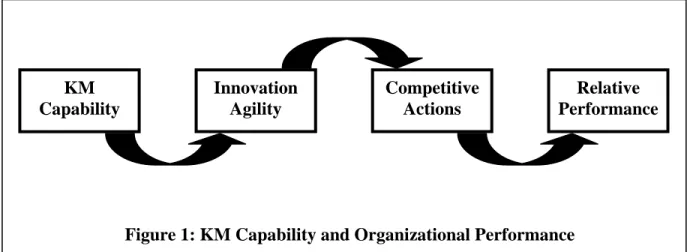
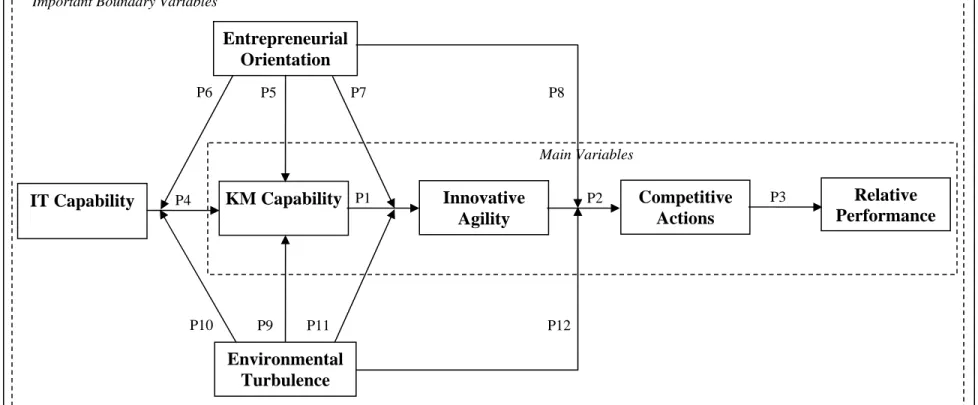
The link is not direct. An organization’s KM capability allows it to achieve innovation agility (i.e., to explore and exploit market opportunities). This agility further allows the organization to take competitive actions in its market, which in turn results in a better relative performance. See Figure 1. The following section elaborates on the key concepts of our theory and builds testable hypotheses.
Before we illustrate our theory it is vital that we bring clarity to what we mean by KM. In order to understand the concept, we turn our attention to evolutionary theory (Nelson and Winter, 1982). Evolutionary theories have been applied to understand dynamic and complex processes such as the emergence of new organizations and new forms of organizations, changes in organizations, and the life cycles of industries. Evolutionary approaches imply that the dynamic processes we observe have an element of change in them. The theory implies uncertainty, learning, a permanent race for competitive advantage, and the possibility of sub-optimal outcomes (Barron, 2003). Since KM is a dynamic and complex concept, evolutionary theory can provide a solid foundation. In addition, evolutionary theory accounts for managerial actions (see Barron, 2003; Volberda and Lewin, 2003). These authors suggest that managerial intentionality within the context of evolutionary theory is not passive but it is limited. Managers can learn from their past experiences and organizations may develop routines or mechanisms that help them take decisions. Thus when managers make decisions, they embody a certain wisdom about the
KM Capability Innovation Agility Competitive Actions Relative Performance
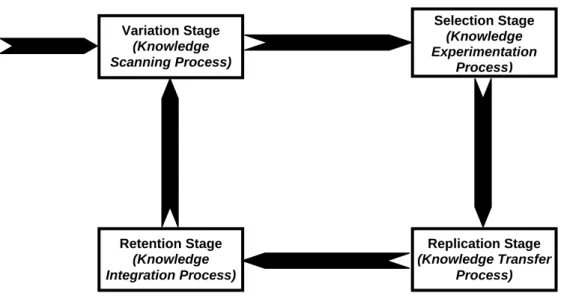
environment. The logic is aligned with how we perceive KM. KM is affected by managers’ intentionality but at the same time a few things about KM are beyond managers’ control (or else all organizations would be able to copy the best practices of KM). This allows us to use Zollo and Winter’s (2002) work on the evolution of knowledge that has been built by applying evolutionary theory. The authors suggest that there are four main stages in the evolution of knowledge within an organization – variation, selection, replication and retention (see Figure 2). The authors suggest that organizational knowledge evolves through a series of stages, chained in a recursive cycle.
At the variation stage, an organization uses knowledge scanning process to scan for new knowledge in its environment to assist with addressing new and old challenges. According to evolutionary theory, this process acts as a mechanism by which external knowledge is introduced into an organization. The scanning may happen due to external stimuli (i.e., competitors’ initiatives, normative changes, scientific discoveries, etc.) or internal stimuli (e.g., performance monitoring) or a combination of external and internal stimuli (Huber, 1991; Zollo and Winter, 2002).
The knowledge from the variation stage is in embryonic form. It is then subjected to an internal selection mechanism in which the new knowledge is exposed to experimentation to determine its potential for enhancing the existing knowledge or the opportunity to create new
Variation Stage (Knowledge Scanning Process) Replication Stage (Knowledge Transfer Process) Retention Stage (Knowledge Integration Process) Selection Stage (Knowledge Experimentation Process)
knowledge (Nonaka, 1994). The new knowledge is considered in relation to the prior knowledge that is shared among individuals, as well as in the context of established power structures and existing legitimization processes. The expected advantages from the new knowledge are probed through articulation, analysis and debate of the merits and risks connected to the knowledge. The process used to evaluate the knowledge is referred as a knowledge experimentation process.
The third stage of the cycle is about transferring the new knowledge to the relevant parties within the organization. The transfer requires the spatial replication of the knowledge to leverage the newly found knowledge in different places and times where it is needed. The application of the new knowledge in diverse contexts generates new information about the performance implications of the new knowledge. The process used to transfer the new knowledge is referred as a knowledge transfer process.
Following the replication stage, at the retention stage, the organization uses knowledge integration processes to embed the knowledge within organizational routines. The central theme during this phase is to integrate the new external knowledge with knowledge that already exists within the organization. Once retained, the knowledge becomes routine as it gets highly embedded in the behavior of the individuals.
All the processes from different stages – scanning, experimentation, transfer and integration – are collectively referred to as knowledge processes. As shown in the model (Figure 2), both the external and internal environments provide stimuli to scan for new knowledge.
Regardless of the method of production, it is generally accepted that organization knowledge is embedded in organization memory (OM) infrastructures that do not disappear as individuals come and go. Rather than belonging to individual members, organizational knowledge is a distinct attribute of the organization (Martin De Holan and Phillips, 2003). Levitt and March (1988), for example, claim that as organizations learn, their knowledge is codified into rules procedures, technologies, beliefs, and cultures that guide future behavior, and the details of the behavior depend significantly on the processes by which the memory is maintained and consulted. Nelson and Winter (1982) suggest that these rules that organizations create are the
crystallization of organizational knowledge.
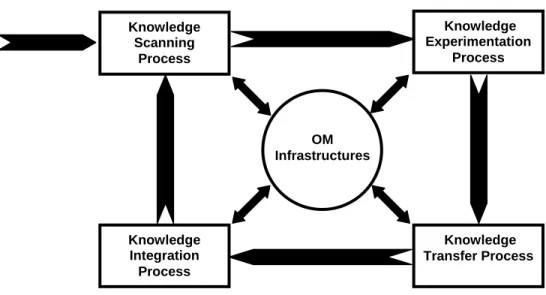
OM infrastructures act as the central organization system involved in the storage of the knowledge produced by processes of knowledge evolution. Thus, the evolution of organizational knowledge and OM infrastructures are intrinsically related, and OM infrastructures are essential for the successful evolution of knowledge within an organization (Figure 3). This conceptualization of OM infrastructures is based on Walsh and Ungson’s (1991) seminal work. They defined OM infrastructures as sources of stored information from an organization’s history that can be brought to bear on present decisions.
The model in Figure 3 has two-way arrows between OM infrastructures and each evolutionary stage. This is meant to suggest that what is learned at each stage is retained (at least in part) and also that what is done at each stage is informed by what has already been learned by the organization. It is this two-way interplay of OM infrastructures and evolving knowledge that enables the organization to learn effectively and to make progress.
This integrated model (Figure 3) of knowledge processes and OM infrastructures allows us to make an important observation. It can be argued that organizations must build an overall ability
Knowledge Scanning Process Knowledge Transfer Process Knowledge Integration Process Knowledge Experimentation Process
Figure 3: The relationship between evolution of knowledge and organizational memory
OM Infrastructures
to engage in managing organizational knowledge with efficacy through knowledge processes and OM infrastructures. Thus, we propose KM as a capability that is a higher-order aggregation of knowledge processes and OM infrastructures.
4. Knowledge Management Capability
The notion of “KM as capability” is consistent with how capability is perceived in the strategic management literature, where it is viewed in terms of processes and infrastructures that an organization uses to convert its inputs into desired outputs (Amit and Schoemaker, 1993; Dutta, et al., 2005). Below we explain processes and infrastructures associated with KM capability
4.1 Knowledge Process
From our knowledge evolution cycle (Figure 3), we identify the following four knowledge processes.
Knowledge Scanning Process
The external environments of organizations change. If the lack of fit between an organization and its environment becomes too great, the organization fails to survive or undergoes costly transformation. Thus, organizations must scan their external environment for new knowledge. Huber (1991) suggests that organizations can either scan a wide range of external environments or scan a narrow segment of the external environment. Of the two scanning behaviors, organizations usually tend to scan a narrow segment of their environment that is in the neighborhood of its current activities (Cyert and March, 1963). This makes radical change within an organization less likely. The literature on organization learning suggests the same regarding search for new knowledge (see Cyert and March, 1963; March and Simon, 1958). It suggests that boundedly rational decision makers rely on established organizational practices to drive the search for knowledge. Organizational theorists see learning as a process that involves trial, feedback, and evaluation. If too many parameters in the learning process are changed simultaneously, the ability of the firm to engage in meaningful learning is attenuated (Teece,
1988). Further, organizational routines that also drive organizational scanning behavior are relatively stable and greatly influenced by the experience and history of the firm (Baum, et al., 2000; Nelson and Winter, 1982). Organizations thus recognize and absorb external knowledge close to their existing knowledge base (Cohen and Levinthal, 1990). Consequently as organizations seek to expand their knowledge, their search processes get restricted to familiar and proximate areas of knowledge and geography (Almeida, et al., 2003).
Another reason for organizations to scan a narrow segment of the environment is that it restricts the breadth and therefore the cost of the scan process (Cyert and March, 1963). A proximate search also results in the acquisition of knowledge that can be more easily recognized and managed within the organization. However, local search restricts the possibilities for innovation through more distant knowledge. Levitt and March (1988) warn of competence traps and suggests that core capabilities associated with existing routines can become core rigidities as environments change. Given the dynamic nature of competition, firms must move beyond local scans to compete successfully over time. Leonard-Barton (1995) suggests that organizations must balance local scans with more distant scans. Thus, organizations must design processes that will allow them to scan the environment and to recognize potentially useful knowledge in both local and distant contexts. Almeida et al. (2003) argue that an organization’s scanning capability is an outcome of the interaction between the scale and the scope of its knowledge. Organizations typically focus on the scale of their knowledge that results in the possession of a large volume of proximate knowledge, which in turn limits the organization’s scanning process only to proximate areas. When the scope of knowledge is increased, an organization becomes more aware of distant knowledge. This not only enhances scanning processes of the organization but it also improves the breadth of its innovative activity. An emphasis on scale and scope of the scanning process assists organizations to recognize novel knowledge that subsequently can enhance the organization’s innovations.
Knowledge Experimentation Process
Arrow (1974) argued that the essence of organizational decisions involves two types of acts- terminal and evaluative. Terminal acts are decisions made using existing knowledge and evaluation acts are decisions made when experimenting with new knowledge. Both decision
types have implications for resource utilization. Terminal acts are based on knowledge that is already possessed and, thus, are less costly. However, such acts make organizations more rigid, rather than responsive to environmental changes. Thus, organizations must look toward the future and explicitly experiment with new knowledge (Fahey and Prusak, 1998). Experiments can include trying new approaches to problems, initiating pilot projects, doing things on a trial-and-error basis and allowing individuals to assume additional tasks and responsibilities. Pisano (1996) and Pisano (1994) suggest that usage of new knowledge requires “learning by doing” (which entails the resolution of unexpected problems that arise when new knowledge is put to use) or “learning before doing” (experimenting in a controlled setting before knowledge is actually put to use by the recipient) or both. In all three cases, experimentation is an important step.
Brown and Eisenhardt (1997) argue that experimenting “into the future” can include four tactics. First, organizations must be able to quickly experiment with the knowledge to see if it is useful. Second, the organizations should have a group of futurists, whose primary task is to think in the future. Third, organizations must be in a position to form partnerships with others to probe and anticipate the future, and finally, they should hold frequent meetings to ponder the future.
Knowledge Transfer Process
Once the external knowledge has been evaluated through experimentation, it must be transferred to the relevant parties within an organization. At this stage of knowledge evolution, it is possible that knowledge is either within the organization or outside the organization. This idea is consistent with the existence of knowledge markets within and outside an organization (Lin, et al., 2005). However, in either case the organizations must develop processes to transfer the new knowledge. To facilitate the transfer process, organizations must develop linkages to the source of knowledge that can act as conduits for knowledge transfer. There are three important mechanisms that create conduits to sources of knowledge (Almeida, et al., 2003). The mechanisms include the forming of alliances, mobility of people, and the appropriation of informal networks. Although Almeida et al. (2003) suggest these mechanisms within the context of the knowledge market outside the firm, the logic can as well be applied to the knowledge market inside the firm.
One of the main ideas in the literature on alliances is that they are useful mechanisms for transferring knowledge that exists outside the organization (Inkpen and Dinur, 1998). In-depth case studies provide us with rich illustrations of knowledge transfer between alliance or network partners demonstrating overall knowledge flows across networks (Doz, 1996). Although, the focus of alliances is inter-organizational collaboration, the idea of alliances is also applicable to intra-organizational associations (Salk and Simonin, 2003). In a multinational enterprise, for instance, foreign subsidiaries or research teams from different strategic business units collaborate with one another on specific projects. Best practices and global campaigns need to be shared within a network of affiliates. In this way, we argue that the knowledge transfer processes within the context of intra-organizational collaboration are not very different (see Makino and Inkpen, 2003). In fact, an alliance is viewed as a purposive linkage between independent units (Kale, et al., 2000), or as an independently initiated linkage that covers any intentional informal or formal collaboration involving exchange, sharing or co-development (Gulati, 1995). These units can be inside or outside an organizational boundary.
Knowledge is also transferred across organizations through the mobility of people. Several studies suggest that people are an important conduit of inter-firm knowledge transfer. For instance, in technology industries there are numerous descriptive studies of people carrying knowledge across firms (Hanson, 1982; Rogers and Larsen, 1984; Saxenian, 1990). The idea of inter-organization mobility is also applicable within the intra-organization context. Personnel transfers within organizations can be considered a process of organizational reflection and a means of mobilizing knowledge (Inkpen and Dinur, 1998). Transfers and rotation of personnel help members of an organization to understand the business from a multiplicity of perspectives, which in turn makes knowledge more fluid and easier to put into practice (Nonaka, 1994).
Finally the research also points out the importance of geographically clustered social networks in facilitating the informal diffusion of knowledge across organizations (Rogers and Larsen, 1984). There is a greater knowledge transfer between organizations in clusters due to the similarity in their knowledge bases and due to the extensive linkages that develop within a region. Though linkages between firms could develop across geographic distances, proximity enhances the knowledge transfer. Locational proximity reduces the cost and increases the frequency of
contacts which serve to build social relations between players in a network that is useful for diffusion of knowledge (Almeida, et al., 2003). Organizations can also encourage such informal networks within an organization for knowledge transfer, given that every organization is essentially a social network (Lincoln, 1982). Strengthening of the informal network facilitates knowledge transfer (Reagans and McEvily, 2003).
Knowledge Integration Process
The final stage in gainfully using the knowledge that has been determined to be useful and transferred is its integration with knowledge existing in parts of the organization for innovation (Cohen and Levinthal, 1990; Kogut and Zander, 1992; Leonard-Barton, 1995). It was Schumpeter (1934) who first pointed out that innovation takes place by “carrying out new combinations.” Henderson and Clark’s (1992) concept of architectural knowledge reinforces this idea, suggesting that a critical feature of a firm’s innovative ability may be its broader managerial capability to combine or link together knowledge within the firm. Thus, integration appears to be an important stage in the evolution of organizational knowledge since it results in value creation. The literature suggests that there are two mechanisms for knowledge integration – direction and routinization (Grant, 1996a; Hislop, 2003).
Direction refers to the principle means by which specific knowledge can be communicated at low cost between specialists and non-specialists. One way is to embody such knowledge in standard operating rules. Direction involves codifying tacit knowledge into explicit rules and instructions. But since a characteristic of tacit knowledge is that “we can know more than we can tell” (Polanyi, 1966), converting tacit knowledge into explicit information to form rules, directives, formulae, expert systems and the like inevitably involves substantial knowledge loss. In addition, sometimes the context in which knowledge is developed is also important. Routinization provides a mechanism for coordination which is not dependent upon the need for communication of knowledge in an explicit form. Routinization here refers to the development of a sequence of individual or organizational actions that require relatively little attention (Nelson and Winter, 1982). A fixed and simplified response pattern is created which permits the integration of specialized knowledge without the need for communicating the knowledge. This may involve closely coordinated working arrangements where each team member applies his or
her knowledge, but where the patterns of interaction appear automatic. This coordination relies heavily upon informal procedures in the form of commonly understood roles and interactions established through training and constant repetition, supported by a series of explicit and tacit signals.
4.2 Organizational Memory
In order to manage organizational knowledge effectively, it is necessary that organizations also manage their organizational memory infrastructure which is comprised of five retention mechanisms (Walsh and Ungson, 1991): culture which stores knowledge in language shared frameworks, symbols, and stories; structure which stores the organization’s expectations of various roles played within the organization; business logic which stores procedures and operational rules which include knowledge to guide the conversion of inputs (such as raw materials) into outputs (such as finished products); individuals who store knowledge in their memories, beliefs, values, and assumptions; and the physical environment which stores knowledge in the layout of the workplace. Below we look at all the infrastructure components in detail.
Culture
Through social and collaborative processes as well as individuals’ cognitive processes (e.g., reflection), knowledge is created, shared, amplified, enlarged, and justified in organizational settings (Nonaka, 1994). While a great deal of knowledge is created through formalized mechanisms (e.g., surveys, R&D, performance reviews), others suggest that unarticulated knowledge – consisting of expertise, ideas, and latent insights – is the very basis of innovation, and is not easily captured or codified (Leonard and Sensiper, 1998). It can be argued that KM is rather a socially constructed process that occurs over time largely though informal human networks (Brown and Duguid, 2000; Fahey and Prusak, 1998; Wenger and Snyder, 2000). Culture is the most significant input that shapes the informal human networks through shared values, beliefs, and work systems. Therefore, an organization’s culture should provide support and incentives as well as encourage knowledge-related activities by creating an environment for knowledge exchange and accessibility.
Walsh and Ungson (1991) also suggest that since knowledge is collectively retained, it is important that individuals proactively interact to seek and offer knowledge. Such interactions between individuals or groups are essential as it facilitates active interpretation of knowledge at every stage of knowledge evolution. This interpretation will be facilitated by the organizational culture because it provides uniformity in cognitive maps among individuals. Daft and Weick (1984) defined interpretation as the process through which information is given meaning, thus, organizational culture can create the context (through values, norms and practices) for individuals to share a common interpretation. Another important aspect of interaction is that of knowledge sharing. Organizational culture will influence what knowledge is viewed as a personal possession or as an organizational asset (Leidner, 1999) and will hence be shared. This view is supported by a wealth of KM literature that consistently argues that firms need to foster the right cultures in order to successfully leverage their knowledge resources (Kayworth and Leidner, 2003).
Some authors argue that formalization may actually stifle knowledge creation activities (Hansen, et al., 1999; Hargadon, 1998; von Krogh, 1998). Huber (1991) supports this idea noting that “units capable of learning may not have access to knowledge because of existing routines for message routing or organizational politics” (p.95). In this vein, Hargadon (1998) draws a distinction between the use of formalized versus cultural control as a means for fostering knowledge brokering activities. He argues against the formalized controls stating that cultural controls are a much more effective means for managing organizational knowledge particularly in non-routine situations that require initiative, flexibility, and innovation.
Kayworth and Leidner (2003) also make an interesting observation - by definition, culture consists of certain underlying values, norms, and practices that are manifested through various symbols, languages, ideologies, myths and rituals within organizational contexts. This characterization is consistent with prevailing definitions of organization knowledge as relevant, high value information that is dependent on the context that is linked to meaningful behavior, and is embodied in language, stories, concepts, rules, and tools. In essence we suggest that culture plays a very important role in KM, as also suggested by others (see Davenport and
Prusak, 1998; Davenport, et al., 1998; Gold, et al., 2001).
Structures
Structures are viewed as roles that are given to individuals that influence their behavior. The role explains behavior in respect to organizational expectations. The roles are guided by collectively recognized and publicly available rules, which represent formal and informal codifications of correct behavior.
Business Logic
Business logic refers to the logic that guides conversion of an input into an output. The logic could be standardized procedures for routine tasks (where there are known ways of solving a problem) or just a set of broad guidelines for the non-routine tasks (where experience, judgment, wisdom and intuition direct problem solving). In either case, the knowledge is retrieved for conversion processes.
Individuals
Individuals in organizations retain information based on their own direct experiences and observations. This information can be retained in their own memory stores or more subtly in their belief structures, cause maps, assumptions, values and articulated beliefs. Individuals store the organization’s memory in their own capacity to remember and articulate experience and in the cognitive orientations they employ to facilitate knowledge processing.
The role of individuals is emphasized in Nonaka’s (1994) model of knowledge conversion. In the model there are four conversion processes - socialization referring to the transmission of tacit knowledge between individuals; combination involving the transmission of explicit knowledge between individuals; articulation referring to the conversion of tacit knowledge to explicit knowledge between individuals; and finally, internalization which is represented by the conversion of explicit knowledge to tacit knowledge between individuals. However, all these processes depend on the willingness of individuals (Bock, et al., 2005), which is in turn shaped by personal belief structures (Szulanski, 1996).
Kelloway and Barling (2000) argue that use of knowledge in organizations is a discretionary behavior and individuals are likely to engage in using knowledge to the extent that they have the ability, opportunity and motivation to do so. Thus, organizations must train individuals and provide them with opportunities to engage in the management of organizational knowledge. These activities must be backed by an incentive system which is structured in such a way that workers are motivated and rewarded for the management of organizational knowledge
Physical Environment
Organization’s physical environment artifacts (such as, blueprints, assembly line layouts, products, equipment) embody knowledge, which can facilitate the management of organizational knowledge (Hargadon and Fanelli, 2002). This applies, for example, to knowledge that has clear cause and effect relationships, is codifiable, and is easily transferred through training. However knowledge which is ambiguous, incompletely codified, and complex requires the use of artifacts (Clark, 1996; Star and Griesemer, 1989). These artifacts convey contextual information about the knowledge being shared, helping to clarify the meaning underlying ambiguous knowledge. Physical artifacts also play a particularly important role in the reuse of knowledge for innovation (Majchrzak, et al., 2004). Organizational members take cues from these artifacts and invoke particular schema which in turn shape their interpretations and actions.
Imai et al. (1985) identify other artifacts such as “a special corner within the factory where workers could experiment,” “holding meetings in a large room with glass walls,” and the use of a system in which “all the team members are located in one large room” (p.354-358).
5. Innovation Agility
Innovation agility is the ability to explore and exploit (Sambamurthy, et al., 2003). Exploration is experimentation with new ideas, paradigms, technologies, strategies, and knowledge in pursuit of finding new opportunities that are superior to obsolete opportunities, whereas exploitation involves improving existing ideas, paradigms, technologies, strategies, and knowledge in pursuit of old certainties (March, 1991). Exploration is associated with complex searches, variation, risk taking, relaxed control, loose discipline, and flexibility. In contrast exploitation is associated with systematic reasoning, risk aversion, defining, refining and stability. In addition, the returns associated with exploration and exploitation are different. Exploration results in returns that are distant in time and highly variable, while the returns associated with exploitation are proximate in time and predictable. March (1991) thus concluded that “the
KM Capability Knowledge Processes Organizational Memory Infrastructures Figure 4: KM Capability Knowledge Scanning Knowledge Transfer Knowledge Experimentation Knowledge Integration Culture Structure Business Logic Individuals Physical Environment
distance in time and space between the locus of learning and locus for realization of returns is generally greater in case of exploration than in the case of exploitation” (p.85). Levinthal and March (1993) defined exploration as “the pursuit of knowledge, of things that might come to be known,” and exploitation as “the use and development of things already known” (p.105)
Levinthal and March (1993) assert that the long term survival of an organization depends on its ability to “engage in enough exploitation to ensure the organization’s current viability and engage in enough exploration to ensure its future viability” (p.105). Exploration at the expense of, or to the exclusion of, exploitation leads to “too many undeveloped ideas and too little distinctive competence” (p.105). Exploitation pursued to the extreme jeopardizes the organization’s survival by creating a competency trap. Thus, it is widely argued in the literature that a balance between exploration and exploitation is required (e.g., Cohen and Levinthal, 1990; Hendry, 1981; Levinthal, 1997). However, often in organizations exploitation tends to drive out exploration as organizations develop core capabilities. Core capabilities are path dependent (Cohen and Levinthal, 1989; Cohen and Levinthal, 1994; Collis, 1991; Mahoney, 1995) and as their exploitation brings success to the organization it reinforces the exploitation of capabilities further (McNamara and Baden-Fuller, 1999).
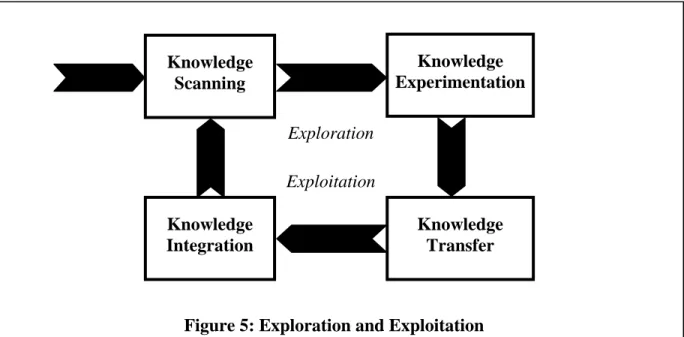
From an innovation perspective, knowledge provides the organization with the potential for novel action, and the process of constructing novel actions often entails finding new uses of new knowledge (exploration) or new uses of existing knowledge (exploitation) (Hargadon and Sutton, 1997; Kogut and Zander, 1992; Schumpeter, 1934). KM capability can enable organizations to balance exploration and exploitation. Zollo and Winter (2002) make an interesting observation from the knowledge evolution cycle. The cycle proceeds from an exploration phase to an exploitation phase and then feeds back into a new exploration phase Exploration activities are primarily carried out through knowledge scanning and knowledge evaluation processes through which the necessary and appropriate knowledge is selected. Exploitation activities, by contrast, rely more on knowledge transfer processes to replicate knowledge in diverse contexts, and knowledge integration processes to absorb transferred knowledge into the existing knowledge for the execution of a particular task. Zollo and Winter (2002) suggest that this recursive relationship indicates that organizations can handle both exploration and exploitation simultaneously in a
balanced fashion (Figure 5). In more formal terms, we propose,
Proposition 1: KM Capability has a positive influence on innovation agility.
6. Competitive Actions and Performance
Competitive action is defined as a set of well-defined, ordered, uninterrupted sequence of repeatable competitive activities (Ferrier, 2001). Competitive actions are externally directed, specific, and observable competitive moves initiated by a firm to enhance its competitive position (Ferrier, 2001; Ferrier, et al., 1999; Sambamurthy, et al., 2003; Smith, et al., 1992; Young, et al., 1996). These actions can be categorized into pricing actions, marketing actions, new product actions, capacity actions, service actions and signaling actions (Ferrier, 2001). Organizations with innovative agility will be capable of taking more of these actions because they not only can explore new market opportunities but they can also exploit existing market opportunities. This agility will allow organizations to take competitive actions across multiple dimensions – action volume, action duration, action complexity and action unpredictability (Ferrier, 2001). Action volume refers to the total number of competitive actions; action duration refers to the time elapsed from the beginning to the end of a sequence of action events; action complexity refers to the extent to which a sequence of actions is composed of actions of many
Knowledge Scanning Knowledge Transfer Knowledge Integration Knowledge Experimentation
Figure 5: Exploration and Exploitation
Exploration
different categories; and action unpredictability refers to the extent to which a firm’s order of competitive actions is dissimilar from one action period to the next. Further, since the organizations that explore new opportunities will also navigate the competitive landscape, they know about possible competitive actions as well as the particular combination and order of such actions that could be undertaken (O'Driscoll and Rizzo, 1985). Thus, in more formal terms, we propose,
Proposition 2: Innovation agility has a positive influence on an organization’s competitive actions.
Organizations that are aggressive in taking competitive actions will also face competitive responses from their rivals (Chen and Hambrick, 1995). If the rivals are confronted with a less aggressive, simple, or familiar competitive challenge, rivals quickly learn how to respond to the action using rigidly structured yet highly efficient and simple problem solving mechanisms and decision making processes (Ferrier, 2001). However, higher levels of focal firm competitive aggressiveness, complexity, and unpredictability will preemptively beat rivals. Since it will likely require rivals to engage in greater levels of decision comprehensiveness and complexity in an effort to conceive of and carry out an appropriate competitive response. The likely consequence is a slower competitive response (D'Aveni, 1994). Much of the research suggests that firms that carry out more actions and respond to competitive challenges more quickly experience better performance (Ferrier, 2001; Ferrier, et al., 1999; Lee, et al., 2000; Miller and Chen, 1996; Young, et al., 1996). Thus, in more formal terms, we propose,
Proposition 3: Competitive actions will improve an organization’s relative performance.
7. Boundary Conditions and Assumptions
Dubin (1978) advocates that theory builders facilitate understanding of a theory by sharing the logic employed in its construction. The logic of our theory is built upon the assumption that environmental turbulence, organization’s aggressiveness and IT capability have important impacts on KM capability and other proposed relationships described in our theory.
Organizations are interpretation systems, where interpretation is a process of translating environmental events to develop models for understanding and bringing out meaning (Daft and Weick, 1984). Based on this meaning, organizations are subsequently able to take action. The two variables that Daft and Weick (1984) propose affect organizational interpretation are organizational intrusiveness and environmental analyzability. KM capability can be seen as a capability that encompasses interpretation and action taking. Organizations with KM capability not only are able to interpret data through knowledge scanning and knowledge evaluation but are also able to take action through knowledge transfer and knowledge integration. Thus, based on the Daft and Weick (1984) seminal work, we believe that organizational intrusiveness and environmental analyzability are important boundary variables that will affect KM capability and other important relationships described in our theory.
Organizational intrusiveness refers to “the extent to which organizations actively intrude into the environment” (Daft and Weick, 1984, p.288). The authors suggest that some organizations actively search the environment. They allocate resources for search activities, they test, change or manipulate the environment and its rules, and they perform trials in order to learn what an error is and to discover what is feasible. In the literature, the idea of organizational intrusiveness is captured by entrepreneurial orientation. Entrepreneurial orientation reflects how a firm operates rather than what it does (Lumpkin and Dess, 1996). An organization with entrepreneurial orientation engages in product market innovation, undertakes somewhat risky ventures, and is the first to come up with proactive innovations (Miller, 1983).
Environmental analyzability refers to the extent to which the environment is “subjective, difficult to penetrate, or changing” (Daft and Weick, 1984, p.287). In such environments, systematic data collection and analysis that apply to stable environments are not possible (Daft and Weick, 1984). In the current literature, the idea of environmental analyzability is captured by environmental turbulence. Turbulent environments have been described as having high levels of change that creates uncertainty and unpredictability (Bourgeois and Eisenhardt, 1988; Dess and Beard, 1984), dynamic and volatile conditions with sharp discontinuities in demand and growth rates (Glazer and Weiss, 1993), temporary competitive advantages that continually are created or eroded (Chakravarthy, 1997), and low barriers to entry/exit that continuously change the
competitive structure of the industry (Chakravarthy, 1997). Many characteristics have been used to describe these types of environments – unfamiliar (Souder and Song, 1998), hostile (Covin and Slevin, 1989; Khandwalla, 1977; Miller, 1987), heterogeneous (Khandwalla, 1977; Miller, 1987), uncertain (Khandwalla, 1977; Thompson, 1967), complex (Duncan, 1972; Emery and Trist, 1965), dynamic (Dess and Beard, 1984; Duncan, 1972; Emery and Trist, 1965; Miller, 1987), and volatile (Bourgeois, 1985).
One other variable that has a significant effect on KM is information technology; thus an associated variable referred as IT capability is also included in our boundary conditions.
7.1 Role of IT capability
IT capability is the ability to acquire, deploy, and leverage IT functionality in combination or co-present with other resources to shape and support business processes in value-adding ways (Bharadwaj, 2000; Sambamurthy, et al., 2003). IT capability has often been defined to include the level of IT investments, IT infrastructure, IT human capital, and the nature of IS/business partnerships (Feeny and Wilcocks, 1998; Henderson, 1990; Ross, et al., 1996; Weill and Broadbent, 1998). Since there is no single accepted definition of IT capability, we accept the definition by Tippins and Sohi (2003) who state that IT capability is the “extent to which an organization is knowledgeable about and effectively utilizes IT to manage information within the organization” (p.748). Included in this definition are IT objects, IT knowledge, and IT operations. IT objects refer to software, hardware and IT personnel; IT knowledge refers to information combined with experience, context, interpretation, and reflection; and IT processes refer to activities or steps that are undertaken in order to achieve a particular objective, e.g., a finished product. The authors further suggest that IT objects, IT knowledge and IT operations are all independent of each other but all are required to be present in order to achieve IT capability. For example, while many organizations possess large stores of IT objects, these organizations may not achieve IT capability because they lack the knowledge necessary to utilize the objects effectively.
impact on organizational learning (Tippins and Sohi, 2003), firm performance (Bharadwaj, 2000; Santhanam and Hartono, 2003) and dynamic capabilities (Pavlou and El Sawy, 2005). Extending these research findings, we consider IT capability as a critical antecedent for KM capability (Tanriverdi, 2005). It can enable KM capability in several ways.
As discussed before, knowledge is variously defined in literature and it has different meanings for different people. In their literature review of KM systems, Alavi and Leidner (2001) show that even if different perspectives on knowledge (and consequently on KM) are held, IT still has a significant role to play in various knowledge processes such as knowledge creation, storage/retrieval, transfer and application. As an example, consider the following illustration. Knowledge originates within individuals or social systems (groups of individuals) (Alavi, 2000). At the individual level, knowledge is created through cognitive processes such as reflection and learning, and social systems generate knowledge through collaborative interactions and joint problem solving. IT can enable this process through its support of the individuals’ learning processes as well as support of collaborative interactions among individuals (Alavi and Tiwana, 2003). A knowledge management technology such as collaboration support systems is a good example of IT that enables knowledge creation. Collaboration support systems refer to integrated information and communication technologies designed to facilitate interactions and connectivity among individuals in support of organizational collaboration during task performance (Bhatt, et al., 2005). New knowledge is created through collaboration – by combining and amplifying the individual group members’ knowledge. This joint creation of knowledge is usually accomplished through the group members’ exposure to each other’s thoughts, opinions, and beliefs, while also obtaining and providing feedback from others for clarification and comprehension. Collaboration support systems aim at improving group collaborative interactions by providing techniques for structuring task interactions and systematically directing the pattern, timing, content, and recall of group discussions. Salazar et al. (2003) illustrate that IT-enabled virtual networks are permitting even small pharmaceutical and biotechnology organizations to enhance their knowledge processes. Similarly, communication support systems enable the transfer of knowledge among individuals, where knowledge transfer involves the transmission of knowledge from the initial location to where it is needed and applied (Alavi and Tiwana, 2003).
IT can also enable knowledge application (Alavi and Tiwana, 2003). Knowledge application is about the use of knowledge for decision making and problem solving by individuals and groups in organizations. Knowledge in and of itself does not produce organizational value but its application does. However, application of new knowledge by individuals is a complex task. Work in the area of individual cognition and knowledge structures has demonstrated that, in most cases, individuals in organizational settings enact cognitive processes (decision making and problem solving) with little attention and by invoking only pre-existing knowledge and cognitive routines (Gioia and Pool, 1984). While this tendency leads to a reduction in cognitive loads and is therefore an effective strategy for dealing with cognitive limitations, it creates a barrier to the search for and application of new knowledge in organizations. IT tools such as expert systems and decision support systems have been shown to play important roles in reducing individuals’ cognitive limits, thus improving the knowledge application (Alavi and Tiwana, 2003).
In the study of multi-business organizations, Tanriverdi (2005) showed that IT-based coordination mechanisms can connect business units to each other, open up opportunities for collaboration, and increase the organization’s knowledge resources. IT enables business units to learn about knowledge sharing opportunities with each other and exploit knowledge. Tanriverdi also argues that in the absence of such a mechanism, some business units may remain isolated, making it difficult for other business units to reach them and exchange knowledge with them.
Tippins and Sohi (2003) demonstrate that IT capability also enhances organizational memory. As organizations create knowledge at each stage, both declarative and procedural “memory bins” accumulate valuable information. IT provides the necessary mechanism for storage of this information. In order to be useful, however, information must be accessible to firm members and must be in a form that will enable each member to interpret it in a similar manner, thereby becoming a part of the whole firm’s knowledge base. IT provides an ideal mechanism for connecting widely dispersed individuals, who are also considered part of organizational memory.
Thus, consistent with these authors and others (e.g., Davenport and Prusak, 1998; Moffett, et al., 2004; Ramesh and Tiwana, 1999; Sher and Lee, 2004; Zack, 1999), we contend that KM
capability can be enhanced and supported through IT capability. Thus, in more formal terms, we propose,
Proposition 4: IT capability positively influences KM capability.
7.2 Role of Entrepreneurial Orientation
Entrepreneurial orientation is defined as an organization’s propensity to innovate to rejuvenate market offerings, take risks to try out new and uncertain products, services, and markets, and be more proactive than competitors toward new marketplace opportunities (Wiklund and Shepherd, 2005). The idea is distinct from having the ability or capacity to take risks, innovate and proceed proactively. As Penrose (1959) proposed, the capacity to realize certain goals is distinct from the willingness to pursue those particular goals. Researchers have agreed that entrepreneurial orientation is a combination of three dimensions – innovativeness, proactiveness and risk taking (Wiklund and Shepherd, 2003). Innovativeness reflects a tendency to support new ideas, novelty, experimentation, and creative processes, thereby departing from established practices and technologies. Proactiveness refers to a posture of anticipating and acting on future wants and needs in the marketplace. Risk-taking is associated with a willingness to commit large amounts of resources to projects where the cost of failure may be high. It largely reflects the organization’s willingness to break away from the tried-and-true and venture into the unknown. From this perspective it appears that entrepreneurial orientation will have a positive influence on KM capability. Proactiveness will make organizations use their knowledge scanning processes to understand future needs of their environment. Risk-taking propensity will encourage organizations to experiment with new knowledge. Innovativeness will make organizations explore and exploit opportunities. In more formal terms, we propose,
Proposition 5: Entrepreneurial orientation positively influences KM capability.
Entrepreneurial orientation will facilitate the conversion of IT capability into KM capability. Although IT capability is an important prerequisite for building KM capability, innovativeness with IT capability (objects, processes, knowledge), particularly with a proliferation of IT and
continuous emergence, is very important. At the same time, innovativeness and risk-taking will be required to recognize the complementarities among IT capability, knowledge processes and organizational memory infrastructures. Therefore, we propose that entrepreneurial orientation will facilitate the leveraging of IT capability into KM capability. In more formal terms, we propose,
Proposition 6: Entrepreneurial orientation positively moderates the relationship between IT capability and KM capability.
An organization endowed with KM capability will explore and exploit even more if it has an entrepreneurial orientation. The organization will be more willing to capitalize on its ability by engaging in exploration and exploitation. Organizations with considerable entrepreneurial orientation know where to look for opportunities, can more accurately assess the value of potential opportunities, and thus explore and exploit more. However, if the organization is not willing to grasp and enthusiastically pursue these opportunities, the KM capability is likely to be underutilized. Thus, in more formal terms, we propose,
Proposition 7: Entrepreneurial orientation positively moderates the relationship between KM capability and innovation agility.
Organizations with entrepreneurial orientation proactively anticipate and act on future needs in order to create first mover advantages as this is the best strategy for capitalizing on a market opportunity (Lumpkin and Dess, 1996). By exploiting the market place, the first mover can capture unusually high profits and get recognition. In addition, such organizations also have a tendency to be competitively aggressive. The innovativeness of these organizations will make them creatively destructive as they will think of new ways of doing things (Schumpeter, 1934). They will not rely on head-to-head competition with competitors. Thus, organizations with high levels of entrepreneurial orientation will use their innovation agility to launch more competitive actions in the market. In more formal terms, we propose,
innovation agility and competitive actions.
7.3 Role of Environmental Turbulence
Environmental turbulence describes the general condition of uncertainty and unpredictability due to high levels of knowledge turnover in markets and/or technologies (Glazer, 1991; Mendelson and Pillia, 1998). The extent of market and technological uncertainty within an environment reflects the amount of uncertainty faced by organizations as they try to understand and make sense of it in order to respond to the environmental conditions. Since the knowledge requirements in the turbulent environment are continuously changing, higher KM capability will be much more needed as these organizations will require efficient knowledge processes and organizational memory to monitor and react to opportunities. In contrast, the organizations in stable environments will find lesser need for efficient knowledge processes and organizational memory. The cost of building and maintaining efficient KM capability may outweigh the benefits since KM capability is resource intensive. Thus, in more formal terms, we propose,
Proposition 9: Environmental turbulence positively influences KM capability.
In turbulent environments, a lot of technical and market information emerges very rapidly which needs to be efficiently and effectively managed (Grant, 1996b). In addition, in such environments, organizations also need more information to make decisions because of higher uncertainty (Eisenhardt, 1989; Haleblian and Finkelstein, 1993). Thus, the role of IT to manage information in such environments will be more pronounced. There will be more emphasis on IT to support rapid information flows (Mendelson and Pillia, 1998) and experimentation with the information (Sambamurthy, et al., 2003). Thus, in more formal terms, we propose,
Proposition 10: Environmental turbulence positively moderates the relationship between IT capability and KM capability.
Turbulent environments reward flexibility since success in such environments involves expecting the unexpected and competing in uncertain conditions (Volberda, 1996). Environmental turbulence increases the advantages of KM capability because organizations in
such environments need to be able to quickly explore and exploit opportunities since the window of opportunity often will be very small. Organizations will maximize exploration and exploitation of opportunities through whatever level of KM capability they possess. In contrast, in stable environments where market and technical demands are fairly stable, there may not be many opportunities for exploration. Thus, information agility may not be rewarded. In more formal terms, we propose,
Proposition 11: Environmental turbulence positively moderates the relationship between KM capability and innovation agility.
A turbulent environment has numerous emerging market needs that can be taken advantage of (Miller, 1987), thus the market will be inundated with competitive actions from various organizations. Under such conditions, an organization with higher innovative agility is expected to be launching more competitive actions because of its ability to explore and exploit more market opportunities. In more formal terms, we propose,
Proposition 12: Environmental turbulence positively moderates the relationship between innovation agility and competitive actions.
The research model derived from this KM theory is shown in Figure 6.
7.4 Assumptions
The predictions and explanations of our theory are proposed for profit-oriented firms, particularly large firms. Just because of the geographic dispersion, size and complexity, larger organizations have a greater need to manage their knowledge. Their growth and expansion largely depend on how good they are in exploring and exploiting market opportunities. KM is also important in smaller organizations but such organizations have simple structures and often compete in niche market opportunities through knowledge exploitation.
innovativeness within organizations. Thus the emphasis of our theory has been on being able to explore and exploit market opportunities.
IT Capability KM Capability Innovative Agility Competitive Actions Relative Performance Entrepreneurial Orientation Environmental Turbulence P10 P1 P2 P3 P5 P4 P9 P11 Main Variables Important Boundary Variables
Figure 6: The Research Model Derived from a KM Theory of Organizational Performance
P6 P7 P8
8. Conclusion
Our intent is that our research will help to bring conceptual clarity to KM and improve our understanding of the connections between KM and organizational performance. There are a few significant implications of our work. First, this inquiry into KM suggests that future research in this area should pay equal attention to knowledge processes and organizational memory infrastructures. Often organizations will build knowledge processes but will not invest in the infrastructure where the knowledge resides and which facilitates the knowledge processes, or vice versa.
Second, the theory is based on how organizations learn over time through knowledge evolution. Thus an identification of knowledge processes in the knowledge evolution cycle will enable researchers to offer prescriptions to managers that can improve organizations’ overall learning capabilities. Better management of learning is an important concern of most organizations.
Third, our theory shows how evolutionary theory and managerial intentionality can be combined together. Most of the research that has been done on knowledge management has used the resource based view. However, in this study we use a different theoretical foundation, which helps us bring further clarity to what KM is or should be. Our focus has been more on learning.
Fourth, our article provides insights into the literature on knowledge management and innovation. We believe our theory “opens up the box” by positioning KM within the context of innovations.
Fifth, our model also highlights the rich and enabling role of IT capability in positively enforcing KM capability. Initially, it was thought that IT capability was directly related to organizational performance (e.g., Bharadwaj, 2000; Santhanam and Hartono, 2003). However, recent studies have started to open up the link between IT capability and organizational performance. Pavlou and El Sawy (2005) show that IT capability affects dynamic capabilities