O’Connor, Peter (2011)
Character in the workplace: self directedness mediates harm avoidance in the prediction of job performance.
In Jimmieson, N (Ed.) 9th Industrial and Organisational Psychology Con-ference Proceedings.
Australian Psychological Society, Australia, pp. 1-20.
This file was downloaded from: https://eprints.qut.edu.au/59011/ c
Copyright 2011 please consult the author
This work is covered by copyright. Unless the document is being made available under a Creative Commons Licence, you must assume that re-use is limited to personal use and that permission from the copyright owner must be obtained for all other uses. If the docu-ment is available under a Creative Commons License (or other specified license) then refer to the Licence for details of permitted re-use. It is a condition of access that users recog-nise and abide by the legal requirements associated with these rights. If you believe that this work infringes copyright please provide details by email to [email protected]
Notice:Please note that this document may not be the Version of Record (i.e. published version) of the work. Author manuscript versions (as Sub-mitted for peer review or as Accepted for publication after peer review) can be identified by an absence of publisher branding and/or typeset appear-ance. If there is any doubt, please refer to the published source.
Character in the workplace: Self directedness mediates harm avoidance in the prediction of job performance
O’CONNOR, P. (Queensland University of Technology) [email protected]
The purpose of this study was to test a model of the relationship between temperament, character and job performance, in order to better understand the cause of stable individual differences in job performance. Personality was conceptualized in terms of Cloninger,
Svrakic and Przybeck’s (1993) theoretical framework of personality. It was expected that Self Directedness (character) would mediate Harm Avoidance and Persistence (temperament) in the prediction of job performance. In order to test the hypotheses, a sample of 94
employee/supervisor pairs was recruited from several organizations across Australia. Participants completed a number of questionnaires online, regarding their personality traits (completed by employees) and Job Performance (completed by Supervisors). Consistent with the hypothesis, Self Directedness was found to be a moderate, direct predictor of job
performance. Also consistent with the hypothesis, Self Directedness mediated Harm Avoidance in the prediction of job performance. Results show that character (Self Directedness) is important in the prediction of job performance, and also suggests that fearful, avoidant individuals are less likely to perform well in the workplace, based on their low level of character development.
Character in the workplace: Self Directedness mediates Harm Avoidance in the prediction of job performance
The idea that personality traits influence overall job performance has been the subject of much inquiry in organizational psychology. Indeed the relationship makes logical sense – individuals whose personalities (in terms of trait profiles) are consistent with job
requirements, should perform better than individuals whose personalities are at odds with such requirements. Early research however, was not supportive of the trait-performance relationship. Such research culminated in two influential qualitative and quantitative reviews in the area (Guion & Gottier, 1965; Schmitt, Gooding, Noe, & Kirsch, 1984), which came to the same conclusions: personality does not adequately predict Job Performance, and therefore should not be used in personnel selection.
Nevertheless, researchers persisted exploring the relationship between traits and job performance, often criticizing early research for poorly conceptualizing personality traits. The most influential meta-analysis on personality and job performance was conducted by Barrick and Mount (1991). Their argument is best summarized in their opening paragraph
“Over the past 25 years, a number of researchers have investigated the validity of personality measures for personnel selection purposes. The overall conclusion from these studies is that the validity of personality as a predictor of job performance is quite low... However, at the time these studies were conducted, no well-accepted taxonomy existed for classifying personality traits. Consequently, it was not possible to determine whether there were consistent, meaningful relationships between particular personality constructs and performance criteria in different occupations” (pp. 1-2).
Barrick and Mount (1991) therefore conducted a large meta-analysis on this topic, and demonstrated that personality, when organised according to the Big Five taxonomy (Digman, 1990) was a valid and reliable predictor of Job Performance. Specifically, they demonstrated moderate estimated true score correlations between the five factors of personality and job performance over several occupational groups. They found support for their hypothesis that conscientiousness is an important predictor of job performance over multiple criteria (the true score correlation, ‘rho’, ranged from 0.20 to 0.23), but only weak support for their hypothesis that Emotional Stability is an important overall predictor of Job Performance.
Barrick and Mount’s (1991) results have been largely replicated by Hurtz and Donovan (2001), who conducted a similar meta-analysis a decade later, using a number of methodological and statistical refinements. One difference between the two meta-analyses was the purported importance of Emotional Stability; in contrast to Barrick and Mount (1991), Hurtz and Donovan reported a much more robust effect, stating “Emotional Stability showed a rather stable influence on performance throughout nearly all of our analyses. It appears that being calm, secure, well-adjusted, and low in anxiety has a small but consistent impact on job performance” (p. 875). Overall however, the message from the two meta-analyses is consistent: personality does have implications for Job Performance, particularly when organised according to a taxonomy.
Therefore we know that personality matters, and as Barrick and Mount (2005) recommended, it is now time to move on to ‘more important matters’. But what are these ‘more important matters’? Barrick and Mount have suggested that researchers place a greater emphasis on understanding the role of Conscientiousness in job performance; indeed we know Conscientiousness is an important predictor of performance, but we do not yet fully understand its boundaries and determinants. They also suggest researchers more explicitely consider the role of motivational processes in the relationship between personality and job
performance. Similarly, Hurtz and Donovan (2001) suggest that research specify intervening variables between personality and Job Performance. It is argued in this paper that such recommendations can be summarised by the need to more thoroughly consider personality theory when focussing on the personality basis of job performance. In particular, it is argued that more emphasis needs to be placed on understanding the mechanisms which underlie the relationships between personality and performance. Such research will increase our
understanding of job performance, and have implications for the management of job performance.
In this paper, a model of the relationship between temperament, character and Job Performance is tested. The model attempts to address the ‘more important matters’ as outlined above in three ways. First, model strongly incorporates personality theory, in that it is guided by Cloninger, Svrakic and Przybeck’s (1993) model of temperament and character. Second, the model considers motivational processes, by linking the motivational determinants of personality with character. And third, the model specifies an intervening variable between traits and performance. Specifically, it is suggested that ‘character’, or that part of our personality related to social and ethical maturity, acts as an intervening variable between stable, biologically based personality (temperament) and Job Performance. In essence, it is argued that temperament influences the level of character development, such that
temperament works through character in predicting Job Performance. In the next section Cloninger et al.’s theory is described in more detail. Following this, specific hypotheses are developed based on Cloninger et al.’s theory and prior research on personality and job performance.
Cloninger et al., (1993) proposed a highly influential1, theory-driven model of personality which argues that personality is comprised of temperament and character.
Cloninger et al., argued that temperament could be reduced to variation along four continuous dimensions, and that these dimensions reflect independent, biologically based neurological systems. Cloninger termed these dimensions Novelty Seeking (NS), Harm Avoidance (HA), Reward Dependence (RD) and Persistence (P). These dimensions of temperament were said to be stable, heritable and genetically-based. Cloninger et al., (1993) focussed on the role of the neuromodulatory system in their model, in particular the role of Dopamine in NS, Serotonin in HA and Noradrenalin in RD. At the trait level NS was characterized by
impulsive, reward-seeking behavior, HA was characterized by fearful, avoidant behavior and RD was characterized by the development of warm social relationships (versus social
insensitivity). P was defined as “perseverance, despite frustration and fatigue” (Cloninger et al, 1993, p. 978)
In contrast to dimensions of temperament which are biologically based, individual differences in character theoretically reflect perceptual biases in conscious information processing based on experientially learnt cognitions (i.e. schemas). According to Cloninger (1998), Character matures across the lifespan and, since it is dependent on insight learning and reflection, “refers to what we make of ourselves intentionally” (p. 3). Importantly Character, as opposed to temperament, is thought to influence one’s overall level of
functionality. For example, Cloninger (1998) points out that “the adventurous temperament (i.e., low Harm Avoidance, high Novelty Seeking, and low Reward Dependence) may lead to either Antisocial Personality Disorder (when character is immature) or imaginative
exploration and objective independence in scientific research (when character is mature)”.
1 The model is highly influential; despite being first proposed in 1993, it had over 200 citations in 2010. Despite this, it has not been applied to organisational behaviour.
Thus character is regarded as a significant component of personality related to an individual’s overall level of success at adapting to society.
The first dimension of character, Self Directedness (SD) theoretically reflects perceptual biases related to self-cognitions, and thus mature SD is characterized by
responsible, purposeful and goal directed behavior. The second dimension, Cooperativeness (C) reflects perceptual biases related to cognitions/schemas about ‘others’, and thus mature C is characterized by empathetic, helpful and team oriented behavior. Finally, Self
Transcendence (ST) reflects perceptual biases based on cognitions/schemas about nature in general, and is thus characterized by transpersonal and spiritual behavior. Research is consistent with Cloninger et al.’s (1993) claim that the procedural and declarative memory systems are functionally distinct (Parkin, Reid, & Russo, 1990) and anatomically separated (Phillips, Malamut, Bachevalier, & Mishkin, 1988; Bachevalier, 1990).
In this study, two components of temperament (Harm Avoidance and Persistence) and one component of character (Self Directedness) are considered in the prediction of Job
Performance. These dimensions were chosen as they have conceptual overlap with Big Five dimensions that have consistently been shown to predict Job Performance (Neuroticism, Agreeableness & Conscientiousness respectively, Barrick & Mount, 1991; Hurtz & Donovan, 2001), and have been shown to predict performance in other domains (e.g. academic
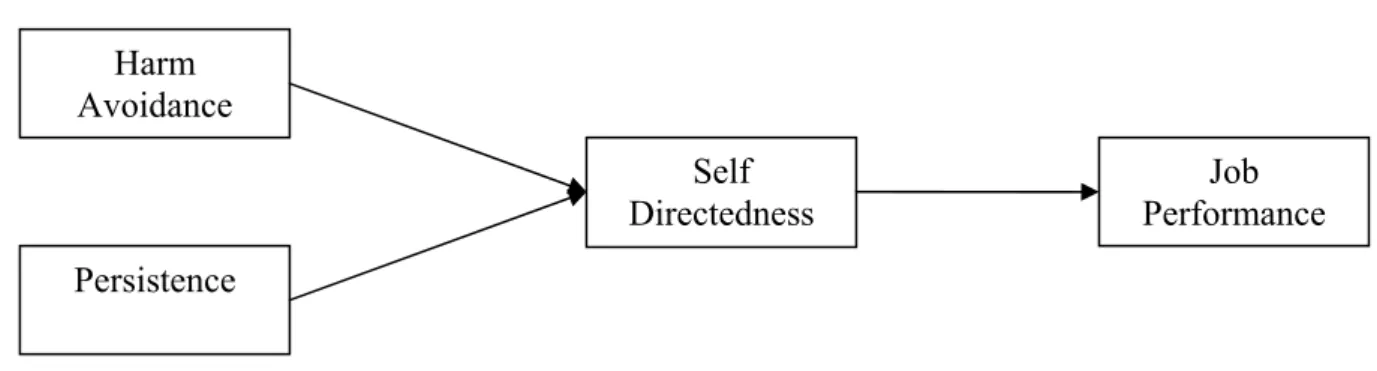
performance, Ham et al., 2006). As noted above, Cloninger et al.’s model was used because it focuses on the cause of personality in terms of motivational systems outlined previously, and therefore has implications for our understanding of why individuals differ in terms of Job Performance. The specific model tested in this paper is illustrated below. Justification for the paths in this model is included in the following section.
Insert Figure 1 here --- Model Justification and Hypotheses
According to Cloninger et al. (1993), dimensions of character influence personal and social effectiveness. Self Directedness is characterized by intrapersonal maturity and is associated with goal directed, responsible, flexible and socially competent behavior. In an organizational context therefore, Self Directedness should be positively associated with workplace effectiveness. Indeed, Self Directedness has been shown to predict personal and social effectiveness in other domains. Research on the TCI and university grade point average (GPA) for example, has indicated that Self Directedness is a significant predictor of GPA in men (Ham et al., 2006). Furthermore, research indicates that people with mature levels of character, tend to be well adjusted and relatively free of psychological disorders (Kim et al., 2006). It is therefore hypothesized that Self-Directedness is a direct predictor of job
performance.
It is further argued that Harm Avoidance and Persistence (dimensions of
temperament) are distal predictors of workplace effectiveness, and that Self Directedness mediates their effects on job performance. As noted above, Harm Avoidance is characterized by fearful and avoidant behavior and research has demonstrated that Harm Avoidant
individuals avoid potentially threatening situations. As a result, Harm Avoidance is likely to lead to low levels of character, and therefore be a negative indirect predictor of Job
Performance. Indeed research has demonstrated negative correlations between Harm Avoidance and Self Directedness (Jylhaa & Isometsa, 2006) and negative relationships between avoidant behavior and positive workplace outcomes (e.g. van der Linden et al., 2007).
Individuals high in Persistence tend to persevere on goal directed behavior, even when they are fatigued or frustrated by their lack of progress. It therefore makes sense that such individuals will develop mature levels of character, and therefore perform well in the workplace. Indeed research has demonstrated a positive relationship between Persistence and Self Directedness (Jylha & Isometsa, 2006; Pelissolo et al., 2005) and research has also demonstrated that persistent individuals are more likely to suffer elements of job strain than those low in Persistence. It follows that such individuals experience strain based on the level of effort they put into their work. Overall therefore, it is hypothesized that Harm Avoidance and Persistence are mediated by Self Directedness in the prediction of job performance.
Method Participants
Participants were 94 part-time workers from a variety of different organizations in Brisbane and Sydney. Supervisor ratings of job performance were paired with participant self ratings of personality, such that data consisted of 94 supervisor-subordinate dyads. As
participants were all from different organizations, supervisor-subordinate pairs represented pure dyads. Thirty-three percent of participants were male, and 67% were female. Forty percent of participants were aged 20 or younger, 34% were aged between 21 and 25, 11% were aged between 26 and 30 and 15% were aged 30 or over. Participants were mostly employed in retail and hospitality industries.
Measures
Temperament and Character. Cloninger et al.’s (1993) scales of personality were measured using the Temperament and Character Inventory (TCI Cloninger, Przybeck, Svrakic, & Wetzel, 1994). The TCI uses a true/false type rating scale and consists of 226
items. Internal consistency for the seven scales is adequate (ranges from 0.65 to 0.89, Cloninger et. al, 1994). Concurrent and construct validity of the TCI have been widely established (e.g., Cloninger et. al., 1994; Griego, Stewart, & Coolidge, 1999; Whiteside & Lynam, 2001).
Supervisor Rated Job Performance. This was measured using Johnson’s (1998) six item Job Performance scale. High scores on this scale indicate high levels of Job
Performance. This measure has good internal reliability (α = 0.75). Job Performance was also measured using Griffin, Neal and Parker’s (2001) Multi-scale Work Performance Questionnaire. This questionnaire measures work performance on 3 scales including, Core Job Performance (11 items), Work Group or Team Performance (11 items), and Organization Performance (Contextual Performance; 9 items). Only two of these scales, Core Job
Performance and Organization Performance were utilized in this study. An example Job Performance item is: “To what extent has your employee avoided mistakes and errors when completing core tasks”. An example Organization Performance item is: “To what extent has your employee adjusted well to changes in the organization”.
Results
Means, standard deviations and correlations between personality subscales and supervisor ratings of performance are summarized in Table 1. Alpha’s tended to be adequate with the exception of Persistence (alpha was 0.59). This is most likely due to the relatively few items in this scale. Table 1 indicates that Self Directedness was significantly correlated with supervisor ratings of Job Performance.
--- Insert table 1 about here
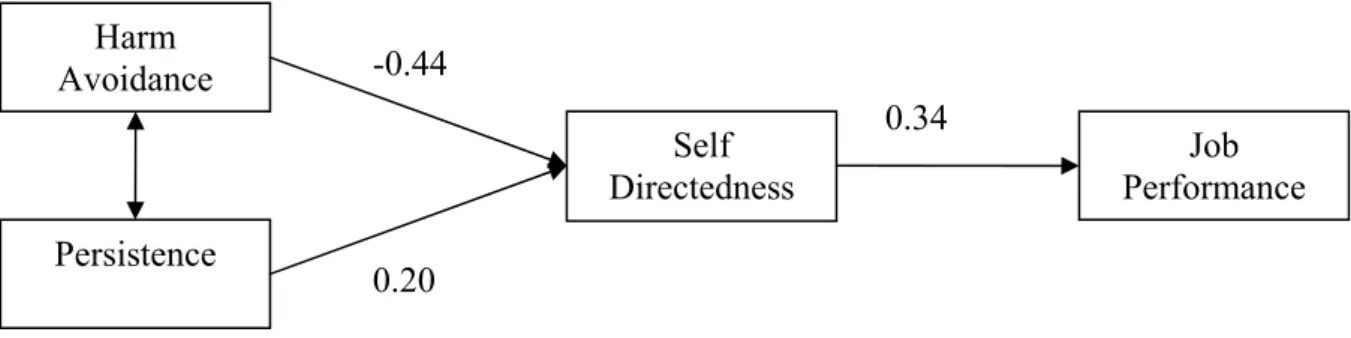
A path analyses was conducted to test the hypothesis that Harm Avoidance and Persistence are mediated by Self Directedness in the prediction of Job Performance. The model tested, along with the standardized parameter estimates are illustrated in Figure 2. This figure indicates that, as hypothesized, Self Directedness (Direct effect = 0.34, p < 0.05) was a significant predictor of Job Performance. Hypothesized indirect (mediated) effects were generated and assessed using the Monte Carlo (parametric) bootstrap procedure. It was found that Harm Avoidance was a significant indirect predictor of Job Performance (indirect effect = -0.15, p < 0.05), but that Persistence was not a significant indirect predictor of Job
Performance (indirect effect = 0.07, p = 0.06). However it should be noted, that the indirect effect of Persistence was very close to significance.
--- Insert Figure 2 about here ---
Discussion
The primary objective of this paper was to propose and test a model of the
relationships between Harm Avoidance, Persistence and Self Directedness in the prediction of Job Performance. The basic model was proposed in an attempt to shed some light on why some stable elements of personality are associated with job performance. Previous research has demonstrated that personality can predict job performance, but such research has not considered determinants of personality or intervening factors in the personality – job performance relationship. In the current study, Cloninger et al.’s theoretical model of personality was used to guide the hypothesis that dimensions of temperament (Harm
the prediction of job performance. It was argued that conceptualizing personality as temperament and character and therefore focusing on why traits are associated with job performance, would have implications not only for our understanding of job performance, but also for the management of job performance.
In support of hypothesis 1, Self Directedness was a moderate, significant direct predictor of job performance (direct effect = 0.34). Therefore, it seems that a mature level of character, particularly when that maturity manifests as Self Directedness (in terms of
behavioral flexibility, goal setting etc) is a moderate predictor of Job Performance. Similar to conscientiousness therefore (Barrick & Mount, 1991; Hurtz & Donovan, 2001), Self
Directedness is an important dimension of personality related to Job Performance. Indeed, Self Directedness and Conscientiousness have conceptual overlap, so this relationship is not surprising. The implications of the Self Directedness/Conscientiousness overlap are further discussed below.
In partial support of hypothesis 2, Self Directedness was found to mediate Harm Avoidance in the prediction of job performance. Indeed the indirect effect between Harm Avoidance and job performance via self directedness was 0.15, which indicates that Harm Avoidance predicts individual differences in job performance, based on its association with Self Directedness. As outlined in the introduction, it is argued here that Harm Avoidant individuals tend to avoid learning situations which limits their development of character. This lack of character development in terms of intrapersonal maturity (Self Directedness) then leads to sub-optimal job performance. Support was not obtained for the hypothesis that Self Directedness mediates persistence in the prediction of job performance. However this effect was close to being significant, and therefore warrants some further investigation.
As noted in the introduction, Barrick and Mount (1991) recommended that
researchers place a greater emphasis on understanding the role of Conscientiousness in job performance. Indeed Conscientiousness is an important predictor of job performance, therefore a greater understanding of its boundaries and determinants will lead to a greater understanding of job performance. In this research, emphasis was placed on Self
Directedness, which overlaps with Conscientiousness both theoretically and empirically (De Fruyt, De Wiele & Van Heeringen, 1999). It is argued conceptualizing conscientious
behavior as ‘mature character’ based largely on experiential learning and temperament (in particular low Harm Avoidance), gives this construct implicit boundaries and determinants. Indeed, Conscientious/Self Directed behavior can be considered the result of effective
learning (Cloninger et al., 1993) and more likely to develop in those low in Harm Avoidance, as these individuals are more likely to encounter learning situations.
A further, related implication of this research is based on the finding that Harm Avoidance is an indirect predictor of work outcome variables. Most importantly, people who tend to be low in Harm Avoidance appear to engage in positive workplace behavior, based on the negative association between Harm Avoidance and Self Directedness. As noted above, it is argued that Harm Avoidant individuals lack Self Directedness because such individuals avoid potential learning situations (Forsyth, Parker, & Finlay, 2003; Stewart, Zvolensky, & Eifert, 2002). However, if such individuals did not avoid potential learning situations, then they should be capable of developing at least moderate levels of Self-Directedness. We therefore argue that Harm Avoidant individuals are most likely to benefit from specific training in Self Directedness within organizational development programs.
From a practical point of view, a focus on Self Directedness lies in the potential modification of this trait for its consequent effects on job performance. Because character dimensions are more strongly associated with outcome variables than are temperament dimensions, and because character scales are theoretically partly the result of conceptual learning, it makes sense to target these scales of personality in training programs. It should be pointed out however, that research has yet to fully explore the extent to which Self Directedness can be modified; therefore, the conclusion that Self Directedness can be modified to improve job performance is only speculative at this point.
Conclusion
To conclude, support was found for the hypothesis that Self Directedness mediates Harm Avoidance in the prediction of job performance. Support was not found for the hypothesis that Self Directedness mediates persistence in the prediction of job performance. It is suggested that research should focus on personality theory when examining the role of personality in job performance as such a focus is likely to increase our understanding of individual differences in job performance.
References
Allport, G. W. (1937). Personality: A psychological interpretation. Holt & Company, NY. Bachevalier, J. (1990). Ontogenetic development of habit and memory formation in primates.
Annals of the New York Academy of Sciences,608, 457-477.
Barrick, M. R., & Mount, M. K. (2005). Yes, Personality Matters: Moving on to More Important Matters. Human Performance, 18(4), 359-372.
Barrick, M. R., & Mount, M. K. (1991). The Big Five personality dimensions and job performance: A meta-analysis. Personnel Psychology, 44, 1-26.
Cloninger, C. R., Svrakic, D. M., & Przybeck, T. R. (1993). A psychobiological model of temperament and character. Archives of General Psychiatry, 50, 975-990.
Cloninger, C. R., Przybeck, T. R., Svrakic, D. M., & Wetzel, R. D. (1994). The Temperament and Character Inventory (TCI): A guide to its development and use. St Louis, MO: Center for Psychobiology of Personality, Washington University.
De Fruyt, F., De Wiele, L. V., & Van Heeringen, C. (2000). Cloninger's psychobiological model of temperament and character and the five-factor model of personality. Personality and Individual Differences, 29, 441-452.
Forsyth, J. P., Parker, J. D., & Finlay, C. G. (2003). Anxiety sensitivity, controllability, and experiential avoidance and their relation to drug of choice and addiction severity in a residential sample of substance-abusing veterans. Addictive Behaviors, 28, 851 – 870. Griego, J., Stewart, S. E., & Coolidge, F. L. (1999). A convergent validity study of
Cloninger’s Temperament and Character Inventory with the Coolidge Axis II Inventory. Journal of Personality Disorders, 13, 256-267.
Griffin, M.A., Neal, A. & Parker, S. (2001). Multidimensional Performance Scale:
4th Australian Industrial & Organizational Psychology Conference, Sydney.
Guion, R. M., & Gottier, R. F. (1965). Validity of personality measures in personnel selection. Personnel Psychology, 18, 135–164.
Ham, B., Lee, Y., Kim, M., Lee, J., Ahn, D., & Choi, M. et al. (2006). Personality, dopamine receptor D4 exon III polymorphisms, and academic achievement in medical students. Neuropsychobiology, 53, 203-209.
Hintsa, T., Hintsanen, M., Jokela, M., Elovainio, M., Raitakari, O., & Keltikangas-Järvinen, L. (2010). The influence of temperament on long-term job strain and its components: The cardiovascular risk in Young Finns study. Personality and Individual Differences, 49(7), 700-705.
Hurtz, G., & Donovan, J. (2000). Personality and job performance: The big five revisited. Journal of Applied Psychology, 85, 869-879.
Johnson, D. E. (1998). Applied multivariate methods for data analysts. Pacific Grove, CA: Duxbury Press.
Jylhä, P., & Isometsä, E. (2006). Temperament, character and symptoms of anxiety and depression in the general population. European Psychiatry, 21, 389-395.
Parkin, A. J., Reid, T. K., & Russo, R. (1990). On the differential nature of implicit and explicit memory. Memory and Cognition, 18, 507-514.
Pelissolo, A., Mallet, L., Baleyte J. M., Michel, G., Cloninger, C. R., Allilaire, J.-F., & Jouvent, R. (2005). The temperament and character inventory-revised (TCI-R): psychometric characteristics of the French version. Acta Psychiatrica Scandinavica, 112, 126–133.
Phillips, R. R., Malamut, B. L., Bachevalier, J., & Mishkin, M. (1988). Dissociation of the effects of inferior temporal and limbic lesions on object discrimination learning with 24-h intertrial intervals. Behavioral Brain Research, 27, 99-107.
Schmitt, N. W., Gooding, R. Z., Noe, R. A., & Kirsch, M. (1984). Meta-analyses of validity studies published between 1964 and 1982 and the investigation of study characteristics. Personnel Psychology, 37, 407–422.
Stewart, S. H., Zvolensky, M. J., & Eifert, G. H. (2002). The relations of anxiety sensitivity, experiential avoidance, and alexithymic coping to young adults' motivations for drinking. Behavior modification, 26, 274-296.
van der Linden, D., Taris, T. W., Beckers, D. G. J., & Kindt, K. B. (2007). Reinforcement sensitivity theory and occupational health: BAS and BIS on the job. Personality and Individual Differences, 42, 1127-1138.
Whiteside, S. P., & Lynam, D. R. (2001). The Five Factor Model and Impulsivity: Using a structural model of personality to understand Impulsivity. Personality & Individual Differences, 30, 669-689.
Table 1
Descriptive statistics and correlations among Cloninger et al.’s dimensions and Job Performance
M SD Alpha 1 2 3
Harm Avoidance (1) 15.20 5.70 0.69
Self Directedness (2) 27.19 6.32 0.83 -0.50*
Persistence (3) 5.18 3.19 0.59 -0.29 0.33*
Job Performance 150.81 24.32 0.93 -0.13 0.32* 0.20 * indicates significance at the p<0.05 level.
Figure 2. A path analysis of the relationship between personality and performance using Cloninger et al.’s dimensions of personality.
Harm Avoidance Self Directedness Job Performance Persistence
Figure 3. Summary of direct effects for the hypothesised relationships between Harm Avoidance, Persistence, Self Directedness and Job Performance.
0.34 -0.44 0.20 Harm Avoidance Self Directedness Job Performance Persistence