Printed Circuit Board Layout Time Estimation
Cyrus Bazeghi and Jose Renau
University of California, Santa Cruz
ABSTRACT
System design complexity is growing rapidly. As a result, cur-rent development costs can be staggering and are constantly increasing. As designers produce ever larger and more com-plex systems, it is becoming increasingly difficult to estimate how much time it will take to design and verify these designs. To compound this problem, system design cost estimation still does not have a quantitative approach. Although designing a system is very resource consuming, there is little work in-vested in measuring, understanding, and estimating the effort required.
To address part of the current shortcomings, this paper in-troducesµPCBComplexity, a methodology to measure and estimate PCB (printed circuit board) design effort. PCBs are the central component of any system and can require large amounts of resources to properly design and verify.
µPCBComplexity consists of two main parts, a procedure to account for the contributions of the different elements in the design, which is coupled with a non-linear statistical regres-sion of experimental measures. We useµPCBComplexity to evaluate a series of design effort estimators on several PCB designs. By using the proposedµPCBComplexity metric, de-signers can estimate PCB design effort.
1
Introduction
Printed circuit board (PCB) design effort keeps growing as ad-ditional constraints such as rising clock frequencies, reduced area, increasing number of layers, mixed signal devices, and the ever increase in component numbers and densities. All of these factors combined have led to a steady rate of increase in development costs for current systems. As we design ever larger, denser and more complex systems, it is becoming in-creasingly difficult to estimate how much time would be re-quired to design and verify them. To compound this problem, PCB design effort estimation still does not have a quantitative approach. We present in this paper a first step toward creat-ing a design effort metric that is highly correlated with design effort for PCB layout. We follow the same approach taken in [1] as the principles that are applicable to microprocessors are also applicable to PCBs. In this paper, design effort cor-responds to the number of engineering-hours required for im-plementation (layout) of a PCB design.
This work was supported in part by the National Science Foundation under grants 0546819; Special Research Grant from the University of California, Santa Cruz; and gifts from SUN.
This paper analyzes and proposes various statistics to esti-mate the layout effort required to develop PCBs. We investi-gate and quantify statistics such as area, component count, pin count and device types and sizes for many PCBs. We analyze several of these statistics, and propose a metric, obtained af-ter applying non-linear regression over the different statistics, which we callµPCBComplexity. In addition, we provide in-sights on the correlation between several statistics and design effort for several known layout design times.
Different designs have different constraints, leading to spe-cific challenges; typical design constraints being area, fre-quency, and cost. For example, having area being a primary design constraint, may lead to a requirement for additional layers, more expensive package types, and more complex placement and routing. A design constrained by cost, on the other hand, may require a balance between number of layers, area, drill density, types of packages and possibly the number of different drill sizes. Having clear constraints is necessary in estimating layout effort as it can drastically affect complexity. We define design effort to be the layout time required by one engineer. Design effort is equivalent to layout time when the project has a single developer, which is frequent even for complex PCBs. Nevertheless, for a given effort requirement, it is possible to reduce the design time by increasing the num-ber of workers. Nevertheless, increasing the numnum-ber of work-ers decreases the productivity per worker. The relationship between these two elements has been widely studied in soft-ware metrics and business models. Since the conversion be-tween design effort and design time can be approximated, the remainder of this paper focuses only on design effort.
The rest of the paper is organized as follows. Section 2 covers other work in this area; Section 3 describes the sta-tistical techniques that allow us to calibrate and evaluate the
µPCBComplexity regression model; Section 4 describes the setup for our evaluation; Section 5 evaluates several statistics for the boards in our analysis; and Section 6 presents conclu-sions and future work.
2
Related Work
The capability to rapidly develop complex PCBs is a tremen-dous competitive advantage, since high development produc-tivity is essential for the success of any design team. Al-though some companies have used statistical methods to es-timate PCB design time, those methods are considered trade secrets [9]. Other companies do not release details because
they provide competitive advantage over other companies. As a result, we are unaware of any published work on the topic of predicting the engineering hours required for a PCB design.
[1] focuses on microprocessor design effort. While the work described in this paper focuses on PCB design met-rics, [1] uses the same regression model, but both papers ana-lyze different set of statistics and targets.
Another paper that looks at productivity is [7] which iden-tifies the need for standards or infrastructures for measur-ing and recordmeasur-ing the semiconductor design process. They propose improving design technology, time-to-market, and quality-of-result by addressing the Design Productivity Gap and the Design ”Technology” Productivity Gap. However, this previous work focused mostly on the problems associated with the infrastructure and design tools related to the physical implementation of semiconductor designs, while the focus of this paper is layout effort associated with PCB designs.
In [8] a factor similar to the productivity factor is described. They use the “process productivity parameter” to tune the es-timating process for software projects. They contend that if you know the size, time, and the process productivity param-eter you can use it to make estimates for a new project. So long as the environment, tools, methods, practices, and skills of the people have not changed dramatically from one project to the next.
Much research has been done in Design for Manufactur-ing (DFM) and Design for Production (DFP) which seek to improve the production and manufacturing times of PCB as-semblies. This paper seeks to develop a metric that can aid in predicting the layout effort, based on analysis of charac-teristics of PCBs at a low-level so as to better plan for future generations of systems. In [2] the issue of embedded passive components is discussed as a necessity to the smaller elec-tronic devices requiring ever smaller PCBs. They note that board area is becoming so critical that to keep pace with the size constraints new techniques are required. Our goal would be to eventually develop a set of metrics and a model that esti-mates design effort by also taking into account manufacturing times.
3
Approach
Our goal is to develop a quantitative approach and to have a model that quickly estimates design effort based on sev-eral easily gathered statistics. This is important because being able to predict design effort is advantageous in helping to re-duce design costs. To build the model, we analyze many com-mercial computer/electronic devices and gather data from the PCBs within. The layout times for these PCBs were well doc-umented which was a requirement for this analysis. Table 1 lists the critical components of PCB designs as determined by [2]. These parameters contribute to the complexity of a design, and hence the time required to do layout.
Some design parameters listed in Table 1 are dependent on other factors. For example, the size of the board is defined by the number of embedded and discrete passive components and
1. Board dimensions (length and breadth) 2. Total wiring requirements
3. Number of layers
4. Number of embedded resistors (if used) 5. Number of embedded capacitors (if used) 6. Set of active component types and their number 7. Thickness of the board
8. Number of discrete resistors 9. Number of discrete capacitors
Table 1:Critical design parameters for a PCB.
total wiring requirements. However, the total wiring require-ments are governed by the number of embedded and discrete passive components in the PCB. And further more, the total number of layers in the PCB depends on the size of the board, the number of embedded and discrete resistors and bypass ca-pacitors [2].
These critical design parameters are focused towards man-ufacturability, not design effort estimation. We used them as a starting point in determining what parameters or metrics to analyze and include for correlation with design effort. None of the boards in our study have embedded passive compo-nents, instead we focus on the total number of all components (passive and discrete) and the pin count for them. These are easily obtainable values.
Since the routing data is not easily obtainable, the number of pins for all the components in the design are taken into ac-count instead. While this is not an ideal metric since not all pins are used or have very short traces (VDD or GND), it is readily obtainable an does not hamper the focus of this pa-per, namely effort prediction starting from higher level design descriptions, such as a bill of materials (BOM) or schematics. In order to find a metric highly correlated with design ef-fort, several statistics were gathered from the existing designs. For each isolated board with a known design effort, we look at several statistics and apply non-linear regression to find a highly correlated metric.
We present our design effort model as the aggregate of a set of statistics (Si). Each of which has a specific constant (wi),
associated with it, which assigns a weight to the importance of every statistic used as input in the model. The aggregate of the statistics is inversely proportional to the productivity of a specific design team which is represented by a constant (ρ). The model is presented in Equation 1. In order to find suitable values for each of the data weights (wi) we perform
mixed non-linear regressions on this equation. The design team productivity factor (ρ) is constant per design group, and it needs to be adjusted on a per company or design team basis. If theρis unknown, then the absolute design effort is invalid and only the breakdown inside the project is correct. Obtain-ing the value ofρis simple; all that is needed is to have the design effort for a single project. Alternatively, it is possible to develop a productivity benchmark suite that calibratesρfor a given company.
Design Effort=1 ρ × n X k=1 (wk×Sk) (1)
In order to determine the weights that give a generalized so-lution to Equation 1, [1] proposes to use a mixed non-linear regression model. If there are no productivity adjustments, it is possible to use a simpler non-linear regression model. While the sum of a large number of random variables is dis-tributed normally, the product of a number of random vari-ables is distributed lognormally — a distribution where the logarithm of the variable is normally distributed [4]. There-fore, since the random variables have a log normal distribution an even simpler linear regression model can not be used.
To evaluate the accuracy of the model (Section 5), we use
σas a measure of error associated with the fit. Consequently, it is important to understand what different values ofσtell us about the quality of the estimate. For a givenσ, we can find a confidence interval for the estimated effort. Thex% confi-dence interval for a metric is defined to be the range of efforts (Estimatelow, Estimatehigh)such thatP(Estimatelow <
metric prediction< Estimatehigh) =x/100. For example,
the 90% confidence interval gives us two valuesaandbsuch that there is a 90% chance that the actual effort is between metric prediction×aand metric prediction×b.
3.1 Productivity Adjustments
In software development projects, it is well known that dif-ferent development teams have difdif-ferent productivities. For example, it has been shown that the productivity difference between teams can be up to an order of magnitude [5]. We be-lieve that a similar effect occurs between PCB design teams. The productivity differences may be due to multiple factors, including the average experience of the designers in the team and the tools used. In our model,ρcaptures this effect.
The boards under study in this analysis all come from one manufacturer and so the use of a productivity factor was not necessary.
3.2 Team Size Dynamics
Although some board designs require long periods of time, it is very rare to find multiple developers doing different sec-tions of the same board. The PCB layout effort by nature is a linear task done by one engineer at a time. To reduce the design time, we have found two approaches: multi-timezone working environments, and ”surgical” teams.
A multi-timezone team has different designers working on multiple time zones, this is, once a designer stops working a new designer can continue and pick up where the previous designer left. A “surgical team” [6] follows an alternative de-sign organization, with the surgeon, or chief dede-signer, at the helm and a supporting staff that has their tasks allocated by the chief of staff. In the PCB case, we may have other design-ers doing such tasks as making footprint images for compo-nents, which can be a tedious effort.
3.3 R-Language
This section provides the R-language [10] code to fit the non-linear mixed-effects model and the non-linear regression model. The mixed-effects model is needed when productivity adjustments (ρ) are required, a simpler model is used when no productivity adjustments are required.
Recall that our model has a multiplicative lognormal er-ror and also a lognormal distribution for the random effect
ρ. Simply taking the logarithm of both sides of the equation gives us the requisite additive normal error and normal ran-dom effect as follows. Hence the need for a non-linear model. # mixed-effects non-linear model
nlme(model=log(Effort) ˜
(log_rho) + log(w1*stat1 + w2*stat2) ,random = log_rho ˜ 1 | team
,fixed = list(w1 ˜ 1, w2 ˜ 1) ,start = c(0.1, 0.1) ,data=(traw) ,method="ML") # non-linear model nls(log(Effort) ˜ log(w1*stat1 + w2*stat2) ,start=list(w1=0.1,w2=0.1) ,data=traw)
The R-language is also used to compute the confidence intervals. To obtain a 90% confidence interval for a given
σ (s) generated, the following R-language code c(exp(s∗
qnorm(0.05)), exp(s∗qnorm(0.95)))is used.
4
Evaluation Setup
We gathered data from a number of PCB designs for the anal-ysis done in this paper. Table 3 shows the types of statistics gathered for each of the boards analyzed. When calculating the area consumed for each component we did not consider the cases where routing, or in the more rare case placement, could be done underneath a component. Several board de-signers pointed out that the component and pin density of the board was one of the crucial factors to estimating design ef-fort. To capture component and pin density, we define them with equation 2 and equation 3 respectively.
Component Density= # Components
PCB Area×# Sides w/ components (2)
Pin Density= # Pins
(PCB Area) (3)
Table 2 gives a description of the boards along with the engineering notes that we were able to gather from the de-signers. Boards B7-B11 used SPECCTRA for OrCAD which is a common autorouter used in industry. No data was avail-able on the use of an autorouter for boards B1-B6 but it can be safely assumed that some autoroute tool was used.
In discussions with the designer of boards B8 and B9 the size of the LCD in the system dictated the size of the PCB and the housing that contained it. The LCD was counted as a
Board Description Engineering Notes
B1 Signal Conditioning Many thru-hole components. Analog board with many important signal paths B2 AE RMS Many thru-hole components. Analog board with many important signal paths B3 PMD Motor Controller Many high density components
B4 Motor Driver New footprints
B5 Enviro Controller Forgot reasons why it took so long
B6 Current Source Many components on a small board. Mechanical constraints B7 Arbitrary Waveform Generator/Amplifier Placement constraints due to noise reduction
B8 ACDC Monitor Cost major factor. Time consuming to keep to a 2 layer board B9 Tank Monitor Cost major factor. Time consuming to keep to a 2 layer board B10 Air spring remote Very small. RF constraints
B11 Air Spring Controller 2 Isolated grounds with placement constraints
Table 2:Description of boards analyzed.
Board Statistic Description
PCB Size (mm2) Physical size of the PCB
# of Sides w/ Comp Either 1 or 2 sides has components # of Routing Layers Layers used for routing traces
# of Layers The total number of layers in the PCB Components
# Passive Passive components (resistors. . . ) # Digital Digital integrated circuits (IC) # Analog Analog ICs or devices (opamps. . . ) # Mixed Signal ICs with both digital and analog sections
Total # Total count of all components on PCB Total Area (mm2) Total area of all components on PCB
Density Ratio of component area to area Pins
# Passive Pins for all passive components # Digital Pins for all digital components # Analog Pins for all analog components # Mixed Signal Pins for all mixed signal components
Total Pins for all devices on PCB Density Ratio of number of pins to area
Table 3:Description of the statistics gathered from the PCBs. component in our analysis and took one complete side of both these boards, forcing the placement and routing of all other components to one side. Cost was the main consideration for both these boards also and this forced the designer to route everything using only 2 layers.
Among boards B7 through B11 the smallest board, B10, was judged to be the most difficult to layout. Where as boards B7 and B11 were the easiest. This was attributed to the ar-eas available to do the placement and routing. B7 and B11 were two of the largest boards reviewed and they were not area constrained, this gives much latitude to the designer for placement and makes the autorouter produce better results. With a more constrained area more human intervention is re-quired during the routing phase which was the case for B10.
For the placement stage we only had to consider the number of sides of the board on which components were mounted. Most of the boards in this study had the components all on one side, though a few had bypass capacitors mounted on one side, which accounted for a negligible amount of space. Again, thru-hole devices would effect the available placement area as it did the available routing area as space would be lost on both sides of the board, unlike with surface mounted components. This was not a factor in this study since most boards only used one side for placement. Boards B8 and B9 had components on both sides but one side was populated by only one component,
the LCD. Board B10, the only other board with components on both sides, did not have any thru-hole devices present.
5
Evaluation
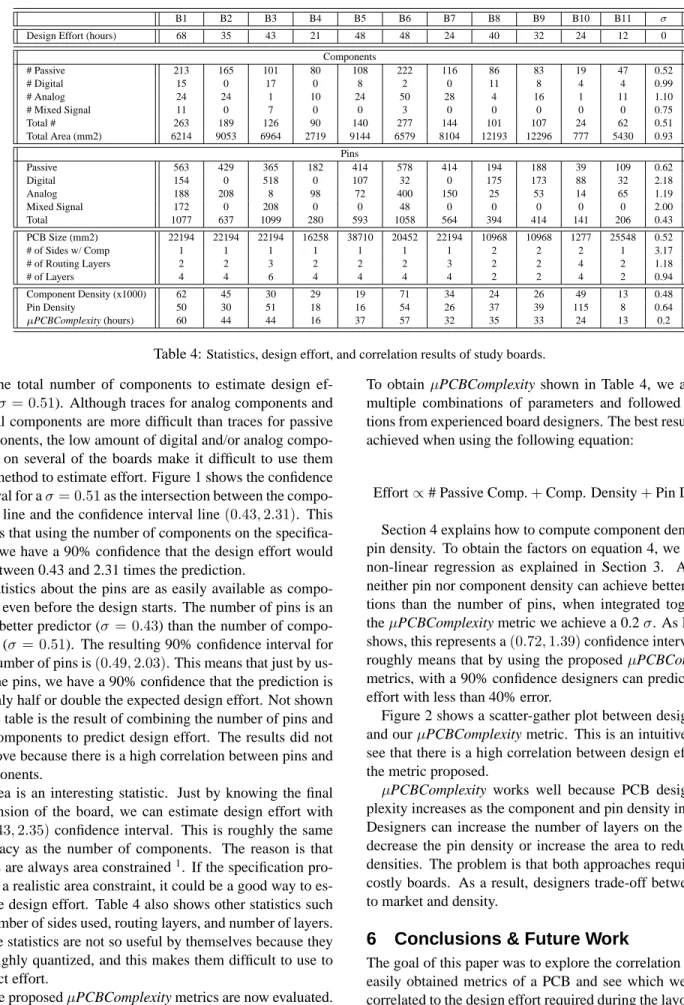
Our evaluation analyzes 11 different printed circuit boards. Table 4 shows the main results and characteristics for each of these. The first column corresponds to each of the statistics or metrics presented in Table 3 (Section 4). Columns B1 to B11 correspond to each of the boards (Table 2). The last column corresponds to theσbetween the row and design effort. Since all the boards are designed by the same team, we do not eval-uate the productivity factor (ρ). This simplifies the analysis, and we can use non-linear regression instead of the mixed-effects non-linear regression model. Withσwe can compute the confidence interval. For the lognormal distribution used, the mapping between σ and the 90% confidence interval is shown in Figure 1. We will use this chart to compare the ac-curacy of different estimators.
0.8
0.5
1
1.5
2
2.5
3
3.5
4
0.1 0.2 0.3 0.4 0.5 0.6 0.7
0
0.2
Multiplicative Factor
σ
PCBComplexity Pins Components90% Conf
Figure 1: Mapping between the standard deviation of the error (σ) and the 90% confidence interval for the lognormal error distribution used.
The design effort values were obtained by interviewing the original designers. Obviously, there is perfect correlation with itself soσ= 0. A zeroσresults in a perfect(1,1)confidence interval. We now proceed to analyze easily available statistics like number of components and pin count. These two sets of statistics are easily available before the PCB design starts. They are part of the PCB specification.
B1 B2 B3 B4 B5 B6 B7 B8 B9 B10 B11 σ
Design Effort (hours) 68 35 43 21 48 48 24 40 32 24 12 0
Components # Passive 213 165 101 80 108 222 116 86 83 19 47 0.52 # Digital 15 0 17 0 8 2 0 11 8 4 4 0.99 # Analog 24 24 1 10 24 50 28 4 16 1 11 1.10 # Mixed Signal 11 0 7 0 0 3 0 0 0 0 0 0.75 Total # 263 189 126 90 140 277 144 101 107 24 62 0.51 Total Area (mm2) 6214 9053 6964 2719 9144 6579 8104 12193 12296 777 5430 0.93 Pins Passive 563 429 365 182 414 578 414 194 188 39 109 0.62 Digital 154 0 518 0 107 32 0 175 173 88 32 2.18 Analog 188 208 8 98 72 400 150 25 53 14 65 1.19 Mixed Signal 172 0 208 0 0 48 0 0 0 0 0 2.00 Total 1077 637 1099 280 593 1058 564 394 414 141 206 0.43 PCB Size (mm2) 22194 22194 22194 16258 38710 20452 22194 10968 10968 1277 25548 0.52 # of Sides w/ Comp 1 1 1 1 1 1 1 2 2 2 1 3.17 # of Routing Layers 2 2 3 2 2 2 3 2 2 4 2 1.18 # of Layers 4 4 6 4 4 4 4 2 2 4 2 0.94 Component Density (x1000) 62 45 30 29 19 71 34 24 26 49 13 0.48 Pin Density 50 30 51 18 16 54 26 37 39 115 8 0.64 µPCBComplexity (hours) 60 44 44 16 37 57 32 35 33 24 13 0.2
Table 4:Statistics, design effort, and correlation results of study boards. use the total number of components to estimate design
ef-fort (σ= 0.51). Although traces for analog components and digital components are more difficult than traces for passive components, the low amount of digital and/or analog compo-nents on several of the boards make it difficult to use them as a method to estimate effort. Figure 1 shows the confidence interval for aσ= 0.51as the intersection between the compo-nents line and the confidence interval line(0.43,2.31). This means that using the number of components on the specifica-tion, we have a 90% confidence that the design effort would be between 0.43 and 2.31 times the prediction.
Statistics about the pins are as easily available as compo-nents even before the design starts. The number of pins is an even better predictor (σ = 0.43) than the number of compo-nents (σ = 0.51). The resulting 90% confidence interval for the number of pins is(0.49,2.03). This means that just by us-ing the pins, we have a 90% confidence that the prediction is roughly half or double the expected design effort. Not shown in the table is the result of combining the number of pins and the components to predict design effort. The results did not improve because there is a high correlation between pins and components.
Area is an interesting statistic. Just by knowing the final dimension of the board, we can estimate design effort with a(0.43,2.35)confidence interval. This is roughly the same accuracy as the number of components. The reason is that PCBs are always area constrained1. If the specification pro-vides a realistic area constraint, it could be a good way to es-timate design effort. Table 4 also shows other statistics such as number of sides used, routing layers, and number of layers. Those statistics are not so useful by themselves because they are highly quantized, and this makes them difficult to use to predict effort.
The proposedµPCBComplexity metrics are now evaluated. 1Bigger PCBs have higher cost.
To obtain µPCBComplexity shown in Table 4, we analyzed multiple combinations of parameters and followed sugges-tions from experienced board designers. The best results were achieved when using the following equation:
Effort∝# Passive Comp.+Comp. Density+Pin Density (4) Section 4 explains how to compute component density and pin density. To obtain the factors on equation 4, we perform non-linear regression as explained in Section 3. Although neither pin nor component density can achieve better predic-tions than the number of pins, when integrated together in theµPCBComplexity metric we achieve a 0.2σ. As Figure 1 shows, this represents a(0.72,1.39)confidence interval. This roughly means that by using the proposedµPCBComplexity metrics, with a 90% confidence designers can predict design effort with less than 40% error.
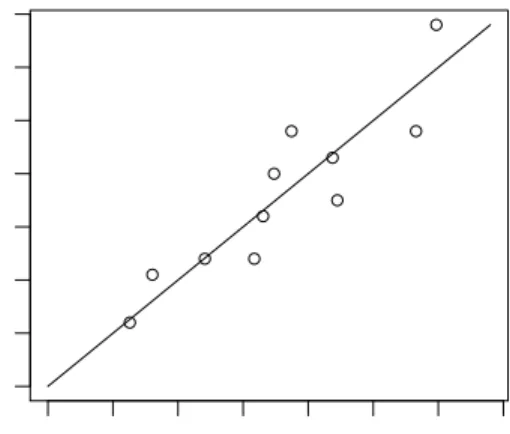
Figure 2 shows a scatter-gather plot between design effort and ourµPCBComplexity metric. This is an intuitive way to see that there is a high correlation between design effort and the metric proposed.
µPCBComplexity works well because PCB design com-plexity increases as the component and pin density increases. Designers can increase the number of layers on the PCB to decrease the pin density or increase the area to reduce both densities. The problem is that both approaches require more costly boards. As a result, designers trade-off between time to market and density.
6
Conclusions & Future Work
The goal of this paper was to explore the correlation of some easily obtained metrics of a PCB and see which were most correlated to the design effort required during the layout stage of development. Many simplifications were made; we did not
● ● ● ● ● ● ● ● ● ● ● 0 10 20 30 40 50 60 70 0 10 20 30 40 50 60 70 uPCBComplexity Design Effort
Figure 2: Scatter-gather plot of design effort vs. PCB metric
account for traces of differing sizes, we did not look at hole sizes or density, the frequency of the boards were not consid-ered, nor the extra considerations required for analog noise filtering. Also, we need additional PCBs from more compa-nies with teams of differing sizes to develop a more general model for predicting design effort.
Many factors and constraints effect the design effort re-quired for a board to be successfully placed and routed. Some difficulty metric would be helpful but guidelines need to be established as difficulty is a very subjective term. Being able to analysis different options for a board would be useful, such as being able to change the size of the board to see what ef-fect it would have on the estimated design effort. This could be expanded to also include the number of layers since this would ease routing congestion.
We see this initial research leading into more areas of study in PCB design optimization and analysis. We are currently analyzing data from additional PCB designs from different sources. These new designs have more components, more layers, higher frequencies, and more power plains. This will give us additional metrics to add to our model for possible better correlation to design effort. These designs also have more designers on the team which will necessitate some team or company productivity factor.
We have extended the previously proposed µComplexity models [1] to the PCB domain. We plan to apply the model to a number of classes at UCSC that do board development to give design guidelines to students and further refine our ap-proach. Our model and metrics will eventually be available to researchers and industry for use in scheduling and planning PCB projects.
The evaluation shows that a simple statistics like PCB area size and number of components yield some correlation with design effort. With a 90% confidence, area has a (0.43
2.35) confidence interval. This means that roughly by look-ing at any of those statistics the typical design time error is half/double with a 90% confidence. Much better results can be achieved with the proposed µPCBComplexity metric. In that case the confidence interval for a 90% confidence is (0.72 1.39). This roughly means that less than 40% estimation error is done with a 90% confidence.
Despite the good results, we still believe that much work needs to be done in gathering relevant designs to evaluate (with associated known design times) and to refine the met-rics and models. A major goal would be a rule of thumb type equation that given some easily obtainable design parameters an accurate estimator of design time would be generated.
Acknowledgments
We thank Martin Greatorex and Adam Harrison from Vena Engineering Corporation for providing design effort numbers and the detailed board data used in this study. Thanks also go to Truong Nguyen from SonicWALL, Inc for his insights on this project and for design data that we plan on using for a fu-ture paper in the works. Additional thanks go Brian Greskamp and Josep Torrellas of the university of Illinois at Urbana-Champaign for their help on the methods developed.
REFERENCES
[1] C. Bazeghi, F. Mesa-Martinez, and J. Renau. µComplexity: Estimating Processor Design Effort. In International
Sympo-sium on Microarchitecture, Nov 2005.
[2] M. Chincholkar and J. Herrmann. Modeling the impact of embedding passives on manufacturing system performance. September 2002.
[3] J. Cohen. Statistical Power Analysis for the Behavioral
Sci-ences. Lawrence Erlbaum, 1988.
[4] E.L. Crow and K. Shimizu. Lognormal Distributions: Theory
and Application. Dekker, 1988.
[5] T. DeMarco and T. Lister. Peopleware Productive Projects and
Teams. Dorset House Publishing, 1999.
[6] JR. Frederick P. Brooks. The Mythical Man-Month. Addison-Wesley, 1995.
[7] A. B. Kahng. Design technology productivity in the dsm era (invited talk). In Conference on Asia South Pacific Design
Au-tomation, pages 443–448. ACM Press, 2001.
[8] L. H. Putnam and W. Myers. Five Core Metrics: The
Intelli-gence Behind Successful Software Management. Dorset House
Publishing, May 2003.
[9] Numetrics Management Systems. Design Complexity and Pro-ductivity. Technical report, Numetrics Management Systems, Inc., 2004. http://www.numetrics.com.
[10] The R Development Core Team. The R Reference Manual