Bootstrapping the Conditional Moment Test for
Parametric Duration Models
James E. Prieger∗ Department of Economics
University of California One Shields Avenue Davis, CA 95616-8578 telephone: (530) 752-8727 fax: (530) 752-9382 [email protected]
June 26, 2003
Working Paper #03-4
University of California, Davis, Department of Economics
Abstract
This letter evaluates the performance of auxiliary regression-based specifi ca-tion tests for parametric duraca-tion models estimated with censored data. The test using asymptotic critical values has poor size. Bootstrapping corrects the size problem but results in a biased power curve.
Keywords: conditional moment test, test size, right censoring, type I cen-soring, duration analysis, exponential distribution, Weibull distribution, specifi -cation test, power curve, bootstrap bias.
∗This paper stems from the author’s dissertation at the University of California, Berkeley. It is a pre-print version of a paper accepted for publication inApplied Economics Letters. Please cite the published version rather than this working paper.
1
Introduction
In empirical work in which observations are durations, economic theory rarely sug-gests which is the correct parametric duration model to use. Therefore when a para-metric model is used, specification testing of the distributional assumption has
be-come the norm. Specification testing of duration models is often done via conditional
moment tests. These tests can be implemented easily via an auxiliary regression that obviates calculation of the variance matrix for the test statistic (Pagan and Vella, 1989). It is well known that test statistics from auxiliary regressions converge very slowly to their asymptotic distribution. Thus, they appear to be prime candi-dates for bootstrapping. In this note I derive suitable moment conditions for censored duration models. Although the bootstrap corrects the size problem of the auxiliary regression test, an unexpected results is that the power curve exhibits severe bias. The bias is exacerbated when the data are censored.
I proceed in the next section by introducing a conditional moment test for censored duration models. The Monte Carlo results are in section 3. For derivations and further details on the Monte Carlo exercise, see Prieger (2000).
2
Conditional Moment Tests
Consider an independent latent sample{yi∗}from the duration random variableY > 0,i= 1, . . . , N. Let the observed sample{yi}be censored, withfixed right censoring
points {ci} and censoring indicators {di} such that yi = min{yi∗, ci} and di = 1 if
yi =ci and 0 ifyi < ci. Let the hazard function ofY beh(y|x, θ0)≡f(y|x, θ0)/[1− F(y|x, θ0)], where f and F are the pdf and cdf of Y, respectively, θ0 is a k-vector
of parameters and x is an -vector of explanatory variables. Define ε(y, x, θ0) ≡
Ry
latent, uncensored quantities, so that ε∗
i ≡ε(yi∗, xi, θ0) and εi ≡ε(yi, xi, θ0). Then
the log likelihood of the observed sample is
l(θ) =
N
X
i=1
(1−di) logh(yi|xi, θ)−ε(yi, xi, θ). (1)
The conditional moment approach to specification testing exploits the fact that if
the model is correctly specified, the sample average moments of ε∗i should be close to the population moment expectations.1 Letm∗: R++→Rqbe a vector of conditional
moments. Denotem0i∗ ≡m∗(ε∗i) and construct m∗ so that
E¡m0i∗|xi
¢
= 0, i= 1, . . . , N. (2)
If the uncensored sample {yi∗} were observed, one could base a specification test on the sample analog of (2). Censoring complicates matters slightly, requiring the expectation of (2) conditional on the censoring. Let wi = (xi, ci, di) and m0i ≡
E[m∗(ε∗i)|εi, wi]. By the law of iterated expectations and (2) we have:
E¡m0i|xi, ci¢=E{E[m∗(ε∗i)|εi, wi]|xi, ci}= 0, i= 1, . . . , N, (3)
where the outer expectation is taken over (εi, di). Thus specification tests for
cen-sored samples may be based on the sample analog of (3). These moment conditions hold for all duration distributions as long as the distribution is correctly specified.
Many tests using generalized residuals in the literature are based on raw moments of powers of ε∗. Because ε∗ is distributed unit exponential for all duration distrib-utions (Lancaster, 1985), if the (p−1)th row of m0i∗ is (ε∗ip−p!) then equality (2) holds. In a censored sample, the appropriate element of m0i corresponding to thepth power ofˆεi is m0ip= ˆεpi −p! +di p−1 X j=0 p! j!ˆε j i. (4) 1
One cannot test the first moment because it is exactly zero when evaluated with the
ML estimate. The moments investigated in the Monte Carlo exercise are the second and third:2 m0i2 = ˆε2i −2 + 2di(ˆεi+ 1) (5) m0i3= ˆε3i −6 + 3di ¡ ˆ ε2i + 2ˆεi+ 2 ¢ . (6)
Let ˆθ be the MLE of θ0, ˆεi ≡ ε
³
yi, xi,ˆθ
´
, and mˆi ≡m(ˆεi, wi). Define gˆi to be
the derivative of the ith log likelihood for observation i(i.e., gˆi ≡ ∇li|θ=ˆθ). For the
auxiliary regression form of the test, regress mˆi on ˆgi and a constant (this will be a
seemingly unrelated regression [SUR] ifq >1) and test the constant(s) for significance with the usual t-test or Wald test.
3
Monte Carlo Results
In this section I examine the small sample performance of the auxiliary regression-based test applied to an exponential regression model. I consider the test with asymp-totic critical values and with bootstrap critical values. Given the known size problems of auxiliary regression tests, they appear to be prime candidates for bootstrapping.
The Monte Carlo exercises have the following design. The data generating process, conditional on a heterogeneity term u, is exponential with hazard function h = exp (−x0iβ0−u). To ensure E(h) = exp (−x0iβ0), u is N¡σ2/2, σ2¢. The data are right-censored, withfixed censoring pointcchosen to achieve a desired expected per-centage of censoring in the data. The generalized residual under the null hypothesis that u = 0 is ˆεi =yiexp(−x0iβˆ). The -vector of scores for the auxiliary regression
aregˆi = [ˆεi−(1−di)]xi for the ith observation. The moment conditions (5)—(6) are
2
Conditionm0i2 is numerically equal to the moment condition in Lancaster’s (1985) LM test for
unobserved heterogeneity when evaluated at the ML estimate ofθ(Pagan and Vella, 1989; Prieger, 2000).
regressed via SUR on the scores and a constant and the constants are tested for joint significance with a Wald test. The critical values are either asymptotic based on the
χ2 distribution or from a parametric bootstrap.3 The covariate vectorxis composed of a constant and a standard normal random variable. The regressors andβ00 = (1,2)
are fixed throughout all simulations.
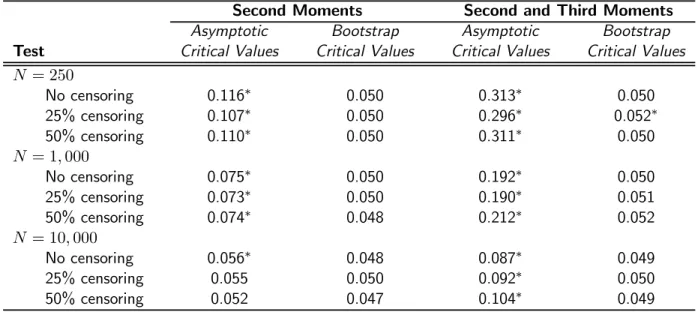
Test statistics from auxiliary regressions have poor size in small samples. The
first two columns of Table 1 present the actual size of the tests based on second
moments, for various sample sizes and levels of censoring. The first column shows
that the size of the raw moments test is far from the nominal 5% level when the asymptotic critical value is used, unless the sample sizes are large. The actual test size is about 11% when the sample size is 250 and about 7.5% when the sample size is 1,000. Censoring does not appear to make the distortion worse. When sample sizes increase to 10,000, the size drops to near the correct level, although the bias is still significant for the uncensored case. Thus, although the auxiliary regression method
is convenient, it may lead to incorrect inference unless sample sizes are large. The use of the bootstrap (column two) clears up the size distortion quite well for all levels of censoring and sample sizes. None of the bootstrap sizes shows significant bias. When
the second and third moments are used together (the last two columns of Table 1), the same general results are evident.
The power of the tests against the alternative of multiplicative lognormally-distributed heterogeneity is depicted in figure 1, for two levels of censoring (none
and 25% of the sample). The second and third moment conditions are used and the sample size is 1000.4 The amount of heterogeneity increases along the horizontal
3In the parametric bootstrap (Horowitz, 2001, pp.3165,3181), bootstrap samples are generated from an exponential distribution using the estimated parameters and the actual x’s. Qualitatively similar results obtain when the paired(y, x)bootstrap is used.
4
The bootstrap sample size is 99 and 100,000 iterations are performed. The power is evaluated at 15 points and curves are smoothed for plotting. The bias persists when more bootstrap iterations
axis, which is scaled in the graphs to be the percentage increase in the variance of the latent duration variable due to the heterogeneity.
The power curves reveal the following points. First, as one would expect, the power of a particular form of the test decreases as the amount of censoring in the sample increases. This is because as the censoring becomes more severe, there is less information in the sample. Second, and more novel, all these auxiliary regression tests are biased: for small amounts of heterogeneity there is a smaller chance of rejecting the null hypothesis when false than when true. The bias persists over a large range of alternatives in the bootstrapped test, particularly under censoring (the heavy dashed line). The bootstrap test is consistent5against all these alternative hypotheses because the auxiliary regression with the true critical value is consistent in this case (Horowitz, 1997, sec. 4.6), so the bias is purely a small sample phenomenon. These small sample results are unfortunate, however, given the convenience of auxiliary regression tests and the growing use of the bootstrap.
4
Conclusion
The raw moment specification test performed via auxiliary regression is one of the
common specification tests for duration data. This note presents moments suitable
for censored samples. As the bootstrap becomes more commonly used, it is natural to expect its application to these tests to clear up the size distortions when asymptotic critical values are used. The simulations in this paper show the size correction pro-vided by the bootstrap comes at a cost: bias and low power. The applied economist will need to interpret a “failure to reject” the chosen specification with this caution
in mind. are used.
References
Horowitz, Joel L. (1997), Bootstrap Methods in Econometrics, in D. Kreps and K. Wallis, eds, ‘Advances in Economics and Econometrics: Theory and Applica-tions: Seventh World Congress. Volume 3.’, Econometric Society (Monographs, no.28), Cambridge: Cambridge U. Press.
Horowitz, Joel L. (2001), The Bootstrap, in J. J. Heckman and E. Leamer, eds, ‘Handbook of Econometrics’, Vol. 5, Elsevier, Amsterdam, chapter 52, pp. 3159— 3228.
Lancaster, Tony (1985), ‘Generalised Residuals and Heterogeneous Duration Models: With Applications to the Weibull Model’,Journal of Econometrics28(1), 155— 169.
Pagan, Adrian and Vella, Frank (1989), ‘Diagnostic Tests for Models Based on Indi-vidual Data: A Survey’,Journal of Applied Econometrics4(0), S29—S59.
Prieger, James E. (2000), ‘Conditional Moment Tests for Parametric Duration Mod-els’, Working Paper 00-10, Department of Economics, University of California, Davis.
Second Moments Second and Third Moments
Asymptotic Bootstrap Asymptotic Bootstrap
Test Critical Values Critical Values Critical Values Critical Values
N = 250 No censoring 0.116∗ 0.050 0.313∗ 0.050 25% censoring 0.107∗ 0.050 0.296∗ 0.052∗ 50% censoring 0.110∗ 0.050 0.311∗ 0.050 N = 1,000 No censoring 0.075∗ 0.050 0.192∗ 0.050 25% censoring 0.073∗ 0.050 0.190∗ 0.051 50% censoring 0.074∗ 0.048 0.212∗ 0.052 N = 10,000 No censoring 0.056∗ 0.048 0.087∗ 0.049 25% censoring 0.055 0.050 0.092∗ 0.050 50% censoring 0.052 0.047 0.104∗ 0.049
Table notes: Nominal size is 5%; * indicates significant (1% level) bias in the empirical size. Nis sample
size. Censoring is accomplished with afixed right censoring point common to all observations. Bootstrap
sample size = 999. Number of Monte Carlo trials is 100,000 for N=250, 25,000 for N=1,000, and 10,000 for N=10,000.
Figure 1: Power curves for the tests vs. lognormal multiplicative heterogeneity (2nd and 3rd moments, N=1,000) 0% 10% 20% 30% 40% 50% 60% 70% 80% 90% 100% 0% 50% 100% 150% 200% 250%
Increase in Variance Due to Heterogeneity
Power
No censoring, bootstrap critical value No censoring, asymptotic critical value 25% censoring, bootstrap critical value 25% censoring, asymptotic critical value