137
Cost and Size Analysis of Hybrid System Using homer Optimization
Nagma Bee1, Siju Geogre2, Dr. A. A. Ansari3 Lakshmi Narain College of Technology- Excellence 1, 2, 3
Department of Electrical and Electronics 1, 2, 3
1
[email protected], [email protected], [email protected]
Abstract: - This paper present a deep review of Homer
optimization tool used for the analysis of cost and optimum size of hybrid system. In remote area where
the availability of electrical power system is not continues or supply for some hour at that places
installation of hybrid system is very economical and also pollution free system. Since the demand of power is more than the generation so we have to develop
some new system which is substitute of conventional generation system. Hybrid system is very much useful
in rural areas were the availability of electrical power is for few hours.
Keywords-- Hybrid system, HOMER, Wind, Solar, Converter and Generator system.
1.
INTRODUCTION
Solar–wind hybrid energy systems allow improving the system efficiency, power reliability and reduce the
energy storage requirements for stand-alone applications. Good compensation characters are
usually found between solar energy and wind energy. These hybrid systems are now becoming popular in
urban area for power generation applications due to advancements in renewable energy technologies and substantial rise in prices of petroleum products. This
study recommend an optimal design model for hybrid solar–wind systems employing battery bank for
calculating the system optimum configurations and
ensuring that the annualized cost of the systems is minimized while satisfying the custom requirements.
The main benefit of solar-wind hybrid system is that when solar and wind powers are used together, the
reliability of the system is enhanced. These alternatives may include hybrid power systems like wind-PV, wind-diesel, PV-diesel and others with or
without battery backup option. With continuous research and development efforts, it has been
established that the hybrid systems, if optimized properly, are both cost effective and reliable compared
to single power source systems. Additionally, the size of battery storage can be reduced as there is less
dependence on only one source of power generation. Often, when there is no sun, there is plenty of wind in
India (as in Monsoon season). Winds are usually relatively strong in winter and solar radiations have
higher intensity in summer. To get the continuous power from renewable energy sources hybrid system
installation is increasing day by day, which can provide the reliable power. Lot of researchers has suggested different ways of optimization of hybrid
system, interfacing of hybrid system with grid etc. Here the brief note of the work which has been already
138
energy based Base System for an isolated location, such as Saint Martin‟s Island, has been proposed. Saint Martin‟s island is one of the most beautiful tourist
islands in Bangladesh where grid connected electric
system for the residents and for the telecommunication system will not be Possible to launch even in future.
The residential consumers use diesel, kerosene and wood for fulfilling their energy demand. Solar and Wind resources are the hybrid options for the Island.
Mohamed El Badawe et al. [2] suggest that Telecommunication towers located in remote locations
are generally powered using diesel generators and batteries. However, diesel generators require higher
maintenance cost and for remote sites this cost will be more due to the added oil transportation cost.
Maximizing the use of renewable energy is beneficial in reducing the diesel generation cost. Maherchandani
et al. [3] discussed that the economic feasibility of stand-alone hybrid power system consisting of
Biomass/PV/Wind generators for electrical requirements of the remote locations. It emphasizes
the use of renewable hybrid power system to obtain a reliable autonomous system with the optimization of the components size and the improvement of the
capital cost. The main source of power to the energy system is biomass generator, whereas, photovoltaic
panels and wind generators are the supported additional sources. The batteries are used to store extra
energy generated that can further be used for the backup. S. M. Hakimi et al. [4] Focused the, a novel
intelligent method is applied to the problem of sizing in a hybrid power system such that the demand of
residential area is met. This study is performed for
Kahnouj area in south-east Iran. It is to mention that there are many similar regions around the world with
this typical situation that can be expanded. The system consist of fuel cells, some wind units, some
electrolyses, a reformer, an anaerobic reactor, and some hydrogen tanks. The system is assumed to be
stand-alone and uses the biomass as an available energy resource. Pragya Nema et al. [5] proposed the design idea of optimized PV-Solar and Wind Hybrid
Energy System for GSM/CDMA type mobile base station over conventional diesel generator for a
particular site in central India (Bhopal). For this hybrid system ,the meteorological data of Solar Insulation,
hourly wind speed, are taken for Bhopal-Central India (Longitude 77ο.23‟and Latitude 23ο.21‟ ) and the
pattern of load consumption of mobile base station are studied and suitably modeled for optimization of the
hybrid energy system using HOMER software. Prabodh Bajpai et al.[6] described that Decentralized
distributed generation technologies based on renewable energy recourses such as Solar Photovoltaic
(SPV)/ Wind Turbine Generators (WTG) address the major issues concerned with conventional diesel generators to a large extent and are therefore
considered as emerging alternate power solutions to stand alone applications. Jose´ L. Bernal-Agustı´n et
al. [7] focused that Stand-alone hybrid renewable energy systems usually incur lower costs and
demonstrate higher reliability than photovoltaic (PV) or wind systems. The most usual systems are PV–
Wind–Battery and PV–Diesel–Battery. Energy storage is usually in batteries (normally of the lead-acid type).
139
proportion of the world‟s population lives in remote
rural areas that are geographically isolated and
sparsely populated. This paper proposed a hybrid power generation system suitable for remote area
application. The concept of hybridizing renewable energy sources is that the base load is to be covered by
largest and firmly available renewable source(s) and other intermittent source(s) should augment the base load to cover the peak load of an isolated mini electric
grid system. GM Shafiullah et al. [9] suggested current power systems create environmental impacts
due to utilization of fossil fuels, especially coal, as carbon dioxide is emitted into the atmosphere. In
contrast to fossil fuels, renewable energy offers alternative sources of energy which are in general
pollution free, technologically effective and environmentally sustainable. There is an increased
interest in renewable energy, particularly solar and wind energy, which provides electricity without giving
rise to carbon dioxide emissions. S. Rehman, A. M. Mahbub et al. [10] proposed that a wind-pv-diesel
hybrid power system has been designed from a village in Saudi Arabia which is presently powered by a diesel power plant consisting of eight diesel generating sets
of 1,120kW each.
2.
HYBRID SYSTEM
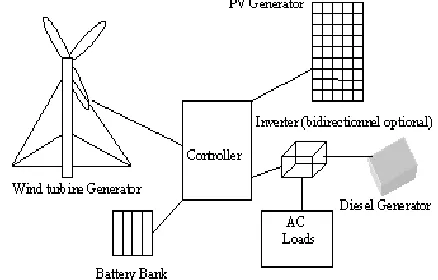
The hybrid energy system proposed consists of wind, solar power as depicted in Fig. 1. The energy system consists of a wind turbine generator, diesel generator,
solar PV array, battery bank, grid power and an AC/DC converter. Distributed electricity generation
from Renewable Energy Sources (RES) such as solar and wind are increasingly seen as cost effective
alternatives to centralized carbon-based generation. A disadvantage, common to wind and solar options,
however, is their unpredictable nature and dependence on weather and climatic changes. The hybrid systems
that combine solar and wind generating units with battery backup can attenuate their individual
fluctuations and reduce energy storage requirements significantly.
Figure 1:Schematic diagram of hybrid energy system.
2.1 Appropriate Hybrid System
Homer simulates the operation of a system by making
energy balance calculations for each of the 8,760 hours in a year. For each hour, Homer compares the electric demand in the hour to the energy that the system can
supply in that hour, and calculates the flows of energy to and from each component of the system. All the
resources and inputs simulated and we got the 360 sustainable configurations. This simulation results
eliminate all infeasible combinations and rank the feasible systems according to increasing net present
cost. There are 360 feasible designs for our site under desirable conditions. After simulating all the possible
system configurations, we should select at least one optimum hybrid system, sorted by net present cost,
140
hybrid system is the optimum system for this site because this system has lower net present cost, higher
battery life with less payback period. The hybrid system has been designed based on the following
steps:
(i) Power requirement,
(ii) Availability of Solar and Wind Resources,
(iii)Configure the inputs for generating sustainable conditions
(iv) Simulations of the sustainable Hybrid Systems, (v) Chosen of the optimum system for fulfilling the
consumer requirement.
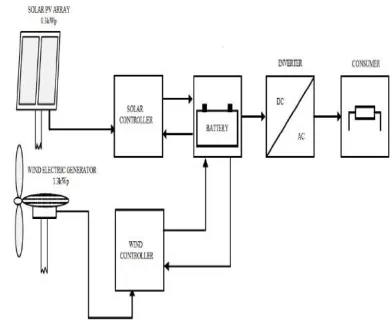
Figure 2: Optimum Solar Wind Hybrid
3.
ABOUT THE HOMER
HOMER, the micro power optimization software
developed by Mistaya Engineering, Canada for the National Renewable Energy Laboratory (NREL) USA,
used in this analysis simplifies the task of evaluating designs of both off-grid and grid-connected power systems for a variety of applications. In designing a
power system, many decisions about the configuration of the system are to be made: components to include in
the system design, size of each component to use etc. The large number of technology options and the
variation in technology costs and availability of energy resources make these decisions difficult. HOMER's
optimization and sensitivity analysis algorithms make it easier to evaluate the many possible system
configurations. HOMER (hybrid optimization Model for Electric Renewable) software is a user-friendly
micro power design tool that simulates and optimizes stand-alone and grid-connected power systems. HOMER allows the designer to compare many
different design options based on their technical and economic merits. Recently, it has been used widely in
the field of renewable energy. It can be used with any combination of wind turbines, PV arrays, run-of-river
hydro power, biomass power, internal combustion engine generators, micro turbines, batteries, and
hydrogen storage, serving both electric and thermal loads. The advantage of HOMER is that it can involve
also all costs such as the initial capital and the maintenance costs including pollution penalties. We
can use HOMER to perform analyses to explore a wide range of design questions:
Which technologies are most cost-effective?
What size should components be?
What happens to the project‟s economics if costs
or loads change?
Is the renewable resource adequate?
HOMER‟s optimization and sensitivity analysis
capabilities help you answer these difficult questions.
It performs a sensitivity analysis which can help the analyst to do „what-if‟ analyses and to investigate the
effects of uncertainty or changes in input variables. The objective of the optimization simulation is to
141
large number of technology options, while considering variations in technology costs and energy resource
availability. HOMER produces the amount of emissions of PV and wind-generator system along
with the amount of emissions.
3.1.What does HOMER do
HOMER finds the least cost combination of
components that meet electrical and thermal loads. HOMER simulates thousands of system
configurations, optimizes for lifecycle cost, and generates results of sensitivity analyses on most
inputs. HOMER simulates the operation of a system by making energy balance calculations for each of the 8,760 hours in a year. For each hour, HOMER
compares the electric and thermal load in the hour to the energy that the system can supply in that hour. For
systems that include batteries or fuel-powered generators, HOMER also decides for each hour how to
operate the generators and whether to charge or discharge the batteries. If the system meets the loads
for the entire year, HOMER estimates the lifecycle cost of the system, accounting for the capital,
replacement, operation and maintenance, fuel and interest costs. You can view hourly energy flows for each component as well as annual cost and
performance summaries.
3.2 Optimal Size of the Proposed System Using
HOMER
The system consists of; PV modules, wind energy
system, batteries, charge controller, inverter, and the necessary wiring and safety devices. The system
feasibility analysis was performed using the HOMER
software. We have discussed HOMER is a computer model that simplifies the task of evaluating design
options for both off-grid and grid-connected power systems for remote, stand-alone, and distributed-generation (DG) applications. HOMER‟s optimization
and sensitivity analysis algorithms allow one to
evaluate the economic and technical feasibility of a large number of technology options and to account for variation in technology costs and energy resource
availability. HOMER models both conventional and renewable-energy technologies. HOMER models a power system‟s physical behavior and its life-cycle
cost, which is the total cost of installing and operating
the system over its life span. HOMER allows the modeler to compare many different design options
based on their technical and economic merits. It also assists in understanding and quantifying the effects of
uncertainty or changes in the inputs.
4.CONCLUSION
Proposed hybrid system will be designed and
optimized using HOMER software computer model to supply lighting load. All the optimization systems are ranked according to net present cost, and all other
economic outputs will be calculated for the purpose of
powering and finding the best net present cost. The result obtained from the optimization gives the initial capital cost as well as operating cost.
REFERENCES
[1]. J. K. Maherchandani1, Chitranjan Agarwal, “Economic Feasibility of Hybrid
142
Advanced Research in Electrical, Electronics and Instrumentation Engineering Vol. 1, Issue 2,
August 2012.
[2]. PragyaNema1, R.K. Nema, Saroj Rangnekar,
“PV-solar / wind hybrid energy system for GSM/CDMA type mobile telephony base station, International
journal of energy and environment 2010.
[3]. Tariq Iqbal, “International Journal of Optimal Sizing and Modeling of a Hybrid Energy System
for a Remote Telecommunication Facility.
[4]. Prabodh Bajpai, Sowjan Kumar, “Sizing
Optimization and Analysis of a Stand-alone WTG System Using Hybrid Energy Storage
Technologies, AIP Journal 2011.
[5]. S. M. Hakimi, “Optimal sizing of reliable hybrid
renewable energy system considered various load types”, AIP Journal of Renewable and sustainable
energy 2011.
[6]. Deepak Kumar Lal, Bibhuti Bhusan Dash, “Optimization of PV/Wind/Micro-Hydro/Diesel
Hybrid Power System in HOMER for the Study Area”, International Journal on Electrical
Engineering and Informatics ‐ Volume 3, Number
3, 2011.
[7]. G. Pepermans, J. Driesen, D. Haeseldonckx, R.
Belmans, W.D haeseleer, “Distributed generation: definition, benefits and issues”, Energy Policy, Vol.
33, No. 6, pp. 787–798, 2005.
[8]. A. M. Azmy, I. Erlich, “Impact of distributed
generation on the stability of electrical power systems”, IEEE Power Engineering Society
General Meeting, Vol. 2, pp. 1056 – 1063, 2005.
[9]. J. K. Maherchandani, Chitranjan Agarwal, MukeshSahi, “Economic Feasibility of Hybrid
Biomass/PV/Wind System for Remote Villages Using HOMER”, International Journal of
Advanced Research in Electrical, Electronics and Instrumentation Engineering Vol. 1, Issue 2,
August 2012.
[10]. GMShafiullah, Amanullah M.T. Ooa, ABM Shawkat Ali b, Dennis Jarvis b, Peter Wolfs c, “
Economic Analysis of Hybrid Renewable Model for Subtropical Climate”, Int. J. of Thermal &
Environmental Engineering 2010.
[11]. S. M. Hakimi, S. M. Moghaddas-Tafreshi, and H. HassanzadehFard, “Optimal sizing of reliable
hybrid renewable energy system considered various load types”, AIP Journal of Renewable and
sustainable energy 2011.
[12].Muselli, M., Notton, G., & Louche, A. (1999). Design of hybrid-photovoltaic power generator
with optimization of energy management. Solar Energy, 65(3), 143–157.
[13].Protogeropoulos, C., Brinkworth, B. J., & Marshall, R. H. (1998). Sizing and techno-economical optimization for hybrid solar photovoltaic/wind
power systems with battery storage. Int J Energy Res, 21(6), 465–479.
[14].Givler, T. and Lilienthal, P., “Using HOMER Software, NREL‟s Micro power Optimization
Model, to explore the Role of Gen-sets in Small Solar Power Systems; Case Study: Sri Lanka Technical Report”, National Renewable Energy
143
[15].Ch. Breyer, J. Schmid, “Population Density and Area Weighted Solar Irradiation: Global Overview
on Solar Resource Conditions for Fixed Tilted, 1-axis and 2-axes PV Systems”, 25th European
Photovoltaic Solar Energy Conference and Exhibition, Valencia, Spain, pp. 4692-4709, 2010.
[16].Ali Al-Karaghouli, L.L. Kazmerski, “Optimization and Life-Cycle Cost of Health Clinic PV System for a Rural Area in Southern Iraq using HOMER Software”, Solar Energy, Vol.84, pp. 710-714,
2010.
[17].K.R. Ajao, O.A.Oladosu & O.T. Popoola, “Using HOMER Power Optimization Software for Cost
Benefit Analysis of Hybrid-Solar Power Generation Relative to utility cost in Nigeria”, IJRRAS, Vol. 7,
Issue. 1, pp. 96-102, 2011.
[18].Borowy, B.S. & Salameh, Z.M., Optimum
Photovoltaic Array Size for a Hybrid Wind/PV System, IEEE Transaction on Energy Conversion,