VFAST Transactions on Software Engineering
http://www.vfast.org/index.php/VTSE @ 2013 ISSN: 2309-3978
Volume 2, Number 2, November-December, 2013
pp. 01–07
ENHANCED CLOUD COMPUTING MODEL
USING SYSTEMATIC APPROACH TOWARDS THE
QUALITY OF SERVICE IN A CLOUD COMPUTING
G
HULAMY
ASIN1,
S
ABAHA
RIF2
ANDN
ATASHA
LIM
IAN3
1Division of Science and Technology, University of Education, Lahore Pakistan 2Department of Computer Science and Technology, The University of Lahore Pakistan 3School of Computer and Information Technology, Beaconhouse National University Lahore[email protected], [email protected]2, [email protected]3
Received June 2013
ABSTRACT. Cloud computing is modrendevelopingtechnoloy which provides on-claim resources in cloud computing envoirnment. Cloud computing is modern technology which guarantees to provide elastic Infrastructure, resources accessible via the Internet with low cost. Cloud refers to a huge bundle of computing and data resources which can be access to different protocols and interfaces. Cloud service model containsSoftware-as-a-service (SaaS),Infrastructure-as-a service (IaaS), and Platform-as-a-service (PaaS. Cloud users can enjoy these services without knowing the underlying technology behind the cloud. Quality of service playsa vital role in any network while providing efficient resourcesto users. To competitive gain, it is compulsory to cloud computing network operator to gain trust of users by providing the best quality of services. Resource virtualization, share pool of resources, on-demand network access, large datacentres, and highly-interactive web applications needs quality of services. In this paper we put an effort to enhance the cloud computing model to show the “Quality as-a-service(QaaS)”layer. This service layer will help the cloud provider how to enhance the quality of service to cloud users to gain competitive advantage over other cloud service providers. Parameters which are to useto measure the quality of services includeService Response Time, Reliability, Interoperability, Accuracy,Execution time etc.
Keywords: Cloud Computing, Quality of Service, Resource Management.
1.
Introduction. Cloud computing is emerging model which is used in distributedcomputing as well as a grid computing environment with characteristics[1]. Cloud computing is emerging platform to provide web-based services. It includes different kinds of services and requests on demand while providing maximum quality of services to cloud computing users. Cloud computing is nowadopted by differentorganizations; its intensive use has led to theclassified of many limitations.Security, dependency, Privacy, quality of service (QoS)isstill major roadblocks for cloud service adoption. Cloud computing empowers the users to remote access, on-demand resource utilization while accessing cloud services.Virtualization is one of the latest technologies in which we can use power in a better way. Multiple virtual machines are used on a single server machine. In this technique servers use less power while they are in idle state. It is also identified asservers capacity while we talk about non ration[2].Now a day’s cloud computing enterprises like Google, theAmazon, Microsoft, and IBMhasstarted different astonishing services besides E-mail or data storage. The Amazon Elastic ComputeCloud (EC2) [3], Google App Engine [4] and Salesforce’s customer relationship management [5] are mainly representative of cloud computing and have set the basics of cloud services.Cloud Service Models: Cloud services model is used to provide different services to cloud users. This model also aims to reduce human efforts, less hard work in different services installation, management, and configuration. It’s a generic model which providesthe best facilities notonly but also cloud service providers but also the cloud users.Cloud computing [6] up-to-date growth in the field of information technologywhere resources are offered on request as services.A software system and a hardware device which accomplishes different services is known as a Platform as a Service (PaaS) and Infrastructure as a Service (IaaS) including all above applications as well as softwareservices which are offered by the Software as a service (SaaS).
The above services areexplained in the following section:
Software as a Service (SaaS): In this service this isa responsibilityto provide,to manage and to keepthe application software, system software and other resources.In this service user uses the cloud service provider application which is running on its own infrastructure. Users can access different applications with the help of devices (think client). User can get different applications such as web mail (Gmail), Google Documents by cell phones and laptop. It is amazing that user does not want to purchase licence, toinstall the software , to enhance the capabilities of software and to sustainservices on the computer [7]. Software as a Services providers include Gmail, Sales Force CRM, Lotus Live, Google Apps etc.
Platform as a Service (PaaS): In this servicelayer service provider maintains and provides different resources. Different application software are managed by the cloud users with the help of system software. The cloud user has no control like real time control environment. The skill which is offered to a cloud user is to implemented onto the cloud infrastructure which is to get developed applicationswhich are developed using differing programming languages and programming toolsmaintained by the cloud service provider (eg. configurations) , Google App Engine, force.com, windows Azure and Aptana etc.
Infrastructure as a Service (IaaS): In thislevelservice provider delivers virtual resources like (data storage, processing capabilities,bandwidth etc)in the cloud environment. Cloud Computing service providerspromise to provideto consumer about processing capabilities, storagecapabilities, networks services, essential resources whileusercaninstall and execute differentsoftwares, including system software and application software. Infrastructure as service providers includes Drop box, amazon EC2 and Akamai.
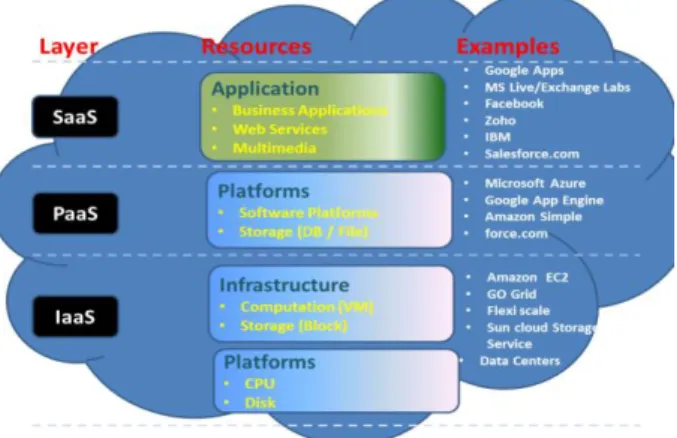
Fig 1: Cloud Architecture
Figure 1 shows generic architecture of cloud. In this infrastructure different layers of resources and service provider have shown.
Irrespective of cloud services model, there are deployment model for different cloud services.
Public Cloud: Public cloud infrastructure is managed and hosted by the service provider. The cloud user has no visibility or authority to control the cloud. Cloud architecture is used by the general public by low cost. Public cloud infrastructure has edge to be very large and has a scalable to enhance the network by adding different value added services.
Private Cloud: Private cloud structure is functioned and managed for one user. The association owns the network to provide services to cloud users.The cloud structure is workedout only for a specific group.
Community Cloud: This cloud structure is common among many organizations and is used for a specific community.
Hybrid Cloud: This cloud structurecan be viewed ascombination of two or more than two clouds which includes (public cloudor private cloud ) .In this structure hybrid cloud contains unique entities but it follows some standardized and propriety technologies which make sure of data and different application compatibilities.
The rest of the paper arranged in the subsequent manner. Section II describes related work. Section III is about need of quality of services.Section IV defines about the problem statement. Section V expresses the purposed solution. In the last weclose the paper with debate on future work in section VI.
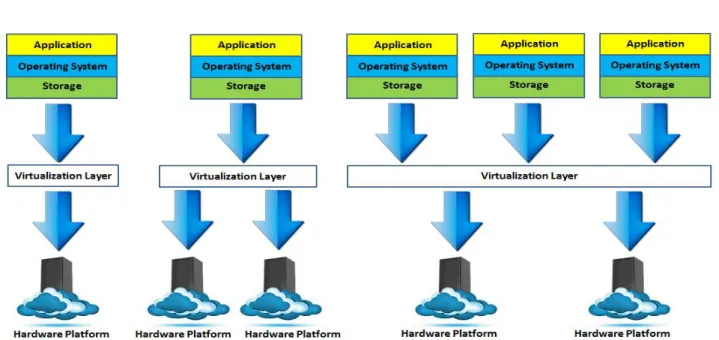
2. Related Work:. Traditional server setup has some drawback by which user effect while they access different resources. Following the figure shows the traditional server scenario in which any one server fails no user can access the resources.
Fig: 2 Demonstrates the Traditional File Server Setup
Figure 2 shows the traditional file server setup in which different applications are accessed by the clients. The Major drawback of this scenario is when any server will go down normally users cannot be able to access the services.
Virtualization
:
The capability to run many operating systems on a single physical system and share the differenthardware.Virtualization provides sophisticated environment in which different services can be rendered maintained by hardwareehich can be viewed on astand-alone-machine.Virtualization can be divided as: Server virtualization, data torage virtualization and network virtualization haveinevitablyhas open new horizons for Cloud computing. [8].Fig: 3 A Virtual Machine Monitor (VMM) Layer Between Guest OS and Hardware
3
different services.
Web Service and SOA: Web service providers are providing different Web services using Hyper Text Mark-up Language (HTML), Extensible Mark-up Language( XML) , Web ServicesDescription Language (WSDL), Simple Object Access Protocol (SOAP), and Universal Description, Discovery,and Integration (UDDI). Cloud service provider manages the serviceswithin a cloud in by Service OrientedArchitecture (SOA). Quality is an important paradigm while providing different services to cloud users.
Application Programming Interface (API): Cloud computing’s presence relies uponan application programming interface (API). All the fields of cloud computing rely on API’s to allow to deploy as well as to configure. Different services like data services, control services and application services are based upon API’s.
Web 2.0 and mash-u: Web 2.0 is one of the latest technologies which is used to create different web pages as well as edit them. Web 2.0 is used to edit and create World Wide Web (WWW) technology.Mash-up is one of the famous web applicationsthat collaborate data form different sources.
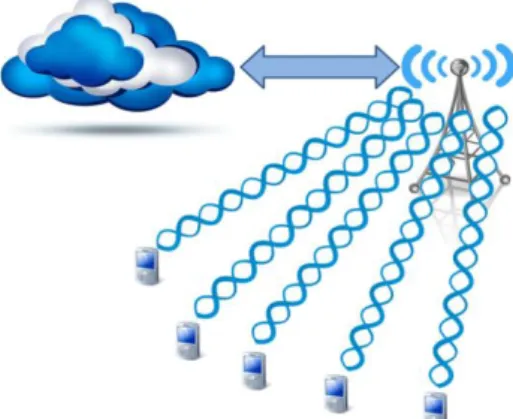
Fig 4: Mobile Cloud Architecture
Figure 4 shows the mobile infrastructure in which mobile devices connecting to the cellular tower for cellular services and also connected with a cloud for cloud services.
A List of characteristics which are provided by the cloud is long but some important characteristics are as under: 1. Pay as much as used and needed
2. “No-need-to-know” in terms of the underlying details of infrastructure 3. Universal network utilization
4. Resouurceavailibilty irrespective of geographical location 5. “Flexibility and elasticity
6. Pay per use
7. Always on!, anywhere and any place” [9].
To provide enhanced services and better management in the cloud it’s important to gain the trust of cloud users. Better quality can achieve the trust of cloud users and profit volume will multiply. The main advantage ofthe Internet is omnipresent access to users for different services. Now day’s new paradigm is going to use to these services named as a cloud. Using Cloud user can access cloud resources such asE-mail, Web-search, community websites,software services andplatform services. A lot of issues create hurdle while accessing the services of Interment. These obstacles contain limited oreven no:
Division of services
Routing the control mechanism Jitter and delay control
Control over applications transportationagainst privacy rules Internet-attach risk
Guarantees about network performance parameters (jitter, data lost, output etc.) On-demand bandwidthprovision
Data-exhaustive cloud setups
To enhance the quality of services in software product, controlling has been mainly used to optimize and to
enhance the performance [10]. As the different technologies are going to evolve, new challenges are also going to be part of discussion like the quality of service, performance, security, stability, scalability, consistency, reliability, validity, etc.[11] It is a great challenge toa cloud service provider the quality cloud services to its users. In short to managethe above servicesas well as to guarantee quality of service (QoS) when a user access the servicesis mostproblematic areain the cloud computing. It is cloud service provider’sresponsibility to provide quality of service services with minimum cost.[12]
3. REQUIREMENT FOR QoS-AWARE CLOUDS: To handle application responetime as well as to maintain QoS in any application or network services is playing a vital role to gain the trust of users. QoS control
management and control is a key challenge for the cloud services providers.Major issues are to control parameters by which quality of services is affected. Virtualization is one of them in which application performance changes due to a virtual machine. Other applications are also available and capacity does not assure about allocation performance. So ultimately QoS is important parameter to judge the trust of the cloud users.
1V. PROBLEM STATEMENT. Cloud computing is a dynamic and emerging field of the network.A critical parameter for the success of cloud computing service provider is to ensure the quality of service (QoS) for applications. Due to lack of quality of service parameters and undefined QoS architecture, it isa big hurdle to build the trust to cloud computing users to use the cloud computing services. In a single statement, the problem that we emphasis on this paper is: How to enhance the trust of the cloud users by providingan enhanced cloud computing model towards quality of service.
V. QaaS ARCHITECTURE ANDMETHODOLOGY. Cloud computing is providing astonishing benefits; that’s why many organization is going to adopt cloud services. This latest technology has made the corporate sector fast, flexible, and competitive.
Although cloud infrastructure is capable to provide vide variety of sophisticated services but it is not so simple to move data in the cloud infrastructure. There are a lot of challenges like data storage, privacy, security and most important quality of service (QoS).
While measuring the quality of services (QoS); we can categorize in to two types: qualitative and qualitative [13]. Qualitative quality parameters are those which cannot be measure or quantified and normally these can be judge by the consumer behaviour, consumer satisfaction or consumer experiences. While other parameter can be measure using different software techniques and hardware tools. Following are some of the quality of service parameters to judge the quality which is provided by the cloud service providers.
Service Response Time. Effectiveness of cloud service can be calculated while we discuss response time. It shows how fast the cloud service is accessible to use. Response time depends upon different factors like minimum response time, maximum response time,and percentage of maximum or minimum response time.
Maintainability: Maintainability is explainedas life time of service of the environment effect of cloud service used by the cloud users. We can categorize as: service maintainability or environment maintainability. Service maintainability is that in which service components are reused while without altering the users’ needs.Environment maintainability is judged by the carbon footmark of the cloud services.
Accuracy: Accuracy is defined as the level of service which is expected by the cloud users. While talking about virtual machine accuracy can be measured as how many times cloud service provider diverges from service level agreement (SLA). It can also explain as frequency of disaster in satisfying the SLA. The agreement can be of computation power, network utilization or storage service.
Transparency
Transparency is another important parameter to judge quality of service. In which we see the time in which performance of users is affected while service are changed.
Interoperability: Interoperability is the capability of the services which interrelate with other services offered by the same service cloud operator or other cloud service provider.
Availability: It is the time in which cloud user can access different services. If the cloud services are unavailable then we can say quality of the service is affected.
Reliability: Reliability means how cloud service is operated without interruption withinagreed terms and conditions. It can also well-defined average time in which cloud user is not getting services while cloud service provider guarantee to provide those services.
Solidity: Solidity is explained as inconsistency while providing service performance. If we talk about storage devices it can be said as read and write average time. While we talk about complex computational power; it is differed from service performance while we talk about service level agreement (SLA).
Resource utilization: Resource utilization is also important parameter which can be seen as CPU utilization, RAM utilization and Bandwidth utilization. While we offer these services maximum utilization must be provided to the users without interruption.
Execution time: Execution time is another parameter to judge the quality of service (QoS). While cloud user will execute any service execution time must be less so that cloud user can access the cloud services without delay.
Energy utilization: Energy utilization is very important issue while we talk about different service in wireless network. Energy utilization must be low as per unit service.
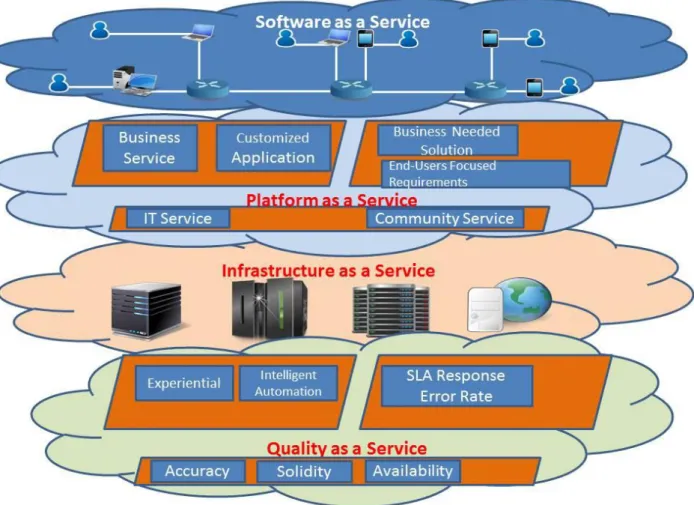
Fig 5: Enhanced Cloud Computing Model (QaaS)
REFERENCES
[1]
Buyya, R., Yeo, C. S., Venugopal, S., Broberg, J., & Brandic, I. (2009). Cloud computing and
emerging IT platforms: Vision, hype, and reality for delivering computing as the 5th utility.
Future
Generation computer systems
,
25
(6), 599-616.
[2]
L. A. Barroso and U. Holzle,“The Datacenter as a Computer: AnIntroduction to the Design
of Warehouse-Scale Machines,” Morgan & Claypool Publishers, 2009.
[3]
Amazon, “Amazon Web Services,” http://aws.amazon.com/.
[4]
[4]. Google, “Google app Engine,” http://code.google.com/appengine/.
[5]
[5]. Sales force, “CRM”, http://www.salesforce.com/.
[6]
Buyya, R., Yeo, C. S., Venugopal, S., Broberg, J., & Brandic, I. (2009). Cloud computing and
emerging IT platforms: Vision, hype, and reality for delivering computing as the 5th utility.
Future
Generation computer systems
,
25
(6), 599-616.
[7]
Joint, A., & Baker, E. (2011). Knowing the past to understand the present–issues in the contracting
for cloud based services.
Computer Law & Security Review
,
27
(4), 407-415.
[8]
Delgado, N., Gates, A. Q., & Roach, S. (2004). A taxonomy and catalog of runtime software-fault
monitoring tools.
Software Engineering, IEEE Transactions on
,
30
(12), 859-872.
[9]
Bakshi, A., & Yogesh, B. (2010, February). Securing cloud from ddos attacks using intrusion
detection system in virtual machine. In
Communication Software and Networks, 2010. ICCSN'10.
Second International Conference on
(pp. 260-264). IEEE.
[10]
Koh, Y., Knauerhase, R., Brett, P., Bowman, M., Wen, Z., & Pu, C. (2007, April). An analysis of
performance interference effects in virtual environments. In
Performance Analysis of Systems &
Software, 2007. ISPASS 2007. IEEE International Symposium on
(pp. 200-209). IEEE.
[11]
A. Verma, P. Ahuja, and A. Neogi,“ Power-aware dynamicplacement of hpcpplications,” In
Proceedings of the InternationalConference on Supercomputing (ICS), 2008.
[12]
Garg, S. K., Versteeg, S., & Buyya, R. (2013). A framework for ranking of cloud computing
services.
Future Generation Computer Systems
,
29
(4), 1012-1023.
Service(QaaS). Although cloud computing model is matured model in which three layers (Saas, Paas, Iaas) are defined in detail. Our work will be beneficial for the cloud users as well as cloud providers while accessing the cloud services. In this layer we add some quality paramters like SLA response error rate, solidity, availaibity etc. These paramters will be helpful for the cloud users while accessing the cloud services. This enhanced model will also a guidline for the cloud service providers to devolpthe trust of the cloud users. This is main issue while we provide the services to users.
4. Conclusion. Cloud computing is emerging platform to provide the web-based services. It includes different
kinds of services and requests on demand while providing maximum quality of services to cloud computing users Cloud computing is one of the modern era technology which is used to provide resources on demand. Cloud users can access the resources with no cost. Cloud users have no tension to install the infrastructure, to download any software specifically on the machine. Cloud computing provide different services like SaaS, PaaS ,IaaS etc. Cloud service provider must deliver the services to cloud users at minimum cost and maximum performance.Cloud services must be trustworthy so that user can easily rely on the cloud.