High-dimensional Data Stream Classification via Sparse Online Learning
Dayong Wang∗, Pengcheng Wu†, Peilin Zhao‡, Yue Wu§, Chunyan Miao∗ and Steven C.H. Hoi† ∗School of Computer Engineering, Nanyang Technological University, 639798, Singapore
†School of Information Systems, Singapore Management University, 178902, Singapore ‡Institute for Infocomm Research, A*STAR, 138632, Singapore
§University of Science and Technology of China, Hefei, 230026, China
Email:{dywang, ascymiao}@ntu.edu.sg,{pcwu, chhoi}@smu.edu.sg, [email protected], [email protected]
Abstract—The amount of data in our society has been exploding in the era of big data today. In this paper, we ad-dress several open challenges of big data stream classification, including high volume, high velocity, high dimensionality, and high sparsity. Many existing studies in data mining literature solve data stream classification tasks in a batch learning setting, which suffers from poor efficiency and scalability when dealing with big data. To overcome the limitations, this paper investigates an online learning framework for big data stream classification tasks. Unlike some existing online data stream classification techniques that are often based on first-order online learning, we propose a framework of Sparse Online Classification (SOC) for data stream classification, which includes some state-of-the-art first-order sparse online learning algorithms as special cases and allows us to derive a new effective second-order online learning algorithm for data stream classification. We conduct an extensive set of experiments, in which encouraging results validate the efficacy of the proposed algorithms in comparison to a family of state-of-the-art techniques on a variety of data stream classification tasks.
Keywords-data stream classification; sparse; online learning;
I. INTRODUCTION
In the era of big data today, the amount of data in our society has been exploding, which has raised many opportunities and challenges for data analytic research in data mining community. In this work, we aim to address the challenging real-world big data stream classification task, such as web-scale spam email classification. In general, big data stream classification has several characteristics:
• high volume: one has to deal with huge amount of
existing training data, in million or even billion scale;
• high velocity: new data often arrives sequentially and
very rapidly, e.g., about182.9 billion emails are sen-t/received worldwide every day according to an email statistic report by the Radicati Group [1];
• high dimensionality: there are a large number of
features, e.g., for some spam email classification tasks, the length of the vocabulary list can go up from10,000
to50,000or even to million scale;
• high sparsity: many feature elements are zero, and
the faction of active features is often small, e.g., the spam email classification study in [2] showed that
accuracy saturates with dozens of features out of tens of thousands of features.
The above characteristics present huge challenges for big data stream classification tasks when using conventional data stream classification techniques that are often restricted to batch learning setting. To tackle the above challenges, a promising approach is to explore online learning method-ology that performs incremental training over streaming data in a sequential manner. In contrast to batch learning algorithms, online algorithms are not only more efficient and scalable, but also able to avoid expensive re-training cost when handling new training data. However, the traditional online-learning algorithms suffer from critical limitation for high-dimensional data. This is because they assume at least one weight for every feature and most of the learned weights are often nonzero, making them of low efficiency not only in computational time but also in memory cost for both training and test phases. Sparse online learning [3] aims to overcome this limitation by inducing sparsity in the weights learned by an online-learning algorithm.
In this paper, we introduce a framework of Sparse On-line Learning for solving large-scale high-dimensional data stream classification tasks. We show that the proposed framework covers some existing first-order sparse online classification algorithm, and is able to further derive new algorithms by exploiting the second order information. The proposed sparse online classification scheme is far more efficient and scalable than the traditional batch learning al-gorithms for data stream classification tasks. We further give theoretical analysis of the proposed algorithm and conduct an extensive set of experiments. The empirical evaluation shows that the proposed algorithm could achieve state-of-the-art performance. The rest of this paper is organized as follows. Section 2 reviews related work. Section 3 presents our problem formulation. Section 4 proposes our novel framework . Section 5 discusses our experimental results, and section 6 concludes this work.
II. RELATEDWORK
A. Sparse Online Learning
Online learning represents a family of efficient and scal-able machine learning algorithms [4]. The general online
learning algorithms have solid theoretical guarantees and perform well on many applications. However, they exploit the full features, which is not suitable for large-scale high-dimensional problem. To tackle this limitation, the sparse online learning [5, 3, 6] has been extensively studied re-cently.Sparse online learningaims to learn a sparse linear classifier, which only contains limited size of active features. It has been actively studied [5, 7, 8, 9]. There are two group of solutions for sparse online learning. The first group study on sparse online learning follows the general idea of subgradient descent with truncation. For example, Duchi and Singer propose the FOBOS algorithm [5], which extends the Forward-Backward Splitting method to solve the sparse online learning problem in two phases: (i) an unconstrained subgradient descent step with respect to the loss function, and (ii) an instantaneous optimization for a trade-off between minimizing ℓ1 norm regularization and keeping close to the result obtained in the first phase. The optimization problem in the second phase can be efficiently solved by adopting simplesoft-thresholdingoperations that perform some truncation on the weight vectors. Following the similar scheme, Langford et al. [3] argue that truncation on every iteration is too aggressive as each step modifies the coefficients by only a small amount, and propose the Trun-cated Gradient (TG) method which truncates coefficients everyKsteps when they are less than a predefined threshold
θ. The second group study on sparse online learning mainly follows the dual averaging method of [10], can explicitly exploit the regularization structure in an online setting. For example, One representative work isRegularized Dual Averaging(RDA) [7], which learns the variables by solving a simple optimization problem that involves the running average of all past subgradients of the lost functions, not just the subgradient in each iteration. Lee et al. [11] further extends the RDA algorithm by using a more aggressive truncation threshold and generates significantly more sparse solutions.
B. Second-order Online Learning
The general online learning algorithms only exploit the first order information and all features are adopted the same learning rate. This problem can be addressed by
second order online learning algorithms [12], which aims to dynamically incorporate knowledge of observed data in earlier iteration to perform more informative gradient-based learning. Unlike first order algorithms that often adopt the same learning rate for all coordinates, the second order online learning algorithms adopt different distills to the step size employed for each coordinate. A variety of second order online learning algorithms have been proposed recently. Some technique attempts to incorporates knowledge of the geometry of the data observed in earlier iterations to perform more effective online updates. For example, Balakrishnan et al. [13] propose algorithms for sparse linear classifiers in the
massive data setting, which requiresO(d2)time andO(d2) space in the worst case. Another state-of-the-art technique for second order online learning is the family of confidence-weighted (CW) learning algorithms [14, 15, 16, 17, 18], which exploit confidence of weights when making updates in online learning processes. In general, the second order algorithms are more accurate, converge faster, but fall short in two aspects (i) they incur higher computational cost especially when dealing with high-dimensional data; and (ii) the weight vectors learned are often not sparse, making them unsuitable for high-dimensional data. Recently, Duchi et al. address the sparsity and second order update in the same framework, and proposed the Adaptive Subgradient method [19] (Ada-RDA), which adaptively modifies the proximal function at each iteration to incorporate knowledge about geometry of the data.
III. SPARSEONLINELEARNING FORDATASTREAM CLASSIFICATION
A. General Sparse Online Learning
Without loss of generality, we consider the sparse online learning algorithm for the binary classification problem, which is also mentioned as sparse online classification prob-lem in this paper. The sparse online classification algorithm generally works in rounds. Specifically, at the roundt, the algorithm is presented one instance xt ∈ Rd, then the
algorithm predicts its label as
ˆ
yt= sign(w⊤txt),
where wt ∈ Rd is linear classifier maintained by the
algorithm. After the prediction, the algorithm will receive the true label yt ∈ {+1,−1}, and suffer a loss ℓt(wt).
Then, the algorithm would update its prediction function
wtbased on the newly received(xt, yt). The standard goal
of online learning is to minimize the number of mistakes suffered by the online algorithm. To facilitate the analysis, we firstly introduce several functions. Firstly, the hinge loss
ℓt(w; (xt, yt)) = [1−ytw⊤xt]+, where[a]+ = max(a,0),
is the most popular loss function for binary classification problem. Let Φt, t = 1, . . . , T be δ-strongly convex func-tions with respect to the normsk · kΦt and letk · k
∗
Φt be the
respective dual norms. The proposed general sparse online classification (SOC) algorithm is shown in Algorithm 1.
For the proposed general sparse online learning (SOL) algorithm, if ℓ is convex and ηt = η, we can achieve that the regret RT =PT
t=1ℓt(wt)−minw
PT
t=1ℓt(w) of the proposed framework (1) satisfies the following inequality
RT ≤ ΦT(w) η + T X t=1 [η 2δkztk 2 Φ∗ t +λtk ztk1] + PT t=1∆∗t η (1) where∆∗
t = Φ∗t(θt)−Φ∗t−1(θt). Due to space limitations, we skip the derivation. Given this framework and these analysis, we would drive some specific algorithms and their regret bounds.
Algorithm 1 General Sparse Online Learning (SOL) INPUT :λ,η INITIALIZATION :θ1= 0. fort= 1, . . . , T do receivext∈Rn ut=∇Φ∗t(θt) wt= arg minw 1 2kut−wk 2 2+λtkwk1 predictytˆ = sign(w⊤ txt)
receive yt ∈ {−1,1} and suffer ℓt(wt) = [1 − ytw⊤txt]+
θt+1=θt−ηtzt wherezt=∇ℓt(wt);
end for
IV. DERIVEDALGORITHMS
In this section, we will first recover the RDA [7] algo-rithm and then derive algoalgo-rithm utilizing the second order-information. In this section, we will adopt the hinge loss function and denote L = {t|ℓt(wt) > 0} and Lt =
I(ℓt(wt)>0), where Iv is indicator function, Iv = 1 if v is
true, otherwiseIv = 0. A. First Order Algorithm
Set Φt(w) = 1
2kwk 2
2, which is 1-strongly convex with respect tok · k2. And it is known that the dual norm ofk · k2 isk · k2 itself, whileΦ∗t = Φt. Under these assumptions, we
get the first order sparse online learning (FSOL) algorithm, which is the same with Regularized Dual Averaging (RDA) algorithm with soft 1-norm regularization [7].
Algorithm 2 First Order Sparse Online Learning (FSOL) INPUT :λ,η INITIALIZATION :θ1= 0. fort= 1, . . . , T do receivext∈Rn wt= sign(θt)⊙[|θt| −λt]+ predictytˆ = sign(w⊤txt)
receive yt ∈ {−1,1} and suffer ℓt(wt) = [1 − ytw⊤txt]+
θt+1=θt+ηLtytxt
end for
The regret of the previous first order algorithm is upper boundedO(√T):
RT ≤ kwk2p(X2+ 2λX)T (2)
B. Second Order Algorithm
SetΦt(w) =1
2w⊤Atw, whereAt=At−1+
xtx⊤
t
r , r >0
and A0 = I. It is easy to verify that Φt is 1-strongly convex with respect tokwk2
Φt =
w⊤Atw. Its dual function Φ∗ t(w) is 12w⊤A− 1 t w, while kwk2Φ∗ t = w⊤A−t1w. Using
the Woodbury identity, we can incrementally update the
inverse ofAtasA−1 t =A−t−11− A−1 t−1xtx⊤tA−1 t−1 r+x⊤tA−t1 −1xt . Under these
assumptions, we get the second order sparse online learning (SSOL) algorithm. We can proof that the regret bound of the second order algorithm in an order ofO(log(T)). Algorithm 3Second Order Sparse Online Learning (SSOL)
INPUT :λ, η INITIALIZATION :θ1= 0. fort= 1, . . . , T do receivext∈Rn A−t1=A−t−11− A−1 t−1xtx⊤tA−t1 −1 r+x⊤tA−1 t−1xt ut=A−t1θt wt= sign(ut)⊙[|ut| −λt]+ predictytˆ = sign(w⊤txt)
receive yt ∈ {−1,1} and suffer ℓt(wt) = [1 − ytw⊤
t xt]+
θt+1=θt+ηLtytxt
end for
C. Diagonal Algorithm
Although the previous second order algorithm significant-ly reduced the regret bound than the first order algorithm, it will consumeO(d2) time, which reduced its application to real-world high dimension problems. To keep the com-putational time stillO(d)similar with the traditional online learning, we further explored the diagonal algorithm, which will only maintains a diagonal matrix. Its details is in the Algorithm (4). In the following experiment, we mainly adopt the diagonal second order sparse online learning algorithm unless otherwise specified, which is also denoted as “SSOL”.
Algorithm 4Diagonal Second Order Sparse Online Learn-ing INPUT :λ, η INITIALIZATION :θ1= 0. fort= 1, . . . , T do receivext∈Rn A−t1=A− 1 t−1− A−t1 −1diag(xtx⊤ t)A −1 t−1 r+x⊤tA−t1 −1xt ut=A−t1θt wt= sign(ut)⊙[|ut| −λt]+ predictytˆ = sign(w⊤txt)
receive yt ∈ {−1,1} and suffer ℓt(wt) = [1 − ytwt⊤xt]+
θt+1=θt+ηLtytxt
end for
V. EXPERIMENTS
A. Experimental Setup
In our experiments, we compare the proposed algorithms with a set of state-of-the-art algorithms. The methodology
Table I
LIST OFCOMPAREDALGORITHMS, “TG”MEANSTRUNCATE
GRADIENT AND“DA”MEANSDUALAVERAGING. Algorithm Order Sparsity Description
STG 1st TG Stochastic Gradient Descent [3] FOBOS 1st TG FOrward Backward Splitting [5] Ada-FOBOS 2nd TG Adaptive regularized FOBOS [19] Ada-RDA 2nd DA Adaptive regularized RDA [19] FSOL 1st DA The proposed Algorithm 2 SSOL 2nd DA The proposed Algorithm 4
details of these algorithms are listed in Table I.
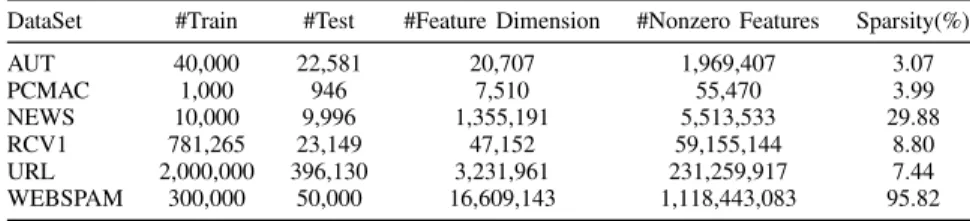
To examine the binary classification performance, we evaluate all the previous algorithms on a number of bench-mark datasets from web machine learning repositories. Ta-ble II shows the details of all the datasets in our exper-iments. These datasets are selected to allow us evaluate the algorithms on various characteristics of data, in which the number of training examples ranges from thousands to millions, feature dimensionality ranges from hundreds to about 16-million, and the total number of non-zero features on some dataset is more than one billion. For the very large-scale WEBSPAM dataset, we run the algorithms only once. The sparsity as shown in the last column of the table denotes the ratio of non-active feature dimensions, as some feature dimensions are never active in the training process, which is often the case for some real-world high-dimensional dataset, such as WEBSPAM. For parameter tuning, we conduct a 5-fold cross validation to search the parameters with the fixed sparsity regularization parameterλ= 0on each dataset.
B. Experiment on Error Rate
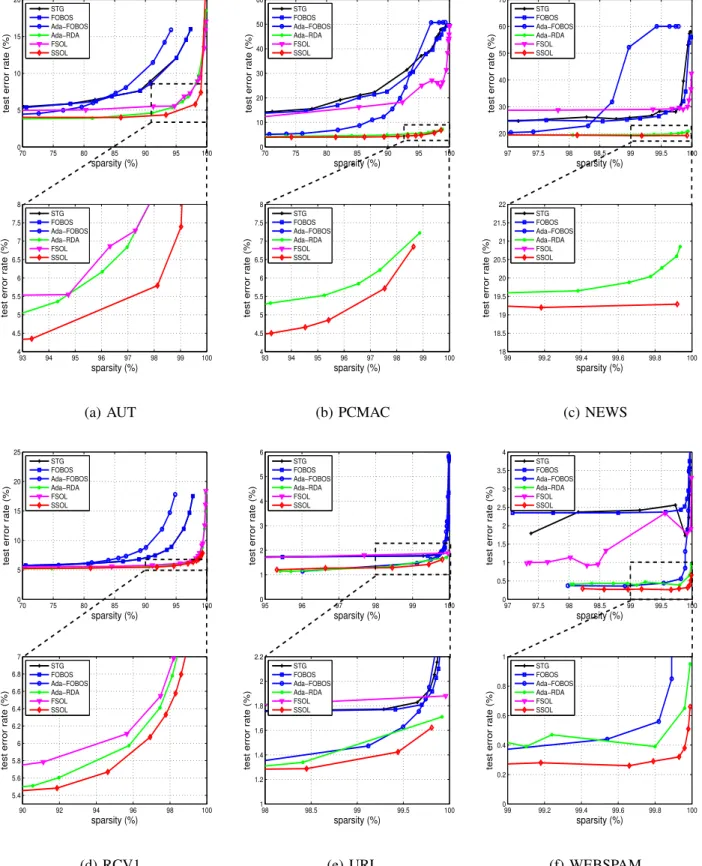
In this experiment, we compare the proposed algorithms (FSOL and SSOL) with the other algorithms on sever-al resever-al-world datasets. Table II shows the details of six datasets, which can be roughly grouped into two major categories: the first two datasets (AUT and PCMAC) are general binary small-scale datasets and the corresponding experimental results are shown in Figure 1 (a)-(b); and the rest four datasets (NEWS, RCV1, URL, and WEBSPAM) are large-scale high-dimensional sparse datasets and the corresponding experimental results are shown in Figure 1 (c)-(f). We can draw several observation from these results as follows.
First of all, we observe that most algorithms can learn an effective sparse classification model with only marginal or even no loss of accuracy. For example, in Figure 1 (d), the performances of all the algorithms are almost stable when sparsity level is smaller than 80%. It indicates that all the compared sparse online classification algorithm can effec-tively explore the low level sparsity information. Second, for most cases, we observe that there exists some sparsity threshold for each algorithm, below which test error rate does not change much; but when sparsity level is greater
than the threshold, test error rate gets worse quickly. Third, we observe that the dual averaging based second order algorithms (Ada-RDA and SSOL) consistently outperfor-m the other algorithoutperfor-ms (STG, FOBOS, FSOL, and Ada-FOBOS), especially for high sparsity level. This indicates that the dual averaging technique and second order updating rules are effective to boost the classification performance. Finally, when the sparsity is high, an essential requirement for high-dimensional data stream classification tasks, the proposed SSOL algorithm consistently outperforms the other algorithms over all the evaluated datasets. For example, when the sparsity is about99.8%for the WEBSPAM dataset (the total feature dimensionality is 16,609,143), the test error rate of SSOL is about0.3%, while the Ada-RDA is
0.4%and the Ada-FOBOS is0.55%, as shown in Figure 1 (f).
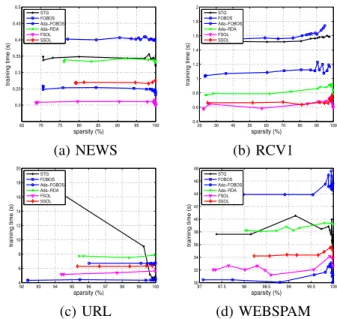
C. Experiment on Running Time
65 70 75 80 85 90 95 100 0.2 0.25 0.3 0.35 0.4 0.45 0.5 training time (s) sparsity (%) STG FOBOS Ada−FOBOS Ada−RDA FSOL SSOL 20 30 40 50 60 70 80 90 100 0.4 0.6 0.8 1 1.2 1.4 1.6 1.8 2 training time (s) sparsity (%) STG FOBOS Ada−FOBOS Ada−RDA FSOL SSOL (a) NEWS (b) RCV1 92 93 94 95 96 97 98 99 100 4 6 8 10 12 14 16 18 20 training time (s) sparsity (%) STG FOBOS Ada−FOBOS Ada−RDA FSOL SSOL 97 97.5 98 98.5 99 99.5 100 30 32 34 36 38 40 42 44 46 48 training time (s) sparsity (%) STG FOBOS Ada−FOBOS Ada−RDA FSOL SSOL (c) URL (d) WEBSPAM
Figure 2. Time cost on four large-scale datasets: NEWS, RCV1, URL, and WEBSPAM
We also examine time costs of different sparse online classification algorithms, and the experiment results are shown in Figure 2. In this experiment, we only adopt the four high-dimensional large-scale dataset. Several observations can be drawn from the results.
First of all, we observe that when the sparsity level is low, the time costs are generally stable; on the other hand, when the sparsity level is high, the time cost of the second algorithms sometimes will somewhat increase. For example, the test costs of Ada-FOBOS, Ada-RDA and FSOL in Figure 2 (b) & (d). One possible reason may be that when the sparsity level is high, the model might not be informative enough for prediction and thus may suffer significant more updates. Since second-order algorithms are
70 75 80 85 90 95 100 0 5 10 15 20
test error rate (%)
sparsity (%) 93 94 95 96 97 98 99 100 4 4.5 5 5.5 6 6.5 7 7.5 8
test error rate (%)
sparsity (%) STG FOBOS Ada−FOBOS Ada−RDA FSOL SSOL STG FOBOS Ada−FOBOS Ada−RDA FSOL SSOL 70 75 80 85 90 95 100 0 10 20 30 40 50 60
test error rate (%)
sparsity (%) 93 94 95 96 97 98 99 100 4 4.5 5 5.5 6 6.5 7 7.5 8
test error rate (%)
sparsity (%) STG FOBOS Ada−FOBOS Ada−RDA FSOL SSOL STG FOBOS Ada−FOBOS Ada−RDA FSOL SSOL 97 97.5 98 98.5 99 99.5 100 20 30 40 50 60 70
test error rate (%)
sparsity (%) 99 99.2 99.4 99.6 99.8 100 18 18.5 19 19.5 20 20.5 21 21.5 22
test error rate (%)
sparsity (%) STG FOBOS Ada−FOBOS Ada−RDA FSOL SSOL STG FOBOS Ada−FOBOS Ada−RDA FSOL SSOL
(a) AUT (b) PCMAC (c) NEWS
70 75 80 85 90 95 100 0 5 10 15 20 25
test error rate (%)
sparsity (%) 90 92 94 96 98 100 5.4 5.6 5.8 6 6.2 6.4 6.6 6.8 7
test error rate (%)
sparsity (%) STG FOBOS Ada−FOBOS Ada−RDA FSOL SSOL STG FOBOS Ada−FOBOS Ada−RDA FSOL SSOL 95 96 97 98 99 100 0 1 2 3 4 5 6
test error rate (%)
sparsity (%) 98 98.5 99 99.5 100 1 1.2 1.4 1.6 1.8 2 2.2
test error rate (%)
sparsity (%) STG FOBOS Ada−FOBOS Ada−RDA FSOL SSOL STG FOBOS Ada−FOBOS Ada−RDA FSOL SSOL 97 97.5 98 98.5 99 99.5 100 0 0.5 1 1.5 2 2.5 3 3.5 4
test error rate (%)
sparsity (%) 99 99.2 99.4 99.6 99.8 100 0 0.2 0.4 0.6 0.8 1
test error rate (%)
sparsity (%) STG FOBOS Ada−FOBOS Ada−RDA FSOL SSOL STG FOBOS Ada−FOBOS Ada−RDA FSOL SSOL
(d) RCV1 (e) URL (f) WEBSPAM
Figure 1. Test error rate on6large real datasets. (a)-(b) are two general datasets, (c)-(f) are four large-scale high-dimensional sparse datasets. The second
Table II
LIST OF REAL-WORLD DATASETS IN OUR EXPERIMENTS.
DataSet #Train #Test #Feature Dimension #Nonzero Features Sparsity(%)
AUT 40,000 22,581 20,707 1,969,407 3.07 PCMAC 1,000 946 7,510 55,470 3.99 NEWS 10,000 9,996 1,355,191 5,513,533 29.88 RCV1 781,265 23,149 47,152 59,155,144 8.80 URL 2,000,000 396,130 3,231,961 231,259,917 7.44 WEBSPAM 300,000 50,000 16,609,143 1,118,443,083 95.82
more complicated than first-order algorithms, they are more sensitive to the increasing number of updates.
Second, we can see that the proposed SSOL algorithm runs more efficiently than another second-order based algo-rithms (Ada-RDA and Ada-FOBOS). It is even sometimes better than the first order based algorithm (e.g. FOBOS and STD). However, the first order FSOL algorithm is consistently faster than the second order SSOL algorithm.
In summary, the proposed SSOL algorithm can achieve comparable or even better performance than all the com-pared second-order algorithms with less time cost.
VI. CONCLUSIONS ANDFUTURE WORK
In this paper we introduced a framework of sparse online classification (SOC) for large-scale high-dimensional data stream classification tasks. We first showed that the frame-work essentially includes an existing first-order sparse online classification algorithm as a special case, and can be further extended to derive new sparse online classification algo-rithms by exploiting second-order information. We analyzed the performance of the proposed algorithms on several real word datasets, in which the encouraging experimental results showed that the proposed algorithms are able to achieve the state-of-the-art performance in comparison to a large family of diverse online learning algorithms.
REFERENCES
[1] S. Radicati, “Email statistics report, 2013-2017.” The Radicati Group,Inc., Tech. Rep., April 2013.
[2] S. Youn and D. McLeod, “Spam email classification using an adaptive ontology.” JSW, vol. 2, no. 3, pp. 43–55, 2007.
[3] J. Langford, L. Li, and T. Zhang, “Sparse online learning via truncated gradient,”J. Mach. Learn. Res., vol. 10, pp. 777–801, 2009.
[4] S. C. Hoi, J. Wang, and P. Zhao, “Libol: A library for online learning algorithms,” Journal of Machine Learning Research, vol. 15, pp. 495–499, 2014. [5] J. Duchi and Y. Singer, “Efficient online and batch
learning using forward backward splitting,” J. Mach. Learn. Res., vol. 10, pp. 2899–2934, 2009.
[6] X. Gao, S. C. Hoi, Y. Zhang, J. Wan, and J. Li, “Soml: Sparse online metric learning with application to image retrieval,” Proceedings of the Twenty-Eighth AAAI Conference on Artificial Intelligence, 2014.
[7] L. Xiao, “Dual averaging methods for regularized stochastic learning and online optimization,”The Jour-nal of Machine Learning Research, vol. 9999, pp. 2543–2596, 2010.
[8] S. Shalev-Shwartz and A. Tewari, “Stochastic methods for l 1-regularized loss minimization,”The Journal of Machine Learning Research, pp. 1865–1892, 2011. [9] J. Wang, P. Zhao, S. C. Hoi, and R. Jin, “Online feature
selection and its applications,” IEEE Transactions on Knowledge and Data Engineering, pp. 1–14, 2013. [10] Y. Nesterov, “Primal-dual subgradient methods for
con-vex problems,” Mathematical programming, vol. 120, no. 1, pp. 221–259, 2009.
[11] S. Lee and S. J. Wright, “Manifold identification in dual averaging for regularized stochastic online learn-ing,”The Journal of Machine Learning Research, vol. 98888, pp. 1705–1744, 2012.
[12] J. Lu, S. Hoi, and J. Wang, “Second order online col-laborative filtering,” in Asian Conference on Machine Learning, 2013, pp. 325–340.
[13] S. Balakrishnan and D. Madigan, “Algorithms for sparse linear classifiers in the massive data setting,”
The Journal of Machine Learning Research, vol. 9, pp. 313–337, 2008.
[14] M. Dredze, K. Crammer, and F. Pereira, “Confidence-weighted linear classification,” in ICML, 2008, pp. 264–271.
[15] K. Crammer, M. Dredze, and F. Pereira, “Exact con-vex confidence-weighted learning,” inNIPS, 2008, pp. 345–352.
[16] K. Crammer, A. Kulesza, and M. Dredze, “Adaptive regularization of weight vectors,” Machine Learning, pp. 1–33, 2009.
[17] J. Ma, A. Kulesza, M. Dredze, K. Crammer, L. K. Saul, and F. Pereira, “Exploiting feature covariance in high-dimensional online learning,” inICAIS, 2010, pp. 493– 500.
[18] J. Wang, P. Zhao, and S. C. Hoi, “Exact soft confidence-weighted learning,” inICML, 2012. [19] J. Duchi, E. Hazan, and Y. Singer, “Adaptive
subgra-dient methods for online learning and stochastic opti-mization,”The Journal of Machine Learning Research, pp. 2121–2159, 2011.