A Model for Policy Interventions in
Support of Electronic Governance
Radha Chauhan, Elsa Estevez and Tomasz Janowski
May 2009
UNU-IIST and UNU-IIST Reports
UNU-IIST (United Nations University International Institute for Software Technology) is a Research and Training Centre of the United Nations University (UNU). It is based in Macao, and was founded in 1991. It started operations in July 1992. UNU-IIST is jointly funded by the government of Macao and the governments of the People’s Republic of China and Portugal through a contribution to the UNU Endowment Fund. As well as providing two thirds of the endowment fund, the Macao authorities also supply UNU-IIST with its office premises and furniture and subsidise fellow accommodation.
The mission of UNU-IIST is to assist developing countries in the application and development of software technology.
UNU-IIST contributes through its programmatic activities:
1. Advanced development projects, in which software techniques supported by tools are applied, 2. Research projects, in which new techniques for software development are investigated,
3. Curriculum development projects, in which courses of software technology for universities in developing countries are developed,
4. University development projects, which complement the curriculum development projects by aiming to strengthen all aspects of computer science teaching in universities in developing countries,
5. Schools and Courses, which typically teach advanced software development techniques, 6. Events, in which conferences and workshops are organised or supported by UNU-IIST, and
7. Dissemination, in which UNU-IIST regularly distributes to developing countries information on international progress of software technology.
Fellows, who are young scientists and engineers from developing countries, are invited to actively participate in all these projects. By doing the projects they are trained.
At present, the technical focus of UNU-IIST is on formal methods for software development. UNU-IIST is an internationally recognised center in the area of formal methods. However, no software technique is universally applicable. We are prepared to choose complementary techniques for our projects, if necessary.
UNU-IIST produces a report series. Reports are either Research R , Technical T , Compendia C or Administrative A . They are records of UNU-IIST activities and research and development achievements. Many of the reports are also published in conference proceedings and journals.
Please write to UNU-IIST at P.O. Box 3058, Macao or visit UNU-IIST’s home page: http://www.iist.unu.edu, if you would like to know more about UNU-IIST and its report series.
P. O. Box 3058 Macao
A Model for Policy Interventions in
Support of Electronic Governance
Radha Chauhan, Elsa Estevez and Tomasz Janowski
Abstract
A policy framework is the backbone of public governance and a major contributor to its quality. Such a framework is particularly required in the areas where public governance seeks technology support, as is the case for Electronic Governance (e-Governance). This report explains the need for a comprehensive set of policies, and presents a model for policy interventions supporting e-Governance development. The model comprises a classification of policies based on their nature and applicability, and describes core areas for which policy interventions are required. The report also presents three major scenarios for the use of the model: (1) a tool to help design and analyze critical policy interventions by developing and transition nations, (2) a template to understand different alternatives for interventions, and (3) a checklist to review all niche areas to be regulated. In particular, the application of this model to the Indian context is discussed.
Radha Chauhan was a Senior Government Fellow at the Center for Electronic Governance - United Nations University - International Institute for Software Technology (UNU-IIST-EGOV) in Macao from 4 May to 27 June 2008.
Elsa Estevez is a Senior Researcher at the Center for Electronic Governance United Nations University -International Institute for Software Technology in Macao (UNU-IIST-EGOV). She is also an Assistant Professor at the Universidad Nacional del Sur (UNS) in Bahia Blanca, Argentina where she teaches subjects related to Software Engineering. Prior to joining UNS, she has been working as a Project Leader, Project Manager, System Analyst and Programmer in Information Technology for major industries, including banking, in Argentina. While in UNU-IIST-EGOV, Elsa Estevez contributed to various tasks of the e-Macao and UNeGov.net projects, from research and development, through training, to networking. Her current research interest include: Electronic Government, developing software infrastructure for Electronic Government, and Component-Based Software Development. Elsa Estevez holds an MSc degree in Computer Science from UNS and a Licenciado Degree in Computer Science from Universidad de Buenos Aires, Argentina.
Tomasz Janowski is the Head of the Center for Electronic Governance United Nations University -International Institute for Software Technology in Macao (UNU-IIST-EGOV) and a Senior Research Fellow of UNU-IIST. Tomasz Janowski has authored and co-authored numerous publications in Computer Science, Software Engineering and Foundations. He has served as Program Committee member at many international conferences, supervised a number of international students and staff, and led several research, development and capacity-building projects. These include the e-Macao Program to build a foundation for Electronic Government in Macao and the UNeGov.net initiative to building a global community of practice for Electronic Governance. As part of the UNeGov.net initiative, he organized many workshops and schools on Electronic Governance in developing countries. His current research interests include foundations of Electronic Governance, tools and applications of formal methods, and rigorous development of enterprise software, particularly software for the public sector. Tomasz Janowski holds a PhD in Computer Science from the University of Warwick, England, and an MSc in Mathematics from the University of Gdansk, Poland.
Contents i
Report No. 415, May 2009 UNU-IIST, P. O. Box 3058, Macao Contents 1 Introduction ... 1
2 Approach ... 2
3 Policy Interventions – Perspectives ... 3
3.1Applicability ... 3
3.2 Orientation ... 3
3.3Evolution ... 4
4 Policy Interventions - Practice ... 5
4.1 United States of America ... 5
4.2 Canada ... 5
4.3 European Union ... 6
4.4 Summary ... 7
4.5 Discussion ... 7
5 A Model for Policy Interventions ... 9
5.1 Model - Premises ... 9
5.2 Model - Structure ... 10
5.3 Model - Refinement ... 10
5.4 Model - Components... 11
5.5 Summary ... 11
6 Model Application - India ... 12
6.1 e-Governance in India ... 12
6.2 Policy Approach ... 12
6.3 Regulatory Framework ... 13
6.4 Challenges ... 13
6.5 Applying the Model ... 13
7 Conclusions ... 16
A Model for Policy Intervention in Support of Electronic Governance
Report No. 415, May 2009 UNU-IIST, P. O. Box 3058, Macao
1
1
Introduction
Policies lay down the basic framework for government operations and provide a clear picture to all stakeholders about expected outcomes and related responsibilities. In addition, in a dynamic political environment, policies provide the much needed protection of government operations from frequent reversals of decisions. They provide the required direction and mandate that leaders at each level of government need regarding correctness and adequacy of decisions, and the extent of accountability for them.
A look at the landscape of policies that drive and regulate e-Governance development reveals a stepwise evolution which runs parallel with the evolution of e-Governance itself. At the initial stage, policy development follows the perception of e-Governance as merely a technology-driven version of traditional government. Along the way, revelations about the transformational nature and evident impact of e-Governance on basic government structures lead to more fundamental interventions at the policy level. At both stages, e-Governance is not regarded as a domain in itself. Hence, it has no clear ownership, diffused all across government structures, which to a great extent weakens the effort as a whole. However, more recently various countries have enacted legislations to drive and regulate e-Governance as a self-contained domain, e.g. USA and Austria, to address this inherent weakness.
Against government interventions in numerous vertical domains – health, education, security, etc. the impact of e-Governance as a cross-cutting horizontal concept has to be recognized in light of the federal nature of government policies as a whole. Federal policies involve hierarchies of policy making, generally aggregated at three levels: (1) federal or central, (2) state or provincial, and (3) district, local or municipal. However, with overlapping jurisdictions within constitutional structures, discretion comes into play and different interpretations may occur at each level of the hierarchy. e-Governance adds an interesting facet to this hierarchy and its dynamics.
This report makes a case that the outcomes envisaged under the discipline of e-Governance need to be fully elaborated at the policy level. The report presents this elaboration in the form of a model for policy interventions that provides insights about expected outcomes and how they are to be produced, while assuring that the value of the overall effort is well understood. The model was derived following the observed evolution of policy frameworks in the countries that have a clear lead on the subject, validated in the context of India, and used to underpin a set of recommendations that can pave the way forward in evolving policy frameworks for e-Governance, particularly in developing countries.
The rest of the report is structured as follows. Section 2 explains the methodology applied in this work. Section 3 presents a theoretical perspective on policy interventions for e-Governance. Section 4 discusses the evolution of policy frameworks in three countries/regions: USA, Canada and the European Union. Section 5 presents our model for policy interventions, while Section 6 demonstrates its applicability in the case of India. Finally, Section 7 draws some conclusions.
A Model for Policy Intervention in Support of Electronic Governance
Report No. 415, May 2009 UNU-IIST, P. O. Box 3058, Macao
2
2
Approach
The main approach adopted in this work was:
o to examine how the countries that are most advanced in e-Governance have addressed the
need for a policy framework,
o to trace the path e-Governance leaders followed to reach the current stage, and o to refer to the experience of India.
Drawing upon personal experience of the first author in eGovernance policymaking and -implementation at the field level, an attempt has been made to critically evaluate the lessons learnt by leading countries in this area, to come up with a model and a set of recommendations that indicate critical areas that need policy interventions and, to some extent, suggest the scope and nature of such interventions.
The report contains an overview of the policy frameworks in three leading countries or regions in terms of e-Governance: USA, Canada and the European Union. Being at the initial stage of the national program for e-Governance, India can learn from these experiences to put in place a strong policy framework. Such a framework could help clarify the roles and responsibilities of various parties taking part in the implementation. It could also act as a bridging tool to forge coordinated, well-orchestrated efforts across state and provincial governments, particularly when they are at different stages of e-Governance development. To some extent, the gap can be bridged by mandating a charter prescribing the aims and the progress towards e-Governance, and providing policy guidelines that cover the topics falling solely within the scope of provincial governments, so as to strengthen and hasten progress in the desired direction.
A Model for Policy Intervention in Support of Electronic Governance
Report No. 415, May 2009 UNU-IIST, P. O. Box 3058, Macao
3
3
Policy Interventions – Perspectives
While defining policy interventions for e-Governance, three perspectives should be considered:
1) Applicability – how to classify policies according to the way in which they could be applied, such as enforcing, ensuring or enabling;
2) Orientation – the domain to be regulated; and
3) Evolution – how the intervention model could evolve depending on the changing context.
Each of these perspectives is described and analyzed in the following sections.
3.1 Applicability
We classify policy interventions based on the nature and extent of their applicability as follows:
1) Regulations are enforceable by law for all stakeholders, usually by legislative enactments. 2) Directives are administrative rules that are valid within the government, as long as they
are not withdrawn or amended. They are not enforceable but mandatory in nature.
3) Guidelines are generally indicative, aiming to guide actions at the discretion of the addressee.
In other words – regulations enforce, directives ensure, and guidelines enable.
3.2 Orientation
Various types of policy orientations come to light while developing policies to support e-Governance development. Some of them are:
1) e-Government – Policies focusing on the services delivered to the public, and administration.
2) e-Democracy – Policies focusing on citizen empowerment and participatory governance. 3) e-Business – Policies focusing on government engaging in electronic business with the
market at large, including procurement and collaborations with partners outside government.
A Model for Policy Intervention in Support of Electronic Governance
Report No. 415, May 2009 UNU-IIST, P. O. Box 3058, Macao
4
3.3 Evolution
The fundamental question with policy interventions for e-Governance, is whether policy statements and regulations on ICT are generally sufficient to deal with e-Governance as a domain, or do they merely form a starting point? To answer this question, Koops et al [1] identified the following approaches as starting points for IT-related policy development: 1) Off-line = On-line – Producing on-line-related laws similarly to the existing
off-line-related laws; for instance, recognizing electronic processes as legally equivalent to paper-based processes.
2) Technology neutrality – Producing policies which are neutral with respect to technology, protected against the rate and speed of technological change; for instance, policies about data privacy.
3) Self regulation – Policies should consider feedback from major stakeholders, particularly to respond to public expectations and to address dynamic nature of technology in regulations; for instance, policies about Public Key Infrastructure.
4) Internationalization – Policies should consider the transnational nature of ICT and its usage; for instance, international electronic funds transfer.
5) Code as Law – Policies should be created when particular technical context requires regulation or intervention; for instance, e-voting.
Koops et al [1] suggests that these points can serve as a procedural checklist for initiating an e-Policy exercise.
A Model for Policy Intervention in Support of Electronic Governance
Report No. 415, May 2009 UNU-IIST, P. O. Box 3058, Macao
5
4
Policy Interventions - Practice
We review in this section the practice of policy interventions for e-Governance, first considering concrete experiences from United States, Canada and the EU, followed by summary and discussion.
4.1 United States of America
Tracing the initial policy path charted by the United States of America, we face a myriad of regulations, either focused on technology or governance [1]. Notable examples include the Freedom of Information Act (FOIA) [1] of 1966, Privacy Act [7] of 1974, Paperwork Reduction Act [1] of 1980, Computer Security Act [1] of 1987, and Computer Matching and Privacy Protection Act [10] of 1988. In particular, the Clinger-Cohen Act [11] of 1996 established a Chief Information Officer (CIO) position in each agency, as well as decentralized and streamlined IT procurement procedures. It marked for the first time the recognition of e-Governance as a separate domain. Continuing this trend was the Government Paperwork Elimination Act (GPEA) [12] that required the Office of Management and Budget (OMB) to provide leadership in acquiring and implementing technologies necessary to substitute paper-based documents with electronic documents. Finally, the E-Government Act [13] of 2002 formally recognized e-Governance as a domain and mapped all previous interventions to one whole policy framework.
The motivation for the Government Act (the Act) included: i) uneven success with e-Government across the whole public administration system; ii) difficulty in establishing inter-agency collaboration, particularly insufficient funds for such collaboration; and iii) lack of management capacity within government to address finances, procurement, human capital, and other challenges facing e-Government development. The reauthorization of the Act is planned to address the fundamental disparity between the horizontal nature of e-Government and the vertical organization of the government’s oversight and funding mechanisms. It also plans to address sustainability and directions of e-Government in light of leadership transitions [14].
Starting from the ‘what is offline applies to online’ approach (FOIA-EFOIA 1996) [5], e-Governance is gradually evolving into a discipline that has its own issues related to people, processes, and technology. The Act, being a comprehensive piece of regulation, supported this transition. It also determined, formally and unequivocally, clear ownerships and responsibility for e-Government development within government structures. Notably, with well defined responsibilities, e.g. the mandate to CIO council or interagency committee [15][16], directions for cascading them were supported by policy guidelines in all core areas.
4.2 Canada
The focus on policies, technical standards like the Common Look and Feel initiative, legislation and privacy requirements are major critical success factors of Government OnLine (GOL) in Canada [17].
A Model for Policy Intervention in Support of Electronic Governance
Report No. 415, May 2009 UNU-IIST, P. O. Box 3058, Macao
6
The regulatory framework is based primarily on the Public Works and Government Services Act that supports the creation of a secure channel infrastructure for delivering public services. The act also stipulates the establishment of a common service agency to provide all agencies with support to their programs.
In addition, the Personal Information Protection and Electronic Documents Act (PIPEDA) protects the privacy of individuals with respect to the collection, use and disclosure of personal information by public and private sector organizations [18]. Policies that support delivery of e-government services include Government Security Policy - safeguarding employees and assets, and the Privacy Impact Assessment Policy – assessing service proposals with respect to privacy issues. Furthermore, the Common Services Policy ensures that departments and agencies acquire cost-effective support for delivering their program, while the Common Look and Feel Standard guarantees equal access to information on national websites [18].
Canada provides another interesting facet to policy framework in that it has a healthy combination of Acts (as Regulations) and policy Guidelines and Directives. Acts concern the safeguarding of the core interests, and are enforceable. Guidelines and Directives exist in the matters where the government and stakeholders need clear directions to achieve the envisaged outcomes.
4.3 European Union
The initial focus in the European Union has been on identifying legislations that impede the uptake of electronic communication. Legal enablement has been seen as critical to the successful development of e-Government, and the strategy was to identify and correct such incompatible provisions.
In France, one of the aims of the e-Government Strategic Plan is to promote evolution of laws aimed at addressing regulatory obstacles to the development of e-Government and establishing an overall coherent legal framework that permits the development of e-Government services. In Germany, the success of e-e-Government is directly linked to the arrangements aiming at legal certainty, with selected administrative procedures and specific statutes amended to enable electronic interaction [19]. In Austria, the Austrian e-Government Act of 2004 is a comprehensive legal mandate that has advanced the realm of e-Government mainly through identification and protection.
One notable feature of EU policies – mandating the region as a whole by transcending national borders, is the focus on privacy protection with broader challenge of identification. The focus is on assuring that in an electronic environment, certain rights and obligations are rightfully attributed to citizens, while fulfilling the underlying requirements for certainty and security [3]. In addition, the following areas were identified as challenging for e-Government: administrative law, authentication and identification, Intellectual Property Rights (IPR), liability, privacy and data protection, freedom of information, and reuse of information [19].
A Model for Policy Intervention in Support of Electronic Governance
Report No. 415, May 2009 UNU-IIST, P. O. Box 3058, Macao
7
4.4 Summary
The above overview of policy evolution in three national contexts brings into focus several areas that are at the core of e-Governance policy interventions. These areas include: inter-agency working and sharing, public-private partnerships, personalized e-services, and the perceived unlimited power of information and knowledge that governments acquire through new technologies. Secondly, once these areas have been identified, ways of regulating them through policies vary from comprehensive regulatory acts, through trans-national policy mandates, to combination of acts and guidelines. The orientation for policy design and its applicability are adopted to fit national contexts. Lastly, the evolution of policy interventions is directly related to the evolution of e-Governance in practice.
4.5 Discussion
The approach generally seen across most countries, including the cases described above, is a hybrid IT Policy orientation, based on the nature of the shared national vision [2]. It is generally a combination of government, business, and citizens contributions.
One of the common starting points is the principles that legal provisions guiding the off-line world can be also applied and upheld in the information society. The principle “what applies offline applies online” has a number of advantages: consistency, legal clarity and legal certainty. The underlying assumption is that the online world is not disconnected from the legal one, and that legal aspects should apply to both off-line and on-line transactions, while expecting e-Governance to comply with domain-specific regulations [3]. This can be considered the first step for policy interventions.
However, considering just the on-line aspects of traditional legal rules is generally insufficient. Rules specific to e-governance are required, like recognizing e-voting as a valid voting method or replacing hand-written signatures with electronic signatures. The central discussion is whether such policy initiatives are part of the e-Governance domain, or require a broader setting. In any case, the impact of e-Governance and the demand for intervention it raises in legal and regulatory frameworks cannot be denied [3].
Initially, legislative and regulatory interventions were limited to assuring that legal frameworks do not pose obstacles upon the development and usage of ICT. However, the adoption of e-Governance in practice and its evolution into a separate functional area, led to regulatory strategies that are designed differently than those applied in traditional paper-based governance. The legal issues to be tackled in the course of e-Governance implementation include, for instance: access to public sector information, dematerialization of government communication, archiving digital records, e-procurement, open source polities, etc. [3].
From an evolutionary perspective, e-Governance policy development is carried out in two major phases:
1) The first phase starts with an indicative policy framework, basically looking at e-Governance as a way of refinement of traditional government and considering technology-enabled processes. This is marked by legislations and policies that dwell
A Model for Policy Intervention in Support of Electronic Governance
Report No. 415, May 2009 UNU-IIST, P. O. Box 3058, Macao
8
solely on the use of technology and its limited fallouts. The focus is on ‘e’, not on governance.
2) The second phase emerges when e-Governance benefits become tangible. At this stage, policy makers come to acknowledge e-Governance as more than just value-addition to traditional ways of governance, and recognize that its sustainability requires an irreversible change – holistic transformation, within and without government.
Finally, although the vertical nature of government cannot be done away, it is increasingly realized that e-Governance needs to cut across verticals and this must be enabled by formal policy interventions. In addition to affecting the nature of interactions in government, e-Governance has an impact upon federal hierarchies within national, state and local governments, and their power sharing and governing mechanisms [1].
A Model for Policy Intervention in Support of Electronic Governance
Report No. 415, May 2009 UNU-IIST, P. O. Box 3058, Macao
9
5
A Model for Policy Interventions
This section presents a conceptual model for policy interventions for e-Governance. The model provides insights about expected outcomes of such interventions and how they are to be produced, while assuring that the value of the overall effort is well understood.
The section covers: premises upon which the model has been based (Section 5.1), the structure of the model (Section 5.2), major policy areas and the stakeholders affected by them (Section 5.3) and policy interventions relevant to three major e-Government components - people, process and technology (Section 5.4).
5.1 Model - Premises
Following the coverage of three main perspectives upon policy interventions – applicability, orientation and evolution (Section 3) and the practice of such interventions in selected countries - United States, Canada and the EU (Section 4) the model is based upon five broad premises:
1) Need for Regulations – Regulations are deemed necessary to support basic shifts in the governance paradigm, with United States being a case in point. Emergence of e-Governance as a standalone functional domain is such a paradigm shift.
2) Relevance of Regulations – Regulations are essential to balance, to the extent possible, the difference that exists across provinces and states. Acting proactively and centrally, regulations help in bridging such gaps to bring about certain uniformity in the attainment of outcomes.
3) Technology Driven Governance – A number of issues peculiar to technology-driven governance must be addressed and regulated at the national level. This includes administrative law, record management, electronic service delivery, identity management and authentication.
4) Directives/Guidelines Support – The preferred approach points at a combination of mandated regulations taking care of the key elements unique to e-Governance, supplemented by an exhaustive array of Directives and Guidelines that provide guidance on critical issues, while leaving the details at the discretion of local governments.
5) Legacy Mapping and Overlaps – A critical need is to map traditional legacies (structures and laws) onto e-Governance structures and methods. Clear directions on how to address the discovered contradictions and overlaps should be provided to the agencies through directives and guidelines.
A Model for Policy Intervention in Support of Electronic Governance
Report No. 415, May 2009 UNU-IIST, P. O. Box 3058, Macao
10
5.2 Model - Structure
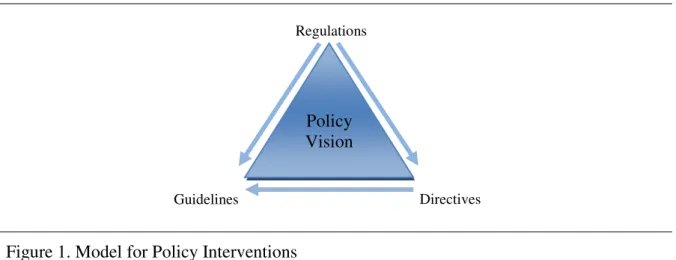
The proposed model comprises a core set of normative Regulations, mandated at the national level that can be followed up with detailed and localized Directives and Guidelines, formulated at the state and local levels. All three are driven by the overall policy vision. The model is shown abstractly in Figure 1.
Figure 1. Model for Policy Interventions
5.3 Model - Refinement
The model can be further refined by classifying the stakeholders – those impacted by the final outcomes of the policies, and for each group of stakeholders determining the areas that require intervention.
Three main groups of stakeholders are citizens, businesses and the government itself. Here are the policy areas affecting each group of stakeholders:
1) Citizens – Major policy areas affecting citizens include: information management, from collection, through sharing, to usage; data security and privacy; delivery of services - application forms, application tracking, electronic and non-electronic processes; and forms of policy enforcement. The reuse of public sector information is an emerging issue that should be guided at this stage.
2) Businesses – Major policy areas affecting businesses include: procurement, authentication, digital signatures, verification mechanisms, protected transactions, etc. 3) Government – The major policy area related to government is the provision of a
comprehensive regulatory administrative framework that lays down unequivocally the roles, and institutional- as well as people-responsibilities for e-Government.
The latter case is considered in detail in Section 5.4. Policy Vision Regulations
A Model for Policy Intervention in Support of Electronic Governance
Report No. 415, May 2009 UNU-IIST, P. O. Box 3058, Macao
11
5.4 Model - Components
The establishment of e-Government environment, comprising people, processes and technology, is the prerogative and responsibility of the government, partly fulfilled through the provision of an appropriate legal framework. Part of this framework, the following Directives and Guidelines relate to these components:
o People - The Directives and Guidelines in this category ought to spell out clearly the
internal measures for capacity building – hiring criteria, career paths, and means of building up a dedicated workforce. This should cover training programs and certifications, and how they are linked to career progress and benefits. Incentives, disincentives and alternative career options should be included, as well as ICT enabling environment comprising infrastructure and fund provision for PCs, connectivity, LAN etc. In addition, people-related policies should outline and authorize ways of acquiring niche technical skills in the market through outsourcing, contractual hiring, etc. their terms and conditions, performance measures, etc.
o Processes – The Directives and Guidelines in this category ought to lay down a legal
roadmap to carry out business process engineering and re-engineering through appropriate models that address the issues of: legacy systems; back office integration; electronic and paper-based record management; auditing of electronic activities and mapping archives onto existing regulations; establishing responsibility frameworks to cover cross-agency activities; inter-agency planning and budgeting; multichannel service delivery, etc. Another niche focus would comprise a Financial/Managerial framework relating e-Procurement, business models including selection of partners, functions that can be outsourced, framework for service charges and sharing methods, transfer back or handing over (skills, source-codes, etc.).
o Technology – Technology-related Directives and Guidelines focus on the provision of
standards that prescribe the use of data, metadata, website designs, interoperability, security, etc.
5.5 Summary
The model prescribes that policy interventions should be executed through a combination of Regulations, Directives and Guidelines. A working model should be derived for particular country contexts, combining the three policy tools based on the context and legacies.
A Model for Policy Intervention in Support of Electronic Governance
Report No. 415, May 2009 UNU-IIST, P. O. Box 3058, Macao
12
6
Model Application - India
In this section, the model proposed in Section 5 is applied to the context of India, aiming at a set of recommendations to guide development and evolution of a policy framework for the country. The section proceeds from an overview of e-Governance in India (Section 6.1), through policy approach (Section 6.2) and regulatory framework applied (Section 6.3), to the challenges (Section 6.4) and how the proposed model can be applied (Section 6.5).
6.1 e-Governance in India
Indian policy is characterized by its federal multiparty structure and a very strong legacy of legislations, starting with the Constitution that apportions power between federal hierarchies. The whole effort towards e-Governance has an underpinning of this reality and has to be appreciated in this light.
The National e-Governance Plan (NeGP) is a policy document on e-Governance that details the charter that India aims to follow. It conveys the vision of the federal government on e-Governance – “to make all Government services accessible to the common man in his locality, through common service delivery outlets, and ensure efficiency, transparency and reliability of such services at affordable costs to realize the basic needs of the citizens [20]. NeGP identifies a set of 27 Mission Mode Projects (MMPs) in key areas of e-Governance, with a stated approach of “centralized initiative and decentralized implementation”. The areas include police, agriculture, panchayats, transport, excise, etc. MMPs are broadly categorized into Integrated, Central, and State Projects: Integrated Projects are implemented by central and state governments; Central Projects are owned by central domain ministries; while State Projects are owned by the states. In the latter case, the central line ministry concerned with the project acts as the coordinating and fund-managing agency, expected to lay down guidelines for implementation by the states. Additionally, core components are defined for the core infrastructure, e.g. wide area networks and electronic data centers across the country.
6.2 Policy Approach
Domain ministries at the central and state levels are basically considered owners of the initiatives, who implement and realize the set of outcomes envisioned in the policy. Central-level ministries are charged with the coordination of domain-specific initiatives and with the management of funds at the national level. Policy Guidelines and Regulations are left at the discretion of specific domain owners and the overall assistance and support rests with the Central IT Department.
The basic approach is to rely on traditional vertical systems to bring in a gradual transformation through e-Government, with federal intervention limited to providing directions related to core technology, such as standards, gateways, security, interoperability, etc. An explicit approach to establish a mandated policy framework for e-Governance as a separate functional domain is missing. This fact can be attributed to the reality of a federal system, and the need to maintain a delicate balance between vertical government structures and horizontal nature of e-Government, particularly when it is impacting federal boundaries.
A Model for Policy Intervention in Support of Electronic Governance
Report No. 415, May 2009 UNU-IIST, P. O. Box 3058, Macao
13
6.3 Regulatory Framework
The legal basis for National e-Government Program is the Information Technology Act 2000 that grants legal recognition to electronic records, and online communications between citizens and government. The Act enables the states to carry out their own policy interventions, as and when required. The key technical issues related to digital signatures and the authority allowed to issue such signatures have been determined by the Act as well. The other key regulation is the Right to Information Act (2005) that mandates and delineates what information should be shared by the government electronically with citizens. In addition, technology issues like the certifying authority and its functions are covered by central rules.
6.4 Challenges
The transformation envisaged in the NeGP is based on Business Process Reengineering, on business models that consider Public-Private Partnerships as the default implementation option and on building and leveraging human capacity in the area with the combination of technological and governance expertise. In addition, NeGP applies market resourcing and its management. Although all these issues indicate the intended paradigmatic shift away from traditional governance, the initiatives have been generally entrusted to individual owner agencies. These agencies are expected to follow up with policy interventions that are basically sector driven, specific and contextual.
For instance, Municipalities (or Panchayats) come up with their own version of what is needed by way of policy interventions, in the form of Guidelines to the States or amendments to specific sectoral Acts. Various States have charted their own course on policy interventions by way of legislative enactments (amendments) that range from the creation of organizations with mandated charters for electronic service delivery, through sector-specific amendments aimed at overcoming mandates related to paper-based documentations in a specific Act (Bhoomi, Karnataka) [21], to the delivery of services with the charges levied by private organizations arising from the PPP business models (Chhattisgarh Citizen Service) [22]. Basically, a common approach is when off-line systems are enabled through a blanket provision to operate online, leaving the required sector-specific interventions to the States to follow up. An explicit attempt to put in a mandated policy framework for e-Governance as a separate domain is missing, attributed to the federal reality and delicate balance maintained with e-Governance impacting federal boundaries.
6.5 Applying the Model
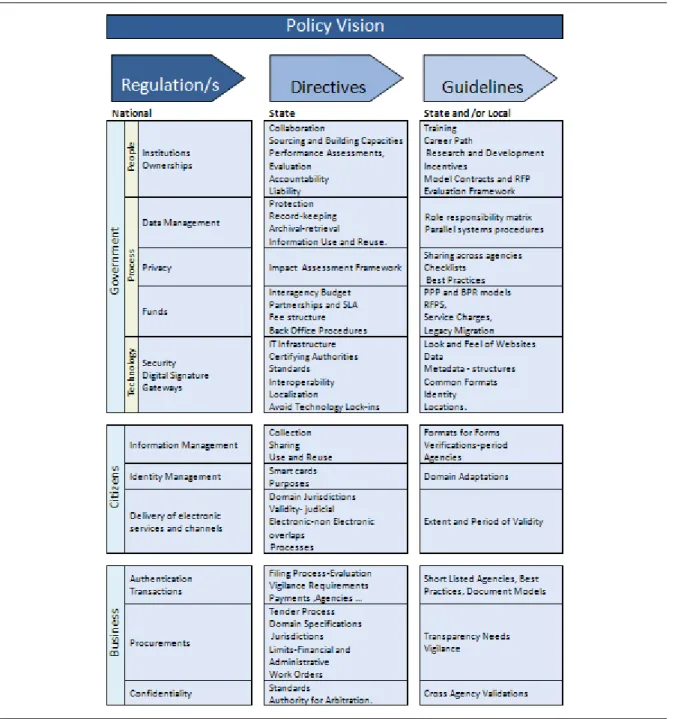
Following the overview of e-Governance in India, its legal basis and challenges earlier in this section, Figure 2 below presents the adaptation of the policy intervention model from Section 5 for India, including concrete examples of areas of intervention.
Applying the policy intervention model to the case of India shows that a federal mandate that addresses core governance issues related to government, citizens and businesses, covering
A Model for Policy Intervention in Support of Electronic Governance
Report No. 415, May 2009 UNU-IIST, P. O. Box 3058, Macao
14
ownership and responsibility, data protection and management, data use and reuse, judicial and audit mandates, etc. is an immediate requirement.
Once the central regulatory framework is in place, it must be followed by directives that clearly lay down the strategies to realize expected outcomes under individual initiatives. Guidelines that indicate possible alternatives, including best options, provide further refinement in achieving concerted and coherent efforts across all agencies at all levels. In essence, the national normative mandate has to be followed by state- and local-level directives and guidance on its local adaptations.
Privacy may not be seen as relevant when aiming at transparency and dissemination, but clearly it is critical to addressing public concerns on how much information, for what, by whom and till when shall be provided.
A Model for Policy Intervention in Support of Electronic Governance
Report No. 415, May 2009 UNU-IIST, P. O. Box 3058, Macao
15
A Model for Policy Intervention in Support of Electronic Governance
Report No. 415, May 2009 UNU-IIST, P. O. Box 3058, Macao
16
7
Conclusions
It is evident that a policy framework determines the evolution of e-Governance, and ultimately how well it can support the delivery of good governance. The critical point is ensuring that policies are in place in time to deal with legacies. Otherwise, the risk is to end up with e-Governance itself as a legacy.
The report presented and analyzed policy roadmaps followed by some leading countries in the area. Based on the analysis, literature review, and experience, the report proposed a model for policy interventions for e-Governance based on different types of policies – Regulations, Directives, Guidelines, affecting various stakeholders – Citizens, Businesses and Government, and covering different components of a working e-Governance environment – People, Processes and Technology. The scope and fitness of the model within federal hierarchies were discussed, and the model was applied to the context of India, aiming at contributions and ownerships from all levels of governance.
Future work includes a rigorous quantitative study of policy roadmaps by selected countries in various stages of e-Governance, applying the findings of the study to the proposed policy model, defining the model precisely, and developing some tool support for it.
A Model for Policy Intervention in Support of Electronic Governance
Report No. 415, May 2009 UNU-IIST, P. O. Box 3058, Macao
17
References
[1] Koops, B-J., et al (Eds) ,“Starting Points for ICT Regulation”, ITeR, The Hague, 2006. [2] Okot-Uma, R., “The Roadmap to eGovernance Implementation: Selected Perspectives” [3] Prins, C. “E-Government: A Comparative Study of the Multiple Dimensions of Required
Regulatory Change”, Vol. 11.3 Electronic Journal of Comparative Law, Dec. 2007, http://www.ejcl.org/113/article113-35.pdf
[4] CRS Report for Congress. “A Primer on E-Government: Sectors, Stages, Opportunities, and Challenges of Online Governance”, http://usinfo.state.gov/infousa/
government/overview/docs/RL31057.pdf
[5] Gant, J.P. “The Public Policy Framework for E-Government in the United States”, Syracuse University Maxwell School and School of Information Studies.
maxwell.syr.edu/jpgant/PPAegov_policy.ppt
[6] United States Department of Justice, “Freedom of Information Act”, United States of America, 2000, http://www.usdoj.gov/oip/index.html
[7] United States Department of Justice, “Privacy Act”, http://www.usdoj.gov /oip/privstat.htm
[8] The National Archives, “Paperwork Reduction Act”, http://www.archives.gov/federal-register/laws/paperwork-reduction/
[9] United States of America, “Computer Security Act” http://epic.org/crypto/csa/csa.html [10] United States of America, “Computer Matching and Privacy Protection Act”,
http://www.whitehouse.gov/ omb/inforeg/computer_amendments1991.pdf [11] United States of America, “The Clinger-Cohen Act”,
http://www.cio.gov/Documents/it_management_reform_act_Feb_1996.html [12] United States of America, “Government Paperwork Elimination Act”,
http://www.cio.gov/documents/ paperwork_elimination_act.html
[13] United States of America, e-Government Act, http://frwebgate.access.gpo.gov/cgi-bin/getdoc.cgi?dbna me=107_cong_public_laws&docid=f:publ347.107.pdf
[14] Seifert, J., “Reauthorization of the E-Government Act: A Brief Overview”, CRS Report for Congress, May 2008, http://assets.opencrs.com/rpts/RL34492_ 20080514.pdf [15] Office of Management and Budget (OMB), “Expanding E-Government-Achieving
Results for the American People”, May 2008, http://www.whitehouse.gov/omb/ egov/documents/2008_Expanding_E-Gov_Report.pdf
[16] OMB, “Implementation Guidance for the E-Government Act of 2002”, August 2003, http://www.regulations.gov/ search/images/eGov_Interpretation.pdf
[17] Riley, T. “Successful e-Government in Canada”, http://www.egovmonitor.com/node/709
[18] Just, M. and Rosmarin, D., “Meeting the Challenges of Canada’s Secure Delivery of E-Government Services”. Public Works and E-Government Services Canada,
middleware.internet2.edu/ pki05/proceedings/just-canada-egov.ppt.
[19] Valero Torrijos, J., et al, “Breaking Barriers to e-Govenment, Section 4 - Legal Foundations,
http://www.egovbarriers.org/downloads/deliverables/1b/Legal_Foundations.pdf [20] Government of India, “National E-Governance Plan”, www.mit.gov.in.
[21] Bhoomi, “Computerization of Land Records”, http://www.revdept-01.kar.nic.in/ [22] Government of India, “Chhattisgarh Citizen Service – Electronic Governance Rules”