Journal of Information Sciences and Computing Technologies(JISCT) ISSN: 2394-9066
SCITECH Volume 4, Issue 1
RESEARCH ORGANISATION| June 05, 2015|
Journal of Information Sciences and Computing Technologies
www.scitecresearch.com
A Comprehensive Review of Cloud Computing Simulators
Hitesh Marwaha, Dr. Rajeshwar Singh
Hitesh Marwaha Research Scholar Punjab Technical University Jalandhar Assistant Professor, KCL Institute of Management & Technology, Jalandhar
E mail: [email protected]
Dr. Rajeshwar Singh Director Doaba Group of Colleges, Rahon Campus Nawanshahar Email: [email protected]
Abstract:
Cloud Computing is an innovation idea that has enabled the organizations to access high performance computing and storage infrastructure at reduced cost through internet. Cloud computing is model in which customer can access IT resources which are priced and provided on demand. Cloud Service providers charge user depending upon space or whatever service availed. It is not always possible for researchers and academicians to have the actual cloud infrastructure for performing experiments, executing or implementing their algorithms. To fulfill their need for the purpose of testing and actual providing them a feel of cloud services simulators are required. Nowadays cloud simulators are widely available in the market for researcher scholars. The objective of this research paper is to do comprehensive review of cloud computing simulators and to research out to get the best cloud computing simulation tool for security based research in area of Cloud.
Keywords:
CSP; CloudSim; Cloud Analyst; Network CloudSim; EMUSI; DCSim; GroundSim; MDCSim.1.
Introduction:
Simulator is a collection of hardware and software systems which are used to take off the behavior of some entity or phenomenon. Simulation is the process of designing a model of a system and executing the same with the help of computer to obtain and analyze the output. Simulators have become very essential part of research these days, as some researchers can not spent a large sum of money on actual implementation of their work. This allows the researcher to actually feel how their system will work and determine the correctness and efficiency of a system before the system is actually constructed. After successful implementation of their work on simulators the same concept can be handed over to the agency that can spent money for the physical implementation of system .In this paper, light is thrown on various cloud computing simulators. Cloud computing refers to application and services that run on distributed network using virtualized resources and requires common internet protocols for its execution.[1]It was a big question in the mind of people, as we are paying the bills of other utilities like electricity and water as per our usage ,either before using or after using then why we spent a large sum on computer hardware and software, so Utility computing, A long held become reality with cloud computing and cloud makes this possible by providing unlimited scalable services which are presented as Software, Infrastructure, or Platform as services (SaaS, IaaS, PaaS) and globally available system ,where one has to pay as per usage and requirement. Cloud computing abstracts the detail of system by running application on physical system that is not specified and provide storage to data at unknown location, from user and developers. A suitable simulations tools is required which can be used to evaluate the hypothesis prior to software development. In Cloud computing, as access to the infrastructure is costly, the cloud customer can take significant benefits by using Cloud Simulators. Simulation based approach allows Cloud customers to test their services in convenient environment without any cost [2].
2.
Cloud Simulators
Journal of Information Sciences and Computing Technologies(JISCT) ISSN: 2394-9066 CloudSim- A Java Based Simulation Toolkit for Cloud computing environment was developed in the CLOUDS Laboratory, at the Computer Science and Software Engineering Department of the University of Melbourne, Australia. It provides basic classes for describing data centers, virtual machines, applications, users, computational resources, and policies for management of diverse parts of the system. It provides generalized framework for modeling and simulating cloud computing services.
The main features of cloud sim are:
Cloud Sim enables modeling and simulation of virtualized server hosts and data centers. It support for dynamic inclusion of simulation elements, discontinue and restart of simulation[3] It also provide support for user defined policies for allocation of hosts to VM’s
The switching between space shared and time shared allocation of processing cores to virtualized services can be implemented in cloud sim. These compelling features of CloudSim would speed up the development of new application provisioning algorithms for Cloud computing.[4]
The major limitation of CloudSim is the lack of a graphical user interface (GUI). But despite this, CloudSim is still used in universities and the industry for the simulation of cloud-based algorithms.
The CloudSim architecture is depicted in Figure1 [5]
Figure: 1: CloudSim Architecture
2.2 Cloud Analyst
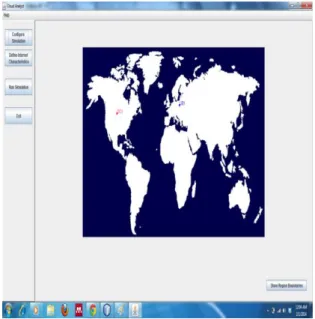
Cloud Analyst: A GUI Based simulator supports the evaluation of social network tools according to the geographic distribution of users and data centers. Cloud Analyst provides powerful simulation framework via Map Interface for deploying real time data centers and monitoring load balancing, cloud cluster monitoring and data center data flow in real time.
The main features of Cloud Analyst are: [6]
High degree of configurability and flexibility: Cloud Analyst provides high degree of control over the experiment, by modeling entities and configuration options such as:
a)
Data Center, whose hardware configuration is defined in terms of physical machines composed of processors, storage devices, memory and internal bandwidthb)
Data Center virtual machine specification in terms of memory, storage and bandwidth quota;c)
Resource allocation policies for Data Centers;Journal of Information Sciences and Computing Technologies(JISCT) ISSN: 2394-9066
e)
Service Broker Policies that control which segment of total user base is serviced by which Data Center at a giventime.
User friendly graphical user interface (GUI): Cloud Analyst provides an easy to use graphical user interface that helps users to perform experiment in an easy manner.
Figure: 2 GUI Interface of Cloud Analyst
Performs different types of experiments with repetitions: As in cloud Analyst simulation experiments input parameters and results are in the form of XML files so experiments can be repeated and yields the identical result.
Connectivity with Java for extensions: Simulator is developed on Java platform i.e. Java SE 1.6, GUI component is built using Java Swing and modeling of data centers is done by using CloudSim. Cloud Analyst is built on the top of Cloud-sim
Figure 3: Components of CloudSim ToolKit
2.3
NetworkCloudSim
Network CloudSim is an extension of CloudSim as a simulation framework that supports generalized applications such as high performance computing applications, workflows, e-commerce and real cloud data centers modeling.Network CloudSim provides scalable and fast simulation. . Network CloudSim structure supports designing of the real Cloud data
Journal of Information Sciences and Computing Technologies(JISCT) ISSN: 2394-9066 centers and mapping different strategies. [7] NetworkCloudSim can be use for simulating Cloud data center network and for those applications which requires communicating tasks such as MPI with a high degree of accuracy.[13]
Figure 4 [5]User Code and Event Simulation Core for CloudSim Simulator
2.4 EMUSIM
EMUSIM is an integrated architecture proposed to anticipate service's behavior on cloud platforms to a higher standard, which is built on Automated Emulation Framework (AEF) for emulation and CloudSim for simulation. [8]. The information can be extracted from application by emulation and the same can be used for developing the corresponding simulation model. EMUSIM uses the open source software stack and therefore it can be used to analyze the behavior of other applications. EMUSIM uses Automated Emulation Framework (AEF) for emulation and CloudSim for simulation. EMUSIM is having limitation regarding scalability due to either hardware constraints or difficulty in generating large and realistic workloads. [8].Figure 5 depicts architecture of EMUSIM. [8]
2.5 GroudSim
GroundSim, is an event-based simulator that requires only one simulation thread for scientific applications on grid and cloud environments. It mainly concentrates on the Infrastructure based service of cloud (IaaS),
Figure5: Architecture of EMUSIM
but it also supports PaaS or real time cloud storage operations. GroudSim provides a comprehensive set of features for complex simulation scenarios such as simple job executions using limited resources and less background load on resources[9]. Experimental results reveal the improved scalability of GroudSim compared to a related process-based approach. [10] The user has given access to simulate their work from real application environment, by integrating GroundSim to ASKALON environment.[14]
Journal of Information Sciences and Computing Technologies(JISCT) ISSN: 2394-9066
2.6 DCSim
In modern IT era for the provisioning of computing resources Data centers are becoming popular. The cost of data centers and operational expenses have increased with the increase in computing capacity The Data Centre Simulator offers IaaS to multiple customers and concentrates on virtualized data centre in order to achieve a simulator to evaluate and develop data centre management techniques. , DCSim provides the additional capability of modeling replicated VMs sharing incoming workload as well as dependencies between VMs that are part of a multi-tiered application.[11] Figure3depictes the architecture of DCSim[12] It differs from CloudSim in that it focuses on transactional, continuous workloads.
Figure 6: Architecture of DC Sim 2.7 MDCSim(A multi-tier data center simulation, platform)
A discrete event based simulator developed at the Pennsylvania State University. It helps in modeling hardware characteristics of components of data center such as servers, communication links [9]. MDCSim is the most famous tool having low simulation overhead and used to preserve a data center topology in the form of directed graph. It is designed to simulate large scale, multi-tier data centers. To measure performance it focuses on data centre architecture and cluster configuration. It supports three-tiered web applications, with the ability to modify and evaluate the configuration of each tier. [11]
2
Comparison: of Various Cloud Simulators
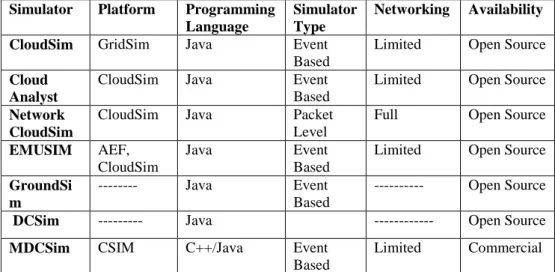
Cloud simulator are helpful for modeling and simulation of cloud computing data centers, virtualized server hosts, data center network topologies and much more. As we have already discussed brief overview of some cloud simulators in above section but these all simulators differ on some aspects. Table 1 throw light on these aspects and would be helpful for researchers for selecting appropriate simulator for implementation of their work.
Table 1
Simulator Platform Programming
Language
Simulator Type
Networking Availability
CloudSim GridSim Java Event
Based
Limited Open Source Cloud
Analyst
CloudSim Java Event
Based
Limited Open Source Network
CloudSim
CloudSim Java Packet Level
Full Open Source
EMUSIM AEF,
CloudSim
Java Event
Based
Limited Open Source GroundSi
m
--- Java Event
Based
--- Open Source
DCSim --- Java --- Open Source
MDCSim CSIM C++/Java Event
Based
Journal of Information Sciences and Computing Technologies(JISCT) ISSN: 2394-9066
Conclusion
Cloud computing has become one of the fastest growing parts in IT industry. Simulation based approaches helps academicians to evaluate performance of cloud computing systems, application behaviors and their security. Several simulators have been developed till date for performance analysis of cloud computing environments...Many organizations have migrated to cloud and many are deciding to migrate. Before migrating to cloud organizations first check CSP’s (Cloud Service Providers) infrastructure and applications it may provide for any security hazards so that controls can be set in place in order to ensure that the transfer to the clouds are secure. Thus the demand of time is to make cloud secure so that it can win the trust of users and user do not feel hesitated for migrating their precious data to cloud. For this researcher is required to develop strategies for secure cloud and before actual implementation of their work, they must require a sort of simulator to see the behavior of their work. Out of many simulators discussed above it can also be concluded that the use of simulator depends upon the need and demand of work.
Future Scope
After analyzing almost all the simulation tools of cloud computing, we can analyze that CloudSim is regarded as the most comprehensive and has most rich cloud libraries functionalities. So, CloudSim would be taken as base simulation tool in Future research on cloud computing security issues resolving.
References:
[1]. Cloud Computing Bible-by Barrie Sisisky, Wiley Publishing Inc. (ISBN-13: 978-0470903568)
[2] http://www.cloudbus.org/
[3] https://code.google.com/p/cloudsim/wiki/FAQ
[4] Rodrigo N. Calheiros1, Rajiv Ranjan2, Anton Beloglazov1, Cesar A. F. De Rose 3 and Rajkumar Buyya1,”CloudSim: a toolkit for modeling and simulation of cloud computing environments and evaluation of resource provisioning algorithms”, Wiley Online Library (wileyonlinelibrary.com), 24 August 2010.
[5] http://students.cec.wustl.edu/~azinoujani/ accessed on Feb, 2015
[6]. Wickremasinghe, B., Calheiros, R. N., & Buyya, R. (2010, April). Cloudanalyst: A cloudsim-based visual modeler for analyzing cloud computing environments and applications in Advanced Information Networking and Applications (AINA), 2010 24th IEEE International Conference on (pp. 446-452). IEEE.
[7]. Dr. Rahul Malhotra & Prince Jain” CloudSim structure supports designing of the real Cloud data centers and
mapping different strategies”, . The SIJ Transactions on Computer Science Engineering & its Applications
(CSEA), Vol. 1, No. 4, September-October 2013.
[8]. Calheiros, R. N., Netto, M. A., De Rose, C. A., & Buyya, R. (2013). EMUSIM: an integrated emulation and simulation environment for modeling, evaluation, and validation of performance of cloud computing applications. Software: Practice and Experience, 43(5), 595-612.
[9] Dr. Rahul Malhotra , Prince Jain “Study and Comparison of Various Cloud Simulators Available in the Cloud Computing “,International Journal of Advanced Research in Computer Science and Software Engineering Research Volume 3, Issue 9, September 2013.
[10] S.J.Mohana , M.Saroja b , M.Venkatachalam “Analysis and Comparison of Simulators to Evaluate the Performance of Cloud Environments”, Journal of Nano Science and Nano Technology”,Vol 2, Issue 6, Spring Edition, February 2014, Pp 739-742
[11] Gaston Keller, Michael Tighe, HananLutfiyya and Michael Bauer ,”DCSim: A Data Centre Simulation Tool “´,IFIP/IEEE International Symposium on Integrated Network Management (IM2013): Demonstration Session Paper 1091
[12] Wei Zhao, Yong Peng, Feng Xie, Zhonghua Dai," Modeling and Simulation of Cloud Computing: A Review", Asia Pacific Cloud Computing Congress (APCloudCC), IEEE, 2012.
[13] Garg, S. K., & Buyya, R. (2011, December). Networkcloudsim: Modeling parallel applications in cloud simulations. In Utility and Cloud Computing (UCC), 2011 Fourth IEEE International Conference on (pp. 105-113). IEEE.
[14] Alam, Md Imran, Manjusha Pandey, and Siddharth S. Rautaray. "A Comprehensive Survey on Cloud Computing." (2015)..
![Figure 4 [5]User Code and Event Simulation Core for CloudSim Simulator 2.4 EMUSIM](https://thumb-us.123doks.com/thumbv2/123dok_us/9676885.2849213/4.892.295.601.157.400/figure-user-code-event-simulation-cloudsim-simulator-emusim.webp)