ePub
WU
Institutional Repository
Katharina Viktoria Stein
The Cause for Action? Decision Making and Priority Setting in Integrated
Care. A Multidisciplinary Approach.
Thesis
Original Citation:
Stein, Katharina Viktoria (2010) The Cause for Action? Decision Making and Priority Setting in
Integrated Care. A Multidisciplinary Approach. Doctoral thesis, WU Vienna University of Economics
and Business.
This version is available at: http://epub.wu.ac.at/2015/ Available in ePubWU: August 2010
ePubWU, the institutional repository of the WU Vienna University of Economics and Business, is provided by the University Library and the IT-Services. The aim is to enable open access to the scholarly output of the WU.
DOKTORAT DER SOZIAL- UND WIRTSCHAFTSWISSENSCHAFTEN
1. Beurteilerin/1. Beurteiler: ao. Univ.Prof.Dr. Hansjoerg Klausinger
2. Beurteilerin/2. Beurteiler: Univ.Prof. Dr. Anita Rieder
Titel der Dissertation:
The Cause for Action?
Decision Making and Priority Setting in Integrated Care. A Multidisciplinary Approach.
Dissertation zur Erlangung des akademischen Grades einer Doktorin/eines Doktors
der Sozial- und Wirtschaftswissenschaften an der Wirtschaftsuniversität Wien
eingereicht bei
1. Beurteilerin/1. Beurteiler: ao. Univ.Prof. Dr. Hansjoerg Klausinger
2. Beurteilerin/2. Beurteiler: Univ.Prof. Dr Anite Rieder
von Mag. Katharina Viktoria Stein
Fachgebiet: Volkswirtschaftslehre
Ich versichere:
1. dass ich die Dissertation selbständig verfasst, andere als die angegebenen Quellen und Hilfsmittel nicht benutzt und mich auch sonst keiner unerlaubten Hilfe bedient habe.
2. dass ich diese Dissertation bisher weder im In- noch im Ausland (einer Beurteilerin/ einem Beurteiler zur Begutachtung) in irgendeiner Form als Prüfungsarbeit vorgelegt habe.
3. dass dieses Exemplar mit der beurteilten Arbeit übereinstimmt.
T
HE
C
AUSE FOR
A
CTION
?
D
ECISION
M
AKING AND
P
RIORITY
S
ETTING IN
I
NTEGRATED
C
ARE
.
A MULTIDISCIPLINARY APPROACH.
Doctoral Thesis
Katharina Viktoria Stein
Vienna, June 2010
Vienna University of Economics and Business Administration
and
To my family
Sapere longe prima felicitatis pars est.
(Sophokles, Antigone 1328)
Acknowledgements
I have been told that nothing will ever be as difficult and challenging again as completing one’s PhD thesis – I hope they are right! This work would not have been possible without the support of my family, friends and colleagues in Vienna and around the world who helped me along my way and who believed in me, especially when I didn’t.
I want to say thank you to my professor, mentor and friend, Anita Rieder, who gave me the chance to find my passion, who introduced me to the world of academia and who always had my back. She is one of those rare professors who foster young researchers by giving them the freedom and support to establish themselves, incessantly ensuring that the environment, the funding and the training are adequately available.
Prof. Hansjörg Klausinger enabled the cooperation between the Medical University Vienna and the Vienna University for Economics and Business Administration, and was kind enough to give me the leeway necessary to complete my research.
My colleague, Thomas Dorner, helped me through the depths of SPSS and opened my eyes to the possibilities of good statistical analysis.
I also want to thank my international network for hours and days of discussions and input which helped me define and outline my research, especially professors Volker Amelung, Ingrid Mur-Veeman, Hindrik Vondeling, Dennis Kodner, Nick Goodwin, Guus Schrijvers and Eric Coleman. The people forming the International Network of Integrated Care and the team of the International Journal of Integrated Care at the University Medical Centre Utrecht have my deepest gratitude for having accepted me in their middle and being a source of constant ideas.
Furthermore, this thesis would not have been possible without the participants and responders of my survey who took the time and effort to fill in the questionnaire and provided me with a fountain of information.
A special thank you goes out to my girls, Verena, Krisztina, Verena, Stefanie and Kathi, who gave me moral support, pep talks and friendship without regard of geographic distances or time.
Finally, I wouldn’t have made it this far without my parents and my brother Valentin, who have endured my struggles to find out what I want, sometimes against better advice. Thank you for always being there for me!
Kurzfassung
Die Ansprüche von Patientinnen und Patienten haben sich seit der Einführung erster öffentlicher Gesundheitsdienstleistungen vor mehr als 100 Jahren ebenso dramatisch verändert wie die Rahmenbedingungen, mit denen ein Gesundheitssystem zurecht kommen muss. Die gewachsenen Gesundheitssysteme der Industriestaaten begegnen diesen Herausforderungen der alternden Gesellschaft, der technologischen Entwicklung und der chronischen Krankheiten seit einigen Jahren mit kontinuierlichen Reformprogrammen, ohne dabei die Grundprinzipien der Leistbarkeit, Zugänglichkeit und Solidarität verletzen zu wollen. Ein Lösungsmodell zur Erfüllung all dieser Anforderungen ist die integrierte Versorgung, welche als patientenzentrierte Gesundheitsversorgung auf bessere Prozesse, Koordination und Kooperation zwischen allen Beteiligten und Sektoren im Gesundheitswesen setzt.
Anhand einer eingehenden Diskussion der bestehenden Theorien zur Gesundheitssystemanalyse, Entscheidungsfindung und Erfolgsmessung im Gesundheitswesen sowie den daraus entstehenden Zielkonflikten werden im ersten Teil dieser Dissertation die veränderten Rahmenbedingungen und Ansprüche, sowie Problemfelder in der Organisation und Restrukturierung von Gesundheitssystemen aufgezeigt. Darauf aufbauend wird das Konzept der integrierten Versorgung vorgestellt, die Entscheidungsprozesse in der integrierten Versorgung anhand eines internationalen Expertenfragebogens untersucht und Rückschlüsse auf die Prioritätensetzungen von Entscheidungsträgern im Gesundheitswesen gezogen. Die Zusammenführung der Ergebnisse zeigt die große Bedeutung eindeutiger politischer Rahmenbedingungen und Anreizsysteme zur Förderung von integrierter Versorgung, sowie den hohen Bedarf an verbesserten Kommunikations-, Koordinations- und Informationsstrukturen auf.
Abstract
The expectations of patients have dramatically changed since the introduction of the first public health services more than a decade ago, as have the surrounding conditions a health system has to tackle. The grown health systems of the industrialised countries counter the challenges of an ageing society, technological advancement and chronic disease by a state of constant reform, which has been present for the last few years, without the abolition of the basic principles of affordability, accessibility and solidarity. One solution to answer all these expectations and requirements is so-called “integrated care”, a patient-centred model, which propagates better processes, coordination and cooperation between the different service providers and sectors in health care.
Based on a comprehensive discussion of the existing theories on health systems analysis, decision making and performance measurement in health as well as the trade-offs emerging therefrom, the first part of this thesis examines the changing conditions and expectations as well as problem areas of organisation and restructuring in health care systems. This analysis serves as a foundation for the introduction of the integrated care concept, an international expert questionnaire on the decision making in integrated care and conclusions on priority setting of decision makers in health. The analysis of the results demonstrates the high value that is placed on a clear political framework and incentives for the promotion of integrated care, as well as the substantive demand for improved communication, coordination and information structures.
Table of Content
TABLE OF CONTENT ...I FIGURES AND TABLES...IV ABBREVIATIONS ... VII
P
ARTI. T
HEORETICALF
OUNDATIONS OFH
EALTH, S
YSTEMS ANDP
OLICY... 1
1 INTRODUCTION... 3
2 HEALTH, SYSTEMS AND POLICIES... 6
2.1 Defining Health (Care) Systems ... 6
2.1.1 What is a Health (Care) System? ... 6
2.1.2 System in Dispute ... 7
2.1.3 Describing the System ... 9
2.1.4 System, Aims and Functions... 12
2.1.5 Provision of Services ... 14
2.2 Health and Policy ... 15
2.2.1 The Principle of Public Health ... 16
2.2.2 Health, Policy and Politics ... 17
2.3 Reforming Health Care Systems ... 19
2.3.1 Reforms and Regulations ... 20
2.3.2 Levers for Reform... 20
2.3.3 “Culture Trumps Strategy” - Making a Change... 21
2.4 Implications for Integrated Care ... 23
3 DECISION MAKING IN HEALTH CARE... 24
3.1 Ideal Models of Public Policy Decision Making ... 24
3.2 Levels of Decision Making... 26
3.3 Decision Makers in Health Care ... 27
3.3.1 Political Decision Making... 27
3.3.2 Professional Decision Making ... 28
3.3.3 Involving the Patients... 29
3.3.4 Direction of Decision Making... 30
3.4 Decision Making Instruments ... 31
3.4.1 Efficiency, Efficacy and Effectiveness ... 31
3.4.2 A Quantitative Method: OR/MS ... 32
3.4.2.1 Decision trees ... 32
3.4.2.2 Markov models ... 33
3.4.4 Health Economics ... 35
3.5 Implications for Integrated Care ... 36
4 PERFORMANCE MEASUREMENT IN HEALTH CARE... 38
4.1 Measuring Health and Welfare... 38
4.1.1 GDP and GNP... 39
4.1.2 Measuring the Global Burden of Disease: DALYs and QALYs... 40
4.1.2.1 GBD and the DALY ... 40
4.1.2.2 An Adaptation: the QALY... 42
4.1.2.3 The HYE... 42
4.1.2.4 HALE and DALE ... 43
4.2 Health Outcomes Measurement... 43
4.2.1 Cost of Illness (COI) ... 44
4.2.2 Cost Benefit Analysis (CBA)... 44
4.2.3 Cost Effectiveness Analysis (CEA) ... 45
4.2.4 Cost Utility Analysis (CUA)... 46
4.2.5 Health Outcomes from Different Perspectives... 46
4.3 Implications for Integrated Care ... 47
P
ARTII. P
EALING THEO
NION: I
NS
EARCH FOR THEC
AUSE OFI
NTEGRATEDC
ARE... 49
5 INTRODUCING INTEGRATED CARE... 51
5.1 Introduction to the Concept ... 51
5.2 Defining the Common Base for Integrated Care ... 52
5.3 Evaluation and Quality – Discussion on Methods and Tools ... 54
5.3.1 Economic Evaluation in Integrated Care ... 54
5.3.2 Quality and Integrated Care ... 55
5.4 Healthy Environs – Governing and Managerial Prerequisites for Integrated Care ... 57
5.5 Research Questions Arising from the Workshop ... 59
5.6 Discussion... 60
5.7 Paving the Way for a Matured Integrated Care ... 61
6 IN SEARCH FOR THE CAUSE OF INTEGRATED CARE... 62
6.1 Why Integrated Care?... 62
6.1.1 The Scientific Approach ... 62
6.1.2 Theories and Hypotheses ... 63
6.2 Conceptualising the Development Process... 64
6.3 Searching for the Cause of Integrated Care ... 67
6.4 The Survey ... 70
6.5 Quantitative Analysis... 73
6.5.1 Describing the Data Set... 73
6.5.1.1 Geographic distribution ... 73
6.5.1.3 Funding sources of integrated care ... 75
6.5.1.4 Scope and scale of integrated care ... 76
6.5.2 Items analysis... 79
6.5.2.1 Most and least important items ... 79
6.5.2.2 Important items for initiators of integrated care... 86
6.5.2.3 Importance of items when considering scale ... 86
6.5.2.4 Important items according to the scope of integrated care... 87
6.6 Correlation with Pearson ... 87
6.6.1 Correlations with the Economic and Legal Dimension... 88
6.6.2 Correlations with the Structural and Managerial Dimension ... 88
6.6.3 Correlations with the Political Dimension ... 89
6.6.4 Correlations with the Medical Dimension ... 89
6.6.5 Correlations with the Social Dimension... 90
6.6.6 Correlations with the Integrated Care Dimension ... 91
6.7 Concluding Remarks... 93
7 DECISION MAKING AND PRIORITY SETTING IN INTEGRATED CARE... 95
7.1 Answering the Hypotheses ... 95
7.1.1 Hypothesis 1... 96
7.1.2 Hypothesis 2... 96
7.1.3 Hypothesis 3... 97
7.2 Priorities and Expectations of Decision Makers towards Integrated Care ... 99
7.2.1 Improving Management and Clarifying Structure ... 99
7.2.2 Patient-centred Care without the Patient ... 99
7.2.3 Long-term Effects and Trends Influence the Decision... 100
7.2.4 Policy Support Initiates Integrated Care ... 100
7.3 The Main Priorities in Integrated Care ... 101
8 THE FUTURE OF INTEGRATED CARE – AMBIVALENT CONCLUSIONS... 102
9 REFERENCES... 104
10APPENDIX... 115
10.1 Sample Questionnaire English... 115
Figures and Tables
FIGURE 2.1. THE HEALTH CARE SYSTEM AND ITS ENVIRONMENT. ... 10
FIGURE 2.2. THE FOUR WORLDS IN A HEALTH CARE SYSTEM... 11
FIGURE 2.3. THE BASIC STRUCTURE OF A NATIONAL HEALTH SYSTEM. ... 14
FIGURE 2.4. SECTORS OF HEALTH CARE WITHIN A NATIONAL HEALTH SYSTEM... 15
FIGURE 2.5. POLICY GOALS IN A MULTI-DIMENSIONAL POLICY SYSTEM... 19
FIGURE 2.6. THE ‘BERMUDA TRIANGLE’ OF HEALTH CARE PROVISION. ... 21
FIGURE 3.1. THE LEVELS OF REGULATION... 26
FIGURE 3.2. THE ‘PUBLIC HEALTH ACTION CYCLE’. ... 28
FIGURE 3.3. MOSLEY’S OPERATION OF THE FIVE GROUPS OF PROXIMATE DETERMINANTS ON THE HEALTH DYNAMICS OF A POPULATION. ... 29
FIGURE 3.4. AN EXAMPLE FOR A SIMPLISTIC DECISION TREE... 33
FIGURE 3.5. EVIDENCE, INFORMATION AND PATIENT CHOICE. ... 35
FIGURE 6.1. THE ‘PYRAMID OF INTEGRATED CARE COMPETENCES’. ... 65
FIGURE 6.2. DIMENSIONS RELEVANT FOR INTEGRATED CARE IMPLEMENTATION. ... 66
FIGURE 6.3. ELIMINATION PROCESS FOR CONTACTS... 72
FIGURE 6.4. GEOGRAPHIC DISTRIBUTION OF THE SURVEY... 73
FIGURE 6.5 INITIATORS OF INTEGRATED CARE PROJECTS AND PROGRAMMES. ... 75
FIGURE 6.6. SOURCES OF FUNDING FOR INTEGRATED CARE. ... 76
FIGURE 6.7. SCALE OF INTEGRATED CARE PROJECTS AND PROGRAMMES. ... 77
FIGURE 6.8. TIME HORIZON OF INTEGRATED CARE... 78
FIGURE 6.9. REASONS FOR INTEGRATED CARE INITIATIVE. ... 79
FIGURE 6.10. THE MEAN IMPORTANCE OF ITEMS IN THE ECONOMIC AND LEGAL DIMENSION. ... 80
FIGURE 6.11. THE MEAN IMPORTANCE OF ITEMS IN THE STRUCTURAL AND MANAGERIAL DIMENSION. ... 81
FIGURE 6.12. THE MEAN IMPORTANCE OF ITEMS IN THE POLITICAL DIMENSION... 82
FIGURE 6.13. THE MEAN IMPORTANCE OF ITEMS IN THE MEDICAL DIMENSION... 83
FIGURE 6.14. THE MEAN IMPORTANCE OF ITEMS IN THE SOCIAL DIMENSION... 84
TABLE 2.1. CHARACTERISTICS OF A PROACTIVE PUBLIC HEALTH SYSTEM. ... 17
TABLE 2.2. OPTIONS FOR DESIGNING FUTURE HEALTH CARE SYSTEMS. ... 22
TABLE 3.1. A GUIDE FOR DECISION MAKING IN HEALTH CARE. ... 36
TABLE 4.1. HEALTH ECONOMIC ANALYSES. ... 43
TABLE 4.2. MEASUREMENT OF COSTS AND CONSEQUENCES IN ECONOMIC EVALUATION. ... 44
TABLE 6.1. INITIATORS AND OWNERS OF INTEGRATED CARE PROJECTS AND PROGRAMMES... 74
TABLE 6.2. CHRONIC DISEASE OR TARGET POPULATION MANAGED WITH INTEGRATED CARE. ... 76
TABLE 6.3. STARTING POINTS OF INTEGRATED CARE INITIATIVES... 78
Abbreviations
ADL Activities of daily living CAS Complex Adaptive System CBA Cost-benefit Analysis CEA Cost-effectiveness Analysis COI Cost of Illness
CUA Cost-utility analysis
DALYs Disability-adjusted Life Years DALE Disability-adjusted Life Expectation DMP Disease Management Programme EU European Union
GBD Global Burden of Disease GDP Gross Domestic Product GNP Gross National Product GP General Practitioner HALE Healthy Life Expectation HYE Healthy Years Equivalent HDI Human Development Index HDR Human Development Report IC Integrated Care
IJIC International Journal for Integrated Care INIC International Network for Integrated Care MS Management Science
OECD Organisation for Economic Co-operation and Development OR Operations Research
PH Public Health
PPP Purchasing Power Parity RCT Randomised Controlled Trial QALY Quality-adjusted Life Year QoL Quality of Life
UN United Nations VAS Visual Analogue Scale WB World Bank
WHO World Health Organization WHR World Health Report
Part I
Theoretical Foundations of Health,
Systems and Policy
1 I
NTRODUCTION
„An integrated and multidisciplinary approach is necessary to achieve a health care supply chain connecting with the needs and demands of the patient. [...] In the future, primary care and care at home will be the standard and multidisciplinary cooperation will be the key to a more patient oriented approach.“ (Van Oosterbos 2006)
The story of modern health systems started in the late 19th century when people like Florence Nightinggale (1820 – 1910), Otto von Bismarck (1815 – 1898) or William Henry Beveridge (1879 – 1963) revolutionised the approach towards the care for the sick and introduced concepts of social insurance and welfarism. Their deliberations and access towards these topics may have been diametrically apart but their ideas were grounded in the same rationale: to introduce public responsibility for the sick and the poor in a systematic and economical way. Since then, much has changed in society, lifestyle and health status, while the national systems, developed on the principles of solidarity, social responsibility and public governance, have reached a point of continuous stress and overload trying to reconcile well-tried approaches with novel challenges. As always, some systems fare better in adapting themselves and introducing necessary changes than others, but they all still have a long way to go, transforming from an acute cure institution-led sectorial system of islands to a chronic care person-centred nodal system of networks.
Integrated care has caught the attention of health professionals and decision makers alike as one solution to the necessary reforms and the concept has sparked off numerous models aiming to reorganise the ailing international health systems. The experiences made so far with various Disease Management Programmes (DMPs) or regional integrated health systems have been as diverse and divergent as the health systems in which they are being implemented, with economic and scientific evaluation presenting serious challenges. Still, there is some common ground for the introduction and development of integrated care projects: as has extensively been stated already [e.g. Gröne/Garcia Barbero 2001, Kodner/Spreeuwenberg 2002, Glouberman/Mintzberg 2001], the ageing societies in industrialised countries along with a rise in chronic diseases and the rapidly evolving health technologies are causing the costs associated with the health sector to reach the limits of (public) financing possibilities. Integrated care
is seen as an appropriate tool to react upon the situation by reducing inefficiencies and at the same time ensuring high quality care.
However, neither have the outcomes of integrated care models been properly evaluated and compared nor have the reasons for initiating such models. [Kodner 2009, Stein/Rieder 2009a] At both ends of the spectrum, there exist assumptions and opinions based on common sense and few validated data but when and how it really pays to implement integrated care and which are the key indicators and priorities decision makers want to achieve still remain largely unexplored. This thesis will investigate the starting point of integrated care, exploring the indicators most crucial for actors in health and social care services and identifying those which lead up to the initiation and implementation of integrated care. Understanding better the reasons why integrated care is chosen and initiated will help to get a clearer picture of the field and assist in formulating a framework for integrated care. The aim of this thesis is to analyse the process leading up to the decision of initiating an integrated care project or programme. In answering the questions of why integrated care is being implemented and what led to the decision for integrated care, it will highlight underlying mechanisms and decision making processes of integrated care.
Part I lays the theoretical foundation for the research question, by introducing systems thinking and the conceptualisation of health care systems, as well as the aims and objectives of said systems (Chapter 2). Considerations on health policy decision making outline the different levels and agents of decision making, as well as the instruments and data base which inform about the options and alternatives within the decision making process (Chapter 3). Consequently, a concise overview of performance measurement in health care completes the methodological basis for further research (Chapter 4).
Part II transfers the theoretical layout into the specific context of integrated care, first establishing the status quo of integrated care research and identifying open research questions of the field (Chapter 5). With these, the research question and the methodologies for the elaboration of the hypotheses are described, as well as the quantitative analysis with which the hypotheses were tested (Chapter 6). Finally, the hypotheses are evaluated and answered according to the results found in the research and conclusions for decision making in integrated care are formulated (Chapter 7).
Integrated care is not a nascent field and can draw a lot out of other research areas. Health economics, sociology, organisation development or public policy analysis all provide insights into the complexities of health system analysis and hence also proof beneficial for integrated care. Still, after a decade of scientific analysis of the concept, it
should come to terms with its diversity and flexibility and give itself a definition and a framework in which to continue to grow. This thesis represents one step in better understanding the mechanisms of integrated care and hence, towards a consolidation of the research field.
2 H
EALTH
, S
YSTEMS AND
P
OLICIES
“The only justification for our concepts is that they serve to represent the complex of our experiences; beyond this, they have no legitimacy.” (Albert Einstein, in Daellenbach 1995)
Health is a basic human right and taking the WHO (1948) definition into account, health care has to provide more than just curative services. The modern health systems of today have evolved over more than a century with the expectations and the demands drastically changing during this time. Still, the main aim of any health system has stayed the same: to provide adequate, high-quality care to those who need it. Unfortunately, many system structures and actors have not changed with them. The task and responsibility to design a framework, set standards and define goals within which boundaries the health system and its actors perform lies with the decision makers and the health policies they set forth. This chapter introduces the main ideas of how this can be achieved.
2.1 Defining Health (Care) Systems
“Systems are recognized as human conceptualizations. They do not exist per se. It is only the human observer who may view something as a system.” (Daellenbach 1995)
Humans are social animals. Our societies are built on interactions, relationships, social norms and structures. They build the cornerstones of the diverse systems a human being is part of – from family and friends to co-workers and political representatives one is a member in many different systems with shifting allegiances and priorities. [Bauch 2006, Sen 2006] But how to define and describe these systems has been a continuing challenge ever since Aristotle started categorising and cataloguing knowledge and nature.
2.1.1 What is a Health (Care) System?
Systems thinking is not inherent in the health sector. In fact, there exists little literature on the system behind health care. [Bauch 2006] While there are abundant sources
available on the management of hospitals or practices [Grant 1977, Dihlmann/Kenda 1997, Berry/Seltman 2008], the financing structures [OECD 2004, Zelman et al. 2004] or economic aspects of health and care [Drummond et al. 2009, Wilkinson/Marmot 2003, OECD 2002] – subsystem analyses, so to speak – the analysis of the overall system is lagging behind. Or is it? The aforementioned spheres of health care are those commonly used to compare health systems according to their performance relative to one another. However, one should keep in mind, as Reinhardt argues in his preface to Rice (2004), that “[H]ealth systems, which follow quite distinct social aims, simply can’t be compared by their relative economic efficiency” [p. 17].
Eckel’s (2001) comparison of the health care systems in the European Union stands as an example for comparative systems analysis where the following aspects of the respective national health systems are considered:
• provision of hospital care (i.e. secondary care)
• provision of primary physician care
• access to health services
• organisation of reimbursement of service provision
Similarly, the OECD study on performance of health care systems (2004), the World Health Report (2000) or Goodwin (2008) define various well-established parameters of health care provision, health status and welfare to assess, evaluate and rank national health care systems. But do these parameters actually describe the system itself or are they mere aspects of the system? Is there more to a health system than is commonly described?
2.1.2 System
in
Dispute
The German sociologist and pioneer in systems theory, Niklas Luhmann (1927 – 1998), thought a lack of reflection and reflective theory is inherent in the health system – a gap that sets it aside from other social systems. Even though ethical standards and professional codes exist, they do not reach beyond the boundaries of the respective professions. [Bauch 2006] Unlike the legal, the economic or the educational system, the health systems’ primary function does not focus on communication, it is a system of “extreme external orientation” [Luhmann 1983, cited in Bauch 2006, p. 2]. The target is a physical or mental dysfunction, which needs repair; communication only plays a marginal role in medicine and health care. This aspect has prompted many economists and
organisational theorists to use F. W. Taylor’s ‘Scientific Management’1 approach of compartmentalisation, specialisation and control for his industrial plants as an analogy for the practice of medicine. It corresponds to viewing the organisation as a machine2, where doctors want to repair ever more detailed physical defects, and the managers and decision makers in politics, health insurance and hospitals try to control and steer this “megamachine health care system”. [Huber 2001] Or as Luhmann put it: “ The doctor knows better, and more importantly, he knows that he knows better than the patient. What good does reflection do then?” [Luhmann 1983, p. 173]
Another peculiarity is found by various authors stating that health is considered the highest good of humankind, and therefore, for a long time, nothing was too expensive for the system to take care of health. [Rüegg-Stürm et al. 2009] The system was not short of financial resources, but of patients. [Luhmann 1990] The four premises that accompanied this approach were [Rüegg-Stürm et al. 2009]:
• Health is considered a desirable and protectable quasi-public good.
• It is politically expedient and necessary to provide this good through public funds, so that nobody shall be excluded because of lack of personal financial resources.
• Because of their professionalism and ethos, service providers bring “optimal care” to their patients.
• Because the results of medical interventions are per definition unknown, reimbursement is based on the inputs for the services rendered rather than their success.
Of course, in the modern health systems where acute cure is being crowded out by chronic care and the concept of pathogenesis is being replaced by salutogenesis, these premises and the traditionalist view of the health care system are being disputed and new approaches sought. The binary values of “sick – healthy” are being replaced by “not healthy anymore – not sick yet”. Chronic care can only be performed by a combination of preventive and therapeutic measures and hence, the acute care system itself becomes a subsystem of the wider health system which, in itself, is now protruding into most of the other social systems of our society. [Bauch 2006, Amelung et al. 2009]
1
F.W. Taylor (1856 - 1915), was a US-American engineer and scientist who applied the principles of natural sciences and engineering to the analysis of business plants and firms, hence the expression “Scientific Management” or Taylorism. His aim was to find the most efficient organisation for the production process.
2
The ‘machine metaphor’ was a popular image for early organisational development and management theories. An organisation or firm was interpreted as a huge machine, where people and processes
represented the screws and bolts and if a problem arose, one merely had to ‘oil’ the parts or replace them in order to have a smoothly running system again. See for example Kieser et al. (1996), Baumol (1977).
With the introduction of the biopsychosocial concept3 to health care the perception of health has come closer to the WHO definition of health (1948), encompassing all aspects of human life, from physical well being, personal and professional achievement to social, environmental and societal influences. To meet these new tasks a reorientation of the health system and its actors within and without is taking place in many countries, experimenting with new forms of health care provision and including social services in the concepts.
The three global challenges of modern health systems, namely the care for chronically ill, the treatment of psychological diseases such as depression, and the topic of obesity, along with the utilisation of an ever more specialised medicine in an economically and societally acceptable framework all lead to question the provision of standard care in separated medical institutions. The identified challenges call for a broader approach to health service provision, as for example kinder gardens, schools and the work place get involved more actively. [Amelung et al. 2009] The integration and coordination of these new players is up for some dispute and focus of many reforms across the world, as a failure to tackle these questions will let us “[…] end up with 2000s technologies embedded in 1940s structures.” [Glouberman/Mintzberg 2001, p. 68]
2.1.3 Describing the System
A system is defined as an organised set of components, performing a unique behaviour, where each component contributes to the system and all are interdependent. Groups of components may form subsystems and the whole system is affected if one component changes or is removed. Furthermore the system has an environment with which it exchanges inputs and outputs. [Daellenbach 1995] Following systems theory, a social system of its own right performs a task unique to the system and which no other system can perform; and it has an autonomy not controllable externally. [Bauch 2006, Bauch 1996a]
“The crucial ingredients of a system are therefore its components, the relationships between the components, the behaviour or the activities or the transformation process of the system, its environment, the inputs from the environment, the outputs to the environment, and the special interest of the observer.” [Daellenbach 1995, p. 27]
3
First described by US-American medical theorist G.L. Engel (1977). Acknowledges that the complex influencing factors of biological, psychological and social determinants as well as their interactions have to be taken into account, especially when considering diagnosis, therapy and cause of chronic disease.
Figure 2.1. The health care system and its environment.
Source: Own adaptation from Güntert (2008).
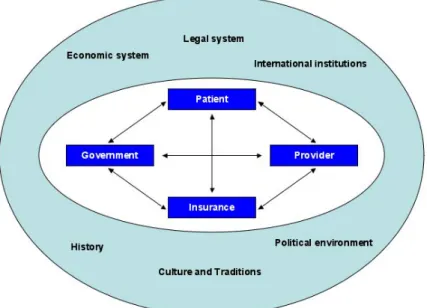
As represented in Figure 2.1, the components of the health care system are the patients, the service providers, the insurances and government. Its environment is the economic, legal, historical and cultural structures of society. The inputs are represented not only by resources but also by regulations and expectations of the people entering the health system, while the outputs comprise individual and public health, productivity and revenues, research and medical advancement, among others.
Typically, the components in the health care system are called actors and/or stakeholders. They are the ones forming relationships and exchanging fees and services. Consequently, they all follow their own sets of goals, adhere to specific principles and define their expectations according to their view on the system. Glouberman and Mintzberg (2001) conceptualised these differing goals and relationships in a matrix of “four Cs: cure, care, control and community”.
Figure 2.2. The four worlds in a health care system.
Source: Adapted from Glouberman/Mintzberg (2001).
In their analysis, they call it the health care and disease cure system, underlining the inherent differences in the care and the cure setting. While cure is provided by hospitals, care is administered in much broader terms in the community, encompassing primary care, long-term care, mobile care and social services, specialists, therapists and other health professionals as well as “alternative” health services. Control is exercised by regulatory bodies, such as public health authorities or health insurance, “…who work above the services they are supposed to control, but within the overall system of health care.” [Glouberman/Mintzberg 2001, p. 59] To the extent that these four worlds remain disconnected and each run along their own way, the system continues to act dysfunctionally.
In an effort to bring order to this apparent pandemonium and replace the machine metaphor with something more appropriate, the theory of complex adaptive systems
(CAS) has recently emerged and is being applied in health systems analysis.
[Plesk/Greenhalgh 2001]
A complex adaptive system pre-empts the unpredictability of individual agents’ actions and the interconnectedness, which exists between the agents of a system. As agents can also be part of several systems simultaneously or change their membership, a CAS has fuzzy boundaries, rather than rigid ones. The actions are driven by internalised rules, such as instincts or models, but do not have to be shared by other agents of the
Community Involvement • elected officials • advocacy groups Acute Cure • acute hospitals • outpatient centres Community Care • LTC facilities
• “primary care” physicians
• “alternate” health services
• social services, mobile care Public Control
• public health authorities
• regulatory agencies
• (social health) insurance companies
system. As agents and their behaviour adapt over time, these systems change as well and co-evolve with other systems within which they are embedded. Naturally, when complex systems interact with each other, tension or paradoxa are created but “[w]hereas conventional reductionist scientific thinking assumes that we shall eventually figure it all out and resolve all the unresolved issues, complexity theory is comfortable with and even values such inherent tension between different parts of the system.” [Plesk/Greenhalgh 2001, p. 626] Leaving room for tension and interaction leads to a system, which enhances creative, surprising and emergent behaviour, but this by no means entails complete unpredictability and randomness. On the contrary, CASs often demonstrate a pattern which make general statements about the system possible. In other words, even though one might not know the exact point in time when an action will occur, one can be sure that eventually, it will occur. Lastly, a sense of self organisation is inherent in complex systems through simple locally applied rules. “While no one directs our detailed actions in such situations (e.g. a social meeting), we all know how to behave adaptively and end up getting to where we want to go.” [Plesk/Greenhalgh 2001, p. 627]
2.1.4 System, Aims and Functions
The aim of a health care system is to provide equitable, effective and efficient services to those who need them. [WHO 2000] Notwithstanding national differences, there is a consensus among European countries that health care is a social good, is based on solidarity with mandatory participation in either social health insurance or tax-funded systems, which experience tight public regulation in a legitimate public sector. [Saltman 2002] Based on these 19th century principles policy and decision makers are increasingly facing the challenge of combining these (undisputed) values with the challenges of the 21st century.
Traditionally, European systems have put high value and focus on an equitable and universal access to services, irrespective of income, personal attributes and location. Cost control, efficiency and effectiveness in these systems were secondary goals, at the most. In recent years however, the focus of the well-established and historically grown systems of the industrialised countries has shifted. With the transition from acute cure to chronic care a paradigm shift from pathogenesis to salutogenesis4 is observed and the interest in the management and governance of the different actors in the system has gained importance. [Glouberman/Mintzberg 2001, Hessinger 2009, Amelung et al. 2009]
4
Pathogenesis = The development of a disease. The origin of a disease and the chain of events leading to that disease. (Webster’s Medical Dictionary)
Salutogenesis = Developed by Prof. Aaron Antonovsky (1979), focusing on factors that support human health and well being rather than those which cause disease.
The rise of patient orientation and more integrated processes can also be attributed to the growing interest of policy and decision makers in a more efficient and effective health care system and cost control. [Hessinger 2009] An active and participatory approach for chronic care has replaced the passive and invasive approach for acute cure. And a more economic view has been taken, redefining the health system as a market, albeit with distinct features: universal access, complexity and uncertainty, information difficulties, market failure, technological progress and changes in demand [Smith et al. 1997] pose serious problems when trying to apply a market-oriented concept to the system of health.
So the question remains: what do we want to achieve with our health care systems? Michaelis (2001) identified the following health aims and corresponding discussion points [pp. 302-304]:
1. The first and undisputed aim of every health care system is the restoration of health. The preservation and strengthening of health already is the cause for some dispute, while the aim of enhancement and creation of health is under heavy discussion.
2. Health services shall be effective. But who defines effectiveness and how should it be measured?
3. What Michaelis calls “friendliness of services” can be translated with accessibility and availability of services.
Similarly, Maxwell (1992) identified the principles of national health care systems as being universal and where the ‘national’ only decides the priority setting and importance of these principles. He formulated his principles according to six dimensions of quality in a health care system [cited in Goodwin 2008, p. 497]:
• Access to services
• Relevance to need (for the whole population)
• Effectiveness (for individual patients)
• Equity (fairness)
• Social acceptability
• Efficiency and economy
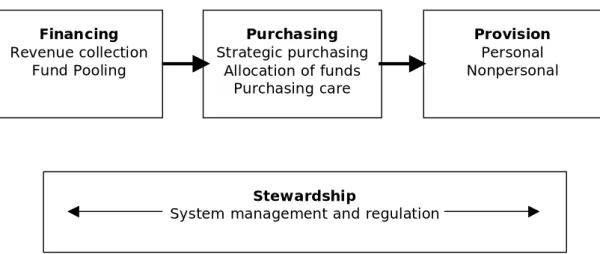
Goodwin (2008) takes a different approach and analyses the system according to its four functions:
Figure 2.3. The basic structure of a national health system. Financing Revenue collection Fund Pooling Purchasing Strategic purchasing Allocation of funds Purchasing care Provision Personal Nonpersonal Stewardship
System management and regulation
Source: Goodwin (2008), p. 498.
Each of these functions can be subdivided into more detailed functions, such as the collection and distribution of revenues, the provision of personal and non-personal care or the management and regulation of the system. As has been stated already, the functions will not vary across countries, the organisation and distribution of these however, will.
Summarising, the aims and objectives of the ideal health system as described by Shortell (2000) include the focus on meeting the health needs of individuals and
populations and the involvement of patients in all aspects of their care. This entails a coordinated and integrated care across the continuum and an ongoing relationship with the patients. Another important aspect is evidence-based medicine (EbM) and continuous improvement of the knowledge base. Finally, this system can only operate with an effective and open information system and information transparency on costs, quality, outcomes and patient satisfaction for all stakeholders. The health system itself is an active partner in the community with which it is in constant exchange.
2.1.5 Provision of Services
When considering the provision of services in a health system it is important to note that over 80% of the actual health care and service provision is accomplished outside the official institutions: at home, in the family and social networks. Even though informal care hence plays a key factor in health care and has major implications for other areas of society, such as work and the economy, it is still under-recognised in health economic
and health system analysis. [Goodwin 2008, Stein 2006] The objective of the health care system should therefore be to assist these carers by providing training, financial support and short term respite care or simply strengthening the rights of informal caregivers. By leading them out of the grey zone and integrating them as a valuable part of the health and social system, all sides would profit.
Figure 2.4. Sectors of health care within a national health system.
Informal care Health care system Primary care Family physician Community nurse Dentist Pharmacist Therapist Mental health worker Walk-in centre Palliative care Secondary care Hospital Inpatient ward Outpatient clinic Day surgery Treatment center Tertiary care Specialist unit Inpatient ward Outpatient clinic Rehabilitation service Palliative care service Longterm care service
Source: Own adaptation from Goodwin (2008), p. 507.
2.2 Health and Policy
“Policy can also be just as much about inaction (‘non-decision-making’) as action…”
(Crinson 2008)
Policy setting requires a strategy, an aim and the power to implement. As described in 2.1.4, the goals of a health system are straightforward but may not be equally emphasised. It is now for health policy to define the priorities and set forth the standards
and regulations to translate those into practice. Public health plays a crucial role in bridging this gap.
2.2.1 The Principle of Public Health
Public health (PH) is defined as
“the science and the art of preventing illness and disability, prolonging life, and promoting physical and mental efficiency through organized community efforts for the sanitation of the environment, the control of infectious and non-infectious diseases as well as injuries, the education of the individual in principles of personal hygiene, the organization of services for the diagnosis and treatment of disease and for rehabilitation, and the development of the social machinery that will ensure to every individual in the community a standard of living adequate for the maintenance of health.”[TDR 2004, p. 30]
Additionally, German-speaking literature puts an emphasis on the pluralistic and cross-sectional aspect of public health, integrating under its roof professionals from fields as diverse as medicine and law, insurance and public administration. [Polak 1999, Preface] Public health therefore encompasses not merely community health (care) but every aspect, whether cultural, political or scientific, of the health sector and society concerned. [Stein 2006] It is consequently associated with prevention, health promotion and health literacy, and thus, should encompass all aspects of daily life. However, many modern health systems seem more intent to regulate financing and hospitals than take a population-based approach to tackle life-style related conditions and chronic care. Since a more proactive stance would mean radical systems change, policy makers are reluctant to set the necessary measures. [Goodwin 2008] How immensely society would profit from an open-minded and more broadly thought concept of health and public health was proven by the seminal work of Wilkinson and Marmot (2003) who concluded that “…the most important factors to improve the health of people, patients, and populations lies primarily outside the formalized system of health care. […] the amount of money spent on health care (in terms of percentage of GDP) is not in itself a direct and causal contributor to a nation’s heath profile.”
Goodwin (2008) summarised the characteristics of a proactive public health system as being at the heart of decision making and health care organisations, being the guiding principle of resource allocation and therefore being the starting point for any strategy in the health system – which consequently would include the consideration of public health in the adjacent policy areas of social services, education and economics.
• Public health at the centre of decision making
• Public health at the cultural heart of care organizations
• Finance, purchasing, and provider strategies integrated to assist health improvement
• Ring-fenced resources for public health
• Interventions at the earliest opportunity to address avoidable deaths
• Preventative initiatives to promote good health and well-being
• Responsibility to the citizen by helping fulfil their economic potential to improve health
Table 2.1. Characteristics of a proactive public health system.
Source: Goodwin (2008), p. 506.
Putting public health into context with the ‘four worlds in a health care system’ (Figure 2.2), one can identify a different directionality between ‘medicine’ and ‘public health’: while medicine, nursing and long term care focus on individuals and their sicknesses, public health targets groups or populations and their health (status). Notwithstanding, social and care services may function in both ways, supporting individuals in their immediate need for assistance and promoting prevention, health literacy and patient empowerment to help improve the health status of communities.
“Ideally, the public-health sector rather than the medical care sector, should be responsible for population health status and for informing and monitoring all government policy initiatives that affect population-health status.” [Ratner et al. 1997]
2.2.2 Health, Policy and Politics
There is no single definition of what constitutes a policy and who formulates a policy [Crinson 2009], which is why it is probably used so often. There are several concepts and theories analysing the mechanisms behind policy making and implementation, closely related to political science, sociology and organisational theories. A public policy is characterised by its primacy and influence over all other policies, whether private or personal, and its provision of a legalistic framework for these operations. [Crinson 2009] The UK government further defined public policy making as being “[…] the process by which governments translate their political vision into programmes and actions to deliver “outcomes” – desired changes in the real world” [Cabinet Office 1999, paragraph 2.1]. The tendency to confuse political statements with scientific arguments and the sometimes disconcerting, though obvious, interaction of health and politics has incited Reinhardt to the following warning to his students:
“When economists or other actors in health politics fall into their normative pattern – when they pretend to use scientific methods to propose what ‘has to be done’ and what is ‘efficient’ – an alarm signal should start ringing in your head. The chances are high that you either have to do with somebody who masks his political ambitions behind science or else with somebody who is not sufficiently clear on the confines of economics as a field of science.” [Reinhardt as quoted in Rice 2004, p. 17]
The study of health policy is closely connected with the interpretation of the role of the state and the distribution of information and agency. In his thorough analysis, Crinson (2009) highlights five theories from Marxism to Neo-Liberalism and analyses their approaches to public health policy.
Goodwin (2008) terms the governance, resource allocation and regulation of a health system “stewardship” (compare Fig. 2.3). The main objectives of policy makers, who are (supposed to be) the “stewards” of the system, are the encouragement of competitive behaviour, while at the same time ensuring that the negative effects of competition are mitigated through the regulation of insurers and health care providers as well as the setting of minimal standards of quality and qualification. Third, they might safe-guard social objectives by setting uniform prices or providing guidelines and protocols. The “essence of stewardship”, Goodwin concludes, is to find the balance between encouraging competition while simultaneously protecting and strengthening the social objectives of a health system. To his description of social objectives one might add, that the access to and the equality of care play an equally important role as does the integration of a ‘Health in all Policies’5 approach, where every action taken in any policy area is to be weighed against the possible impact on the health and well being of the citizens.
Examples of health policies and the questions they are trying to answer are henceforth connected to the distribution of funds, the pricing and reimbursement of patients and service providers, the accessibility and equity of the services, and the quality and control of those services. Moreover, they need to take into consideration the wider aspect of environmental, social, economic and cultural influences and steer them accordingly to reach the final goal of improved health for all. [Henderson 2005, Chapter 18] These policies may be implemented via recommendations, market price systems, incentives or
5
disincentives, self-administration, limitations and restrictions, legal requirements and licences or indirect steering mechanisms. [Güntert 2008]
Figure 2.5. Policy goals in a multi-dimensional policy system.
Access/Equity Quality Patient satisfaction Effectiveness Efficiency Society (Solidarity) Attractiveness
Source: Own adaptation from Güntert (2008).
2.3 Reforming Health Care Systems
“The general egalitarian principle in health care has been defined as receiving treatment according to need and paying according to ability to pay. […] The current emphasis on health care reform has potential to lead increasingly to the provision of health services and treatment according to willingness to pay, a trend which undermines the principle as far as both paying according to the ability to pay and provision of care according to need are concerned.” (Koivusalo/Ollila 1996)
Health care reforms have an air of being something innovative and purposeful. They are designed to perpetuate the provision of public and private health services by redefining the framework for the societal and structural changes of the future – and for the market. [Stein 2006] Policymakers have tried to find concepts, which enable the combination of social equity and entrepreneurial efficiency. Since cost control has come into the focus of most governments, they shift their focus on setting standards and monitoring and evaluating outputs. The idea is to organise the health care system more effectively and efficiently while at the same time improving the quality of and guaranteeing accessibility to services. [Saltman 2002] So for the past two decades, the mature health systems of
this world have been practicing themselves in continuous health care reforms, sometimes implementing diametrically opposed approaches, but always trying to reach the same goals: cost containment and introduction of ‘more market and competition’. [Eckel 2001, Huber 2001, Glouberman/Mintzberg 2001, Plesk/Greenhalgh 2001, Crinson 2009, Amelung et al. 2009] A regular update and documentation of these reform efforts can be found in the ‘Health Systems in Transition (HiT)’ series of the WHO Regional Office for Europe.6
2.3.1 Reforms and Regulations
There has already been extensive mention of ‘regulation’ throughout this chapter. It is an intrinsically political function, which gives the state, government or “regulator” the instrument with which to steer and control the actors in the system. Whether it is the ‘invisible hand’ of Adam Smith or a more active proponent of the social welfare states determines the form, impact and range of its regulations. Regulations form a permanent or at least long term framework, whereas reforms are temporary interventions, albeit with long term effects. [Noweski 2008]
2.3.2 Levers for Reform
There are three major concerns common to all reforms: the introduction of user charges, the issue of health insurance and decentralisation [Koivusalo/Ollila 1996, Güntert 2008]:
• The user charges in government health facilities have been promoted as a way to mobilise revenues, promote efficiency, foster equity, increase decentralisation and sustainability, and foster private sector development.
• Health insurance is seen both as a problem and a solution in health care reforms. […] According to the egalitarian aims in health care, insurance cost-sharing should be based on the ability to pay, without changes in benefits.
• Decentralisation can be defined as the transfer of authority in public planning, management and decision making from the national to the regional and community levels. Different degrees according to the actual transfer of power are distinguished: deconcentration, devolution, delegation and privatisation. Although it is appreciable to move the decision making process nearer to where the people concerned are, this concept also poses many problems in execution. The subordinate levels may lack the managerial skills and the financial and human resources to administer the new responsibilities. Furthermore, it adds yet another layer to public administration and hence increases instead of decreases costs.
6
Porter and Teisberg (2006) argue on similar lines when they identify three “broad areas” of health care: the cost and access to health insurance, the coverage of health insurance versus individual contributions and the organisation of health care delivery itself. Along these lines important decisions have to be made about the extent to which resources are distributed and which principles and aims are applied to distribute these finite resources.
Figure 2.6. The ‘Bermuda Triangle’ of health care provision.
Source: Güntert (2008).
Further aspects of health care reform are connected with the cooperation within and between organisations and professions, the establishment of networks and the introduction of management tools, such as quality assurance, performance measurement or process and information management. [Halvorson 2007, Amelung et al. 2009]
2.3.3 “Culture Trumps Strategy” - Making a Change
The major obstacle to be overcome in implementing any kind of change is “culture”. Halvorson (2007) attests the culture(s) within a health care system to be uniquely immune to any kind of change. “Health care is an ultimate bastion of the ‘not invented here’ approach to idea rejection.” [Halvorson 2007, p. 87] Likewise, managers and agents in the health institutions have learnt to “sit out” any reform and reorganisation issues, knowing that these efforts will pass and they can continue with business as usual after the storm has passed. [Glouberman/Mintzberg 2001] Unlike other areas of the
Optimise total benefit through prioritisation
Rationing
Limit services based on financing restraints
Rationalisation
Rational allocation
Improve resource utilisation through better management
economy, where the evaluation of good and best practices and the sharing of experiences is inherent in the business models, every unit in every hospital or doctor’s office has its own set of rules and procedures, cultures to be well aware of. The concepts of systematic process analysis and improvement, of quality management and transparency are whole new sciences for health care systems and their actors, in which none of them are trained. [Halvorson 2007] The constant reform efforts of the past decades may have introduced these instruments into the systems, but they are far from having changed the attitudes of those supposedly implementing them. It may be time to stop reforming and start acting since “[…] systems and institutions are like people in that they function best under steady care, not intermittent cure. The problem is not how to intervene across the great horizontal divide, but how to dissolve it into a cooperative network.” [Glouberman/Mintzberg 2001, p. 63]
Table 2.2. Options for designing future health care systems.
Source: Adapted from Güntert (2008).
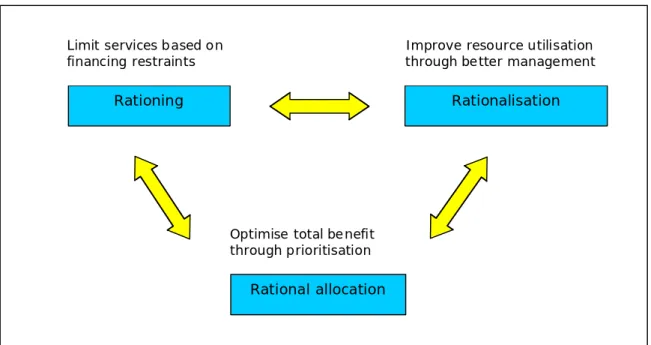
• Consistent rationalisation to avoid rationing and to reach the best possible cost/benefit ratio.
• Securing a good basic health care system for everyone by governmental regulation.
• Use a combination of different systems to finance the health care system.
• Improve the knowledge base for rational decision making on all levels.
• Promote innovations which also lead to rationalisation.
• Improve health promotion on all levels to secure better health outcomes and a more equitable health care.
• Improve integration of the different providers and actors in the system by using information technology, incentivise cooperation and promote integrated care.
• Clear regulations for quality standards on all levels to increase transparency and enhance outcomes measurement.
2.4 Implications for Integrated Care
“Since each agent and each system is nested within other systems, all evolving together and interacting, we cannot fully understand any of the agents or systems without reference to the others.” (Plesk/Greenhalgh 2001)
The definition and extent of “adequate health services”, depends from country to government but the aim is clear: to provide services as efficiently and inexpensively as possible. [Stein 2006] The challenges presented in this chapter underline the importance of finding and implementing new approaches to health care, such as interdisciplinary and intersectorial cooperation, more efficient procedures and more effective patient management. These measures must take into account the wider social, economic and cultural systems health care is embedded in and enable the people working within the system to translate theory into practice. As will be presented in Part II of this thesis, integrated care necessitates a clear structure and management organisation, supportive stakeholders and a pro-active priority setting by policy and decision makers. Transforming the system from within to improve and sustain it for future generations is a side effect of successful integrated care and enables the actors to consolidate the conflicting aims of finite resources and infinite demands for health.
First efforts have been made by Edgren (2008) and colleagues (2009) to consolidate the existing theories on integrated care with those of systems theory and complex adaptive systems and preliminary results are promising, and certainly shed new light on the power of both concepts. Still, it is too early to appraise the outcomes of this research and it can only be hoped that more groups of researchers try to transfer and merge theories and methodologies from different disciplines to build a theoretical framework for integrated care. [Stein/Rieder 2009a]
3 D
ECISION
M
AKING IN
H
EALTH
C
ARE
“…the goals and values of state organisations are themselves policies and so are continually subject to dispute and change.” (Hill 2004)
Every day we make countless decisions of most of which we are not even consciously aware of or to which we give little methodological thought. Being a woman, I know how difficult it sometimes is to decide on whether to wear jeans or a skirt, whether to eat a salad or rather a club sandwich and which trends to follow so as to fit into the intended social surroundings. Even these seemingly simple decisions might require a literature review (i.e. study magazines), sometimes accompanied by field research and a survey among friends and peers – so, if we put so much thought into the more banal questions of life, why is there so little evidence of decision making (strategies) in health care?
3.1 Ideal Models of Public Policy Decision Making
“I do not know a way to certain success, but the way to certain failure: wanting to please everybody.” (Plato)
The most famous and influential public policy decision making model is Max Weber’s rational bureaucracy (1921). In his understanding, the bureaucracy was the natural progression from the feudal, pre-modern states governed by traditions and emotions to the modern industrialised state governed by rationality. The principles of his theory are
division of tasks (i.e. specialisation), hierarchy, regularity and documentation. In such organisations, clear rules and regulations are abided by the agents, who have no self-interest in their tasks and who follow a predefined and transparent career path. The leader of the bureaucratic organisation, whether public or private, is not himself part of the organisation and through the detachment of personal and professional interests will only decide for the greater good of the organisation. [Crinson 2009, Kasper/Mayrhofer 1996, Weber 1972]
After World War II, the emerging normative models all elaborated and criticised Weber’s bureaucracy model and tried a more realistic approach towards public policy decision making. Simon’s rational decision making model (1957) focused on the process of decision making as a selection of the most promising and profitable alternative for the
aims of the organisation, irrespective of the function and setting of the organisation itself. This requires the prior definition of ‘means’ (= how to achieve the selected option) and ‘ends’ (= what do we want to achieve) and a situation analysis from the decision makers. The incrementalist approach, also known as ‘muddling through’ juxtaposed rational decision making by arguing, in practice and policy making, decisions are made based on already existing policies and selecting those alternatives which best fit the status quo. This is due to the lack of adequate information and evaluation methods and the plethora of variables within which organisations work. Incrementalism was developed as a reaction to the apparent inability of many organisations to implement problem-solving capacities. [Braybrooke/Lindblom 1963]
Based on rational choice theory, public choice theory stipulates that decisions are fundamentally influenced by self-interest maximisation of the (public) policy makers – the complete opposite of Weber’s ideas. Reflections of this theory are said to be found in pre-election promises and spending by politicians in order to positively influence the ballots [Nordhaus 1975, Mueller 1989] or in the continuous growth of power and importance of bureaucracies which lead to the inefficient use of public resources. [Crinson 2009] It developed by applying economic concepts of agency, utility and game theory to political analysis and is associated with the analysis of lobbyism and advocacy groups and their influence on political decision making. [Buchanan/Tulock 1962, Buchanan 2003]
The garbage can model of policy decision making came up in the late 1970s rejecting the ideas of a rational or linear – incremental model and postulating a more realistic view on public organisations. In the light of “…ambiguous organisational values, uncertain knowledge about outcomes of decisions, and rules about decision-making which were largely politically symbolic” the model emphasised the irrationality and chaotic aspect of organisational decision making. [Crinson 2009, Hill 2004]
In summary, while all the above theories have some merit and attain some value in describing (public) policy decision making, none of them has emerged to replace the Weberian theory in its influence and scope. Today, the rationalist and the realist interpretations bounce between some sense of control and predictability on the one side and chaos and insurmountable complexity on the other. However, it is only the rationalist approaches, which give the analyst some kind of pathway and framework to follow. [Crinson 2009]
3.2 Levels of Decision Making
“Fear not! I do not revenge evil, but force to the good. My hand is hard, but my spirit is mellow.” (Inscription on a Dutch workhouse, cited in Kieser 2002)
The different levels of decision making have inherently been touched by the systems models introduced in Chapter 2, however they have not yet been formally defined. There is a very basic description used in many different fields when analysing processes and systems, whether natural, constructed or societal, and that is ordering the layers into macro-, meso- and micro-levels.
In policy terms, one has the regulation subject, the regulation agency and the regulation object. The regulation subject sets norms, which influence and constrain the decision options for the regulation object. In a steady regulation system, the regulation object learns to rely on the norms and standards set forth by the regulation subject. In case of a violation of the set norms, the sanctioning of the regulation object is devolved to the regulation agency. [Noweski 2008]
Figure 3.1. The levels of regulation.
Regulation subject
Regulation agency
Regulation object
Source: Noweski (2008), p. 18.
In health care, it is easy to identify the governmental or political level as the macro-level, that is the regulation subject, but it depends on the system and the viewpoint of the analyst where to identify the meso- and the micro-level. Traditionally, the meso-level or