Influence of Sleep Position Experience on Ability of Prone-Sleeping
Infants to Escape From Asphyxiating Microenvironments by
Changing Head Position
Dorota A. Paluszynska, MD; Kathleen A. Harris; and Bradley T. Thach, MD
ABSTRACT. Objective. Several studies have found that back- or side-sleeping infants who are inexperienced in prone sleeping are at much higher risk for sudden infant death syndrome (SIDS) when they turn to prone or are placed prone for sleep compared with infants who normally sleep prone. Moreover, such inexperienced in-fants are more likely to be found in the face-down posi-tion at death after being placed prone compared with SIDS infants who are experienced in prone sleeping. We hypothesized that lack of experience in prone sleeping is associated with increased difficulty in changing head position to avoid an asphyxiating sleep environment.
Methods. We studied 38 healthy infants while they slept prone. Half of these were experienced and half were inexperienced in prone sleeping. To create a mildly as-phyxiating microenvironment, we placed infants to sleep prone with their faces covered by soft bedding. We re-corded inspired CO2(CO2I), electrocardiogram, and
res-piration, and we videotaped head movements. Also, we assessed gross motor development (Denver Develop-ment Scale).
Results. When sleeping prone, with their faces cov-ered by bedding, all infants experienced mild asphyxia as a result of rebreathing. All aroused and attempted escape from this environment. Infants used 3 stereotyped head-repositioning strategies. The least effective was nuzzling into the bedding with occasional brief head lifts. More effective were head lifts combined with a head turn. Some infants, however, could turn only to 1 side, right or left. Infants who were inexperienced in prone sleeping had less effective protective behaviors than experienced infants. Infant age did not correlate with efficacy of protective behaviors. Infants who were experienced in prone sleep had advanced gross motor development compared with inexperienced infants.
Conclusion. Infants who are inexperienced in prone sleeping have decreased ability to escape from asphyxi-ating sleep environments when placed prone. These ob-servations potentially explain the increased risk associ-ated with prone sleep in infants who are inexperienced. The increased occurrence of the face-down position in such infants is also potentially explained. These find-ings suggest that airway protective behaviors may be acquired through the mechanism of operant conditioning
(learning). Pediatrics 2004;114:1634–1639; SIDS, acciden-tal suffocation, motor development in infants.
ABBREVIATION. SIDS, sudden infant death syndrome, CO2I,
inspired CO2.
S
everal epidemiologic studies have indicated that infants who are inexperienced in sleeping in the prone position are at exceptionally high risk for sudden infant death syndrome (SIDS) if they are placed prone.1–3 That is to say, SIDS risk isgreatly increased over that of infants who are used to sleeping prone. Furthermore, when SIDS infants who are inexperienced in prone sleep are found lying prone at death, they are more likely to be found face down than infants who are used to prone sleep.1It is
well established that the prone, face-down position incurs a risk for suffocation and that normally infants escape by turning their heads to 1 side or the oth-er.4–8 However, the potential role of sleep-position
experience on acquisition of protective responses has not been evaluated. Moreover, the effect of matura-tion on these responses is unknown. In this study, we use the terms “inexperienced” and “experienced” to indicate the infant’s history of exposure to prone sleeping. We tested the hypotheses that infants who are inexperienced have increased difficulty in escap-ing from a potentially suffocatescap-ing environment when sleeping prone and that age may modify this behav-ior.
METHODS
We studied 38 infants (aged 3–37 weeks; mean age: 151 days), 21 girls and 17 boys. Three infants were born prematurely, at 36 weeks of gestation, but when studied, they were ⬎40 weeks’ postconceptional age. Thirty-eight of the infants were recruited through advertisements within the hospital and local media. In 36 of these, we had no knowledge of their sleep habits before the study. Although we did not ask parents for deep history before the study, parents of 2 infants had already informed us of their infant’s usual sleep position. The Washington University Human Studies Committee approved the study, and informed consent was obtained from the parents of all infants. As in our previous studies, safety measures included constant oxygen saturation and electrocardiogram monitoring; direct observation of infants at all times by 2 neonatologists; and termination of rebreathing if a decrease in oxygen saturation to 85%, bradycardia, or sustained crying indicating that distress occurred. Parents were invited to be present during the study, and almost all of them chose to do so. When infants were being prepared for study, parents were given a questionnaire that covered basic medical history and infant care practices. The questions that pertained to sleep position were, “In what position is your infant placed for sleep?” “In what From the Edward Mallinckrodt Department of Pediatrics, Washington
Uni-versity School of Medicine, St Louis, Missouri. Accepted for publication Jun 2, 2004. doi:10.1542/peds.2004-0754 No conflict of interest declared.
Reprint requests to (B.T.T.) Washington University Department of Pediat-rics, 660 S Euclid Ave, Campus Box 8208, St Louis, MO 63010. E-mail: [email protected]
position is he/she found in the morning?” “In what position does infant sleep most of the time?” “Has your infant been found face down during sleep?” Parents filled out this form while the inves-tigators conducted the sleep study. Therefore, except for the 2 infants mentioned above, the studies were conducted without previous knowledge of the infants’ sleep position experience. At termination of the study, parents were asked whether their infant had ever slept in a position other than those indicted in the questionnaire. The majority reported that infants always had slept in a single position. Others reported that the infant had rolled from back or side to prone or had been placed in various positions on multiple occasions. An attempt was made to establish the extent of the infant’s experience in prone sleep. Very often, parents were unable to provide accurate information on duration of prone sleeping because this required knowledge of when the infant had changed sleep position during the night or how often this oc-curred. Lacking this information, we were unable to quantify accurately the extent of the infant’s experience in prone sleeping. Therefore, all infants who normally slept prone as well as those who had occasionally slept prone or had a history of turning to prone during sleep were termed “experienced,” whereas the re-mainder were termed “inexperienced.” As it turned out, 19 of the infants studied were experienced and an equal number were inexperienced.
All infants had spent variable amounts of time while awake in the prone position (“tummy time”). As the amount of time spent during tummy time could not be quantified accurately from par-ents’ histories, we did not attempt to determine its effect on protective behaviors, if any.
To create an asphyxiating microenvironment, we placed infants prone and face down on soft bedding, consisting of a comforter placed over a foam rubber mattress with a 2-in deep circular depression cut into its surface as previously described.9The
de-pression lay directly beneath the infant’s face. This bedding ar-rangement limits dispersal of expired air more than most soft surfaces studied in the past.9During the study, we recorded CO
2
at the nose via a silastic catheter firmly taped beneath the infant’s nostrils (Ohmeda 5200), respiration (Respitrace), airflow at the nostrils,5and electrocardiogram. Also, we videotaped the infants
using an infrared light source. All tests were performed during late morning or early afternoon during the infants’ usual postfeed-ing naptime. Room temperature was 72 to 73°F. First, the infants were allowed to go to sleep. Then, if not already in the face-down position, then their heads were turned face down. As in our previous studies, if arousal did not occur within 4 to 5 minutes, then silk scarves were placed at timed intervals around the in-fant’s head to increase further inspired CO2(CO2I) and decrease
inspired O2.5When the infant successfully turned the head to the
side and seemed to have gained access to fresh air, we let him or her resume sleeping and then placed scarves against the face to produce rebreathing in this new face-to-side position. This was done to test the infant’s ability to escape by turning the head to the other side, right or left, as the case might be.
The study was terminated after the infant’s ability to turn the head (to right and to left) had been established or when head turning did not occur despite evidence of full arousal (thrashing movements, crying) combined with other defensive behaviors (eg, nuzzling, head lifting).
Assessment of Airway-Defense Ability
On the basis of several previous studies of infant behavior during rebreathing, we decided on a 3-point scoring system4–7:
score 1, rapid side-to-side movements of the face against the bedding (nuzzling) with or without brief head lifts but without turning the head to the side sufficient to lower inspired CO2Ito ⱕ1%; score 2, a head turn to 1 side only, right or left, sufficient to lower CO2Itoⱕ1% associated with failure to avoid rebreathing by
turning the head to the opposite side; score 3, head turns to both the right and the left that lowered CO2Ito ⱕ1% in each case.
Infants were observed continuously during the study, and notes of infant head movements written directly on the polygraph during the study were used to document behaviors. Later these tracings were reviewed to ascertain degree of reduction in CO2Iproduced
by head movements. This provided an objective measure of avoid-ance efficacy. The⬍1% CO2Ivalue was chosen to reflect successful
avoidance because such minimal exposure to increased CO2Imay
occur during sleep with sucking on a pacifier or when the hands
are near the face. This low level is not associated with increased arousals.4,5
Inspired CO2Measurements and Other Analyses
To compare efficacy of protective behaviors, we randomly se-lected a subgroup of infants. This was done to reduce the mass of data and time spent in multiple measurements of individual CO2I
levels, which required precise measurement by hand ruler. Nine infants who scored 3 (ie, accomplished in head turning) and 9 who scored 1 (able only to nuzzle and or lift head) were randomly selected. We measured the CO2Iimmediately before, during, and
10 seconds after head turns (infants who scored 3) or nuzzling (infants who scored 1). Selection of events was without regard to the CO2Imagnitude at these 3 times. For infants who scored 3,
both episodes of head turning were scored and averaged. For infants who scored 1 and had repeated nuzzling episodes, up to 3 episodes were chosen at random and the CO2Ivalues were
aver-aged. Again, this randomization procedure was performed to reduce the number of tedious measurements that otherwise would have been required.
For all 38 infants, ability to raise and keep the head above the mattress was evaluated by expressing total duration of time the head was lifted as a percentage of total study time (ie, from beginning of sleep onset to termination of the study). The percent-age of total time that the infant spent face down was calculated in a similar manner.
Denver Developmental Screening Test
After the polygraph study, we assessed gross motor develop-ment in each infant using the Denver Developdevelop-mental Screening Test (Denver II).10We developed a 3-point scale to assess each
infant’s ability. We used information on the test form showing the percentage of infants who had already acquired a specific motor skill at a given age. This allowed a semiquantitative assessment for comparison of the 2 infant groups. The most advanced gross motor skill that the infant could perform was identified. One point was given when this skill was shared by 25% to 50% of infants of the same age. Two points were given when this ability was pos-sessed by 50% to 75% of the population. Three points were given when ⱖ75% infants of his age had already acquired the most advanced skill that he or she could perform. Hence, infants who had gained gross motor skills at a slower rate than the majority of same-aged infants had the highest scores. Statistical analyses were performed using2, analysis of variance, and repeated measures
analysis of variance.
RESULTS
The average duration of the studies was (40.9 ⫾ 3.17 minutes [mean ⫾ SEM]). The mean peak CO2I
obtained during rebreathing for experienced infants was 5.16% ⫾ 0.17% compared with 4.98%⫾ 0.34% for the inexperienced infants (not significant). All infants aroused and attempted to escape from the mild asphyxia of the rebreathing environment. CO2I and O2 saturation levels at onset of arousal were
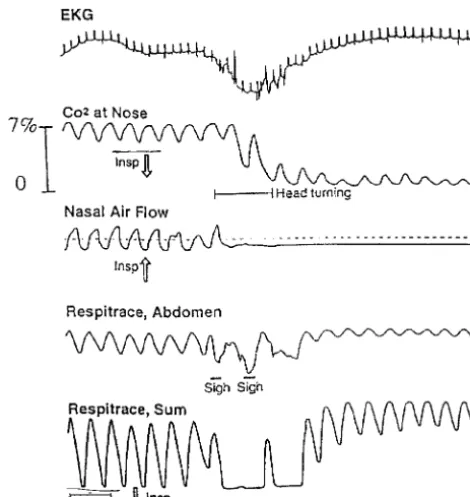
variable from infant to infant and for a given infant who experienced multiple arousals. As predicted from previous studies, 3 distinct, highly stereotyped patterns of movement were observed when rebreath-ing infants aroused from sleep. Some attempts to escape consisted only of back and forth head move-ments (nuzzling; Fig 1). This was sometimes com-bined with brief straight-up head lifts. Other infants were able to combine head lifting with head turning to right or left. Some of these could turn in 1 direction only, right or left, whereas others were able to turn in both directions.
Nuzzling produced only transient lowering of in-spired CO2I, whereas complete head turns produced
inspired CO2Ito room air levels (ie, atmospheric), the decrease in CO2I lasted only as long as the infant
maintained this position. On lowering his or her head back into the bedding pocket, rebreathing re-sumed as before.
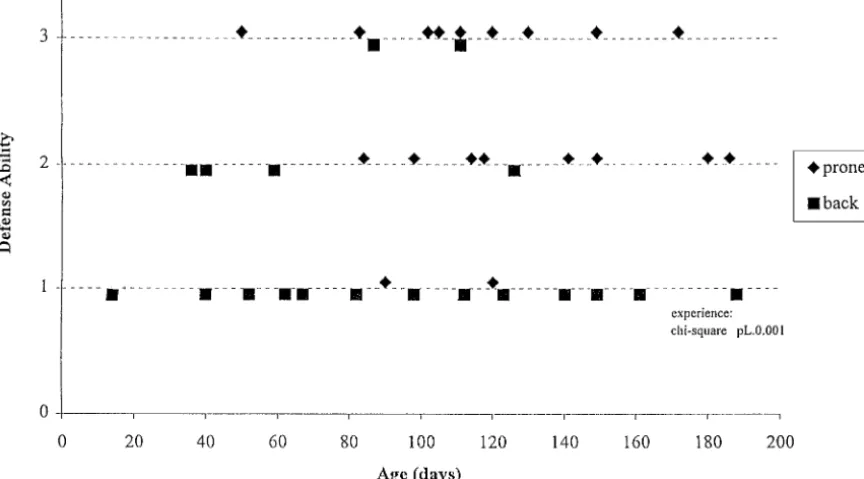
Experienced infants generally performed better in airway protection (ie, had higher scores) than inex-perienced infants (2,P⫽.002; Fig 5). There was no
significant association between infant scores and in-fant age (analysis of variance, P ⫽ .93; Fig 5). This was also true when postconceptional age was con-sidered. In contrast, it was noted that age was a significant variable when duration of head lifting, quantified as percentage of total sleep time, was considered, irrespective of usual sleep position, with older infants tending to keep their head elevated for longer periods of time (analysis of variance, P ⫽
.016). In addition, the inexperienced infants spent more time in the face-down position during the Fig 1. Illustrations of the protective behaviors observed in this study.
Fig 2. Tracings in 1 infant who had a score of 1 for protective skills showing transient reduction of inspired CO2associated with
nuz-zling. Sighs are associated with onset of arousal. A 2-second time bar is shown at the bottom.
Fig 3. Tracings in an infant who had a score of 3 for protective skills showing sustained reduction in inspired CO2 associated
study than those who were experienced in prone sleeping (48.4 [range: 0.2– 88.4%] vs 14.6 [range: 0.0 – 68.6%]; analysis of variance,P⫽.0002). Gross motor development was more advanced in experienced than in inexperienced infants (mean score: 2.31 vs 2.83;2,P⫽ .029).
DISCUSSION
All infants aroused and attempted to escape the mildly asphyxiating environment caused by re-breathing. We did not attempt to measure an asphyx-ial arousal threshold in the infants. In past infant rebreathing studies using the same model as re-ported here, the end tidal CO2at arousal onset was frequently less than levels that occurred before arousal.11Therefore, factors other then CO
2stimuli,
such as interactions with stimuli from arterial oxy-gen pressure and/or factors that regulate periodi-cally occurring spontaneous arousals must be in-volved when an infant arouses while rebreathing.5,11
Accordingly, we do not view the concept of CO2
arousal threshold as useful in this context. That peak CO2Ivalues were no different in the 2 infant groups
suggests that they had similar CO2sensitivity. The most rudimentary of the defensive behaviors and the least protective in terms of lowering inspired CO2I was side-to-side nuzzling. All infants who
scored 1 and the majority of those who scored 2 or 3 nuzzled to some degree. Nuzzling had only a tran-sient effect on CO2I. Head lifts in the midline had a slightly greater protective value as they briefly low-ered CO2Ilevels to that of room air; however, as with nuzzling, permanent escape from rebreathing was not achieved. It should be noted, however, that head lifting may offer some degree of increased protection because the infant’s cries, when and if they occur, are not muffled, as would be the case with nuzzling.
By far the most effective protective response was head lifting coordinated with head turning, a behav-ior well documented in previous studies.5–8 To our
knowledge, it has not previously been documented that many infants may not be capable of bilateral head turning. Ability to lift and turn the head to 1
side only would be adequate in many potentially asphyxiating situations; however, this would not be true for other situations in which an infant pulls soft bedding against his or her face in the prone, face-to-side position. This has been observed to cause sig-nificant rebreathing6and has been described in SIDS
deaths in which rebreathing was presumed to be a causal factor.12
During this study, the inexperienced infants spent more time sleeping face down. Of more importance, these infants had decreased ability to escape from the asphyxia caused by breathing. This ability was not associated with age, either actual or postconcep-tional, indicating that the expected motor maturation that occurs with increasing age, in and of itself, has no strong effect on ability to escape. Maturation of protective infant behaviors, however, does require maturation of essential neural networks. It now is generally accepted that once such maturation has occurred, situations that allow the infant to practice the motor behavior is required for development of full strength and coordination.13,14 It has also been
well established that infants can learn, in operant conditioning paradigms, to perform a variety of vo-litional motor behaviors. For this to occur, several factors must be present15: first, as mentioned above,
the neural motor networks must be mature enough to allow the skill to be learned. Second, the capacity to sense a feeling of either discomfort or comfort associated with the motor act must be present. Third, an innate reflex such as the sleep startle must be present, which can be conditioned (reinforced or modified) as a result of the pleasant or unpleasant sensory feedback. It therefore is relevant that head lifting is a prominent component of the innate sleep-startle reflex, a brainstem-mediated response that occurs at the onset of arousal.5,13Also relevant is that
infants who sleep prone often turn spontaneously face down.4–6In such a rebreathing environment, the
head lift associated with the startle component of arousal can from time to time be followed by slight changes in head position, thereby producing a de-crease in inspired CO2Ias a result of the startle.5Such
reductions in CO2I that cause any decrease in the
discomfort of asphyxia would create the basis for modification of the startle reflex such as occurs dur-ing operant conditiondur-ing.15 Such conditioning then
could result gradually in larger and more effective head turns in which neck extensor muscles are smoothly coordinated with head-rotating muscles.
Relevant to the above, neuroanatomic findings suggest that sensation from elevated arterial carbon dioxide pressure may be diminished in many SIDS cases.16Because CO
2sensation is a primary basis for
discomfort during asphyxia, its loss could impair the infant’s learning to lift and turn his or her head. Thus, such a sensory deficit could be a basis for failure to acquire protective responses. With respect to SIDS infants who are found face down, the present finding of decreased airway protective skills in the inexperienced infants who were placed prone1–3
adds support for the hypothesis advanced by Burns and Lipsitt16 stating that some cases of SIDS may
Fig 4. Mean inspired CO2levels for 9 infants before, during, and
after head turning and nuzzling. Repeated measures analysis of variance indicated a significant interaction by type of movement and time (P⬍.0001). The initial CO2Ilevels were not significantly
result from insufficiently learned airway protective responses.
If learning is important, then why does peak risk for such deaths occur during a narrow age range? Burns and Lipsitt15,17suggested that peak risk occurs
during a critical transition period when innate pro-tective reflexes are in the process of developing into volitional responses. This theory is based on McGraw’s description of a period during infant de-velopment when protective and other responses be-come relatively ineffective or “disorganized” at 2 to 4 months of age.13 During this period, innate reflexes
such as sleep startles are rapidly diminishing in strength and may not have been fully replaced by voluntary protective behaviors. Furthermore, during this period, McGraw found that partially acquired voluntary behaviors might be transiently less effec-tive than at an earlier age. In this regard, it is note-worthy that, as shown in Fig 5, 2 experienced infants in this age range had absence of head-turning ability. Previous reports indicate that infants who are placed on their back for sleep have less advanced gross motor development as compared with prone-sleeping infants.14,18,19 Our findings are consistent
with this. It should be noted, however, that although the inexperienced infants had a delay relative to the others, their development was still within the normal range. It has been recommended that placing back-sleeping infants prone for play (tummy time) might narrow the gap in gross motor development.19 All
back-sleeping infants in our study had experienced tummy time to varying degrees. Whether this de-creased their lag in gross motor development is un-clear. It is noteworthy that even with tummy time, a lag in development was still clearly present in the inexperienced infants whom we studied. However,
tummy time experience when awake may have been sufficient for some inexperienced infants to develop head-turning skills as we observed in this study and as previously reported by Holt.14 Also, practice in
head lifting during tummy time may have been re-sponsible for the increased duration of this behavior observed with increasing age in the inexperienced infants.
Burns and Lipsitt17proposed that there is a
SIDS-susceptible group of infants who have congenital deficiencies in reflexes and/or neural pathways that impair timely acquisition of robust defensive behav-iors. Relevant to the theory are findings of abnormal brainstem anatomy and evidence of altered neuro-transmitter function in the brainstems of SIDS in-fants.16The present findings suggest that Burns and
Lipsitt’s theory should be considered as regards mechanisms for the associations between sleep posi-tions, SIDS risk, and peak age of occurrence. In par-ticular, this theory also seems to be relevant to deaths that occur as a result of head entrapment, as such cases also are likely attributable, in part, to inade-quate development of defensive behaviors.
Our findings suggest potentially useful messages for caregivers. We have noted that parents often express relief when their infants can lift their head when lying prone. However, a history of good head-lifting ability is also occasionally obtained from SIDS parents whose infants died face down. These reports as well as the present findings suggest that observa-tions of head-lifting ability in an infant may lead to a false sense of security. In the present study, we used very soft bedding with a permanent pocket—a worst-case scenario. On firmer, flatter bedding than that used in the present study, one might predict that simple head lifts alone without full turning might be Fig 5. Scores for airway protective ability (1 lowest, 3 highest) for all 38 infants. Nineteen were experienced in prone sleeping (“prone”;
associated with head repositioning to a degree that would be protective in many or most circumstances. Accordingly, use of firm bedding for infants should continue to be advocated.
It has been suggested that very closely supervised brief “training” periods in which back-sleeping in-fants are allowed to sleep prone might improve air-way protective skills.1,3,20Certainly, the present
find-ings support this concept. These same findfind-ings indicate, however, that even with substantial prone-sleep experience, some infants are still unable to protect their airway fully. Accordingly, the prone position would continue to pose a risk for asphyxia. Back sleeping should continue to be strongly encour-aged. Additional studies are warranted before “training” infants for prone sleep can be generally recommended.
ACKNOWLEDGMENTS
This work was funded by National Institute of Child Health and Diseases grant HD 10993.
We thank Elizabeth Grant, Department of Biostatistics, Wash-ington University (St Louis, MO), for assistance with statistical evaluations.
REFERENCES
1. L’Hoir MP, Engelberts AC, van Well GTHJ, et al. Risk and preventive factors for cot death in The Netherlands, a low-incidence county.Eur J Pediatr.1998;157:681– 688
2. Mitchell E, Thach BT, Thompson J, Williams S. Changing infant’s sleep position increases risk of sudden infant death syndrome.Arch Pediatr Adolesc Med.1999;153:1136 –1141
3. Cote A, Gerez T, Brouillette RT, Laplante S. Circumstances leading to a change to prone sleeping in sudden infant death syndrome victims.
Pediatrics.2000;106(6). Available at: www.pediatrics.org/cgi/content/ full/106/6/e86
4. Chiodini B, Thach BT. Impaired ventilation in infants sleeping face down: potential significance for sudden infant death syndrome.J Pedi-atr.1993;123:686 – 692
5. Lijowska A, Reed NW, Mertins Chiodini BA, Thach BT. Sequential arousal and airway defensive behavior of infants in asphyxial sleep environments.J Appl Physiol.1997;83:219 –228
6. Waters KA, Gonzalez A, Jean C, Mortielli A, Brouillette RT. Face-straight down and face-near-Face-straight down positions in healthy, prone sleeping infants.J Pediatr.1996;128:616 – 625
7. Beal S. Infants and the prone position and its relation to SIDS [letter].
J Pediatr Child Health.1995;31:155–156
8. Skadberg BT, Markestad T. Infant behavior in response to a change in body position form side to prone during sleep.Eur J Pediatr.1996;155: 1052–1056
9. Kemp JS, Thach BT. Quantifying the potential of infant bedding to limit CO2 dispersal and factors affecting rebreathing in bedding. J Appl Physiol.1995;78:740 –745
10. Frankenburg WK, Dodds JB. The Denver Development Screening Test.
J Pediatr.1967;2:181–191
11. Reed N, Lijowska A, Chiodini B, Kemp J, Thach B. Protection of the external airway (AW) during hypercapneic rebreathing in sleeping infants.Am J Respir Crit Care Med.1995;151:A151
12. Kemp JS. Sudden infant death syndrome: the role of bedding revisited.
J Pediatr.1996;129:946 –947
13. McGraw MB.The Neuromuscular Maturation of the Human Infant. New York, NY: Columbia University Press; 1963
14. Holt KS. Early motor development: Posturally induced variations.J Pe-diatr.1960;57:571–575
15. Lipsitt L. Infant Learning. In: Quay HC, Troll L, Finlay CE, eds.Review of Infant Development. New York, NY: John Wiley & Sons; 1982:62–78 16. Kinney HC, Filiano JJ, White WF. Medullary serotonergic network
deficiency in the sudden infant death syndrome review of a 15-year study of a single dataset.J Neuropathol Exp Neurol.2001;60:228 –247 17. Burns B, Lipsitt LP. Behavioral factors in crib death: toward an
under-standing of the sudden infant death syndrome.J Dev Psychol.1991;12: 159 –184
18. Dewey C, Fleming P, Golding J, and the ALSPAC Study Team. Does the supine sleeping position have any adverse effects on the child? II: development in the first 18 months.Pediatrics.1998;101(1). Available at: www.pediatrics.org/cgi/content/full/101/1/e5.
19. American Academy of Pediatrics Task Force on Infant Positioning and SIDS. Positioning and sudden infant death syndrome (SIDS): update.
Pediatrics.1996;98:1216 –1218
20. Davis BE, Moon RY, Sachs HC, Ottolini MC. Effects of sleep position on infant motor development.Pediatrics.1998;102:1135–1140
PROFIT CENTERS
“Pediatrics departments and children’s hospitals are now financially dependent on NICU preemies. At the University of Chicago, for example, over the past 3 years, the NICU has had the highest revenue-to-expense ratio of any unit in the entire hospital, including both adult and pediatric units. Recognizing this fact, the new University of Chicago Children’s Hospital, like most new children’s hospitals, will have more NICU beds than the current one but will not have room left over for a new emergency department, new outpatient clinics, or an auditorium for public gatherings.”
Lantos JD. Hooked on neonatology.Health Aff (Millwood). 2001;20:233–240
DOI: 10.1542/peds.2004-0754
2004;114;1634
Pediatrics
Dorota A. Paluszynska, Kathleen A. Harris and Bradley T. Thach
Escape From Asphyxiating Microenvironments by Changing Head Position
Influence of Sleep Position Experience on Ability of Prone-Sleeping Infants to
Services
Updated Information &
http://pediatrics.aappublications.org/content/114/6/1634
including high resolution figures, can be found at:
References
http://pediatrics.aappublications.org/content/114/6/1634#BIBL
This article cites 16 articles, 2 of which you can access for free at:
Subspecialty Collections
sub
http://www.aappublications.org/cgi/collection/fetus:newborn_infant_ Fetus/Newborn Infant
_management_sub
http://www.aappublications.org/cgi/collection/administration:practice Administration/Practice Management
following collection(s):
This article, along with others on similar topics, appears in the
Permissions & Licensing
http://www.aappublications.org/site/misc/Permissions.xhtml
in its entirety can be found online at:
Information about reproducing this article in parts (figures, tables) or
Reprints
http://www.aappublications.org/site/misc/reprints.xhtml
DOI: 10.1542/peds.2004-0754
2004;114;1634
Pediatrics
Dorota A. Paluszynska, Kathleen A. Harris and Bradley T. Thach
Escape From Asphyxiating Microenvironments by Changing Head Position
Influence of Sleep Position Experience on Ability of Prone-Sleeping Infants to
http://pediatrics.aappublications.org/content/114/6/1634
located on the World Wide Web at:
The online version of this article, along with updated information and services, is
by the American Academy of Pediatrics. All rights reserved. Print ISSN: 1073-0397.