Palm Print Recognition Using Contour let
Transform
Mrs. Sampada A. Dhole
1*Prof.Dr.V.H.Patil
21. Ph.D. Scholar, B.V.D.U.C.O.E, Pune, Maharashtra, India
2 Professor, vice Principal, Matoshree college of Engg.& research center ,Nasik , Maharashtra, India
Abstract--- In the era of Information Technology, openness of the information is a major concern. As the confidentiality and integrity of the information is critically important, it has to be secured from unauthorized access. Traditional security and identification are not sufficient enough; people need to find a new authentic system based on behavioral & physiological characteristics of person which is called as Biometric. Palm print recognition gives several advantages over the other biometrics such as low resolution, low cost, non-intrusiveness and stable structure features. Now a days Palm print based personal verification system is used in many security application due to its ease of acquisition, high user acceptance and reliability. Various approaches which deal with palm recognition are texture approach, line approach and appearance approach. By using texture approach it is possible to obtain texture sample with low resolution and texture is much more stable as compare to line and appearance. This paper is aimed to analyze the performance of palm print recognition systems using Contourlet features and for dimension reduction PCA is used.
Index Term— canny edge detection, border tracing, PCA, Contourlet, Euclidian distance.
1.INTRODUCTION
Person identification refers to identifying individuals by their unique personal characteristics. Biometrics refers to the identification of humans by their characteristics or traits. Biometric identifiers are often categorized as physiological versus behavioural characteristics A physiological biometric would identify by one's voice, DNA, iris, retina, fingerprint, palm print. Behavioural biometrics are related to the behavior of person. Physiological traits are unique and relatively stable and one‟s unique characteristics cannot be stolen, forgotten, duplicated, shared or observed. Finger print and iris recognition does not have good psychological effect on the user and it cannot be used by common man but palm print recognition system can be used by common man on day to day basis because digital camera with low resolution are enough for palm print recognition. And it has many advantages over fingerprint such as low resolution, low cost, non-intrusiveness and stable structure features. It gives more information than fingerprint in terms of principle lines, wrinkles and creases. . A palm is defined as the inner surface of a hand between the wrist and the fingers. There are various approaches which deals with palm recognition are texture approach, Line approach and appearance approach. Line and appearance approaches uses
principle lines and appearance of palm respectively. Texture approach deals with study of outer texture of palm which includes texture lines and ridges and valleys in it. By using texture approach it is possible to obtain texture sample with low resolution and texture is much more stable as compare to line and appearance. This is an excellent approach for ecommerce application. It requires very less space. This paper investigate the performance of palm print recognition system using wavelet features such as Contourlet.
2.IMPLEMENTATION
As we know palm print is rich of texture information, this pattern of texture offers stable, unique and repeatable features for personal identification. To use palm texture as feature, transform based Approach is generally used. Among the work that appear in the literature are Eigen palm [1][2], Gabor Filters , Fourier Transform and Wavelet[4][8]. DWT gives only three directional features (horizontal, vertical, diagonal).To overcome these disadvantages Gabor filter is used which gives multiscale, multi directional features.But all these algorithm dosen‟t give curve discontinuity well so curvelet is used which gives curve discontinuity well .Curvelet transform that transform in continuous domain and then discretize for sample data. But the contourlet transform starts with discrete domain construction then studies its convergence to an expansion in continuous domain. To test the proposed approach, Poly U palm print database is used.
General steps in palm print Recognition:
Capture the image: First step is to capture the image of the person who is to be recognized by using digital camera Palm print cropping: Next is detection of actual palm print
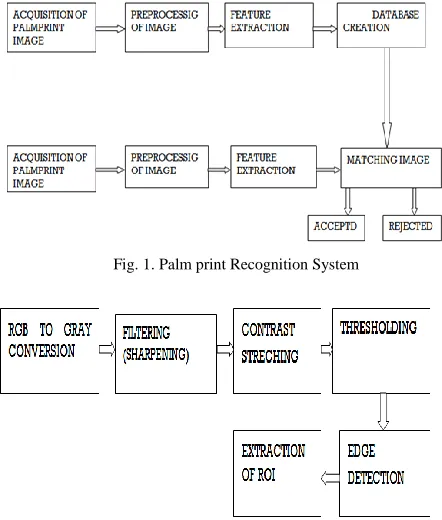
from hand image. The steps used for ROI extraction are RGB to gray, Thresholding, edge detection, finding maxima and minima points, extraction of ROI.
Feature extraction: After a ROI has been detected, the task of feature extraction is to obtain features that are fed into a palm print recognition system. These features can be principle line, appearance, texture.
Fig. 1. Palm print Recognition System
Fig. 2. Steps of cropping of palm print image
2.1 Image Acquisition:
There are two types of systems available for capturing the palm print of individuals i.e. scanners and the pegged systems. Scanners are hygienically not safe whereas the pegged systems cause considerable inconvenience to the user. Hence both of these systems suffer from low user acceptability. Therefore we use digital camera for acquiring the palm images or also results are tested using standard poly_u database for palm print authentication. Our captured database contains palm print samples of 100 persons and six samples per person so total 600 samples.
Fig. 3. Acquired Images
2.2 Palm print cropping:-
To extract the central part of the palm print, for reliable feature extraction, the corner points near the wrist are used as reference points to determine a co-ordinate system. Following major steps are used for obtaining central part of palm.
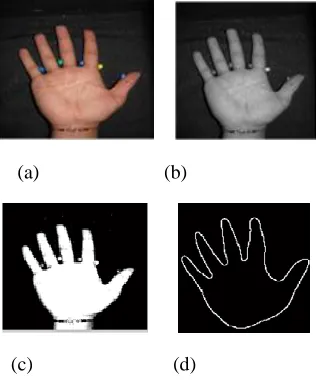
2.2.1 RGB to GRAY Conversion
The acquired color (RGB) parameters of palm print are changed to GRAY level. The color images are change to gray level images using the following equation:
I=(0.2989*R)+(0.5870*G)+(0.1140*B)
2.2.2. GRAY to Binary conversion
A threshold is used to convert the Gray image to binary image. A threshold image is defined as
G(x,y) =1 …..if f(x,y)>T
= 0 ….. if f(x,y)<T
Where T is threshold value.
And „1‟ corresponding to object and „0‟ corresponding to background.
2.2.3 Edge Detection
To obtain the boundaries of image canny edge detection algorithm is used.
Algorithm for Canny Edge Detection:-
Noise Reduction: canny edge detector uses a filter based on the 1st derivative. The image is sharpened using a sharpening filter with standard deviation.
Find the Intensity gradient of region: The local maxima of gradient, G(x,y) =[Gx2+Gy2]1/2, and edge
detection θ(x,y)=tan-1
(Gy/Gx), are computed at each
point.
Non maximal suppression: The edge point give rise to ridges in the gradient magnitude image. The algorithm then top of these ridges and sets to 0 all pixels that are not actually on the ridge top so as to give a thin line, a process known as non-maximal suppression. Here a set of edge points, in the form of a binary image is obtain.
Hysteresis thresholding: canny uses thresholding with hysteresis. The method uses to threshold to detect strong and weak edges and includes the weak edges in the output only if they are connected to strong edges. The ridge pixels are the thresholded using threshold T1 and T2, with T1<T2. Ridge pixels with values greater than T2 are said to be strong edge pixels.
Differential geometric formulation of the canny edge detection: A more refined approach to obtain edge with sub pixel accuracy is by using the approach of differential edge detection.
(a) (b)
(c) (d)
Fig. 3. a) Input Image b) Gray Image c) Binary Image d) Edge detected image
2.2.4 Border tracing
After the Edge Detection step, the images are traced to obtain the boundary of hand shape by making use of border tracing algorithm. The main purpose of this process is to find the boundary of hand and then to locate the positions of five fingers for the determination of palm region. This region is also called region of interest (ROI). The border tracing algorithm is described as follows .In the beginning, we find out the first hand shape point from left to right and upper to low and denote this point as P0 . P0 is the starting pixel of the region border. We take the eight directions in the border tracing algorithm.
Fig. 4. The eight directions in the border tracing algorithm
Border Tracing Algorithm:
Set variable “dir.” to be 7.
Search the 3x3 neighborhood of the current pixel in an anti-clockwise direction, beginning the neighborhood search in the pixel positioned in the direction.
The first pixel that found with the same value as the current pixel is a new boundary element n P. Update the dir. value.
If the current boundary element is equal to the second border element P1 and if the previous border element n-1 P is equal to 0 P, stop, otherwise repeat step 2.
The detected inner border is represented by pixels 0 n-2 PKP. According to the consequence of above algorithm, the tracing result of above figure is shown below with the starting point p0.
Fig. 5. The result of border tracing algorithm, where P0point is the
Starting point [2]
Fig. 6. The Extraction generating process of ROI. [2]
Fig. 7. The ROI of palm print image
2.3 Feature Extraction:-
Recently Do and Vetterli proposed an efficient directional multi resolution image representation called the contour let transform. Contour let transform has better performances in representing the image such as lines, edges, contours and curves than wavelet and curve let transform because of its directionality and anisotropy. The contour let transform consists of two steps which is the sub band decomposition and the directional transform. A Laplacian pyramid is first used to capture point discontinuities, then followed by directional filter banks to link point discontinuity into lineal structure. Starts with a discrete-domain construction that is amenable to efficient algorithms, and then investigates its convergence to a continuous-domain expansion.
Fig. 8.The Contourlet transform framework[13]
Fig. 9.The Contourlet filter bank[13]
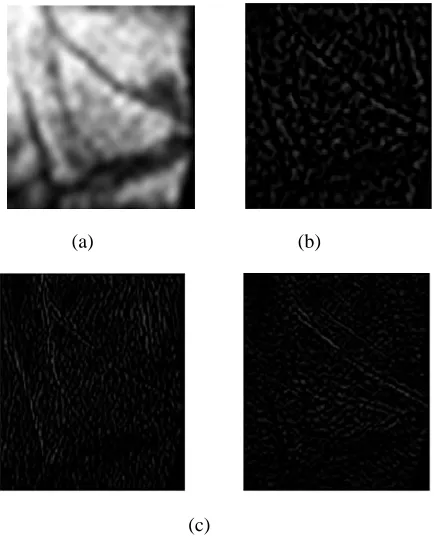
Combination of LP and DFB gives a double filter bank structure known as contourlet filter bank.Band pass images from LP are fed to DFB so that directional information can be captured as shown in fig.7.The contourlet filter bank decomposes the given image into directional sub bands at multiple scales as shown in fig.8.The results of contourlet filter bank for fingerprint are as shown in fig.9.
(a) (b)
(c)
Fig. 10. a)Contourlet Coeffient Level 1 b) Contourlet Coeffient Level 2 c) Contourlet Coeffient Level 3
After Contourlet, PCA is used to extract Feature vector and reduce size of feature vector.PCA is used with two main purposes. First it reduces dimensions of data to computationally feasible size. Second it extracts the most representative features out of input data so that although the size is reduced, main features remain and still be able to represent the original data. The best low-dimensional space can be determined by the "best" eigenvectors of the covariance matrix of x (i.e., the eigenvectors corresponding to the "largest" eigenvalues also called "principal components").
PCA Algorithm
Suppose x1, x2, ...,xM are Nx1 vectors Step 1:
Step 2: subtract the mean: = xi – x
Step 3: form the matrix A = [ 1, 2. . . M] (NxM matrix), then Compute:
C = =
(Sample covariance matrix, NxN, characterizes the scatter of the data)
Step 4: compute the eigenvalues of C: λ 1 > λ 2 > . . . > λN Step 5: compute the eigenvectors of C: u1, u2, . . . ,uN Since C is symmetric, u1, u2, . . . ,uN form a basis, (i.e., any vector x or actually (x- ), can be written as a linear combination of the eigenvectors):
Step 6: (dimensionality reduction step) keep only the terms corresponding to the K largest eigenvalues:
x - =
The above steps are needed to generate the principal components of the image. Corresponding Eigen vectors are uncorrelated and have the greater variance.
3.RESULTS
The results are tested using Poly_U database and our own captured database. Our captured database contains palmprint samples of 100 persons and six samples per person so total 600 samples. For Matching Euclidean Distance algorithm is used. If the value is greater than threshold then we accept it otherwise we reject it. If p = (p1, p2)
and q = (q1, q2) then the Euclidean distance is given by
(3)
3.1 Performance measurement parameters:-
The performance of a biometric system can be measured by reporting its false accept rate (FAR) and false reject rate (FRR). These two error rates are brought together in a receiver operating characteristic (ROC) curve that plots the FAR against the GAR (1-FRR). FAR and FRR depends on threshold so EER (Equal error Rate) and Efficiency are used for comparison. For finding FAR, FRR, Efficiency we use confusion matrix.
True Positive=Correctly Identified False Positive=Incorrectly Identified True Negative=correctly rejected False Negative=Incorrectly Rejected
Fig. 11. Confusion Matrix
FAR-False Acceptance Rate.
It gives how many imposter are falsely accepted.
FAR=TP/(TP+FN)
FRR-False Rejection Rate
It gives how many genuine are falsely rejected
FRR=TN/(FP+TN)
Efficiency=TP+TN/(TP+TN+FP+FN)
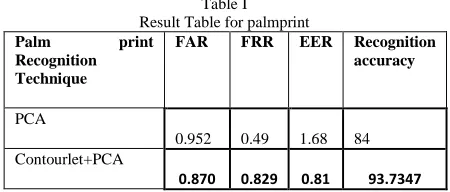
Table I Result Table for palmprint
Palm print
Recognition Technique
FAR FRR EER Recognition
accuracy
PCA
0.952 0.49 1.68 84
Contourlet+PCA
0.870 0.829 0.81 93.7347
The result table shows that Contourlet+PCA gives better accuracy than PCA. PCA is used after applying contourlet for dimension reduction of features.
4 CONCLUSION
In this paper, Eigen palm technique using principal component analysis for face recognition and a multiscale representation technique for palm print recognition is demonstrated using Contourlet.
PCA is the simplest of the true eigenvector-based multivariate analyses. Often, its operation can be thought of as revealing the internal structure of the data in a way which best explains the variance in the data. However, in spite of PCA's popularity, it suffers from two major limitations: poor discriminatory power and large computational load. Discrete wavelet transform provides the time and frequency information which is not being provided by the Fourier and short time Fourier Transform. DWT gives only three directional features (horizontal, vertical, diagonal).To overcome these disadvantages Gabor filter is used which gives multiscale, multi directional features. But all these algorithm doesn‟t give curve discontinuity well so curvelet is used which gives curve discontinuity well .Curvelet transform that transform in continuous domain and then discretize for sample data. But the contourlet transform starts with discrete domain construction then studies its convergence to an expansion in continuous domain. The standard database used for employing PCA algorithm and Contourlet is the Poly_U database; it is also employed using a local database consisting of 100 images with each image of a person oriented in 6 different angles. The experimental result shows that efficiency obtained using this Contourlet is more than PCA algorithm..
.
REFERENCES
[1] Tee Connie, Andrew Teoh, Michael Goh, David Ngo. “Palmprint
Recognition with PCA and ICA.” Image and Vision Computing New Zealand 2003, Palmerston North, New Zealand, 3 (2003) 232-227
[2] Guangming Lu , David Zhang , Kuanquan Wang “Palmprint
recognition using eigenpalms features ” / Pattern Recognition Letters 24 (2003) 1463–1467
[3] Dhananjay D.M , C. V. Guru Rao and I. V. Muralikrishna “Palm
print Classification based on inter-Distal Region Texture features” International Journal of Computer Applications (0975 – 888)Volume 47– No.6, June 2012
[4] Xiang-qianWu, Kuan-quanWang, David Zhang “Wavelet Based
Palm print Recognition” International Conferance on Machine Learning and Cybernetics,Beijing,4-5 November 2002
[5] Lei Zhang, Zhenhua Guo, Zhou Wang, and David Zhang, “Palm
print verification using complex wavelet transform”, IEEE Int.
TP FP
Conf. on Image Processing, San Antonio, pp. II - 417 - II - 420, 2007
[6] Chin-Chuan Han, Hsu-Liang Cheng, Chih-Lung Lin, and Kuo-Chin
Fan, “Personal authentication using palm-print features”, Pattern Recognition, vol. 36, pp. 371-381, 2003.
[7] W. Shu, D. Zhang, Automated Personal Identification by
Palmprint", Opt.Eng. 37(8), August 1998, pp. 2359-2362
[8] Hassan Masood,, Mustafa Mumtaz,, M Asif Afzal Butt, Atif Bin
Mansoo.,” Wavelet Based Palmprint Authentication System”, 1-4244-2427-6/08/,2008 IEEE
[9] Wenxin Li, Jane You, and David Zhang, ,” Texture-Based
palmprint Retrieval Using a Layered Search Scheme for Personal Identification”, IEEE Transactions On Multimedia, Vol. 7, No. 5, October 2005
[10] J. You, W. Li, D. Zhang, Hierarchical Palmprint Identification via Multiple Feature Extraction, Pattern Recognition 35, 2002, pp. 847-859.
[11] Jiansheng Chen ,Yiu-Sang Moon , Ming-Fai Wong c, Guangda Su
,” Palmprint authentication using a symbolic representation of images”, Image and Vision Computing 28 (2010) 343–351, j Elsevier journal
[12] Minh N,Martin Vetterli,”The contourlet Transform: An efficient
directional Multiresolution Image Representation ”,IEEE
Transaction on Image Processing ,Vol. 14,No.12,December 2005
[13] Arthur L,Jianping Zhou and Minh N.,”The Nonsubsampled