MEDICAL EDUCATION ORIGINAL ARTICLE
ISSN: 2091-2749 (Print) 2091-2757 (Online)
Correspondence Mili Joshi
Assistant Professor, Department of Pharmacology
Patan Academy of Health Sciences
Email: [email protected]
Peer Reviewed By Dr. Roshana Shrestha Kathmandu University
Peer Reviewed By Dr. Ashis Shrestha Patan Academy of Health Sciences
Evaluation of core faculty development
workshop: Experience from Patan
Academy of Health Sciences, Nepal
Mili Joshi,1 Ira Shretha,2 Shital Bhandary3
Assistant Professor, 1Department of Pharmacology, 2Department of
Physiology, 3Department of Community Health Sciences
Patan Academy of Health Sciences, Lalitpur, Nepal
ABSTRACT
Introductions: Faculty development is important to promote the core education principles/philosophies and instil the innovations planned and/or carried out in any educational program. Thus, Patan Academy of Health Sciences (PAHS) has carried out regular faculty development programs for its faculty in order to effectively implement an innovative curriculum, teaching/learning methods and student assessment.
Methods: Effectiveness of the workshop was assessed by validated retro-pre questionnaire at the end of the workshop. Paired t-test was used to test the differences between before and after scores on knowledge and application on various aspects of the program. Effect size was also calculated to determine the size of the difference between before and after the workshop.
Results: The core faculty development program was effective as it significantly increased the overall knowledge and application scores among most of the participants. The workshop benefitted the most to the experienced male faculty as the effect size for these groups were very high (Cohen’s d>1.3).
Conclusions: As PBL is implemented during the basic sciences years only, the concerned faculty benefitted the most from the workshop. Further such trainings are advocated to increase the pool of trained tutors for effective implementation of the PBL.
Key words: faculty development, innovation, medicine, PAHS
Mili: Faculty training for problem based learning
INTRODUCTIONS
Problem based learning (PBL) is a method of learning in which the learners first encounter a problem, followed by a systematic, student-centered enquiry process1. Students’ learning is
initiated by an authentic problem or puzzle that the learner wants to solve and find solutions.2 It
is one of the innovative themes in medical education.3
In order to use PBL as a teaching tool, faculty must be familiar with PBL and comfortable with the role transition from 'teacher' to 'facilitator' or 'tutor'.4 This transition is critical for the
success of PBL.5 A good tutor should know the
goals of the curriculum and learning objectives, group dynamics, problem solving, critical thinking, conflict resolution and assessment of the students individually and as group.6
Thus, PBL training workshop was done to train the tutors in the process and skills of PBL tutoring using a well-tailored module at Lumbini Medical College, Nepal.
METHODS
Three founding faculty and experts on PBL content and process from Patan Academy of Health Sciences (PAHS) conducted a 3-day long in-depth workshop on PBL at Lumbini Medical College (a private medical college affiliated to the Kathmandu University) by sharing experiences on designing, executing and assessing the hybrid PBL curriculum and teaching/learning methods used at Kathmandu University School of Medical Sciences and School of Medicine, PAHS (PAHS-SOM).
The workshop used few interactive lectures to clarify the key concepts followed by hand-on exercise on PBL case selection, PBL tutorial session using volunteer medical and nursing students and, PBL process assessments using Tutor Assessment of Students (TAS) tools used at PAHS-SOM. After each small group sessions, issues and concerns were discussed and clarified in a plenary session.
Effectiveness of the workshop was assessed using a pre-validated 20-item retro-pre questionnaire using a rating scale of 0 to 100 after the workshop. It also contained personal (age and gender) and academic (discipline and work experience) information. Knowledge, Application and Opinion scales were constructed adding the corresponding items afterwards. Filling the evaluation form was volunteer and once filled it was taken as implied consent leading to publication.
RESULTS
There were 21 participants in the workshop where 12 were male and 9 were female. The mean age of the participants was 39 years with a large variation i.e. standard deviation was 18.11 years. Thus, minimum age was 24 and maximum was 78 years. There were 7 participants below the age of 30, 8 were between the age of 30-39 and the rest were above 40. Among them 8 were from nursing background, 9 were from basic sciences background and 4 from the clinical sciences background, 6 participants had academic experience less than 2 years, 8 had 2-4 and 7 with more than 5 years of experience.
DISCUSSIONS
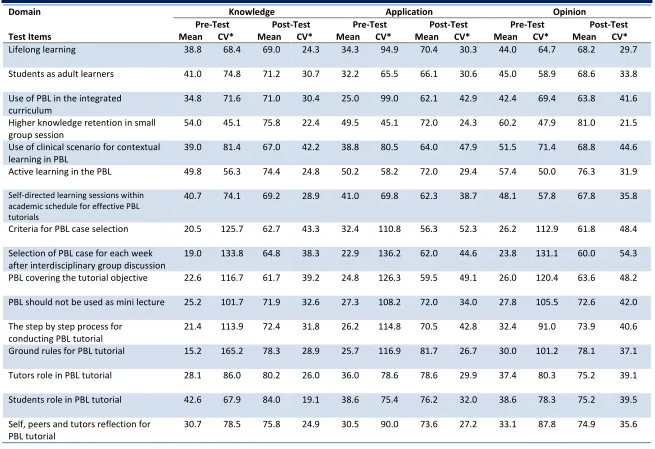
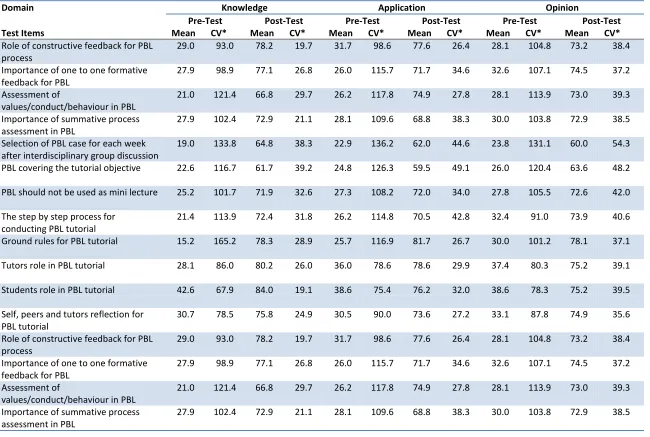
Table 1. Knowledge, application and opinion of problem based learning, Lumbini medical college, Palpa, Nepal, 2014
Domain Knowledge Application Opinion
Pre-Test Post-Test Pre-Test Post-Test Pre-Test Post-Test
Test Items Mean CV* Mean CV* Mean CV* Mean CV* Mean CV* Mean CV*
Lifelong learning 38.8 68.4 69.0 24.3 34.3 94.9 70.4 30.3 44.0 64.7 68.2 29.7
Students as adult learners 41.0 74.8 71.2 30.7 32.2 65.5 66.1 30.6 45.0 58.9 68.6 33.8
Use of PBL in the integrated
curriculum 34.8 71.6 71.0 30.4 25.0 99.0 62.1 42.9 42.4 69.4 63.8 41.6
Higher knowledge retention in small
group session 54.0 45.1 75.8 22.4 49.5 45.1 72.0 24.3 60.2 47.9 81.0 21.5
Use of clinical scenario for contextual
learning in PBL 39.0 81.4 67.0 42.2 38.8 80.5 64.0 47.9 51.5 71.4 68.8 44.6
Active learning in the PBL 49.8 56.3 74.4 24.8 50.2 58.2 72.0 29.4 57.4 50.0 76.3 31.9
Self-directed learning sessions within academic schedule for effective PBL tutorials
40.7 74.1 69.2 28.9 41.0 69.8 62.3 38.7 48.1 57.8 67.8 35.8
Criteria for PBL case selection 20.5 125.7 62.7 43.3 32.4 110.8 56.3 52.3 26.2 112.9 61.8 48.4
Selection of PBL case for each week
after interdisciplinary group discussion 19.0 133.8 64.8 38.3 22.9 136.2 62.0 44.6 23.8 131.1 60.0 54.3
PBL covering the tutorial objective 22.6 116.7 61.7 39.2 24.8 126.3 59.5 49.1 26.0 120.4 63.6 48.2
PBL should not be used as mini lecture 25.2 101.7 71.9 32.6 27.3 108.2 72.0 34.0 27.8 105.5 72.6 42.0
The step by step process for
conducting PBL tutorial 21.4 113.9 72.4 31.8 26.2 114.8 70.5 42.8 32.4 91.0 73.9 40.6
Ground rules for PBL tutorial 15.2 165.2 78.3 28.9 25.7 116.9 81.7 26.7 30.0 101.2 78.1 37.1
Tutors role in PBL tutorial 28.1 86.0 80.2 26.0 36.0 78.6 78.6 29.9 37.4 80.3 75.2 39.1
Students role in PBL tutorial 42.6 67.9 84.0 19.1 38.6 75.4 76.2 32.0 38.6 78.3 75.2 39.5
Self, peers and tutors reflection for
PBL tutorial 30.7 78.5 75.8 24.9 30.5 90.0 73.6 27.2 33.1 87.8 74.9 35.6
M
ili J
os
hi:
Fac
ult
y t
ra
ini
ng
fo
r pr
obl
em
ba
sed l
ea
rni
ng
Jo
urn
al
o
f P
at
an
A
cad
emy
o
f H
eal
th
S
cie
nc
es. 2
01
5 Ju
ly;2
(1
):2
Table 1. continued..
Domain Knowledge Application Opinion
Pre-Test Post-Test Pre-Test Post-Test Pre-Test Post-Test
Test Items Mean CV* Mean CV* Mean CV* Mean CV* Mean CV* Mean CV*
Role of constructive feedback for PBL
process 29.0 93.0 78.2 19.7 31.7 98.6 77.6 26.4 28.1 104.8 73.2 38.4
Importance of one to one formative
feedback for PBL 27.9 98.9 77.1 26.8 26.0 115.7 71.7 34.6 32.6 107.1 74.5 37.2
Assessment of
values/conduct/behaviour in PBL 21.0 121.4 66.8 29.7 26.2 117.8 74.9 27.8 28.1 113.9 73.0 39.3
Importance of summative process
assessment in PBL 27.9 102.4 72.9 21.1 28.1 109.6 68.8 38.3 30.0 103.8 72.9 38.5
Selection of PBL case for each week
after interdisciplinary group discussion 19.0 133.8 64.8 38.3 22.9 136.2 62.0 44.6 23.8 131.1 60.0 54.3
PBL covering the tutorial objective 22.6 116.7 61.7 39.2 24.8 126.3 59.5 49.1 26.0 120.4 63.6 48.2
PBL should not be used as mini lecture 25.2 101.7 71.9 32.6 27.3 108.2 72.0 34.0 27.8 105.5 72.6 42.0
The step by step process for
conducting PBL tutorial 21.4 113.9 72.4 31.8 26.2 114.8 70.5 42.8 32.4 91.0 73.9 40.6
Ground rules for PBL tutorial 15.2 165.2 78.3 28.9 25.7 116.9 81.7 26.7 30.0 101.2 78.1 37.1
Tutors role in PBL tutorial 28.1 86.0 80.2 26.0 36.0 78.6 78.6 29.9 37.4 80.3 75.2 39.1
Students role in PBL tutorial 42.6 67.9 84.0 19.1 38.6 75.4 76.2 32.0 38.6 78.3 75.2 39.5
Self, peers and tutors reflection for
PBL tutorial 30.7 78.5 75.8 24.9 30.5 90.0 73.6 27.2 33.1 87.8 74.9 35.6
Role of constructive feedback for PBL
process 29.0 93.0 78.2 19.7 31.7 98.6 77.6 26.4 28.1 104.8 73.2 38.4
Importance of one to one formative
feedback for PBL 27.9 98.9 77.1 26.8 26.0 115.7 71.7 34.6 32.6 107.1 74.5 37.2
Assessment of
values/conduct/behaviour in PBL 21.0 121.4 66.8 29.7 26.2 117.8 74.9 27.8 28.1 113.9 73.0 39.3
Importance of summative process
assessment in PBL 27.9 102.4 72.9 21.1 28.1 109.6 68.8 38.3 30.0 103.8 72.9 38.5
M
ili J
os
hi:
Fac
ult
y t
ra
ini
ng
fo
r pr
obl
em
ba
sed
lea
rni
ng
Jo
urn
al
o
f P
at
an
A
cad
emy
o
f H
eal
th
S
cie
nc
es. 2
01
5 Ju
ly;2
(1
):2
Table 2: Change in knowledge, application and opinion on problem based learning, Lumbini medical college, Palpa, Nepal, 2014
Domain Scores N Pre-Test
Mean Pre-Test CV Post-Test Mean Post-Test CV p-value (Cohen’s d)* Effect Size
Knowledge Score 21 31.37 58.26 72.05 18.62 <0.001 2.52
Application Score 21 32.21 68.60 69.45 26.11 <0.001 1.83
Opinion Score 21 37.01 59.64 70.99 31.81 <0.001 1.52
* Corrected effect size for paired t-test.
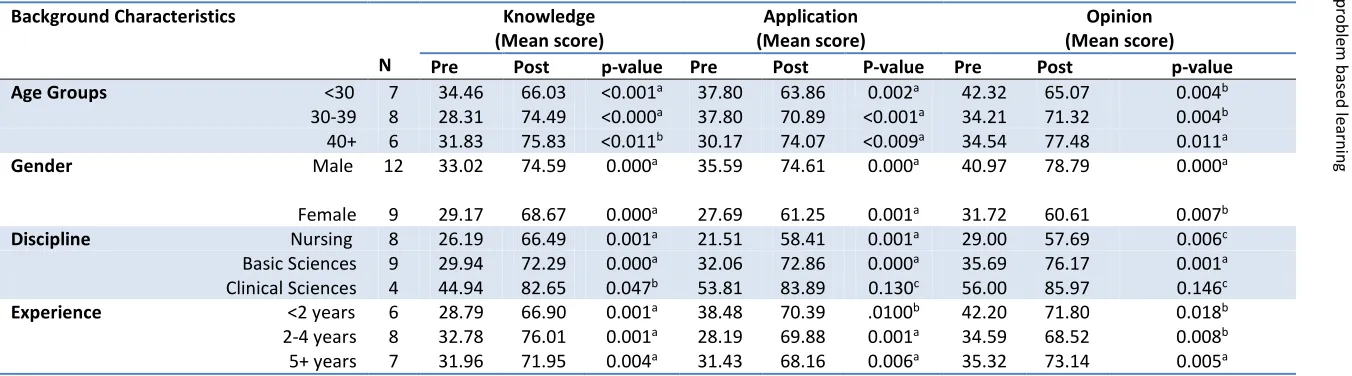
Table 3: Change in knowledge, application and opinion on PBL by participant’s background characteristics, Lumbini medical college, Palpa, Nepal, 2014
Background Characteristics
N
Knowledge
(Mean score) (Mean score) Application (Mean score) Opinion
Pre Post p-value Pre Post P-value Pre Post p-value
Age Groups <30 7 34.46 66.03 <0.001a 37.80 63.86 0.002a 42.32 65.07 0.004b
30-39 8 28.31 74.49 <0.000a 37.80 70.89 <0.001a 34.21 71.32 0.004b
40+ 6 31.83 75.83 <0.011b 30.17 74.07 <0.009a 34.54 77.48 0.011a
Gender Male 12 33.02 74.59 0.000a 35.59 74.61 0.000a 40.97 78.79 0.000a
Female 9 29.17 68.67 0.000a 27.69 61.25 0.001a 31.72 60.61 0.007b
Discipline Nursing 8 26.19 66.49 0.001a 21.51 58.41 0.001a 29.00 57.69 0.006c
Basic Sciences 9 29.94 72.29 0.000a 32.06 72.86 0.000a 35.69 76.17 0.001a
Clinical Sciences 4 44.94 82.65 0.047b 53.81 83.89 0.130c 56.00 85.97 0.146c
Experience <2 years 6 28.79 66.90 0.001a 38.48 70.39 .0100b 42.20 71.80 0.018b
2-4 years 8 32.78 76.01 0.001a 28.19 69.88 0.001a 34.59 68.52 0.008b
5+ years 7 31.96 71.95 0.004a 31.43 68.16 0.006a 35.32 73.14 0.005a
Note: a = d>=1.3 (Very large), b = 0.8<d<1.3 (Large); c = 0.5<d<0.8 (Medium); d = 0.2<d<0.5 (Low)
M
ili J
os
hi:
Fac
ult
y tra
in
in
g f
or p
ro
ble
m
ba
sed l
ea
rni
ng
Jo
urn
al
o
f P
at
an
A
cad
emy
o
f H
eal
th
S
cie
nc
es. 2
01
5 Ju
ly;2
(1
):2
Mili: Faculty training for problem based learning
were equally high for PBL process, reflections, feedback and assessment. The coefficient of variation has decreased substantially suggesting the decreased variation between before and after scores. This table showed increase in the overall knowledge, application and opinion among the participants as the mean of summated knowledge, skill and opinion scores increased from 31.4 to 72.1 (129.7%), 32.2 to 69.5 (115.6%), 37.0 to 71.0 (91.8%) respectively between before and after the workshop. Most importantly, the variation in the scored decreased drastically for posttest scores than the pretest scores.
The differences between these scores for three domains were found to follow the normal distribution as Shapiro Wilk test were not statistically significant. Thus, parametric test for dependent samples i.e. paired t-test was used. It showed effectiveness of the workshop as knowledge, application and opinion scores were found to be statistically different for before and after the workshop. The knowledge, application and opinion scores had very high effect size (Cohen’s d > 1.3) (Table 2).
Increase in the overall knowledge, application and opinion among the participants in terms of their age, gender, discipline and teaching experience as the mean of summated knowledge, skill and opinion scores increased among the each categories of these variables between before and after the workshop, (Table 3). These results were statistically significant (p<0.05) for all the sub-groups except for application and opinion of PBL among the clinical sciences faculty. The effect sizes were also very high (d>1.3) and large (0.8<d<1.3) for most of the scores in age group, gender, discipline and experience. The opinion scores in younger age groups, females and less than 5 years of teaching experiences were large within the range of 0.8 to 1.3 whereas it was only medium with range of 0.5 to 0.8 for nursing faculty.
The PBL training was effective as it increased knowledge, application and opinion on PBL based on the 20-items retro-pre questionnaire used after the workshop. Similar result was also observed for the tutor training program conducted at Suez Canal University, Egypt6 and
BP Koirala Institute of Health Sciences, Nepal7.
Most importantly, it was able to normalize the knowledge, application, and opinion of PBL among participants as the coefficient of variation decreased drastically after the workshop thus enabling them to come to a similar understanding to implement PBL at their institute as mandated by the university they are affiliated with.8,9
Increment of the knowledge, application and opinion scores were not only statistically significant (p-value<0.05), the difference between before and after scores were also very large and large as Cohen’s d (corrected for dependent samples) were greater than 1.3 and between 0.8 and 1.3 for most of the sub-groups as well10 indicating that these scores were
indeed significantly different even for small samples. However, clinical sciences faculty were still skeptical of its application and their opinion of PBL did not change statistically after the workshop as the difference was not statistically significant. Similarly, younger faculty and faculty with low teaching experiences and female gender and nursing background had medium effect size suggesting that they still had doubts about effective implementation of the PBL at their institute compare to the experienced, basic sciences and male faculty.
As the PBL was advocated at basic sciences phase of the MBBS curriculum by the Kathmandu University8,9, the 21 tutors trained
for it had all it takes to implement it effectively at the Lumbini Medical College and similar results were recorded at a deemed health sciences university situated at the eastern part of Nepal7 and Suez Canal University, Egypt6. The
Mili: Faculty training for problem based learning
terms of actual application and behavior levels of faculty.11
CONCLUSIONS
The study concluded that there was significant increase in knowledge, application and opinion of participants regarding PBL after the workshop. The tutor training workshop was effective in improving tutor facilitation skills in the areas of active learning, self- directed learning, collaborative learning, group skill, and increase educational effectiveness of the PBL sessions based on self-evaluation of the participants. The tutor training workshop increases tutors’ understanding of the philosophy of PBL and the importance of different aspects of PBL tutorial process.
ACKNOWLEDGEMENTS
We would like to thank Prof Dr Chet Raj Pant, former associate dean, Kathmandu University School of Medical Sciences for facilitating the PBL tutor training workshop at Lumbini Medical College. We would also like to express our gratitude to all the participants and volunteer medical and nursing students for their valuable time during the workshop. At last we are thankful to the Lumbini Medical College management for making our stay pleasant as well as meaningful.
REFERENCES
1. Barrows HS. A learning Method Based on the Principle of Using Problems as a Starting Point for the Acquisition and Integration of New knowledge. Spring Publication Co, New York, USA, 2008. 2. Azer SA. Problem Based Learning: A
Critical Review of Its Educational Objectives and the Rational for Its Use. Saudi Med J. 2001;22:299-305.
3. Newble D, Cannon R. A Handbook for Teaching in Universities and Colleges. Kogan Page London, UK, 1995.
4. Wood DF. ABC of learning and teaching in medicine: Problem Based Learning. BMJ. 2003;326:328-30.
5. Ghimire SR, Bhandary S. Student’s Perception and Preference of Problem Based Learning during Introductory Course of a Nepalese Medical School. Journal of Patan Academy of Health Sciences, 2014;1(1):64-8.
6. El-Aziz El Naggar MAA, Maklady FAH, Hamam AM, Omar AS. Effectiveness of Implementing a Tutor Training Workshop for Problem Based Learning Class Tutors at the Faculty of Medicine, Suez Canal University. Intel Prop Rights. 2013:1-104. 7. Baral N, Paudel BH, Das BKL, Aryal M,
Gautam A, Lamsal M. Preparing tutors for problem-based learning: An experience from B. P. Koirala Institute of Health Sciences, Nepal. Kathmandu Univ Med J. 2010;8(1):141-5.
8. Mansur DI, Kayastha SR, Makaju R, Dongol M. Problem Based Learning in Medical Education. Kathmandu Univ Med J. 2012;10(4):78-82.
9. Pradhan B, Ranjit E, Ghimire MR, Dixit H. History of Problem Based Learning in Nepal and Experiences at Kathamndu Medical College. Journal of Kathmandu Medical College. 2012;1(1):37-44. 10. Field A. Discovering Statistics using SPSS
(and sex and drugs and rock ‘n’ roll). 3rd ed Sage Publication, London, UK, 2009. 11. Kirkpatrick DL Evaluating Training
Programs: The Four Levels. Berrett- Koehler Publishers, San Francisco, CA, USA, 1994.