An Improved Ant Colony Algorithm Optimization for
Automated MRI Segmentation Using Probabilistic Atlas
Ahmad Mostaar
*, Meghdad Ashtiyani, Saeedeh Navaei Lavasany
Department of Biomedical Engineering and Medical Physics, Faculty of Medicine,Shahid Beheshti University of Medical Sciences, Tehran, Iran *[email protected]
Abstract— Segmentation plays a crucial role in image processing, especially in medical image analysis
which encompasses an extensive range of image formation modalities including Magnetic Resonance Imaging (MRI). In this paper, a fully automated segmentation of brain MR images is presented. The proposed approach is an improved version of ACO (Ant Colony Optimization) algorithm conflating with the a prior probability atlas images of gray matter, white matter and cerebrospinal fluid to robustly segment the brain MR images. The ACO optimization algorithm is inspired by the natural food-searching behavior of some ant species. Ants retrace the pheromone trial on the ground which deposited by their other colony members while walking and foraging. The propounded improved ACO-Atlas based segmentation algorithm is qualified to generate three different pheromone matrices that each of which corresponds to a brain tissue class. The establishment of the pheromone matrix is based on the randomly scattered ants’ movements on the MR image. Furthermore, these movements are steered by the local statistical moments of the MR image’s intensity values. Experiments are done to demonstrate the effectiveness and high accuracy of the proposed method.
Keywords- MRI, Ant colony optimization, Segmentation, Probabilistic Atlas, Statistical central moments
I. INTRODUCTION
II. ANT COLONY OPTIMIZATION ALGORITHM
Ant colonies, and more generally social insect societies, are distributed system that in spite of the simplicity of their individuals, present a highly structured social organization. As a result of this organization, ant colonies can accomplish complex tasks in some cases far exceed the individual capabilities of a single ant [12]. The field of ant algorithms studies models derived from the observation of real ants’ behavior, and uses these models as a source of inspiration for the design of novel algorithms for the solution of optimization and distributed control problems [12].
In the category of the most successful examples of ant algorithms, ACO illustrates the point, which is used in this study. ACO is inspired by the foraging behavior of some ant colonies, and targets discrete optimization problems. This foraging behavior is based on indirect communication mediated by chemicals produced by the ants, which are called pheromones. While walking from food sources to the nest and vice versa, ants deposit pheromones on the ground, forming in this way a pheromone trail. Ants can smell the pheromone and they tend to choose, probabilistically, paths marked by strong pheromone concentrations [12]. And the more ants choose the path, the stronger the pheromone concentration. Thus the pheromone trail can help the ants find quickly the shortest way (the most preferred way) to the food sources [13]. Ant colony optimization exploits a similar mechanism for solving optimization problems. To be more specific, ACO is an iterative algorithm [15] which aims to discover the optimal solution of the target problem over solution space, a weighted graph [8], which consists of nodes and edges by constructing candidate solutions via a pheromone model, that is, a parameterized probability distribution over the solution space. In other word, the movement of the ants is probabilistically dictated by the transition probability which reflects the likelihood that an ant will move from a given node to another. This probability is influenced by heuristic information and pheromone information [8]. The former is problem specific and the latter is constructed and updated during the search and is called pheromone matrix. Consider totally K ants are applied to find the optimal solution in a space χ that consists of (M1×M2) nodes. The procedure of ACO iterates over three phase as follows [8, 15].
–Step one: In this step the positions of totally K ants, as well as the pheromone matrix and parameters are
initialized.
– Step two: For the construction-step index n=1: N - For the ant index k = 1: N
• Consecutively move the kth ant for L steps according to a probabilistic transition matrix ,(with a size
of M1M2 ×M1M2).
- Update the pheromone matrix .
– Step three: Make the solution decision according to the final pheromone matrix .
The establishment of probabilistic transition matrix and the update of the pheromone matrix are of immense value in the ACO algorithms which are described as follows: At the nth construction-step of ACO, the kth ant moves from the node i to the node j according to the transition probability , the probability that an ant in node i will move to node j, which is the basis of decision rule is determined by:
(
)
∑ ( ) (1)
Where is the quantity of pheromone on the traverse linking the two nodes, i and j. represents the
heuristic information for going from node i to node j, which is fixed to be same for each construction step. i is the neighborhood nodes for the ant which is on the node i. The constant α and β control the influence of the pheromone update. To be more specific, it is performed by all the ants after each construction-step. The pheromone matrix is updated as:
(2)
where ] is the pheromone decay coefficient, and is the initial value of the pheromone. The second update performed at the end of the construction process which is called offline pheromone update and its formula is cited as:
{ (3)
where is the evaporation rate. Moreover, the determination of best tour is subject to the user-defined criterion, it could be either the best tour found in the current construction-step, or the best solution found since the start of the algorithm, or a combination of both of the above two [8].
III. THE PROPOSED MRI SEGMENTATION ALGORITHM USING IMPROVED ACO BASED ON PROBABILISTIC ATLAS
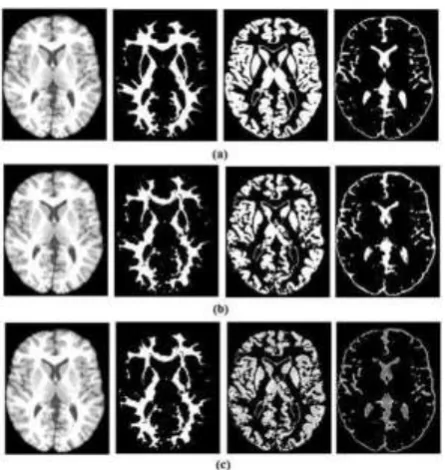
according to three different rules to crawl on an image for constructing three distinct pheromone matrices. The aggregation of ants represents the segmented brain MR image. Furthermore, local variation of the MR image’s intensity navigates the movements of the ants. The proposed method here, utilizes spatial maps of prior probabilities of the voxel belonging to the GM, WM and CSF classes. This information is in the form of probability images provided by the Montreal Neurological Institute as part of the ICBM, NIH P-20 project (Principal Investigator John Mazziotta), and derived from scans of 152 young healthy subjects [9], [16] and [17]. These probability images contain values in the range of zero to one, representing the prior probability of a voxel being GM, WM or CSF after an image has been normalized to the same space (Fig. 1) [9]. Thanks to the prior knowledge, it is possible to obtain a more robust classification [9]. In order for the proposed algorithm to work properly, the MR image must be in register with the prior probability images. This registration is automatically done by SPM (Statistical Parametric Mapping) [19]. The rest of the procedure is repeated three times to achieve the GM, WM. and CSF. The initialization process commences and after that the approach runs for iterations to construct the pheromone matrix by iteratively executing not only the construction process but also the update process. Ultimately, the decision process is preformed.
A. Initialization Process
Totally k ants are randomly assigned on an image I with a size of M1×M2, each pixel of which can be viewed as a node. Furthermore, each component of pheromone matrix must be set. The prevalent view for setting the pheromone matrix is to adjust its elements to be a constant which leads to MR edge detection, whereas we have designated another strategy to segment the MR image. More explicitly, thanks to the prior probability images, we take cognizance of the spatial distribution of the voxels which belongs to a class such as GM. Consequently, each component of pheromone matrix is proposed to be a proportion of the related prior probability atlas. Since this scheme steers the ants’ movements from the primary step the invaluable consequence which is less executing time, is expected.
B. Construction Process
At the nth construction step, one ant out of the total k ants is randomly selected, and this is subject to move on the image for L movement-step. This ant moves from the node to its contiguous node according to a transition probability which is determined as
(
)
∑ ( ) (4)
where is the pheromone value of the node is the contiguous nodes of the node
stands for the heuristic information by
(5)
where is the distance between the two nodes. However, there are some other one who support to determine the heuristic information by the local statistics at the pixel position as
(6)
where ∑ ∑ which is a normalization factor. is the intensity value of the pixel at
the position of the image I, the function is a function of a local group of pixels c (called the clique), and its value depends on the variation of image’s intensity values on the clique c [8]. This idea is preferred to utilize in this paper. Like [8], for the pixel under consideration, the function is defined as:
( ) | | | |
| | | |
| | | |
| | | | (7)
Four functions are selected to consider as the function in above equation [8] which are as follows:
(8)
(9) { (
)
(10)
{ ( ) ⁄
(11)
of the image can be used as a texture metrics in order to define the heuristic information. Therefore, we scrutinize the local different orders of central moment. In general, the central moment of order k(2−4) of a distribution is defined as:
(12)
where is the expected value of x and μ is the mean [20]. The permissible range for the ant’s movement is the second issue to be considered which is determined to be like [8] either the 4-connectivity neighborhood or the 8-connectivity neighborhood (Fig.3).
C. Update process
The algorithm possesses two level updates operations for updating the pheromone matrix, one is global and the other is local.
1. The global pheromone update this level of pheromone updating process is carried out after the movement of each ant within each construction step.
Each component of pheromone matrix is updated according to [8],
{
(13) where is defined in (3) previously, i,j is equal to heuristic matrix .
2. The local pheromone update the local level of updating the pheromone matrix is preformed after the movement of all ants within each construction step with the given in (2) is defined as: [8]
(14)
D. Decision process
After the three previous steps, in order to educe commensurate cluster, making a decision on the updated pheromone matrix τ (n) is inevitable. Hence, an efficient approach to adaptively search for the global threshold T of the last pheromone matrix using the Otsu’s method is deployed [8], [21].This method involves iterating through all the possible threshold values and calculating the statistic criterion, here the mean, for the pixel belongs to each side of the threshold. The schema of the mentioned algorithm is as follow. First of all, the initial threshold T0 is defined as the mean value of the pheromone matrix. Secondly, the pheromone matrix elements are categorized into two classes according to the criterion whether its value is less than T0 or not. Thirdly, the average of two mean values of each of above two categories is defined as the new threshold. Finally, the two former steps are reiterated until the threshold value does not change any more (based on a user-defined tolerance).
IV. DISCUSSION ON THE PROPOSED METHOD
In order to ensure that the proposed definition of the heuristic information would led in the better results, we compare our method (modifying the initialization of pheromone matrix is neglected) with that of Tian et al. [8], For this purpose both methods were executed on benchmark images, such as Lena and Cameraman. As Fig. 4 and Fig. 5 illustrate our results is not only as well as theirs but also better than Tian et al.’s [8]. What’s more, the invaluable consequence of our modified heuristic function is the convergence time of the algorithm which is one order of magnitude less than Tian et al.’s method. Consequentially, the proposed heuristic function is decently replaced with the former one for the rest of the algorithm.
V. EXPRIMENTAL RESULT
VI. CONCLUSION
An improved ACO algorithm using probabilistic atlas is proposed to segment MR brain images. Prior to evaluate the performance of the propounded method on brain MR images, two benchmark images were used to demonstrate the efficiency of the algorithm in edge detection. Experimental results illustrate the feasibility and high accuracy of the algorithm in segmenting the gray matter, white matter and cerebrospinal fluid of the simulated brain MR image. In the assessment of the method the effects of noise and intensity non-uniformity are not consider which will be study in the future works. To conclude, the proposed method is capable to segment the brain MR images.
TABLE I. SEGMENTATION EVALUATION ON SIMULATED T1BRAIN MR IMAGE.
Evaluation parameters % White mater Gray mater CSF
Sensitivity Specificity Accuracy
95.54 82.19 96.26
99.98 82.39 93.29
98.76 91.35 99.38
Figure 1. The prior probability images of GM, WM, CSF and none brain tissue. Values range between zero and one [8]
Figure 2. Various functions with the parameter λ = 10; (a), (b), (c) and (d) are the functions defined in (8), (9), (10) and (11) [8]
Figure 4. Different edge extracted image of the Lena benchmark image, (a) The original image. (b) The proposed improved ACO image edge detection algorithm with the central moment of second order as a heuristic function (c) The proposed improved ACO image edge detection algorithm with the central moment of third order as a heuristic function. (d) The proposed improved ACO image edge detection algorithm with the central moment of forth order as a heuristic function. (e) − (h) The Tian et al.’s method with the heuristic function defined in (8) − (11), respectively
Figure 5. Different edge extracted image of the Cameraman benchmark image. (a) The original image. (b) The proposed improved ACO image edge detection algorithm with the central moment of second order as a heuristic function (c) The proposed improved ACO image edge detection algorithm with the central moment of third order as a heuristic function. (d) The proposed improved ACO image edge detection algorithm with the central moment of forth order as a heuristic function. (e) − (h) The Tian et al.’s method with the heuristic function defined in (8) − (11), respectively.
ACKNOWLEDGMENT
The authors acknowledge helpful comments provided by the anonymous reviewers. We benefited from advices by Parmida Moradi Birgani, Mostafa Abdolghafar, Meysam Siyahmansoori, Amin Ashgharzadeh Alvar and critical readings by Parmida Moradi Birgani. The authors are grateful to Department of Biomedical Engineering and Medical Physics, Shahid Beheshti University of Medical Science.
REFERENCES
[1] AH. Anderson and Z. Zhang and MJ. Avison and DM. Gash 2002. Automated segmentation of multispectral brain MR images. Journal of Neuroscience Methods, 122: pp 13-23J. Clerk Maxwell, A Treatise on Electricity and Magnetism, 3rd ed., vol. 2. Oxford: Clarendon, 1892, pp.68–73.
[2] Birgani, Parmida Moradi, Meghdad Ashtiyani, and Saeed Asadi. "MRI segmentation using fuzzy c-means clustering algorithm basis neural network." Information and Communication Technologies: From Theory to Applications, 2008. ICTTA 2008. 3rd International
Conference on. IEEE, 2008.
[3] Shen and W. Sandham and M. Granat and A. Sterr 2005. MRI fuzzy segmentation of brain tissue using neighborhood attraction with neural-network optimization. IEEE Trans. on Information Technology in Biomedicine, 9(3):459-467.
[4] AW. Toga and PM. Thompson 2003. Temporal dynamics of brain anatomy. Annual Review Biomedical Engineering, 5: 119-145. [5] S. Ouadfel and M. Batouche 2007. An efficient ant algorithm for swarm-based image clustering. Journal of Computer Science,
3(3):162-267.
[6] R. Laptik and D.Navakauskas 2007. Ant colony Optimization Application for image segmentation. Electronics and Elctrical Engineering, System Engineering, Computer Technology, 80(8): 13-18.
[7] M. Dorigo, V. Maniezzo, and A. Colorni 1996. Ant system: Optimization by a colony of cooperating agents. IEEE Trans. on Systems, Man and Cybernetics, 26:29-41.
[8] J. Tian, W. Yu and S. Xie 2008. An ant colony optimization algorithm for image edge detection. In IEEE Congress on Evolutionary Computation,Hong Kong, China, pp 751-756.
[9] J. Ashburner and K.J. Friston 2003. Human Brain Function. In Academic Press, 2nd Edition M. Young, The Technical Writer's Handbook. Mill Valley, CA: University Science, 1989.
[10] M.E. Lee, S.H. Kim, W.H. Cho, S.Y Park, J.S. Lim 2009. Segmentation of brain MR Images using an ant colony optimization algorithm. In Proceeding of Ninth IEEE International conference on bioinformatics and bioengineering. Tech. ECTI, pp 366-369M. [11] J.Jaya and K.Thanushkodi 2010. Segmentation of MR brain tumor using parallel ACO. International Journal of Computer and
Network Security, 2(6):150-153.
[12] M. Dorigo and T Sttzle 2004. Ant colony optimization. Publoshed By The MIT Press. ISBN:0-262-04219-3.
[13] Y. Han and P. Shi 2005. An Improved ant colony algorithm for fuzzy clustering in image segmentation. In Proceeding of the International Conference on Intelligent Computing, pp 394-403.
[14] Mansoory, Meysam Siyah, Meghdad Ashtiyani, and T. N. Hojjat. "Cardiac motion evaluation for disease diagnosis using ICA basis neural network." Computer Science and Information Technology-Spring Conference, 2009. IACSITSC'09. International Association of. IEEE, 2009.
[15] O.P. Verma, M.Hanmandlu, P. Kumar and S. Srivastava 2004. A Novel approach for edge detection using ant colony optimization and fuzzy derivative technique. In Proceeding of IEEE International Advance Computing Conference (IACC), 3: 1206-121M. Young, The Technical Writer's Handbook. Mill Valley, CA: University Science, 1989.
[16] A. C. Evans, D. L. Collins, S. R. Mills, E. D. Brown, R. L. Kelly, and T. M. Peters 1993. 3D statistical neuroanatomical models from 305 MRI volumes. In Proceedings of the IEEE-Nuclear Science Symposium and Medical Imaging Conference, pp 1813-1817. [17] A. C. Evans, M. Kamber, D. L. Collins, and D. Macdonald 1994. Edited by S. Shorvon, D. Fish, F. Andermann, G. M. Bydder, and
Stefan H An MRI-based probabilistic atlas of neuroanatomy. Published by Plenum Press.M. Young, The Technical Writer's Handbook. Mill Valley, CA: University Science, 1989.
[18] Ashtiyani, Meghdad, Saeed Asadi, and Parmida Moradi Birgani. "ICA-Based EEG Classification Using Fuzzy C-mean Algorithm."
Information and Communication Technologies: From Theory to Applications, 2008. ICTTA 2008. 3rd International Conference on.
IEEE, 2008.
[19] Statistical Parametric Mapping 2008. Available at http: // www.fil.ion.ucl.ac.uk/spm/
[20] R.C. Gonzalez and R.E. Woods and S.L. Eddind 2001. Digital image processing using Matlab. Published by Pearson Education, 1st Edition, ISBN:81-7758-898-2.
[21] N. Otsu 1979. A threshold selection method from gray level histograms. IEEE Transactions on Syst., Man, Cybern, 9:62-66 [22] BrainWeb. Available at http: // www.bic.mni.mcgill.ca/brainweb
[23] R.K.-S. Kwan, A.C. Evans, G.B. Pike 1999. MRI simulation-based evaluation of image-processing and classification methods. IEEE Transactions on Medical Imaging, 18(11):1085-1097.
[24] Ashtiyani, Meghdad, Parmida Moradi Birgani, and Hesam M. Hosseini. "Chaos-based medical image encryption using symmetric cryptography." Information and Communication Technologies: From Theory to Applications, 2008. ICTTA 2008. 3rd International
Conference on. IEEE, 2008
[25] D.L. Collins, A.P. Zijdenbos, V. Kollokian, J.G. Sled, N.J. Kabani, C.J. Holmes, A.C. Evans 1998. Design and Construction of a Realistic Digital Brain Phantom. IEEE Trans. on Medical Imaging, 17(3):463-468.
[26] M. Ashtiyani, P. Moradi Birgani , S. S. Karimi Madahi, “Speech Signal Encryption Using Chaotic Symmetric Cryptography, ” J.Basic. Appl. Sci. Res., 2(2)1678-1684, 2012.
[27] S.K. Warfild, K.H. Zou and W.M Wells 2004. truth and performance level estimation (STAPLE): An algorithm for the validation of image segmentation. IEEE Trans. on Medical Imaging, 23(7):903:921.
[29] Mozhgan Mokhtai, Meghdad Ashtiyani, Hassan Naraghi, “Image Encryption Using Hyper Chaos and Symmetric Cryptography”, International Journal of Innovative Research in Science & Engineering, ISSN: 2347-3207
[30] Ashtiani, Meghdad, Saeed Asadi, and Pedram Hassani Goudarzi. "A New Method in Transmitting Encrypted Data by FCM Algorithm." Information and Communication Technologies, 2006. ICTTA'06. 2nd. Vol. 1. IEEE, 2006
[31] Ashtiyani, Meghdad, et al. "Transmitting encrypted data by wavelet transform and neural network." Signal Processing and
Information Technology, 2007 IEEE International Symposium on. IEEE, 2007.
[32] Mansoory, Meysam Siyah, Meghdad Ashtiyani, and Hossein Sarabadani. "Automatic Crack Detection in Eggshell Based on SUSAN Edge Detector Using Fuzzy Thresholding." Modern Applied Science 5.6 (2011): p117
[33] A Mostaar, B Hashemi, MH Zahmatkesh, SMR Aghamiri, SR Mahdavi, “A basic dosimetric study of PRESAGE: the effect of different amounts of fabricating components on the sensitivity and stability of the dosimeter”. Physics in medicine and biology, volume 55, page 903.
[34] Fotouhi, Ardeshir, Ehsan Eqlimi, and Bahador Makkiabadi. "Evaluation of adaptive parafac alogorithms for tracking of simulated moving brain sources." Engineering in Medicine and Biology Society (EMBC), 2015 37th Annual International Conference of the IEEE. IEEE, 2015.
[35] Birgani, Parmida Moradi, and Meghdad Ashtiyani. "Wireless Real-time Brain Mapping." Communication Technology, 2006. ICCT'06.