141 | P a g e
AN IMPROVED STUDY OF DIGITAL
WATERMARKING FOR IMAGES USING DWT-SVD
ALGORITHMS
Jeelani Karim
1, Swati Gupta
2 1,2CSE, M.D University, Haryana , (India)
ABSTRACT
Protection of digital multimedia content has become an important issue for content owners and service
providers are protection of digital media content. An invisible signature that is embedded inside an image to
provide authenticity or proof of ownership is known as watermark. A digital watermark is covertly embedded in
a noise tolerant signal such as audio, video or image data. It is typically used to identify ownership of copyright
of such signal. To achieve this objective a hybrid image watermarking scheme based on value decomposition
Singular Value Decomposition is proposed in this paper, making it a robust technique. To design a robust
digital watermarking scheme in selecting watermark embedding position is a key to this procedure. In this
paper, watermark is not embedded directly on the wavelet coefficients but rather than on elements of singular
values of cover image of discrete wavelet transform sub-bands.
Keywords: Copyright, Discrete wavelet transform, image watermarking, ownership, robust, SVD
1.
INTRODUCTION
Development of technology has lead us to sharing information‟s at large bases. But with development also
develops techniques to grab this through unlawful means leading to many negative issues such as pirates in
digital world. Now a day‟s many large corporations face t5hese threats (unwanted pirates) through illegal
modification, copy and distribution to their digital worker. To avoid these alarming problems many ways
techniques have been dealt with. Among these, digital marking was developed first during 1990‟s. Digital
watermarking and Data hiding have been applied in large ranges of digital media applications including
copyright protection, copy control and authentication. These watermarks are inserted invisibly into another
image so that it can be extracted later as an evidence of authentic owner. Watermarks can be embedded in pixel
domain or a transform domain. In multimedia applications, embedded watermarks should be invisible, robust
and have a high capacity (6).
The degree of distortion introduced by watermark and its effect on the viewers or listeners is referred as
invisibility. Resistance of an embedded watermark against intentional attacks and normal A/V processes such as
142 | P a g e
amount of data that can be represented by an embedded watermark is known as capacity. The approaches used
in watermarking still images include least significant bit(LSB) encoding, basic M-sequence, transform
techniques and image adaptive techniques.
According to the location of watermark embedded, spatial (8,9) and transform domain (10,1)
algorithms are divisions of digital watermarking. Algorithms based on spatial are to embed watermark directly
into spatial domain, so algorithms are often weak to resist attacks and usually simple in computing. No doubt it
is simple and easy to implement, it is less robust than frequency domain watermark embedding including
discrete Fourier transform (DFT), discrete cosine transform (DCT) and Discrete wavelet transform (DWT).
In order to make it more robust and effective, we have used hybrid technique comprising of DWT and
SVD based schemes.
The cover image is decomposed into four bands(LL,HH,LH and HL), SVD is applied to watermark and
coefficients of cover image with the singular valves of the visual watermark are modified. The modification
allows development of a watermarking scheme which is robust to a wide range f attacks in all frequencies.
2.
DISCRETE WAVELET TRANSFORM
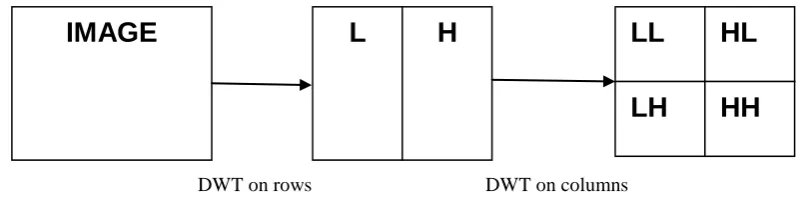
This technique is used to decompose image into four components namely LL,HL,LH and HH where first letter
to applying either a low pass frequency operation or high pass frequency operations to the rows and second
letter refers to the filter applied to the columns which is shown in fig1. The resolution level LL is lowest
consisting of approximation part of original image. The remaining resolution levels consist of detailed arts and
give vertical high (LH), horizontal high(HL) and high(HH) frequencies. In this proposed algorithm, watermark
is embedded into the host image by modifying the coefficient of high frequency bands i.e HH sub band.
DWT on rows DWT on columns
Fig 1. DWT decomposition
3.
SINGULAR VALUE DECOMPOSITION
This mathematical approach provides an elegant way for extracting algebraic features from an image. The SVD
matrix of an image has good stability where main features of SVD matrix of an image can be exploited in
image watermarking with a small deviation added to the image does not result in large deviations(14,15). The
IMAGE
L
H
LL
LH
HL
143 | P a g e
same property of SVD matrix of an image when put to use produces watermark which can be embedded to this
matrix without large variation in the obtained image.
4.
PROPOSED ALGORITHM
The algorithm is to be applied in two phases, first phase carries out watermark embedding and then second
phase is used for watermark extraction.
4.1
watermark embedding
1.Use two-level Haar DWT on original and watermarking image and apply SVD on both the images
K K K KT
A U S V ,
K
1, 2
(1)Where „K‟ represents one of two sub-bands
2.Modify the values and then apply SVD to them, respectively, i.e,
K K
W
S W CA (2)
K K K K KT
S
W U WS WV WWhere
,
denotes the scale factor. The scale factor is the used to control the strength of watermark to be inserted.3.Compute modified SVD with help of original and watermarked SVD components obtain two sets of modified
DWT coefficients i.e
*K K K KT
A
U S WV
(3) 4.Reshape the image using SVD component.5.Obtain watermarked image Aw by performing the inverse DWT.
4.2 watermark extraction
1. Use two-level Haar DWT to decompose the watermarked image and original image into four sub
bands: LL, LH, HL, HH
2. Apply SVD to the original and watermarked image i.e
*K *K *K *KT
A W
U S WV
, K = 1, 2 (4)Where k represents one of two sub bands.
3. Compute the modified SVD with help of original and watermarked SVD components
*K K *K *KT
D
U WS WV
, K = 1, 2 (5) Where k represents one of two sub bands4. Reshape the image using SVD component.
144 | P a g e
5. EXPERIMENTAL RESULTS
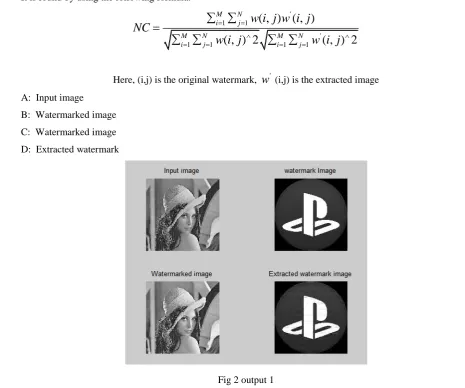
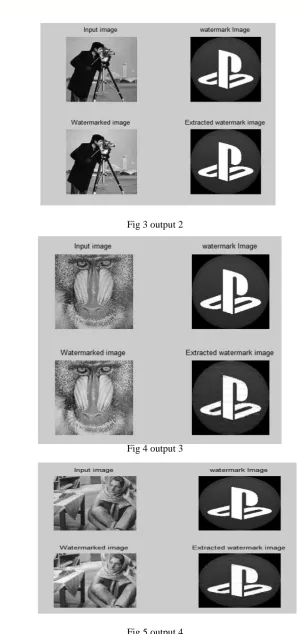
In this experiment, MATLAB is used and various input images have been taken on which a watermark image
has been embedded. Input image and watermark image is as shown. Then a watermarked image has been
watermark has been extracted.
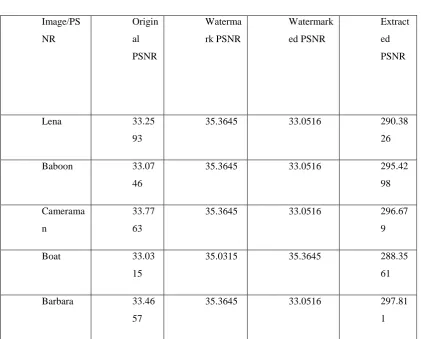
The PSNR and NC values of various images have been calculated and shown in table below.
5.1 Peak signal to noise Ratio (PSNR)
It is a metric which is used regularly the find the quality of watermarked image. It is calculated by the following
formula
10*log(255*255 /
) / log(10)
PSNR
MSE
(
(
*
) / (
* )
MSE
Sum Sum error error
M N
5.2 Normalized correlation (NC)
It is am metrics used to find the quality of extracted watermark mage with respect to original watermark image
It is found by using the following formula.
'
1 1
'
1 1 1 1
( , ) ( , )
( , ) 2
( , ) 2
M N
i j
M N M N
i j i j
w i j w i j
NC
w i j
w i j
Here, (i,j) is the original watermark,
w
' (i,j) is the extracted imageA: Input image
B: Watermarked image
C: Watermarked image
D: Extracted watermark
145 | P a g e
Fig 3 output 2
Fig 4 output 3
fig 5 output 4
146 | P a g e
Fig 6 output 5
Table 1 PSNR table
Image/PS
NR
Origin
al
PSNR
Waterma
rk PSNR
Watermark
ed PSNR
Extract
ed
PSNR
Lena 33.25
93
35.3645 33.0516 290.38
26
Baboon 33.07
46
35.3645 33.0516 295.42
98
Camerama
n
33.77
63
35.3645 33.0516 296.67
9
Boat 33.03
15
35.0315 35.3645 288.35
61
Barbara 33.46
57
35.3645 33.0516 297.81
1
147 | P a g e
IMAGE NC VALUE
Lena 1
Baboon 1
Cameraman 1
Boat 1
Barbara 1
6.
CONCLUSION
From the experimental results, it is concluded that algorithm is robust and give good results for PSNR and NC.
The proposed techniques are based on the fusion method and have been assessed using a number of
experiments. The main aim of the paper was to assess the performance of these techniques in terms of
robustness of watermarked image under certain imperceptibility criterion. The method can embed the maximum
amount of watermark while watermark is imperceptible. As experimental results have shown, the proposed
algorithm achieves two important desirable watermarking characteristics, invisibility and robustness.
REFERENCES
[1] Chin chin lai et al. “Digital Image Watermarking Using Discrete Wavelet transform and singular Value
Decomposition”,IEEE Transactions on instrumentation and Measurement, VOL. 59, NO. 11, November 2010
[2] C. D. Rawat and S. M. Shivamkutty, "Digital watermarking of video using hybrid techniques," Advances in
Communication and Computing Technologies (ICACACT), 2014 International Conference on, Mumbai, 2014
[3] Anita and A. Parmar, "Image security using watermarking based on DWT-SVD and Fuzzy
Logic," Reliability, Infocom Technologies and Optimization (ICRITO) (Trends and Future Directions), 2015 4th
International Conference on, Noida, 2015
[4] A. Furqan and M. Kumar, "Study and Analysis of Robust DWT-SVD Domain Based Digital Image
Watermarking Technique Using MATLAB," Computational Intelligence & Communication Technology (CICT),
2015 IEEE International Conference on, Ghaziabad, 2015
[5] P. Shah, T. Meenpal, A. Sharma, V. Gupta and A. Kotecha, "A DWT-SVD based digital watermarking
technique for copyright protection," Electrical, Electronics, Signals, Communication and Optimization
(EESCO), 2015 International Conference on, Visakhapatnam, 2015
[6] F. Hartung and M. Kutter, “Multimedia Watermarking Techniques,” Proceedings of the IEEE, Vol.87, No. 7,
148 | P a g e
[7] R. B. Wolfgang, C. I. Podilchuk and E. J. Delp, “Perceptual Watermarks for Digital Images and Video,”
Proceedings of the IEEE, Vol. 87, No. 7, July 1999, pp. 1108-1126.
[8] C. Yang, C. Weng, S. Wang, and H. Sun, “Adaptive Data Hiding in Edge Areas of Images with Spatial LSB Domain Systems”, IEEE Transaction on Information Forensics and Security, 2008, 3(3), p. 488-497.
[9] S. Dey, A. Abraham, and S. Sanyal, “An LSB Data Hiding Technique Using Prime Numbers”, Third
International Symposium on Information Assurance and Security, 2007, 37, pp. 101-106.
[10] Q. Cheng, and T. S. Huang, “Robust Optimum Detection of Transform Domain Multiplicative Watermarks”, IEEE Transactions on Signal Processing, 2003, 51(4), pp. 906-923.
[11] V. Fotopoulos, and A. N. Skodras, “A Novel Approach on Transform Domain Watermarking Against
Geometrical deformations”, signal processing system design and implementation IEEE, 2005, 11, pp. 403-4-6.
[12] Gaurav Bhatnagar, Balasubramaniam Raman, K. Swaminathan, “DWT-SVD based Dual watermarking Scheme” application of Digital information and web technologies,2008.ICWAT 2008 pages 526-531.
[13] E.Ganic and A. M. Eskicioglu,“Robust embedding of Visual Watermarks Using DWT-SVD.” Journal of
electronic Imaging Vol 14 no. 4,2005.
[14] R.liu and T. tan, “An SVD-Based Watermarking Scheme for protecting rightful ownership”, IEEE Trans.
On multimedia, Vol. 4, no. 1 March 2002.
[15] Y. H. Wang, T. N. Tan and Y. Zhu, “Face Verification Based on Singular Value Decomposition and Radial
Basis Function
[16] Neural Network”, National Laboratory of Pattern Recognition (NLPR), Institute of Automation, Chinese