DOI : 10.32628/CSEIT1952112
An Efficient Digital Watermarking Technique in Two-Dimensional Image
Using DWT Algorithm
Dr. D. Napoleon, R. Saikumar
Department of Computer Science, Bharathiar University, Coimbatore, Tamil Nadu, India
ABSTRACT
Discrete Wavelet Transform is the algorithm which can be used to increase the contrast of an image for better visual quality of an image. Histogram value for original image with two highest bins are taken for the process of embedding the data to perform histogram equalization. Watermarking become a major area of research in image processing to face the challenges initialized from the growth of dispersal of digital content over the network. To avoid the misuse of the data in the internet, watermarking plays a major role in prevention of the data by encrypting the data. The watermarked message maybe logo, label, etc. which can be embedded into the digital data used with various applications like protection of copyright, authentication and so on. The watermarking can be applied with two- dimensional image, three-dimensional image and also in video for protecting the data to secure the data. Watermarking can do with several image processing algorithms like DWT, DCT, etc. Here, the proposed research work implements the DWT algorithm for digital watermarking using MATLAB for encryption and decryption process for the process of authentication.
Keyword : Watermarking Technique, 2D Image, DWT, MATLAB.
I. INTRODUCTION
Now a days, internet is the fast-growing thing which carries lot of things like digital data, video, image, audio, etc. The image has taken for communication purpose which carries data. While transferring the data by encrypting in an image the image maybe hacked or viewed by the third parties like hackers and so. To prevent the misuse of accessing the data by others, watermarking is the efficient technique used by the senders to protect their data which encrypts the data. There are several methods and algorithms have used to encrypt the data in an image. Also, the decryption done at receiver side to decrypt the encrypted data. Image processing is the interesting domain in the current research field which gives more pictorial information to the human for processing the data of an image for storage,
transmission of the data and so. Nowadays, the image captured from the camera have been taken for the various application for communicating purpose. This field improves the various fields day by day in science and technology. Image compression is the method of reducing the size of an image file and while retaining the information the data can be accessed without any pixel loss while reconstructing the image. The reconstruction of an image is the resultant process of compressed image. The ratio of an original image as uncompressed image the ratio is referred as compression ratio of the image in this method.
II. LITERATURE REVIEW
performing different techniques used to embed and
Where the robustness used to measure the ability of watermarking against alteration of an image. The imperceptibility can be indistinguishable of host image and marked signal and the capacity measures the amount of information added into the source image. In embedding method there are two domains with embedding is done as spatial and frequency domain.
III. DWT (DISCRETE WAVELET TRANSFORM)
By comparing the two different domain techniques as spatial and frequency, the frequency domain watermarking technique performed and executes well as producing the high-quality image with low error rate of an image in digital watermarking algorithms [8]. Commonly used frequency-domain transforms include the Discrete Wavelet Transform (DWT), the Discrete Cosine Transform (DCT) and Discrete Fourier Transform (DFT) techniques. Due to excellent spatial localization and multi-resolution characteristics DWT technique has used in digital image watermarking more frequently. It is useful for processing of non-stationary signals. In transformation of small waves which are called wavelets of varying frequency and limited duration are used as parent wavelet. Wavelets are created by translations and dilations of a fixed function called mother wavelet. Wavelet transform provides both frequency and spatial description of an image DWT is the multi resolution description of an image. The decoding can be processed sequentially from a low resolution to the higher resolution. The DWT splits
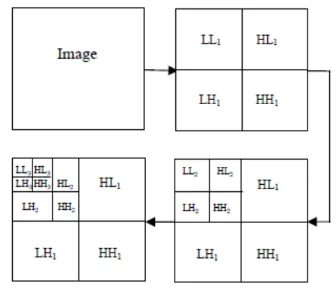
the signal into high and low frequency parts. The high frequency part contains information about the edge components, while the low frequency part is split again into high and low frequency parts. The high frequency components are usually used for watermarking since the human eye is less sensitive to changes in edges [11]. In two dimensional applications, for each level of decomposition, we first perform the DWT in the vertical direction, followed by the DWT in the horizontal direction. After the first level of decomposition, there are 4 sub-bands: LL1, LH1, HL1, and HH1. For each successive level of decomposition, the LL sub band of the previous level is used as the input. To perform second level decomposition, the DWT is applied to LL1 to perform third level decomposition, the DWT is applied to LL2 band which decompose this band into the four sub-bands – LL3, LH3, HL3, HH3. This results in 10 sub-bands per component. LH1, HL1, and HH1 contain the highest frequency bands present in the image tile, while LL3 contains the lowest frequency band and the approximate image. [10]
Figure 1. Three level DWT of original image
IV.PROPOSED WORK
extraction algorithm for hiding the data for security reasons.
Embedding algorithm: For embedding the host image and watermarked image has taken.
Step 1: DWT is performed on the host image to decompose it into four sub bands as LL1, HL1, LH1 and HH1.
Step 2: DWT is performed on the LL1 sub band to get four smaller sub bands LL2, HL2, LH2 and HH2. Step 3: DWT is performed on the LL2 sub band to get four smaller sub bands LL3, HL3, LH3 and HH3. Step 4: DWT is performed on the watermark image to decompose it into four sub bands wLL1, wHL1, wLH1 and wHH1.
Step 5: DWT is performed on the LL1 sub band to get four smaller sub bands wLL2, wHL2, wLH2 and wHH2.
Step 6: DWT is performed on the LL2 sub band to get four smaller sub bands w LL3,w HL3,w LH3 and wHH3.
Step7: An embedding function is used to add the two sub bands are added with a embedding formulae with value 'a' as follows:
new LL3=LL3+ a*wLL3
Step8: Now, Inverse DWT is performed using the sub bands new LL3, LH3, HL3, HH3 to get image new
Extraction algorithm: For extraction host image and watermarked images are used:
Step 1: First level DWT is performed on the host image to decompose it into four sub bands LL1, HL1, LH1 and HH1.
Step 2: The second level DWT is performed on the LL1 sub band to get four smaller sub bands LL2, HL2, LH2 and HH2.
Step 3: The third level DWT is performed on the LL2 sub band to get four smaller sub bands LL3, HL3, LH3 and HH3.
Step 4: First level DWT is performed on the watermarked image to decompose it into four sub bands nLL1, nHL1, nLH1 and nHH1.
Step 5: The second level DWT is performed on the LL1 sub band to get four smaller sub bands nLL2, nHL2, nLH2 and nHH2.
Step 6: The third level DWT is performed on the LL2 sub band to get four smaller sub bands n LL3, n HL3, n LH3 and nHH3.
Step7: Then following extracting is performed to get wLL3 with the extraction formulae with same value of 'a' as in embedding wLL3= new LL3-LL3/ a
Step 8: Apply inverse DWT on wLL3 with all other sub bands (LH, HL, HH ) equal to zero to get wLL2 Step 9: Repeat step 8 two times each level to get the extracted watermarks.
V. EXPERIMENTAL RESULTS
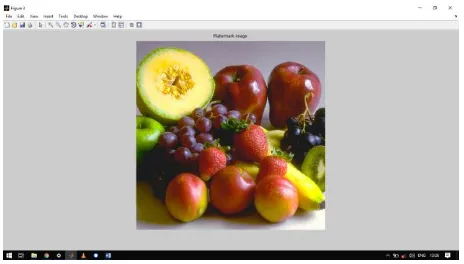
Figure 2. Two- dimensional image taken for watermarking
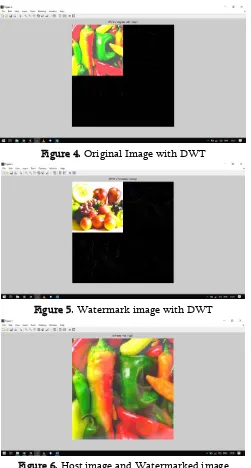
Figure 4. Original Image with DWT
Figure 5. Watermark image with DWT
Figure 6. Host image and Watermarked image encrypted.
VI.CONCLUSION
In this research work, watermarking technique has used with 3-level discrete wavelet transform where DWT transform is performed on both original and watermark image and watermarked content is embedded into the host image with a scaling factor 'a'. The experimental results show that the quality of the watermarked image and the reconstructed image which can be dependent on the scaling factor ‘a’ and also Higher scaling factor results in a visible
watermark. Thus, the scaling factor of watermarked image makes the image to be visible or invisible according to the need of media. The results are executed successfully by encrypting the image with some digital data.
VII. REFERENCE
[1] Sumedh P, “Digital Watermarking Algorithm
using DWT Technique”, International Journal
of Computer Science and Mobile Computing, Vol.5 Issue.5, May- 2016, pg. 01-09.
[2] Cox, IJ, Miller, ML & Bloom, JA 2002, "Digital Watermarking", Morgan Kaufmann Publisher, San Francisco, CA, USA 2002.
[3] Christine I. Podilchuk, Edward J. Delp, "Digital watermarking: Algorithms and application", IEEE Signal processing Magazine, July 2001. [4] Lalit Kumar Saini, Vishal Shrivastava " A
Survey of Digital Watermarking Techniques and its Applications".
[5] G. Rosline Nesa Kumari, B. Vijaya Kumar, L.Sumalatha, and Dr V. V. Krishna," Secure and Robust Digital Watermarking on Grey Level Images", International Journal of Advanced Science and Technology, 2009.
[6] Baisa L. Gunjal, R.R. Manthalkar, "An overview of transform domain robust digital image watermarking algorithms", Journal of Emerging Trends in Computing and Information Sciences, 2010.
[7] W. Hong and M. Hang, "Robust Digital Watermarking Scheme for Copy Right Protection," IEEE Trans. Signal Process, 2006. [8] Deepshikha Chopra, Preeti Gupta, Gaur Sanjay
B.C., Anil Gupta, “Lsb Based Digital Image Watermarking For Gray Scale Image” IOSR Journal of Computer Engineering (IOSRJCE).
[9] Qing Liu,Jun Ying(2012),”Grayscale Image
Digital Watermarking Technology Based on Wavelet Analysis”.
Cite this article as :
Dr. D. Napoleon, R. Saikumar, "An Efficient Digital Watermarking Technique in Two-Dimensional Image Using DWT Algorithm", International Journal of Scientific Research in Computer Science, Engineering and Information Technology (IJSRCSEIT), ISSN : 2456-3307, Volume 5 Issue 2, pp. 478-482, March-April 2019.