ISSN: 2278-7461, ISBN: 2319-6491
Volume 1, Issue 11 (December 2012) PP: 63-67
Adsorption of Metals from synthetic wastewater by plant
material
Sonia Aggrawal
1, Kailash Daga
2, Vinod Vaishnav
3, Madan Lal
4 1,2,3,4Environ-Industrial Laboratory, Department Of Chemistry, Jai Narain Vyas University, Jodhpur (Rajasthan) India
Abstract:–Industrial activities and mining operations have exposed man to the toxic effects of metals . Toxic metal compounds are frequently used in industrial processes and are widely distributed in the environment. Metals can be distinguished from other toxic pollutants, because these are non biodegradable, may undergo transformation, and can have a large environmental, public health, and economic impact. Zinc is an essential mineral, but too much is not beneficial. Adsorption technique is one of the most important technology for the treatment of polluted water from zinc , but seeking for the low-cost adsorbent is the target of this study. Removal of zinc was studied using adsorbent prepared from poly vinyl activated charcoal of Procopis cineria leaves (PVAC-PC). Batch adsorption experiments were performed by varying adsorbent dose, pH of the metal ion solution and contact time. Adsorption of zinc is highly pH dependent and the results indicate that the maximum removal took place in the pH range of 6 and initial concentration of 60 ppm . The adsorbent capacity was also studied the zinc adsorption followed both the Langmuir and Freundlich equation isotherms. Comprehensive characterization of parameters indicates that PVAC-PC to be an excellent material for adsorption of zinc ion to treat wastewater containing low concentration of the metal.
Key words:–Wastewaters, Adsorption isotherms, Procopis cineria
I.
INTRODUCTION
Industrial activities and mining operations have exposed man to the toxic effects of metals (Carrein and Becker, 1984). Toxic metal compounds are frequently used in industrial processes and are widely distributed in the environment. Due to their extended persistence in biological systems and tendency to bio-accumulate as they move up the food chain, they represent important environmental and occupational hazards. The removal of toxic contaminants from industrial wastewaters is one of the most important environmental issues. Intensive research and development efforts are being made all over the world to develop low cost adsorbents and to utilize the wastes for remediation of toxic metal ions from aqueous solutions Several industrial, agricultural processes and mining activities have increased the concentration of toxic contaminants in water around the world.Best water management systems based on scientific methods and effective control of industrial waste and preventing the water resources from pollution is an important aspect. The presence of various heavy metals in the water and land system cases serious concern in nature as they are non-biodegradable and may accumulate at high levels. Exposure of Zn in large amounts is extremely toxic to living organisms. In humans, it can cause a range of serious ailments including anemia, damage to pancreas, lungs, metal fume fever, decreased immune functions, ranging from impaired neuropsychological functions, growth retardation and stunting, impaired reproduction, immune disorders, dermatitis, impaired wound healing, lethargy, loss of appetite and loss of hair (Lanouette K.H., W.H.O).
The aim of this research is to develop an inexpensive and effective matel ion adsorbent from plentiful natural waste sources, such as PVAC-PC, and to explain the adsorption mechanism taking place.
II.
MATERIALS AND METHODS
2.1 Preparation of Poly Vinyl Activated Charcoal from Procopis cineria (PVAC-PC):
lumps. The lumps were further ground into fine powder. This powder was then used as an adsorbing material. When 2.5gm Furnace Black was used the results were better.
2.2 Zinc sulphate solution: A stock solution of aqueous solution of Zinc (II) was obtained by dissolving 0.4404 g of AR grade Zinc Sulphate in 1000ml of double distilled water to give 100 ppm solution.
III.
SORPTION ISOTHERMS
These two isotherms model were used to assess the different isotherms and their ability to correlate experimental data.
3.1 Langmuir Model:
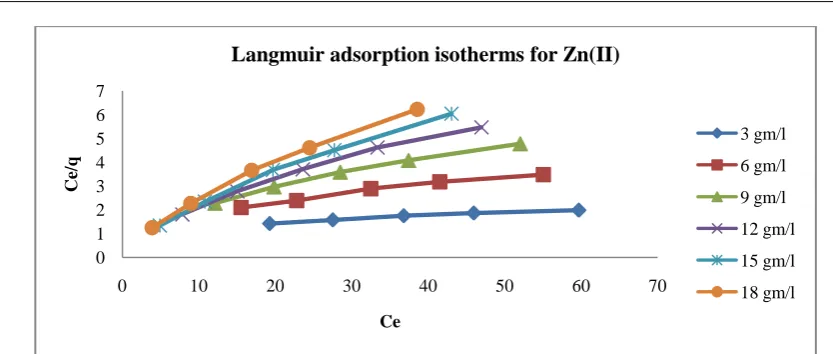
The Langmuir equation is derived from simple mass-action kinetic, assuming chemisorptions. This model is based on two assumptions that the forces of interaction between adsorbed molecules are negligible and once a molecule occupies a site and no further sorption takes place. The saturation value is reached beyond which no further sorption takes place. The saturation monolayer can then be represented by the expression:
Ce/qe = 1/Qob +Ce/Qo
Where,Ce is equilibrium concentration (mg/I), q is the amount at equilibrium time per unit adsorbent
(mg/g) and Q and b are Langmuir constants related to adsorption capacity and energy of adsorption respectively. The essential characteristics of a Langmuir isotherm can be expressed in terms of a dimensionless constant separation factor or equilibrium parameter RL . It is defined by
RL = 1/ (1+bCo)
Where Co is the initial adsorbate concentration (mg/l) and b is the Langmuir constant (mg/l). Values of
dimensionless equilibrium parameter RL show the adsorption to be favorable (0< RL<1).
3.2 Freundlich Adsorption Isotherm:
The Freundlich isotherm model was chosen to estimate the adsorption intensity of the
sorbent towards the adsorbent. It is an empirical equation employed to describe the isotherm data given by: qe = Kf (Ce)1/n
The linear form of the equation or the log form is
Log qe = log Kf + 1/n log Ce
Kf and n are Freundlich constants; n gives an indication of the favorability and kf the capacity of the
adsorbent. . The values of 1/n, (0.3026) less than unity is an indication that significant adsorption takes place at low concentration but the increase in the amount adsorbed with concentration becomes less significant at higher concentrations and vice verse. The higher the KF value (1.42048), the greater the adsorption intensity. The value
of 1/n, less than unity were obtained mostly for the PVAC-CP. Also the Kf value, the greater the adsorption
intensity.
The equilibrium concentration was calculated using following formula Ce = C0 – (% adsorption x C0 / 100)
The amount of metals adsorbed per unit weight of an adsorbent ‘q’ was calculated using following formula q = (C0 – Ce) x V /m
Where Ce is the equilibrium concentration (mg/l) and qe the amount adsorbed (mg/g) at equilibrium
time; C0 is the concentration (mg/l), m is the mass of the adsorbent (gm) and V is the volume of the solution (L).
The Langmuir and Freundlich constants increase with the rise in temperature. The values of then lie between 1 to 10 indicating good sorption potential of the sorbent.The correlation coefficient (R) for Freundlich and Langmuir isotherms are merely equal. Therefore for the present adsorption study it can be stated that Freundlich and Langmuir adsorption equations are found to be better fitted. (R2 0.999)
IV.
EXPERIMENTAL CONDITIONS
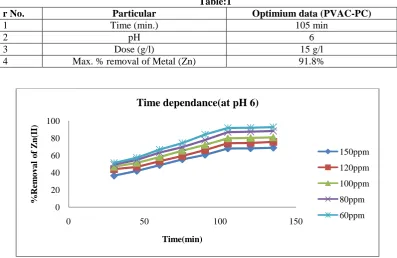
4.1 Effect of contact time: In adsorption system, the contact time play a vital role irrespective of the other experimental parameters, affecting the adsorption kinetics. Figure 1 depicts that there was an appreciable increase in percent removal of Zinc up to 105 min. thereafter further increase in contact time the increase in removal was very small. Thus the effective contact time (equilibrium time) is taken as 105 min. and it is independent of initial concentration.
that 91.8 % removal of Zn (II) achieved at pH 6 and thereafter the percent removal decreases with increases in pH as 7and 8. Thus the optimum adsorption pH for Zn (II) removal was found to be 6.
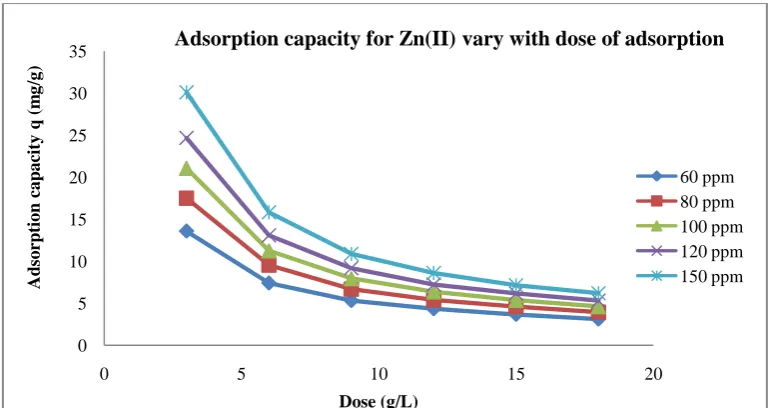
4.3 Effect of adsorbent dose: The effect of adsorbent dose on percent removal of Zinc is shown in Figure 3 Adsorbent dose was varied (3, 6, 9, 12, 15,18g/l) and performing the adsorption studies at pH 6. The present study indicated that the amount of Zn (II) adsorbed on PVAC-PC increase with increase in the PVAC-PC dose up to 15g/l and thereafter further increase in dose the increase in removal was very small. Thus the effective dose is taken as 15g/l.
V.
CONCLUSION
Pollution of the aquatic environment with toxic valuable metals is widespread. Consideration of the modes of purifying these contaminations must be given to strategies that are designed to high thorough put methods while keeping cost at minimum. Adsorption readily provides an efficient alternative to traditional physiochemical means for removing toxic metals. In conclusion, PVAC-PC could be used as potential adsorbent for the removal of Zn (II) from aqueous solutions. The optimium data were found from this adsorption studies is given below in
Table:1
r No. Particular Optimium data (PVAC-PC)
1 Time (min.) 105 min
2 pH 6
3 Dose (g/l) 15 g/l
4 Max. % removal of Metal (Zn) 91.8%
Figure 1: Effect of contact time on removal of Zn (II) at different concentration by PVAC-PC at pH 6
0 20 40 60 80 100
0 50 100 150
%
Re
m
o
v
a
l
o
f
Z
n
(II
)
Time(min)
Time dependance(at pH 6)
150ppm
120ppm
100ppm
80ppm
60ppm
0 20 40 60 80 100
2 3 4 5 6 7 8 9
%
REm
o
v
a
l
o
f
Z
n
(II
)
pH
pH dependance
150ppm
120ppm
100ppm
80ppm
Figure 2: Effect of pH on removal of Zn (II) at different concentrations by 15g/l of PVAC-PC at constant contact time 105 min.
Figure 3 : Effect PVAC-PC dose on percent removal of Zn(II) at equilibrium contact time 105 min. and effective at pH 6.
Figure 4: Effect of dose of adsorbent on adsorption capacity at equilibrium contact Time 105 min and effective pH 6.
Figure 5: Freundlich Isotherm plot for Zn (II) adsorption by PVAC-PC at optimum conditions
50 55 60 65 70 75 80 85 90 95 100
0 5 10 15 20
%
R
em
o
v
a
l
o
f Z
n
(I
I)
Dose (g/l)
Dose dependance at pH 6
60ppm
80ppm
100ppm
120ppm
150ppm
0 5 10 15 20 25 30 35
0 5 10 15 20
Ad
so
rp
tio
n
c
a
p
a
city
q
(m
g
/g
)
Dose (g/L)
Adsorption capacity for Zn(II) vary with dose of adsorption
60 ppm 80 ppm 100 ppm 120 ppm 150 ppm
0.2 0.4 0.6 0.8 1 1.2 1.4 1.6 1.8
0.4 0.6 0.8 1 1.2 1.4 1.6 1.8 2
Lo
g
q
Log Ce
Freundlich adsorption isotherm for Zn(II)
3 gm/l
6 gm/l
9 gm/l
12 gm/l
15 gm/l
Figure 6: Langmuir Isotherm plot for Zn (II) adsorption by PVAC-PC at optimum conditions.
Table -2 Langmuir and Freundlich constants for adsorption of Zinc (II)
Dose (gm/l)
Freundlich isotherm (linear equation)
Langmuir isotherm (linear equation)
R2
Freundlich R
2
Langmuir
15 y= 0.3026x+0.351 y= 0.1217x+0.9968 0.994 0.984
Table -3
Dose
(gm/l) Freundlich constants Langmuir constants
15
Kf n 1/n Qm (mg/g) b (l/ mg) RL
1.42048 3.304693 0.3026 8.216927 0.122091 0.12011
REFERENCES
1) Akporhonor, E. E.1* and Egwaikhide, P. A.2 Scientific Research and Essay Vol. 2 (4), pp. 132-134, April 2007
2) APHA, AWWA(1994) Standard Methods for Examination of water and wastewater 19th Edition Washington DC
3) Broadley, M. R.; White, P. J.; Hammond, J. P.; Zelko I.; Lux A. (2007), "Zinc in plants", New Phytologist 173 (4): 677.
4) Chand, S., Aggarwal V.K. and Kumar P. (1994). Removal of Hexavalent Chromium
5) Freundlich H 1926 Colloid Capillary Chemistry(London; Metheun)
6) From the Wastewater by Adsorption. Indian J Environ. Health, 36(3): 151-158 pp.
7) Hambidge, K. M. and Krebs, N. F. (2007), "Zinc deficiency: a special challenge", J. Nutr. 137 (4)
8) Iqbal Ahmad, J.Appl. Sci. Enviorn.Mgt.2005 Vol.9(1) 123-126
9) Kadirvelu, K., Thamaraiselvi, K, and Namasivayam, C., (2001) Bioresource Techn. 76: 63-65 pp.
10) Langmuir I J 1918, J. Amer. Chem. Society. 40, 1361
11) Lanouette, K.H., "Heavy Metals Removal", Chem. Eng., 84(2 1): 73-80(1977).
12) R. P. Tiwari, P. Bala Ramudu, 1 R. K. Srivastava, 2 M. K. GuptaIran. J. Environ. Health. Sci. Eng., 2007, Vol. 4, No. 3, pp. 139-146
13) World Health Organization, Geneva, Guidelines for drinking Water Quality, 1984.
0 1 2 3 4 5 6 7
0 10 20 30 40 50 60 70
Ce
/q
Ce
Langmuir adsorption isotherms for Zn(II)
3 gm/l
6 gm/l
9 gm/l
12 gm/l
15 gm/l