Volume 5, Issue 06[June 2016] PP: 51-56
Intelligent Automatic Car Braking Control System Using Neural
Network Classifier
1
Bamigboye, O. O and
2Obaje, S.E
1
Department of Electrical/Electronic Engineering, Federal Polytechnic, Offa, Kwara State
2Department of Computer Engineering, Federal Polytechnic, Offa, KwaraState
ABSTRACT: - Protection structures in street automobiles are classified into two fundamental sorts: passive and energetic systems. The Intelligent braking machine (IBS) is an active protection device in road cars, which senses the slip value among the tyre and the road and uses these values to determine the gold standard braking pressure. due to the high non-linearity of the tyre and avenue interplay, and uncertainties from automobile dynamics, standard manipulate methods: like PID, sliding mode manipulate and feedback linearization will not suffice.The performance of the Intelligent Brake Control is assessed with a full vehicle model, sustained by vehicle dynamic principles. The model is integrated with brakeline dynamics and a tire friction model based on reliable simulational data. Straight line brake simulations are performed and results are evaluated in terms of braking efficiency, under different and variable conditions.
This paper, consequently proposes a neural network-based totally remarks linearization manage design approach. The simulational outcomes monitor that slip law the usage of neural community-based totally manage scheme is possible for distinct slip values (avenue situations) and robust to outside disturbances.
Keywords: Intelligent braking machine, slip manipulate, neural community, model
I.
INTRODUCTION
The effects of road accidents on lives and properties cannot be overemphasized.so any vehicle without an effective brake system is prone to accident and apparently disastrous effect follows. The purpose of automated car braking system is to develop an automated control system that would maintain a safe driving distance from obstacles while driving. This research work proposes a car braking system that will be controlled by the artificial neural networks to curb road accidents and effectively assure safety and stress free driving. In many road accident cases, a major cause of the accident is the driver distraction and failure to react in time (Aldair,, 2010). Advanced system of auxiliary functions will be developed to help avoid such accident and minimize the effects of collision in effect. This will be achieved by reducing the total stopping distance through works done by researchers in the past. Lately some of the works will be used in many car brake system developments deploying electronic brake control system which has led to significant safety in driving
(Baslamisli, 2007) proposes a back stepping control design scheme for a non-linear ABSassisted with active suspension system (ASS) to further reduce vehicle braking time and stopping distance. The goal is to utilize the vertical normal force that increases during braking, leading to increased frictional forces between the tyre and the road to achieve more shorter stopping distance than using just ABS. Simulation results using a quarter-car model show that the integrated system achieved a 12% improvement in stopping distance.
The feedback linearization control (FBL) method as applied to non-linear systems is one method to turn to for solving the slip control problem. However, there exists minimum literatureon the application of feedback linearization control method to ABS. (Chin et al, 1992) presented simulation results of a wheel slip control employing the feedback linearization control method with an adaptive sliding mode control. The novelty of this work is the introduction of a time delay to the input. The time delay is necessary because in practice, there exists a time delay in the actuator dynamics. To compensate for the time delay, the sliding mode controller is incorporated to bound the uncertainties, using a method proposed by (Blanchett et al, 2000). The simulation results presented did not show a significant difference between the models incorporating time delay to the model without the time delay.
1.1 Problem statements
1. Overspeeding 2. Careless drivers 3. Accidents 1.2 Aim
The aim is to develop automated break control system
1. To design automated break control
2. To implement the develop model in (1) using matlab Simulink 1.4 Scope
This report is limited to the design of automatic brake control system with artificial neural network. An automatic brake control system using artificial neural network will be designed to reduce acceleration from a predetermined speed once it detects an obstacle 100m ahead. Two inputs and one output parameters; position, velocity and brake, will be designed using Fuzzy logic toolbox, to develop the car brake controller while Simulink based on back propagation training algorithm will be used to train the network
.
II.
REVIEW OF RELATED WORK
Choi(2008)Applied a predictive approach to design a non- linear model-based controller for the wheel slip. The integral feedback technique is also employed to increase the robustness of the designed controller. Therefore, the control law is developed by minimizing the difference between the predicted and desired responses of the wheel slip and it‟s integral.Huang(2010) proposed a static-state feedback control algorithm for anti-lock brake system (ABS) control. The robustness of the controller against model uncertainties such as tire longitudinal force and road adhesion coefficient has been guaranteed through the satisfaction of a set of linear matrix inequalities.A neuro-fuzzy adaptive control approach for nonlinear system with model uncertainties in Intelligent braking systems was proposed .The control scheme consists of PD controller and an inverse reference model of the response of controlled system. Its output is used as an error signal by an online algorithm to update the parameters of a neuro-fuzzy feedback controller
Layne(2013) Described a quarter-vehicle and an ABS in MATLAB-SIMULINK known as the SWIFT-tire model. This has relevance in modeling the SWIFT-tire characteristics and the dynamic behavior on a flat as well as an uneven road. From the performance of ABS with variation of weight, friction coefficient of road, road inclination etc. a self-tuning PID control scheme to overcome these effects via fuzzy GA is developed; with a control objective to minimize stopping distance while keeping slip ratio of the tires within the desired range Li (1998). An intelligent controller can be used to design a control system for a full vehicle nonlinear active suspension system such as Neural Controller (NC). Neural Networks (NNs) are capable of handling complex and nonlinear problems, process information rapidly and can reduce the engineering effort required in controller model development. Artificial neural networks are made up of a simplified individual models of the biological neuron that are connected together to form a network. It consists of a pool of simple processing units which communicate by sending signals to each other over a large number of weighted connections. Capability of learning information by example; ability to generalize to new input and robustness to noisy data are the important properties of neural networks. From these properties, neural networks are able to solve complex problems that are currently intractable. The artificial neural network is an intelligent device wildly used to design robust controllers for nonlinear processes in engineering problems. In many publications, neural networks are used to design controllers, such as the model reference adaptive control, model predictive control, nonlinear internal model control, adaptive inverse control system and neural adaptive feedback linearization. The control architectures in these papers depend on designing a neural network identifier and then this identifier is used as a path to propagate the error between the output of the process and output of the reference model to train and select the optimal values of the neural network control. Therefore, in those methods two neural networks were trained to track several control objectives
III.
METHODOLOGY
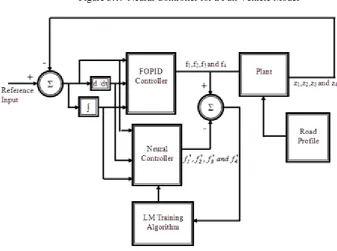
3.1 Design of the Neural ControllerNeural Networks (NNs) are capable of handling complex and nonlinear problems, process information rapidly and can reduce the engineering effort required in controller model development. Figure 3.3 depicts the controlled vehicle system with a neural controller as a key component. A neural controller has been designed to generate suitable control signals. The control signals will be applied as a control input signals to govern the hydraulic actuators to generate suitable damping forces for improving the vehicle performance. To find the optimal values of the trainable parameters of the neural controller for driving the plant to meet all control objectives, FOPID controllers was designed. The input and output was used to train the parameters of neural controller using the LM Training Algorithm. Figure 3.4 depicts the training phase of the Neural Controller.
Figure 3.1: Neural Controller for a Full Vehicle Model
Figure 3.2 Training Phase of Neural Controller
After the optimal values of trainable parameters are obtained the neural controller design should be improved by adjusting the scaling gains, i.e. GE, GED, GEI and GU, as shown in Figure 3.1. To select the optimal values of the scaling gains, four-dimensional Golden Section Search (4-D GSS) method is introduced to reduce the trial time
IV.
RESULT AND DISCUSSION
4.1 Result Algorithm for the training Machine
The rule base of the longitudinal control generated by the Neuro-fuzzy system is described by the following rules:
IF Speed_errorNegative AND Acceleration Negative THEN Output a05
IF Speed_errorNegative AND Acceleration Positive THEN Output a02
IF Speed_errorPositive AND Acceleration Negative THEN Output a06
IF Speed_errorPositive AND Acceleration Positive THEN Output a07
IF Speed_errorPositive AND Acceleration Null THEN Output a09
IF Speed_errorNull AND Acceleration Negative THEN Output a01
IF Speed_errorNull AND Acceleration Positive THEN Output a04
IF Speed_errorNull AND Acceleration Null THEN Output a08
4.2 Result for Real Time Brake Response
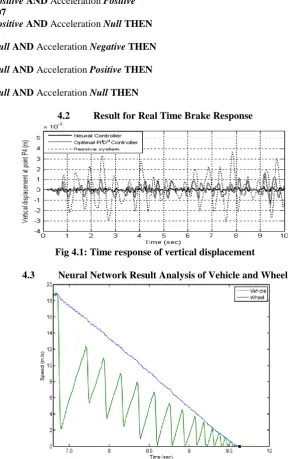
Fig 4.1: Time response of vertical displacement
4.3 Neural Network Result Analysis of Vehicle and Wheel
Figure 4.2: Simulational results for deceleration of vehicle and wheel using NNFBL controller for the case of slip regulation
Figure 4.4: Simulational results for deceleration of vehicle and wheel using neural network controller for the case of slip tracking
Considering the plots of the slip regulation, the PID controller exhibits higher slip values thanthe NNFBL controller, before the end of the simulation. The NNFBL records high slip values only towards the end of the simulation, reaching its maximum peak value as expected in reality. The NNFBL recorded the lowest effective braking torque of 39Nm compared to the 108Nm by the PID controller.The results of the deceleration of the vehicle and wheel show the NNFBL performed better than the PID by recording the lowest stopping distance of 20:75m as against 22:17m by the PID controller.Considering the plots of the slip tracking case, a reference slip trajectory is imposed. This is done to imitate changes in road condition, thereby evaluating the robustness of the controllers. Similar to the case of slip regulation, braking commenced at an initial longitudinal velocity of 68km=h (1500rpm) until rest. There was no further tuning of the controllers so that the robustness of the controllers could be evaluated
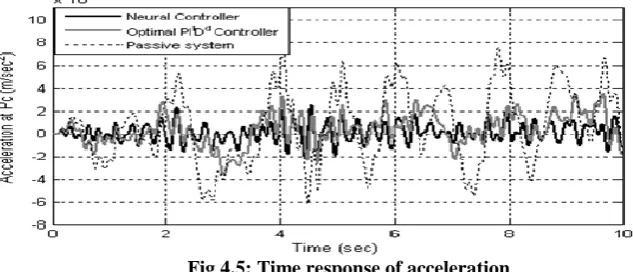
Fig 4.5: Time response of acceleration
The efficient controller is the controller that is still stable even the disturbance signals are applied on the plant. Therefore, to establish the effectiveness of any controller the robustness should be examined. After the optimal values of the trainable parameters of the neural controllers have been obtained, the robustness of the proposed neural controllers with optimal values should be tested. Six types of disturbances are applied in turn to test the robustness of the neural controller.
V.
CONCLUSION AND RECOMMENDATION
5.1
CONCLUSION
VI.
RECOMMENDATION
Neuro-fuzzy structures have many programs in ITS location. Designing, tuning and implementation of the lateral control can be taken into consideration for destiny works. Furthermore, neuro-fuzzy strategies will be used to version the behavior of the car, and we think that this will help us to improve the present day controllers in the autonomous driving.The longitudinal control can also be progressed if different variables are thinking of inside the manage loop. In future works, a multivariable system, considering longitudinal and transversal variables, may be designed. Furthermore, the weather element can also be taken into consideration.
REFERENCES
[1] Aldair, A. and W.Wang, 2010.”Layout of Fractional order Controller based on Evolutionary algorithm for a full Vehicle Nonlinear energetic Suspension device." worldwide journal of manage and Automation (IJCA) 33(4): 33-forty six.
[2] Baslamisli, S. (2007), „strong manipulate of anti-lock brake system‟, car machine Dynamics , India [3] Blanchett, T. P., G. C. Kember, et al., 2000 . "PID benefit scheduling the usage of fuzzy good judgment."
ISATransactions 39: 317-325.
[4] Chin, Y. ok., W. C. Lin, et al.,1992 . Sliding Mode ABS Wheel Slip control. proceeding of American manipulate conference
[5] Choi, B. (2008)„ Intelligent Brake gadget with a non-stop Wheel Slip manage to maximize the Braking performance and the ride first-class‟, IEEE Transactions on control structures technology pp5 101-113 [6] Choi, S. B., J. H. Bang, et al., 2002 . Sliding mode manipulate for anti-lock brake gadget ofpassenger
motors featuring electrorheological valves. court cases of the organization of Mechanical Engineers, element D: magazine of automobile Engineering., SAGE.
[7] Drakunove, S., U. Ozguner, et al., 1995 . "ABS control using optimal seek thru Sliding Modes." IEEE Transactions on manage systems technology three(1): seventy nine-85.
[8] Habibi, M. and A. Yazdizadeh, 2010 .a unique Fuzzy-Sliding Mode Controller for IntelligentBraking gadget. 2d global convention on superior pc manipulate (ICACC) Shenyang: 110-114.
[9] He, S., S. Tan, et al.,1993 . "Fuzzy Self Tuning of PID Controllers." Fuzzy units and structures56: 37-46. [10] Huang C. and Shih M. 2010, “design of a hydraulic anti-lock braking system (ABS)
[11] for a motorbike” journal of mechanical technology and technology” can also 2010, volume 24, issue five, pp 1141-1149
[12] Jang, J.1993 . "ANFIS: Adaptive network based Fuzzy Inference machine." IEEE Transaction on systems 23: 665-686
[13] Layne, J. R., okay. M. Passino, et al., 1993. "Fuzzy learning control for Antiskid Braking structures." IEEE Transaction s on manipulate systems era 1(2): 122-129.
[14] Layne, J. (2013) „Fuzzy gaining knowledge of control for antiskid braking system‟, IEEE Trans. control system tech., vol. 1 pp 456-469
Engr. O.O. Bamigboye holds a Bachelor and Master degrees in Electrical and Electronic Engineering from the University of Ilorin Kwara State Nigeria. He is currently undergoing his PHD in Instrumentation and control at the University of Ibadan, Nigeria. He is an author of many published and yet to be published journals and textbooks. He is an associate member of Nigerian Society of Engineers (MNSE), Nigerian institution of Engineering management and Council for the regulation of Engineering in Nigeria (COREN). He is currently a principal lecturer in the Department of Elect/Elect Engineering in the Federal Polytechnic OFFA, Kwara State, Nigeria.