447
International Journal of Pharmaceutical Sciences and Drug Research 2018; 10(6): 447-453
Research Article
ISSN: 0975-248X
CODEN (USA): IJPSPP
Formulation Development and in vitro Evaluation of Eletriptan
Fast Dissolving Oral Films
Shrushti V. Somwanshi
*, Sanjay S. Thonte
Mewar University, NH-79, Gangrar, Chhitorgarh-312901, Rajasthan, India
Copyright © 2018 Shrushti V. Somwanshi et al. This is an open access article distributed under the terms of the Creative Commons Attribution-NonCommercial-ShareAlike 4.0 International License which allows others to remix, tweak, and build upon the work non-commercially, as long as the author is credited and the new creations are licensed under the identical terms.
ABSTRACT
The present study aimed at preparing fast dissolving oral films of Eletriptan as a model drug which is used for the migraine treatment. Fast dissolving dosage forms have acquired great importance in pharmaceutical industry because of their unique properties. In the present research work various trials were carried out using different grades of HPMC E3, E6, and E15, maltodextrin DE6 and other polymers by solvent casting method. The prepared films were evaluated for film thickness, folding endurance, surface pH, morphological properties, % drug content and content uniformity, tensile strength, percent elongation, in vitro disintegration time and in vitro dissolution studies. The optimized formulation F24 prepared using HPMC E15 showed minimum disintegration time (10 sec), highest dissolution rate i.e. 99% of drug within 8 min and satisfactory physicochemical properties. The optimized film was evaluated for its bioavailability compared with pure drug as reference standard. Statistical analysis revealed that no significant difference between the bioavailability parameters of the film and the reference standard indicated that they exhibited comparable plasma level-time profiles. These findings suggest that the fast dissolving film containing Eletriptan is considered to be potentially useful for the treatment of migraine where quick onset of action is desirable.
Keywords: Eletriptan, fast dissolving films, solvent casting method, HPMC.
DOI: 10.25004/IJPSDR.2018.100604 Int. J. Pharm. Sci. Drug Res. 2018; 10(6): 447-453
*Corresponding author: Mrs. Shrushti V. Somwanshi
Address: Mewar University, NH-79, Gangrar, Chhitorgarh-312901, Rajasthan, India Tel.: +91-9908124092
E-mail: [email protected]
Relevant conflicts of interest/financial disclosures: The authors declare that the research was conducted in the absence of any commercial or financial relationships that could be construed as a potential conflict of interest.
Received: 09 August, 2018; Revised: 03 October, 2018; Accepted: 12 October, 2018; Published: 20 November, 2018
INTRODUCTION
Oral ingestion has been the most convenient and commonly employed route of drug delivery. [1] The
lower bioavailability, long onset time and dysphagia patients turned the manufacturer to the Parenteral and liquid orals, But the liquid orals have the problem of accurate dosing and parenterals are painful drug delivery, so mostly patient incompliant. Many
pharmaceutical firms have directed their research activity in reformulating existing drugs into new dosage forms having higher bioavailability, quick action and patient compliance. [2] Fast dissolving drug
dosage forms. One such relatively new dosage form is the Fast Dissolving Oral Film (FDOF) prepared using hydrophilic polymers that rapidly dissolves on the tongue or buccal cavity. Fast dissolving oral films (FDOF’s) are gaining interest as an alternative to fast dissolving tablets to definitely eliminate patient’s fear of choking and overcome patent impediments. [3] Fast
dissolving film is a novel approach to get quick onset of action and to get immediate relief of the symptoms. Therefore, fast dissolving films are the best formulations as they are soluble in saliva within 1 minute releasing the drug and inactive ingredients. [4]It
gives quick absorption and instant bioavailability of drugs due to high blood flow and permeability of oral mucosa is 4-1000 times greater than that of skin. [5]
Migraine is a common, chronic disorder with episodic attacks. [6]It affects 10-20% of the population during the
most productive periods of their working lives; women are affected up to four times more often than men. [7]
Clinically, migraine is characterised by recurrent attacks of headache and various combinations of symptoms related to the gastrointestinal and autonomic nervous system. Migraine greatly affects quality of life. WHO ranks migraine among the world’s most disabling medical illness. [8] The causes are still
not well understood. A migraine attack consists of an initial visual disturbance (the aura), in which a flickering pattern, followed by a blind spot (a scintillating scotoma), progresses gradually across an area of a visual field. This is followed by a severe throbbing headache starting unilaterally, often accompanied by photophobia, nausea, vomiting and prostration which lasts for several hours. [9]Eletriptan is
a selective serotonin 5-HT1B/1D receptor agonist used for the treatment of migraine with or without aura. [10]
The half-life of the Eletriptan is 2.5 to 3 hours and it undergoes hepatic metabolism, the absolute oral bioavailability is about 40-50%. Bioavailability of drug in film dosage form is greater than the convectional dosage form. [11] In the present study we intend to
prepare oral dissolving films of Eletriptan (40 mg) in order to improve the bioavailability and efficacy with Hydroxy Propyl Methyl Cellulose, Maltodextrin DE6, Propylene glycol, Xanthan gum, Citric acid and evaluating its in vitro and in vivo potential. [12]
MATERIALS AND METHODS Materials
Eletriptan was obtained as a gift sample from Matrix laboratories, Hyderabad, India. Hydroxy Propyl Methyl Cellulose (HPMC E3, E6 & E15) was obtained from Nectar life sciences, Hyderabad, Maltodextrin DE6, Xanthan gum and Aspartame was obtained from MSN labs, Hyderabad, Propylene glycol, Vanillin, Citric acid Amaranth from SD FINE CHEM LTD, Mumbai. Methanol, Acetonitrile and MilliQ water are of HPLC grade. All other chemicals used were of analytical grade.
Methods
Preparation of Eletriptan Mouth Dissolving Films
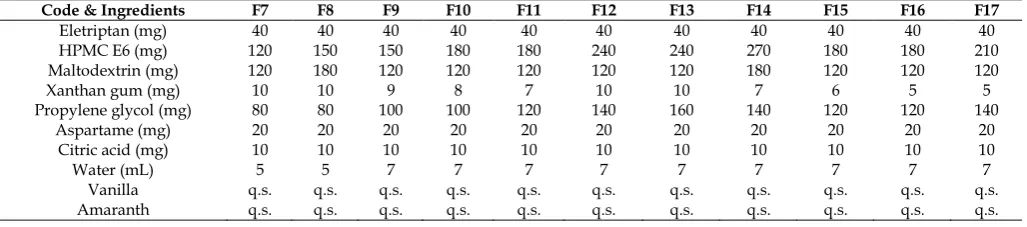
The mouth dissolving films of Eletriptan using polymers were prepared by solvent casting method. Hydroxypropylmethyl cellulose (HPMC) with different grades like HPMC E3, E6, and E15 is known for its good film forming properties and has excellent acceptability. Maltodextrin DE6 as film modifier, it acts as film-forming agent, solubilizer and imparts sweetness to the formulation. Propylene glycol as plasticizer, xanthan gum as stabilizing agent, citric acid as saliva stimulating agent, aspartame as sweetening agent and vanilla was used as a flavouring agent. The aqueous dispersion was prepared by dissolving HPMC, maltodextrin in distilled water maintained at 70°C. The suspension was used after 24 h to remove all the air bubbles entrapped. The active ingredient was added in the required quantity. Then remaining ingredients were added in the proportions given in Table 1 using HPMC E3, Table 2 using HPMC E6, Table 3 using HPMC E15. The solution was poured on petri plate and then kept for drying at 75°C for first 30 min and then it was decreased to 45°C for next 24 h. The resultant film was cut into the dimension of 2 cm × 2 cm in size, in which 8 mg of Eletriptan was included.
The formulation was carried out using three different grades of HPMC E3, E6 and E15 and other polymers. The resulting films were evaluated for physicochemical properties.
Evaluation of fast dissolving films Physical characterization of FDOFs
Physical characterization of FDOFs can be carried out by visual inspection for characteristics such as colour, thickness, brittleness, peeling ability, transparency, surface smoothness, tack property and film forming capacity.
The prepared films were subjected for in vitro
evaluation tests like Thickness, Folding Endurance [13-15], Surface pH [13], Morphological properties, % Drug
content and content uniformity [15], Tensile strength,
Percent elongation, In vitro Disintegration time, In vitro
Dissolution studies and in vivo studies on rabbits.
In vitro dissolution studies
The phosphate buffer pH 6.8 was taken as the dissolution medium to determine the drug release. The dissolution profile of quick release films of Eletriptan was carried out in USP basket type apparatus containing 300 ml of the phosphate buffer pH 6.8. The film was placed in the basket, maintained at 37 ± 0.5°C and the agitation speed was 50 rpm. Aliquots (5 ml) of the dissolution medium were withdrawn at 1, 2, 4, 6, 8, 10 and 12 minutes time intervals and the same amount was replaced with the fresh medium. Samples were assayed spectrophotometrically at 231 nm. The cumulative percentage drug release was calculated.
Drug excipients compatibility studies
Int. J. Pharm. Sci. Drug Res. November-December, 2018, Vol 10, Issue 6 (447-453)
Differential Scanning Calorimetry (DSC)
Differential Scanning Calorimetry (DSC) studies were carried out using DSC 60, having TA60 software, Shimadzu, Japan. The DSC thermograms were recorded for pure drug, HPMC E15, Maltodextrin, Drug and HPMC mixture and optimized formulation. Accurately weighed samples were placed on aluminium plate, sealed with aluminium lids and heated at a constant rate of 5ºC /min, over a temperature range of 0 to 250ºC.
Fourier Transform Infrared Spectroscopy (FTIR)
FTIR spectra for pure drug, physical mixture and optimized formulations were recorded using a Fourier transform Infrared spectrophotometer. The analysis was carried out in Shimadzu-IR Affinity 1 Spectrophotometer. The IR spectrum of the samples was prepared using KBr (spectroscopic grade) disks by means of hydraulic pellet press at pressure of seven to ten tons.
Stability studies
The stability study of the formulated fast-dissolving films was carried out under different conditions according to ICH guidelines. The film was packed in the aluminium foil and stored in a stability chamber for stability studies. Accelerated Stability studies were carried out at 40°C/75% RH for the best formulations for 2 months. The patches were characterized for the drug content and other parameters during the stability study period. [15]
RESULTS AND DISCUSSION
Evaluation of Fast Dissolving Oral Films Physical characterization of FDOFs
Formulations (F1-F5) prepared using HPMC E3 were not evaluated for physical parameters and other tests as they fail to satisfy the preliminary characteristics of films due to their poor film forming ability, tack property and ease of handling/peeling.
Physical characterization of FDOFs was carried out by visual inspection and the following observations were made. All the prepared films were evenly coloured and no migration of colour was observed. The increased thickness of film is attributed to the increase in the amount of HPMC. Formulation F7, F8, F9, F10 and F18 were found to be brittle in nature. Formulation F6, F12, F14 and F19 films were tacky and difficult to handle. Surface pH of all mouth dissolving films prepared by using different polymers was found to be in the range
of 6.09 to 6.81 pH (Table 4), which was close to the neutral pH, which indicated that films may have less potential to irritate the sublingual mucosa, and hence, more acceptable by the patients.
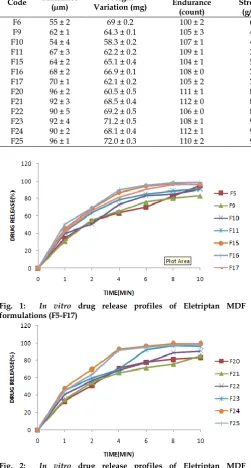
The weight variation of the formulations was in the range of 60.5 ± 0.5 to 71.2 ± 0.5 mm, which was acceptable. The results showed that as the concentration of polymer increases weight of film also increases.
Thickness of mouth dissolving film depends on the concentration of polymer. All the mouth dissolving formulations of different polymers are show thickness value in the range of 0.04 ± 0.01 to 0.15 ± 0.02 mm (Table 4). The optimized film (F24) has thickness of 90 ± 2µm. A result of thickness measurement showed that as the concentration of polymer increases, thickness of mouth dissolving film also increases.
Folding endurance gives an indication of brittleness of the film. It was shown that as the concentration of polymer and plasticizer increases, folding endurance of mouth dissolving film increases. The folding endurance value of the prepared films ranged from 100 ± 2 to 112 ± 1 (Table 4). The optimized film (F24) has folding endurance value of 112 ± 1, which was desirable. The % drug content and content uniformity was performed for all the fast dissolving oral films and found to contain almost uniform quantity of the drug, as per content uniformity studies indicating reproducibility of the technique.
Drug content in the films was evaluated and the values were found to be between 96.4 ± 0.5 to 101.2 ± 0.9% (Table 4) for three different cuts from each film. The optimized formulation (F24) % drug content was found to be 100.1 ± 0.2. As per the USP requirements, the films found to meet the criteria for content uniformity.
Table 1: Formulation Trials Using HPMC E3
Code & Ingredients F1 F2 F3 F4 F5 F6
Eletriptan (mg) 40 40 40 40 40 40 HPMC E3 (mg) 300 300 240 240 210 210 Maltodextrin (mg) 180 160 120 100 120 140 Proplylene glycol (mg) 80 80 100 100 120 140 Xanthan gum (mg) 10 9 8 7 5 5
Aspartame (mg) 20 20 20 20 20 20 Citric acid (mg) 10 10 10 10 10 10 Water (mL) 5 5 5 5 5 5
Vanilla q.s. q.s. q.s. q.s. q.s. q.s. Amaranth q.s. q.s. q.s. q.s. q.s. q.s.
Table 2: Formulation Trials Using HPMC E6
Code & Ingredients F7 F8 F9 F10 F11 F12 F13 F14 F15 F16 F17
Eletriptan (mg) 40 40 40 40 40 40 40 40 40 40 40 HPMC E6 (mg) 120 150 150 180 180 240 240 270 180 180 210 Maltodextrin (mg) 120 180 120 120 120 120 120 180 120 120 120 Xanthan gum (mg) 10 10 9 8 7 10 10 7 6 5 5 Propylene glycol (mg) 80 80 100 100 120 140 160 140 120 120 140
Aspartame (mg) 20 20 20 20 20 20 20 20 20 20 20 Citric acid (mg) 10 10 10 10 10 10 10 10 10 10 10 Water (mL) 5 5 7 7 7 7 7 7 7 7 7
Table 3: Formulation Trials Using HPMC E15
Code & Ingredients F18 F19 F20 F21 F22 F23 F24 F25
Eletriptan (mg) 40 40 40 40 40 40 40 40 HPMC E15(mg) 90 90 110 110 130 140 150 160 Maltodextrin (mg) 60 90 100 110 120 110 110 110 Xanthan gum (mg) 10 10 8 8 7 6 5 5 Propylene glycol (mg) 100 120 120 120 140 140 140 160
Aspartame (mg) 20 20 20 20 20 20 20 20 Citric acid (mg) 10 10 10 10 10 10 10 10
Water (mL) 5 5 7 7 7 7 7 7
Vanilla q.s. q.s. q.s. q.s. q.s. q.s. q.s. q.s. Amaranth q.s. q.s. q.s. q.s. q.s. q.s. q.s. q.s.
Table 4: Evaluation Values of Prepared Films
Code Thickness (µm) Variation (mg) Weight Endurance Folding (count)
Tensile Strength
(g/cm2)
In-vitro disintegration
time(sec)
% Elongation % Drug content Surface pH
F6 55 ± 2 69 ± 0.2 100 ± 2 6.8 30 ± 2 3 100.2 ± 0.4 6.67 ± 0.02 F9 62 ± 1 64.3 ± 0.1 105 ± 3 4.5 20 ± 3 4 97.4 ± 0.2 6.76 ± 0.01 F10 54 ± 4 58.3 ± 0.2 107 ± 1 4.4 29 ± 2 5 98.3 ± 0.3 6.28 ± 0.01 F11 67 ± 3 62.2 ± 0.2 109 ± 1 3.2 27 ± 3 8 99.5 ± 0.1 6.09 ± 0.02 F15 64 ± 2 65.1 ± 0.4 104 ± 1 5.1 20 ± 2 5 96.6 ± 1.1 6.68 ± 0.03 F16 68 ± 2 66.9 ± 0.1 108 ± 0 7.2 18 ± 2 5 101.2 ± 0.9 6.72 ± 0.05 F17 70 ± 1 62.1 ± 0.2 105 ± 2 7.5 19 ± 3 9 96.4 ± 1.4 6.78 ± 0.01 F20 96 ± 2 60.5 ± 0.5 111 ± 1 8.2 15 ± 2 8 99.7 ± 1.0 6.75 ± 0.00 F21 92 ± 3 68.5 ± 0.4 112 ± 0 8.8 13 ± 2 7 97.5 ± 1.6 6.67 ± 0.01 F22 90 ± 5 69.2 ± 0.5 106 ± 0 8.5 12 ± 2 5 96.4 ± 0.5 6.92 ± 0.02 F23 92 ± 4 71.2 ± 0.5 108 ± 1 9.1 12 ± 2 6 100.5 ± 0.5 6.64 ± 0.02 F24 90 ± 2 68.1 ± 0.4 112 ± 1 9.5 09 ± 2 8 100.1 ± 0.2 6.81 ± 0.01 F25 96 ± 1 72.0 ± 0.3 110 ± 2 9.8 10 ± 3 10 99.7 ± 1.3 6.77 ± 0.1
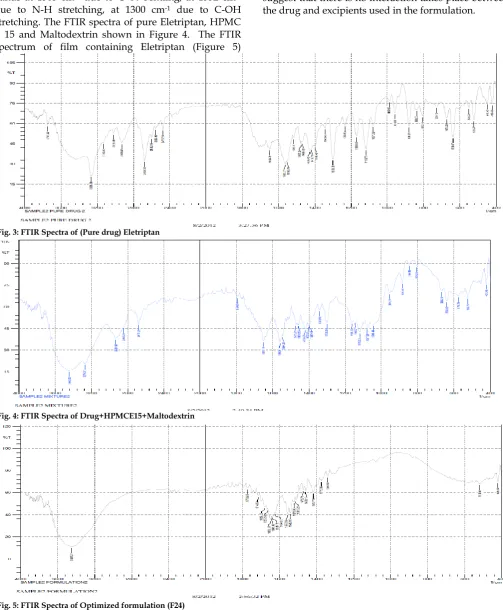
Fig. 1: In vitro drug release profiles of Eletriptan MDF formulations (F5-F17)
Fig. 2: In vitro drug release profiles of Eletriptan MDF formulations (F20- F25)
No significant difference in the drug content among the films indicated good content uniformity. The tensile testing gives an indication of the strength and elasticity of the film, reflected by the parameters, tensile strength and percent elongation at break. Results revealed that optimized formulation (F24) showed better tensile
strength (9.5 g/cm2) and moderate % elongation (Table
4).
In vitro disintegration studies
The disintegrating time of all the formulations using Eletriptan ranges from 9 to 31 sec. In vitro
disintegrating time for mouth dissolving film using HPMC E6 was ranges from 18 to 31 sec and the disintegrating time for the films made by the polymer HPMC E15 was ranges from 9 to 18 sec. The disintegration time of optimized formulation (F24) was found to be 9 sec, when compared with Marketed Product (30 sec) which was very less and desirable for quick onset of action.
Cumulative % Drug Release of Mouth Dissolving Films
Cumulative % drug release was calculated on the basis of drug content of Eletriptan present in the respective film. The results obtained in the in vitro drug release for the formulations were tabulated in table. The graphs from F5 to F17 are depicted in Figure 1 and the graphs of formulation F20 to F25 are shown in Figure 2. The formulations F5, F9, F10, F11, F20, F21 & F22 show drug release up to 89% at the end of 8 min. Rapid drug dissolutions were observed in F15, F16 and F17 which release 98.6 and 96.1 respectively. The optimized formulation (F24) shows highest percent of drug release 99.45 by the end of 8 min. The initial release of the optimized formulation was more when compared with innovator product, therefore the onset of action was very quick compare with the innovator product.
Int. J. Pharm. Sci. Drug Res. November-December, 2018, Vol 10, Issue 6 (447-453) within 8 min. In vitro release of Marketed Product was
found to be 97.4 in 30 min.
Drug Excipients Interaction Studies FTIR Interpretation of FTIR Data
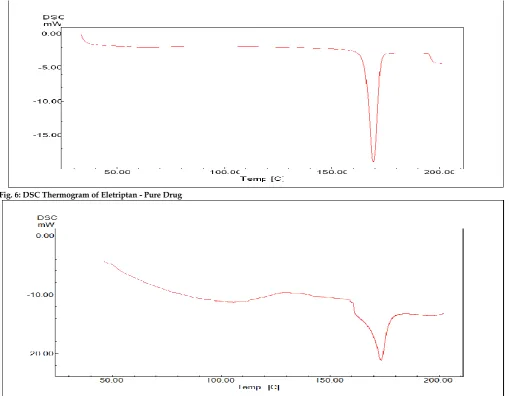
The FTIR spectra of pure Eletriptan (Figure 5) displayed band at 2928 cm-1 due to C-H stretch, at 1710
cm-1 due to C=O stretching, at 1649 cm-1 due to
heterocyclic C=C stretching. The spectra also showed bands at 1563 cm-1 due to C=N bending, at 1552 cm-1
due to N-H stretching, at 1300 cm-1 due to C-OH
stretching. The FTIR spectra of pure Eletriptan, HPMC E 15 and Maltodextrin shown in Figure 4. The FTIR spectrum of film containing Eletriptan (Figure 5)
exhibited characteristic bands consistent with the molecular structure of Eletriptan such as bands at 2921 cm-1 due to C-H stretch, at 1773 cm-1 due to C=O
stretching, at 1650 cm-1 due to heterocyclic C=C
stretching, at 1557 cm-1 due to C-N stretching, at 1542
cm-1 due to N-H stretching and at 1295 cm-1 due to
C-OH. Thus, the presence of characteristic absorption bands of Eletriptan and the film containing Eletriptan suggest that there is no interaction takes place between the drug and excipients used in the formulation.
Fig. 3: FTIR Spectra of (Pure drug) Eletriptan
Fig. 4: FTIR Spectra of Drug+HPMCE15+Maltodextrin
Fig. 6: DSC Thermogram of Eletriptan - Pure Drug
Figure 7: DSC Thermogram of Eletriptan Formulation (F24)
Table 5: Accelerated stability testing data of optimized formulation (F24) kept for stability at 40ºC /75 %RH
Retest Time For Optimized formulation
F24
Disintegration Time (sec)
Percent Drug Content/ Assay (%)
Transparency
1 Week 9±4 100.1±0.2 Transparent 2 Weeks 10±2 100.2±0.2 Transparent 1 Month 10±2 99.1±0.2 Transparent 2 Months 10±2 99.0±0.2 Transparent
Drug Excipients compatibility studies by DSC
DSC thermograms revealed that there is no considerable change observed in melting endotherm of Eletriptan pure drug (165.97) and drug in optimized formulation (168.35). The thermograms of pure drug Eletriptan and optimized film (24) are shown in Figure 6 & 7. It indicates that there is no interaction takes place between drug and other excipients used in the formulation.
Stability Studies
The optimized film (F24) did not show any significant change in appearance and weight loss on storage, disintegration time and % drug content. From these results it was concluded that, formulations F24 containing Eletriptan is stable and retained their
original properties. The results of disintegration time, drug content and transparency are shown in the Table 5, which indicates no alteration after storage.
In this work, systemic efforts were made to prepare mouth dissolving film of Eletriptan (8 mg/2 cm × 2 cm film) by using solvent casting method with different concentrations of HPMC-E3, E6 and E15.
Film forming property of various grades of HPMC was investigated based on preliminary characteristics of various batches of FDOFs. Formulations with HPMC E3 were not evaluated because of their poor film property and other physical parameters.
The bitter taste of the drug was masked by Aspartame and Vanilla flavour. Formulations with HPMC E6 and E15 were evaluated for their physical characteristics. Among the prepared formulations F24 showed minimum disintegration time 9 sec.
Int. J. Pharm. Sci. Drug Res. November-December, 2018, Vol 10, Issue 6 (447-453) The initial release of the optimized formulation (F24)
was more when compared with innovator product, therefore the onset of action was very quick compare with the innovator product.
DSC and FTIR data revealed that no interactions takes place between the drug and polymers used in the optimized formulation. In vitro and in vivo evaluation of the films confirmed their potential as an innovative dosage form to improve delivery of Eletriptan. This further confirms successful formulation of Eletriptan in the form of mouth dissolving films.
REFERENCES
1. Chugh I, Seth N, Rana AC, Gupta S. Oral sustained release drug delivery system. International research journal of pharmacy. 2010; 3 (5): 57-62.
2. Siddiqui N, Garg G, Sharma PK. A Short Review on “A Novel Approach in Oral Fast Dissolving Drug Delivery System and Their Patents”. Advances in Biological Research. 2011; 5 (6): 291-303.
3. Patel AR, Prajapati DS, Raval JA. Fast Dissolving Films (FDFs) as a Newer Venture in Fast Dissolving Dosage Forms. International Journal of Drug Development & Research. 2010; 2(2): 232-246..
4. Nagaraju R, Sujatha B, Vidyadhara S, Sasidhar RLC. Design and evaluation of fast dissolving films containing Nizatidine. Indian journal of pharmaceutical education and research. 2012; 46(4): 318-322.
5. Galey WR, Lonsdale HK, Nacht S. The in vitro permeability of skin and buccal mucosa to selected drugs and tritiated water. J. Investigative Dermatol. 1976; 67(6): 713-717.
6. Haut SR, Bigal ME, Lipton RB. Chronic disorders with episodic manifestations: focus on epilepsy and migraine. Lancet Neurol. 2006; 5: 148–57.
7. Lipton RB, Bigal ME. The epidemiology of migraine. Am J Med. 2005; 11(8): S3-10.
8. Panchal MS, Patel H, Bagada A, Vadalia KR. Formulation and Evaluation of Mouth Dissolving Film of Ropinirole Hydrochloride by Using Pullulan Polymers. International Journal of Pharmaceutical Research & Allied Sciences. 2012; 1(3): 60-72.
9. Kunte S, Tandale P. Fast dissolving strips: A novel approach for the delivery of Verapamil. J Pharm Bioallied Sci. 2010; 2(4): 325-328.
10. Kumar GV, Krishna RV, William GJ, Konde A. Formulation and evaluation of buccal films of salbutamol sulphate. Indian J Pharm Sci. 2005; (67): 160–4.
11. Nagar M, Nagar M, Chopra V. Formulation and evaluation of mouth dissolving film of antipsychotic drug aripiprazole. Der Pharmacia Lettre. 2012; 4 (4): 1221-1227.
12. Prabhu P, Malli R, Koland M, Vijaynarayana K, D’Souza U, Harish NM, Shastry CS. Formulation and evaluation of fast dissolving films of levocitirizine dihydrochloride. Int J Pharm Inves. 2011; 1(2): 99–104.
13. Nafee NA, Boraie MA, Ismail FA, Mortada LM. Design and characterization of mucoadhesive buccal patches containing cetylpyridinium chloride. Acta Pharm. 2003; 53:199–212. 14. Mashru RC, Sutariya VB, Sankalia MG, Parikh PP.
Development and evaluation of fast dissolving film of salbutamol sulphate. Drug Dev Ind Pharm. 2005; 31: 25–34. 15. Shimoda H, Taniguchi K, Nishimura M, Matsuura K,
Tsukioka T, Yamashita H, Inagaki N, Hirano K, Yamamoto M, Kinosada Y, Itoh Y. Preparation of a fast dissolving oral thin film containing dexamethasone: A possible application to antiemesis during cancer chemotherapy. Eur J Pharm Biopharm. 2009; 73(3): 361-365.